
Revaluation and reform of council tax in Scotland: design considerations and potential impacts
This report considers the design and impact of potential reforms to Scotland’s council tax system.
6. Transition and mitigation
This section of the report considers the design of:
- transitional arrangements, which could be used to phase in large increases in council tax bills, and;
- mitigation measures, which could be used to address potential adverse impacts on some population groups of concern, for the longer-term.
We begin by considering the design and potential cost of transitional arrangements. We then look at a range of mitigation options for the minority of households with relatively low incomes but who live in high-value properties and would see increases in council tax under some reform options. This includes deferral schemes for owner-occupiers with relatively low income but potentially substantial property wealth, and an expansion of means-tested reductions in bills for others, including tenants, with low incomes.
6.1 Transitional arrangements
Transitional arrangements would aim to ease the introduction of a new council tax system by slowly phasing in the largest increases in tax bills, to give affected households time to prepare for the full increase they face.
The cost of phasing in increases in tax bills could be met, in part, by phasing in decreases in tax bills for those due a reduction as a result of revaluation and reform as well. This is how the transitional relief scheme for non-domestic property revaluations traditionally worked in England (Ministry of Housing, Communities and Local Government, 2016).[12] Alternatively, decreases in bills could be implemented in full immediately and transitional reliefs for those seeing large increases in bills could be funded through ring-fenced grant funding for Scottish councils. Economically, this is akin to how the transitional relief scheme for non-domestic property revaluations has previously worked in Scotland (Scottish Government, 2023).[13] It was also the approach taken by the Welsh Government for funding the transitional relief scheme that accompanied the revaluation in Wales in April 2005 (Welsh Assembly Government, 2004). A third alternative would be for councils to fund such a transitional relief scheme through higher Band D council tax rates, in effect spreading the cost across all council taxpayers in proportion to their council tax bills.
A key trade-off in the design of transitional relief schemes is between the amount of temporary support given to those facing increases in bills and the cost of the scheme. To illustrate this trade-off, we have modelled two transitional relief schemes, both of which would phase in the largest bill increases over several years, but which phase in changes in bills at different paces:
- Scheme 1: Gross bill increases as a result of the reforms capped at the lower of 10% or £300 each year, before any annual change in council tax applied by councils (which households would continue to bear in full).
- Scheme 2: Gross bill increases as a result of the reforms capped at the lower of 25% or £600 each year, before any annual change in council tax applied by councils (which households would continue to bear in full).
In both cases, we assume the cap would apply to gross bills before any discounts, premiums, exemptions (and the CTRS). This means that the effective cash-terms cap for a household in receipt of the 25% single person discount, for example, would be £225 and £450 (both 25% lower than the cap on increases in the full gross bill), respectively, under schemes 1 and 2.
These schemes are merely illustrative. There are many ways a transitional relief scheme could be designed.
Figures 6.1 and 6.2 show estimates of the percentage of properties eligible for transitional relief and the cost of transitional relief, respectively, for the first four years of these schemes. The top panel of each chart is for scheme 1 and the bottom panel is for scheme 2. All estimates are only approximate, due to data limitations.[14] Results for two intermediate variants (caps of 15% or £300, and 20% or £400) can also be found in Tables B.10 and B.11 in the accompanying Excel workbook.
Bearing in mind these caveats, consider first scheme 1, which would phase in increases in bills most slowly. The 10% element of the cap would mean that under a pure revaluation, any property moving up a band would benefit from transitional relief in the first year (since the difference in bills between bands is always more than 10%) – an estimated 24% of all properties. We estimate that similar or larger numbers would benefit in year 1 under the 12-band and 14-band systems. The number of beneficiaries from transitional relief would fall over the following years as further increases brought properties up to their full bill increase. But in year 4, we estimate that 2.5% of properties would still be receiving transitional relief under a pure revaluation and 5.5% under the 14-band less regressive system.
Large numbers of beneficiaries would also mean relatively high costs. Even after accounting for discounts, exemptions and CTRS, we estimate that first-year costs would vary from around £100 million for the pure revaluation to around £200 million for the 12-band and 14-band less regressive systems. Costs would be higher for the less regressive systems as these entail bigger changes in bills, especially for the highest-value properties. To put these costs in perspective, council tax revenues this year are forecast to be approximately £3,300 million, and overall Scottish council funding approximately £18,300 million.[15] We estimate that year 4 transitional relief costs would be £7 million for a pure revaluation, or around £25 million under the 12-band and 14-band less regressive systems.
Figure 6.1 Estimated percentage of properties eligible for transitional relief by system and year


Sources: Authors’ calculations using data from Scottish Assessors, Registers of Scotland, Energy Performance Certificates, Understanding Society waves 8-10 and 14 and TAXBEN, the IFS tax and benefit microsimulation model.
Figure 6.2. Estimated cost of transitional relief scheme (£ million), by system and year
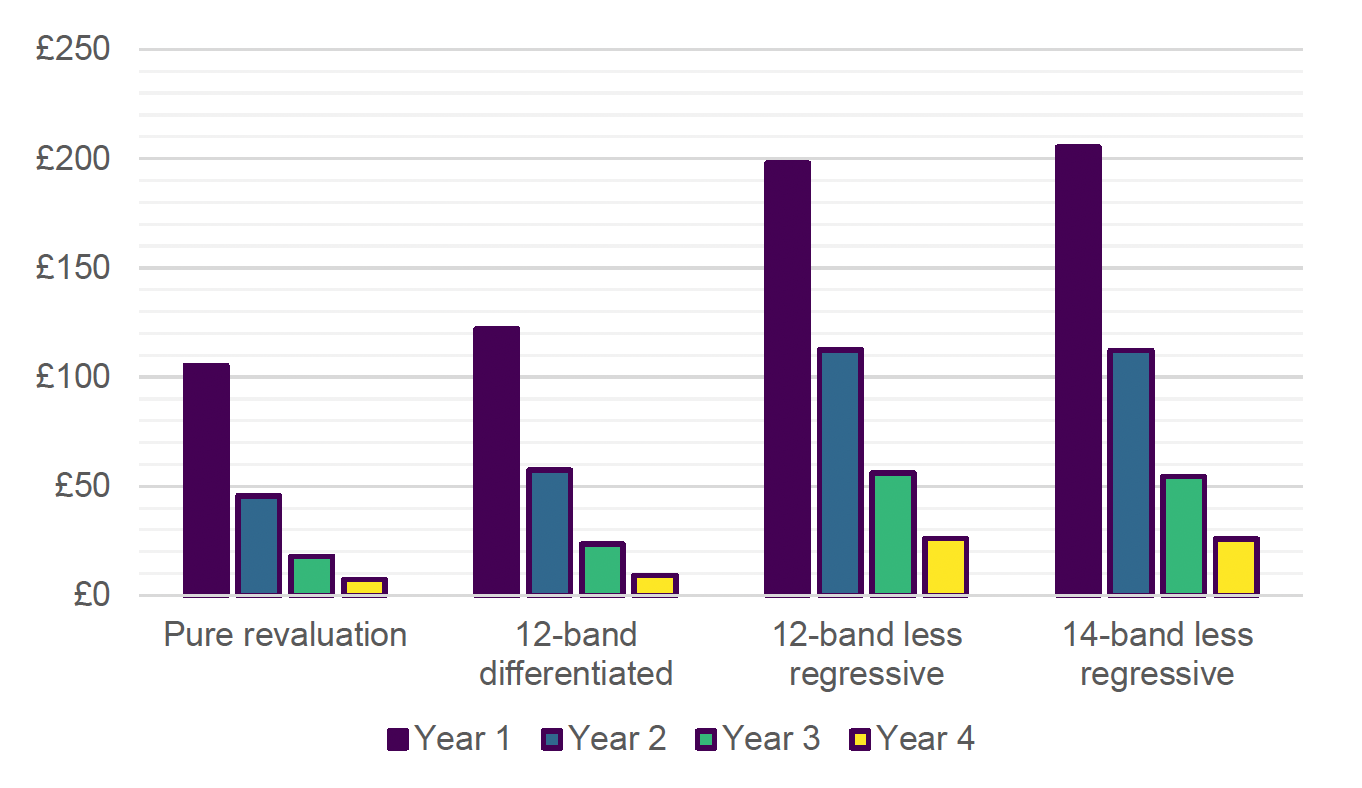
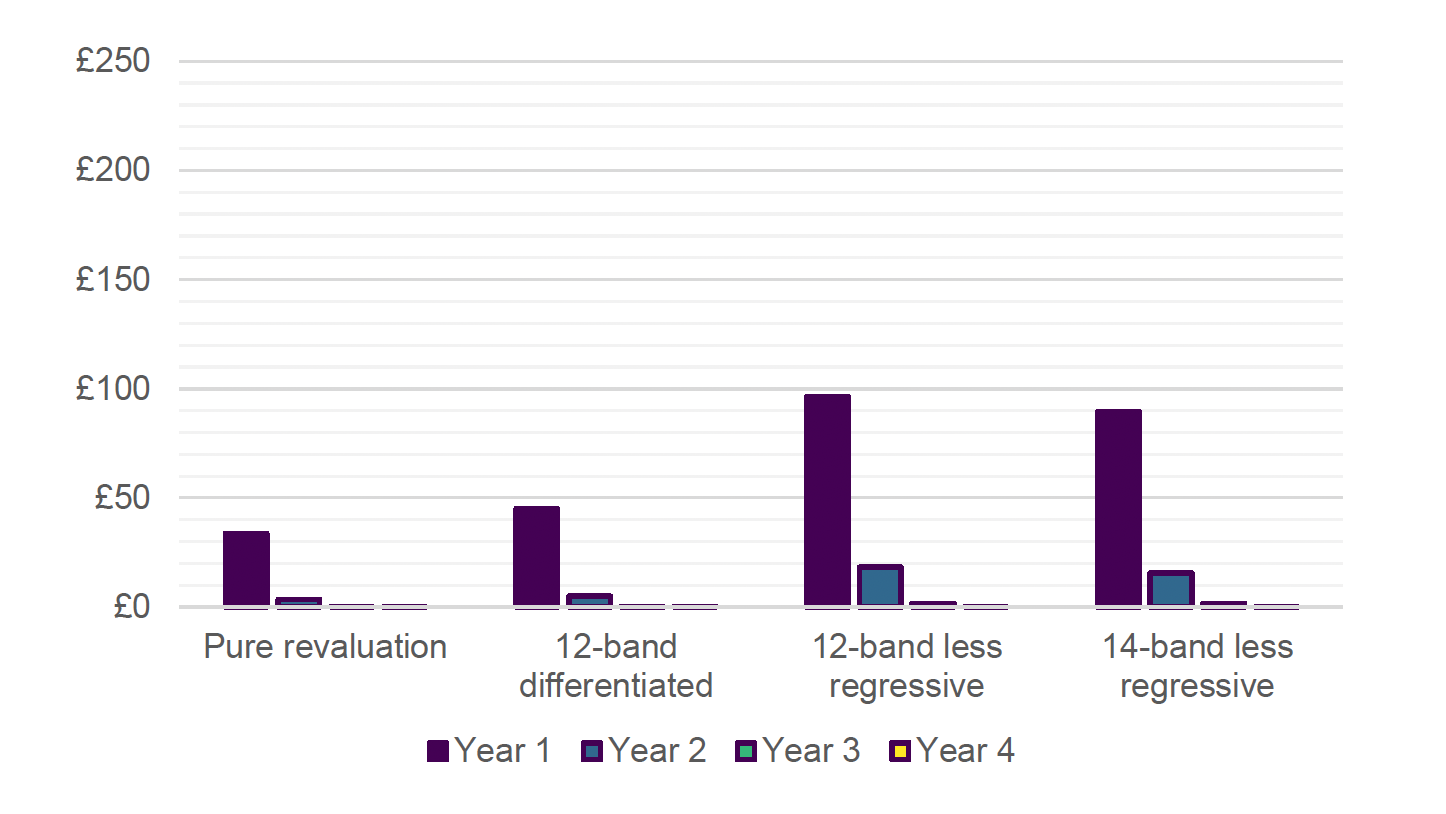
Sources: Authors’ calculations using data from Scottish Assessors, Registers of Scotland, Energy Performance Certificates, Understanding Society waves 8-10 and 14 and TAXBEN, the IFS tax and benefit microsimulation model.
Under scheme 2, far fewer households would be expected to receive transitional relief. Estimated costs would be significantly lower than scheme 1, but not by as much as the numbers of households covered. For example, under a pure revaluation only those moving from Band D to E (the biggest percentage jump for any single band movement) or moving up two or more bands would be eligible for support in year 1: an estimated 7% of properties, at a cost of just over £50 million. We estimate that year 1 eligibility for the 12-band and 14-band less regressive systems would be around 10% and 16%, respectively, at a cost of around £130 million. After four years only very small numbers of properties would still be receiving transitional relief – no more than 0.05%, according to our estimates. Year 4 costs are estimated to vary from less than £0.1 million for the pure revaluation to £2-3 million for the 12-band and 14-band less regressive systems. There is therefore a real trade-off between coverage of the transitional relief scheme on the one hand and its cost and effective duration on the other.
The proportion of properties eligible for, and the cost of, transitional relief would vary significantly across council areas. Full information can be found in Table B.10 in the accompanying Excel workbook.
We estimate that Aberdeen City, for example, would have relatively few eligible households, reflecting our finding that only a small fraction of properties would see an increase in bill (before any change to the council’s Band D tax rate) under any of the reforms we model. For example, under scheme 1, we estimate that just 1% of properties there would be capped in year 1 under a pure revaluation, rising to 3% under the 12-band less regressive system. Under scheme 2 this is estimated at just 0.3% of properties in year 1 under a pure revaluation and 0.8% under the 12-band less regressive system.
At the other end of the spectrum, we estimate that Edinburgh City, where a majority of properties are estimated to face an increase in their gross relative tax rate, would see far higher numbers benefiting from transitional relief. For example, under scheme 1, we estimate that 65% of properties would be eligible for relief in year 1 under a pure revaluation, with 13% still eligible by year 4. Under the 12-band less regressive systems we estimate the year 1 and 4 eligibility rates would be 71% and 18%, respectively. In contrast, under scheme 2, we estimate that year 1 and year 4 eligibility for transitional relief would be 31% and 0%, respectively, for a pure revaluation, and 43% and 0.1%, respectively, under the 12-band less regressive system.
6.2 Mitigation options
We estimate that the majority of low-income households would see little change in their net council tax bill from a pure revaluation, and reforms which reduced the regressivity of council tax would mean more seeing reductions than increases in bills. However, some low- and middle-income households would face higher bills – with those living in the highest-value properties potentially seeing much higher bills under less regressive council tax systems. In this subsection we consider some possible options for mitigating the impact of bill increases on such households, on a longer-term basis than transitional reliefs would.
In designing mitigation measures it is useful to distinguish between two groups of households:
- The ‘cash-poor, asset-poor’, which we define here as those who have both low incomes and low wealth. This would include those with low incomes renting high-value properties (or who own their homes but have little equity in them), and who also have low savings and financial wealth.
- The ‘cash-poor, asset-rich’, which we define here as those who have low current incomes but high wealth. This would include those with low incomes owning high-value properties, but with few liquid assets.
The former may not have the resources to pay the new, higher council tax on the property they live in at all; the latter have the resources, but cannot easily access them without selling (or releasing equity from) their property. The different constraints faced by these two groups would therefore be targeted most accurately via different approaches: an expanded means-tested council tax reduction scheme (CTRS) and a council tax deferral scheme, respectively.
An expanded means-tested reduction scheme
The existing CTRS means that many of the households with the lowest incomes and with low levels of financial assets would be unaffected by council tax revaluation and reform – either their bill is covered in full by this means-tested support or (if they are entitled to only partial CTRS) a change in their bill would be matched by a change in their CTRS entitlement (Scottish Government, 2025d).[16] However, the scope of the CTRS could be expanded either in general or specifically for those households facing a significant increase in bills because of a reformed council tax structure.[17]
For example, when the Scottish Government increased the gross relative tax rates applied to properties in council tax bands E to H in 2017, it introduced a specific CTRS for those seeing an increase in bill (see description in Child Poverty Action Group, 2019). Specifically, single adults with a net income of up to £321 per week (£16,692 per year) and couples with a net income of up to £479 per week (£24,908 per year) and low levels of financial savings can continue to pay council tax based on the old, lower relative tax rates.
A scheme of this nature could be introduced under a reformed system. This would be most straightforward under a pure revaluation, given the retention of the existing banding structure (so eligible households in bands E to H could continue to receive the same reductions as now). However, any scheme introduced could also be adapted to apply to the other reforms. For example, under the 12-band less regressive system it could be made available to all those in Bands E1 or above, with those in bands E1 and E2 eligible for support to bring their bill down to what it would be under the pre-2017 Band E, Band F bills brought down to a pre-2017 Band F bill, bands G1 and G2 brought down to a pre-2017 band G, and bands H and I brought down to a pre-2017 Band H.
We do not model the Band E–H CTRS scheme in any of our main household-level results because published figures imply that very few households who would be entitled to the scheme actually take it up, meaning a full take-up assumption would be far from reality (Scottish Government, 2018). To indicate the level of support that this scheme could provide in principle, Table 6.1 reports the estimated number of households entitled to the scheme and the estimated annual cost under full take-up for each council tax system (the current system and the reforms we model).[18] It shows that only a small proportion of households would be entitled to the scheme under any of the reforms. The cost of the scheme would be higher if it were applied to less regressive council tax systems, both because more households would be entitled and because the average amount of support for each household would be higher.
| Council tax system | Number of households entitled | Annual cost under full take-up (£ millions) |
|---|---|---|
| Current system | 13,000 | 2.6 |
| Pure revaluation | 17,000 | 3.3 |
| 12-band differentiated | 12,000 | 4.6 |
| 12-band less regressive | 18,000 | 6.4 |
| 14-band less regressive | 19,000 | 4.4 |
| Continuous proportional | 31,000 | 11.9 |
Note: Household figures rounded to the nearest 1,000. Cost figures rounded to nearest £100,000.
Source: Authors’ calculations using Understanding Society waves 8-10 and 14 and TAXBEN, the IFS tax and benefit microsimulation model.
On the other hand, reform of the council tax system could provide an opportunity to consider the design of CTRS more generally, to provide additional support to those above the income and capital limits in the main means test. For example, we estimate that reducing the rate at which CTRS is withdrawn as income rises (the ‘taper rate’) from 20p to 10p per £1 of additional income would cost between £130 million and £150 million, and benefit around 400,000–500,000 households. The cost of this expansion to CTRS depends on the council tax system modelled, with lower costs for less regressive systems. This is because as shown in Section 4, lower-income households tend to have lower gross council tax bills under less regressive systems. It is important to note that this reduction in the CTRS taper rate would significantly increase the number of households eligible for the scheme (and therefore subject to the means test). Our estimates imply that the proportion of households entitled to CTRS would rise from around 25% to 35%, an increase of between 200,000 and 300,000 households (depending on the council tax system modelled). Thus, we estimate that slightly over half of the 400,000–500,000 beneficiaries of reducing the taper rate would be those newly entitled to CTRS as a result; the remainder (about 200,000) would be existing claimants who would see their entitlements increase.

Note: Assumes full take-up of CTRS. Households are allocated to quintiles based on income measured after taxes and benefits but before housing costs are deducted, and are adjusted for household size and composition using the modified OECD equivalence scale.
Source: Authors’ calculations using Understanding Society waves 8-10 and 14 and TAXBEN, the IFS tax and benefit microsimulation model.
As an example, Figure 6.3 shows the combined estimated distributional effect of the 12-band less regressive reform and this change to CTRS, by quintile of household income. The taper rate reduction would significantly reduce average net bills for households in the bottom 40% of the income distribution, as many would become newly eligible or eligible for more CTRS than they were previously. Households in the middle-income quintile would gain on average by an estimated £46 per year more if the taper rate were reduced than if it were not, as the lower taper rate would extend eligibility to households further up the income distribution.
A deferral scheme
A deferral scheme could allow certain households who own their property and have equity in it to defer paying part or all of their bill for a period of time – for example, until sale or death, or some fixed time period (say 5 or 10 years) – by taking out a loan to cover the part they do not pay immediately. Such schemes are in place in parts of the US and Canada and in Ireland (see, for example, California State Controller’s Office (2025), Government of British Columbia (2025), Irish Tax and Customs (2025) and Maine Revenue Services (2025)). Additionally, in the UK, somewhat similar schemes are available for people facing high social care costs – with the council paying in the short term, and being repaid when the owners sell their property or die (Care for Scotland, 2025).
The design of such a scheme would require consideration of several key issues, including but not limited to the following:
Which households are deemed eligible. In order to help ensure that households have the ability to repay the loan (and deferred tax liability) once a property is sold, a deferral scheme would need to be restricted to those with sufficient equity (or expected to have sufficient equity by some future date) to cover the expected liability. For example, the deferral scheme for social care costs requires councils to register a charge against a property (Care for Scotland, 2025). This is unproblematic for homes owned outright but is not always possible for properties with a mortgage still in place, as some mortgage contracts do not allow other charges against a property until the mortgage is paid off (UK Finance, 2018). Mortgagees in such circumstances might need to be excluded from the deferral scheme. Even if mortgagees are not excluded, limits on the total charges against a property, including mortgages and deferred taxes could be put in place: British Columbia’s scheme caps charges at 75% of the official estimated value of a property, for instance (Government of British Columbia, 2025).
Eligibility could also be restricted in other ways, based on the characteristics of the household (such as the income, wealth or age of household members) and/or the characteristics of the property (such as the council tax band it is in or the gross bill it attracts). For example, in Ireland, for those who have paid off their mortgage, the main deferral scheme is available only to single-adult households with an income up to €30,000 and couples with a joint income up to €42,000, with higher thresholds for those who have an outstanding mortgage (Irish Tax and Customs, 2025).[19] In British Columbia, eligibility is not means-tested but is restricted to certain groups: those aged over 55, widows and widowers, people with disabilities, and families with children (Government of British Columbia, 2025). Means-testing or otherwise restricting eligibility would increase administration costs per claimant, as additional information would need to be collected (and for at least a sample of claimants, verified) to assess eligibility. On the other hand, it would reduce the amount of deferred tax, and may reduce aggregate administration costs if it reduces the number of households applying for and utilising the deferral scheme.
Important in the Scottish context is the growing number of people with a defined-contribution pension who (under ‘pension freedoms’ introduced in 2015) draw down their accumulated savings rather than purchasing an annuity (Adam et al., 2023). Treating such individuals in the same way as those with a defined benefits pension or annuity might involve treating their drawdowns as income and comparing that to the income they would receive from an annuity. For example, under pension credit rules, the income used for calculating entitlement in any given period is the maximum of the annuity that could be purchased from the pension pot and the actual amount withdrawn. Tax-free lump sum withdrawals are treated as capital and assumed to generate capital income according to the normal capital rules (Child Poverty Action Group, 2025). Other approaches are possible; but the issue is not a straightforward one.
What fraction of bills are eligible for deferral. A deferral scheme could allow councils tax bills to be deferred in full or only in part, and this could differ between different types of households. For example, in Ireland’s scheme, full deferral is only available to single adults without a mortgage whose income is below €18,000 and couples without a mortgage whose income is below €30,000, again with higher thresholds for those with an outstanding mortgage. Those with incomes between these limits and the upper limits for the deferral scheme can only defer 50% of their bills (Irish Tax and Customs, 2025). Allowing full deferral would provide most support to eligible households, but would increase the amount of deferred tax, and hence the amount that would need to be borrowed to cover the deferred tax until loans to households are repaid.
The duration of deferral. Any deferral scheme would need to specify how long payments can be deferred for. Possible options for the latest point at which deferred taxes become due include sale of the property, death of a sole (or final) resident, and/or a simple time limit such as five or 10 years, which would help to avoid the accrual of large tax debts (and the associated default risk), especially for households headed by working-age adults.
The interest rate charged on the deferral loan. Deferring (a portion of) a council tax bill is valuable to households and costly to the authorities – the household can potentially save or invest the money in the meantime instead, earning a return, while the authorities must borrow to pay for the expenditure that would have otherwise been covered by the tax bill. Charging interest on the deferral loans can address this issue and cover the cost of any loan defaults. Ireland, for example, charges an interest rate of 3% (it was 4% between 2013 and 2021), while as of June 2025, British Columbia charges 3.45% to the over-55s, widowed and disabled, and 5.45% to families with children (Government of British Columbia, 2025; Irish Tax and Customs, 2025). The interest rate could be set below, at or above an actuarially fair rate. A rate below (or charging no interest at all) would represent an implicit subsidy to those deferring their tax bill, which could encourage those who do not need to defer to take it up so that they can benefit from a lower (interest-adjusted) bill. A rate above could discourage those who do not need to defer their tax bill from doing so, but would mean those who do take it up effectively pay more (in interest-adjusted terms) than those who choose not to defer.
The administration arrangements. In Ireland, deferral loans are provided by central government (via Irish Tax and Customs) and in British Columbia they are provided by the provincial government (Government of British Columbia, 2025; Irish Tax and Customs, 2025). In Scotland’s case, restrictions on Scottish Government borrowing mean that loans would more feasibly be provided by councils, as is already the case for social care cost loans (HM Government and Scottish Government, 2023; Care for Scotland, 2025).
Following typical practice elsewhere would suggest focusing such a scheme on low- and middle-income households ineligible for CTRS who may nevertheless find it challenging to pay a higher bill, and/or demographic groups that may find it more difficult to move properties to reduce bills; however, other approaches are possible. The number of households potentially eligible would depend on the precise design of the scheme. To illustrate the potential number, Table 6.2 shows estimates of the number of households who would face an increase in net bill of over £300 under each modelled reform, who are owner-occupiers and not eligible for full CTRS, and who also satisfy the following conditions:
1. They contain at least one adult aged at or above the state pension age (66).
2. They satisfy (1) or they contain at least one individual in receipt of disability benefits.
3. They satisfy (1) or (2) or they have at least one child.
Conditions (2) and (3) add additional routes for eligibility, and so the number of eligible households is higher under these options.
The table shows that an estimated 250,000 to 360,000 owner-occupier households would face an increase in net bill of over £300 per year, depending on the reform modelled. This is between 10% and 14% of all households in Scotland. We estimate that restricting eligibility for deferral to those over state pension age would reduce these figures by around two-thirds. Our estimates are that including households in receipt of disability benefits would modestly increase the numbers eligible for deferral, while including families with children as well would more significantly increase eligibility, up to between 5% and 8% of households.
Lower (or higher) bill increase thresholds would increase (or reduce) potential eligibility. Restricting eligibility based on incomes as well as demographics would reduce potential eligibility.
Unlike with a transitional relief scheme, there is no long-term trade-off between eligibility and cost for a deferral scheme if the tax is deferred with interest at an actuarially fair rate accounting for default risk: the value of the tax ultimately paid would be the same regardless of deferral. However, wider eligibility and take-up would mean councils’ borrowing more in the short term to cover deferred bills.
| Pure Reval | 12-band Diff | 12-band LR | 14-band LR | Continuous Proportional | |
|---|---|---|---|---|---|
| Owner-occupier and not eligible for full CTRS | 250,000 | 250,000 | 260,000 | 360,000 | 320,000 |
| Additional restrictions | No data | No data | No data | No data | No data |
| (1) At least one adult above State Pension Age | 80,000 | 80,000 | 80,000 | 120,000 | 100,000 |
| (2) Satisfies (1) or at least one individual in receipt of health-related benefits | 90,000 | 90,000 | 90,000 | 140,000 | 120,000 |
| (3) Satisfies (1) or (2) or at least one child | 150,000 | 140,000 | 150,000 | 210,000 | 180,000 |
Note: Figures rounded to the nearest 10,000. Pure reval = pure revaluation; 12-band diff. = 12-band differentiated; 12-band LR = 12-band less regressive; 14-band = 14-band less regressive; continuous = continuous proportional.
Source: Authors’ calculations using Understanding Society waves 8-10 and 14 and TAXBEN, the IFS tax and benefit microsimulation model.
Contact
Email: socialresearch@gov.scot