
Revaluation and reform of council tax in Scotland: design considerations and potential impacts
This report considers the design and impact of potential reforms to Scotland’s council tax system.
4. Impacts across households
This section examines the estimated impacts of revaluation and reform across different households.
We begin by examining the proportion of households that we estimate would see bills reduced, increased or little changed across Scotland as a whole – we define increases and reductions as changes of £50 or more per year, and little change as a change of less than £50 per year. We then consider how average impacts vary across households with different incomes and ages of household members. Other breakdowns can be found in the accompanying Excel workbook.
As discussed in Section 2, and in contrast to Section 3, here we model estimated changes in the council tax bills that households would face (rather than just the tax rates that apply to their properties relative to Band D). In doing this we account for the single person discount, students’ exemptions and means-tested CTRS, to consider the effects on their actual net council tax bills. As discussed earlier, all reforms are modelled on a revenue-neutral basis, and we assume that, in approximate terms, grant funding would be fully redistributed across councils to account for changes in their tax base. Alternative assumptions on grant funding would change the impacts on groups shown here.
4.1 Numbers seeing bills rise or fall
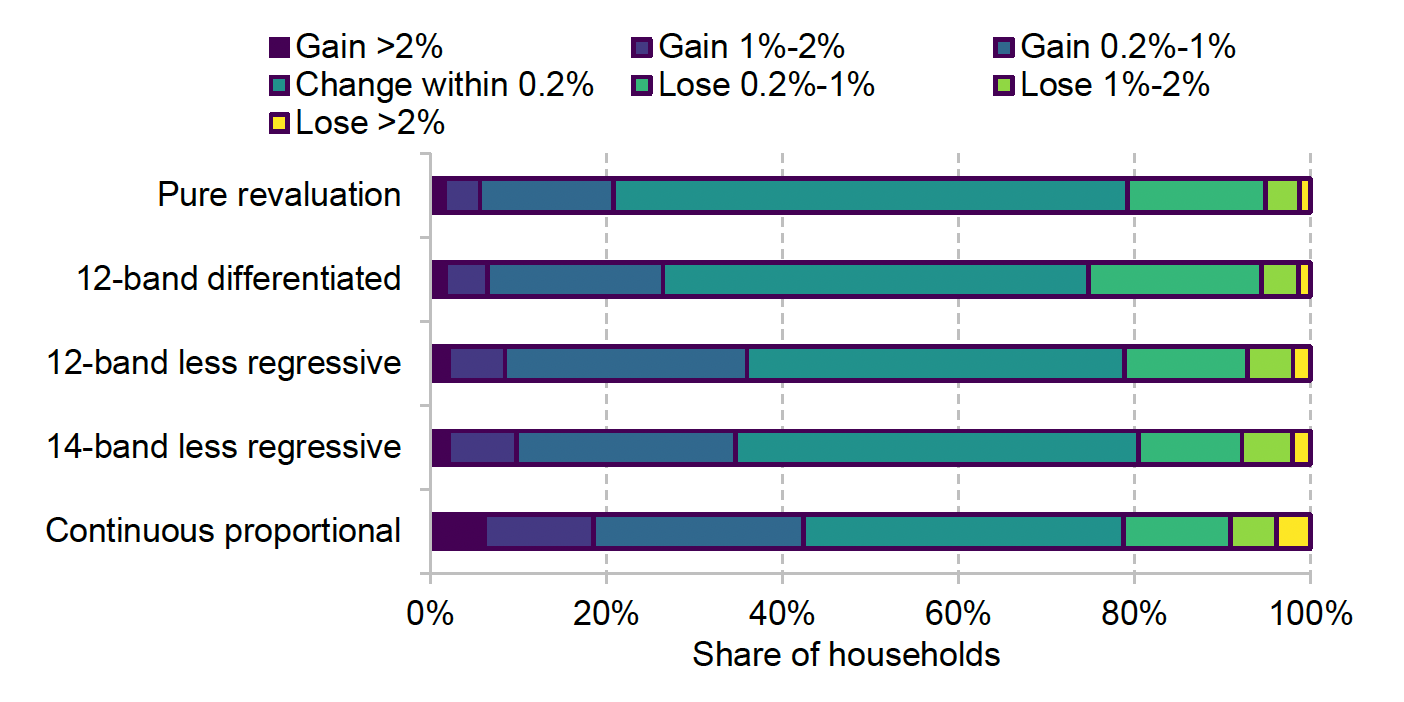
Figure 4.1 shows, for each of the reform systems we model, our estimates of the share of households seeing reductions or increases of various sizes in their net council tax bills. Figure 4.2 repeats the analysis but expresses estimated changes in net bills as a percentage of households’ disposable income (rather than in cash terms) to give a sense of how important the changes are relative to households’ budgets.
The top bar in Figure 4.1 shows our estimates that under a pure revaluation just over a fifth (21%) of households would see a reduction in net bill of £50 a year or more, a similar number (22%) would see an increase of £50 a year or more, while over half (57%) would see little change. We estimate that most increases and decreases would be between £50 and £500 a year, reflecting properties moving up or down one band. The group of households seeing little change in their council tax bill would include those living in properties that remain in the same band, as well as households in receipt of CTRS or exempt from council tax.

Note: Assumes full take-up of CTRS.
Source: Authors’ calculations using Understanding Society waves 8-10, 14 and TAXBEN, the IFS tax and benefit microsimulation model.
We estimate that the 12-band differentiated system would increase the share of households seeing both decreases (29%) and increases (29%) in net bills as new bands and changes in the tax rates applied to bands reduce the number of households seeing no change in their gross bills.
Under less regressive systems, we estimate that a greater fraction of households would face larger changes in bills, with more of these households seeing a reduction in net bill than an increase. For example, under the 12-band less regressive system we estimate that 40% of households would see a reduction in gross bill of less than £50 a year, compared with 22% seeing an increase of £50 a year or more. Since we assume that all reforms would be implemented in a revenue-neutral manner, the estimated average increase among those facing an increase is larger than the estimated average decrease among the (more numerous) group seeing a decrease. For example, while we estimate that 6% of households would see a reduction in net bill of £500 or more, we estimate that 8% would see an increase of £500 or more.
Note: Assumes full take-up of CTRS. Incomes are measured after taxes and benefits but before housing costs are deducted, and are adjusted for household size and composition using the modified OECD equivalence scale.
Source: Authors’ calculations using Understanding Society waves 8-10, 14 and TAXBEN, the IFS tax and benefit microsimulation model.
Turning to Figure 4.2, the top two rows show that when measured as a percentage of household income, the shares of properties we estimate facing increases and decreases in net bill of a given magnitude are fairly similar. For example, under a pure revaluation, we estimate around 6% of households face a reduction in net bill equivalent to 1% of net household income or more, while 5% face an increase of that size. Estimates for the less regressive systems show that there would be more large reductions than large increases when measured as a percentage of household income, despite there being more large cash-terms increases. This is because, as we shall see below, the households in our data seeing reductions in their bills under less regressive systems tend to have lower incomes than those seeing increases in bills. For example, we estimate that under a continuous proportional system, while 19% of households would see a reduction in bill equivalent to 1% or more of their net household income, only 9% would see an increase of 1% or more.
4.2 Average impacts by household type
As indicated above, different types of households would be expected to face systematically different changes in bills under different reform systems.
Household income
Figure 4.3 shows the estimated average cash change in bill for households with different levels of ‘equivalised’ net income[8] (average changes measured as a percentage of household net income can be found in the accompanying Excel workbook).
The green line shows estimated effects of a pure revaluation. It shows, on average, little change in average net bill for any of the income groups. This suggests that while richer households live in more valuable properties, they do not live in properties that have increased in value at a faster rate than average since 1991, the year current council tax bands are based on.

Note: The analysis assumes full take-up of CTRS. Households are allocated to quintiles based on income measured after taxes and benefits but before housing costs are deducted, and are adjusted for household size and composition using the modified OECD equivalence scale. Pure reval = pure revaluation; 12-band diff. = 12-band differentiated; 12-band LR = 12-band less regressive; 14-band = 14-band less regressive; continuous = continuous proportional.
Source: Authors’ calculations using Understanding Society waves 8-10 and 14 and TAXBEN, the IFS tax and benefit microsimulation model.
The grey line shows the estimated effect of a continuous proportional system. We estimate that this reform would increase net bills for households in the highest quintile (fifth) of the income distribution by an average of £267 per year, and reduce average bills for households across the rest of the distribution. This reflects the fact that tax rates would increase for high value properties and fall for low- and mid-value properties under a proportional council tax. The biggest estimated falls in net bill would be for households in the second-lowest income quintile (an average of £132 per year) rather than those in the lowest income quintile (£39 per year). This partly reflects the impact of means-tested CTRS, which means many of the lowest-income households do not pay council tax and so are not affected by increases or decreases in council tax.
The orange line shows that the estimated impact of the 12-band differentiated system is similar to the pure revaluation, albeit with slightly higher bills for the top fifth of the income distribution, allowing for very slightly lower bills for low- and middle-income households.
The overlapping blue and purple lines show that the estimated effects of the 12-band less regressive and 14-band less regressive systems would be very similar. We estimate that average net bills would increase by around £100 a year for households in the top fifth of the income distribution and fall for low- and middle-income households (peaking at £40–50 a year for those in the second-lowest income quintile).
Household composition
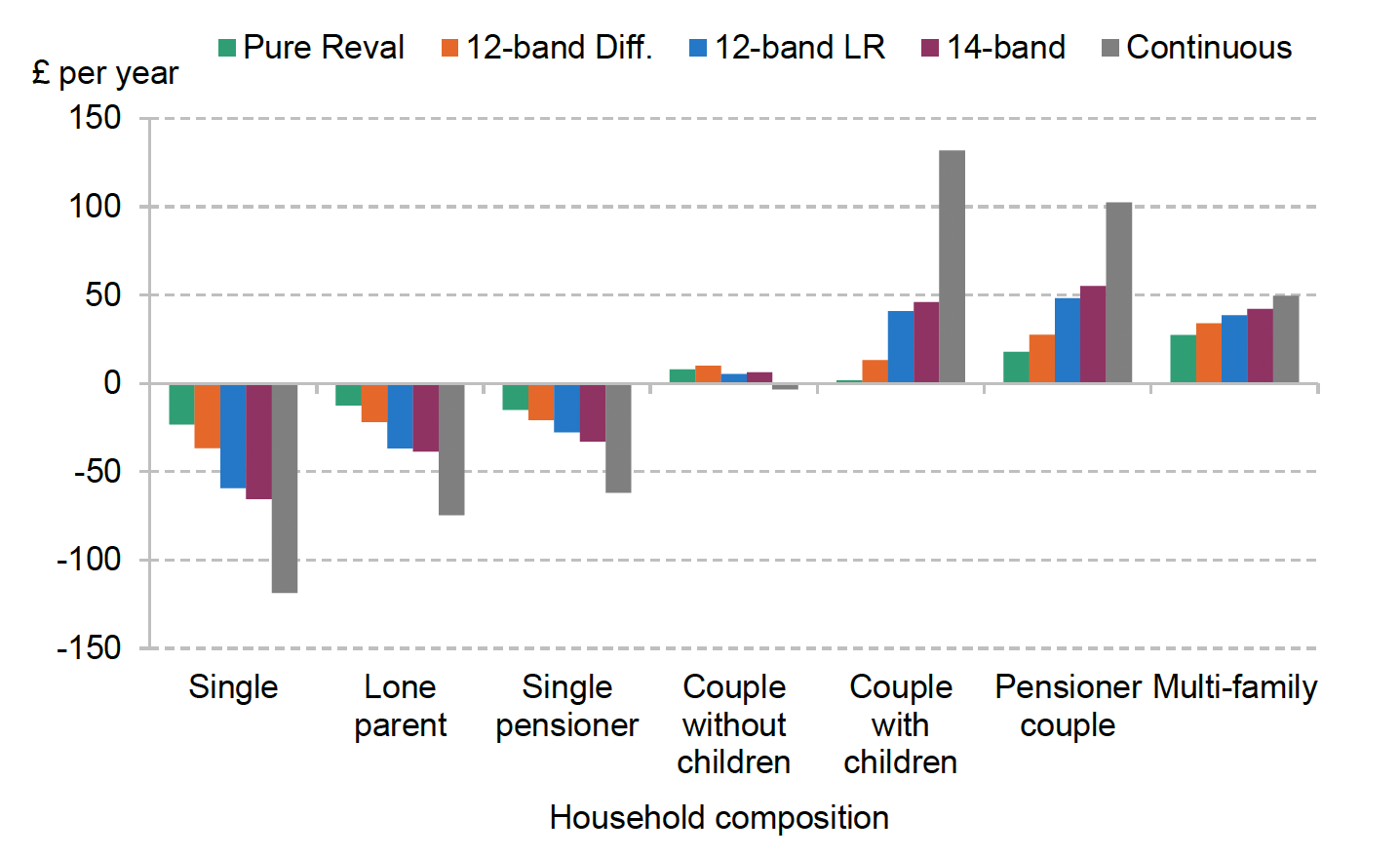
Figure 4.4 shows the estimated average change in bill, in cash terms, for households with different compositions.
The green bars show that estimated changes in average tax bills would be small under a pure revaluation. The grey bars show much bigger estimated changes under a continuous proportional system, with households containing only one adult estimated to see reductions in bills, and households containing two or more adults estimated to see increases in bills. For example, we estimate households consisting of a single working-age adult without children would see a fall in average bill of £119, while working-age couples with children would see an increase in average bill of £132. This reflects the fact that in our data single adults typically live in smaller, lower-value properties, while couples with children live in larger, higher-value properties. The yellow, blue and purple lines show that estimated impacts of the 12- and 14-band systems that we model would lie between the estimated impacts of a pure revaluation and proportional system.
Note: Assumes full take-up of CTRS. Pensioner households are those that include at least one individual aged at or above state pension age (65). The multi-family category includes all households containing more than one family. Pure reval = pure revaluation; 12-band diff. = 12-band differentiated; 12-band LR = 12-band less regressive; 14-band = 14-band less regressive; continuous = continuous proportional.
Source: Authors’ calculations using Understanding Society waves 8-10 and 14 and TAXBEN, the IFS tax and benefit microsimulation model.
Age of oldest household member
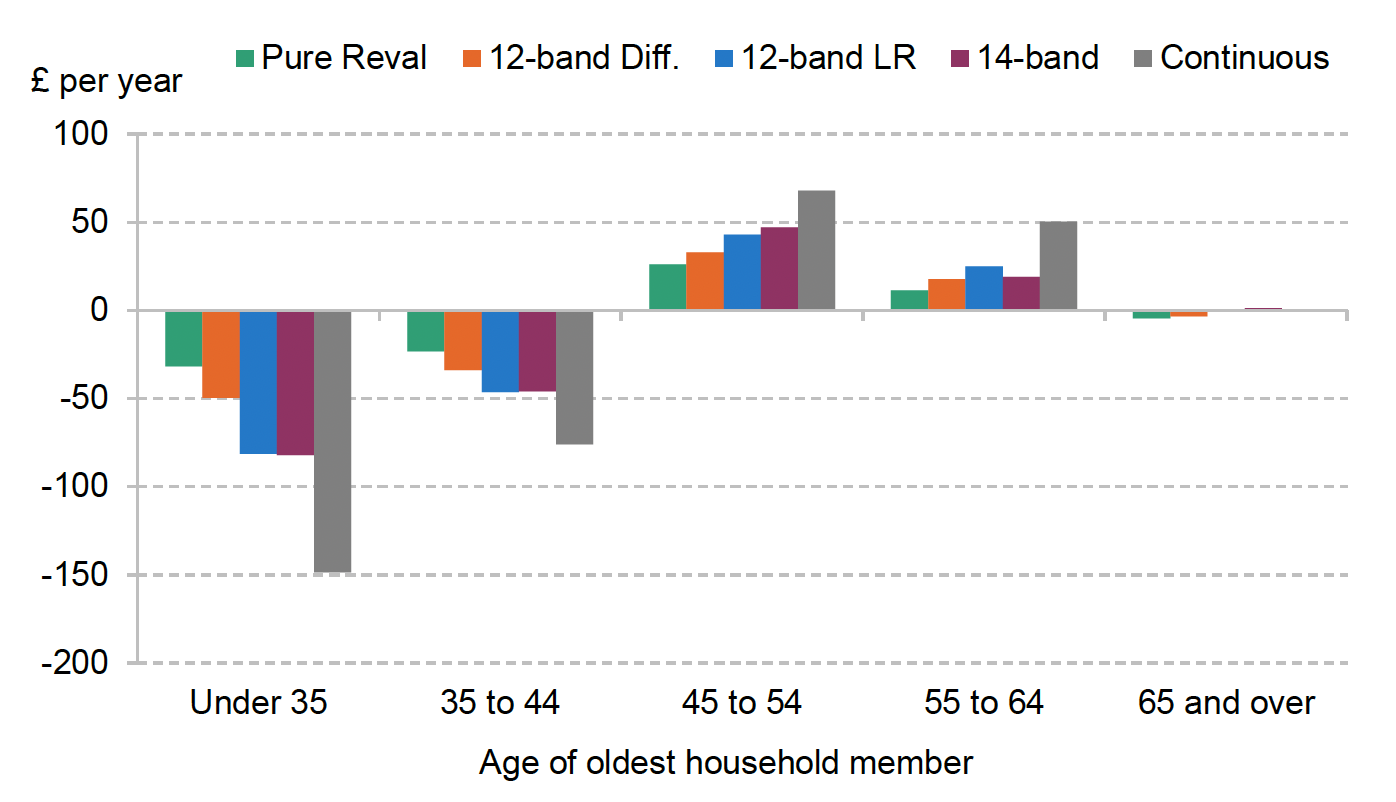
Figure 4.5 repeats this analysis by age of the oldest household member. As above, average effects are estimated to be modest for a pure revaluation but much larger for a continuous proportional system, with the 12- and 14-band systems lying in between.
For example, under the 12- and 14-band less regressive systems, we estimate that average net bills would fall by around £80 per year for households where the oldest member is aged 35 or below, and around £45 per year for households where the oldest member is aged 35 to 44. We estimate that average bills would increase by around £45 per year for households where the oldest member is aged 45 to 54. We estimate that average bills would be little changed for households where the oldest member is 65 or over, reflecting the falls among single pensioners and rises among pensioner couples shown in Figure 4.4.
Note: Assumes full take-up of CTRS. Pure reval = pure revaluation; 12-band diff. = 12-band differentiated; 12-band LR = 12-band less regressive; 14-band = 14-band less regressive; continuous = continuous proportional.
Source: Authors’ calculations using Understanding Society waves 8-10 and 14 and TAXBEN, the IFS tax and benefit microsimulation model.
Disability status
We also estimate how the impact of council tax reforms differs by disability status of household members (adults and children). To do this, we group households into three categories: households receiving health-related benefits, other disabled households, and households with no disabled member. The main health-related benefits we include are adult disability payment, child disability payment, pension age disability payment, personal independence payment, disability living allowance and employment and support allowance.[9] ‘Other disabled households’ includes households where any adult reports having a longstanding illness or disability in the survey, or if any child has a limiting longstanding illness.
Figure 4.6 shows estimated impacts by disability status. As with other demographic breakdowns, we estimate that a pure revaluation would have only a modest impact on average bills for the different groups. In contrast, we estimate that a continuous proportional system would see a reduction in average net bills of around £75 a year for households receiving health and disability-related benefits, which translates into an estimated fall of 12% of their current average net bill (a relatively high percentage reduction because many in this group are entitled to the means-tested CTRS and therefore have a zero or much-reduced council tax bill). We estimate that other households containing a person with disabilities would see an increase in average bill of around £25 per year under a continuous proportional system, reflecting the fact that this group contains a relatively high share of older working-age adults (who, all other things being equal, our analysis finds tend to live in the most valuable properties).

Note: Assumes full take-up of CTRS. Households classified as ‘receives a health-related benefit’ or as ‘other disabled’ if any household member falls into that category. See text for definitions of those terms. Pure reval = pure revaluation; 12-band diff. = 12-band differentiated; 12-band LR = 12-band less regressive; 14-band = 14-band less regressive; continuous = continuous proportional.
Source: Authors’ calculations using Understanding Society waves 8-10 and 14 and TAXBEN, the IFS tax and benefit microsimulation model.
The 12- and 14- band systems lie in between these two benchmark systems, with households receiving health and disability-related benefits estimated to see a fall in average net bill of around £25 per year under both the 12-band and 14-band less regressive systems.
Housing tenure
Figure 4.7 shows estimated impacts by housing tenure. Again, we estimate that a pure revaluation would have little impact on average bills by tenure type. We estimate that a continuous proportional system would lead to large falls in average net bills for private (£122) and social (£133) renters, the latter representing a 22% reduction from current estimated levels. This would be offset by an average increase for owner-occupiers, estimated at £65 per year. This reflects the higher values of owner-occupied properties compared to both privately and socially rented properties.

Note: Assumes full take-up of CTRS. Pure reval = pure revaluation; 12-band diff. = 12-band differentiated; 12-band LR = 12-band less regressive; 14-band = 14-band less regressive; continuous = continuous proportional.
Source: Authors’ calculations using Understanding Society waves 8-10 and 14 and TAXBEN, the IFS tax and benefit microsimulation model.
We estimate that the 12-band and 14-band less regressive systems would see reductions in average bills for renters of between £40 and £60 a year, with estimated increases of around £20-25 for owner-occupiers.
Ethnic group
We estimated impacts separately for households by aggregated ethnic groups. Due to the small sample sizes for some ethnic groups in the Understanding Society survey data, it was not possible to undertake analysis across the full range of ethnic groups included in the data. Consequently, we have aggregated the data into the following two categories to allow for analysis: a) ‘white’ – which we categorise as households where all residents belong to one or more of the following ethnic groups listed in the Understanding Society survey: White: English, Welsh, Scottish, Northern Irish or British; Irish; Gypsy or Irish Traveller; and Other White; and b) ‘all other ethnic groups’ – which we categorise as households where at least one resident belongs to one or more of the following ethnic groups listed in the Understanding Society survey: White and Black Caribbean; White and Black African; White and Asian; Any other mixed background; Indian; Pakistani; Bangladeshi; Chinese; Any other Asian background; Caribbean; African; Any other black background; Arab; Any other ethnic group. Even following this aggregation, the sample for ‘all other ethnic groups’ in the data is still a relatively small fraction of the overall sample (4% of households), and so estimates should be treated with caution.
Bearing this in mind, we estimate that households where all residents belong to one or more of the ‘white’ ethnic groups in the Understanding Society data (see above for full list) would see little change in average net bills under the modelled reforms. We estimate that households where at least one resident belongs to one or more of the ‘all other ethnic groups’ listed in the Understanding Society data (see above for full list) would see increases in average net bills, although these would be smaller under a continuous proportional system (£28 per year) than under the other systems (£50 to £65). This suggests that people from ethnic minority backgrounds live in properties that have increased in value by more than average since 1991, but which remain below average in value.
Contact
Email: socialresearch@gov.scot