
Revaluation and reform of council tax in Scotland: design considerations and potential impacts
This report considers the design and impact of potential reforms to Scotland’s council tax system.
3. Impacts across places
This section examines the impact of revaluation and reform across different places – specifically different council areas and neighbourhoods (data zones).
We begin by first showing our estimates of average property value by council area and data zone in map format – full information on these averages and property value distributions can be found in our accompanying Excel workbook of further results. We then look at impacts of council tax reform options across council areas, before considering impacts on neighbourhoods with different characteristics (such as with more or less deprivation, and in more urban or more rural areas).
3.1 Estimated property values
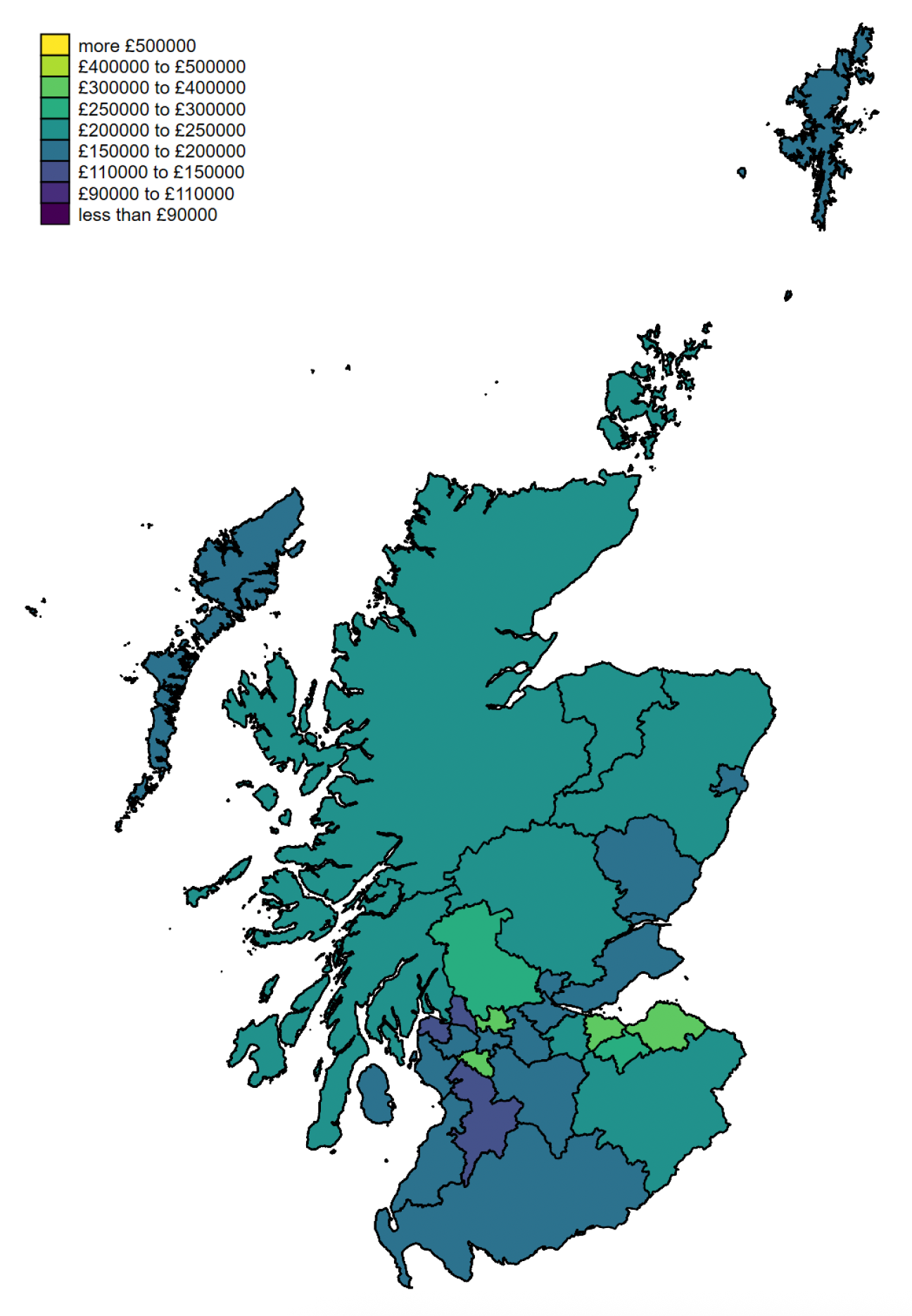
Figure 3.1 shows our estimates of the average value of properties by council area in Scotland as of Q3 2024. Average (mean) values are estimated to be lowest in East Ayrshire (£140,000), Inverclyde (£140,000) and West Dunbartonshire (£141,000). At the other end of the spectrum, average (mean) values are estimated to be highest in East Dunbartonshire (£322,000), East Renfrewshire (£331,000) and Edinburgh (£335,000). This compares to an average (mean) estimated value for Scotland as a whole of £211,000. Further information on how the distribution of estimated property values varies by council area can be found in Table B.1a in the accompanying Excel workbook.
Estimated values vary even more significantly at the neighbourhood level. For example, in the tenth of data zones (areas containing between 500 and 1,000 residents) with the lowest property values, the average (mean) estimated property value is less than £99,000. On the other hand, in the tenth with the highest property values, the average estimated property value is more than £353,000. As shown in Table B.1b in the accompanying Excel workbook, values are highly correlated with deprivation levels: the average (mean) estimated value for properties located in the most deprived tenth of local areas in Scotland is £107,000, compared to £388,000 for those located in the least deprived tenth of local areas.
Source Authors’ calculations using data from the Scottish Assessors, Registers of Scotland, and Energy Performance Certificates.
Table B.1c in the accompanying Excel workbook shows that average (mean) estimated values are highest in ‘accessible rural’ areas – settlements of less than 3,000 but within 30 minutes’ drive of a settlement of 10,000 or more – at £277,000. They are lowest in ‘very remote small towns’ – settlements of 3,000 to 10,000 that are over 1 hour drive to a settlement of 10,000 or more – at £166,000.
Property values are most varied in large settlements and particularly the area around Glasgow which contains council areas and neighbourhoods with both very low and very high average property values (see the maps at the bottom of Table B.1 in the accompanying Excel workbook).
3.2 Impacts across council areas
We now turn to the estimated impacts of our four reform options across council areas. Full estimates of the share of properties by current and new tax band can be found in Tables B.2 and B.3 in the accompanying Excel workbook. Here we summarise results using three main metrics:
- For the pure revaluation system, we estimate the percentage of properties in a council area moving up one or more bands, remaining in the same band, and moving down one or more bands.
- For all other systems, we estimate the percentage of properties in a council area seeing an increase, no change and a decrease in their gross relative tax rate (where the relative tax rate for a Band D property is 1) compared to the current council tax system. (For the pure revaluation system, this would be the same as the percentages moving up and down bands).
- For all systems, we estimate the average gross relative tax rate of properties in a council area, and how this changes compared with the current council tax system.
Note that changes in the relative tax rates properties are subject to are not the same as the change in the bills they would face: this will depend on any changes made to council tax rates, and any adjustments made to grant funding for councils alongside any revaluation and reform of council tax. It will also depend on whether given properties are subject to exemptions, discounts or premiums. However, in general properties seeing a decline in their gross relative tax rate are more likely to see a fall in their tax bill than properties seeing an increase in their gross relative tax rate. Gross relative tax rates are therefore a meaningful measure of how reforms are likely to affect households in different parts of Scotland.
Changes in bands and relative tax rates
Under the pure revaluation system, around half of properties would remain in the same band, with 23% moving down 1 band, 3% moving down 2 or more bands, 20% moving up 1 band and 4% moving up 2 or more bands.
Figure 3.2 shows our estimates of the percentage of properties moving up bands, remaining in the same band, and moving down bands by council area under this system. Council areas where property values have increased by more than the Scottish average between 1991 and 2024 would generally see more properties move up bands than down, whereas those where property values have increased by less than average over the same period generally see more properties move down bands than up. (The relationship is not perfect as band movements depend on the relative change in values of individual properties, not council-level averages).
Figure 3.2 shows that we estimate that a majority of properties would move down bands in Aberdeen City and West Dunbartonshire. Around a sixth of properties (16%) in Aberdeen City would move down two or more bands. Conversely, we estimate that over half would move up bands in Edinburgh City and the Orkney Islands, with over a fifth (21%) moving up two or more bands in the capital. Areas such as Angus, East Renfrewshire, Falkirk and Glasgow City would see roughly equal numbers move up and down bands. Angus, Dundee City, East Ayrshire and Fife would see the smallest percentage moving band – over 60% of properties are estimated to remain in the same band in each of these council areas.
Table 3.1 shows the proportion of properties estimated to see an increase, no change, and a fall in the gross relative tax rate under each of the other reform systems we model, by council area. The changes in the structure of council tax these entail mean that even if a property’s value has increased in line with the national average since 1991, it is still likely to see a change in its gross relative tax rate: for example, the less regressive 12-band and 14-band systems and continuous proportional system reduce relative tax rates for low-value properties and increase them for high-value properties. But the rate of increase in property value since 1991 still matters – properties whose value has increased by more since 1991 will have moved up the property value distribution and therefore may have moved up the tax band distribution too, even if their value remains below the average.

Note: Full results can be found in Table B.4 in the accompanying Excel workbook.
Source: Authors’ calculations using data from the Scottish Assessors, Registers of Scotland, and Energy Performance Certificates.
For example, it can be seen in Table 3.1 that in Aberdeen City, under the 12-band differentiated system, we estimate that 93% of properties would see a reduction in the gross relative tax rate applied to them (relative to a Band D property in Aberdeen City, whose Band D rate might change in response to the reform), 4% would see no change (those that remain in Band D), and 3% would see an increase. The fact that more are estimated to see a reduction than under a pure revaluation reflects the introduction of Band A1, as well as slightly lower tax rates than in the current system on bands A2 to C and Band E1. The proportion of properties moving up and down is very similar under the other systems, although the size of the changes in relative tax rates for those estimated to see a change is generally larger (especially under the continuous proportional system).
As well as Aberdeen City, other council areas where we estimate that a large majority of properties would see a fall in the gross relative tax rate they face under the 12-band, 14-band and continuous proportional systems we model include West Dunbartonshire (between 82% and 88% depending on the system), East Ayrshire (between 82% and 87%), North Ayrshire (between 78% and 84%) and Inverclyde (between 78% and 87%). These are all areas which have seen below-average increases in property values and have low average values.
At the other end of the spectrum, we estimate that 82% of properties in Edinburgh City would see an increase in the gross relative tax rate applied to them under the 12-band differentiated system. It is estimated that between 80% and 83% would see an increase under the other systems modelled, with the scale of increases among those seeing increases generally being larger (especially for the continuous proportional system). Other council areas that we estimate would see a majority of properties face an increase in relative tax rate under all modelled systems include East Lothian (between 72 and 76%), Midlothian (between 65 and 69%) and the Orkney Islands (between 63% and 76%). These are all areas which have seen both above-average increases in property value and that now have above-average values. We estimate that East Dunbartonshire and East Renfrewshire would see a majority of properties face an increase in relative tax rate under a continuous proportional system – reflecting the high average values in these areas.
| 12-band differentiated | 12-band less regressive | 14-band less regressive | Continuous Proportional | ||||||||||
|---|---|---|---|---|---|---|---|---|---|---|---|---|---|
| Down | Same | Up | Down | Same | Up | Down | Same | Up | Down | Same | Up | ||
| Aberdeen City | 93% | 4% | 3% | 92% | 3% | 5% | 87% | 5% | 7% | 91% | 1% | 8% | |
| Aberdeenshire | 71% | 10% | 18% | 71% | 12% | 17% | 59% | 16% | 25% | 71% | 5% | 25% | |
| Angus | 62% | 10% | 28% | 62% | 13% | 25% | 57% | 16% | 28% | 66% | 5% | 30% | |
| Argyll and Bute | 55% | 8% | 37% | 55% | 8% | 37% | 49% | 11% | 39% | 55% | 4% | 40% | |
| Clackmannanshire | 68% | 8% | 24% | 68% | 14% | 18% | 65% | 14% | 21% | 77% | 4% | 19% | |
| Dumfries and Galloway | 77% | 7% | 15% | 77% | 8% | 15% | 71% | 12% | 17% | 79% | 3% | 17% | |
| Dundee City | 69% | 8% | 24% | 69% | 14% | 18% | 69% | 11% | 20% | 77% | 4% | 20% | |
| East Ayrshire | 87% | 5% | 8% | 87% | 7% | 7% | 82% | 10% | 9% | 87% | 2% | 11% | |
| East Dunbartonshire | 42% | 15% | 43% | 42% | 11% | 47% | 31% | 19% | 51% | 36% | 4% | 59% | |
| East Lothian | 20% | 8% | 72% | 20% | 6% | 74% | 15% | 9% | 76% | 19% | 5% | 76% | |
| East Renfrewshire | 39% | 14% | 47% | 38% | 9% | 53% | 29% | 15% | 56% | 34% | 4% | 62% | |
| Edinburgh City | 12% | 6% | 82% | 12% | 8% | 80% | 8% | 8% | 83% | 14% | 5% | 81% | |
| Eilean Siar | 38% | 7% | 54% | 38% | 23% | 38% | 43% | 12% | 45% | 60% | 8% | 32% | |
| Falkirk | 57% | 9% | 34% | 57% | 19% | 24% | 56% | 14% | 30% | 71% | 6% | 23% | |
| Fife | 64% | 7% | 29% | 64% | 10% | 26% | 60% | 12% | 28% | 68% | 4% | 28% | |
| Glasgow City | 60% | 7% | 33% | 60% | 12% | 28% | 61% | 9% | 30% | 67% | 4% | 29% | |
| Highland | 36% | 10% | 53% | 36% | 16% | 48% | 32% | 15% | 53% | 42% | 7% | 51% | |
| 12-band differentiated | 12-band less reg. | 14-band less reg. | Cont. Proportional | |||||||||
|---|---|---|---|---|---|---|---|---|---|---|---|---|
| Down | Same | Up | Down | Same | Up | Down | Same | Up | Down | Same | Up | |
| Inverclyde | 78% | 4% | 18% | 78% | 13% | 9% | 79% | 7% | 14% | 87% | 2% | 11% |
| Midlothian | 25% | 10% | 65% | 25% | 8% | 67% | 18% | 12% | 69% | 25% | 8% | 67% |
| Moray | 35% | 9% | 56% | 35% | 21% | 44% | 34% | 15% | 51% | 49% | 7% | 44% |
| North Ayrshire | 83% | 5% | 12% | 83% | 7% | 10% | 78% | 10% | 12% | 84% | 2% | 14% |
| North Lanarkshire | 72% | 7% | 21% | 72% | 14% | 14% | 70% | 11% | 18% | 79% | 3% | 17% |
| Orkney Islands | 18% | 6% | 76% | 18% | 16% | 66% | 20% | 8% | 71% | 30% | 7% | 63% |
| Perth and Kinross | 50% | 12% | 38% | 50% | 12% | 38% | 41% | 16% | 43% | 50% | 6% | 44% |
| Renfrewshire | 79% | 8% | 13% | 79% | 7% | 14% | 70% | 13% | 17% | 77% | 4% | 19% |
| Scottish Borders | 39% | 8% | 53% | 39% | 15% | 47% | 38% | 9% | 53% | 48% | 5% | 47% |
| Shetland Islands | 45% | 9% | 45% | 45% | 21% | 33% | 46% | 14% | 39% | 59% | 7% | 35% |
| South Ayrshire | 77% | 10% | 13% | 77% | 8% | 15% | 66% | 15% | 19% | 73% | 3% | 24% |
| South Lanarkshire | 70% | 9% | 21% | 70% | 13% | 17% | 64% | 14% | 22% | 73% | 4% | 24% |
| Stirling | 43% | 11% | 46% | 42% | 15% | 43% | 35% | 13% | 52% | 48% | 7% | 45% |
| West Dunbartonshire | 87% | 6% | 7% | 87% | 6% | 6% | 82% | 11% | 8% | 88% | 2% | 10% |
| West Lothian | 33% | 8% | 60% | 33% | 17% | 51% | 31% | 12% | 57% | 46% | 8% | 46% |
| Scotland | 57% | 8% | 35% | 57% | 11% | 32% | 52% | 12% | 36% | 61% | 4% | 35% |
Note: The ‘same’ (i.e. no change) category is defined as a change in gross relative tax rate of between -0.02 and +0.02.
Source: Authors’ calculations using data from the Scottish Assessors, Registers of Scotland, and Energy Performance Certificates.
Average relative tax rates by council area
With properties moving up and down bands and seeing their relative tax rates change, the average gross relative tax rates in different council areas would change under each of the reforms modelled. This is illustrated in Table 3.2. As explained above, Band D property has a relative tax rate of 1, and currently Bands A and H have relative tax rates of 0.667 and 2.45 respectively. Thus, the 1.028 average gross relative tax rate under the current system for Aberdeen City means that the average gross council tax bill in Aberdeen City is slightly higher than that for a Band D property. The 0.881 for Dundee City means that properties there on average attract a gross council tax bill just below that for a Band C property (which would be 0.889).
Changes in relative tax rates under a pure revaluation would depend on whether property values in an area have increased by more or less than the average across Scotland as a whole since 1991, when current bands were first set.
Table 3.2 shows that we estimate that a pure revaluation would lead to notable declines in the average gross relative tax rate faced by properties in Aberdeen City and Aberdeenshire as more properties move down than up bands (Figure 3.2), in turn reflecting the below-average increase in property values in North East Scotland since 1991 (see Figure 1.1 and Table B.0 in the accompanying Excel workbook). For example, we estimate that the average gross relative tax rate faced by properties in Aberdeen City would fall to 0.888 – equivalent to that faced by a Band C property (roughly in line with Dundee City). Other areas that we estimate would see a decline in the average relative tax rate would include Dumfries and Galloway (0.996 to 0.927), East Ayrshire (0.907 to 0.848), North Ayrshire (0.925 to 0.871), South Ayrshire (1.072 to 0.992) and West Dunbartonshire (0.923 to 0.844). At the other end of the spectrum, we estimate there would be large increases for Edinburgh City (1.137 to 1.307) and the three other councils in the Lothians, the Orkney Islands (0.918 to 1.047), Highland (1.027 to 1.075) and Moray (0.947 to 1.001). According to our estimates, this means, for example, that the average relative tax rate faced by properties in the Orkney Islands would increase from just over that faced by a Band C property to over that faced by a Band D property.
| Council area | Current | Pure Reval | 12-band Diff | 12-band LR | 14-band | Continuous Proportional |
|---|---|---|---|---|---|---|
| Aberdeen City | 1.028 | 0.888 | 0.874 | 0.857 | 0.842 | 0.766 |
| Aberdeenshire | 1.148 | 1.05 | 1.055 | 1.059 | 1.066 | 1.053 |
| Angus | 0.964 | 0.956 | 0.948 | 0.937 | 0.936 | 0.884 |
| Argyll and Bute | 1.058 | 1.064 | 1.074 | 1.086 | 1.08 | 1.084 |
| Clackmannanshire | 0.978 | 0.938 | 0.935 | 0.918 | 0.912 | 0.864 |
| Dumfries and Galloway | 0.996 | 0.927 | 0.921 | 0.902 | 0.898 | 0.843 |
| Dundee City | 0.881 | 0.875 | 0.862 | 0.838 | 0.827 | 0.743 |
| East Ayrshire | 0.907 | 0.848 | 0.821 | 0.804 | 0.785 | 0.676 |
| East Dunbartonshire | 1.287 | 1.294 | 1.34 | 1.41 | 1.403 | 1.551 |
| East Lothian | 1.156 | 1.261 | 1.302 | 1.36 | 1.365 | 1.508 |
| East Renfrewshire | 1.314 | 1.328 | 1.377 | 1.458 | 1.443 | 1.597 |
| Edinburgh City | 1.137 | 1.307 | 1.355 | 1.427 | 1.431 | 1.614 |
| Eilean Siar | 0.855 | 0.896 | 0.895 | 0.858 | 0.86 | 0.813 |
| Falkirk | 0.965 | 0.945 | 0.945 | 0.925 | 0.923 | 0.876 |
| Fife | 0.988 | 0.986 | 0.989 | 0.984 | 0.979 | 0.958 |
| Glasgow City | 0.933 | 0.947 | 0.947 | 0.934 | 0.928 | 0.896 |
| Highland | 1.027 | 1.075 | 1.087 | 1.092 | 1.101 | 1.109 |
| Inverclyde | 0.898 | 0.847 | 0.821 | 0.803 | 0.783 | 0.676 |
| Midlothian | 1.081 | 1.144 | 1.165 | 1.185 | 1.196 | 1.244 |
| Moray | 0.947 | 1.001 | 1.006 | 0.992 | 1.002 | 0.98 |
| North Ayrshire | 0.925 | 0.871 | 0.854 | 0.836 | 0.822 | 0.73 |
| North Lanarkshire | 0.922 | 0.889 | 0.876 | 0.853 | 0.843 | 0.761 |
| Orkney Islands | 0.918 | 1.047 | 1.055 | 1.049 | 1.066 | 1.06 |
| Perth and Kinross | 1.116 | 1.104 | 1.12 | 1.134 | 1.139 | 1.166 |
| Renfrewshire | 1.009 | 0.936 | 0.927 | 0.915 | 0.908 | 0.847 |
| Scottish Borders | 1.023 | 1.067 | 1.079 | 1.093 | 1.087 | 1.1 |
| Shetland Islands | 0.904 | 0.929 | 0.927 | 0.901 | 0.91 | 0.862 |
| South Ayrshire | 1.072 | 0.992 | 0.992 | 0.991 | 0.985 | 0.955 |
| South Lanarkshire | 1.01 | 0.966 | 0.964 | 0.957 | 0.95 | 0.912 |
| Stirling | 1.174 | 1.161 | 1.189 | 1.218 | 1.215 | 1.288 |
| West Dunbartonshire | 0.923 | 0.844 | 0.824 | 0.796 | 0.781 | 0.68 |
| West Lothian | 0.989 | 1.035 | 1.047 | 1.04 | 1.043 | 1.044 |
| Scotland | 1.018 | 1.018 | 1.024 | 1.027 | 1.024 | 1.018 |
Source: Authors’ calculations using data from the Scottish Assessors, Registers of Scotland, and Energy Performance Certificates.
Under the other systems it is not just the change in property values but the values themselves that affect the change in relative tax rate faced by properties. Because these systems all reduce the regressivity of council tax with respect to property values (a little in the case of the 12-band differentiated system and fully in the case of the continuous proportional system), in areas where property values have not only increased by less than average but are also low in absolute terms, making council tax less regressive would further reduce the average relative tax rate. For example, under the 14-band less regressive system, we estimate that the average relative tax rate would fall further to 0.842 in Aberdeen City, 0.785 in East Ayrshire, and 0.781 in West Dunbartonshire – in the latter two cases close to the level currently faced by Band B properties (0.778). Similarly, in areas where property values have not only increased by more than average but are also high in absolute terms, making council tax less regressive would further increase the average relative tax rate. For instance, under the 14-band less regressive system, we estimate that the average relative tax rate faced by properties would further increase to 1.431 in Edinburgh, 1.365 in East Lothian and 1.196 in Midlothian.
There are some areas, though, where the effects of revaluation and making council tax less regressive work in opposite directions. These include Perthshire and Stirling, where we estimate that revaluation alone would slightly reduce the average relative tax rate, but making council tax less regressive would slightly increase the average relative tax rate. This reflects the fact that, while property values in these areas have increased by slightly less than average since 1991, they remain above average.
Similarly, while East Dunbartonshire and East Renfrewshire have seen property values move broadly in line with the Scottish average and so we estimate that they would see little change in average tax rate under a pure revaluation, their high average values mean we estimate that they would see substantial increases in average relative tax rates under less regressive council tax systems.
3.3 Impacts across neighbourhoods
Variation in the impacts of revaluing and reforming council tax would be greater across neighbourhoods than across council areas, reflecting within-council variation in changes in, and the level of, property values.
Impacts by neighbourhood
The detailed data underlying our geographical estimates allow us to estimate the impacts of reforms for each Scottish ‘data zone’ (areas which typically contain 500 to 1,000 people) and ‘intermediate zone’ (groupings of data zones which typically contain between 2,500 and 6,000 people). In urban areas these can reasonably be termed ‘neighbourhoods’, but in very sparsely populated rural areas they can cover areas of hundreds of square miles.
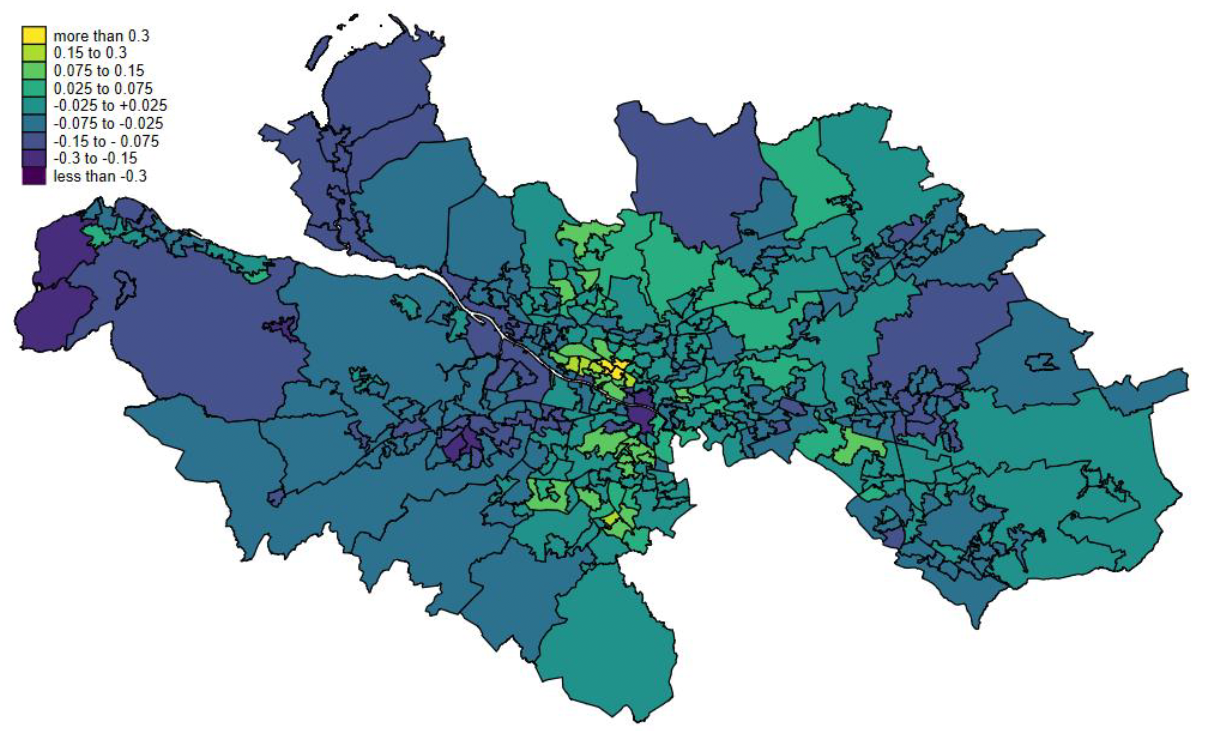
Maps showing the estimated change in average gross relative tax rates for properties in each intermediate zone in Scotland can be found in Table B.5 in the accompanying Excel workbook. Areas seeing an estimated increase in their average gross relative tax rates are shown in yellow and green, while areas seeing an estimated decrease are shown in blue and purple, with areas seeing little change (defined as -0.025 to +0.025) shown in turquoise. In interpreting these figures, it is important to remember that the gross relative tax rate for a Band D property is 1. Thus, a change in the gross relative tax rate of -0.1 means that the average gross relative tax rate for properties in a neighbourhood would fall by the equivalent of 10% of the tax charged on a Band D property in that council area. A change of +0.2 would mean that the average gross relative tax rate would increase by the equivalent of 20% of the tax charged on a Band D property in the relevant council area.
Example maps for Glasgow and its environs are shown in Figure 3.3 and 3.4, which show the estimated changes in average gross relative tax rates for intermediate zones under the pure revaluation and continuous proportional systems.[7]
The blues on the western side of Figure 3.3 show that we estimate that a pure revaluation would reduce the average gross relative tax rate faced by properties in most neighbourhoods in Inverclyde, Renfrewshire and West Dunbartonshire. The greens and yellows towards the centre of the map show revaluation is estimated to increase average gross relative tax rates in the west end of Glasgow, and parts of the outer south side of Glasgow, Giffnock and Clarkston. The blues for the east of the map show an estimated fall in average gross relative tax rates for much of North Lanarkshire.
Source: Authors’ calculations using data from the Scottish Assessors, Registers of Scotland, and Energy Performance Certificates.

Source: Authors’ calculations using data from the Scottish Assessors, Registers of Scotland, and Energy Performance Certificates.
The yellows and purples in Figure 3.4 show the much larger estimated changes in gross relative tax rates that properties and hence neighbourhoods would face under a continuous proportional system. The purples and dark blues show that we estimate that there would be substantial falls in average gross relative tax rates in many of the more deprived parts of Glasgow and its environs – the east end and inner south side of Glasgow, Airdrie, Coatbridge, parts of Cumbernauld, Motherwell and Wishaw, as well as the urban parts of Inverclyde and virtually all of West Dunbartonshire. The yellows and light greens indicate substantial estimated increases in gross relative tax rates for the west end and outer south side of Glasgow, most of East Dunbartonshire and East Renfrewshire, and the more rural areas of Renfrewshire and Inverclyde – more affluent areas with higher average property values.
The equivalent maps for the 12-band and 14-band systems in Table B.5 in the accompanying Excel workbook show that the estimated impacts for these reforms would lie between those under a pure revaluation and a continuous proportional system.
Impacts by neighbourhood characteristics
The impacts of the reforms would differ systematically by types of neighbourhoods. Table 3.3 below shows the average gross relative tax rates for the current system and estimates for each modelled reform by the deprivation level and urban/rural classification of each data zone, as well as for island communities.
Panel (a) of the table shows clearly how under the current system, the average gross relative tax rate for properties in the most deprived tenth of data zones (0.768, or just below a Band B) is a little over half that for the least deprived tenth of data zones (1.414, or between a Band E and F). We estimate that a pure revaluation would make little difference to these averages – slightly reducing it for the most deprived (to 0.755) and increasing it for the most deprived (1.443) reflecting the fact that we estimate that values have risen somewhat less-than-average in the most deprived areas and somewhat more-than-average in the least deprived areas since 1991. In contrast, we estimate that a continuous proportional system would see substantial changes, reducing the average gross relative tax rate for properties in the most deprived areas to 0.518 – a reduction of around a third compared to the current average. At the other end of the scale, the average would increase to 1.869 for the least deprived tenth of data zones – an increase of almost a third compared to the current average. The other systems lie between these two benchmark reforms. For example, we estimate that the 12-band and 14-band less regressive systems would reduce the average gross relative tax rate for properties in the most deprived tenth of data zones to around the level of a current Band A property (0.686 and 0.659, respectively). They are estimated to increase the average gross relative tax rate for the least deprived tenth of areas to around the level of a current Band F property (1.620 and 1.614, respectively). These reforms therefore move between one-third and one-half of the way towards outcomes under the continuous proportional system.
Panel (b) shows that under the current system, it is ‘accessible rural’ areas – that is settlements with fewer than 3,000 people that are within a 30-minute drive time of a settlement of 10,000 or more – that face the highest gross relative tax rates (1.208). Very remote small towns – that is settlements with between 3,000 and 10,000 people at least a 1-hour drive from a settlement of 10,000 or more – that face the lowest gross relative tax rates (0.888). Under a pure revaluation, we estimate that these two types of areas would still face the highest and lowest average relative tax rates, respectively. We estimate that the most notable changes would be for very remote rural areas, with an increase in average gross relative tax rate (from 0.996 to 1.065) and other urban areas – that is settlements from 10,000 to 125,000 – with a decrease in average gross relative tax rate (from 0.956 to 0.924). The modest estimated increase in the average gross relative tax rate for large urban areas reflects the aforementioned increase for Edinburgh City (and in turn the Edinburgh urban area), partially offset by a decline for Aberdeen urban area.
Making council tax less regressive is estimated to further increase the average gross relative tax rate faced by properties in rural areas (especially accessible rural areas), and decrease them for other urban areas and small towns. This reflects the above-average and below-average estimated values in rural areas versus towns. We estimate that the increase in average gross relative tax rate under less regressive systems is driven by the Edinburgh urban area, with the Aberdeen urban area and Dundee urban area seeing decreases in average gross relative tax rates that partially offset this.
The final row of the table shows that we estimate that island communities would see an increase in average gross relative tax rate under all modelled reforms. This is driven by the revaluation effect and the fact that property values have increased by more than average on Scottish islands overall (especially in Orkney Islands). Our estimates suggest that making council tax less regressive, conditional on revaluation, has little effect on the average relative tax rate faced by properties in the islands (although it would significantly affect the tax rates faced by individual properties in the islands, as elsewhere in Scotland).
Table 3.3. Average estimated relative tax rate by data zone type
(a) by data zone deprivation
| Deprivation decile | Current | Pure Reval | 12-band Diff | 12-band LR | 14-band | Continuous Proportional |
|---|---|---|---|---|---|---|
| Most deprived | 0.768 | 0.755 | 0.723 | 0.686 | 0.659 | 0.518 |
| 2nd | 0.799 | 0.79 | 0.769 | 0.73 | 0.71 | 0.595 |
| 3rd | 0.836 | 0.832 | 0.817 | 0.781 | 0.768 | 0.675 |
| 4th | 0.887 | 0.892 | 0.886 | 0.858 | 0.852 | 0.79 |
| 5th | 0.954 | 0.959 | 0.959 | 0.941 | 0.942 | 0.905 |
| 6th | 1.039 | 1.055 | 1.066 | 1.069 | 1.075 | 1.079 |
| 7th | 1.113 | 1.123 | 1.14 | 1.158 | 1.167 | 1.204 |
| 8th | 1.207 | 1.198 | 1.222 | 1.257 | 1.268 | 1.33 |
| 9th | 1.285 | 1.257 | 1.288 | 1.337 | 1.35 | 1.444 |
| Least deprived | 1.413 | 1.443 | 1.508 | 1.62 | 1.614 | 1.871 |
(b) by data zone rural/urban classification
| Rural/urban classification | Current | Pure Reval | 12-band Diff | 12-band LR | 14-band | Continuous Proportional |
|---|---|---|---|---|---|---|
| Large urban area | 1.002 | 1.024 | 1.032 | 1.041 | 1.034 | 1.044 |
| Other urban area | 0.956 | 0.924 | 0.918 | 0.9 | 0.893 | 0.837 |
| Accessible small town | 0.985 | 0.965 | 0.963 | 0.953 | 0.95 | 0.911 |
| Remote small town | 0.957 | 0.95 | 0.948 | 0.937 | 0.932 | 0.899 |
| Very remote small town | 0.888 | 0.9 | 0.892 | 0.868 | 0.863 | 0.798 |
| Accessible rural | 1.208 | 1.201 | 1.226 | 1.265 | 1.27 | 1.336 |
| Remote rural | 1.11 | 1.123 | 1.137 | 1.16 | 1.162 | 1.191 |
| Very remote rural | 0.996 | 1.065 | 1.077 | 1.079 | 1.088 | 1.096 |
| Island communities* | 0.92 | 0.999 | 1.004 | 0.993 | 0.999 | 0.978 |
Note: *We present averages for Island communities but these are not part of the rural/urban classification, hence these data zones also fall into one of the other categories. Deprivation is based on the overall Scottish Index of Multiple Deprivation 2020 score.
Source: Source: Authors’ calculations using data from the Scottish Assessors, Registers of Scotland, Energy Performance Certificates, Scottish IMD Statistics and National Records of Scotland urban/rural classification and island postcode look-up.
Contact
Email: socialresearch@gov.scot