
Revaluation and reform of council tax in Scotland: design considerations and potential impacts
This report considers the design and impact of potential reforms to Scotland’s council tax system.
1. Introduction
This report considers the design and potential impact of reforms to Scotland’s system of council tax, a tax levied on the occupiers of residential property to help fund the provision of local services. Overall, the council tax system in Scotland operates as follows: the Scottish Government determines the structure of the tax, while councils set the overall tax rate in each of their areas, and collect and retain the revenues to help fund the services they provide (Scottish Government, 2025a). Across Scotland as a whole, it is budgeted to have raised £3 billion in 2024–25, roughly equal to the amount raised by non-domestic rates, and approximately 19% of councils’ general funding for day-to-day (resource) spending (Scottish Government, 2024b).
The amount of tax due on a property depends on (Scottish Assessors, 2025; Scottish Government, 2025a):
- the tax band a property is placed in (from A to H), which in turn depends on its assessed value as of April 1991, the assessment being conducted by valuation joint boards;
- the tax rate set by the council covering the area it is located in; and
- whether the occupier is entitled to an exemption, discount or the means-tested council tax reduction scheme (CTRS), or must pay a premium over the standard rate as a result of rules set by the Scottish Government or local council.
Table 1.1 shows each band’s 1991 property value thresholds, share of properties across Scotland as a whole, and associated tax bill based on the average tax level set by Scottish councils.
The bill for a property in Band A is 67% of the bill for a Band D property, while the charge for a property in Band H is 245% of the bill for a Band D property. A majority of properties (58%) are in the bottom three bands, A to C, while only a relatively small fraction (14%) are in the top three bands, F to H.
| Band | 1991 value range | Share of properties | Tax rate relative to Band D | Standard gross tax bill, Scotland average |
|---|---|---|---|---|
| A | Up to £27,000 | 19.1% | 0.667 | £1,029 |
| B | £27,001 to £35,000 | 22.3% | 0.778 | £1,200 |
| C | £35,001 to £45,000 | 16.3% | 0.889 | £1,372 |
| D | £45,001 to £58,000 | 14.0% | 1 | £1,543 |
| E | £58,001 to £80,000 | 13.9% | 1.314 | £2,027 |
| F | £80,001 to £106,000 | 8.4% | 1.625 | £2,507 |
| G | £106,001 to £212,000 | 5.4% | 1.958 | £3,022 |
| H | Above £212,000 | 0.6% | 2.450 | £3,780 |
Source: Share of dwellings in each band and average bills calculated using data from Scottish Government council tax datasetsthe Scottish Government Council Tax Datasets. Note that Band D tax rates – and hence tax rates for all other bands – vary across councils. In 2025–26, for example, Band D rates ranged from £1,379 in South Lanarkshire to £1,666 in Midlothian. Share of properties by band is based on data originally compiled in 2024–25.
Issues with current council tax design
A number of significant concerns have been raised with the current design of council tax (e.g. Cheshire and Hilber, 2021; Congreve, 2023; Corlett and Gardiner, 2018; Fairer Share, 2021; Hawkey, 2023; Leishman et al., 2014; Mirrlees et al., 2011; Murphy, 2019).
First is the continued use of 1991 property values to assign properties to tax bands (Scottish Assessors, 2025). This may pose practical difficulties for the valuation of new properties by valuation joint boards, which must assess what they would have been worth in 1991. That may be particularly difficult in residential areas that did not exist in 1991, especially if the wider local context has changed (Valuation Office Agency, 2024).
More fundamentally, the use of 1991 valuations creates disparities in council tax bills between properties with similar current values. These disparities arise not because property values have increased so much nationally over the last 34 years: if properties were revalued, the property value thresholds between bands could be reset to account for this. Instead, it is because the values of different properties have changed so differently over the last third of a century – some increasing by much more, and others much less, than average. For example, Figure 1.1, shows that the change in average property value between 1993 (the earliest year for which data is available) and 2024 ranges from 168% in Aberdeen City to 500% in East Lothian (compared with an average of 357% for Scotland as a whole).
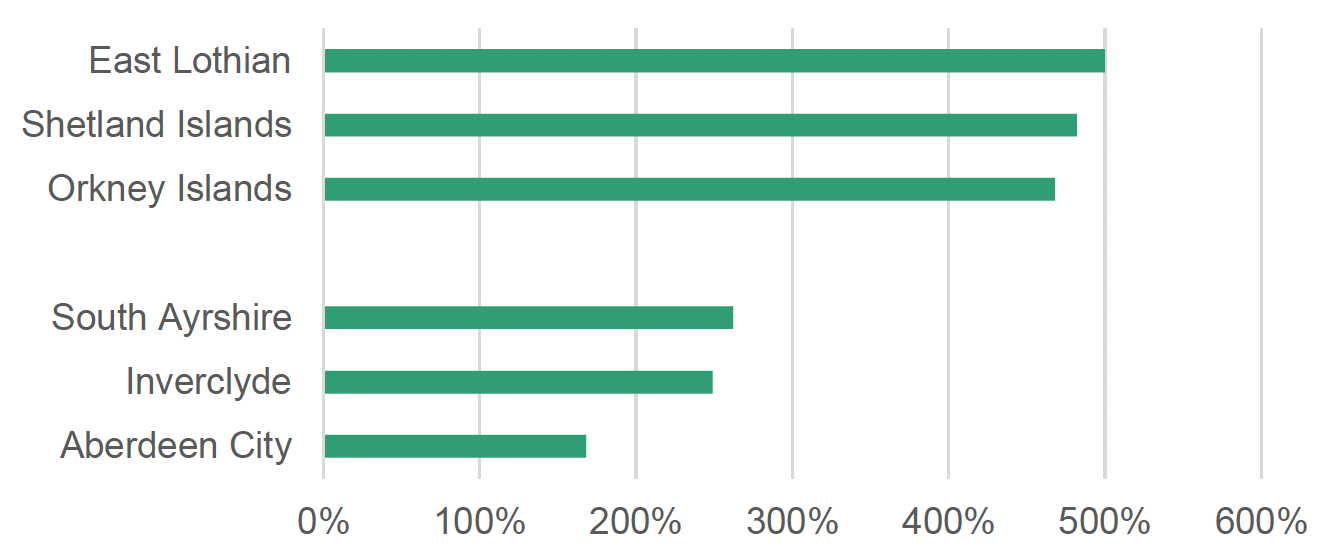
Note: highest and lowest three council areas only. All councils are included in Table B.0 in the accompanying Excel workbook.
Source: Scottish Government (1993 to 2004) and UK House Price Index (2004 to 2024).
Values for different properties in the same council area will also have changed differently. As a result, properties in the same council area, with the same value in 1991 and hence in the same tax band and bill, may now differ in value by tens or even hundreds of thousands of pounds.[1] Conversely, two households living in properties in the same council area, with the same value today, can have very different tax bills because one property was worth more than the other 34 years ago.
Second, the banded structure of council tax means that two properties on either side of a band cut-off can attract very different tax liabilities: 31%, or over £480 a year on average (as of 2025–26), higher at the bottom of Band E than at the top of Band D, for example (see Table 1.1). Again, this means that households living in very similar properties can face very different tax bills. Conversely, two properties at opposite ends of the same band attract the same tax liability. This is particularly notable for Band H: all properties in this band in a given council area attract the same gross tax bill regardless of whether they were worth £212,000 in 1991 or were million-pound-plus mansions (see Table 1.1 and Scottish Assessors, 2025). Thus, while there may be practical advantages of a banded system, analysis of systems with more bands or even continuous point-value systems (as in Northern Ireland’s domestic rates system: see nidirect, 2025) is also worthwhile as these options could relate tax liabilities more precisely to property values and reduce or remove cliff-edges in bills at band thresholds.
Third, council tax (before discounts) is regressive with respect to property value, by design: the tax is a lower percentage of (1991) property value for higher-value properties. Reforms made by the Scottish Government in 2017 reduced the regressivity to some extent by increasing the relative tax rates on properties in bands E to H (Scottish Government, 2024a). But even following this reform, Table 1.1 shows that the tax levied on a Band H property is 3.675 times higher than that levied on a Band A property in the same council area, despite Band H properties being worth (in 1991) at least 7.85 times more than Band A properties, and in many cases much more than that.[2] A further set of proposed increases in the relative tax rates on Bands E to H consulted upon in 2023 were not enacted following feedback from consultation respondents, some of whom highlighted the fact that the use of 1991 valuations (which they considered ‘outdated’) meant that these further tax increases would often apply to the ‘wrong’ properties (Scottish Government, 2024a).
Regressivity of an individual tax is not necessarily a problem – it is the design of the tax (and benefit) system as a whole that matters for distributional outcomes (Mirrlees et al, 2011). However, council tax is deliberately regressive with respect to its base, and as explained in Mirrlees et al. (2011), it is hard on either equity or efficiency grounds to justify why the taxation of housing, but not other goods, should be regressive by design. Indeed, under the tenets of optimal tax theory (e.g. Mirrlees et al., 2011), council tax is a relatively straightforward and efficient tax to make more progressive, since it is harder to reduce a council tax bill than other taxes such as income tax, where more progressive rates may lead to reductions in declared income. Hence, even conditional upon the overall progressivity of the tax system as a whole, there would be potential benefits from making council tax less regressive (and other parts of the tax system, such as income tax or land and buildings transactions tax, less progressive) to redistribute more efficiently (Mirrlees et al, 2011).
Policy context
In light of this context, there has been a broad (albeit not universal) consensus among academics, think tanks, wider civil society and many politicians that the current council tax system is in need of reform, both in Scotland and the rest of the UK (Cheshire and Hilber, 2021; Congreve, 2023; Corlett and Gardiner, 2018; Fairer Share, 2021; Hawkey, 2023; Leishman et al., 2014; Mirrlees et al., 2011; Murphy, 2019).
In Scotland, the official Commission on Land Tax Reform (2015) concluded that the existing council tax system should be replaced with a fairer, more progressive system. As highlighted above, the Scottish Government did modestly increase the relative tax rates on properties in bands E to H in 2017 (Scottish Government, 2018). However, a proposal to ‘end’ the current system was rejected by the Scottish Parliament in 2018 due to a lack of a consensus on an appropriate alternative system (Scottish Parliament, 2018).
More recently, the Joint Working Group on Sources of Local Government Funding and Council Tax Reform was established to consider changes to the council tax system (Scottish Government, 2025b). This Group, bringing together the Scottish Government and COSLA, has announced a programme of engagement with stakeholders in 2025, with the aim of building a broad consensus about the way forward for council tax reform.
This report
To help ensure that this engagement is informed by robust analysis of the potential impacts of different reform options – and, implicitly, of continuing with the status quo – the Scottish Government has commissioned researchers at the Institute for Fiscal Studies (IFS) to undertake an analysis of indicative reform options developed jointly by the Scottish Government, COSLA and the IFS. These are designed to illuminate the impacts and trade-offs associated with different possible reforms to council tax in order to help identify those which can command the widest support.
The remainder of this report is structured as follows:
Section 2 sets out the reform options considered in this report. These range from a revalued version of the current 8-band system, through to a revalued proportional property tax, where each property is taxed in proportion to its exact estimated value. The section also explains the type of analysis we undertake, including a summary of our methodological approaches.
Section 3 sets out the estimated impacts of the different reform options on different parts of Scotland. In particular, we consider impacts on the proportion of properties in different bands, and facing different relative tax rates, in different council areas and different neighbourhoods.
Section 4 focuses on the estimated impacts of different reform options on different types of households.
Section 5 considers the potential impacts of reforms on the housing market.
Section 6 considers potential transitional arrangements and mitigations that could help phase in and address potential adverse impacts on population groups of particular concern.
Section 7 concludes and highlights where further research could help deepen the understanding of impacts and refine the design of reforms if council tax revaluation and reform is taken forward.
Appendix A provides further information on our methodology. There is also an accompanying Excel workbook which provides further results from our quantitative modelling, including estimated property values and the estimated impacts of reform options across places, household types and on property values.
Contact
Email: socialresearch@gov.scot