
Programme for International Student Assessment 2025: national report for Scotland
This report presents Scotland’s results from the OECD’s Programme for International Student Assessment (PISA), examining the performance and experiences of 15 year old pupils and how these compare internationally and over time.
6 Performance in reading
6.1 How reading is assessed
The reading assessment in PISA 2025 uses the reading framework introduced in PISA 2018, when reading was the major assessment domain. The same framework was retained for PISA 2025, with reading assessed as a minor domain.
The framework is based on the concept of reading literacy, defined as an individual’s ability to understand, use, evaluate, reflect on and engage with texts in order to achieve their goals, develop their knowledge and potential, and participate effectively in society. Rather than assessing reading as a school subject, PISA focuses on how well 15 year olds can apply their reading skills to a range of real-world texts and situations.
The framework is organised around three dimensions: reading processes, texts, and situations. Reading processes include locating information, understanding texts, and evaluating and reflecting on texts, alongside the metacognitive skills needed to plan, monitor and regulate reading. Pupils are assessed using a variety of text types and formats, including continuous, non-continuous and multiple-source texts, presented in personal, public, occupational and educational contexts.
The PISA 2018 framework was updated to reflect the changing nature of reading in a digital world, recognising the increasing importance of navigating, evaluating, and integrating information from multiple online sources.
6.2 Scotland’s performance in reading
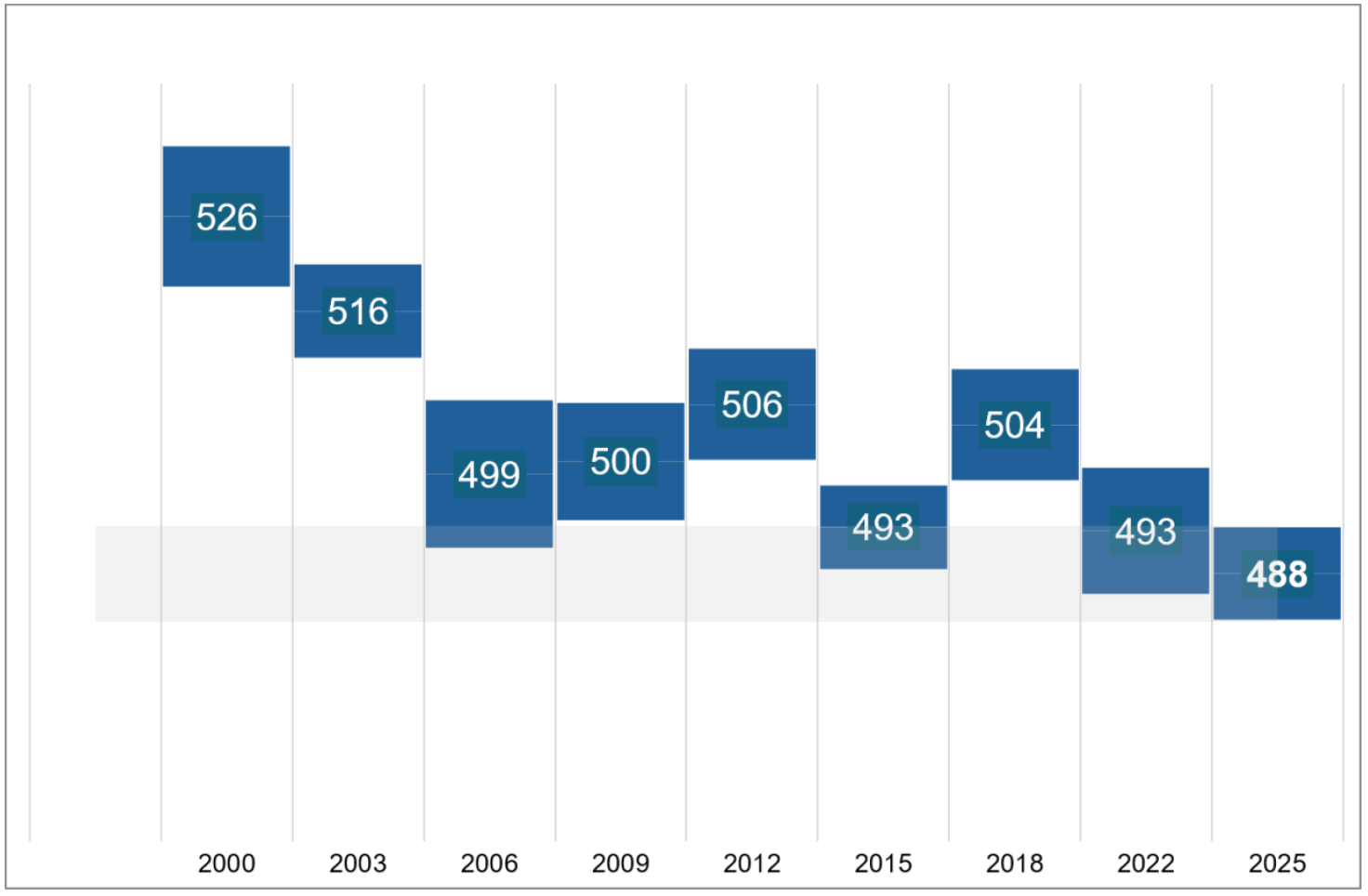
Scotland’s average score in reading in PISA 2025 was 488 points. This was not statistically significantly different from Scotland’s score in PISA 2022 (493 points), indicating that reading performance has remained broadly stable since the previous assessment cycle.
Despite this stability in the most recent cycle, Scotland’s reading performance has declined over the longer-term. Scotland’s average reading score was 526 points when reading was first assessed as the major domain in PISA 2000.
Scotland’s average reading score in PISA 2025 was significantly lower than its performance in 2000, 2003, 2012 and 2018. However, there was no statistically significant difference between Scotland’s performance in 2025 and its performance in 2006, 2009, 2015 or 2022.
Figure 6.1 shows trends in Scotland’s average reading performance since 2000.
Overall, Scotland’s reading performance has declined over the longer-term, although there was no statistically significant change between the 2022 and 2025 assessment cycles.
6.3 Reading performance by sex
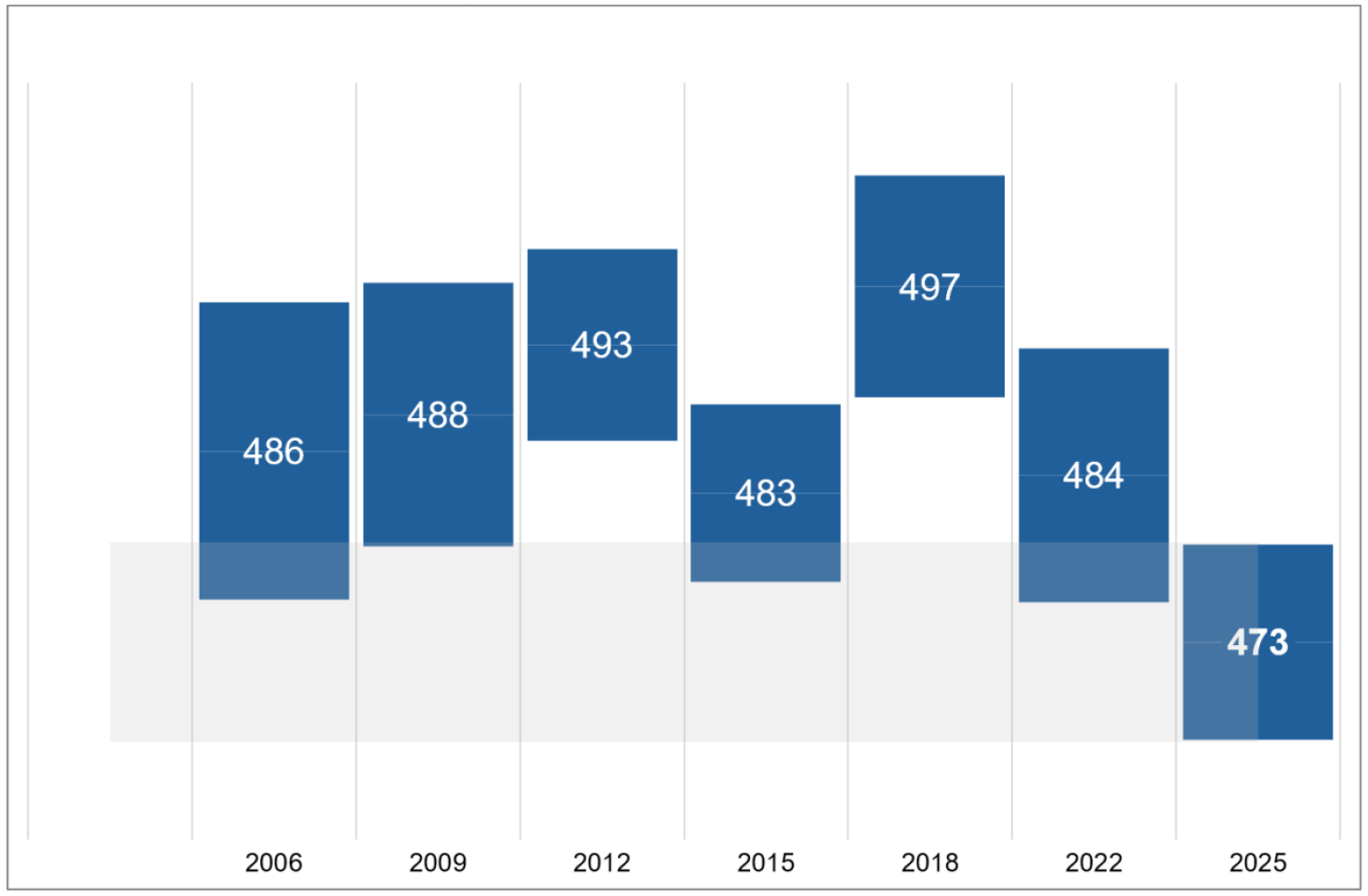
In PISA 2025, girls in Scotland achieved a mean reading score of 503 points, compared with 473 points for boys. Girls’ reading performance was significantly higher than boys’.
Among boys, the mean reading score was 473 points in 2025. This was significantly lower than boys’ performance in 2009, 2012, 2018 and 2022, but was not significantly different from their performance in 2006 or 2015.
Among girls, the mean reading score was 503 points in 2025. This was significantly lower than girls’ performance in 2012, but was not significantly different from their performance in 2006, 2009, 2015, 2018 or 2022.
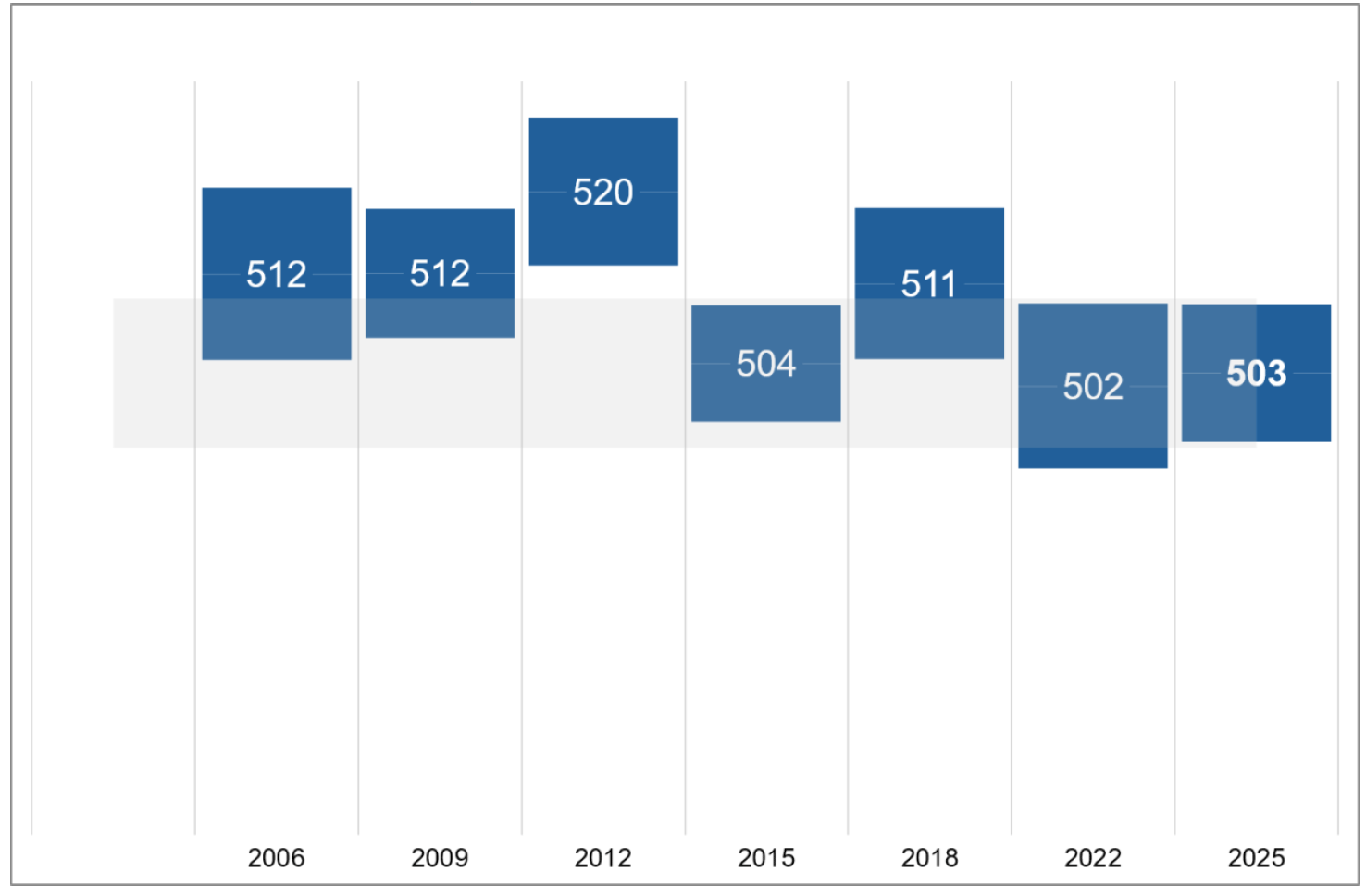
Overall, the longer-term pattern in reading performance differed between boys and girls. Boys’ performance in 2025 was significantly lower than in a number of previous cycles, including 2018 and 2022. For girls, performance in 2025 was not significantly different from most previous cycles, including 2018 and 2022.
6.4 Reading performance across the United Kingdom
As in previous PISA cycles, there was variation in reading performance across the four UK nations.
Scotland achieved a mean reading score of 488 points, compared with 494 points for the United Kingdom as a whole. Scotland’s performance was not significantly different from the UK average or Northern Ireland (482 points), significantly lower than England (497 points), and significantly higher than Wales (459 points).
The pattern of comparisons across the UK differed between boys and girls.
Among girls, Scotland achieved a mean reading score of 503 points. This was not significantly different from England, the UK overall or Northern Ireland, and was significantly higher than Wales.
Among boys, Scotland achieved a mean reading score of 473 points. This was significantly lower than England and the UK overall, not significantly different from Northern Ireland, and significantly higher than Wales.
Overall, Scotland’s reading performance was significantly lower than England, significantly higher than Wales, and not significantly different from the UK average or Northern Ireland. However, Scotland’s position within the UK differed by sex. Among girls, performance was not significantly different from England or the UK overall, whereas among boys, performance was significantly lower than both England and the UK overall.
6.5 How Scotland’s reading performance compares internationally
Across all pupils, Scotland achieved a mean reading score of 488 points in PISA 2025. This was significantly higher than the OECD average of 461 points.
Scotland’s reading performance was significantly lower than six countries and UK administrations, including Japan, Ireland, and Estonia.
Scotland performed at a statistically similar level to five countries and UK administrations, including Australia and Poland. Scotland’s performance was also not significantly different from the United Kingdom as a whole.
Scotland performed significantly higher than 29 countries and UK administrations, including Finland, Denmark, and Germany. Scotland’s score was also significantly higher than the OECD average.
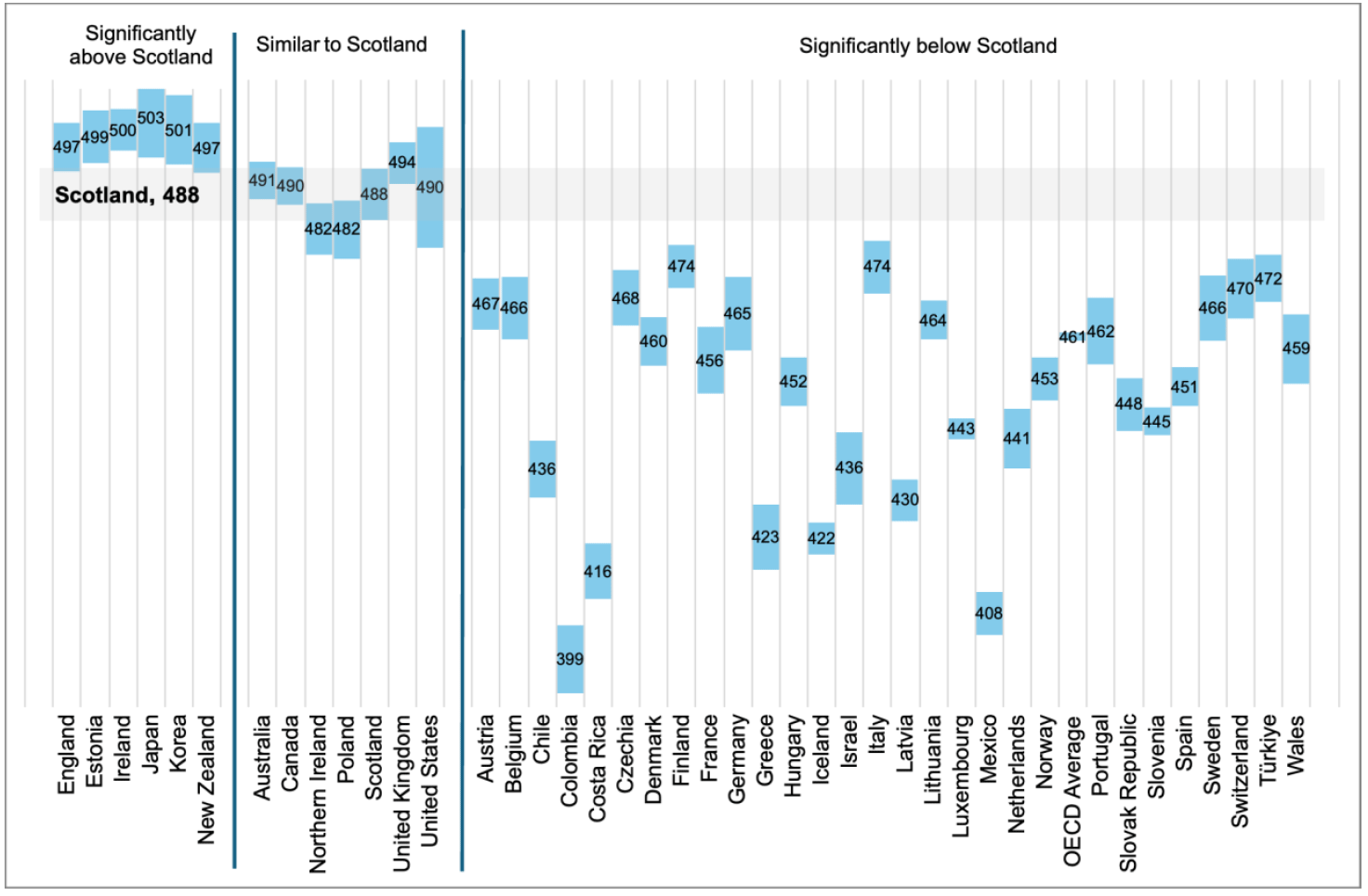
The wider international picture for reading is considerably less positive. Across OECD countries, average performance fell significantly between 2022 and 2025, and more than half of participating systems with comparable data recorded a decline. Reading has also seen the largest OECD-wide deterioration over the past decade, alongside an increase in low performers and a reduction in top performers. Scotland’s lack of a significant change since 2022 therefore contrasts with this widespread recent decline, although Scotland’s own longer-term performance remains below that recorded in some earlier PISA cycles.
Table 6.1: OECD countries and UK administrations, higher than, similar to and lower than Scotland in reading, PISA 2025
Higher score than Scotland
- England (497)
- Estonia (499)
- Ireland (501)
- Japan (503)
- Korea (501)
- New Zealand (497)
Similar score to Scotland
- Australia (491)
- Canada (490)
- Northern Ireland (482)
- Poland (482)
- Scotland (488)
- United States (489)
- United Kingdom (494)
Lower score than Scotland
- Austria (467)
- Belgium (466)
- Chile (436)
- Colombia (399)
- Costa Rica (416)
- Czechia (468)
- Denmark (460)
- Finland (474)
- France (457)
- Germany (464)
- Greece (423)
- Hungary (452)
- Iceland (422)
- Israel (436)
- Italy (474)
- Latvia (430)
- Lithuania (464)
- Luxembourg (443)
- Mexico (408)
- Netherlands (441)
- Norway (453)
- OECD Average (461)
- Portugal (462)
- Slovak Republic (448)
- Slovenia (445)
- Spain (451)
- Sweden (466)
- Switzerland (470)
- Türkiye (472)
- Wales (459)
6.6 International comparisons by sex
The pattern of international comparisons differed somewhat between boys and girls.
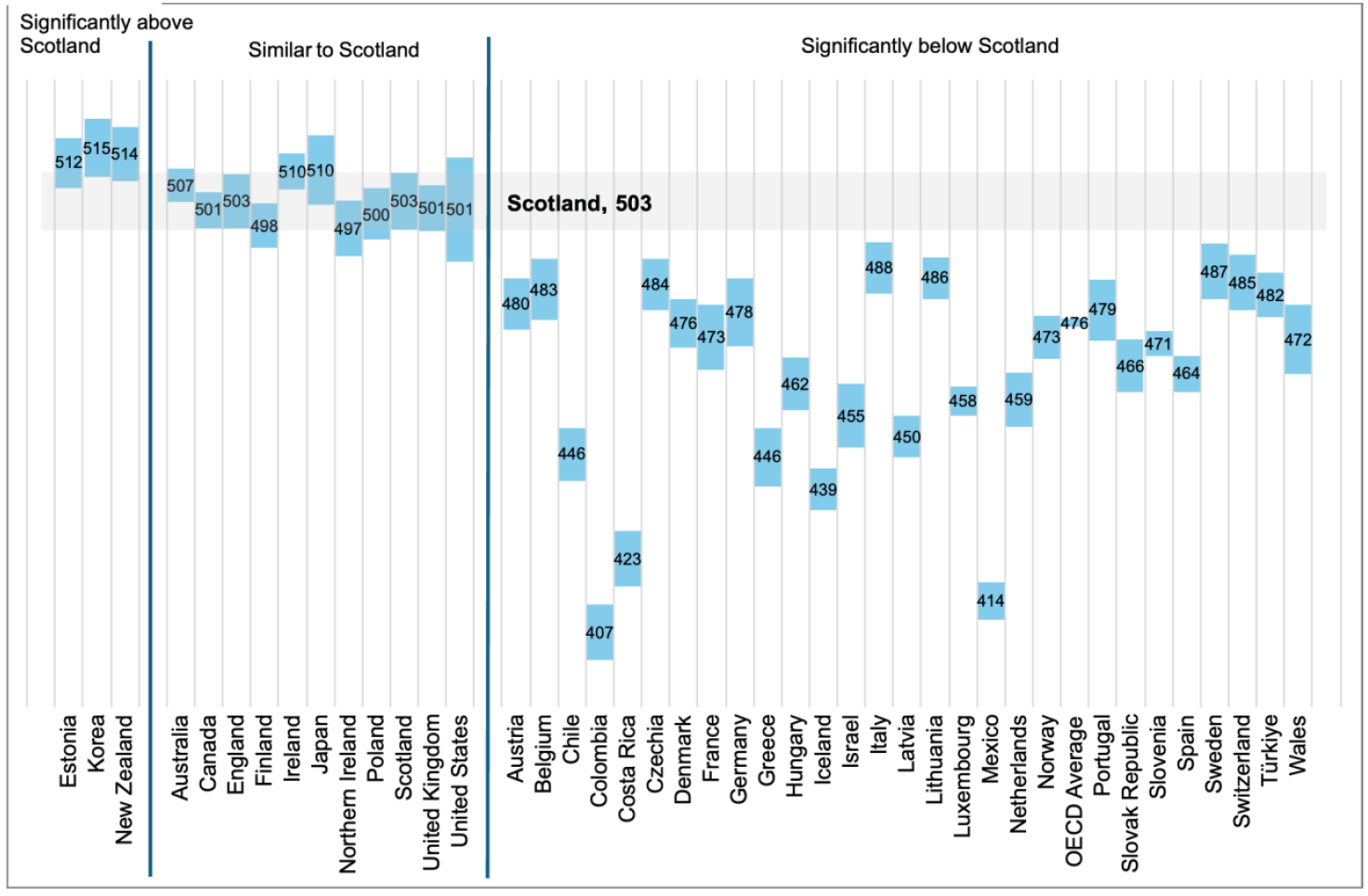
Among girls, Scotland achieved a mean reading score of 503 points, which was significantly higher than the OECD average for girls (476 points). Scotland’s performance among girls was significantly lower than three countries, New Zealand, Korea and Estonia; statistically similar to nine countries and UK administrations, including Japan, Ireland, and Australia; and significantly higher than 28 countries and UK administrations, including Italy, Sweden and Switzerland
Among boys, Scotland achieved a mean reading score of 473 points, which was significantly higher than the OECD average for boys (446 points). Scotland’s performance among boys was significantly lower than five countries and UK administrations, including Estonia, Ireland and Japan; statistically similar to six countries and UK administrations, including Australia and Poland; and significantly higher than 29 countries and UK administrations, including Finland, Germany and Denmark.
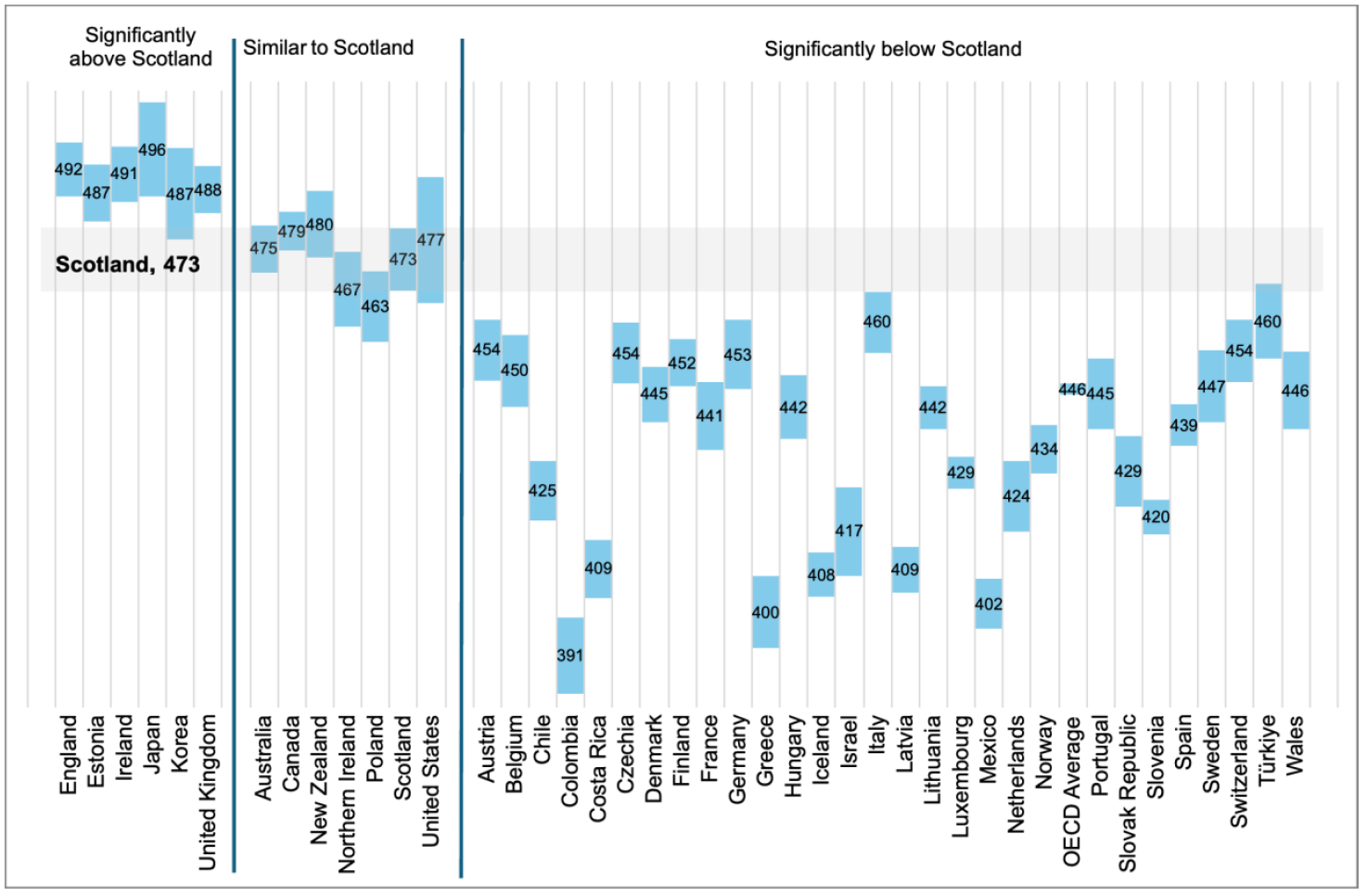
Overall, Scotland’s relative international position was stronger among girls than among boys. Fewer countries significantly outperformed Scotland among girls than among boys. Nevertheless, both girls and boys performed significantly above the OECD average for their respective groups and outperformed the majority of participating OECD countries and economies. Scotland’s international standing in reading therefore remained comparatively strong for both sexes and particularly for girls.
6.7 Reading performance by proficiency level
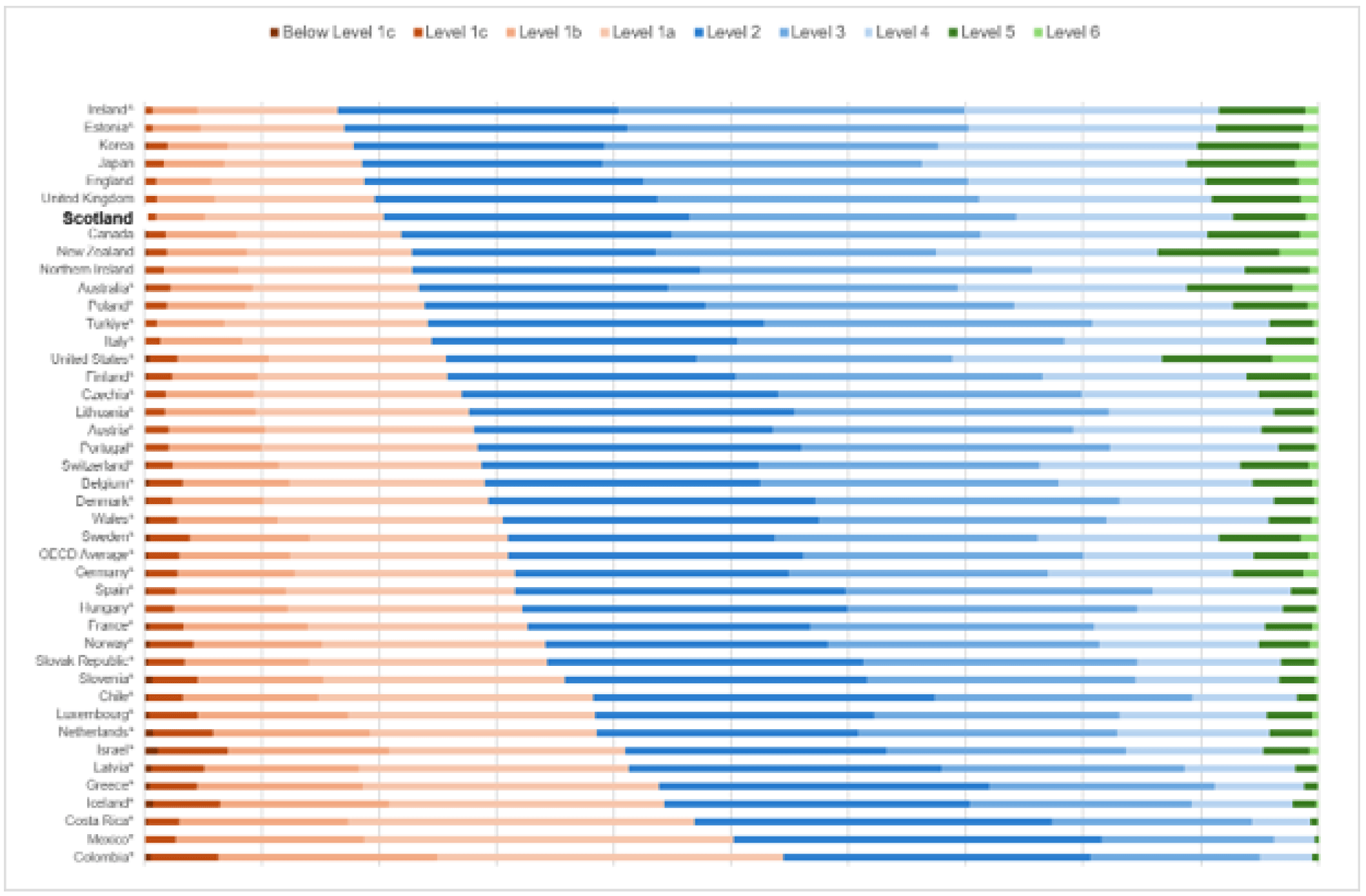
PISA reports performance using a series of proficiency levels that describe the types of reading tasks pupils can typically complete. Pupils performing at Level 2 or above are considered to have achieved the baseline level of reading proficiency required to participate effectively in society. Pupils performing below Level 2 are more likely to experience difficulties locating, understanding and evaluating information in written texts.
Figure 6.7 shows the distribution of Scottish pupils across reading proficiency levels between 2006 and 2025. The proportion of pupils performing below Level 2 was higher in 2025 than in several earlier assessment cycles. In 2006 16.6% of Scottish pupils performed below Level 2 (5.2% below Level 1a and 11.5% at Level 1a). By 2025, this had risen to 20.4% (5.1% below Level 1a and 15.2% at Level 1a). The proportion below the baseline level of reading proficiency was at its lowest in 2012 (12.5%) before increasing in subsequent cycles. The proportion below Level 2 was not significantly different from 2022, 2015 or 2006, but was significantly higher than in 2009, 2012 and 2018.
At the highest proficiency levels, 7.3% of pupils performed at Level 5 or above in 2025. This was significantly lower than in 2018 (10.3%), but was not significantly different from 2006, 2009, 2012, 2015 or 2022.
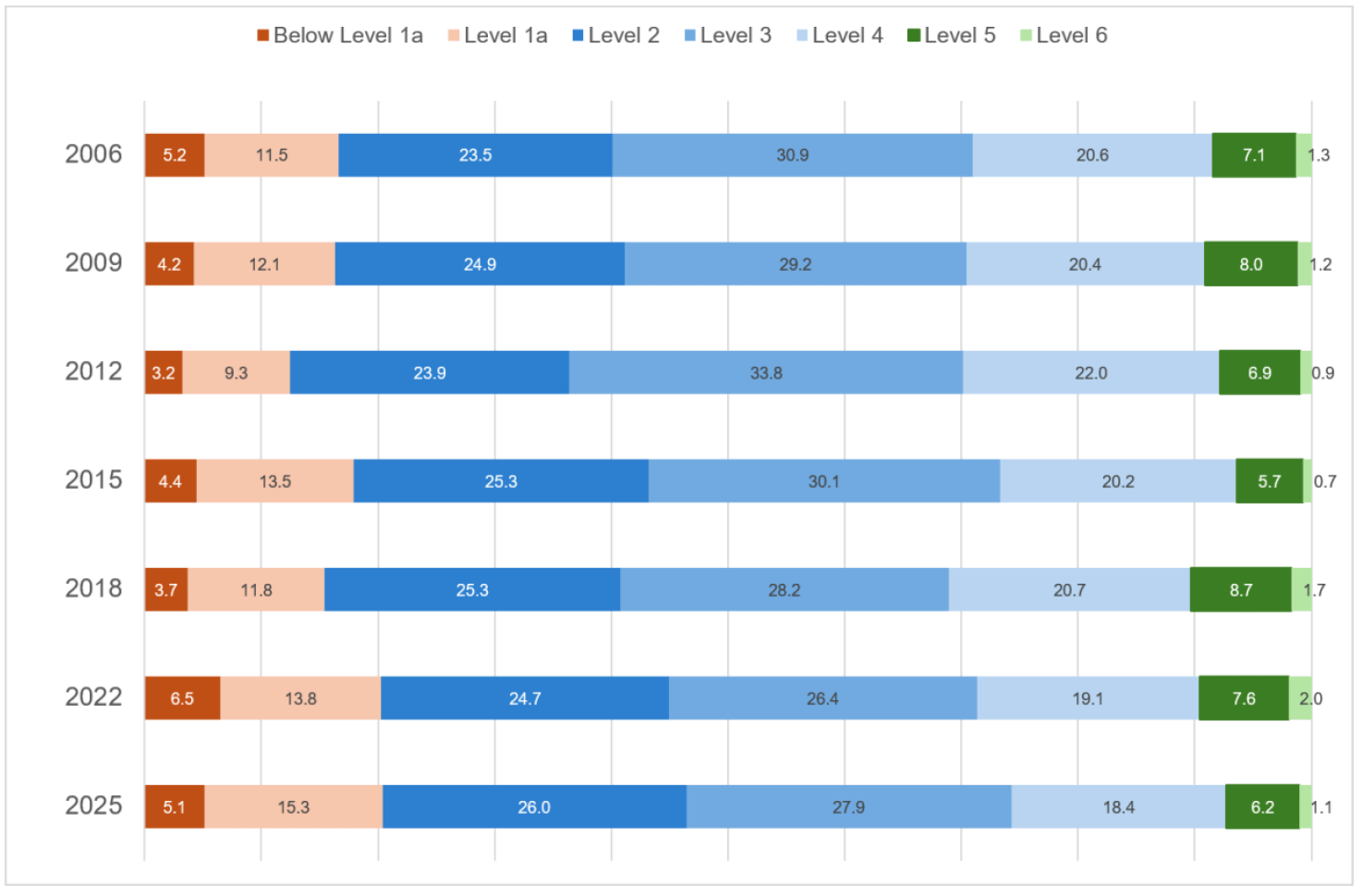
Overall, there is evidence of a shift towards lower reading proficiency in comparison with some previous assessment cycles. In 2025, the proportion of pupils performing below Level 2 was significantly higher than in 2009, 2012 and 2018, although it was not significantly different from 2006, 2015 or 2022. The proportion performing at Level 5 or above was significantly lower than in 2018, but similar to the other earlier cycles.
6.7.1 International comparison of reading by proficiency levels
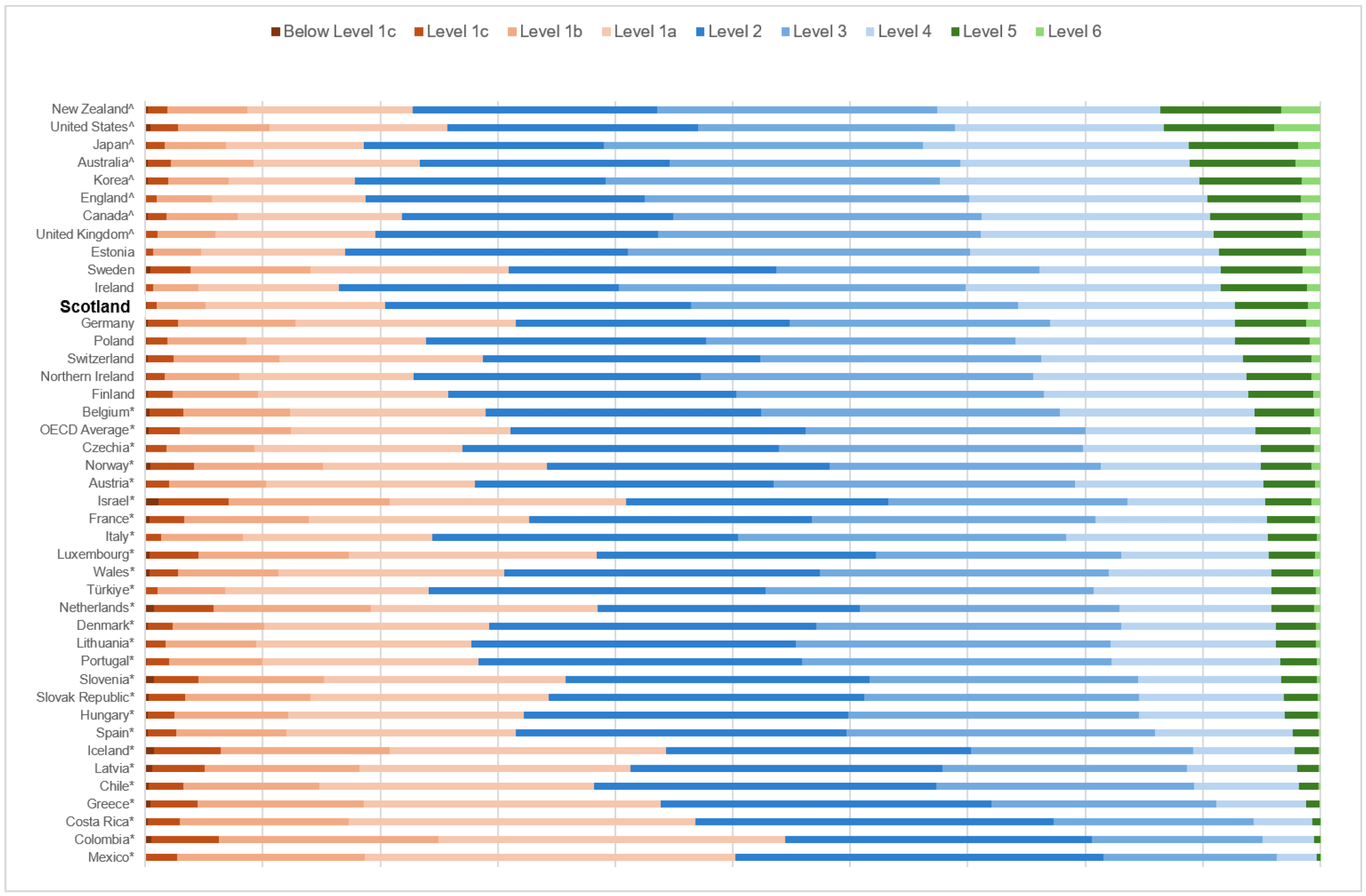
In 2025, 20.4% of pupils in Scotland performed below Level 2 in reading. This was significantly lower than the OECD average (31.0%) and Wales (30.6%). The proportion in Scotland was not significantly different from England (18.8%), Northern Ireland (22.8%) or the United Kingdom overall.
Across the other OECD countries included in the comparison, Scotland had a significantly lower proportion of pupils performing below Level 2 than 32 countries, including France, Germany and Sweden. Scotland was not significantly different from four countries: Canada, Japan, Korea and New Zealand. Only two countries, Estonia and Ireland, had a significantly lower proportion of pupils performing below Level 2 than Scotland.
At the upper end of the proficiency scale, 7.3% of pupils in Scotland performed at Level 5 or above. This was significantly higher than the OECD average and Wales (4.2%), and was not significantly different from Northern Ireland (6.3%). However, the proportion of high-performing pupils in Scotland was significantly lower than in England (9.6%) and the United Kingdom overall.
Across the other OECD countries included in the comparison, six countries had a significantly higher proportion of pupils performing at Level 5 or above than Scotland, including Australia, Japan, and Korea. Scotland was not significantly different from seven countries, including Estonia, Ireland, and Switzerland. Scotland had a significantly higher proportion of pupils performing at Level 5 or above than the remaining 24 countries.
Overall, Scotland compared favourably with the OECD average on both measures. Scotland had a significantly lower proportion of pupils performing below Level 2 and a significantly higher proportion performing at Level 5 or above. Within the UK, Scotland did not differ significantly from Northern Ireland on either measure. Compared with Wales, Scotland had a significantly lower proportion of pupils below Level 2 and a significantly higher proportion at Level 5 or above. Compared with England and the UK overall, Scotland had a similar proportion of pupils below Level 2, but a significantly lower proportion reaching Level 5 or above.
6.8 Reading performance by socio-economic background
PISA examines the relationship between pupils’ socio-economic background and reading performance using the PISA index of economic, social and cultural status (ESCS). This is based on information about pupils’ home and family circumstances, including parents’ education and occupations and resources available in the home.
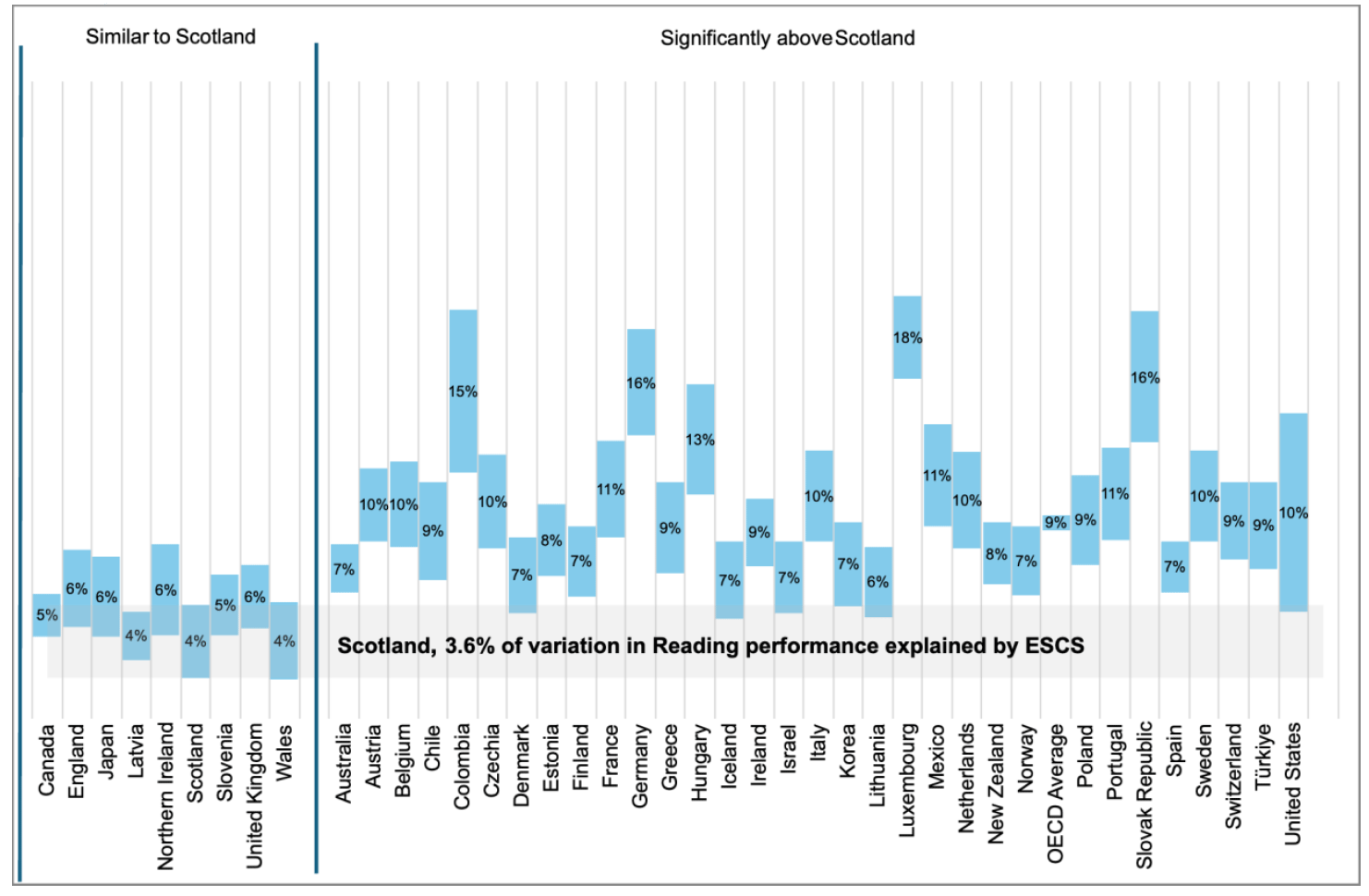
In 2025, socio-economic background explained 3.6% of the variation in reading performance between pupils in Scotland. This means that differences in pupils’ socio-economic backgrounds accounted for a relatively small proportion of the overall differences in reading scores between pupils. This was significantly lower than in every previous assessment cycle between 2006 and 2022. This indicates that socio-economic background was less strongly related to differences in pupils’ reading performance in 2025 than in previous PISA cycles.
PISA also measures the socio-economic gradient, which shows how much reading performance tends to differ as pupils move up the ESCS scale. A steeper gradient indicates a stronger relationship between socio-economic advantage and performance, while a shallower gradient indicates a weaker relationship. In practical terms, this shows how much of a difference in reading performance is associated with being more socio-economically advantaged.
In 2025, a one-point increase on the ESCS scale was associated with an average increase of 19 points in reading performance. This means that pupils who were one point higher on the ESCS scale scored, on average, 19 points higher in reading. The gradient was significantly smaller in 2025 than in every previous assessment cycle between 2006 and 2022.
Overall, pupils from more advantaged socio-economic backgrounds tended to perform better in reading in 2025. However, the relationship between socio-economic background and reading performance was significantly weaker in 2025 than in every previous PISA cycle shown, including 2022. This does not mean that socio-economic differences in reading performance have disappeared; rather, socio-economic background was less strongly associated with reading performance than in any of the previous cycles shown.
6.8.1 International comparisons of reading performance by socio-economic background
The relationship between socio-economic background and reading performance in Scotland was weaker than in most of the countries shown on both measures.
In Scotland, socio-economic background explained 3.6% of the variation in reading performance. This was significantly lower than in 32 countries, including Belgium, France and Germany; and not significantly different from seven countries, including England, Northern Ireland and Wales. No country had a significantly lower proportion of variation explained by socio-economic background than Scotland. Scotland was also not significantly different from the United Kingdom as a whole and was significantly lower than the OECD average.
Scotland’s socio-economic gradient in reading was 19 points. The gradient was significantly smaller than in 32 countries, including Australia, France and Sweden; and not significantly different from seven countries, including England, Northern Ireland and Wales. No country had a significantly smaller gradient than Scotland. Scotland’s gradient was also not significantly different from the United Kingdom as a whole and was significantly smaller than the OECD average.
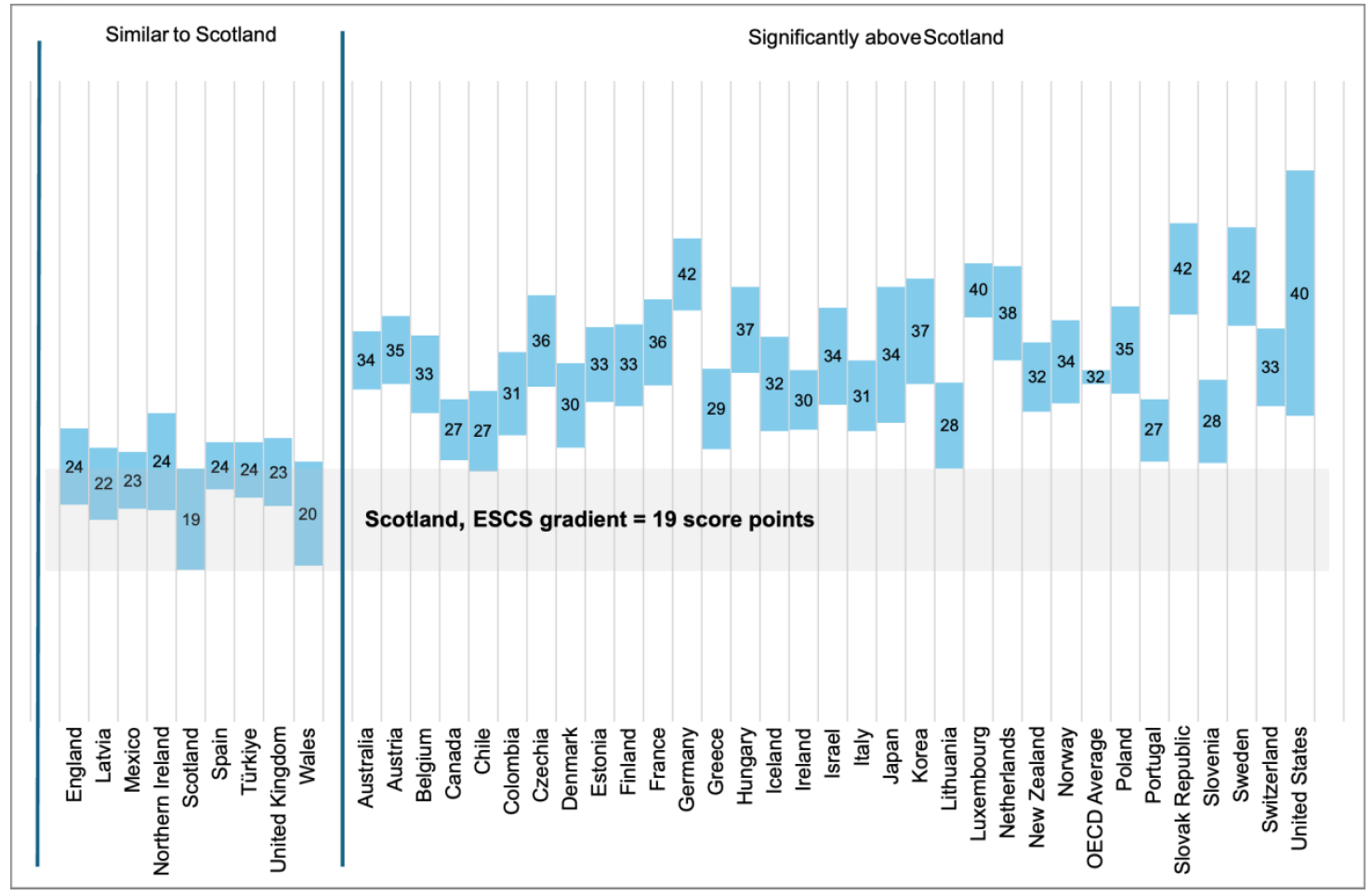
Overall, both measures indicate that socio-economic background was less strongly related to reading performance in Scotland than in most of the countries shown. However, this does not in itself show that disadvantaged pupils achieved higher reading scores; it reflects the strength of the relationship between socio-economic background and performance.
6.9 Reading performance by immigration background
PISA also examines reading performance by pupils’ immigration background. Pupils are classified as non-immigrant, second-generation immigrant (born in the UK but whose parents born elsewhere), and first-generation immigrant (born outside the country and whose parents were also born outside the country).
In 2025, non-immigrant pupils in Scotland achieved a mean reading score of 489 points. Second-generation immigrant pupils achieved a mean score of 521 points, which was significantly higher than the score for non-immigrant pupils. First-generation immigrant pupils achieved a mean score of 499 points, which was not significantly different from either non-immigrant or second-generation immigrant pupils.
The pattern over time differed between the three groups. Among non-immigrant pupils, reading performance in 2025 was significantly lower than in 2009, 2012 and 2018, but was not significantly different from 2006, 2015 or 2022.
Among second-generation immigrant pupils, performance in 2025 was not significantly different from any previous assessment cycle between 2006 and 2022.
Among first-generation immigrant pupils, performance in 2025 was significantly lower than in 2012 and 2018, but was not significantly different from 2006, 2009, 2015 or 2022.
Contact
Email: socialresearch@gov.scot