
National Islands Plan
Under an overarching population retention and attraction objective, the new National Islands Plan provides a programme of actions to address challenges and opportunities facing Scotland's islands.
Economy, Education and Skills
Our island economies are becoming increasingly diverse. Traditional sectors such as agriculture[30] and fisheries continue to account for a higher share of private businesses and local employment compared with Scotland as a whole, remaining deeply intertwined with island heritage. Alongside them, the public sector remains one of the largest employers in island areas[31]. Meanwhile, a vibrant visitor economy and fast-growing industries such as renewable energy, space and aquaculture are becoming central drivers of economic growth and inward investment.
In 2023, our islands contributed £3 billion to Scotland’s Gross Value Added (GVA)[32]. Between 2010 and 2025, both the number and share of high-growth businesses increased across all island local authorities, albeit at varying rates[33]. Our islands’ entrepreneurial spirit is reflected in the large number of small and micro enterprises that form the backbone of their business base. High levels of self-employment – partly driven by the prevalence of farmers and crofters operating their own business – are also a defining feature of island economies.
The Scottish Islands Survey 2023 recorded a strong rise in the number of respondents who agreed that business activity is growing on their island[34]. It also highlighted a clear appetite for greater support to help businesses develop and thrive.
Sustainable growth and employment opportunities are prerequisites for our overarching population retention and attraction goal. At the same time, shrinking working-age cohorts constrain growth, making it harder for businesses to recruit and for communities to find people with the right skills. For that reason, this Plan brings together economy, education and skills under a single Strategic Objective.
Our aim is to ensure that island communities have access to high-quality education, can pursue rewarding careers locally, and have the opportunity to expand their skills to meet the needs of an economy that is increasingly diverse, digital and innovative.
Case Study – Staffin Harbour (Skye)
Scottish Government investments – including over £409,000 through the Islands Programme and over £1 million via the Regeneration Capital Grant Fund (RCGF) – have enabled Staffin Community Trust to advance the development of harbour infrastructure and business premises in the north-east of Skye. This area has faced challenges such as depopulation and a lack of year-round employment opportunities. Today, community-owned Staffin Harbour supports 16 jobs and is home to nine businesses, spanning from aquaculture and boat engineering, to Gaelic youth outdoor activities and bike hire. The newly developed onshore area has become a vital asset for the island, with the recent acquisition of a telehandler enhancing boat hauling and storage services. A Harbour Facilities Building is currently under construction – once complete, it will provide retail space and washroom facilities, further strengthening the project’s contribution to community wealth building.
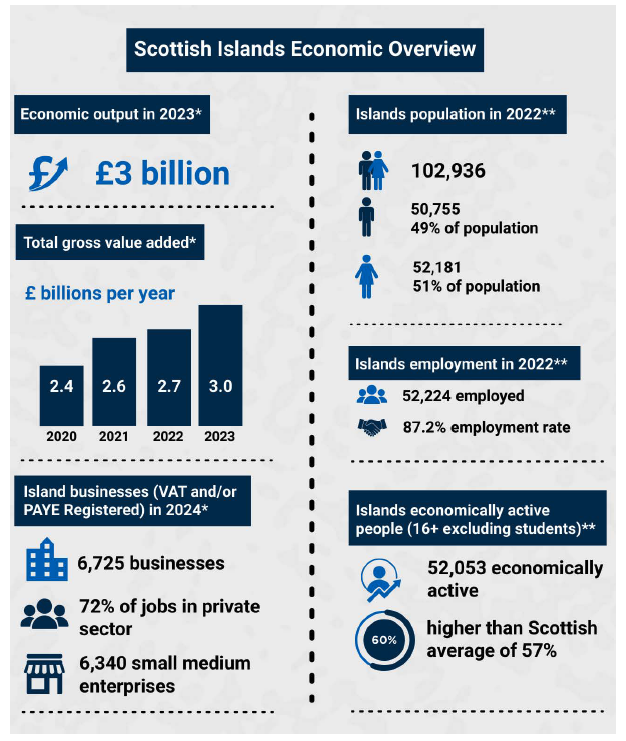
Scottish Islands Economic Overview
Economic output in 2023*
- £3 billion
Total Gross value added*
£ billions per year:
- 2020: 2.4
- 2021: 2.6
- 2022: 2.7
- 2023: 3.0
Island businesses (VAT and/or PAYE Registered) in 2024*
- 6,725 businesses
- 72% of jobs in private sector
- 6,340 small medium enterprises
Islands population in 2022**
- 102, 936
- Male: 50,755, 49% of population
- Female: 52,181, 51% of population
Islands employment in 2022**
- 52,224 employed
- 87.2% employment rate
Islands economically active people (16+ excluding students)**
- 52, 053 economically active
- higher than Scottish average of 57%
Sources[35]
Agriculture and Crofting
With more than half of Scotland’s crofts located on islands, the future of crofting is deeply intertwined with the future of our islands. Crofting is much more than food production – it preserves island culture, contributes to managing fragile landscapes and has significant potential to enhance biodiversity. In addition, a crofter’s statutory duty to be ordinarily resident within 32 kilometres of their croft is a significant contributor to population retention and attraction.
Every year, we provide over £40 million to crofting businesses through funding mechanisms such as the Crofting Agricultural Grant Scheme (CAGS), the Croft House Grant (CHG), Less Favoured Area Support Scheme, Basic Payment Scheme and Farm Advisory Service[36]. Between 2015 and January 2026, over £21 million in CAGS funding has been awarded to 3,990 island croft businesses. Since 2007, £20.7 million in CHG funding has been awarded to 926 island recipients to support the development or improvement of croft homes.
Effective succession planning is key to building a robust future for crofting. The Scottish Land Matching Service (SLMS) facilitates connections between landowners without a successor, those looking to wind down, new entrants and those seeking to expand. Since 2023, through a collaboration with the Crofting Commission, the SLMS has featured a dedicated crofting resource.
Every year, there are over 500 new entrants to crofting. In the year between October 2023 and 2024, for instance, 560 new entrants were recorded. Of these, 287 were island-based. The Crofting Commission has also focussed on its duties enforcement, prioritising the residency duty, which will support island population retention. While this is welcome progress, we know additional efforts are required.
We will support a campaign across island parishes to provide information on croft succession planning, gather views on key areas of concern for crofters and highlight the work of the Scottish Land Matching Service.
There are around 1,000 common grazings across Scotland, 689 of which are located on islands. Of these, however, 314 only had a committee in office as of January 2026.
At the time of publication, the Crofting and Scottish Land Court Bill is making its way through the Scottish Parliament. Among other provisions, it aims to strengthen the role of grazing committees and encourage crofters and their communities to have a greater say over how common grazing land is used. This Plan shares the ambition of maximising the potential of common grazings, including for biodiversity restoration and climate action.
We will develop new training resources for island crofters to support active management of common grazings and encourage the establishment of new grazings committees.
We recognise the important role that crofting and small producers can play in improving access to local food, especially as communities and businesses seek to become more self-sufficient and climate-conscious. However, crofters and other producers often face significant challenges, compounded by harsher island climates. Investing in infrastructure such as polytunnels and hybrid greenhouses supports year-round, climate-resilient production and strengthens the productivity of crofting and small-scale agriculture.
Focusing on horticulture, we will establish and support a network of island food producers to strengthen local food resilience and retail opportunities.
Women are essential to the long-term sustainability of island agriculture. Welcoming new entrants and expanding the skills of those already working in the sector is critical to building business resilience and inclusivity.
Building on progress made to date, this Plan will take targeted action to tackle the structural and practical barriers faced by women and girls in island agriculture and crofting, ensuring they have equal opportunity to lead, participate and thrive.
We will support new training opportunities co-designed with island women who are interested in pursuing a career in agriculture and deliver enhanced support to encourage and empower women to become trainers in the agricultural sector on islands.
Local abattoirs play an essential role in supporting the viability of agriculture and crofting. However, small island abattoirs are under increasing pressure due to rising operational costs, a shortage of skilled workers and competition from larger mainland processors. Securing the future of island abattoirs is not just about preserving a service – it is about supporting resilient island economies, shortening food chains and enabling crofters and farmers to add value close to home.
We will provide targeted support that facilitates small producer access to abattoir services on our islands.
Marine Economy
The marine economy continues to provide significant opportunities for employment and economic growth among island communities, both directly and by supporting a range of other local industries and supply chains. In 2023, for example, the marine sector accounted for 16% of Shetland’s approximate Gross Value Added (aGVA) with fishing alone contributing over £88 million[37].
Our Blue Economy Vision for Scotland (2022) sets out the Scottish Government’s long-term ambition of ensuring a sustainable use of marine assets that helps us tackle the twin crises of climate change and biodiversity loss while continuing to create prosperity, jobs and wellbeing. Since 2021, our Marine Fund Scotland has awarded £5.8 million to 63 island-based projects that align with that ambition.
A new National Marine Plan (NMP2) is currently under development. It will provide an updated planning framework to further sustainable development in Scotland’s seas and reduce conflict arising from increased competition over marine space and resources. Our islands are vital to the fisheries sector in Scotland, which in 2023 recorded £652 million in landings and supported over 7,000 jobs in fishing and processing[38]. Over a third of all Scottish vessels were registered in island districts as of December 2024[39].
Certain inshore fisheries in Shetland (out to six nautical miles) are managed by the Shetland Shellfish Management Organisation under the Shetland Islands Regulated Fishery (Scotland) Order 2012. The Order enables application of local restrictions over and above the UK vessel licensing scheme.
In 2023-24, we carried out a public consultation to seek views on how the Scottish Government should allocate the portion of sea fish quota known as Additional Quota. Reflecting on its results, we have committed to exploring in greater detail how communities’ role in managing Additional Quota could be strengthened, delivering greater benefits close to where fishing activity happens. This is not a simple process and requires careful consideration as to the implications – including of a legal nature – of delegating management responsibilities. However, we recognise communities’ aspirations and fully understand the community wealth building potential of diversifying Additional Quota allocations.
We will undertake a feasibility study to inform discussions on increasing communities’ role in directly managing quota stocks, including options to run a pilot project in an island area.
In 2023, the aquaculture sector contributed £468 million to Scotland’s GVA[40], with our islands playing a significant role in the success of these industries. The overall value of Atlantic salmon farmed in Na h-Eileanan Siar, Orkney and Shetland was worth over £723 million in 2024, well over half of Scotland’s total[41]. In addition, in 2024 Shetland produced 87.5% of Scotland’s mussels for a value of over £10.7 million[42].
There is substantial potential to grow the sector further in a way that is sustainable and roots opportunities locally on our islands. An efficient, transparent and well-resourced consenting scheme is key to unlocking additional investments. In 2024-25, we piloted a new pre-application process in four sites within the Shetland Islands Council and Highland Council areas. Pilots focused on ensuring that constraints and opportunities are identified at an early stage in the consenting process, with a view to increasing confidence among both developers and local communities. An independent evaluation was published in July 2025 and work is now underway to address its recommendations, widening testing of the pilot process in other local authority areas.
We are also working to clarify the consenting process for aquaculture developments between 3-12 nautical miles, keeping pace with technological innovations that enable operations further offshore and recognising the potential growth opportunities for island and marine economies.
Following the introduction of planning controls supporting local democracy and decisions in relation to aquaculture developments between 3-12 nautical miles, a public consultation on the regulation of fish farm deposits between 3-12 nautical miles ran from September – December 2025. Our response to the consultation was published in February 2026 and we are now working to enact proposals to identify SEPA as the responsible regulator for fish farm discharges between 3-12 nautical miles, and clarify the application of existing exemptions on marine licence requirements for fish and shellfish farms.
We will work with public and private sector partners to ensure an efficient approach towards the fish farm consenting processes, remove duplication and enable a pathway for aquaculture development from 3 to 12 nautical miles.
We will engage with island communities, local authorities and businesses to inform the development of good practice principles for community benefits for aquaculture developments.
Tourism, Events and Hospitality
Our islands are a core part of Scotland’s tourism offer and international appeal. Visitor spend helps to grow local economies, create jobs and enhance the cultural vibrancy of our island communities. In 2024, there were over 260,000 overnight stays in Orkney and Shetland alone, with a total visitor spend of over £128 million[43].
Together with VisitScotland and HIE, we are working with island businesses and communities to pursue further opportunities for growth, in a way that is sustainable and attuned to local circumstances and capacity. From July 2024 to June 2025 , we have provided more than £3.7 million in support of tourism initiatives on islands, primarily through place-based programmes managed by HIE.
The Rural Tourism Infrastructure Fund has provided £8 million in support of 48 island-based projects since 2018, helping to leverage £7.2 million in extra funding. In addition, £1.5 million has been invested to support 55 events across islands since 2019, including the Shetland Tall Ships Races in 2023, the Orkney Island Games in 2025 and recurring events such as the Tiree Music Festival and HebCelt.
We know that each island destination faces unique opportunities and challenges relating to connectivity, accommodation pressures and environmental concerns. It is vital that island communities have the capacity, skills and infrastructure to maximise the benefits of tourism and drive sustainable growth.
We will deliver tailored training programmes to grow skills and build capacity for island communities to steward sustainable tourism in ways that reflect their values and ensure that the economic, social and environmental benefits are retained locally.
Scottish island ports are among the most popular cruise ship destinations in the UK, with Orkney and Shetland welcoming over 213,000[44] and 138,000[45] passengers in 2024 respectively. A consultation on the potential introduction of a Cruise Ship Levy closed earlier this year. As part of this, we invited feedback on a Point of Entry Levy – an alternative approach proposed by islanders. Engagement with island communities will continue to be central as we consider next steps.
Investment
Our islands hold vast potential for economic investment. The Regional Transformational Opportunities in the Highlands and Islands report (2025) identified several clusters of high-growth opportunity in island areas, from Shetland to Islay. If fully realised, these opportunities could generate up to £32.5 billion in investments and more than 30,000 additional jobs in Orkney, Shetland and Na h-Eileanan Siar alone, with further growth expected on other islands. While these figures are based on modelling assumptions, they demonstrate the scale of opportunity if the right conditions are in place.
The Scottish Government is working with councils, development agencies and other local partners to attract investment into island areas. Our Infrastructure Investment Strategy 2027-2037 sets out the strategic direction for public investment over the next decade, including targets to increase investment in priority infrastructure across Scotland. This will include work with Shetland Islands Council, Orkney Islands Council and Comhairle nan Eilean Siar to agree a mixed‑model funding package for social and economic infrastructure. We expect this Accelerator Model to unlock hundreds of millions of pounds of investment across the three areas, supporting projects aligned with local priorities and the ambitions of this National Islands Plan.
While public funding plays an important role in delivering infrastructure and services among our island communities, it alone cannot deliver our economic ambitions. Attracting and leveraging private investment, including global capital, is crucial.
We are committed to a balanced and inclusive approach that supports economic development, and delivers lasting outcomes for island communities. Achieving this depends on parallel progress in housing, childcare, transport and skills, so that communities have the capacity and connectivity needed to seize new opportunities.
Working with public and private partners, we will incorporate investment opportunities from across the islands into our national project pipeline and showcase “investment ready” projects through the Invest Scotland online portal. We will also explore opportunities to bundle projects together to attract private investment on islands.
The devolution of Crown Estate assets has created an opportunity to increase investments in our islands. With their vast coastlines and rich marine resources, islands are among the largest beneficiaries of net revenues from Scottish Crown Estate marine assets out to 12 nautical miles. These are allocated to councils to support projects that benefit communities in their areas. In 2024-25 alone, contributions to island local authorities totalled over £9.8 million, up from £8.9 million in 2023-24[46].
Regional Growth Deals
Since the publication of the first National Islands Plan, the Ayrshire Growth Deal (2020), the Islands Growth Deal (2023) and the Argyll and Bute Rural Growth Deal (2025) have been signed and entered delivery. Each Growth Deal has been developed with regional stakeholders to drive sustainable economic growth based on local priorities. Over the lifetime of the Deals, the Scottish Government will invest a combined total of over £67 million in island-based projects. In the coming years, notable milestones will include the opening of the flagship visitor centre at Calanais, the renovation of Rothesay Pavilion, new housing for workers on Mull, the development of the Dales Voe ultra-deep water port and a marine tourism investment programme for both Arran and Cumbrae.
In addition, net revenues deliver direct benefits to community organisations. Crown Estate Scotland’s (CES) Sustainable Communities Fund supports local regeneration and sustainable development across the Scottish Crown Estate. Since 2020, the Fund has awarded over £564,000 in grants to 20 island-based projects.
The marine assets managed by CES underpin some of our most important island industries. CES’s offshore wind option agreements include requirements to produce and update Supply Chain Development Statements to understand projects’ ambitions and commitments to the Scottish supply chain. Through these actions and future initiatives, we can ensure islands continue to play a central role in Scotland’s renewable and marine sectors, with lasting benefits for local communities.
We will explore opportunities to improve how net revenues from the Scottish Crown Estate support community infrastructure on islands.
Crown Estate Scotland will engage offshore wind developers on their commitments to island supply chains and consider opportunities to invest in island ports.
Childcare
Improving the provision of childcare can have a particularly significant impact on our islands’ economic performance and resilience. It contributes to population retention and attraction, supports parents – and especially women – into employment and training, and improves families’ wellbeing. Access to reliable childcare is especially vital on islands, where many people balance multiple economic and social roles.
The Scottish Islands Survey 2023 highlighted challenges in accessing childcare across island areas. Only one third of respondents agreed that early learning and childcare services met their working needs, and almost two in five said they were unable to access a registered childminder.
Since 2021, the Scottish Government has provided nearly £1 billion per year to Local Authorities across Scotland to offer 1140 hours of free Early Learning and Childcare (ELC) to all eligible children. Scotland is the only part of the UK that already offers 30 hours per week in term time of funded ELC to all three- and four-year-olds and around a quarter of two-year-olds regardless of whether their parents are working or not.
We appreciate, however, that the 1140 support is only available to those who can access a registered childcare provider on their island.
In our School Age Childcare Delivery Framework (2023), we committed to developing and testing solutions that support the sustainability of essential school age childcare services within rural and island communities. The 2025-26 Programme for Government included a commitment to expanding childcare provision further, particularly for families most at risk of living in poverty. In line with these commitments, our Early Adopter Communities project is working with partners in Shetland to create reliable year-round school age childcare options – including breakfast clubs, after school provision and holiday activities. The project includes efforts to bring existing activities together through improved transport links and is exploring new recruitment methods to attract and retain staff in combined early years and school age childcare roles. The learning is giving us greater insight into what is required to establish and sustain childcare services in island areas, linked to demand.
Through a joint initiative with the Scottish Football Association, the Extra Time Programme supports football clubs and trusts across Scotland to deliver free wraparound activity sessions during the school day and full-day holiday clubs, targeted at primary school children from low-income families. We have committed to working with island local authorities to understand how we deliver ‘Extra Time’ services in a way that is relevant and effective for their communities, particularly where there may not be an established football club in the area.
Backed by £1.6 million in 2025-26, a programme of childminder recruitment and retention is now underway in partnership with the Scottish Childminding Association. It covers 28 local authority areas including Argyll and Bute, Highland, Orkney and Shetland. The programme offers a £750 start-up grant to new childminding businesses as well as practical support to facilitate the retention of existing workforce, with the latter strand open to all the above local authorities as well as Comhairle nan Eilean Siar.
We will convene a roundtable with key partners to utilise evidence gathered by Highlands and Islands Enterprise on the challenges and potential solutions to delivering childcare services in island and rural communities. This will seek to agree practical recommendations for action that will be taken forward through key strategic groups such as the Convention of the Highlands and Islands, and the Islands Strategic Group.
In 2026, we will launch a consultation and introduce the necessary legislative changes to create a new definition for School Age Childcare within the regulatory framework. This would enable a review of workforce qualifications, supporting services to attract a more diverse workforce to address recruitment and retention challenge in island areas.
Education
Demographic shifts are reshaping the school-age cohort. As noted earlier in this Plan, all island local authorities face a downward trend in pupil numbers. While several communities record healthy – sometimes increasing – rolls, there are many others who are concerned for the future of their local schools.
The sustainability of primary and secondary education in island communities is also fundamentally dependent on the ability to recruit and retain teachers. While recruitment challenges exist across Scotland, these are often amplified in island settings, leading to long-term vacancies, repeated advertising cycles and reliance on temporary solutions.
We have developed a range of initiatives to encourage candidates to take up posts in rural and island areas. These include the Preference Waiver Payment, which offers £6,000 for primary and £8,000 for secondary probationary teachers in exchange for flexibility in placement location. In addition, teachers can be eligible for both the Remote Schools Allowance (up to £3,819 annually) and the Distant Islands Allowance (£2,859 annually).
This Plan will sustain efforts to strengthen longer-term teacher workforce planning to deliver place-based solutions that secure the future of education on our islands.
Through the Education and Childcare Assurance Board, we will work in partnership with COSLA to build considerations of our islands educational context into a wider workforce strategy.
As part of a review of the Teacher Induction Scheme, we will consider additional measures and changes to encourage more graduate teachers to undertake probation in island locations.
On many islands, schools serve not only as centres of learning but also as community anchors, providing extracurricular activities, hosting events and creating a sense of place that is critical to community cohesion. While school management remains a local authority responsibility, the Scottish Government continues to have a presumption against the closure of rural schools, many of which are also island schools.
Our Learning Estate Investment Programme (LEIP) supports our ambition to provide essential school infrastructure to our island communities. As part of our £2 billion investment through LEIP, we have committed to delivering projects in Shetland, Orkney, Mull and Skye in collaboration with relevant local authorities.
In addition, our 2025-26 Programme for Government underlined our continued commitment to progressing work on the Barra and Vatersay Community Campus.
Through the Learning Estate Investment Programme, school infrastructure projects will be delivered in Brae, Broadford, Kirkwall and Mull before the end of 2029. Working with COSLA, local authorities and Scottish Futures Trust we will explore how we can deliver further improvements in the school estate across island areas.
Schools also serve as crucial links between education and employment. The Scottish Government-funded Developing the Young Workforce (DYW) Employer Network is very active on islands, supporting young islanders in secondary schools to engage with local employers and learn about local career opportunities. Via DYW, for instance, Shetland Islands Council and NHS Shetland recently engaged with Anderson High School pupils to showcase careers in the health and social care sectors.
Of course, education does not end with secondary schools. Further and higher education institutions such as the University of the Highlands and Islands (UHI), Robert Gordon University and Heriot-Watt University all maintain a physical presence on our islands, with their campuses anchoring high-value jobs locally and attracting students and staff into communities.
Through a combination of Islands Growth Deal (£1.5 million) and Islands Programme funding, we have invested £1.75 million into a new Technology and Innovation Centre at UHI’s North, West, and Hebrides’ Stornoway campus. Support has also enabled the provision of a range of mobile equipment that can be transported to other venues across Na h-Eileanan Siar.
Led by UHI and working with Robert Gordon University and Heriot-Watt University, the TalEntEd Islands programme is supported by £4.4 million of Scottish Government funding to unlock economic opportunities, foster net zero skills and drive innovation in Orkney, Shetland and Na h-Eileanan Siar.
Together with universities and colleges across the wider sector, these institutions are equipping islands with the skills and talent needed to harness opportunities for sustainable development and community wealth building.
We will pilot an island scholarship scheme for postgraduate students to address skills shortages in locally-identified priority sectors.
We will work with further and higher education institutions to attract international students and staff to our islands, including through the joint implementation of the Destination Scotland campaign, and to ensure that delivery of our International Education Strategy fully reflects the opportunities within island communities.
Skills and Workforce
Accessible opportunities for adults to retrain, upskill, or pursue vocational and professional development are essential to help island communities remain adaptable and competitive. As we transition to a low-carbon economy and seek to harness the unique potential of our islands, the development and attraction of a skilled workforce will be a defining factor in our success.
Working with Skills Development Scotland (SDS), we continue to make a broad range of support and the Scottish Funding Council (SFC) available to all islands via initiatives such as the Careers Information, Advice and Guidance (CIAG) service, apprenticeship programmes, and redundancy support.
With the forecast reduction in the number of people of working age impacting the availability of labour across island areas, workforce planning and attraction initiatives will be vital to complement efforts to retain population. Workforce North is a collaborative effort that brings together regional partners – including SDS, HIE, and UHI – to align skills planning with the social and economic priorities of the Highlands and Islands. Support is tailored to meet the specific needs of each local authority and deliver workforce strategies that address issues such as limited access to training and the impact of seasonal employment.
A coordinated approach between the public, private and education sectors is needed to address future workforce demand, design skill-development programmes, and amplify national and local campaigns that promote career opportunities on islands.
We will work with island local authorities to convene localised workforce engagements that bring together employers, investors and public agencies to agree actions that address local skills shortages. This could include proposals for shared public-private investments, including through the Workforce North initiative.
The end of free movement following the UK’s exit from the European Union has had significant impacts on our islands, with labour shortages affecting both the private and public sectors. While immigration powers are reserved to the UK Government, we have developed tangible reform proposals to address Scotland’s specific population and skills needs. These include the proposed Rural Visa Pilot, designed to offer targeted migration solutions for rural and island areas experiencing acute skills shortages in key sectors.
In 2024, we launched Scotland’s Migration Service, providing free, impartial advice to help people better understand and use the existing immigration system. The service supports migrants and assists employers seeking to recruit and retain an international workforce. It is also available to inward investors establishing or expanding businesses in Scotland. Free one-to-one advice sessions with immigration lawyers are available for those who would benefit from personalised support.
We will work with partners to promote Scotland’s Migration Service to island employers and investors, highlighting its support for those who wish to undertake international recruitment and retention activities.
Contact
Email: info@islandsteam.scot