
International strategy: annual report 2024 to 2025
Annual report on delivery of Scotland’s International Strategy, highlighting progress made during the 2024 to 2025 reporting year.
Scotland in a changing world
The Global Affairs Framework published in May 2022 set out a series of principles, vision and values for Scotland’s international engagement, which underpins Scotland’s International Strategy and has been built on by work since. In addition to the climate crisis and climate justice, addressed in chapter 2 of this report, and Scotland’s culture, addressed in chapter 3, these include:
- our relationship with the European Union
- gender equality
- respect for human rights and the rule of law
- our international network
This chapter also discusses our wider international engagement on key global issues in a time of geopolitical uncertainty and change.
European Union
Scotland remains a friend and active partner to the European Union, united by shared interests, values and ambition. The geopolitical context has become increasingly complex in recent years, with Russia’s full-scale invasion of Ukraine, events in the Middle East, the climate crisis, and challenges around global trade, energy and cost of living. In this context the Scottish Government considers that working closely with the EU – and indeed returning to EU membership in future – is the right choice for Scotland.
Our engagement with the EU takes place at all levels, and spans a wide range of policy areas, including education, culture, energy, marine affairs, the environment, inclusive growth, research and innovation and trade. In July this year, the First Minister met with Commission President Ursula von der Leyen in Scotland to discuss a range of areas of shared interest.
The International Strategy makes clear that we are committed to maintaining and strengthening our ties with the European Union and our European neighbours, and it set out a number of areas of priority for the development of the Trade and Cooperation Agreement (TCA) which we committed to pursue with the UK Government. We welcome improvements to the UK/EU relationship, and we set out the priorities of the Scottish Government in a series of papers which sought to influence the EU-UK Leaders’ Summit in May 202545.
We will continue to argue for deepening cooperation with the EU as negotiations on a series of areas continue in the coming months, and we welcome progress on areas like an Agriculture, Food and Drink (‘SPS’) Agreement, linking emissions trading schemes, rejoining the Erasmus+ programme and developing a UK-EU Youth Mobility scheme – improvements which will be important to Scotland. However, we also note that the UK Government is maintaining its ‘red lines’ around not rejoining the EU Customs Union, Single Market or EU Free Movement.
Indeed, the UK Government’s red lines in the negotiations mean that the scope of a future deal, and its benefits, will be unnecessarily limited. The UK Government’s own figures show that a deal will add £9 billion to UK national income by 2040, just 0.2% of GDP. The loss to GDP caused by Brexit is estimated to be 20 times that: according to the Office for Budgetary Responsibility, 4% of GDP.
Spotlight: Scotland House Brussels
Scotland House Brussels is situated in the heart of the European Quarter in Brussels and is the centre of Scotland’s engagement with the EU (and Belgium) and a convenor of relationships between Scottish, European and international partners.
2024-25 was characterised by significant political change in Europe. This period saw European Parliament and Belgian federal elections, the formation of a new College of European Commissioners and 2024-2029 European Commission guidelines that will set Europe’s political direction in the years to come.
The Scotland House Brussels team (made up of Scottish Government and Scotland Europa team members) have been uniquely placed in 2024-25 to leverage our longstanding diplomatic relationships and policy expertise to follow this and support Ministers, including support of domestic policy priorities, in particular growing the economy and tackling the climate emergency. The team also helps maximise opportunities for trade and investment, as well as long term opportunities for businesses, civil society organisations and people in Scotland.
Economy, trade and investment
In parallel to profiling Scotland’s research and innovation expertise, we have worked to amplify and promote Scotland as a hub for research, innovation, partnership and investment. The overall aim in 2024-25 has been to boost Scotland’s engagement following Horizon association, support the delivery of the Scottish Government’s Innovation Strategy and Scottish Enterprise’s Scaling Innovation Mission, as well as demonstrate our added value to Framework Programme. This work has continued throughout this business year, hosting four online sessions and working with research leads to develop one of the first position papers on FP10.
More broadly, Scotland Europa launched a series of Horizon Europe Ecosystem sessions, hosting five in-person meetings in different cities in Scotland, aiming to facilitate engagement across a range of stakeholders and maximise opportunities under Horizon Europe.
Scotland House Brussels have promoted this messaging via targeted, strategic engagement with contacts in Brussels, as well as in Scotland. Within the scope of this work, colleagues from Universities Scotland visited Brussels to follow a Scottish Government coordinated high-level visit programme on the opportunities offered by Horizon Europe.
We have maintained our strong presence in key networks, such as European Regions Research and Innovation Network (ERRIN),46 hosting their Annual General Meeting in June 2024. Our teams have further strengthened ties with Brussels-based university liaison offices and other Research and Innovation (R&I) stakeholders.
A core strand of our work is to profile Scotland’s trade and economic development priorities. Against an evolving economic landscape, brought about by political change in the past business year, this has involved more strategic collaborative work with colleagues in Scotland and abroad (SG, SE and SDI). We have worked together on issues such as engaging with FP10 with a view to maximise funding for our strategic R&I sectors and clusters. We have also worked with SDI particularly on the issue of the EU’s Carbon Border Adjustment Mechanism (CBAM), hosting several online sessions for businesses to understand the potential implications of CBAM vis-à-vis trade and access to EU markets, alongside our work to influence the UK/EU negotiations to minimise the impact of EU CBAM on Scotland, which is ongoing.
Our events in 2024-25 focused on promoting key Scottish industries, including a reception profiling Scotland’s food and drink export markets and a financial services roundtable. Cabinet Secretary for Rural Affairs, Land Reform and Islands Mairi Gougeon hosted the former as part of her October 2024 visit to Brussels, alongside the Chief Executive of Scotland Food & Drink. Our financial services roundtable brought together Scottish and EU-based experts, industry and EU institutional representatives. The roundtable was complemented by a whisky tasting event, where we highlighted Scotland’s financial services offer to an audience of EU27 representatives, including speech by Scottish Financial Enterprise Chief Executive, Sandy Begbie.
Climate change, biodiversity and renewable energy
Scotland House Brussels’ continued focus on climate change, biodiversity and energy seeks to showcase Scotland’s high ambition and expertise on net zero and advance the associated economic and just transition opportunities, including Scotland’s vast potential in offshore wind production and as a green hydrogen exporter to Europe.
This focus was reflected in the 2024-25 programme of Ministerial visits to Brussels. Cabinet Secretary for Rural Affairs, Land Reform and Islands Mairi Gougeon joined us in October 2024 to host a reception in Brussels promoting Scotland’s food and drink sectors, alongside a series of meetings with industry partners and the European Commission. Scotland House Brussels hosted Minister for Climate Action Dr Alasdair Allan for a programme of engagements during EU Hydrogen Week in November (see International Network Case Study 6), followed by Cabinet Secretary for Constitution, External Affairs and Culture Angus Robertson’s visit in February which partially focused on promoting our renewable energy potential, including a meeting with the EU’s Clean Hydrogen Partnership.
Scotland House Brussels has continued to promote Scotland’s expertise in net zero and renewable energy, working to maximise opportunities for Scotland. A key deliverable of this work was our presence at Hyvolution 2024 in Paris, which was an ideal opportunity to showcase Scottish expertise and connect with potential partners and customers across Europe. A delegation from Scottish Enterprise, SDI and over 10 Scottish hydrogen companies attended the tradeshow, showcasing the full spectrum of the Scottish hydrogen supply chain. The delegation held various bilateral meetings, including with delegations from Pays de la Loire and Occitanie. A Memorandum of Understanding was signed between Scottish Hydrogen and Fuel Cell Association (SHFCA) and France Hydrogène, as well as an event hosted between Scotland and Brittany to celebrate their previously signed Memorandum of Understanding in 2023.
2024-25 also saw Scottish Government publish a series of position papers on our priorities ahead of negotiations EU–UK Trade and Cooperation Agreement in 2025-26. These have included papers on SG’s support for closer energy and climate cooperation47 and for a comprehensive EU-UK veterinary and sanitary and phytosanitary agreement.48
Reputation, influence and relationships
Scotland enjoys a strong reputation in Brussels, bolstered by its consistent policy positions, strong European values and well-respected culture offer. Scotland House uses its presence at the heart of the European district to promote Scotland’s aims and develop strong and enduring partnerships with EU institutions and others in Brussels.
Scotland House Brussels has strong relationships with senior contacts in the Commission, European Parliament and Member States. For example, the European Parliament Friends of Scotland Group has 23 MEPs who take an active interest in Scotland. Scotland Europa produced a strategic policy communications campaign, including a series of insights and briefings providing analysis and updates on the key developments, and their effects on Scottish stakeholders. They have also provided support to Scottish stakeholders seeking to maximise the opportunity of Horizon Europe association. Scotland House Brussels issues a regular report for Ministers and officials across SG on EU political and legislative developments to ensure they are informed on key developments, including those relevant to our ongoing commitment to aligning with EU policies wherever possible. We have also provided stakeholders with analysis of EU policy changes that have a particular impact/implications for Scotland; for example, Hydrogen and chemicals.
Across the year, we delivered another successful annual programme of events, profiling Scotland’s ambitions and expertise across various sectors. Our annual Winter Festivals programme once again brought together a variety of stakeholders in Brussels showcasing Scottish culture, featuring performances by young musicians from the Royal Conservatoire of Scotland.
This period also included our first event under the Scottish Connections Framework, where we celebrated 25 years of Scotland House Brussels by connecting new and longstanding friends of Scotland House for an evening reception to reflect on our work over the years, and our ambitions going forward.
A key example to highlight is our work on promoting Scotland’s research and innovation expertise. Following the UK’s full association to Horizon Europe in 2024, and as negotiations start for the next Framework Programme (FP10), we have worked with cross-sector stakeholders in Scotland to promote Scotland as a reliable partner that is committed to international collaboration.
Gender equality
The Scottish Government aims to be a good global citizen, making distinctive contributions to addressing global challenges. We want to use our voice to push for a fairer world, contending with the root causes of inequality which drive insecurity. This is why the Scottish Government is committed to a Feminist Approach to International Relations (FAIR). A feminist approach for Scotland seeks to leverage all aspects of Scotland’s international policy to advance the rights of women, girls and marginalised groups in pursuit of a fairer world, across four focus areas: international development and humanitarian, climate, trade and peace and security.
In 2024-25, we continued to provide direct funding streams to civil society organisations in our partner countries of Malawi, Rwanda and Zambia. We are reviewing our Global South Advisory Panel work to ensure it aligns with our International Development (ID) Principles and best practice across the Scottish Government. We continue to embed these ID Principles across our work to support programmes which are safe, collaborative and partner-country-led.
Our £36 million Climate Justice Fund (CJF), which is in its final year of implementation, has been designed to be gender-responsive, aligning with FAIR and in recognition of the fact that the climate crisis is having a disproportionate impact on women and girls worldwide. Within our Climate Just Communities (CJC) and our Non-Economic Loss and Damage Programmes (NELD) programmes, women and girls are given a strong voice throughout all stages of programme design. The programmes seek to address not only the physical impacts of climate change but also the social inequities that magnify its effects. For example, through various gender equality, disability, and social inclusion (GEDSI) initiatives, the programmes aim to work within communities to tackle structural inequalities, reshape power dynamics and challenge harmful social norms and attitudes.
In February 2025 the Scottish Government published the Gender Export Gap research that found that Scottish male-led SMEs export between 2-9% more than women-led SMEs. The report outlined the economic benefits to Scotland if women-led SMEs were boosted and could export at the same rate. A working group of key delivery agencies and stakeholders was established to drive forward implementation of the report’s recommendations. Progress on this will be set out in the upcoming Vision for Trade annual report.
The groundwork has also been laid for the new Scottish Peace Programme, which will develop Scotland’s unique offer as a peacebuilding hub to ensure we continue to play a constructive role in addressing global challenges, and this includes the delivery of our Women in Conflict 1325 Fellowship Programme.
Our FAIR principles and actions can also be found in the Scottish Government’s Wellbeing Economy policy. This work aligns with FAIR principles as it helps address systematic inequalities by putting people at the heart of policy making. Scotland is a member of the Wellbeing Economy Government Partnership (WEGo), which won the inaugural Wellbeing Prize earlier this year for its collaborative and cross-government efforts to rethink traditional economic approaches, through knowledge sharing, bilateral exchanges and policy labs.
The Scottish Connections Fund has also supported projects which equalise power and improve inclusivity for Scotland’s diaspora groups. For instance, in April 2024 the New York Genealogical & Biographical Society launched their Scottish Connections funded project, helping African Americans to trace their roots back to Scotland. Funding has also been awarded to improve links between Scotland and the Caribbean and to fund an Africa Scotland Business Network Future Leaders Network.
Earlier this year, we began developing of a Theory of Change for FAIR, setting out how the activities described in the 2023 Position Paper are expected to contribute to FAIR outcomes and the overall FAIR Vision. This has been a collaborative process, with key stakeholders from trade, international development, human rights, international climate change, LGBTQ+ and gender equality policy teams, as well as representatives from the Scottish Government’s international offices. We are taking action to embed FAIR principles across international policy by updating and sharing our Theory of Change model, expanding and utilising staff communication channels and training to support colleagues across government to incorporate the overall aims of the policy into their work.
International Strategy Case Study 13
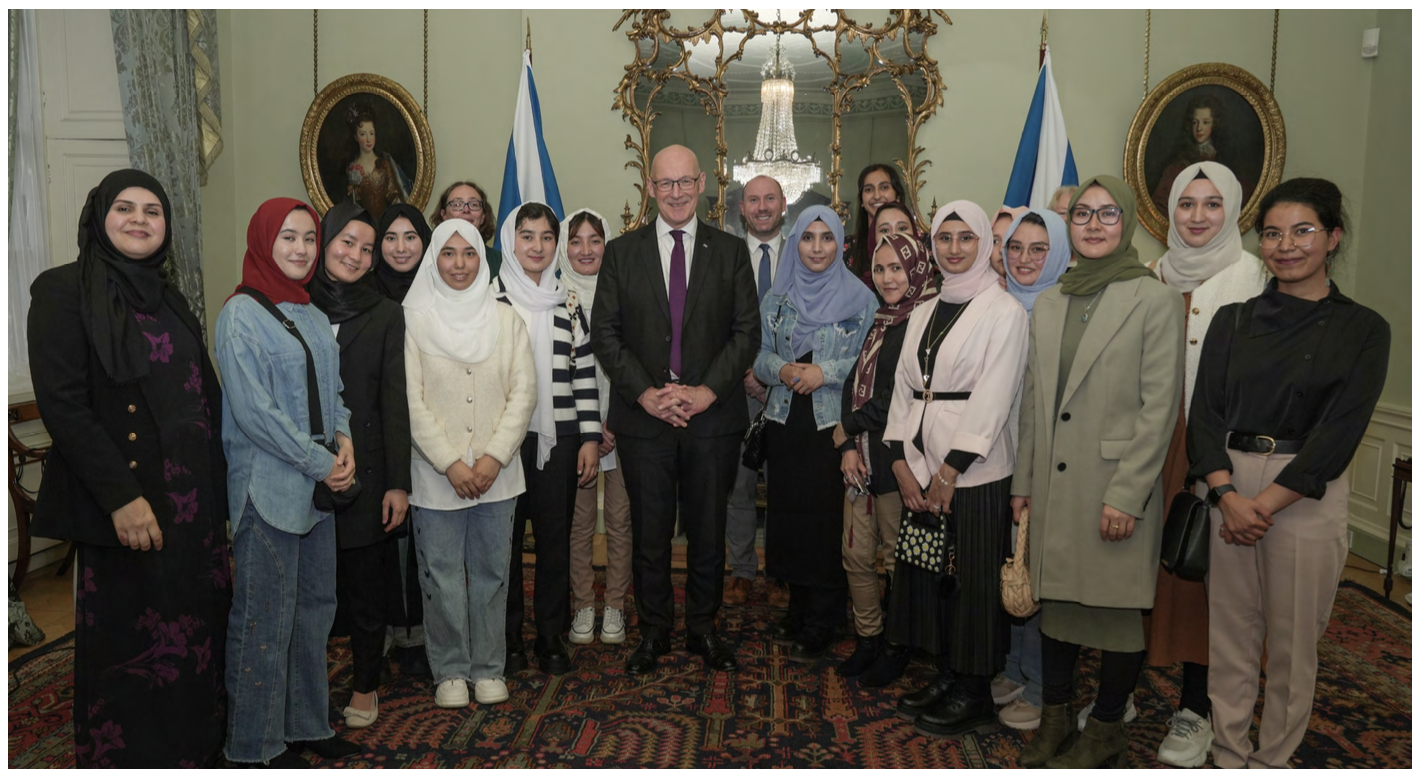
Afghan Medical Students – Leading With Our Values
In August 2024, the Scottish Government worked alongside a charity, universities and the Scotland Office to help bring nineteen female medical students to Scotland to complete their studies after women were banned from continuing with their education in Afghanistan by the Taliban. Lewis-based charity The Linda Norgrove Foundation had been supporting the women and secured agreement with four Scottish universities – St Andrews, Glasgow, Dundee, and Aberdeen to take the students in the academic year 2024-25.
In an example of putting domestic policy to work to align with our international values, the Scottish Government amended domestic legislation to allow them to be treated as home students.
Cabinet Secretary for Education Jenny Gilruth was present to welcome the students’ arrival in Scotland and said: “Gender should not be a barrier to accessing education, and I am pleased that the Scottish Government has been able to support these extraordinary women in their journey to complete their medical education.
“The changes we made to the legislation will ensure they can access the same benefits as their peers, including free tuition and student support.
“Scotland has a proud history of welcoming people from across the world who need support. I wish each and every one of these inspiring women the warmest of welcomes to Scotland and look forward to the positive contribution they will make to our country.”
Human rights
Over the last year, the Scottish Government has participated in three periodic reviews on the implementation of international human rights treaties, via the UK Government as the state party to these treaties. This work has included reporting on devolved matters relating to the International Covenant on Civil and Political Rights (March 2024), International Convention on the Elimination of All Forms of Racial Discrimination (August 2024) and the International Covenant on Economic, Social and Cultural Rights (February 2025). We also hosted an ad hoc visit of the Committee for the Prevention of Torture, Inhuman and Degrading Treatment over June 2025 and will respond to its preliminary findings shortly.
The UN Guiding Principles on Business and Human Rights (known as the UNGPs) continue to inform Scotland’s trade policy, as reflected in Scotland’s Vision for Trade. This year we have worked with the UK Government to ensure that the experiences of businesses operating in Scotland are considered and reflected in their National Baseline Assessment on the implementation of the UNGPs.
To give further effect to international human rights domestically, we consulted on our proposals for a new Human Rights Bill that would seek to incorporate four UN treaties into Scots law, within the limits of devolved competence. This consultation led to a discussion paper published in July 202549 that set out the proposals in more detail to support further stakeholder engagement and refinement, with the intention of taking forward legislation in the next Parliamentary session subject to the outcome of the forthcoming Scottish Parliament election.
The promotion of human rights is a cornerstone of our approach to international engagement. Since 2018, we have provided funding to the University of Dundee to deliver the Scottish Human Rights Defender Fellowship which provides temporary respite and support to Fellows to further develop their skills, extend their networks and continue their vital work from a place of safety.
International Strategy Case Study 14
Human Rights Defenders
The Scottish Human Rights Defender Fellowship hosted two women human rights defenders from Kenya over 2024-25. The Fellows engaged with senior government and UN figures including Lord Collins, the then Parliamentary Under Secretary of State in the Foreign, Commonwealth and Development Office, the UK Human Rights Ambassador to the UN and the UN Special Rapporteur on human rights defenders. The Fellows also provided expert advice to the FCDO during the review of the Guidance for Human Rights Defenders.
The Fellowship also supported a wider network of 30 grassroots defenders remotely, delivered more than 100 workshops covering research, capacity building and security and protection training, and mobilised additional resource to support the longer term work and safety of defenders. This includes supporting an alumni of the Fellowship to raise funds to launch a community organisation for indigenous women and girls impacted by climate-related emergencies in Colombia. An Alumni member of the Fellowship was awarded an honorary Law PhD from the University of Dundee in recognition of her “exceptional contribution to the defence of human dignity, freedom, and justice in Guatemala and across Latin America.”
International network
Scotland’s international network comprises:
- two Scotland House offices in Brussels and London
- seven Scottish Government international offices in North America, Europe and Asia
- around thirty SDI offices across the world
Scotland House Brussels and Scotland House London are both standalone sites operated by the Scottish Government in conjunction with key partners including SDI in London, Scotland Europa in Brussels and others. They provide a platform for businesses and organisations to develop networks, work, do business and stage events to drive their growth. Both Scotland Houses generate income from events and membership services.
There are seven further Scottish Government international offices. All these offices are based in British Embassies or High Commissions and work jointly with SDI. Like the other devolved governments, as well as UK departments with an overseas presence, the Scottish Government pays an annual platform charge to the FCDO for access to facilities and local support in the Embassy or High Commission. In 2024-25, the Scottish Government paid FCDO £590,648 in accommodation and platform costs in connection with our offices based in British Embassies and High Commissions.
SDI is the international arm of Scottish Enterprise, Scotland’s national economic development agency, and has over 100 officials based in 22 countries. These local trade and investment specialists provide support to companies and ensure that business relationships formed, or investment created, help to build Scotland’s international connections, positively impact Scotland’s economy and SDI’s aim to grow Scotland’s exports, increase inward investment to Scotland and secure new capital investment to fund a just transition to net zero.
SDI delivers international business support in collaboration with the Scottish Government and other public sector entities, including Highlands and Islands Enterprise and South of Scotland Enterprise.
The GlobalScot network, managed by Scottish Enterprise, brings together a group of dynamic and influential business leaders based in international markets around the world, who volunteer their time to support Scotland’s economic vision. They do this by providing advice and mentorship to growth-oriented companies, make senior introductions and trading connections for Scottish partners and deliver international insights, live market updates and opportunities to Scotland’s enterprise agencies and government. With over 1,200 GlobalScots across 64 countries, this impressive network plays a key role in supporting the delivery of our ambitious economic vision for Scotland.
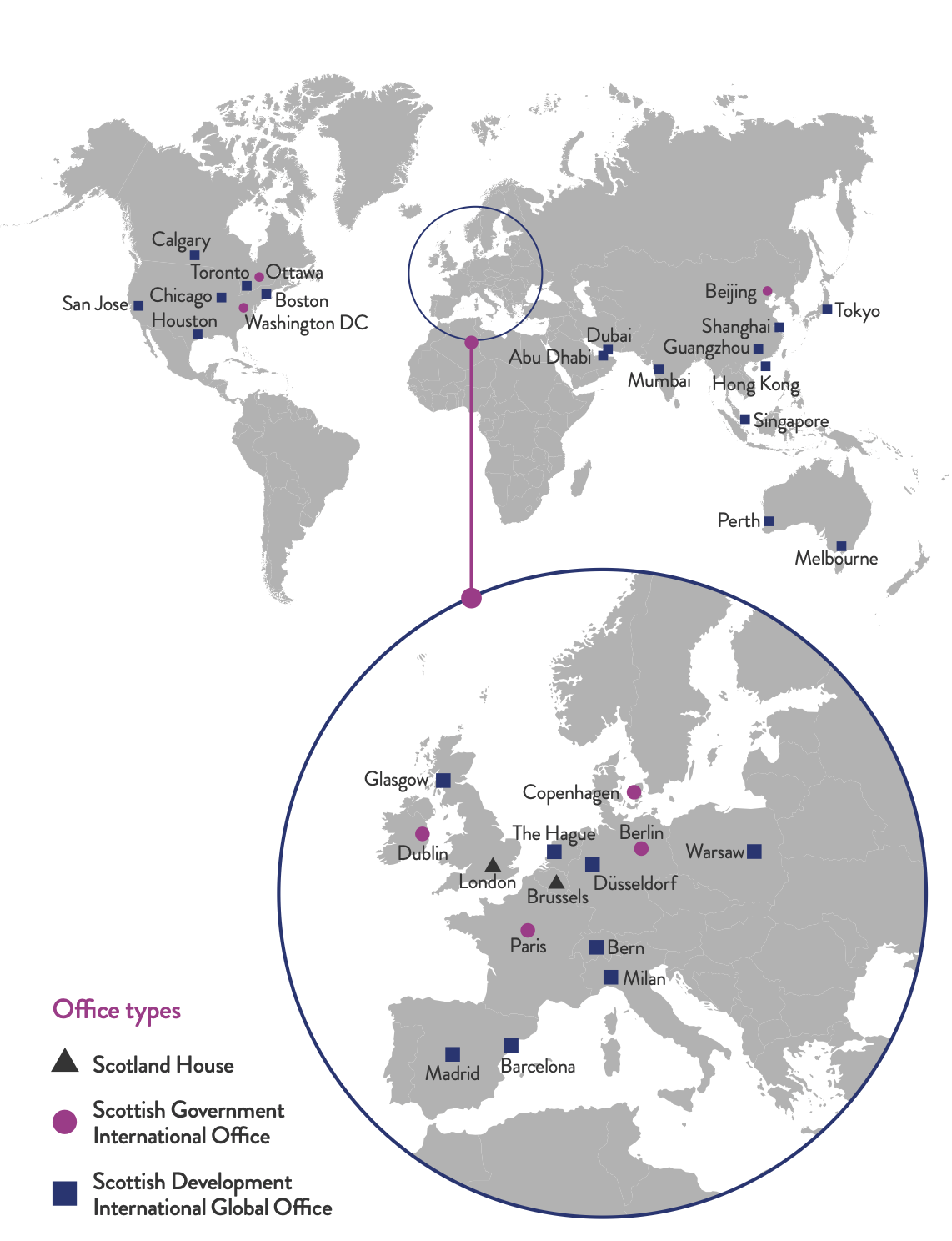
Office types
- San Jose
- Scotland House
- Scottish Government International Office
- Scottish Development International Global Office
- Chicago
- Houston
- Calgary
- Toronto
- Washington DC
- Ottawa
- Boston
- Glasgow
- Dublin
- Madrid
- London
- Barcelona
- Abu Dhabi
- Paris
- The Hague
- Copenhagen
- Brussels
- Dubai
- Düsseldorf
- Bern
- Berlin
- Milan
- Mumbai
- Guangzhou
- Warsaw
- Shanghai
- Beijing
- Hong Kong
- Perth
- Singapore
- Melbourne
- Tokyo
Spotlight: Scotland House London
Scotland House London is a unique collaboration between the Scottish Government, SDI, VisitScotland and Scotland Food & Drink (SFD), which provides a platform for these partners to showcase the best of Scotland to key London and international audiences. The office is permanently staffed by thirteen Scottish Government staff, seven SDI staff, and one permanent market trade specialist working for industry-leading body Scotland Food & Drink.
It provides a place for the Scottish Government and its partner agencies to work, do business, host meetings, engage networks and stage events in order to drive their organisational objectives. It also provides a base for Scottish Government Ministers and officials when they are in London, which enables them to more easily engage with London-based stakeholders and organisations in order to further Scottish Government policy objectives.
Scotland House London also provides a home in London for a range of Scottish businesses and organisations, who are able to make use of our co-working space through our membership model. This presents an opportunity to connect these companies with opportunities to develop relationships and influence within new markets in order to succeed and grow.
The Scottish Government’s work at Scotland House London supports increased trade and investment between Scotland and the rest of the UK and internationally, strengthens government to government relations, expands Scotland’s international networks, and facilitates collaboration across a broad range of Programme for Government priorities.
Using London as our gateway into the world, through strategic engagement with the diplomatic community, we develop opportunities for cooperation with partner countries to pursue Scotland’s international agenda as defined in the International Framework. Our relationships with key partner countries and multilateral institutions such as the European Commission Permanent Representation in London allow us to ensure Scotland’s distinct interests and policy positions are represented and well understood (for example as we progress to the new phase of the UK’s relationship with the EU).
Reflecting London’s position as a global financial centre with an unrivalled concentration of corporate HQs of those investors central to increasing capital investment flows into Scotland, we take forward a comprehensive programme of engagement to promote Scotland’s high growth industries and investable propositions.
SDI’s London-based team is responsible for SDI’s Investment work on behalf of Scotland throughout the rest of the UK and Ireland. This market typically accounts for approximately one-third of SDI’s inward investment results annually, and Scotland House London plays a central role in supporting the delivery of that, as well as supporting the wider attraction of foreign direct investment given London’s unique location as a hub for the European headquarters of many global corporations, including from Asia and the US, and for international governments through the network of London based embassies.
Scotland Food & Drink’s work at Scotland House London strives to deliver on the £1 billion market opportunity for Scottish food and drink producers that has been identified across the rest of the UK over the next five years. In line with the industry strategy ‘Sustaining Scotland, Supplying the World’, SFD’s in-market specialist identifies opportunities for growth across all food and drink sectors, including customer led initiatives to help foster and build key relationships, giving Scottish food and drink producers access to commercial opportunities for sustainable growth and development.
International engagement
Ukraine
Throughout 2024-25, the Scottish Government maintained a strong and principled response to Russia’s illegal invasion of Ukraine, focusing on humanitarian support, resettlement, policy collaboration and advocacy for Ukrainian sovereignty and rights.
The Scottish Government consistently condemned Russia’s aggression and reaffirmed support for Ukraine’s sovereignty and territorial integrity, marking Ukraine’s Independence Day with high-profile events attended by senior ministers and Ukrainian representatives. Ministers pressed the UK Government for clarity on and improvements to Ukraine visa schemes, advocating for displaced people to remain in Scotland as long as needed and for visa processes to be as supportive and stress-free as possible.
Scotland’s ‘Warm Scots Welcome’ continued to provide the most favourable and supportive arrangements for displaced Ukrainians in the UK. Between March 2022 and 2025, over 28,000 people sponsored by individuals in Scotland or by the Scottish Government arrived in the UK, with more than 21,000 coming through the Scottish Government’s Super Sponsor Scheme.50 This made Scotland’s per capita intake of displaced Ukrainians more than double that of any other UK nation.
The Scottish Government has invested heavily to support people displaced from Ukraine to rebuild their lives in Scotland. In 2024-25, over £40 million of funding was provided by the Scottish Government to help Ukrainian people to settle into communities across Scotland.
The Scottish Government has worked closely with local authorities, particularly City of Edinburgh Council, to support people into longer-term housing. The Ukraine Longer Term Resettlement Fund continued bring local authority and registered social landlord homes back into use, providing 1,361 homes accommodating more than 2,370 Ukrainians to date, while homelessness rates among Ukrainian households remained low in 2024-25, at just 0.8% of the national total.51
Since April 2025, the UK Government has announced a further 24 month extension to Ukraine visas, which should help provide greater stability for displaced Ukrainians in Scotland. The Scottish Government marked Ukraine’s Independence Day with public events, reaffirming solidarity and support for Ukraine’s sovereignty. The welcome accommodation estate has been closed to all but new arrivals, with ongoing support focused on long-term integration and housing.
The Scottish Government contributed to the UK-Ukraine 100 Year Partnership signed in January 2025 and agreed a number of key areas for exchange and policy collaboration, including trade and investment, women’s leadership, the relationship between our legislatures, digital, culture, environment and agri-food.
In June 2024 the Scottish Government supported the John Smith Trust Ukrainian Women’s Leadership programme in collaboration with the University of Edinburgh Business School. This was followed up in February 2025 with a Scotland-Ukraine Reconstruction and Recovery Fellowship Programme, focused on innovation and digitalisation.
Work is also continuing to help unlock support for Ukraine’s recovery. Scottish Enterprise are providing support by sharing knowledge and practice from an economic development perspective and exploring how Team Scotland can support Ukraine’s trade and investment ambitions to aid economic recovery.
In May 2025, the ‘Re-birth Ukraine’ delegation of 60 Mayors and business people visited Scotland to intensify civic and business relations. The visit culminated with the signing of a trade and investment Memorandum of Understanding at the ‘Re-Birth Ukraine’ conference at Edinburgh City Chambers where Scottish and Ukrainian businesses explored collaboration opportunities. The First Minister, the Minister for Business, Cabinet Secretary for Constitution External Affairs and Culture, and the Minister for Equalities met the delegation at various points in their three day visit.
Further collaboration on key strands of the 100 Year Partnership is planned for 2025-26 and beyond.
Middle East
Throughout 2024-25, the Scottish Government has taken a proactive and principled stance in response to the crisis in the Middle East, particularly the conflict in Gaza. The Scottish Government’s approach has been characterised by a strong commitment to international law, humanitarian principles, and the protection of human rights.
Scottish Government Ministers repeatedly called throughout the reporting period for an immediate ceasefire, the unfettered flow of humanitarian aid into Gaza, the immediate release of all hostages and an end to all licenced arms exports from the UK to Israel. Ministers also called on the UK Government to recognise the State of Palestine without conditions and to press for accountability for those responsible for war crimes or crimes against humanity.
In response to the intensification of violence in Gaza and mounting evidence of humanitarian catastrophe, the Scottish Government paused all Ministerial-level engagement with the Government of Israel, stating that such engagement would not resume until there was real progress towards peace, unimpeded humanitarian access and Israeli cooperation with international investigations into genocide and war crimes.
The Scottish Government also welcomed the Scottish Parliament’s overwhelming support52 for the immediate recognition of the State of Palestine in September 2025, and called on the UK Government to do the same. This was accompanied by calls for the UK to withdraw from its Free Trade Agreement with Israel, end all military cooperation while the conflict continued, and prohibit the import of goods produced in illegal settlements.
More recently, and recognising the acute humanitarian crisis in Gaza, in September 2025 the Scottish Government allocated £400,000 to Kids Operating Room to establish the Gaza HOPES Field Readiness Hub, a deployable hospital providing essential surgical, maternity, and paediatric services. An additional £600,000 was provided to the UNOCHA-led (United Nations Office for the Coordination of Humanitarian Affairs) Humanitarian Fund for the Occupied Palestinian Territories, supporting life-saving health services, food and nutrition assistance, emergency shelter, water and sanitation, protection services, education, and cash for families. This funding is in addition to a £750,000 contribution to UNRWA in November 2023 and £550,000 to the DEC Middle East appeal as well as SCIAF and Mercy Corps for their humanitarian work in Lebanon and Syria.
The Scottish Government paused new awards of public money to defence companies supplying countries where there was plausible evidence of genocide, including Israel. Relevant bodies such as Scottish Enterprise were instructed, where possible, not to support trade with Israel. The Government also pressed the UK Government to suspend all arms exports to Israel, welcoming the UK’s partial suspension but urging a complete halt.
Prior to the Scottish Parliament statement and debate held on 3 September 2025, Ministers met representatives of Scotland’s Jewish community to assure them of the Scottish Government’s commitment to their safety and to combating antisemitism. The Scottish Government consistently made clear that there could be no place for hatred of any kind in Scotland.
The Scottish Government called for urgent UK Government action to enable Gazan students to take up places at Scottish universities, working with UK authorities to support their safe departure and visa applications. Scotland’s NHS also welcomed children from Gaza who needed urgent medical treatment.
The Scottish Government welcomed the sanctioning of Israeli ministers by the UK and other countries for inciting violence and called for accountability for crimes committed during the conflict. It also supported international efforts to investigate allegations of genocide and war crimes.
Since April 2025, the most significant development has been the UK Government’s formal recognition of the State of Palestine on 21 September, a move long advocated by the Scottish Government and supported by the Scottish Parliament. The First Minister was proud to be invited to a ceremony at the Palestinian Mission in London the following day, marking the UK’s recognition. This recognition, alongside France and Australia and following similar actions by Ireland, Norway, Spain, and Slovenia, marked a pivotal shift in UK foreign policy and has been welcomed by the Scottish Government as an essential step towards a two-state solution and lasting peace in the region.
A summary of international engagement by Ministers in 2024-25 is provided in Table ii, below. More detail on international Ministerial visits is provided in the performance and transparency data annexes. This information is routinely published on gov.scot throughout the year.
|
Country |
Visits |
Minister(s) |
|---|---|---|
|
Germany |
7 |
First Minister Cabinet Secretary for Constitution, External Affairs and Culture (x2) Cabinet Secretary for Net Zero and Energy (x2) Minister for Social Care, Mental Wellbeing and Sport Minister for Climate Action |
|
Belgium (EU Institutions) |
3 |
Cabinet Secretary for Constitution, External Affairs and Culture Cabinet Secretary for Rural Affairs, Land Reform and Islands Minister for Climate Action |
|
France |
3 |
First Minister Deputy First Minister and Cabinet Secretary for Economy and Gaelic Cabinet Secretary for Rural Affairs, Land Reform and Islands |
|
Spain |
3 |
Cabinet Secretary for Rural Affairs, Land Reform and Islands (x2) Minister for Business |
|
Denmark |
1 |
Cabinet Secretary for Constitution, External Affairs and Culture |
|
Iceland |
2 |
Cabinet Secretary for Education and Skills Minister for Employment and Investment |
|
Ireland |
2 |
Cabinet Secretary for Net Zero and Energy Cabinet Secretary for Transport |
|
Sweden |
2 |
Cabinet Secretary for Constitution, External Affairs and Culture Minister for Climate Action |
|
United States of America |
2 |
Cabinet Secretary for Constitution, External Affairs and Culture Cabinet Secretary for Net Zero and Energy |
|
Azerbaijan |
1 |
Cabinet Secretary for Net Zero and Energy |
|
Bosnia and Herzegovina |
1 |
Minister for Victims and Community Safety |
|
Malaysia |
1 |
Minister for Business |
|
Norway |
2 |
Minister for Climate Action Cabinet Secretary for Rural Affairs, Land Reform and Islands |
|
Poland |
1 |
Cabinet Secretary for Education and Skills |
|
Singapore |
1 |
Minister for Business |
|
United Arab Emirates |
1 |
Minister for Business |
International Strategy Case Study 15
Ireland-Scotland Bilateral Review
Ireland holds a special place in Scotland’s priorities, with both nations benefitting from continued collaboration. Our shared history, geographic proximity, close-knit communities, cultural ties and common experiences, form a strong foundation for partnership.
The Ireland-Scotland Joint Bilateral Review 2021, co-produced by both governments, underscores the importance of this cooperation across a wide range of areas including government engagement, business, diaspora, culture, education, research and support for rural and island communities.
In September 2024, Ireland’s Former Tánaiste and Minister for Foreign Affairs, Micheál Martin, met with the Cabinet Secretary for Constitution, External Affairs and Culture to assess progress on the Review and agree on priorities for the coming year.
Substantial progress has already been made over 2024-25, and since the Review’s publication. The Scottish Government Ireland Office and Irish Consulate General in Edinburgh have played key roles in fostering bilateral ties. This includes regular ministerial engagement and policy collaboration in areas such as child poverty, renewable energy, and the prevention of violence against women and girls.
Other notable developments include the establishment of an Enterprise Ireland office in Scotland, and successful trade missions arranged by SDI focused on sustainable healthcare and offshore wind. Under Ireland’s Shared Island Fund, there has also been support for NatureScot’s Peatland Action programme, promoting peatland restoration and community engagement. Cultural exchanges have also flourished, with Irish artists participating in the Edinburgh festivals, the revival of the Shinty Hurling International, Scottish contributions to the Dublin International Film Festival and partnerships between Dance Ireland and Dance Base Scotland. Both countries also use annual events such as St Andrew’s Day and Burns Night, St Brigid’s and St Patrick’s Days, to forge new relationships, showcase our cultural talents and enhance community outreach.
Further, academic connections continue to deepen. This includes the partnership between the University of Strathclyde and University College Dublin focused on growing the space industry for economic prosperity, scientific discovery and environmental sustainability. This has been supported by the Scottish Government’s Education Exchange Programme. The Royal Society of Edinburgh and the Royal Irish Academy have also supported collaborative research projects on regenerative tourism and aid for deaf domestic abuse victims across both countries.
An updated Ireland Scotland Bilateral Framework will be published later this year, setting out our key areas for cooperation from 2025 to 2030, signalling a strong and shared commitment to deepening the already close relationship between Scotland and Ireland.