
International review of approaches to tackling child poverty: Comparative summary report and key learnings for Scotland
A summary of the evidence on historical approaches to tackling child poverty in Finland, Denmark, Slovenia and Croatia, with the key learnings for policy makers in Scotland.
Policies supporting parents with the cost of living
This section explores the impact of wider cost of living factors on child poverty rates across the case study countries. This centres on the impact of housing costs, and childcare costs and provision, on child poverty rates.
Housing costs
Housing costs are recognised by the Scottish Government as forming not only the foundation for family life – as a safe place for children to grow and learn, and for families to come together – but also as one of the most significant costs which families must continue to meet on an ongoing basis. Typically, with the exception of pensioners, poverty rates are higher after accounting for the costs of housing that a household needs to pay. This impact has decreased over time, and in 2021-24 the rate of relative child poverty in Scotland was only one percentage point higher after housing costs compared to before housing costs (23% of children live in poverty after housing costs, and 22% before housing costs in 2021-24).[146]
House prices and rents have been rising across Europe, and the cost of housing can be a burden for many families. Housing affordability can be assessed by measuring the share of household income that is spent on housing costs. For all of the case study countries, those without children who are living in poverty spend a much greater proportion of their income on housing than equivalent households in poverty with children. Figure 19 shows that this difference is highest in Denmark, where households without children in poverty spend 61% of their income on housing, and parents in poverty spend over half (40%) of their income on housing.
Although equivalent data is not available for Scotland or the UK, Fraser of Allander Institute analysis has found that Scottish households in the bottom income quintile spend over a quarter of their income on housing costs,[147] whereas JRF analysis found that six in ten private renters in Scotland spend more than 30% of their income on housing.[148] Moreover, housing costs as a proportion of income are lower for those in poverty in Scotland than in the rest of the UK, evident by the divergence in AHC poverty rates between Scotland and the rest of the UK.[149] This is often explained by a higher proportion of people in Scotland living in the social rented sector, and social rents in Scotland being lower, on average, than the rest of the UK.
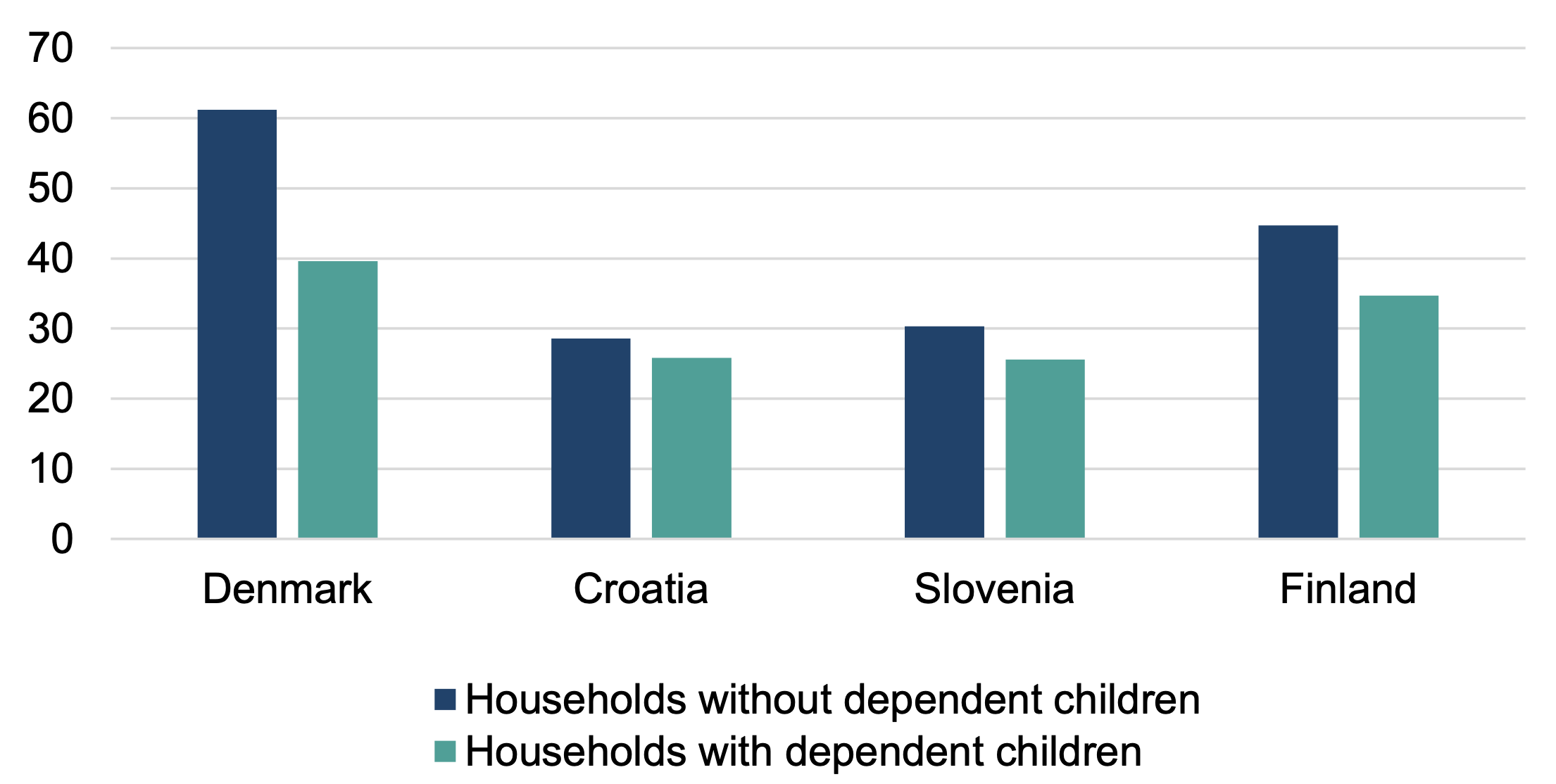
Source: Eurostat, Share of housing costs in disposable household income, by type of household and income group, 2024 (ilc_mded01)
Housing policies vary across the countries studied. All countries provide support with housing in the form of means-tested housing benefits, as well as social housing in Scotland, Finland, Denmark and Slovenia. However, it is notable that in Finland and Croatia, housing benefits also explicitly intend to cover at least some utilities, like heating and water costs, whereas this is not the case in Scotland. In Finland, for example, this is motivated by the cold climate, which has meant that supporting families with children with their housing costs has been seen as a core part of providing for the wellbeing of children, rather than reducing poverty directly. Furthermore, in Finland and the other case study countries, housing benefit payment amounts are calculated on the basis of family size or actual rental costs, rather than dwelling size as in Scotland. However, all countries have a cap on the amount of housing benefit that can be paid. This means that, similarly to Scotland, housing benefits do not necessarily cover 100% of the actual housing costs of most households. Several countries have also cut the generosity of their payments in recent years. For example, in Finland as of 2025, housing allowance can no longer be claimed by households in owner-occupied accommodation, which had been a feature of the system since 1987.
- Scotland: In Scotland, low-income households can receive support with housing costs through the housing element of Universal Credit or Support for Mortgage Interest (SMI) if they live in owner-occupied accommodation. SMI is paid as a loan, and is repayable (with interest) when a house is sold or ownership is transferred. The level of payments to cover private rents is capped by the Local Housing Allowance (LHA) at the 30th percentile of local market rents. This means that housing benefits will only cover the full rent of someone living in the cheapest 30% of properties in their area. However, LHA is often not uprated annually, meaning LHA does not support those households it should without supplementary support. Scotland has a larger social rented sector than the UK average – with over a fifth (21%) of Scottish households living in social housing in 2023/24 compared to 17% in the UK.[150] Social housing homes typically charge a below-market rent, although working-age people living in social homes that are larger than they need may lose part of their Housing Benefit through the ‘bedroom tax’. Those with one spare bedroom will lose 14% of their eligible rent and those with 2 or more spare bedrooms will lose 25%.[151] Local authorities in Scotland can pay an additional Discretionary Housing Payment (DHP) where households need additional help affording their housing costs, with the Scottish Government funding the mitigation of both the ‘bedroom tax’ and benefit cap as fully as possible. Support through DHP may be provided via one-off or regular payments.
- Finland: Low-income families can claim housing allowance which pays up to 70% of ‘acceptable’ housing costs for eligible low-income households (including rent, heating and water). The maximum limits vary by household size and region - for example, in Helsinki the maximum limit for a one-person household is €563 per month, and €1,188 for a four-person household.[152] Social housing is also important in Finland. It is provided by municipality-owned companies or nationwide non-profit organisations, who offer state-subsidised rents.
- Denmark: A means-tested housing benefit is paid to help cover rent costs, before utilities. It is paid on the basis of the size of the property, with maximum amounts applied depending on family size. The maximum payment in 2024 was DKK 48,120 or 25% higher for households with more than three children (DKK 60,150). A special housing benefit is also available to people on social assistance with particularly high housing costs. The special housing benefit varies by household composition, and is subject to a benefit ceiling that particularly impacts couples and large families. As mentioned above, a temporary child subsidy was introduced for large families to counter the impact of the benefit cap. Social housing also provides about 20% of the housing stock in Denmark.[153] It is provided by non-profit housing associations under municipal supervision. However, this does not specifically cater for low-income families; it intends to provide affordable housing to all.
- Croatia: Housing allowance is paid to those receiving guaranteed minimum benefit. It is an additional payment to cover rent, utilities, heating and water, and capped at 30% of the guaranteed minimum benefit payment the household is eligible for. Croatia's social housing programmes focus on promoting homeownership through subsidised construction and bank loans.[154] The Programme of State-Subsidised Housing Construction (POS) started in 2001, sells public housing at non-profit prices with subsidised loans. The Housing Loan Subsidies for Young People, launched in 2011, offers good credit terms for young families and individuals to buy homes.[155] Croatia faces the challenge of underutilisation of housing stock, with about 40% of the total housing units being used for purposes other than residence. The Croatian National Housing Policy Plan 2030, the first comprehensive plan for housing in the country, was adopted in 2025 to tackle underutilisation and increasing unaffordability of housing.[156]
- Slovenia: Individuals who do not earn enough to afford rent may be eligible for a rent subsidy, with the size of the subsidy depending on the applicant’s income, the number of residents and the square footage of the residence. Both private and social housing tenants can apply for subsidised rent. Social tenants’ entitlement to rent subsidisation lasts for a maximum of one year before having to reapply, whilst private tenants’ eligibility lasts the duration of the lease. On social housing rent (referred to as non-profit rent), the maximum subsidy one can receive is 85% of the rent. On market rents, the size of the subsidy is the difference between the market rent and the non-profit rent for the same residence. The non-profit rent of private residences is set at €4/m². In addition to subsidised rents, Slovenia has a supply of non-profit housing provided by municipalities, the state and non-profit housing organisations. In 2022, there were 352 accommodation places for homeless people in Slovenia, equivalent to 16.7 per 100,000 residents.[157]
Across the case study countries in 2024, children living in rented accommodation are more likely to be living in poverty than children living in owner-occupied housing as shown in Figure 20. In Croatia and Slovenia, children living in owner-occupied housing have higher child poverty rates than Finland and Denmark. This is a result of the tenure mix within these countries, with 91% of the population owning their own home in Croatia and 76% in Slovenia, a higher rate than in the other countries.[158] In Scotland in 2021-24, those in rented accommodation – both private and social – are much more likely to live in poverty. Almost half (45%) of children in social rented accommodation live in poverty, and 40% of children living in private rental accommodation are in poverty.
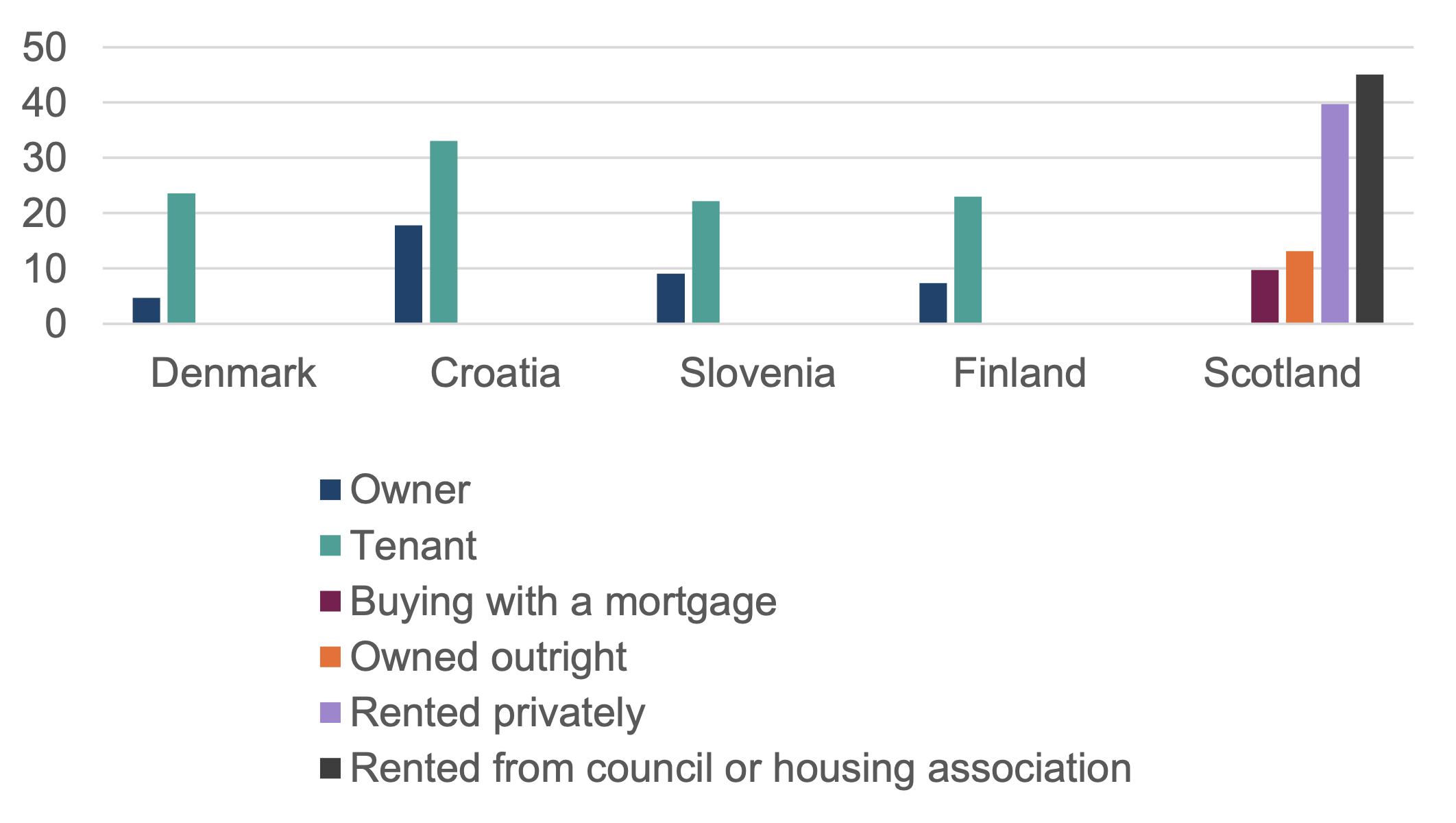
Source: Eurostat, At-risk-of-poverty rate by poverty threshold and tenure status, 2024 (ilc_li08); Poverty and Income Inequality in Scotland National Statistics report, 2025 (three-year averages, 2021-24)
Childcare costs
The approach to childcare – both in terms of provision and funding – varies across the case study countries, but its importance has been particularly central to policymaking in Denmark, Finland and Slovenia. In all these countries, childcare has played an indirect role in supporting reductions in child poverty by facilitating labour market participation and reducing the cost of childcare for families. For Denmark and Finland in particular, it underpins the high levels of dual-parent full-time work, which in turn has a direct impact on child poverty levels. In Croatia, formal childcare is less developed and there is still reliance on informal networks for childcare. It is also notable that all these countries provide their full subsidies to all children under school age, including babies, whereas in Scotland fully-funded childcare is only available after the child turns two.
- Scotland: All three- to five-year-olds are entitled for up to 1,140 hours of funded early learning and childcare a year (equivalent to 22 hours a week if used all year, or 30 hours a week term-time only). In addition, children of parents on certain benefits and who have experienced care (or if their parents did) are entitled to this provision from the age of two. Support is also available through Universal Credit for low-income families (covering up to 85% of childcare costs paid by the parent) and Tax-Free Childcare for working families. Tax-Free Childcare provides a 20% UK Government top-up towards regulated childcare up to £2,000 per child under the age of 12 per year (up to £4,000 if the child is disabled).
- Denmark: All children aged six weeks to six years old in Denmark are guaranteed a subsidised public childcare place. There is a 75% subsidy for public childcare, and municipal discretion to apply to private or home-based care. Low-income families, single parents and families with multiple children receive additional discounts and subsidies. For instance, parents with a household income below DKK 622,200 in 2024 received a tapered additional subsidy, and parents on the lowest incomes paid no childcare fees.
- Finland: There are three forms of Government-assisted childcare; municipal day care, private day care, and child home care allowance, which are available to all children under school age (or under three for child home care allowance). Subsidy amounts and methods vary across the three. For municipal day care, an 86% subsidy is applied with a means-tested fee exemption for low-income families. For private daycare, a payment of up to € 192.28 per month is paid towards fees plus a € 265.85 per month means-tested supplement. Finally, child home care allowance payments are € 377.68 per month for the first child plus a € 202.12 per month means-tested supplement.
- Slovenia: Preschool education is subsidised for all parents with children under school age, with the size of the subsidy depending on income. Families with multiple children in preschool benefit from free preschool fees for the younger child(ren). Low-income families (earning below 25% of the gross average salary) receive a 90% subsidy, and the size of the subsidy decreases by 10% for every additional 10% earned above the minimum income threshold. The maximum any family pays in early childhood education and care (ECEC) costs is 80%, meaning all families benefit from some level of ECEC subsidisation.
- Croatia: ECEC in public and private kindergartens is offered to children aged six months to primary school age (under seven years old) in accordance with the provisions of the Act on Preschool Education and Care. The Ministry of Science and Education holds overall responsibility for ECEC. There is no legal provision ensuring a place in ECEC for children under the age of 6. However, a compulsory one-year pre-primary programme is mandated for 6-year-olds prior to starting school. ECEC services are subject to fees for educational and care activities throughout the ECEC period. A small percentage of children, approximately 7% annually, who enrol in compulsory pre-primary classes without having attended kindergarten receive these services free of charge. The total cost for a standard ECEC programme ranges from €200 to €330 per month, depending on the institution. Parents or guardians are required to cover part of this expense, with most cities and municipalities capping the monthly fee at €110.[159]
Denmark in particular is viewed as an international frontrunner in formal childcare provision, first developing its system in the mid-1960s. This long history means it is renowned internationally for providing high-volume, high-quality childcare for 0-5 year olds that is universally available and affordable (initially for all working parents and then all children since the early 2000s).[160] Finland has a similarly universal system, underpinned by a right to childcare introduced in 1973.[161] In both these countries, childcare provision has been motivated by their focus on children’s development, and society’s collective responsibility for children’s wellbeing. Local authorities also play a central role in both countries, ensuring the provision of childcare meets the needs of families in their areas, whereas in Slovenia state funding for childcare was introduced in 1996, when The Kindergarten Act (1996) enshrined parents’ rights to ECEC and introduced the state funding of preschool education. This aimed to reduce the cost of early years education for parents, but over time these subsidies have been reduced.[162]
To put this public spending on childcare into context, Denmark and Finland spent over 1% of GDP on childcare provision in 2022, as shown in Figure 21. Finland’s spending has been broadly consistent since 2009, although Denmark’s has slowly decreased from a peak of 1.7%. However, levels of childcare spending in Denmark and Finland remain significantly above Croatia, Slovenia and the UK. Comparative data is not available for Scotland, but the latest available data from the OECD for the UK reported public spending of just 0.04% of GDP on childcare in 2019.[163] Childcare funding is devolved, and the Scottish Government’s current budget for 2025-26 invested £1 billion into early learning and childcare, 1.6% of the total 2025-26 Scottish Budget spend.[164]
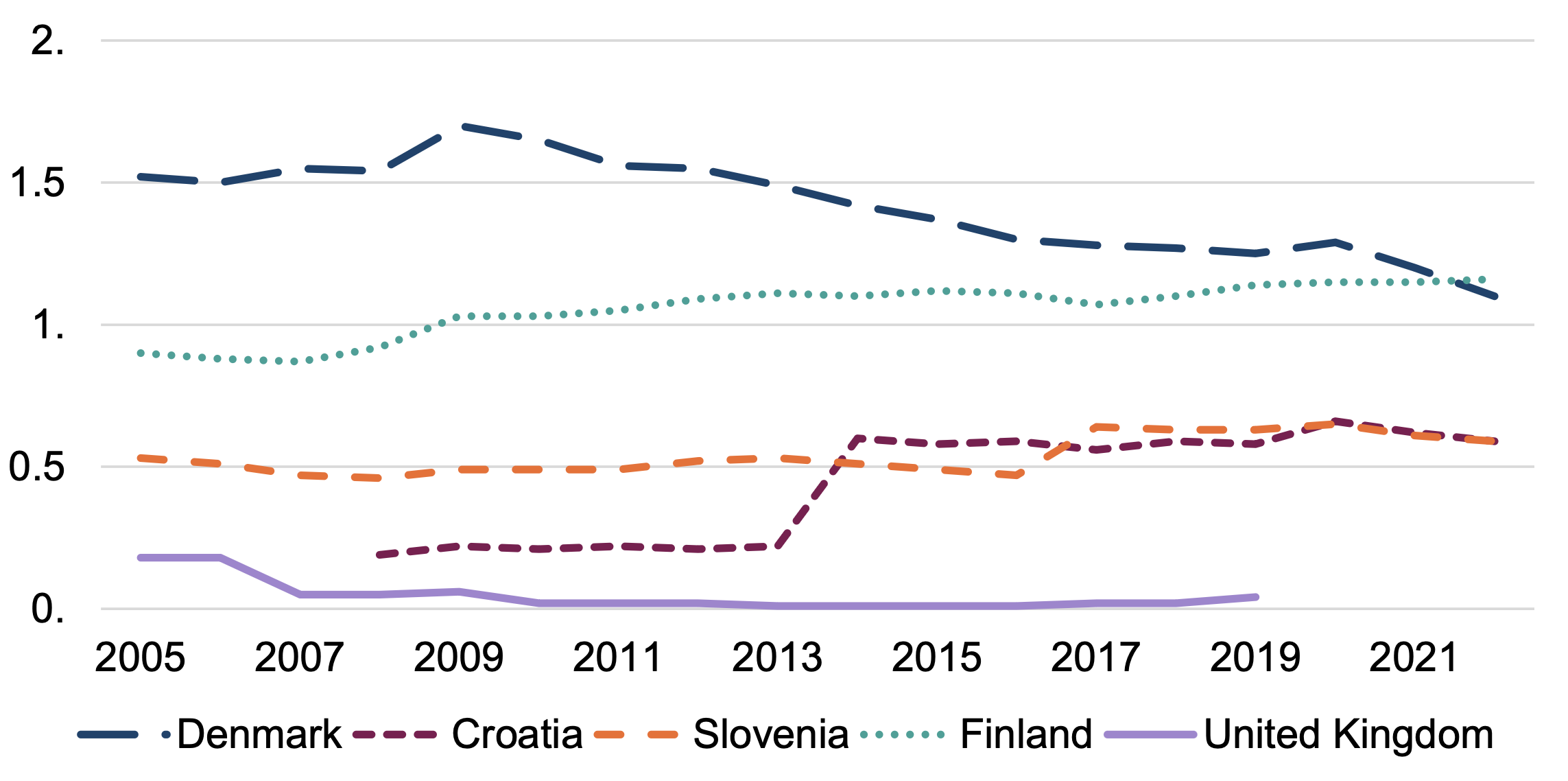
Source: Eurostat, Expenditure on family/children function by type of benefit and means-testing, 2005-2022 (spr_exp_ffa); OECD Family Database, Public spending on childcare and early education, 2005-2019 (PF3.1)
Table 14 shows that where significant subsidy is provided, this significantly reduces a family’s childcare costs. This is especially notable in Finland and Denmark where single parents spend only 4% and 2% of their net income on childcare costs respectively. In Denmark, single parents are eligible for additional discounts on top of the universal subsidy whereas in Finland, the subsidy level is based on a family’s income and size, which advantages single-earning households. In these countries, the level of subsidies or discounts families receive are also higher for additional children, which supports large families, which are a group typically at higher risk of poverty in Scotland and other countries. Croatia is an outlier in that it has low childcare costs without a well-developed state-sponsored childcare network. Instead, there is reliance on informal childcare, usually provided by female relatives.[165] While UK parents spend substantially more of their income on childcare than in the comparator countries, Scotland’s childcare system has been noted as being around 20% cheaper than in England.[166]
| Two-earner family with two children | Single-parent family with two children | |
|---|---|---|
| Croatia | 4% | 4% |
| Denmark | 9% | 2% |
| Finland | 13% | 4% |
| Slovenia | 11% | 15% |
| UK | 22% | 14% |
Source: OECD Family Database, Childcare support, 2021 (PF3.4)
The more universal and affordable a childcare system is, the better it is able to support low-income families, as Figure 22 shows. For example, in Denmark 95% of children at-risk of poverty receive at least 25 hours a week of formal childcare in 2024. Finland and Slovenia also had high participation amongst children at-risk of poverty – 73% and 85% respectively. In Croatia – where the childcare system is less developed – less than half (47%) of children in poverty are able to access the formal childcare system.
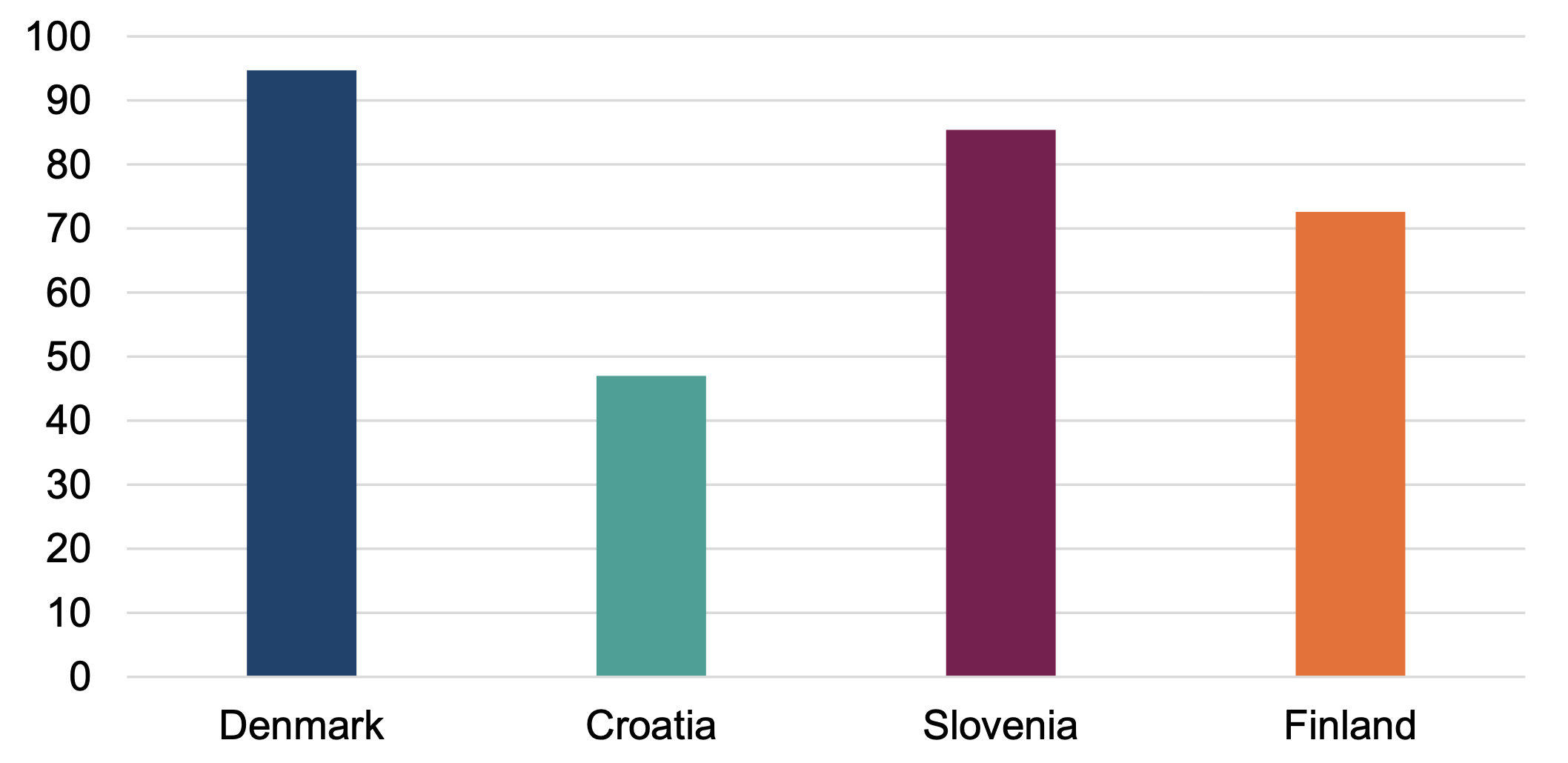
Source: Eurostat, Children in formal childcare or education by age group, duration and risk of poverty or social exclusion, 2024 (ilc_caindform25b)
Comparable data is not available for Scotland or the UK. However, in Scotland participation in childcare varies by age group. For 3–4-year-olds, who receive the highest level of provision, 94% of 3-4-year-olds are registered in early learning and childcare services, whereas for two-year-olds, only 13% are registered.[167] The average number of hours attended per week is 21.6 across all formal early learning and childcare settings.[168]
Contact
Email: TCPU@gov.scot