
International review of approaches to tackling child poverty: Comparative summary report and key learnings for Scotland
A summary of the evidence on historical approaches to tackling child poverty in Finland, Denmark, Slovenia and Croatia, with the key learnings for policy makers in Scotland.
Policies to increase income through employment
Boosting income from employment is often one of the best routes out of poverty. This is especially the case for parents who currently do not work, as entering the labour market can often make a substantial increase in a family's income. This is important because families that are in poverty are more likely to contain workless adults than those who are not in poverty. In addition, for those who are already in work, increasing earnings is often the clearest route to increasing household income. Typically, families in poverty have lower earnings. While some families with children may choose to spend more time with their children at the expense of higher incomes, other families can struggle to juggle paid employment with childcare responsibilities, and they often work limited hours or on lower pay. Government policy has a key role to play here to support families to improve their labour market position where they can.
Parental leave and pay
Employment-protected paid parental leave is a central element of family policy in all of the case study countries. Paid parental leave primarily aims to support parents – especially mothers – to take time off paid work to care for a very young child. These policies help to safeguard household finances to a degree and support child-parent relationships.
- Scotland:[97] Mothers can take up to 52 weeks’ maternity leave. Maternity leave can be taken 11 weeks before the expected week of childbirth and mothers must take at least two weeks after the birth (or 4 weeks if they are a factory worker). Statutory Maternity Pay can be paid for up to 39 weeks, with the first six weeks equivalent to 90% of average weekly earnings before tax and the remaining 33 weeks at £187.18 or 90% of average weekly earnings (whichever is lower). Fathers can take one or two weeks’ paternity leave, with the Statutory Paternity Pay set at £187.18, or 90% of average weekly earnings (whichever is lower). In addition, up to 50 weeks of maternity leave and up to 37 weeks of maternity pay can be shared with the father as part of Shared Parental Leave. This can be booked in three blocks during the first year after a child’s birth. Statutory Shared Parental Pay is paid at the rate of £187.18 a week or 90% of average weekly earnings, whichever is lower. Employers can offer enhanced pay schemes above the statutory minimums for mothers, fathers and shared leave.
- Croatia:[98] Both maternity and paternity leaves are available, plus a shared parental leave element. Maternity leave is for 28 days prior to birth and 70 days after at 100% compensation. Paternity leave is for 15 days at 100% compensation for one child, with 30 days available in the case of multiple births. Shared parental leave is four months each per child for first two children, and 15 months for any additional children or twins. Compensation is up to 120% of the €750 base. Employees who have made social security contributions for at least nine consecutive months (or 12 months within two years with interruptions) are eligible. Ineligible parents are entitled to a reduced amount of 70% of the full payment.
- Denmark:[99] Denmark moved to a system of shared parental leave of 52 weeks per family in 2022. Of these 52 weeks, mothers can take four weeks prior to birth, and two compulsory weeks after birth, nine weeks of non-transferable leave and 13 weeks of transferable leave. Fathers receive 11 weeks of non-transferable leave and 13 weeks of transferable leave. There is an accompanying cash benefit based on former earnings, up to a limit of DKK 4,695 per week in 2024. Eligibility is based on having worked at least 160 hours in the four months preceding the paid leave. Under collective agreement or individual work contracts, full earnings for employees can be paid during leave instead of the cash benefit.
- Finland:[100] Finland also moved to a system of shared parental leave in 2022 in an effort to further support shared childcare responsibilities. Each parent is entitled to 160 days’ leave, plus 40 days’ pregnancy leave for the ‘birthing parent’. Up to 63 days can be transferred to the other parent. Parental allowance payments are financed by the employer using employees’ sickness and health insurance contributions as part of Finland’s social insurance system, and these are earnings-related. A minimum allowance of €31.99 per working day is also available for those without access to the parental allowance payment.
- Slovenia:[101] Both maternity and paternity leaves are available, plus a shared parental leave element. Maternity leave is provided for 105 days, paternity leave for 30 days and parental leave covers 160 days per parent – 60 of which are non-transferable. All of this leave is compensated at 100% of previous earnings for residents who have made social security contributions for 12 months in the last three years. Ineligible parents receive a parental allowance of €494 per month.
The policy design of shared parental leave schemes is important, with individualised and partially non-transferable schemes, as in Finland and Denmark, seen as more effective and better suited to encouraging fathers to use their leave entitlements and get more involved in childcare. This is evident in Denmark, with the 2022 system leading to an increase in the number of days of parental leave a father takes compared to 2021 levels.[102] By contrast, the UK’s transferable shared parental leave scheme has been seen as too complex for parents, and some have argued that it unfairly penalises mothers and disincentivises fathers.[103] In fact, a UK Government evaluation of the shared parental leave scheme found that only 1% of eligible mothers and 5% of eligible fathers took shared parental leave, with especially low awareness and uptake amongst lower-income families.[104]
Especially problematic is the low rate of statutory pay in the UK (and thereby Scotland) compared with the case study countries who all have more generous minimum payments (see Table 8) as well as better institutionalised arrangements for employers to provide additional financial support.
| Maternity leave | Paternity leave | |
|---|---|---|
| Croatia | 100% | 73.8% |
| Denmark | 49.7% | 49.7% |
| Finland | 84.8% | 66% |
| Slovenia | 100% | 100% |
| UK | 31.1% | 20.4% |
Source: OECD Family Database, Key characteristics of parental leave system, 2024 (PF2.1)
Moreover, integrating flexibility within parental leave polices can allow parents to make the right choices for them in balancing home and work life, and at different stages of their child’s life. Both Denmark and Finland are notable for this approach, allowing parents to extend their parental leave. In Denmark, a parent can request that parental leave is extended to 40 or 46 weeks and return to work on a part-time basis over this extended period of leave. Moreover, five weeks of parental leave can be taken at any point until their child is nine years old, with up to five weeks also transferable to the other parents. In Finland, parents can take extended childcare leave until their child is three years old, and they can receive child home care allowance.
Minimum wages
The approach taken to employment protection, including both wages and conditions, varies across the case study countries:
- Scotland: The UK National Minimum and Living Wages apply in Scotland. This sets the minimum rate at which workers must be paid at £12.21 per hour for workers aged 21 and over, or £10 per hour for those aged 18-20 years old and £7.55 for those under 18 and apprentices. The UK Government sets and reviews the minimum wage rates each year – this is based on recommendations from the Low Pay Commission which includes employers, unions and experts.
- Croatia: A minimum wage in Croatia was first introduced through the 2008 Minimum Wage Act. The minimum wage setting process is not based on collective bargaining and is set by the Government with input from social partners.[105] Croatia has a monthly minimum wage of €970 based on a 40-hour work week. This was increased in January 2025, up by 15.48% from the previous year.[106]
- Denmark: Denmark does not have a national minimum wage, instead combining a system of collective bargaining within a flexible, unregulated labour market. 2018 estimates suggest that collective agreements cover 100% of employees in the public sector, 73% of those in the private sector and 87% of those who work for companies that are members of the Confederation of Danish Employers.[107] The unregulated nature of the labour market means it is easy to hire and fire employees, with Denmark having the tenth least protection employment practices according to the OECD.[108] This labour market flexibility is accepted politically and by the Danish workforce due to the social security system providing generous financial support for the unemployed and an extensive programme of Active Labour Market Policies to help people return to work.[109]
- Finland: Finland does not have a national minimum wage, instead there is a strong tradition of collective bargaining, and these agreements are often extended to whole sectors. In 2019, 88.8% of workers in Finland were covered by collective agreements.[110]
- Slovenia: Minimum wages are determined by collective bargaining between trade unions, employer organisations and the Government. Today, 27% of employees are in a union and 90% are covered by collective bargaining.[111] In 2010, pressure from trade unions to increase wages in line with the rising cost of living resulted in a 22.9% increase in the minimum wage, making low-skilled workers disproportionately expensive for firms. This encouraged firms to slow down hiring of low-skilled workers and adopt more non-conventional forms of employment such as temporary contracts and agency work. In 2010, the minimum-to-average-wage ratio rose to 47.6% and, by 2013, 10.5% of workers were on minimum wage – almost double the number of workers (5.4%) before the minimum wage increase in 2009.[112] Today, Slovenia has one of the highest minimum wages in the EU at €1,278 per month.[113]
Denmark and Finland’s approaches are distinct from Scotland and the other case study countries. While there is no minimum wage, the role of trade unions in these countries means that there is a much higher degree of collective bargaining to help guarantee that income from work provides families with a sufficient income.[114]
The use of a minimum wage policy in Slovenia and Croatia on the other hand has been important and has driven wage rises over time. Table 9 shows that in both these countries the minimum wage is a higher proportion of the average wage, measured by both the mean and median wage, than in the UK. In Slovenia, this is also supported by collective bargaining, where unions, employers and the Government negotiate to set the minimum wage. However, it show be noted that in Slovenia rapid rises in minimum wages have had unintended consequences, such as in 2010 when a 22.9% rise in a single year resulted in higher levels of unemployment amongst lower-skilled workers.[115] In the UK and Croatia there are more informal arrangements for social partners, employers and employee representatives to advocate for and make recommendations about minimum wage rates, but the governments in these countries sets the rates.
| Minimum wage as % of mean average wage | Minimum wage as % of median average wage | |
|---|---|---|
| Croatia | 52.6 | 63 |
| Slovenia | 50 | 59.6 |
| UK | 40.1 | 45 |
Source: OECD, Earnings and wages database, 2023
Employment support schemes
Active labour market policies are a key part of employment support and ensuring those who are out of work move back into employment quickly. Denmark has been noted as a leader in the deployment of active labour market policies since the mid-1990s, and since 2009 it has spent between 1.5% and 2% of GDP on active labour market policies. As Figure 17 shows, this is considerably higher than the spending in other case study countries. OECD data for the UK only extends until 2011, but until then the UK’s spending was broadly comparable to Slovenia’s. The UK’s decline in spending on active labour market policies between 2009 and 2011 coincided with the end of the various New Deal programmes implemented by the New Labour Government.
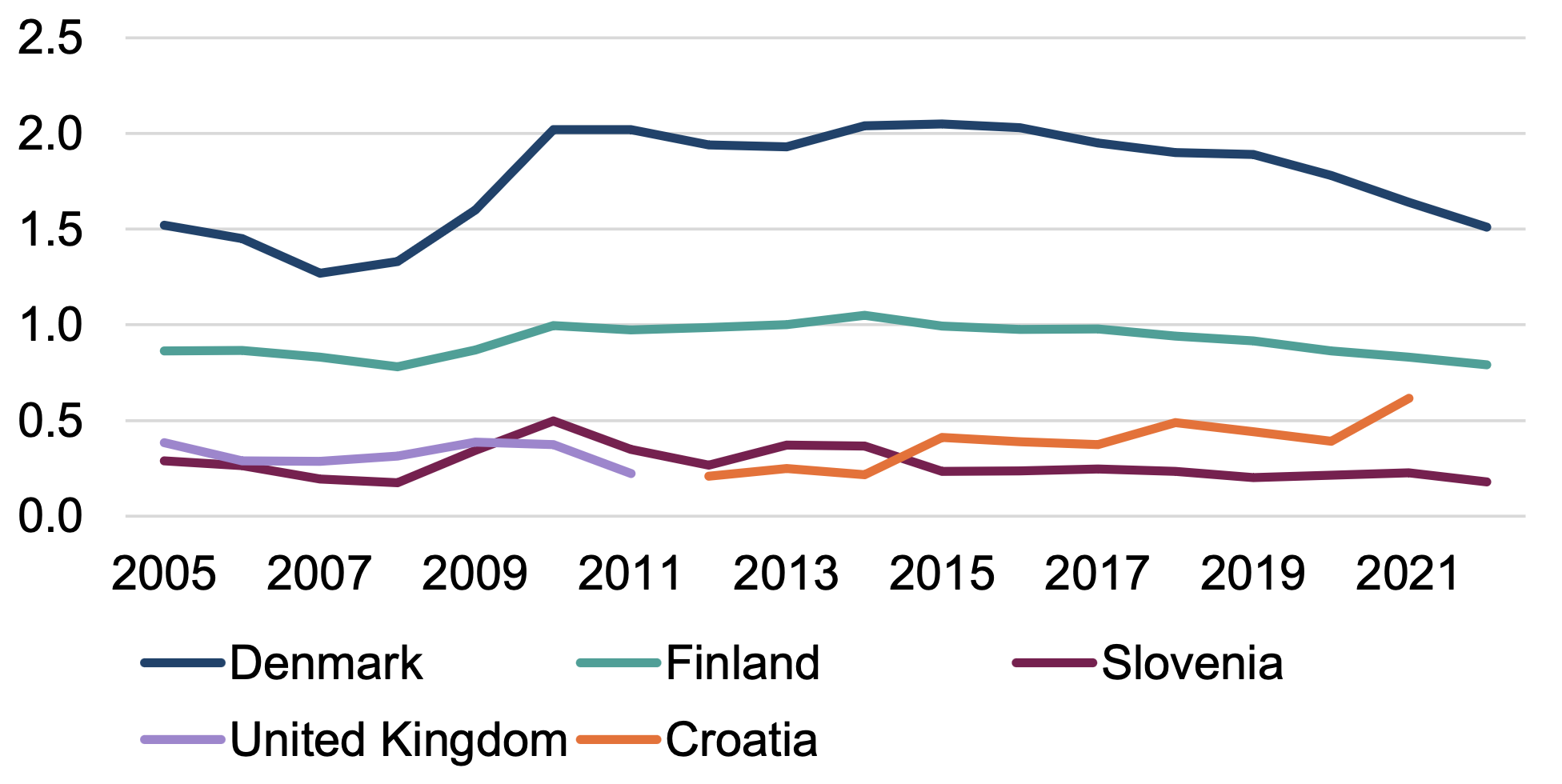
Source: OECD, Labour Market Programmes Database, 2005-2022
In Denmark, active labour market policy is heavily decentralised, with municipalities having control over not only delivering active labour market policies locally, but also the design of their active labour market policies to cater to local need.[116] As a result of this decentralised approach, there is a wide variety of approaches to labour market activation in Denmark. For example, the municipality in Copenhagen funded a local college to provide up to 11 young single mothers with access to training and education qualifications, social guidance and employment support. These places were costly, but they had a 100% success rate upon completion.[117]
The Scottish Government has limited powers over employment policy, with most powers reserved for the UK Government. That said, the Scottish Government’s 2025-26 Budget has allocated £104.5 million for employability policies, around 0.3% of Scottish Government expenditure.[118] Since 2024, the Scottish Government has taken a No One Left Behind approach to employability policy which – as in Denmark – seeks to take a localised approach to employment support targeted at specific at-risk groups.[119] Parents are a key target group, with the Scottish Government setting the aim to support 12,000 parents to enter and sustain employment and 3,000 working parents to improve their earnings.[120] In 2023/24, parents made up almost half of those supported by Scotland’s devolved employability services.[121] In Scotland, local authorities support parents via locally tailored programmes financed by the Parental Employment Support Fund (PESF), with £40.1 million of support provided by PESF in 2024/25.[122] Although the impact of PESF has not been formally evaluated, an assessment by the Joseph Rowntree Foundation (JRF) has noted that the scale of PESF means the scheme is unlikely to be sufficient and the voluntary nature of PESF limits its accessibility.[123]
Contact
Email: TCPU@gov.scot