
Scotland's Migration Service: early insights evaluation
This report presents the findings from an early‑insights evaluation of Scotland’s Migration Service, which will inform future policy development and provide further recommendations.
4. EQ1: To what extent has SMS been delivered as intended?
The first component of this early insights evaluation considers the delivery and implementation of SMS and seeks to answer the following evaluation question:
- EQ1: To what extent has SMS been delivered as intended?
This chapter presents findings from analysis of:
- a narrative evidence submission from the SG SMS team on service development, implementation, and delivery to date;
- appointment records, KPI data and web analytics data.
- focus groups with CAS and Seraphus lawyers (n=15) conducted in the autumn of 2025;
- and stakeholder feedback.
The SMS theory of change was used as a foundational framework to assess whether SMS was implemented as intended. It provided a structured representation of the expected causal pathways, including key activities, outputs, and short- and medium-term outcomes. By comparing actual implementation against the theory of change, we sought to:
- identify whether core components of the service were delivered as planned;
- examine the delivery practices and the original design;
- explore contextual factors that influenced implementation fidelity;
- and highlight any deviations, adaptations, or gaps in delivery.
This approach enabled a systematic assessment of how closely the service adhered to its intended design and supported the identification of suitable recommendations.
Delivery of an Accessible Digital Platform Which Meets the Needs of Migrants and Employers
A key output articulated in the SMS theory of change is the delivery of an accessible digital platform which meets the needs of migrants, employers, and investors. In addition to providing more in-depth advice to users through one-to-one appointments and webinars, one of the key aims of the service is to provide free online content which can be a source of clear and useful information for migrants, employers and investors. In developing the service, it was anticipated that many of those who engaged with SMS’ online content would find the information they required and not require additional support beyond this.
An interim version of SMS was launched in late March 2024, with the first operational data on the service available in April 2024. This included the creation of new webpages on Scotland.org (a pre-existing website operated as part of Brand Scotland), which offered high-level advice for migrants seeking to relocate to or settle in Scotland and for employers and investors looking to recruit internationally or expand their business in Scotland. The full service was launched in November 2024, and since then the SMS online content offered to migrants, employers and investors has significantly expanded. It has also been consistently updated to reflect any changes in the UK Government immigration system since the service launched. Information is now provided across two websites; Scotland.org (primarily providing content and advice for migrants) and Scotland’s Migration Service for Employers and Investors. At the time of this evaluation, across these sites, there were around 20 pages of content aimed at migrants interested in relocating to or settling in Scotland, and around 80 pages aimed at employers and investors. Amongst other topics, these pages currently offer advice and information on moving to Scotland, studying or working in Scotland, employing and sponsoring international workers and investing in Scotland.
Design of digital platform
The development of SMS’ two digital platforms (one for migrants and one for employers and investors) was overseen by the SG SMS Team with the digital supplier (Dentsu Creative, later replaced by Leith Digital in January 2025) leading on the design and technical operation of the platform.
User research was conducted at several stages with prospective service users, service users from the interim launch, and advisers working with delivery partners. The original intention of the service was to deliver a single digital platform for migrants, employers and investors. This intended design was deviated from as a result of findings from the user research. This research highlighted the divergence of needs between user groups, with employers and investors requiring tailored information on business immigration matters and guidance on navigating the immigration system, while migrants require information on personal immigration aspects and life in Scotland. Therefore, two online platforms were developed instead to better meet the needs of different categories of user. While this decision impacted the implementation fidelity of the service, it represents an evidence-based service adaptation in order to enable the service to better deliver the intended output and meet its desired outcome of meeting the needs of migrants, employers, and investors. The extent to which this was successful is discussed in the next section.
As indicated above, SMS’ migrant-focused online content is hosted on Scotland.org. Prior to the development of SMS, Scotland.org included a number of pages aimed at prospective and recent migrants, which included content and guidance linked to living and working in Scotland. As part of the launch of the SMS migrant-focused platform, the SMS Team updated the content of these pre-existing pages, and continue to have a role in ensuring that the content of these pages is up-to-date and accurate. As such, analysis of web-analytics data presented in this report covers user engagement with web-pages either created or maintained by the SMS team.
Performance and delivery of digital platform that meets users’ needs
Since the launch of the interim service in March 2024, web analytics data for SMS indicates that SMS’ two digital platforms have received an estimated[33] total of 1,425,787 views (up to August 2025)[34], suggesting that the service has had significant reach online.
Migrant-focused platform
The level of traffic which migrant-focused platform has received has gradually increased since the full launch of the full service in November 2024, with the number of views per month peaking in March 2025 at 447,196, following the launch of the Brand Scotland Study in Scotland marketing campaign (Figure 2; while this campaign was not specifically intended to promote SMS, it boosted traffic towards SMS’ migrant-focused content on Brand Scotland’s Scotland.org).[35]
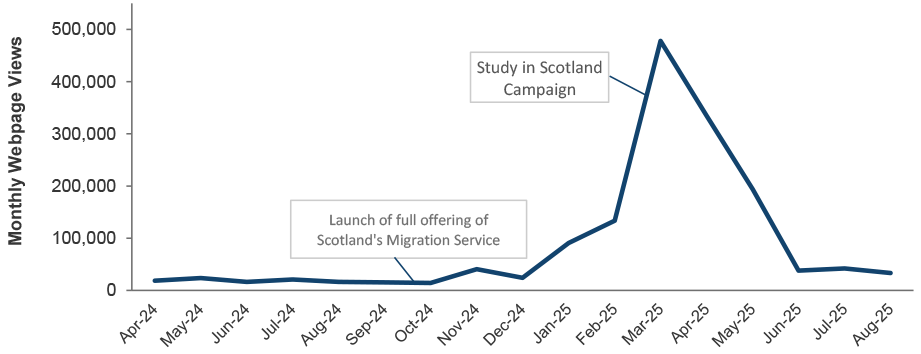
Migrant-focused SMS webpages have received visits from individuals located in 183 different countries, with the highest number of visits from a single country coming from India, United States, Indonesia, Pakistan and Vietnam (see Annex A, Table B2 for figures). The ten countries from which migrant-focused pages received the greatest number of visits from are all outside of the EU.
Pages on the migrant platform focused on studying in Scotland, visas, finding employment and general advice on moving to Scotland received the greatest level of traffic to date (see Annex A, Table B1). The page for booking an advice appointment with CAS received an average of 179 views per month from April 2024 to October 2024. After the full service launch, this average increased to 821 views between November 2024 and August 2025.
Employer and investor-focused platform
The platform aimed specifically at employers and investors launched in November 2024. As of August 2025, this site had received 29,398 views, with monthly views steadily increasing over time, and peaking in July 2025 at 5,160.
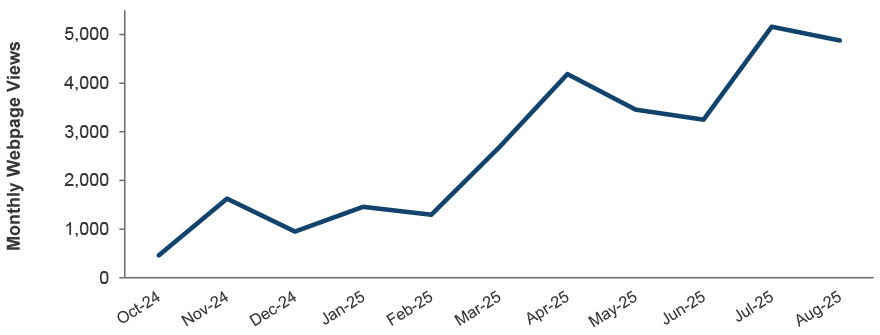
The employer and investor page on the Skilled Worker Visa received significantly more views (an average of 887 per month) than others, with other popular pages including the entrant discount for the skilled worker visa and visa routes for hiring international workers (see Annex A, Table B3 for further details on page views). A page which allows individuals to book appointments with Seraphus lawyers received an average of 79 views per month during the interim launch of the service, which rose to an average of 260 views per month after the full launch of the service in November 2024. The majority of visitors (67%) to the site were from the UK, although a significant proportion (20%) were from the United States (see Annex A, Table B4 ).These figures are in line with expected outcomes for the service, given that this platform is intended to cater to employers based in Scotland and to investors based abroad, demonstrating evidence of successful implementation.
Overall performance of digital platforms
Feedback from stakeholders evidenced positive experiences of the digital platforms, particularly highlighting the clear and helpful advice they provide. One stakeholder, whose role involved supporting international students at a university, reflected on how information on immigration policies and procedures are often ‘hidden’ and ‘confusing’ and therefore appreciated having a resource of the SMS digital platform which they found to be accessible and could signpost international students to.
One stakeholder provided feedback on their perception of website content updates. While SMS has a structured process in place for ensuring that the service’s online content always reflects the latest changes to UK Government immigration policy, this stakeholder commented that they would like to see online content updated more quickly to align with changes in immigration policy. As such, it may be beneficial for the service to more clearly indicate that online content reflects the most recent changes in policy, or to give an indication of when online content was last reviewed.
Considering both platforms, evidence from focus groups with CAS and Seraphus lawyers included recommendations on how the digital service could be improved upon, including developing case studies to feature on the digital platform. Advisers suggested case studies of international students gaining employment in Scotland or of how employers’ and investors’ skills gaps could be filled through tapping into global talent pools at Scottish universities. This recommendation from adviser focus groups reflects a broader implementation learning on the fact that showcasing tangible, relatable examples may help improve user engagement with the service, clarify its value, and support uptake, particularly among international students, and employers and investors unfamiliar with the immigration system. Further to this, stakeholder feedback recommended knowledge exchange between SMS and Scottish universities, which could help inform online content and advice around common misconceptions shared by migrants and employers.
Overall, analysis of web analytics data suggests that the online content provided by SMS has reached a large international audience, and helped direct traffic towards adviser appointments with CAS and Seraphus. Furthermore, evidence suggests that the Study in Scotland marketing campaign substantially boosted international awareness of SMS.
Accessibility of digital service
As a digital service funded by the Scottish Government, SMS was required to meet Digital Scotland Service Standard (DSSS) criteria. Among other outcomes, the DSSS criteria aim to ensure SG digital services meet user needs, are sustainable, and accessible. Prior to the launch of the service, SMS underwent and passed three DSSS assessments, confirming it had been developed using a user-centred approach and could demonstrate it would offer a secure and reliable service. In line with DSSS criteria 5, ‘Make sure everyone can use the service’, SMS was required to demonstrate the accessibility of the service. The DSSS assessment of SMS confirmed that:
- the design and development of the service, and linked digital platform, have been informed by a comprehensive understanding of how people would engage with the service
- all aspects of the service were inclusive
- the service has been considerate of people with a range of skills and different levels of confidence in using technology
- the service has been informed by user needs research with a diverse range of individuals, including individuals with disabilities
- the service had set up measurable targets for accessibility
- the service had carried out, and improved the service, following accessibility testing with real service users
An accessibility audit was carried out by a third-party supplier shortly before the full-service launch in October 2024. The purpose of the audit was to ascertain how SMS performed relative to the WCAG 2.2 Level AA criteria, the minimum required accessibility standard for public sector websites[36]. SMS online platforms achieved a ‘pass’ score in relation to 76% of the criteria. The auditor identified 16 issues and 5 observations. Of the 16 issues, 5 were marked as high-severity findings. All high-severity issues were fixed prior to full-service launch. The lower priority issues have been gradually addressed by the SMS project team in line with available digital resource, with 2 issues remaining as of September 2025. In line with best practice, another accessibility audit will be carried out during the 2026/27 financial year to ensure any new accessibility issues which have emerged during the intervening period are identified and resolved.
The reading age of SMS content has also been monitored from the Beta phase and throughout the service’s live operations. The Scottish Government’s content design guidelines[37] recommend a reading age of 9-11 years but this was deemed unfeasible to meet for SMS because of the nature of the legal content SMS conveys (for example, the names of various visas, in themselves, do not correspond to a reading age of 9-11 years). A target of 12 years was therefore agreed as representing the lowest reading age possible while retaining the necessary legal nuances. Records indicate that, since the launch of the interim service in March 2024, this average target was maintained until June 2025, where changes in content raised the average reading age to 14 years old. Following a review of this content, adjustments are being made to individual content pages to restore the reading age to 12 years.
Comments from migrant users relating to the usability and accessibility of the migrant-focused platform were limited to three pieces of feedback but was consistently positive. Respondents noted that the website was well-structured, and the information was easy to understand. The accessibility of the migrant-focused platform was also noted by some stakeholders. One stakeholder highlighted the platform’s accessibility as one of its strengths and stated that they felt able to signpost international students to it. Interviews with two employers highlighted that they both felt the employer and investor-focused platform was easy to navigate and looked professional.
Findings discussed in this section indicate that overall, an accessible digital service, consisting of two platforms, has been delivered as intended. Considerable efforts have been made to ensure that the SMS digital platforms have been designed to meet user needs and have been successful in reaching a large international audience. In addition to the above, an on-page feedback tool has recently been introduced to both SMS platforms, allowing users to provide feedback on specific webpages. While on-page feedback data was not available at the time this evaluation was carried out, in the future, this data will allow the SMS project team to identify pages where content could be improved from an accessibility perspective and make appropriate changes.
Advice and support to migrants, employers, and investors
A further key output of the service, as articulated in the theory of change, is the provision of advice and support to migrants through one-to-one appointments, and the provision of advice and support to employers and investors through the one-to-one and one-to-many appointments and webinars. The impact of these and the experiences of users are explored in detail in the following chapter. This section includes high-level descriptive statistics, but for further detail see chapter 4.
Advice and support to migrants
SMS provides advice through CAS appointments to current and prospective migrants. The need for eligibility criteria for one-to-one services was not identified during the policy scoping and development phase. However, eligibility criteria for migrants, employers, and investors were developed during the design and delivery stage of the service in order to manage demand. The eligibility criteria were based on four principles:
- Eligibility criteria should be clear and transparent
- Eligibility criteria should be set at an optimum level to manage demand
- The service must not duplicate existing services
- The service must use its limited budget effectively and efficiently to have the greatest impact on service users and Scotland’s economy
During the interim service, one-to-one advice appointments for migrants were open to:
- People who have moved to Scotland within the past six months
- International students in their final year at a Scottish university or college who would like to stay in Scotland after graduating
With the full service launch, one-to-one advice appointments for migrants became available to:
- People abroad who want to work in Scotland and have a job offer
- People abroad who want to join a close family member in Scotland
- People who have moved to Scotland and have arrived within the last 24 months
- People in Scotland who have limited leave to remain or enter the UK
The above eligibility criteria were introduced by the service to manage demand while initial delivery challenges were addressed. This change illustrates how service design decisions were adapted during implementation to ensure sustainable service delivery.
Between March 2024 and August 2025, 1,131 recent and prospective migrants contacted the service to book an advice appointment with CAS, either through the online booking tool or through offline methods (e.g. attending CAS drop-in sessions and attending a follow-up appointment in person). From these bookings, 71% (n=804) of appointments proceeded, and in the remainder of cases, migrants did not turn up for scheduled appointments, or else appointments were cancelled by service providers, due to those booking appointments not meeting the eligibility criteria for the service. 79% of appointments were with post-move migrants (meaning that they were already living in Scotland) and the majority of appointments (65%) were held with migrants who were aged between 25 and 44. In total, 92 nationalities were represented among those attending appointments. The service delivered an average of 16 appointments per month between the launch of the interim service (March 2024) and October 2024, increasing to an average of 70 per month after the launch of the full service (November 2024) and August 2025. The number of appointments per month peaked in June 2025 (107) and July 2025 (99). While the vast majority (90%) of migrants had one appointment with the service, 5% had two appointments and < 1% had three (with one notable exception of one user attending four appointments). There was no evidence to suggest that the subject of the support sought at a first appointment was linked to the number of additional appointments an individual attended. These figures suggest that the service has been able to scale up delivery over time and respond to increasing demand, particularly following the launch of the full service. The cancellation rate also indicates that eligibility criteria played a necessary role in maintaining service focus.
Analysis focusing on how migrants had found out about advice appointments indicated that 39% had found out about these through an online search or on Scotland.org. Others found out about the service through social media or after being referred by another service. One person said they accessed the service after it was promoted in a letter by the Home Office. Service data indicates that many international students and graduates seek support from SMS to find employment in Scotland after graduation, predominantly desiring to use the skilled worker route. The number of international graduates seeking work appears to substantially outstrip the supply of sponsored jobs available. Stakeholders who submitted feedback also noted that many employers appear unaware that there are a large number of international graduates already in Scotland on Graduate visas who could help them meet their skills gaps without requiring sponsorship. Whilst SMS is not an employability service that can match or facilitate contact between graduates and employers who have suitable vacancies, the service has expanded the ‘finding a job after you graduate’ page to signpost students and graduates to useful resources. Additionally, four webinars have been delivered to employers on the topic of employing and recruiting international graduates. This indicates the service is responding to a clear demand from international students and graduates, but limited employer awareness and the lack of job availability present challenges.
Focus group discussions with CAS advisers described providing advice to a diverse range of migrants requesting advice and support on subjects such as:
- understanding UK immigration policy,
- identifying an appropriate visa route,
- supporting dependents to move to Scotland,
- gaining employment in Scotland
- and, in the case of international students, changing to a new type of visa.
CAS advisers noted the importance of the face-to-face provision for vulnerable service users. CAS advisers also indicated that there had been a gradual shift in the type of advice and support requested since the service launched, with migrants increasingly requesting more holistic advice, such as support linked to housing and schooling for dependents, rather than support linked to specific visas (which was more common in earlier appointments). While this insight is drawn from small scale qualitative research, this shift in user needs suggests that the service is being used not only for immigration advice but also as a broader support mechanism for settlement, in line with the longer-term outcomes of the service articulated in the SMS theory of change.
Stakeholder feedback showed appreciation of the service for delivering advice appointments to a broad range of migrants. This feedback, some of which was provided by universities and career services, described the decision to expand eligibility criteria to offer appointments to international graduates as important, given that this is the time in which international students are more likely to be in need of immigration support. Another university praised the service for the holistic support that it provided. However, one university indicated that the service was unable to meet some students’ needs. As will be discussed throughout in the impact chapter of this report, it is possible that in some cases the service will be unable to meet needs due to the support required falling outside of the scope of the service or due to external factors (e.g. UK Government policy) influencing an individual’s particular circumstances and constraining the support SMS is able to offer in aid of its outcomes.
Focus group discussions on the delivery experiences of CAS advisers identified suggestions for potential service improvements. Some CAS advisers noted they felt it challenging to stay informed on the latest UK Government immigration policies, given frequent changes since the service launched. Similarly, advisers also felt that CAS resources did not contain all the information required to answer migrants’ questions, and that they were required to seek additional information from the SMS websites and the UK Government’s online content on immigration policy.
Opportunities for strengthening service delivery in response to these considerations were also suggested by advisers. For example, advisers recommended the development of a centralised knowledge hub to consolidate guidance and reduce reliance on external sources. One adviser also indicated that it would be helpful to have more information on migrants (e.g. the type of visa they have or their degree if they are an international student) ahead of appointments, to ensure the delivery of informed and tailored advice. While advisers are already requesting this information in advance, it would be beneficial to explore routes for improving the information available to advisers ahead of appointments, including how to improve the response rate to requests from advisers. Other advisers were less sure about this recommendation, feeling the information provided in advance by users tended to be different to what was then shared in appointments. Any actions taken to improve access to information prior to appointments would therefore also have to consider how to ensure this was accurate and relevant to the appointment.
In addition to the above, the expertise of advisers was also discussed. CAS advisers are accredited by the Immigration Advice Authority, and can be accredited at Level 1 or Level 2, with Level 2 advisers qualified to give advice on more complex situations. Focus group evidence indicated that advisers felt there was a need for more Level 2 advisers, to ensure enough capacity to support undocumented migrants and migrants who have overstayed their visas or leave. It is worth noting that 18 additional CAS advisers are currently undertaking training to be certified to Level 2 as part of continuous improvement activities to the service, and are expected to be qualified in between 6-12 months.
These findings suggest that there are opportunities to strengthen the knowledge of advisers and capacity of the service to support more complex user needs. Acting on these opportunities identified by advisers could improve operational efficiency and enhance the reliability of advice provided across appointments.
Overall, the insights discussed in this section suggest that the service has been broadly successful in delivering advice to a diverse user base. Focus group evidence also suggests that there are areas where resources and processes could be strengthened to better support advisers, meet user needs, and ensure effective and efficient delivery of the service.
Advice and support to employers and investors
Between April 2024 and August 2025, a total of 175 one-to-one advice appointments were booked with Seraphus, with 83% (n=146) of appointments proceeding. These appointments were attended by 82 employers, and 29 investors, with 27% of employers and 12% of investors attending second or third appointments with advisors.
During this period, Seraphus provided advice appointments to an average of 6 employers and investors each month between the interim launch of the service, and October 2024, increasing to 11 per month between the full launch of the service (November 2024) and August 2025. The largest number of appointments held with employers and investors in a single month was 15, in March 2025. Despite the steady delivery of appointments, the number of bookings from employers and investors has increased more conservatively compared to migrant users since the full launch of the service. This lower-than-anticipated uptake may reflect perceived barriers such as the cost and resource burden associated with navigating the UK immigration system. This is related to the external factors highlighted in the methodology which may constrain the success of SMS.
In addition to the one-to-one appointments, SMS also offers one-to-many webinars to employer and investor users. These webinars aim to provide more in-depth content and advice for employers and investors than is available on the website and they offer the opportunity for employers and investors to ask questions. The service has delivered an average of one webinar per month since June 2024, and amongst other topics, these sessions have focused on employing international graduates, the sponsorship license process, the skilled worker visa, and hiring temporary workers. Recordings of each of these webinars are hosted on the Scotland’s Migration Service for Employers and Investors platform. From June 2024 to August 2025, 749 employers and investors attended webinars hosted by SMS. Furthermore, between January and September 2025, recordings of the webinars (hosted one SMS’ platform for employers and investors) were viewed 352 times in total. The most well attended webinars focused on the Sponsor Management System (61 attendees) and Sponsor licence compliance (57 attendees). Attendees are asked to complete post-webinar surveys to indicate their satisfaction with the content provided. While only 19 surveys were completed, these were associated with a 100% satisfaction rate. The focus group discussion with Seraphus advisers noted that where attendees of webinars asked complicated questions during webinars in the associated chat function, they were encouraged to book a one-on-one appointment with the service.
Seraphus lawyers reported tailoring advice based on the size of the organisations seeking support. Smaller organisations typically required step-by-step guidance through the immigration system, whereas larger employers sought support for strategic planning and understanding the implications of UK Government policy changes on recruitment practices. This tailored approach was viewed as essential to meeting the varied needs of service users. Advisers also indicated that since the launch of the service there had been a gradual shift in those who attended appointments. While following the interim launch of the service the majority of appointments were small and medium sized organisations, over time there had been an increase in appointments with public sector organisations including NHS boards and local authorities. Seraphus lawyers believed that this shift had occurred partly as a result of the webinars delivered, which had improved awareness of the service amongst organisations of this size. Despite generally positive feedback about the webinars, advisers observed that many appointment attendees were unaware of the webinars, suggesting scope to improve promotion and awareness. Stakeholders also highlighted the dual function of webinars, both as informative sessions and as a means of demonstrating to employers the feasibility of hiring international talent.
Qualitative evidence demonstrated that Seraphus has taken proactive steps to strengthen service delivery based on user and stakeholder feedback. In February 2025, two employers used feedback surveys to indicate that they faced barriers to accessing advice appointments, due to the service not offering appointments through Microsoft Teams software. As such, from March 2025 onwards, Seraphus introduced the option to speak to advisers through Microsoft Teams, and since 40 employers have attended appointments through this channel. Seraphus lawyers also indicated that based on feedback from stakeholders (including representatives from universities), they had developed a resource on common visa routes, which they suggested would be helpful for both universities and the employers they work with when supporting international students.
Seraphus lawyers also identified further ideas for continuous improvement for the service such as giving it a more unified service identity across user groups:
“I think if we were designing the service again, it would be important to consider the service having its own profile as a consistent and comprehensive service for employers and individuals.”
Another suggestion was that the service could reach more employers and investors through a stronger social media presence and using more digestible content formats including video reels, short how-to-guides, and short clips. Advisers suggested this could be paired with targeted outreach to smaller businesses who may be unaware of the service.
Stakeholders also suggested that there were opportunities for improvement. For example, one stakeholder indicated that it would be beneficial to align the content of webinars with the needs of private sector employers, and another was less positive on the advice and support available to service users, indicating that there was a lack of ‘real-life’ insight into the immigration process from a business perspective.
Input from employer and investor users also included a recommendation from an employer that an SMS ‘helpline’ would be ‘ideal’ as an addition to the service. However, the employer acknowledged that this may be an unrealistic expectation of a free service and recognised that Seraphus lawyers need time to prepare in advance and would therefore not be able to provide the same level of advice for helpline callers as they would in appointments. Another employer expressed a desire for an increase in the available appointments per year due to the complexity of the immigration scenarios they face. When asked about improvements for the service, a further employer suggested an idea to change the duration of SMS appointments, suggesting that appointments could be arranged as six 30-minute appointments rather than three 1-hour appointments.
Summary
The evidence considered in this chapter indicates that SMS has largely been delivered as intended, with core components of the service implemented in line with its theory of change. The SMS digital platforms have reached a wide international audience and were developed using a user-centred approach, meeting accessibility standards and adapting to user needs. Advice and support to migrants, employers, and investors has been delivered through individual appointments and webinars, with evidence of tailored advice and responsiveness to feedback. While the service has demonstrated implementation fidelity and responsiveness based on the evidenced considered here, limited user feedback and data availability constrained the ability to assess consistency of user experience and continuous improvement.
This evaluation has identified significant adaptations made during the delivery of the service, which have included engaging a broader user base than initially anticipated and accommodating divergent user needs (e.g. through the introduction of two digital platforms rather than one). The need to respond to regular changes in the UK Government immigration system rules has also driven ongoing changes to online content to respond to evolving user needs.
While feedback from stakeholders was broadly positive and commended the service as valuable resource offering clear and helpful advice, a small number of users indicated having less positive experiences with the service. These users suggested that some CAS advisers are not adequately prepared to answer questions on more complex subjects. This mirrors comments from CAS advisers, who highlighted in focus groups that they would like to have access to more information on immigration policies and matters, and to receive accurate information about appointment attendees in advance, to ensure they provide appropriate support.
Contact
Email: migrationservice@gov.scot