
Developing a Mental Health Experience of Services (MHES) Survey for Scotland
This report explores and summarises the requirements from and options for a National Mental Health Experience of Services (MHES) survey. The MHES would gather regular data on service user experiences and help inform standards measurement and service improvement, policy development and NHS reform.
Chapter Two: The aims, purpose, aspirations and need for a MHES survey
This chapter explores views on the overall aim, purpose and aspirations for a MHES survey. After briefly outlining the existing data available to stakeholders, the analysis explores stakeholders’ broad aspirations for a survey and ways in which a survey could be useful.
Chapter summary
Key Findings and Further Considerations
- Existing data is either not being accessed or is insufficient to fully understand service user experiences. Therefore, a Mental Health Experiences of Services (MHES) survey would be a valuable tool.
- There is agreement that the key purposes of data collected from an MHES survey are to:
- Better understand experiences of mental health services in Scotland.
- Improve services.
- Learn from good practices identified through the survey.
- Further Consideration: It is important to ensure that the survey is seen and valued as a vehicle for positive change. This can be achieved by making sure the data collected is relevant, useful, and aligned with the survey’s aims.
Existing data on service user experience
All TLB survey respondents were asked: ‘Do you have access to any data currently that provides you with insight into the experiences of people accessing mental health services and support?’. Just over half (53%) stated that they do not currently have access to any data that provides this kind of insight.
Among the 47% who do have access, data was most commonly gathered through service user feedback or interviews with service users. The second most common method was the use of surveys/questionnaires, followed by using quantitative service measures, through family/carers, advocacy groups, staff, existing data sources, and service complaint information.
Regarding how existing data is used, from most to least common, comments detailed its use for service improvement/development, service evaluation/audit of service provision, as evidence for service need and funding, discussions at management levels, service user co-designing services, and taking a person-centred approach.
Interviewees also described the limitations of current data about mental health services in Scotland, highlighting waiting time data and the number of people in beds as the main data captured. They felt this fails to provide an understanding of the quality of services, people’s experiences and outcomes following service use.
Key purpose, aspirations and uses
Given the apparent lack of existing data, when all TLB survey respondents were asked, ‘How relevant do you expect an Experience of Mental Health Services and Support survey to be to you/your role?’, the vast majority (96%) expected it to be very or somewhat relevant.
An open question asked all TLB survey respondents: ‘If you think it is important to have a survey that explored people’s experiences of mental health services and support, please tell us why’. The themes raised in responses, from most to least prevalent, were that a MHES survey could help to:
- Ensure service development is led by service users and people with lived experience, ensuring services are designed to meet their needs.
- Improve the quality, timeliness, accessibility, signposting, referrals to and planning of services.
- Understand barriers to accessing services, identify good practices, monitor trends in data over time, and address current gaps in data.
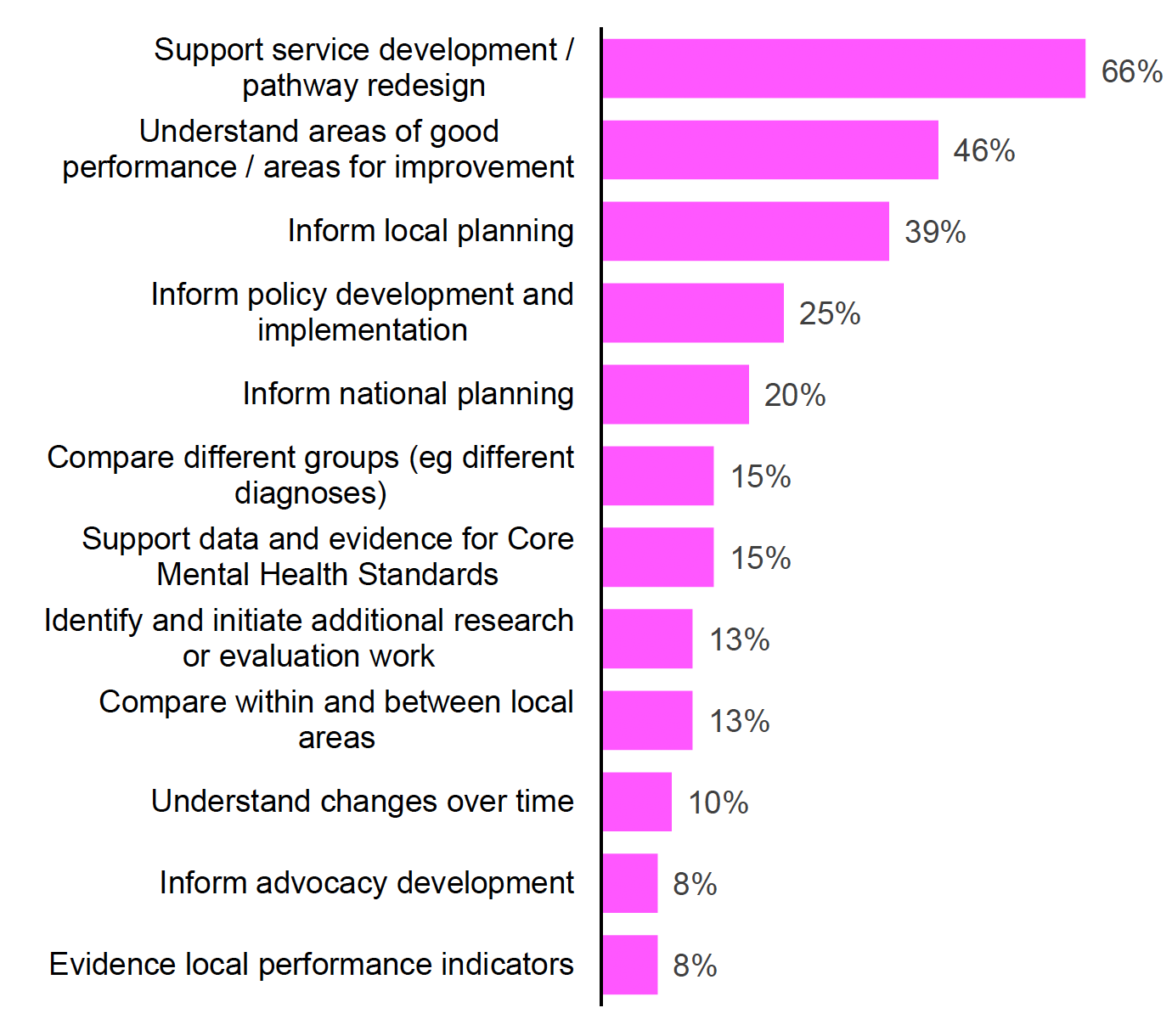
TLB survey respondents were asked to select from a predefined list the three most important potential uses of MHES survey data (see Figure 2). The most important, selected by two thirds (66%), was using the data to support service development and pathway redesign. Two other areas were considered important by a large proportion of respondents: to understand areas of good performance and areas for improvement (46%) and to inform local planning (39%). The next most important, selected by 25%, was to inform policy development and implementation, with other possible uses selected by fewer than one in five. A few TLB survey respondents added that they wanted to have service user involvement in service design and to guide carers of people with poor mental health to services.
When asked the open question: ‘What could the survey and its results enable you to do?’, the majority of TLB survey respondents highlighted the potential to improve services for service users. More specifically, respondents hoped to identify and make evidence-based changes to improve access to mental health support and service user outcomes, ensure services better meet service user needs, and direct resourcing to areas where improvements are most needed.
The second most common response to this question was to use a MHES survey to better understand the current performance and service user experience of mental health services. This includes whether service needs and standards are being met and to better understand local contexts.
Other uses raised, from most to least mentioned, were to identify gaps in service provision, use data for future planning, enable people with lived experience to share their experiences and be heard, understand barriers to service use, compare specific services/areas/treatments, identify good practice, support the funding of mental health services, and inform research.
Interviewees’ views on the purposes of a MHES survey aligned very closely with the above responses from TLB survey participants. They described two key aspirations: to capture the experiences of people with poor mental health and to collect data that is useable and focused on problem-solving, as opposed to collecting information for benchmarking. One noted that a survey presents an opportunity to show Scotland taking a lead in wellbeing in the UK and beyond.
The key desire for data from a MHES survey was for service improvement, with the data enabling the identification of problems and their resolution, as well as learning from instances of good practice. There is a strong desire to understand service user experiences, whether quality services are being delivered, and to identify differences in services and experiences through disaggregation of the data. There were a few suggestions to look at outcomes following service use.
A few other specific aspirations for the survey were each raised by individual interviewees:
- Taking a whole system approach, beyond just service use, for people with poor mental health particularly those with severe and enduring mental health conditions. This includes exploring whether people feel belonging, connected to community, and are supported in all aspects of life.
- To include experiences of neurodevelopmental services and pathways, including the process of receiving a diagnosis and being on waiting lists, and using survey data to identify training needs or reviews of guidance.
- Concerns about the limited usefulness of capturing data about negative experiences of services in a system that is trying to improve in the face of workforce challenges and a lack of capacity.
Other comments on the survey design
Multiple interviewees expressed a view that the entire survey process should be co-designed with people with lived experience of poor mental health from a range of different settings, potentially in collaboration with advocacy groups. At the other end of the process, one interviewee suggested that respondents with an interest in the findings may be interested in getting involved in changes to their local services.
A few interviewees made individual comments on the importance of taking time to develop an effective survey. This included calls for thorough planning, preparation, and engagement with likely respondents, stakeholders, and data users. They also noted that once a survey has been launched, it becomes very difficult to make changes without compromising the ability to track changes over time. Conversely, one interviewee suggested periodic reviews of a MHES survey to identify areas where the survey could be improved and whether accessibility requirements were consistently being met.
Limitations and challenges of a MHES survey
A few interviewees were asked about the challenges and risks of conducting a MHES survey. Potential issues raised included::
- Possible defensiveness from those working within mental health services about the survey, based on concern that negative survey results could contribute to a negative media view of mental health service provision.
- Challenges in getting buy-in to a survey, suggesting the need for positive, top-down organisational support and promotion of a survey, explaining how it will benefit service users
- Ensuring there is a plan to sustain a MHES survey in the long term.
Contact
Email: socialresearch@gov.scot