
Attainment Scotland Fund (ASF) Evaluation Summative report, 2026
The summative report is the final output of the Attainment Scotland Fund Evaluation Strategy 2022-26. It brings together both quantitative and qualitative evidence to report on progress towards the short, medium and long term outcomes of the Scottish Attainment Challenge.
Introduction
This report brings together the independent evidence and evaluation activities over the life of the Scottish Attainment Challenge (SAC) with a focus from 2022 and the introduction of the SAC mission to reflect on the progress towards the long term outcomes.
Scottish Attainment Challenge
The SAC is a key Government priority with investment over the past decade aiming to improve outcomes for children and young people impacted by poverty.
The SAC was launched in February 2015 with the strategic aim of closing the poverty-related attainment gap between children and young people from the least and most disadvantaged communities. The SAC was refreshed in 2022 with a strategic mission (‘To use education to improve outcomes for children and young people impacted by poverty with a focus on tackling the poverty-related attainment gap’) to deliver on the Scottish Government’s vision of equity and excellence in education, set out in the Framework for Recovery and Accelerating Progress.
Attainment Scotland Fund (ASF)
The Attainment Scotland Fund (ASF) is the collective name for the funding that supports the SAC. The stated aim of the ASF is to achieve excellence and equity in education by prioritising improvements in literacy, numeracy, and health and wellbeing of those children and young people adversely affected by poverty. The ASF represents approximately 3% of school education spending in Scotland. It is designed to leverage wider change within the system towards the SAC strategic mission. The ASF in this parliamentary term represents a commitment to invest £1 billion, spread over the following funding streams:
- Strategic Equity Funding (SEF): introduced in 2022 across all 32 local authorities to support planning and strategic activities contributing to the strategic mission in recognition that poverty impacts children and young people in all local authority areas. SEF replaced the earlier Challenge Authority Funding provided to the 9 local authorities with the highest levels of deprivation
- Pupil Equity Funding (PEF): introduced in 2017 and allocated directly to schools on the basis of free school meal (FSM) registration for pupils in P1-S3 in accordance with the Pupil Equity Funding: national operational guidance 2023. Over 97% of schools in Scotland receive PEF. Funding is allocated to schools on a per-pupil basis and headteachers decide how to allocate the budget within their school
- Care Experienced Children and Young People (CECYP) Funding: introduced in 2018/19 and allocated to all local authorities based on the number of care experienced children and young people aged 5 to 15. The fund aims to improve the educational outcomes and experiences for care experienced children and young people and is supported by the strategic goals of The Promise as well as the SAC. Funding can be invested on care experienced children and young people aged between 0 and 26. It includes all children and young people who have had any care experience at any stage in their life
- National Programmes: ASF also contributes to investment in third sector partnerships with national youth organisations, provision of Education Scotland Attainment Advisor support for all local authorities, workforce development and the evaluation of the SAC programme
A key element in the Framework for Recovery and Accelerating Progress was for local authorities to set ambitious, and achievable ‘stretch aims’ for progress towards attainment and closing the poverty-related attainment gap across a sub-set of the National Improvement Framework (NIF) measures. Local authorities initially submitted stretch aims for the 2022/23. For 2023/24 – 2025/26, they set multi-year stretch aims for the 3 year period. Individual stretch aims are published alongside an aggregation to provide a national picture (see for example, Scottish Attainment Challenge - local stretch aims: 2022 to 2023).
The ASF Evaluation
A comprehensive evaluation has been ongoing since the start of the SAC programme in 2015, to provide evidence and learning about the overall implementation of the ASF to enable assessment of progress towards its long-term outcomes.
The Scottish Government and Education Scotland published Closing the poverty-related attainment gap: progress report 2016 to 2021 which summarised the impacts of the first 5 years of the fund (£750m).
The evaluation programme was refreshed in 2022 to incorporate the SAC strategic mission. Collaborative work with national stakeholder organisations identified the inputs, activities, and short-, medium- and long-term outcomes of the SAC programme, which was used to develop the Scottish Attainment Challenge Logic Model. The Logic Model is ‘nested’ to set out activities at school, local authority, regional and national levels. The Logic Model is the framework guiding all of the evaluation activities, and underpins the assessment of the extent to which progress has been made towards meeting intended outcomes.
The Evaluation Strategy for the Attainment Scotland Fund 2022-26 set out the evaluation approach during the current parliamentary term. Analytical plans were produced in 2022/23, 2023/24 and 2024/25 with detail on the evaluation activity and outputs in each year.
The evaluation strategy comprises the following four key strands:
- Process evaluation to consider implementation of the refreshed ASF including SEF, PEF and CECYP funding
- Thematic evaluation strands to respond to emerging system priorities and to consider ‘what works, for whom and in what circumstances’
- Reporting on the National Improvement Framework (NIF) measures of the poverty-related attainment gap
- Impact evaluation to ascertain the impact of ASF through a combination of qualitative and quantitative research and analysis
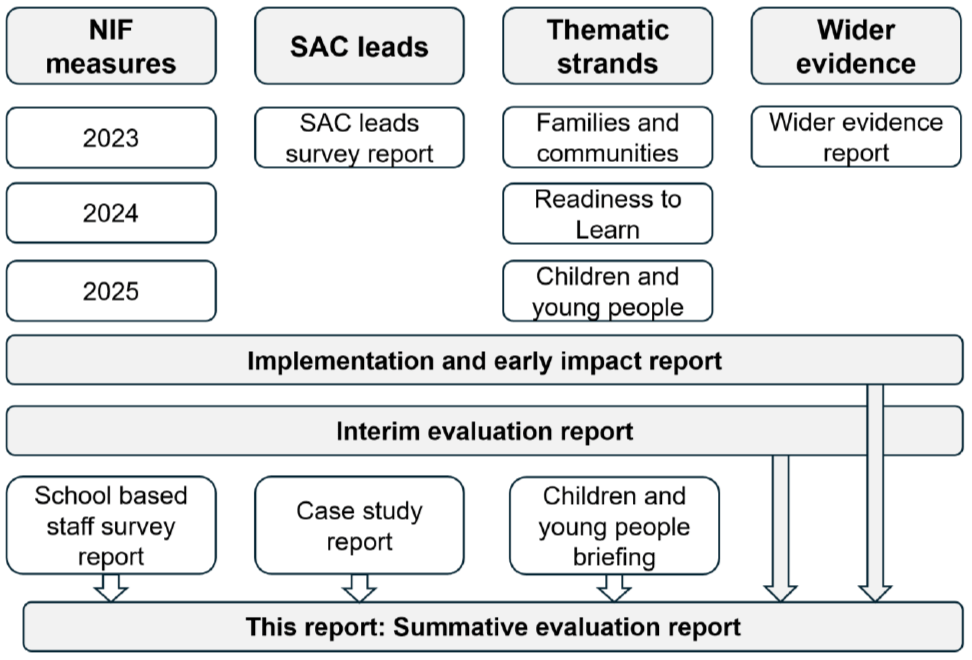
The figure below outlines the evaluation evidence sources in more detail along with the evaluation outputs:
About this report
This summative report builds on the 2025 ASF Evaluation Interim Report and summarises the evaluation evidence to enable an assessment of progress achieved against the evaluation questions set out in the Evaluation Strategy for the Attainment Scotland Fund 2022-26. The following new evidence sources have become available since the interim report and underpin the final perspectives in this report:
- SAC Leads Survey: The latest iteration was carried out in November – December 2025 with 28 of 32 local authorities responding (87% response rate). Findings are presented in this report and the methodology is covered in Annex 2
- Case study research: Qualitative case study research undertaken in 14 schools across Scotland and published in November 2025. This provides more detailed insights into the experiences and perceptions of staff working in (or with) the case study schools in relation to the implementation and impact of the ASF, to complement the quantitative data gathered in the School Survey
- National Stakeholder Interviews: a series of interviews with national stakeholders was undertaken in December 2025 – January 2026. This included 6 individual interviews and one interview with two stakeholders
The report also updates the NIF data where it is available for 2024/25. It is structured across the following key outcome areas and links to the relevant evaluation questions:
- Implementation of the Fund
- Embedded practices and culture
- Closing the gap
- Achievement
Contact
Email: socialresearch@gov.scot