
1+2 languages policy: Findings from the 2024-25 survey of local authorities
Findings of a 2024-25 survey of local authorities on the implementation of the 1+2 languages policy in schools.
5. Language learning in special schools
Recognising that satisfying the criteria of the 1+2 policy may not be fully applicable / appropriate for special schools, we instead asked local authorities the broader questions of how many of their special schools were providing opportunities for language learning.
The responses received show that approx. 84% of special schools responding were providing such opportunities in 2024-25 (compared with 70% in 2022-23 and 91% in 2020-21).
The provision of languages / communications systems such as Picture Exchange Communication System (PECS), Makaton, Signalong and BSL was more common.
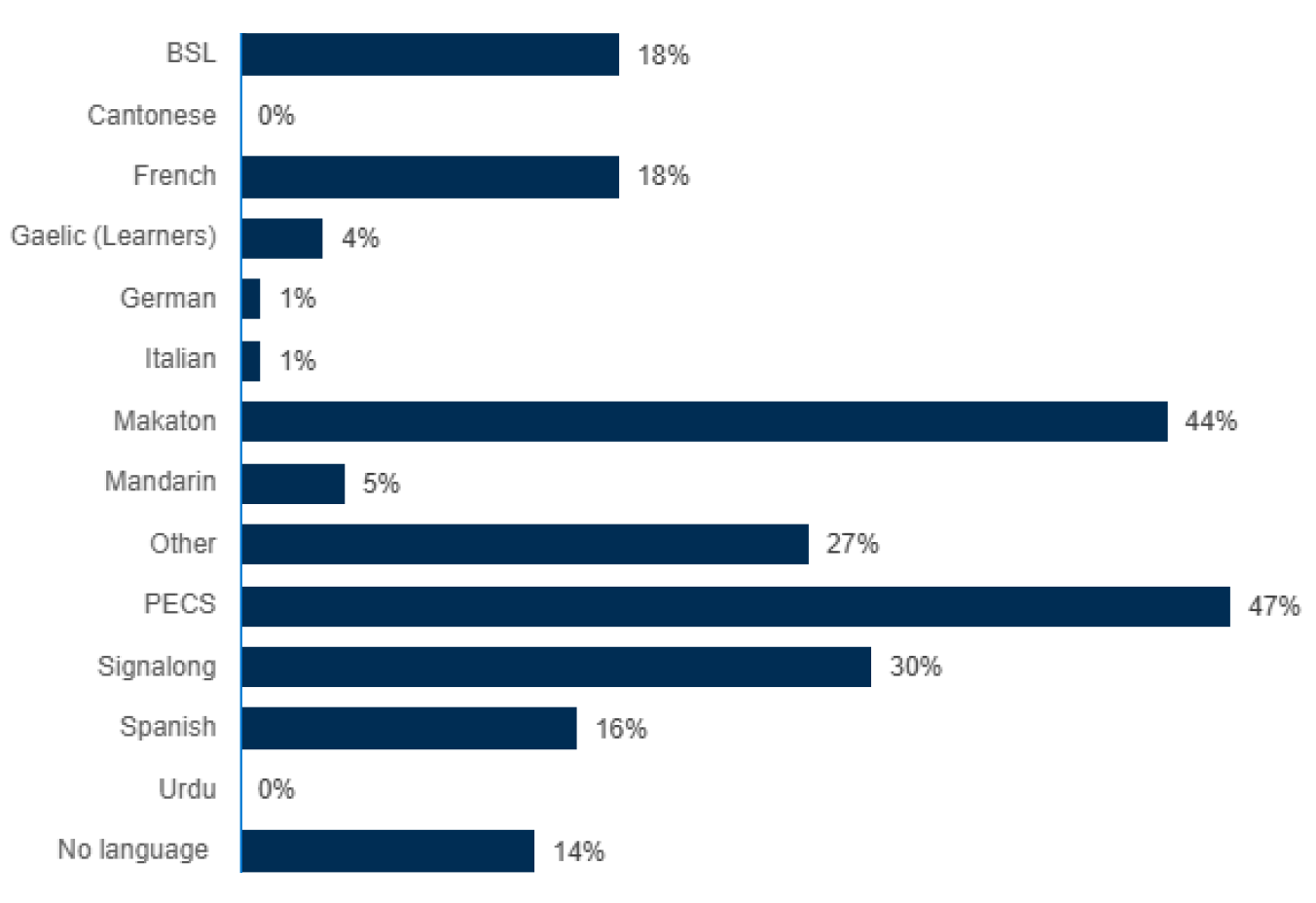
N.B. Adds to over 100% as more than one option per school is possible. Out of 73 schools.
Languages reported in the ‘Other’ category included Arabic, Braille, Sign Supported English, Movement / Gesture and Signs.
Further various Augmentative and Alternative Communication (AAC) systems as well as ‘high and low tech’ technologies and communication aids included:
- Tactile Signing for Sensory Learners (TaSSeLs) a means of communication with children with Profound and Multiple Learning Disabilities.
- Eye Gaze a communication technology designed for users to communicate with eye movements.
- Proloquo2go an app used by non-speaking children and adults.
- The Canaan Barrie On Body Sign System, a sign system used to communicate with children who have multiple disabilities, as well as visual impairment.
- Boardmaker, Pragmatic Organisation Display (PODD) and TD Snap which organise vocabulary using symbols and words.
- Pixon, a system using manual communications boards and single meaning pictures.
Contact
Email: ceu@gov.scot