
1+2 languages policy: Findings from the 2024-25 survey of local authorities
Findings of a 2024-25 survey of local authorities on the implementation of the 1+2 languages policy in schools.
4. Language learning in secondary schools
L2 provision - secondaries
4.1 Overall L2 provision
We asked local authorities how many of their secondary schools were providing an L2 entitlement. We defined this as:
- By full we mean an L2 is taught continuously from S1 to S3.
- By partial we mean an L2 is not taught continuously from S1 to S3.
- By none we mean an L2 is not taught at all from S1 to S3.
The responses received show that approximately 98% of secondary schools were providing either a full or partial L2 entitlement during 2024-25, down from 100% in 2020-21 and 2022-23. This breaks down as follows:
| L2 entitlement % | 2024-25 | 2022-23 | 2020-21 |
|---|---|---|---|
| Full | 53% | 61% | 70% |
| Partial | 45% | 39% | 30% |
| None | 3% | 0% | 0% |
The overall L2 language learning implementation in secondary schools shows a decrease of the full L2 entitlement from 70% in 2020-21 to 61% in 2022-23 and 53% in 2024-25. 3% of secondary schools reported not providing any L2 language learning from S1 to S3.
4.2 L2 provision by language
The most taught L2 language continued to be French, being taught by approx. 83% of secondary schools that responded to the survey (compared to 82% in 2022-23 and 86% in 2020-21).
Spanish remained the second most taught languages being taught in 46% of schools growing from 36% in 2022-23 and 23% in 2020-21.
German remained the third most taught languages being taught in 16% of schools potentially stabilising with year-on-year variation (17% in 2022-23 and 11% in 2020-21).
Gaelic (Learners) was taught in 8% of schools (compared to 8% in 2022-23 and 5% in 2020-21).
Italian was taught in 3% of schools (compared to 3% in 2022-23 and 1% in 2020-21).
Mandarin was taught in 3% of schools in 2024-25 compared to 1% in 2020-21 and 2% in 2022-23.
Urdu and Cantonese were being taught in less than 1% of schools.
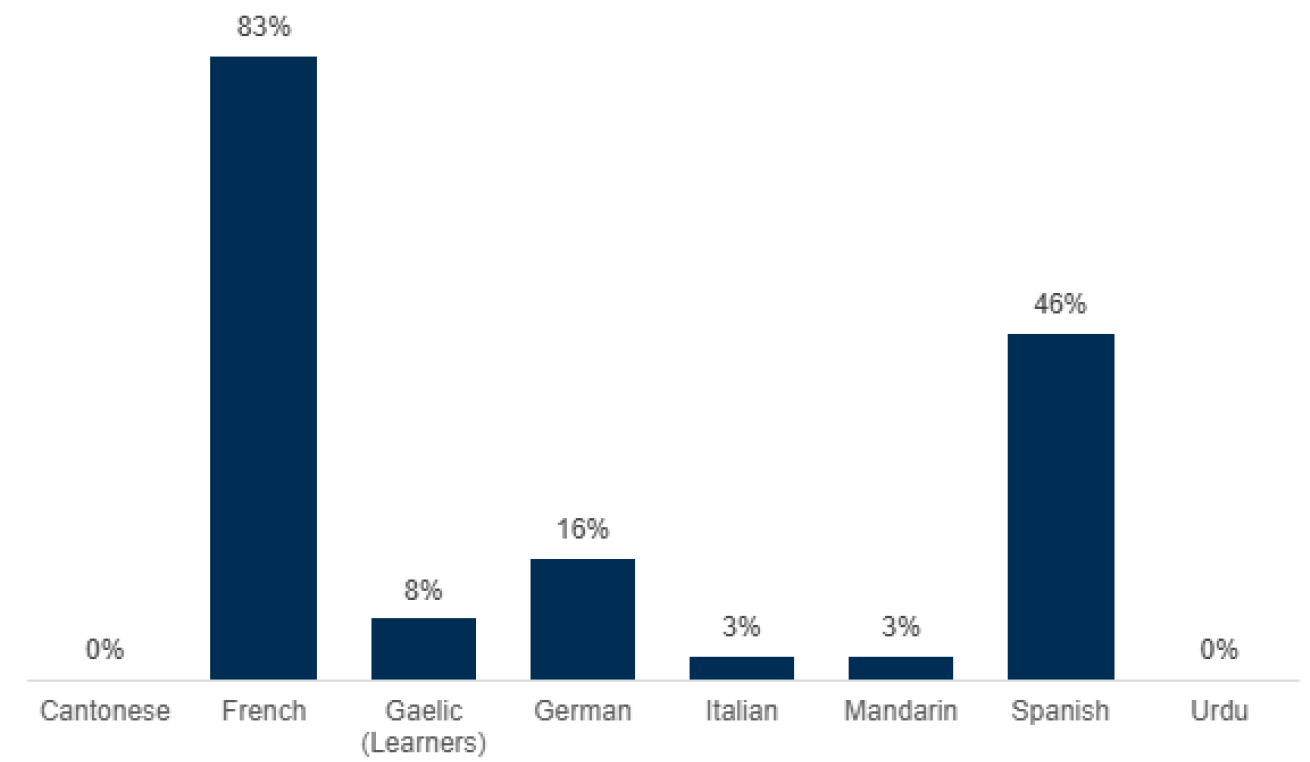
N.B. Total adds to over 100% as a school can provide more than one L2 language. Out of 320 schools responding to the survey.
4.3 L2 approach
We asked local authorities to provide details on which other speakers support their secondary schools use to provide the L2 entitlement.
Only a small percentage of all schools reported using support from other speakers; 4% used staff outwith the language department and 1% used a language assistant.
| Support from other speakers | Percentage of schools* |
|---|---|
| Language assistant | 1% |
| School staff outwith language department | 4% |
* Percentage of 320 schools that answered the survey on providing an L2
L3 provision - secondaries
4.4 Overall L3 provision
We asked local authorities how many of their secondary schools were providing an L3 entitlement. We defined this as follows:
- That, in addition to the L2, one or more languages are taught as a planned part of the curriculum at some point during the Broad General Education.
The responses received show that approx. 83% secondary schools were providing an L3 entitlement in 2024-25 decreasing from 2022-23 (88%) and 2020-21 (88%) when implementation appeared stable.
| L3 entitlement % | 2024-25 | 2022-23 | 2020-21 |
|---|---|---|---|
| Yes | 83% | 88% | 88% |
| No | 18% | 12% | 13% |
N.B. Figures may not add to 100% due to rounding.
Because the L3 entitlement does not require the L3 to be taught continuously, it may be easier to implement, and this could explain why the L3 implementation was greater than the “full” L2 (53%).
4.5 L3 provision by language
The most popular L3 language continued to be Spanish, taught by 59% of secondary schools (down from 65% in 2022-23 and 62% in 2020-21).
French remained the second most popular L3 taught by 33% of schools (compared to 34% in 2022-23 and 28% in 2020-21) followed by German (24% in 2024-25 slightly decreasing from 27% in 2022-23 and 29% in 2020-21), Mandarin (11%), Italian (8%), Gaelic (Learners) (6%) and Urdu (1%).
In contrast to primary schools, the majority of languages offered as L3 in secondary schools are languages that can be taken at National 5, Higher, or Advanced Higher level (i.e. the L2 group of languages) – which may suggest a stronger link between L3 and potential senior phase subject selection in secondary pupils. Other languages are offered mostly BSL (3%) and Scots (3%) but Arabic, Latin and Russian were also mentioned.
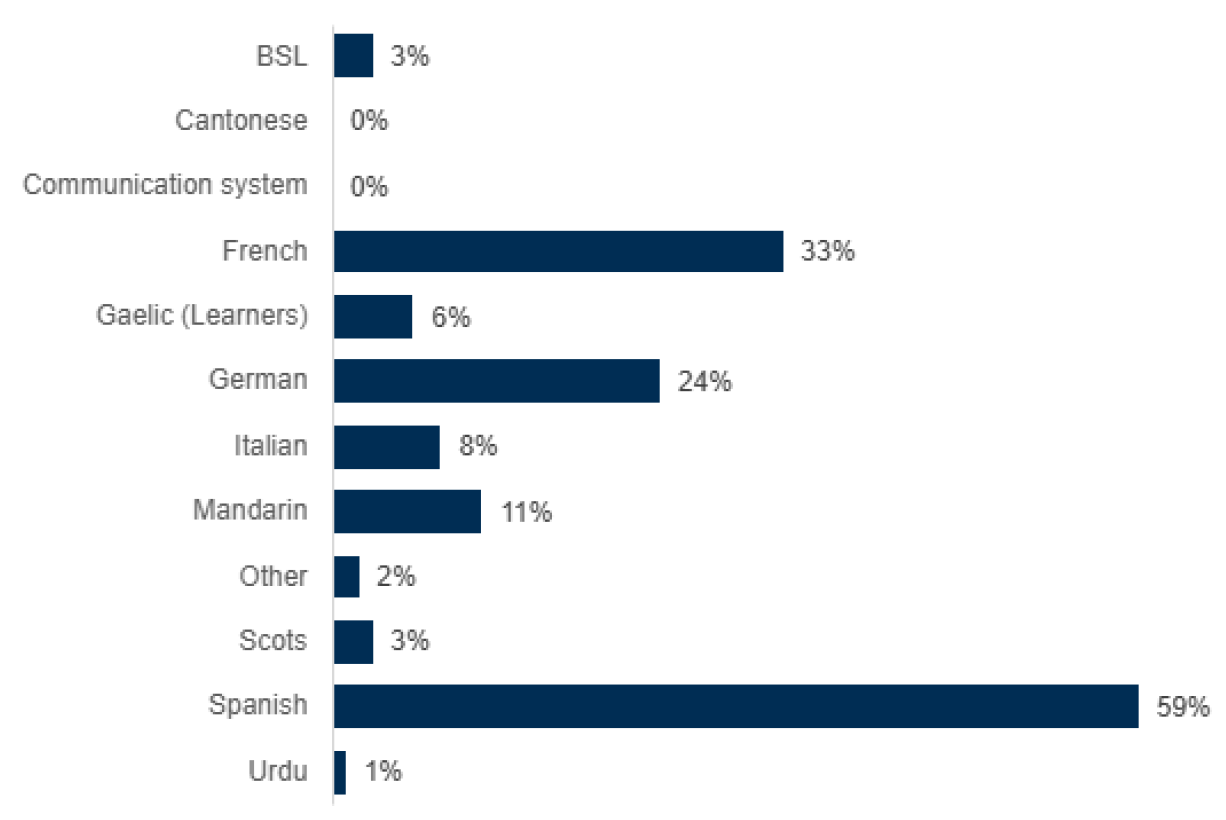
N.B. Adds to over 100% as more than one L3 may be provided at a school. Out of 320 schools.
4.6 Approaches to L3 provision
We asked local authorities to elaborate on approaches their secondary schools take to provide the L3 entitlement.
The majority of schools offered the L3 provision from S1 to S3 (65%) although about a third of schools only offered the L3 for one year in S1 (11%), S2 (15%) or S3 (8%).
| Years entitlement is provided | Percentage of schools* |
|---|---|
| L3 is provided in S1 only | 11% |
| L3 is provided in S2 only | 15% |
| L3 is provided in S3 only | 8% |
| L3 is provided throughout S1 to S3 | 65% |
* Percentage of schools which provided an L3 and answered this question.
92% of the schools reported that the class is taught solely by a member of the language department.
| Approach | Percentage of schools* |
|---|---|
| Taught solely by a member of languages department | 92% |
| Taught by / with support of another speaker | 8% |
* Percentage of schools which provided an L3 and answered this question.
Furthermore, schools reported that support from another speaker was equally divided between support from a language assistant and school staff outwith the language department.
Contact
Email: ceu@gov.scot