
Agricultural reform: environmental report - strategic environmental assessment
We are reforming agricultural support. This strategic environmental assessment (SEA) environmental report, required under the Environmental Assessment (Scotland) Act 2005, highlights the positive environmental impacts of proposed changes to farming and food production.
Chapter 1 Introduction
Purpose of this report
The Scottish Government is currently preparing their Agricultural Reform, changing how the government will support farming and food production in Scotland. The ‘Vision for Agriculture’, published in March 2022, [See reference 36] outlines the long-term vision for Scotland to become a global leader in sustainable and regenerative agriculture. The Agriculture and Rural Communities (Scotland) Act 2024 [See reference 37] establishes the legislative foundation for the Agricultural Reform, enabling the introduction of a four-tiered support framework underpinned by the five key objectives of the Act:
a) the adoption and use of sustainable and regenerative agricultural practices,
b) the production of high-quality food,
c) the promotion and support of agricultural practices that protect and improve animal health and welfare,
d) the facilitation of on-farm nature restoration, climate mitigation and adaptation, and
e) enabling rural communities to thrive.
The objectives of the Act translate to the Agricultural Reform outcomes shown in the Figure 0.1.
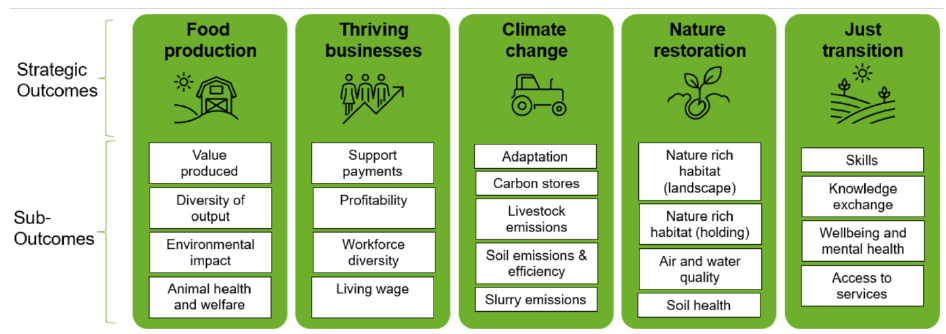
Strategic Outcome - Food production
Sub-outcome
- Value produced
- Diversity of output
- Environmental impact
- Animal health and welfare
Strategic Outcome – Thriving businesses
Sub-outcome
- Support payments
- Profitability
- Workforce diversity
- Living wage
Strategic Outcome – Climate change
Sub-outcome
- Adaption
- Carbon stores
- Livestock emissions
- Soil emissions and efficiency
- Slurry emissions
Strategic Outcome – Nature restoration
Sub-outcome
- Nature rich habitiat (landscape)
- Nature rich habitat (holding)
- Air and water quality
- Soil health
Strategic Outcome – Just transition
Sub-outcome
- Skills
- Knowledge exchange
- Wellbeing and mental health
- Access to services
LUC was commissioned by the Scottish Government to undertake a Strategic Environmental Assessment (SEA) of the Agricultural Reform. The SEA process is a requirement of the Environmental Assessment (Scotland) Act 2005 [See reference 38] which requires that an environmental assessment is carried out of certain plans and programmes which are likely to have significant effects on the environment. The purpose of this Environmental Report is to present the findings of the SEA process.
Emerging Agricultural Reform
Context of the Agricultural Reform
The Agricultural Reform involves the development of a new policy framework to deliver the Vision for Agriculture that will replace the current Common Agricultural Policy and the Scottish Rural Development Programme (SRDP). It will support and help ensure the delivery of the Vision for Agriculture [See reference 39]. The Agricultural Reform and its implementation via the Agriculture and Rural Communities (Scotland) Act 2024 [See reference 40], lie at the heart of Scotland’s commitment to become “a global leader in sustainable and regenerative agriculture” and deliver “high quality food production, climate mitigation and adaptation, and nature restoration”.
The Agricultural Reform Route Map [See reference 41] sets out the process for changing to the new agricultural support framework, outlining key dates for change, future measures being considered, when existing schemes will end and how farmers should prepare for change.
The Agriculture and Rural Communities (Scotland) Act 2024 requires Scottish Ministers to publish a Rural Support Plan which sets out requirements on the role, content, scrutiny, reporting and monitoring and evaluation of plans. The Rural Support Plan will build upon for the Vision for Scottish Agriculture and the Agricultural Reform Route Map and outline the phased transition from legacy EU CAP schemes to the new four-tier framework.
The Agriculture and Rural Communities (Scotland) Act 2024 requires the Scottish Government to publish a Code of Practice on Sustainable and Regenerative Agriculture, which sets out the principles of sustainable and regenerative agriculture and provides guidance and practical examples on the types of sustainable and regenerative activities that can be adopted on farms or crofts.
Scope and content of the Agricultural Reform
The Vision for Agriculture introduces a new four-tiered Support Framework which is undergoing development. The first changes were introduced on 1 January 2025 and future measures will be introduced on a phased basis over several years. Given the phased implementation of the Agricultural Reform, elements of each Tier are at varying stages of development. However, an overview of each Tier is set out below:
- Tier 1 Base and Tier 2 Enhanced are direct payments
- Tier 1 Base will provide direct payments to support active farming. Scottish Government will start off using the current Basic Payment Scheme (BPS) and add new conditions over time. Receiving this support will require meeting what will be called essential standards (e.g. Cross Compliance, Statutory Management Requirements, etc.).
- Tier 2 Enhanced will support farmers and crofters to do even more for climate and nature. It will build on the standards established in Tier 1 and provide additional measures to reduce greenhouse gas emissions and restore and improve nature for those who opt to go further.
- Tier 3 Elective and Tier 4 Complementary are indirect payments
- Tier 3 Elective will support action that protects habitats or species or improves business sustainability. It will focus on funding targeted actions for climate change and nature restoration. This could be specific to a particular species or habitat, support conversion to alternative forms of agriculture such as organic production, encourage innovation and provide supply chain support.
- Tier 4 ‘Complementary will help to grow skills and capabilities. This will include training and advice. It will focus on ensuring applicants are prepared for the suite of management options, new practices and innovation under Tiers 1-3.
Stage of the Agricultural Reform
The Scottish Government has taken a phased approach to developing the Agricultural Reform. The Vision for Agriculture was published in 2022, outlining the high-level outcomes for the future Agricultural Reform and the Agricultural Reform has adopted an incremental, transitional approach to delivering the Vision. This is to allow for changes in legislation, IT systems and people’s practice.
The ‘Agricultural Reform List of Measures’ [See reference 42], which sets out the types of actions the government may expect from farmers and crofters who wish to receive certain agricultural support payments in the future, was published 10 February 2023. The Scottish Government continues to work on this list and to establish where they best fit in the future Agricultural Reform Support Framework.
The changes being delivered within the Agricultural Reform are set out in the Agricultural Reform Route Map. The Scottish Government published the most recent iteration of the Agricultural Reform Route Map on 12 June 2025 [See reference 43], setting out timescales for known changes to the support framework. It also sets out high level future measures being considered as part of the longer-term implementation of the Agricultural Reform. The Route Map will be regularly revised and updated in the future as information and guidance on what the sector can expect becomes available.
The first Tier 1 changes were introduced on 1 January 2025, as follows:
- Introduction of the Whole Farm Plan;
- a new calving interval requirement for the Scottish Suckler Beef Support Scheme; and
- new protections for peatlands and wetlands, with new conditions added to Good Agricultural and Environmental Conditions (GAEC) 6: Maintenance of soil organic matter.
Measures which will take effect from 1 January 2026 include initial changes to requirements for the management of Ecological Focus Areas (EFAs) under Tier 2: Enhanced Greening. The Future Farm Investment Scheme (FFIS), was a capital grant scheme for farmers and crofters under Tier 3: Elective, which was announced 19 June 2025 and was open for applications 14th July-22nd August 2025. Other measures for Tier 3: Elective and Tier 4: Complementary will be introduced from 2027, meanwhile existing support mechanisms remain in place.
A preliminary version of the ‘Code of Practice on Sustainable and Regenerative Agriculture’, was published on 19 June 2025 [See reference 44]. It sets out best practice guidance on the types of activities that can be adopted on a farm or croft that will contribute to the development of sustainable and regenerative agricultural practices in Scotland, to ensure a balance between producing food and doing so in a sustainable way. The Scottish Government are developing an updated version to be published in 2026.
Policy development is being supported by the Agricultural Reform Implementation Oversight Boad (ARIOB), an external Board of industry experts co- chaired by the Cabinet Secretary for Rural Affairs, Land Reform and Islands, in addition to an expanded Academic Advisory panel. Their work builds on the work of Farmer-Led Groups.
This SEA is being undertaken at a ‘point in time’ of the development of the Agricultural Reform, which will constitute a longer-term programme of change. As such, varying degrees of information and certainty about the future development of individual Tiers and delivery mechanisms are known at the time of writing. Some elements, including change to be implemented in 2025 and 2026 (generally within Tier 1 and Tier 2) have been fully developed. Other changes, including elements of Tier 3 and Tier 4 and longer-term aspirations for all Tiers, remain in the early stages of development and therefore limited detail is available for consideration in this assessment. The Scottish Government’s Agricultural Reform Route Map [See reference 45] therefore forms the basis of assessment contents of this SEA.
Strategic Environmental Assessment
The Environmental Assessment (Scotland) Act 2005 (‘the 2005 Act’) [See reference 46], is a means to judge the likely impact of a plan, programme or strategy on the environment and to seek ways to minimise adverse effects, if likely to be significant. The Agricultural Reform falls with section 5 (3) of the 2005 Act, requiring an SEA to be undertaken.
The Scottish Government, which is preparing the Agricultural Reform, is the 'Responsible Authority' with a duty to undertake the SEA, and LUC has been commissioned to do this on its behalf.
The SEA process comprises a number of stages described below:
- Screening
- Scoping – preparation of a Scoping report and consultation with the SEA Consultation Authorities [See reference 47] on the scope and level of detail to be considered in the assessment of the Agricultural Reform.
- Environmental Assessment and Reporting
- Environmental Report - An assessment of the likely significant impacts on the environment as a result of the emerging Agricultural Reform.
- Consultation on the draft Environmental Report.
- Post Adoption SEA Statement
- Monitoring the significant environmental effects of implementing the Agricultural Reform.
A Scoping Report was prepared and submitted to the SEA Gateway on 4 July 2025 for a five-week consultation period with the three statutory bodies (SEPA, HES and NatureScot). Responses from the consultation authorities were received on 8 August 2025. The comments received and how these have been addressed are presented in Appendix B.
The UK withdrawal from the European Union (Continuity) (Scotland) Act 2021
Section 14 of the Continuity Act [See reference 48] places a duty on Scottish Ministers to have due regard to the ‘guiding principles’ on the environment when developing policy, including the development of legislation. The guiding principles are set out below and have been taken into account in the preparation of the Environmental Report: The guiding principles as set out in Section 13 (1) of the Act are:
- the principle that protecting the environment should be integrated into the making of policies,
- the precautionary principle as it relates to the environment,
- the principle that preventative action should be taken to avert environmental damage,
- the principle that environmental damage should as a priority be rectified at source,
- the principle that the polluter should pay.
Structure of the Environmental Report
This chapter describes the background and context of the Agricultural Reform and the requirement to undertake SEA. The remainder of this report is structured as follows:
- Chapter 2 describes the approach to assessment including the development of an SEA framework, consideration of reasonable alternatives and an outline of difficulties encountered during the assessment.
- Chapter 3 describes the relationship of the Agricultural Reform to other plans programmes and strategies and environmental protection objectives of relevance to the Agricultural Reform (this is supported by additional information in Appendix A).
- Chapter 4 sets out the environmental baseline information and identifies the key trends and environmental problems for Scotland relating to each subject area, and sets out their likely evolution without the emerging Agricultural Reform.
- Chapter 5 describes the findings of the SEA, i.e. the significant environmental effects expected from the Agricultural Reform and reasonable alternatives.
- Chapter 6 describes the mitigation and enhancement measures proposed.
- Chapter 7 describes the approach to monitoring.
- Chapter 8 sets out conclusions and the next steps for the Agricultural Reform and the environmental assessment process.
The main body of the report is supported by appendices:
- Appendix A presents the review of plans, programmes and environmental protection objectives of relevance to the emerging Agricultural Reform.
- Appendix B presents the consultation comments received in relation to the SEA Scoping Report, and how these comments have been addressed in this Environmental Report.
- Appendix C presents environmental baseline supporting figures.
- Appendix D presents the SEA assessment findings.
- Appendix E presents an overview of assessment scores
Contact
Email: ARPEngage@gov.scot