
Agricultural reform: environmental report - strategic environmental assessment
We are reforming agricultural support. This strategic environmental assessment (SEA) environmental report, required under the Environmental Assessment (Scotland) Act 2005, highlights the positive environmental impacts of proposed changes to farming and food production.
Appendix D Assessment findings
Assessment findings for Agriculture and Rural Communities (Scotland) Act Objectives and Agricultural Reform Outcomes
D.1 The Agriculture and Rural Communities (Scotland) Act 2024 [See reference 402] establishes the legislative foundation for the Agricultural Reform, enabling the introduction of a four-tiered support framework underpinned by the 5 key objectives of the Act:
a) the adoption and use of sustainable and regenerative agricultural practices,
b) the production of high-quality food,
c) the promotion and support of agricultural practices that protect and improve animal health and welfare,
d) the facilitation of on-farm nature restoration, climate mitigation and adaptation, and
e) enabling rural communities to thrive.
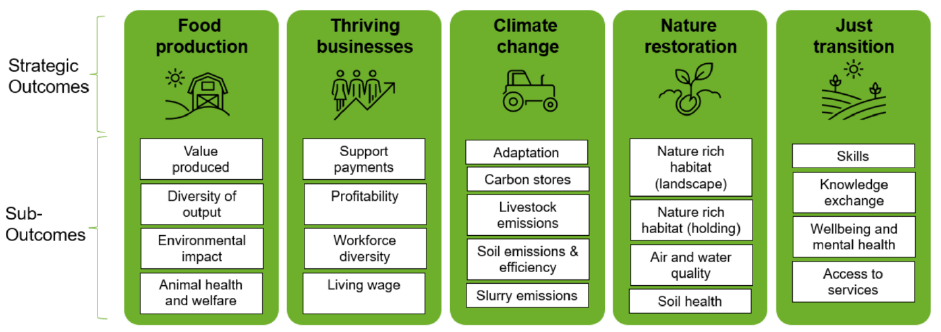
D.2 The objectives of the Act translate to the Agricultural Reform outcomes shown in the Figure D.1. They are:
- High quality food production (value produced, diversity of output, environmental impact, animal health and welfare)
- Thriving agricultural businesses (support payments, profitability, workforce diversity, living wage)
- Climate change mitigation and adaptation (adaptation, carbon stores, livestock emissions, soil emissions and efficiency, machinery emissions, slurry emissions)
- Nature restoration (nature rich habitat (landscape), nature rich habitat (holding), air and water quality, soil health)
- Support for a just transition (skills, knowledge exchange, wellbeing and mental health, access to services)
Strategic Outcome - Food production
Sub-outcome
- Value produced
- Diversity of output
- Environmental impact
- Animal health and welfare
Strategic Outcome – Thriving businesses
Sub-outcome
- Support payments
- Profitability
- Workforce diversity
- Living wage
Strategic Outcome – Climate change
Sub-outcome
- Adaption
- Carbon stores
- Livestock emissions
- Soil emissions and efficiency
- Slurry emissions
Strategic Outcome – Nature restoration
Sub-outcome
- Nature rich habitiat (landscape)
- Nature rich habitat (holding)
- Air and water quality
- Soil health
Strategic Outcome – Just transition
Sub-outcome
- Skills
- Knowledge exchange
- Wellbeing and mental health
- Access to services
Table D.1: Assessment findings for Act objectives and Agricultural Reform strategic outcomes framework
1. Biodiversity, flora and fauna
The Act strongly supports farming methods across the whole of Scotland which are more beneficial for the environment and nature recovery on farmland, in particular, the outcomes of “Nature restoration” and “Climate change” are focused on improving wildlife, air and water quality, and soil health across both individual farms and wider landscapes. This is expected to create better connected habitats, reduce fragmentation, and improve conditions for species. In addition, measures for improving animal health and sustainable food production also help ease pressure on the land, which can reduce harm to ecosystems.
This is significant because biodiversity loss is a major environmental problem in Scotland, with species abundance down 15% since 1994 and 11% of species threatened with extinction. The Agricultural Reform applies nationally across 69% of Scotland’s land used for agriculture, so the scale of change is large. Given that habitat restoration and ecological recovery take time, the effects are expected to occur in the medium to long term.
This provides a direct uncertain significant positive effect, bringing about change in the medium to long term. Effects are uncertain as they will depend on the actual changes and measures introduced by the Agricultural Reform over the course of its development.
2. Population and human health
By promoting the production of high-quality food and enabling rural communities to thrive, the Act contributes to better diets, local food security, and stronger community wellbeing. The Agricultural Reform outcomes “Thriving agricultural businesses” and “Support for a just transition” reinforce this by improving livelihoods through fair payments, profitability, workforce diversity and living wage commitments, while also investing in skills, knowledge sharing, mental health, and access to services. Overall, these measures help to support healthier and more resilient populations across Scotland. In addition, rural communities across Scotland are particularly vulnerable to climate change and economic decline, and the Agricultural Reform applies nationally to all of them. The positive change is therefore considered significant, even though benefits will take time to emerge.
This provides an indirect uncertain significant positive effect, bringing about change in the medium to long term. Effects are uncertain as they will depend on the actual changes and measures introduced by the Agricultural Reform over the course of its development.
3a. Climate mitigation
The objectives and outcomes help to mitigate greenhouse gas emissions by promoting sustainable farming, efficiency, and climate-smart approaches. The Act’s objective’s directly support climate mitigation and the Agricultural Reform outcome of “Climate Change mitigation and adaptation” directly address emissions from livestock, soils, machinery, and slurry, while also encouraging protection of carbon stores.
Agriculture is the second largest source of emissions in Scotland (7.7 MtCO₂e in 2022), so action in this sector has a significant influence on meeting the 2045 net zero target. Since carbon storage and reductions in livestock and soil emissions depend on sustained land use change, the positive impacts are expected in the medium to long term.
This provides a direct uncertain significant positive effect, bringing about change in the medium to long term. Effects are uncertain as they will depend on the actual changes and measures introduced by the Agricultural Reform over the course of its development.
3b: Climate adaptation
The objectives and outcomes include measures which will aid in climate change adaptation, for example the Agricultural Reform outcome on “Climate change mitigation and adaptation” highlights measures to increase resilience, while “Nature restoration” supports the creation of healthy ecosystems which also help to mitigate climate risks, in particular measures to support soil health, water retention, and biodiversity.
This is significant given Scotland faces major risks from flooding, drought and heat stress, with 284,000 properties already at risk of flooding. Measures that increase resilience in soils, water, and ecosystems are expected to provide widespread adaptation benefits over time.
This provides an indirect uncertain significant positive effect, bringing about change in the medium to long term. Effects are uncertain as they will depend on the actual changes and measures introduced by the Agricultural Reform over the course of its development.
4. Air
Although air quality is not directly addressed in the Act, many of the actions of the objectives and outcomes, such as sustainable farming, cutting emissions, and restoring nature, will aid in mitigating air pollution. Changes in livestock emissions and land management can also support improved air quality over time.
Agriculture accounts for 90% of ammonia emissions in Scotland, which is a significant contributor to poor air quality and PM2.5 pollution. Reducing emissions will therefore support cleaner air, but changes will be indirect and gradual.
This provides an indirect minor positive effect, bringing about change in the medium to long term. Effects are uncertain as they will depend on the actual changes and measures introduced by the Agricultural Reform over the course of its development.
5. Soil
The Act’s focus on regenerative agriculture and nature restoration directly supports the protection of soil health and carbon-rich soils. The Agricultural Reform outcome of “Climate change mitigation and adaptation” supports soil health by cutting greenhouse gas emissions from fields, livestock, and slurry, while also protecting soils as carbon stores and making them more resilient to drought and flooding. The Agricultural Reform objective of “Nature restoration” includes a specific commitment to soil health and recognises the role of habitats like grasslands and wetlands in reducing erosion and building soil fertility.
This is significant as Scotland’s soils store around 3,000 million tonnes of carbon, but over 80% of peatlands are degraded. Protecting and restoring these soils therefore helps to address this significant environmental issue. Improvements in soil condition will take time, so positive effects are expected in the medium to long term.
This provides a direct uncertain significant positive effect, bringing about change in the medium to long term. Effects are uncertain as they will depend on the actual changes and measures introduced by the Agricultural Reform over the course of its development.
6. Water
The Act’s objectives focus on sustainable and regenerative practices, as well as its objective to facilitate nature restoration and climate adaptation, will provide benefits for water environments. The Agricultural Reform outcomes on “Nature Restoration” and “Climate Change” will likely result in improvements to water quality and management through measures such as reduced fertiliser and slurry runoff, healthier soils with better structure, and increased infiltration. These help to protect rivers, lochs and groundwater, while also reducing flood risk and improving resilience to drought.
This is significant given that 40% of Scottish surface water bodies are at risk of failing environmental targets due to diffuse pollution from agriculture. Benefits will likely emerge gradually as farming practices change.
This provides an indirect uncertain minor positive effect, bringing about change in the medium to long term. Effects are uncertain as they will depend on the actual measures introduced by the Agricultural Reform.
7. Cultural heritage including architectural and archaeological heritage
While cultural heritage is not directly mentioned, the Act’s objectives’ focus on sustainable land management could still benefit historic settings. Traditional land-use patterns may be maintained, and less intensive practices can help avoid damage to sensitive heritage features. Agriculture is a key pressure on cultural heritage, with risks such as damage to buried archaeology, erosion around historic field systems, or impacts from land-use change. By promoting more sustainable practices, the Act could therefore help to reduce these risks, although benefits are likely to be localised and gradual. Future actions introduced by the Agricultural Reform may also have the potential to adversely affect cultural heritage assets due to its omission from the strategic objectives of the Agricultural Reform which will guide future measures. It also may miss opportunities to promote the positive management of heritage assets through agricultural practices.
Overall, this provides an uncertain negligible effect, bringing about change in the medium to long term. Effects are uncertain as they will depend on the actual changes and measures introduced by the Agricultural Reform over the course of its development.
8. Landscape, seascape and townscape
The Act’s objective’s support of nature restoration and sustainable land management will help to protect and enhance Scotland’s rural character. Agricultural Reform outcomes supporting nature rich habitats at farm and landscape scales are likely to enhance the visual character of rural areas. Traditional features and scenic views may also be maintained through less intensive farming as a result on the objectives and outcomes.
This is assessed as a minor positive effect because the contribution will mainly come through gradual improvements in land management practices, such as reduced intensification, restoration of habitats, and more sustainable grazing. These will support the condition of valued landscapes, particularly in rural and agricultural areas, but they will not directly address larger landscape pressures such as climate change, coastal erosion, or major infrastructure development. The Agricultural Reform applies across the farmed landscape, which covers a large proportion of Scotland, so the positive impacts are widespread but will likely emerge as practices shift over time.
This provides an indirect uncertain minor positive effect, bringing about change in the medium to long term. Effects are uncertain as they will depend on the actual changes and measures introduced by the Agricultural Reform over the course of its development.
9. Material assets
The Act’s objectives encourage efficient resource use through sustainable and regenerative practices. Agricultural Reform outcomes related to food production, business profitability, and emission reductions promote more efficient and sustainable use of land, inputs, and machinery. The Act and Agricultural Reform will interact with the competing demands on Scotland’s land, which is a finite resource. The objectives and outcomes imply that land should be managed to service its multiple functions, promoting an integrated approach to land management. However, while the ambition for integrated land use is clear, how this can be achieved in practice remains uncertain, meaning that outcomes for material assets may depend heavily on how implementation is designed and delivered.
86% of Scotland’s agricultural land is classed as Less Favoured Area, with declining livestock numbers and risks of land abandonment already evident, efficient land use is therefore a national challenge. However, outcomes are uncertain and depend on implementation.
This provides an indirect uncertain minor positive effect, bringing about change in the medium to long term. Effects are uncertain as they will depend on the actual changes and measures introduced by the Agricultural Reform over the course of its development.
Assessment findings for Tier 1
Assessment findings for Whole Farm Plan
Previous policy actions (prior to 2025)
D.3 Before the Whole Farm Plan was implemented in 2025 farmers and crofters were operating under:
- Basic Payment Scheme (BPS) (CAP-style system, with regional land categories)
- Cross Compliance (GAEC/SMRs) obligations (without peatland/wetland protections).
- Greening Requirements (CAP legacy greening measures).
- Preparing for Sustainable Farming (PSF) (2022–2025), a voluntary transitional scheme.
D.4 The previous BPS actions (2015-2024), set out the minimum Statutory Management Requirements covering the environment, food safety, animal and plant health and animal welfare (Cross Compliance) [See reference 403] and the requirements to maintain land in Good Agricultural and Environmental Condition (GAEC) [See reference 404]. A greening payment is available through protecting permanent grassland designated as environmentally sensitive grassland and/or farming five per cent of arable area in a manner that promotes biodiversity [See reference 405].
D.5 There is also an option to undertake alternative practices for the three different payment regions. Regarding Payment Region 1, actions involve controlling injurious weeds, maintaining water sources for livestock on permanent grassland, and preventing scrub encroachment on arable land. For Payment Regions 2 and 3 this involves carrying out an environmental assessment consisting of six elements: Habitats Survey, Breeding Birds Survey, Mammal Survey, Butterfly Survey, Vegetation Monitoring and Plant Health Survey. The results of these assessments were then expected to guide the farmer or crofter’s land management activities, for example by showing where habitats should be protected, where grazing needed adjusting, or where scrub and vegetation should be managed to benefit biodiversity.
New policy actions (from 1 January 2025)
D.6 The Whole Farm Plan (WFP) builds on these standards. The WFP provides a baseline review of farmers and crofters current land and livestock management practices. It allows them to measure progress over time and consider appropriate actions that will ensure their future agricultural activities are sustainable.
D.7 The WFP allows farmers and crofters to prepare for 2026 where at least half of all funding for farming and crofting will be targeted towards outcomes for biodiversity gain and climate mitigation and adaption.
D.8 There are five audits and plans under the WFP:
- Animal Health and Welfare Plan
- Aim to improve livestock efficiency.
- Must include details of species and breeding stock, disease risk assessment and management plan, livestock management calendar, euthanasia policy and fallen livestock management details.
- Needs evidence of veterinary involvement during the past 12 months.
- Biodiversity Audit
- Identifies habitats and linear features from a list of around 30 on farms and crofts. Farmers and crofters can then assess the quality of the habitats and consider and prioritise management options for habitats or species.
- Identifies areas for the creation of new habitats such as unimproved grass banks or unproductive areas within fields that can be used to meet future Tier 2 (enhanced) requirements or could be managed under Tier 3 (elective) as well as potentially sequester carbon.
- Carbon Audit
- Provides an “estimated” carbon footprint at a whole farm/croft and at individual enterprise level.
- Identifies where the greatest emissions are being produced or are being/can be sequestered.
- Integrated Pest Management (IPM) Plan
- Applicable to those which use plant protection products.
- Must demonstrate measures to prevent, monitor, intervene and control the products.
- Soil Analysis
- Applicable to all claimed Region 1 land that has artificial fertilisers and/or organic manure applied.
- The analysis must include details on pH level, phosphate (P), potash (K) and carbon as a minimum.
- Recommended to produce a Nutrient Management Plan (will be a mandatory requirement from 2028).
D.9 As of 2205 under the WFP to claim BPS support, at least two of the audits and plans need to be completed. By 2028 at the latest, all businesses will need to have all plans and audits that are applicable to their business in place.
Table D.2: Assessment findings for the Whole Farm Plan
1: Biodiversity, flora and fauna
BPS Greening measures in 2024, such as ecological focus areas where applicable and the maintenance of permanent grassland, provided some protection against habitat loss and fragmentation, while cross-compliance rules helped to retain landscape features of biodiversity value. The Preparing for Sustainable Farming scheme could indirectly support biodiversity through better soil management and herd health, which may reduce pollution pressures on habitats. These measures applied across both farming and crofting land, though uptake of PSF by crofters varied depending on scale and capacity. Because these measures only applied to some holdings and were largely limited to maintaining existing features rather than creating new ones, the effect is minor and uncertain. The short to medium term reflects that benefits were dependent on the continuation of annual BPS claims and voluntary PSF uptake, with limited scope for cumulative, long-term improvements.
This provides an uncertain indirect minor positive effect, bringing about change in the short to medium term.
The Whole Farm Plan introduces mandatory biodiversity audits and habitat mapping, requiring all farmers and crofters to baseline and monitor the habitats and ecological features on their land. This help to ensure that biodiversity is assessed consistently across Scotland, strengthening protection beyond the limited greening and cross-compliance measures under the 2024 framework. The WFP also requires soil analysis and integrated pest management, which helps to reduce pressures on habitats from fertiliser and pesticide use, while habitat mapping supports ecological connectivity and identifies opportunities for nature restoration. Overall, these measures help to integrate biodiversity into core farm management and create stronger links between agriculture and statutory climate and nature targets. Compared with the 2024 policy preceding the WFP, the WFP changes policy from generalised requirements to a more structured, whole-business approach to biodiversity protection that applies equally to crofts and farms, ensuring crofting landscapes also contribute to statutory biodiversity targets. The timeframe is medium to long term as audits and mapping will gradually be implemented across all holdings, with stronger effects building towards 2028 when all audits become mandatory. Some requirements, such as carbon audits, have the potential drive climate efficiency measures which could encourage land use intensification for some farms. Land use intensification has the potential to result in negative outcomes for nature due to increased pressure on local wildlife and habitats.
Overall, the WFP requirements provide a direct significant positive effect. This is mixed with an uncertain direct minor negative effect associated with potential trade-offs for nature in pursuit of climate efficiency. Overall, a mixed significant positive / minor uncertain negative effect is identified, bringing about change in the medium to long term.
2: Population and human health
The continuation of the BPS in 2024 provided income stability for farmers and crofters, which has a positive impact on wellbeing in rural areas. Cross-compliance and greening requirements help maintain a healthier living environment by protecting soils, landscape features and watercourses, thereby supporting cleaner air and water for nearby communities. Preparing for Sustainable Farming also offered funding for animal health and welfare measures, which can reduce the spread of livestock disease and improve working conditions for farmers and crofters with livestock. Overall, these measures help sustain rural livelihoods and improve the quality of the living environment. However, these actions were not primarily designed to deliver health outcomes, so effects were relatively modest and variable. The short to medium term reflects that benefits were linked to annual compliance or PSF uptake and were not cumulative in nature.
This provides an indirect minor positive effect, bringing about change in the short to medium term.
The Whole Farm Plan indirectly supports health and wellbeing by encouraging sustainable land management that improves environmental quality, reduces pollution, and increases the resilience of rural businesses and communities. Healthier soils, water and air contribute to a better living environment, while more resilient farming practices reduce risks to livelihoods, lowering stress and improving wellbeing for farmers and crofters. These benefits build on the 2024 framework, which offered only limited indirect health improvements through cross compliance and greening, by embedding whole-farm assessment and planning that explicitly considers resilience and sustainability. The effect remains minor, as health and wellbeing are not the main policy objective, but the long-term embedding of resilience and planning means these benefits will persist and gradually increase over time.
This provides an indirect minor positive effect, bringing about change in the short to long term. This effect is relatively stronger than the current actions, particularly for crofting areas where income stability and environmental resilience are closely tied to community wellbeing.
3a: Climate mitigation
The Basic Payment Scheme and greening measures in 2024 offered limited but steady safeguards for carbon retention through permanent grassland protection and ecological focus areas, while cross-compliance obligations supported baseline standards that can help avoid land degradation contributing to greenhouse gas emissions. Preparing for Sustainable Farming provided voluntary funding for carbon audits and soil testing, enabling some farms to identify opportunities to reduce emissions through more efficient fertiliser use, herd management and soil carbon management. However, uptake of PSF is voluntary and therefore uneven, which means the overall effect is minor and uncertain as actions were only implemented by a proportion of farmers.
This provides an indirect uncertain minor positive effect, bringing about change in the short to medium term, as while audits could be completed quickly, meaningful emission reductions would depend on voluntary follow-up action and gradual uptake across holdings.
The Whole Farm Plan makes climate change mitigation a core requirement by mandating a Carbon Audit for all claimants, ensuring every farm measures and understands its emissions profile. This builds on the 2024 policy framework, where Preparing for Sustainable Farming provided voluntary incentives and cross compliance or greening rules offered only limited indirect mitigation and therefore represents a clear strengthening of policy rather than a completely new intervention. By identifying emission hotspots and linking them to practical improvements such as livestock efficiency, soil health, and reduced fertiliser and pesticide use, the WFP creates a structure to help ensure farms to cut greenhouse gas emissions. However, as two audits are required initially and full implementation will not be reached until 2028, the scale of mitigation benefits is likely to be more gradual and less certain in the short term.
This provides a direct minor positive effect, bringing about change in the medium to long term.
3b: Climate adaptation
The 2024 baseline provides some support for farm adaptation, mainly through existing cross-compliance soil measures which help maintain ground cover and reduce erosion, thus limiting flood risks and soil loss during heavy rainfall. Greening requirements, such as the retention of ecological or boundary features, can also provide buffers that slow water movement and reduce runoff. In addition, PSF funding for soil analysis allows farmers to better understand soil condition and tailor management, which can improve resilience to both drought and excess rainfall. However, because PSF is voluntary and uptake varies, the extent of these benefits is uncertain and uneven spatially. This results in a minor and uncertain score, with benefits arising in the medium term as soil analysis and management changes would only show measurable results after a number of seasons.
This provides an indirect uncertain minor positive effect, bringing about change in the medium term.
The Whole Farm Plan supports adaptation by requiring all farmers to assess biodiversity and soil condition across their holdings by 2028, which encourages land management that is more likely to withstand climate stresses such as flooding, drought, and extreme weather. By embedding biodiversity audits and soil analysis, the policy helps to promote habitat restoration, nature-based solutions and more sustainable water and nutrient management, all of which strengthen the resilience of both farmland and wider ecosystems. Compared with the 2024 framework, which relied mainly on general GAEC obligations for soil and water protection, the WFP creates a positive change by introducing a structured and mandatory whole-farm assessment that can help to inform targeted adaptation actions.
This provides an indirect minor positive effect, bringing about change in the medium to long term, as resilience benefits will take time to develop as audits are completed and management actions are put in place.
5: Air
The 2024 baseline offers limited direct influence on air pollutants from agriculture (e.g. ammonia, particulate precursors). PSF/greening may lead to minor improvements via more efficient input use or adoption of integrated practices, but impacts are uncertain and likely small.
This provides a negligible effect.
The Whole Farm Plan is expected to improve air quality through Integrated Pest Management (IPM) and soil testing, which will help reduce reliance on chemical pesticides and fertilisers, thereby reducing emissions. By encouraging more efficient input use and livestock health improvements, the WFP also indirectly reduces fossil fuel consumption from production and transport, further reducing emissions. Compared with the 2024 framework, which only delivered limited indirect air quality benefits through cross compliance and greening measures, the WFP provides a more systematic and measurable pathway to lowering agricultural air pollution. The minor score reflects that while improvements are clearer than under the previous framework, air quality is still not the primary policy aim, and changes will become visible gradually as audits are adopted over the medium term.
This provides an indirect minor positive effect, bringing about change in the medium to long term.
6: Soil
The 2024 baseline provides some direct safeguards for soil health through cross-compliance duties requiring farmers to prevent erosion, maintain soil cover, and protect organic matter. Legacy greening rules requiring the retention of permanent grassland further helps to reduce risks of degradation and loss of soil carbon. Preparing for Sustainable Farming adds a voluntary but funded incentive for soil analysis, which helps farmers identify nutrient imbalances and adapt management to reduce over-application of fertilisers and manures, thereby lowering risks of compaction and nutrient depletion. These effects are limited in scope as they rely on voluntary participation and basic compliance, but where applied they can lead to measurable improvements within a few years.
This provides a direct minor positive effect, bringing about change in the short to medium term.
The Whole Farm Plan will have a significant impact on soil health through its mandatory soil sampling and analysis requirements, alongside Integrated Pest Management. These measures help to encourage more sustainable nutrient use, reduce reliance on synthetic fertilisers, and help prevent erosion and degradation. By requiring farmers to monitor soil condition directly, the WFP supports a systematic approach to improving fertility, soil structure and carbon storage, supporting long-term agricultural productivity and climate goals. Compared with the 2024 framework, where soil protections under GAEC were general and reactive, the WFP introduces proactive and evidence-based monitoring, resulting in improvements to soil protection and sustainable management.
This provides a direct significant positive effect, bringing about change in the medium to long term, as measurable benefits will only be realised as soils are analysed and management plans take effect over successive years.
7: Water
Under the 2024 baseline, cross-compliance rules require the protection of watercourses through measures such as maintaining buffer strips and avoiding damage to boundary features, which help limit sedimentation and nutrient leaching. Greening measures, including the retention of ecological focus areas and permanent grassland, also support water quality by stabilising soils and reducing run-off. In addition, PSF-funded soil analysis promoted more efficient nutrient management, reducing the risk of pollution, while animal health and welfare measures could indirectly reduce contamination from livestock waste by supporting better herd condition and management. These measures contributed to modest improvements, but were applied unevenly across holdings, justifying a minor effect.
This provides an indirect minor positive effect, bringing about change in the medium term, as soil and nutrient improvements take time to show measurable benefits in water quality.
The Whole Farm Plan helps to protect and enhance water quality by requiring soil analysis and encouraging better nutrient management, which reduces fertiliser and pesticide run-off into rivers and groundwater. The Integrated Pest Management plan also promotes reduced chemical use, mitigating pollution. In addition, biodiversity audits and habitat restoration can enhance natural water retention and slow flows, reducing flood risk and supporting drought resilience through healthier ecosystems. Together, these measures go beyond the protections in the 2024 framework, which relied mainly on GAEC standards, by embedding whole-farm monitoring and management actions. The indirect and minor score reflects that while improvements are likely, water quality outcomes will take time to emerge, and the full benefits will build gradually towards 2028.
This provides an indirect minor positive effect, bringing about change in the medium to long term.
8: Cultural heritage including architectural and archaeological heritage
The 2024 baseline offers limited direct mechanisms for heritage protection, but cross-compliance obligations help retain features such as stone walls, hedgerows and other boundary structures that contribute to the historic rural environment. In addition, the continuation of CAP-style support helps sustain traditional land management in some areas, indirectly reducing pressures for land use change that could otherwise negatively impact the setting of historic or archaeological sites. This includes crofting areas, where the maintenance of traditional practices has historically helped preserve distinctive cultural landscapes. These indirect effects are positive but modest and slow to show change, as they rely on the continuation of traditional management rather than proactive action.
This provides an indirect uncertain minor positive effect, bringing about change in the long term.
The biodiversity audit includes a mapping category for designated/historic sites, improving visibility of these assets within farm decision-making and helping avoid inadvertent impacts from routine operations. While the WFP does not require specific heritage management actions, better information is likely to support protection in future choices or schemes. Relative to the 2024 framework, which contained no explicit heritage mapping requirement, the WFP creates a greater positive impact for cultural heritage awareness. This applies to both farming and crofting land, ensuring that features distinctive to crofting areas, such as stone dykes and traditional field systems, are also captured in the requirements for mapping.
This provides an indirect uncertain minor positive effect, bringing about change in the medium term, as benefits will appear as audits are rolled out and mapping information begins to influence land management decisions.
9: Landscape, seascape and townscape
The continuation of CAP-style greening measures in 2024, particularly the protection of permanent grassland, along with cross-compliance duties to maintain hedgerows, dykes and other boundary features, help to conserve existing patterns of land use and reduce changes in land cover. These requirements support the retention of traditional farmland character, helping to limit fragmentation or intensification that could negatively impact valued landscapes. Although the measures were not designed specifically to enhance scenic quality, they contribute indirectly to maintaining the visual character of rural areas. Because this policy mainly act as safeguards to stop deterioration, rather than actively enhance the landscape, the effect is minor. The benefits only become noticeable gradually, as the continued application of greening and cross-compliance prevents loss of landscape features over time rather than creating immediate improvements.
This provides an indirect minor positive effect, bringing about change in the medium to long term.
The Whole Farm Plan indirectly supports the enhancement of Scotland’s landscapes and seascapes by requiring farmers and crofters to complete biodiversity audits and habitat mapping, which will identify and promote the protection, restoration, and creation of ecological features across farmland. These actions help to encourage the management of hedgerows, wetlands, grass margins and other features that contribute to the visual and ecological quality of the rural environment. While the policy does not directly target landscape character, more sustainable and nature-positive farm management is expected to gradually improve the appearance, diversity, and resilience of Scotland’s landscapes, particularly in areas where previous greening measures had less influence. Compared with the 2024 framework, which delivered limited landscape benefits through general greening obligations, the WFP is a stronger mechanism for delivering landscape enhancement through systematic habitat assessment and management.
This provides an indirect minor positive effect, bringing about change in the medium to long term, as these enhancements will only become visible as audits feed into practical management and new habitats are created or restored.
10: Material assets
The Preparing for Sustainable Farming scheme provided funded Carbon Audits and soil analysis, which encouraged farmers to make better use of fertilisers, nutrients and other inputs, reducing waste and supporting more efficient resource use. In addition, the PSF’s animal health and welfare measures helped improve livestock productivity and efficiency, meaning fewer resources were required per unit of output. Though these actions are voluntary, they support minor improvements in resource efficiency. Because PSF was voluntary and capped in its funding, the scale of improvements was limited, and benefits were realised in the short to medium term as businesses adopted measures gradually.
This provides an indirect minor positive effect, bringing about change in the short to medium term.
The Whole Farm Plan requires all farmers and crofters to complete relevant audits such as carbon, soil, and pest management plans, each of which directly promotes more efficient use of resources across the business. By encouraging precision in nutrient application, reducing reliance on pesticides and fertilisers, and cutting unnecessary inputs through better herd and crop efficiency, the policy helps to lower costs while reducing waste. This supports a more circular approach to resource use in agriculture and reduces dependency on natural resources. Compared with the 2024 framework, which encouraged resource efficiency mainly through voluntary Preparing for Sustainable Farming measures, the Whole Farm Plan makes efficiency a baseline requirement for support payments. However, as only two audits are required between 2025 and 2027, not all businesses will address every aspect of resource efficiency until 2028. In addition, audits highlight inefficiencies but do not directly require corrective actions, meaning benefits depend on follow-up management decisions. A minor positive effect is therefore expected, though stronger than for the previous policy actions.
This provides a direct minor positive effect, bringing about change in the medium to long term, as full benefits will build over time as audits are implemented and management changes occur across the sector.
Assessment findings for the new calving interval for the Scottish Suckler Beef Support Scheme
D.10 Suckler calves are the offspring of beef-bred cows in suckler herds, where calves are reared by their mothers for beef production rather than for milk. These systems are a key part of Scottish agriculture, especially in upland and remote areas. The Scottish Suckler Beef Support Scheme (SSBSS) is part of the Voluntary Coupled Support (VCS) mechanism under Scotland’s Agricultural Reform and provides direct payments to farmers and crofters who produce eligible suckler calves, supporting around £40 million annually across the mainland and islands. The scheme aims to maintain beef production in areas where other farming options are limited, sustain rural and crofting communities, and improve herd efficiency.
D.11 Under the Basic Payment Scheme (BPS) introduced in 2015, Scottish farmers and crofters received direct payments with minimal behavioural conditions beyond basic Cross Compliance rules. VCS, including the SSBSS, provided additional income per eligible calf born and retained on farm for at least 30 days. However, no requirement existed around calving intervals, meaning cows could remain in the herd with long intervals between calves—an inefficiency from both an economic and emissions perspective.
D.12 From 1 January 2025, the Agricultural Reform introduced Tier 1 reforms to embed minimum sustainability and efficiency standards, including a new calving interval requirement under SSBSS: calves are only eligible for subsidy if they are either the first registered calf of the dam or the product of a dam with a calving interval of ≤410 days. This requirement applies to individual animals, not herd averages, and will be enforced using ScotEID registration data. The mean calving interval of the Scottish suckler herd in 2021 was approximately 400 days [See reference 406], meaning most herds are already compliant with the new standard. This condition is intended to reduce unproductive emissions, improve herd fertility, and support Scotland’s climate targets while ensuring the continued viability of the beef sector.
D.13 The spatial distribution of suckler cows in Scotland is closely linked to regional variations in land use, climate, and agricultural practices. Suckler herds are predominantly concentrated in the upland and the Highlands and Islands, Dumfries and Galloway, and parts of the Scottish Borders. These regions are characterised by extensive grazing systems, where the rough terrain and poorer quality pasture are more suited to hardy beef breeds rather than intensive arable farming or dairy production. In contrast, the eastern and central lowlands, which benefit from more fertile soils and milder conditions, tend to support higher levels of arable and mixed farming, with fewer suckler cows. This pattern reflects the role of suckler beef systems in maintaining agricultural activity and rural livelihoods in Scotland’s more marginal and remote areas. Changes to the Scottish Suckler Beef Support Scheme will therefore affect such areas to a greater extent.
Previous policy actions (prior to 2025)
- Provides per-calf support to specialist beef producers on the mainland and islands; the flat per-head rate varies each year once total eligible calves are known.
- The scheme year is 1 January–31 December; claims can be made during the year but must be submitted 1–14 January of the following year.
- Eligible calves are at least 75% beef-bred, born on a Scottish holding, kept there for at least 30 days, born on/after 2 December 2014, correctly identified and passport-valid, and not previously paid under earlier beef schemes. Dual-purpose breeds only count where the dam is in a suckler beef herd (not a milking herd).
- Businesses register on Rural Payments & Services and submit a Single Application Form each year. Claimants own or lease the animals and hold economic responsibility (herd management, feeding, housing, vet care, ownership/receipts from progeny, stock selection).
- Cattle keepers maintain a herd register and follow ID and traceability rules, including reporting births, movements and deaths (e.g. via ScotEID/ScotMoves+).
- Cross Compliance applies: land kept in GAEC and SMRs (including cattle ID rules) to stay eligible.
- There are administrative checks and on-farm inspections; penalties apply for ineligible claims or over-declarations, late SAF, Cross Compliance breaches, banned substances, or false declarations.
- Agents can act under mandate; claims may be made online or by post; no limit to the number of claims; holdings must be in Scotland.
- Payments are by BACS to a UK sterling account, with an aim to pay all eligible claims by 30 June after the scheme year.
- Policy Aim:
- To provide economic support to beef producers and maintain viability of the suckler beef sector, particularly in remote and rural areas.
Future Policy Actions (from 1 January 2025)
- New 410-day calving interval requirement:
- Calves must be the first calf or from a dam with a calving interval of ≤410 days, verified via ScotEID.
- Exemptions:
- First calves always eligible.
- Businesses claiming 10 calves or fewer will be exempt from 2026 (small herd derogation).
- Part of Tier 1 of the Agricultural Reform, supporting Scotland’s net zero and regenerative agriculture vision.
- Policy Aim:
- To increase herd efficiency, lower greenhouse gas emissions, and better align agricultural support with climate targets and sustainable production goals.
Table D.3: Assessment findings for the new calving interval for the Scottish Suckler Beef Support Scheme
1: Biodiversity, flora and fauna
The scheme pays per calf and aims to support beef production, not nature outcomes. Keeping herds on the ground can help maintain some grassland habitats and the mix of fields and open land of grazing land. But without nature-specific rules, there can also be local negative effects such as poaching on wet ground or disturbance in sensitive areas if stocking or timing is off. Cross Compliance provides baseline protections (e.g. GAEC) but these are broad safeguards rather than targeted biodiversity restoration requirements. In crofting areas, support for cattle can help maintain traditional grazing patterns that keep open habitats such as machair, but this is incidental rather than targeted. This mix of positive and negative outcomes is generally localised, as grazing is important for maintaining open habitats but also risks of overgrazing and soil damage.
This provides an indirect mixed minor positive and minor negative effect, bringing about change in the short to medium term, as annual cycles of grazing and management decisions play out.
Making support payments dependent on calving intervals may change grazing behaviour. Farmers may shift from rougher ground to more productive grassland to improve efficiency. This could reduce use of less-managed habitats, increase grazing pressure, and cause more trampling damage in some areas, which might affect wildlife such as ground-nesting birds. On the other hand, a shorter and more focused calving period could mean medicines like wormers are used over a shorter time, which might reduce pressure on insects, though this is uncertain. Since the average calving interval is already about 400 days (below the new 410-day requirement), the overall change from 2024 to 2025 will be small across Scotland, but more noticeable for less efficient herds. Because crofters with 10 calves or fewer will be exempt from the new requirement, their grazing systems are likely to continue unchanged, which means traditional crofting landscapes will be safeguarded but efficiency gains will be limited. However, measures that drive technical efficiency, like the 410-day rule, can encourage more intensive grazing on productive pastures. This may increase risks for habitats and species locally, meaning there are uncertain minor negatives for biodiversity. There is also a risk that herds using slower-breeding native breeds, which are valuable for conservation grazing, may find it harder to meet the interval requirement. If these herds reduce or shift away from native breeds, there could be uncertain minor negative consequences for biodiversity where such grazing supports open habitats.
Biodiversity is under pressure in Scotland from habitat loss and management intensity. The new requirement does not directly address these pressures, and the change from 2024 is expected to be small at national level, but could be more noticeable in less efficient herds that need to shorten calving cycles. These effects will become apparent in the short to medium term as calving cycles adjust.
This provides an indirect uncertain mixed minor positive and minor negative effect, bringing about change in the short to medium term. This effect is relatively stronger than the current action’s.
2: Population and human health
By providing coupled support to specialist beef producers, the pre 2025 scheme supports farm incomes and the viability of remote and rural communities that depend on the suckler sector, with subsequent benefits for wellbeing and community resilience (e.g. sustaining services and employment). Crofting and cattle grazing are socially and culturally important in fragile rural areas, where alternative employment opportunities are limited. Support helps reduce depopulation pressures and maintain rural services. This stability can support wellbeing, and any negative environmental impacts are addressed only at the standard compliance level. The positive effect is considered minor because benefits are indirect and mostly limited to those communities reliant on cattle farming, but they are real in terms of social resilience.
This provides an indirect minor positive effect, bringing about change in the short to medium term, because the scheme supports incomes on an annual basis, and benefits are seen as long as the payment is maintained
More efficient calving means healthier animals and potentially less reliance on veterinary treatments, which can improve beef quality and make farm work more predictable. This can also help farmers plan workloads and reduce stress. The benefits for local communities are likely to be modest but generally positive where farm businesses are strengthened. Because most herds already meet the new requirement, the change from 2024 to 2025 will be limited, with the main benefits felt by farms that need to make adjustments.
In addition, the introduction of a small herd derogation (covering crofters and keepers with very small herds) safeguards their access to support, reducing the risk of financial loss if their herd performance does not meet the new 410-day calving interval. This provides an indirect minor positive effect for crofters and small herd businesses, by helping them remain viable and easing pressure on fragile rural communities. Protecting incomes for small-scale producers is important in sustaining rural population levels and cultural identity. However, because these herds are exempt, the policy is less likely to drive efficiency improvements or environmental change in crofting areas. The overall magnitude remains minor because the effect is supportive but not transformational.
Overall this provides an indirect minor positive effect, bringing about change in the short to medium term, as the change in rules supports incomes year-on-year rather than delivering longer-term structural health outcomes. This effect is relatively stronger than the current action’s.
3a: Climate mitigation
The payment is coupled to calf numbers and therefore helps maintain ruminant production, which emits greenhouse gases (especially methane). In 2023, suckler beef emissions contributed 41% of total agricultural emissions [See reference 407]. The scheme does not include mitigation requirements (e.g. feed additives, slurry covers) and Cross Compliance does not directly target methane reduction. In Scotland, emissions from cattle are a key driver of agricultural greenhouse gas emissions, and without targeted action these will continue to make a significant contribution to Scotland’s climate footprint. Compared with a scenario where herd sizes fall, ongoing support is likely to maintain or increase sector emissions. The effect is expected to be significant negative because the scheme directly sustains emissions-intensive production.
This provides an indirect significant negative effect, bringing about change in the medium to long term, as the scheme maintains herd structures year after year rather than producing a short-term impact.
Shorter calving intervals mean cows spend fewer days producing emissions without producing a calf. Reducing the interval by just 5 days can cut emissions by around 39 kg of CO₂ equivalent per cow [See reference 408]. Although most herds already calve below 410 days, the threshold still pushes slower herds to improve. However, supporting beef farming will still result in emissions. In practice, the change from 2024 is small at sector scale, because the national herd average is already around 400 days, and many businesses will not need to change. The emissions savings therefore come only from a small proportion of herds that previously had longer calving intervals. This makes the overall scale of improvement modest, and the continuation of beef support means the significant negative effect identified for 2024 largely continues. So the new rule does not change the baseline much as the policy still supports a high-emitting system, and only small efficiency gains are likely. The effect therefore remains a direct significant negative one. Real emissions reductions would need further mitigation or enhancement measures beyond this scheme.
This continues to provide a direct significant negative effect, bringing about change in the short to medium term, as changes will come into effect relatively quickly as the new eligibility requirement comes into force in 2025.
3b: Climate adaptation
The scheme contains no adaptation-specific measures (e.g. drought or flood resilience requirements). Environmental baselines are maintained through Cross Compliance only.
This provides a negligible effect.
A tighter calving pattern can increase risks if extreme weather or disease hit during that period, as most cows will be exposed at the same time. However, having healthier animals and clearer planning can also help farmers prepare better. The results depend on local conditions and how flexible farmers can be. The national herd average calving interval is already around 400 days, therefore the change from 2024 is limited and most herds will not see a large difference. The new requirement could heighten risks only in those herds that shorten their interval significantly, for example if drought or heavy rainfall coincides with a concentrated calving season. This means that at national level, the effect is negligible, because most herds are already compliant and will not change their practice. For the relatively few herds that do tighten their calving interval, there may be small and uncertain risks or benefits, depending on local conditions.
This provides a negligible effect, with only minor and uncertain effects in specific cases.
4: Air
Cattle systems release ammonia and particulates from housing, manure and grazing. By sustaining these systems, the scheme is likely to keep these emissions ongoing, particularly as there are no scheme-specific air quality controls beyond general law. Effects will vary by farm practice, but at programme level the negative effect is small. This is assessed as a minor negative effect because the policy maintains livestock numbers in a sector that is a major source of ammonia, but does not add to existing regulatory requirements. The effect is indirect, since it comes from maintaining beef systems rather than setting air quality conditions.
This provides an indirect minor negative effect, bringing about change in the short to medium term, as emissions occur continuously while the scheme is in place.
Air quality impacts from the new calving interval requirement are indirect. More efficient calving may mean fewer inputs and less manure per kilo of beef, and slightly less methane from fewer unproductive days. But the improvements for air quality are likely to be very small overall. However, the SSBSS still supports beef farming which results in emissions. Because most herds already meet the 410-day average, the change from 2024 is negligible at the national level. Any reductions in emissions intensity will be very modest and limited to the small number of less efficient herds that adjust calving patterns. This means the minor negative effect seen under the 2024 scheme largely continues, with only a very small improvement in efficiency for some herds.
This continues the previous indirect uncertain minor negative effect, with uncertainty because local management and housing practices affect the scale of emissions. This brings about change in the short to medium term, as any small efficiency gains would appear relatively quickly once the new requirement is applied, but will not shift the sector’s overall contribution to air pollution.
5: Soil
Regarding maintained suckler numbers on soils, grazing can help maintain vegetative cover in permanent grasslands. However, poaching and compaction risk arises on wet/heavy soils or where access is poorly managed. Cross Compliance (GAEC) provides a level of soil protection, but the scheme itself does not set stocking density, timing, or infrastructure to protect soils.
This means the effect is mixed, with positive outcomes where grazing maintains cover and negative outcomes where trampling and poaching occur. Because these impacts vary across farm types and conditions, the magnitude is minor rather than significant.
This provides an indirect mixed minor positive and minor negative effect, bringing about change in the short to medium term, as soil impacts (positive and negative) can occur quickly each grazing season and continue as long as the scheme supports herds at current levels.
If herds move towards more productive grass and tighter calving, grazing pressure could increase in some areas, which raises risks of soil compaction or trampling if not well managed. This can be controlled with good grazing plans. Because the average calving interval is already around 400 days, the change from 2024 to 2025 is fairly small across Scotland. Only herds that had longer intervals will change practice, so any soil impacts are likely to be localised rather than widespread. The overall effect therefore continues the mixed positive and negative outcomes seen under the 2024 policy, with negligible national-level change. The magnitude remains minor because risks are confined to certain farms and locations rather than sector-wide.
These effects will occur in the short to medium term, as the change is already in place.
6: Water
Similar to soils, there can be diffuse pollution and bank erosion if cattle have open water access and infrastructure is lacking, though good practice and regulation can reduce this. The scheme does not add water-specific conditions. Diffuse agricultural pollution is a major contributor to water quality pressures in Scotland. The magnitude of the effect is minor because impacts on water quality are highly variable and site-specific, depending on farm infrastructure and grazing management. Negative effects include nutrient run-off and faecal contamination, but positive effects can occur where grazing maintains vegetative cover and reduces erosion.
This provides an indirect mixed minor positive and minor negative effect, bringing about change in the short to medium term, because these effects occur relatively quickly through annual grazing and nutrient management cycles, and continue while the scheme is active.
Concentrating calving into shorter periods could mean temporary peaks in nutrients and waste around handling areas, or pressure on water supplies during dry spells if facilities are not adapted. These effects are local and can be managed with investment in infrastructure. Compared with 2024, the overall change is minor because most herds already calve below 410 days. However, in less efficient herds, more synchronised calving may create sharper peaks in waste and nutrient loads. This makes the negative effects more noticeable in some locations, particularly where watercourses are already under pressure. The 2025 policy does not introduce water-specific safeguards, therefore the general mixed effect from 2024 largely continues, but with slightly greater risk for certain herds adjusting to the new requirement.
This provides an indirect uncertain minor negative effect, as the potential for concentrated pressures outweighs any incidental benefits. This will bring about change in the short term, as impacts will arise immediately when the new calving interval applies from 2025, with implications most visible during the calving and grazing season.
7: Cultural heritage including architectural and archaeological heritage
The pre-2025 scheme does not include measures directed at historic environment assets or their settings, there is some risk to historic features such as earthworks if cattle graze on them. This negative effect is considered minor in part because the baseline across Scotland is that cattle already graze on farmland and rough grazing, which inherently poses some level of risk to heritage features where they overlap. This risk is site-specific and small in scale, because damage only occurs if livestock are kept on or near heritage assets. In addition, maintaining cattle on the land can help preserve the open character of some traditional cultural landscapes, particularly in crofting areas, though this is incidental rather than targeted. This positive role in maintaining traditional crofting landscapes justifies recognising a minor positive effect alongside the minor negative one. Overall, this results in a mixed minor effect, as positive and negative aspects can occur in different places.
This provides an indirect uncertain minor negative and minor positive effect, bringing about change in the short to medium term, as impacts arise each year the scheme continues.
The new calving interval rule does not specifically address historic environment or cultural heritage and any new widespread grazing/trampling pressure compared to 2024 is likely to be near-negligible. This is because most herds already calve within 410 days, so the requirement is unlikely to change grazing patterns significantly across Scotland. For the small number of less efficient herds that adjust, there may be slightly more concentrated grazing on improved pastures, which could in turn increase localised trampling risk, but this is minor and not a significant change overall. For crofters and small herds, the derogation from 2026 means their traditional grazing systems will continue unchanged, helping safeguard cultural landscapes, though efficiency gains are less likely. A further issue is that native breed herds, which often play a role in maintaining cultural landscapes through conservation grazing, may face more difficulty meeting the 410-day interval. If these herds are disadvantaged, there could be uncertain minor negative effects on cultural heritage landscapes tied to native breeds and traditional grazing systems.
Overall, the change largely continues the same uncertain minor negative pressures, alongside minor positives for maintaining cultural landscapes At national level the change from 2024 is negligible, but because grazing continues under the scheme and a small number of herds may concentrate use of improved pastures, the overall effect remains a minor negative with uncertainty.
This provides an indirect uncertain minor negative effect, bringing about change in the short to medium term, as any effects arise as soon as the rule is applied and continue while it is in force.
8: Landscape, seascape and townscape
By helping sustain extensive grazing in many rural areas, the scheme can support the character of traditional pastoral landscapes (e.g. open grassland mosaics, field-boundaries kept in active use). Adverse effects (e.g. localised poaching scars or nutrient hotspots) may occur but are typically site-specific and moderated by baseline regulation. This supports a minor positive effect overall because continued cattle grazing is important for maintaining the open visual character of many rural and crofting areas, though the effect is indirect and incidental rather than a targeted landscape policy. Any negative effects such as poaching tend to be small-scale.
This provides an indirect minor positive effect, bringing about change in the medium term, as the effect results from the continuation of annual management practices sustained by the scheme.
If some rough pastures are used less, as more productive land is favoured, scrub could spread, changing the look of more open landscapes. On the other hand, more even spring grazing could improve the condition of productive pastures. The impact will vary across different places and farm systems. Because the average calving interval is already below 410 days, the change from 2024 to 2025 is expected to be modest at national level. Most landscape effects will continue to reflect the current scheme. The small herd derogation means crofters will be able to continue with traditional extensive grazing, helping to preserve cultural landscapes such as machair and common grazings, though the efficiency gains expected elsewhere will be less pronounced. There is also a risk that native breed herds, which contribute strongly to the character of crofting and open grazing landscapes, may be disadvantaged if they struggle to meet the calving interval. If their role in extensive grazing declines, this could have uncertain minor negative consequences for the appearance and management of some traditional landscapes.
This will result in minor positive effects due to productive pasture quality and negative effects where marginal land is abandoned and scrub develops.
This provides an indirect uncertain mixed minor positive and minor negative effect, bringing about change in the medium to long term, because visual landscape changes develop gradually over years.
9: Material Assets
Suckler beef systems are resource-intensive (feed, water, energy) and the payment per eligible calf does not include efficiency conditions or circular-economy measures. While some holdings will adopt efficient practices independently, the scheme itself is unlikely to result in improved resource efficiency and may indirectly sustain existing resource use. A minor negative effect is expected because the scheme helps maintain a production system with high demands on resources without requiring efficiency improvements. The effect is indirect, because the payment influences herd numbers rather than inputs directly.
This provides an indirect minor negative effect, bringing about change in the short to medium term, because these impacts occur as soon as payments sustain production and continue while the scheme remains in place.
More efficient calving should mean better use of feed and vet resources for every kilo of beef produced. Some farms may need to invest in infrastructure like handling facilities or fencing to manage tighter calving periods. This increases resource use in the short term but supports longer-term efficiency. Because the national herd average already meets the 410-day requirement, the change from 2024 is small at sector level, with most herds seeing no new effect. The policy therefore continues the existing minor negative effect for resource use overall, while adding some modest efficiency gains in slower herds.
This provides an indirect uncertain mixed minor positive and minor negative effect, bringing about change in the short to medium term, as the requirement comes into force immediately in 2025 and investments or efficiency gains would occur within a few years of adjustment.
Assessment findings for Peatlands and wetlands cross-compliance
D.14 From 1 January 2025, new protections of peatlands and wetlands have been added to ‘GAEC 6: Maintenance of soil organic matter’, which state that the following activities must not be carried out:
- ploughing or cultivating peatlands and wetlands unless approved as part of an Environmental Impact Assessment (EIA)
- reseeding
- new drainage or maintenance of existing drainage systems that causes peatlands or wetlands to dry out
- application of pesticides, fertilisers including manures, lime other soil conditioners
- creating new roads and tracks (include vehicle rutting exposing the soil)
- planting trees (either on peatlands or wetland or on sites where it would compromise the hydrology of adjacent peatlands or wetlands)
- activities that cause damage to the vegetation cover exposing the soil (e.g. excessive poaching/ trampling by livestock due to high stocking rates or unsuitable supplementary feeding)
- activities which disrupt connections between rivers/water courses and wetlands that will cause wetlands to dry out
Previous policy actions (prior to 2025)
- Farmers must maintain soil organic matter and avoid practices that damage sensitive habitats such as peatlands, wetlands, rough grazing and semi-natural areas.
- Ploughing, reseeding, drainage, use of fertilisers, pesticides or manures, road or track building, and tree planting are not permitted on peatlands or wetlands if they risk drying or degrading the land.
- These restrictions also apply to land next to peatlands or wetlands where the same damage could occur.
- Burning of crop stubble is banned, except where it is essential for disease or pest control.
- Muirburn is only allowed if carried out in line with the Muirburn Code, and breaches include leaving fires unattended, failing to control them properly, or causing damage to woodland.
- Peat cutting for domestic use is still permitted.
- Spot use of pesticides is only allowed for controlling injurious or invasive weeds and usually requires written approval.
- Maintenance of drains is limited to keeping partly vegetated drains clear; reopening fully blocked drains is not permitted if it would dry out peatlands or wetlands.
- Any tree planting must comply with the UK Forestry Standard.
- Certain otherwise prohibited activities may go ahead where they form part of peatland restoration projects, wind turbine works, or other permitted developments, but only with written consent from the Scottish Ministers.
- Aim:
- To protect soil organic matter by preventing damaging land practices, safeguarding peatlands and wetlands, and reducing greenhouse gas emissions.
New policy actions (from 2025)
D.15 From 2025, GAEC 6 adopts a tiered approach with enhanced protection:
- Tier 1: On all rough grazing or semi-natural areas, ploughing or cultivating remains prohibited unless EIA-approved.
- Tier 2: On peatlands and wetlands specifically, additional explicit bans are now in place on:
- Reseeding
- New drainage, or maintenance that leads to drying
- Application of pesticides, fertilisers or lime
- Creating new roads or tracks (including rutting)
- Tree planting that compromises hydrology
- Activities that damage vegetation (e.g. over-trampling)
- For wetlands only: disrupting their connection with watercourses which might cause drying
- Aim:
- To protect peatland and wetland integrity, reduce greenhouse gas emissions, and support biodiversity and water regulation.
Table D.4: Assessment findings for the peatlands and wetlands cross-compliance
1. Biodiversity, flora and fauna
GAEC 6 pre-2025 directly protects priority habitats and species by preventing drainage, cultivation, reseeding and chemical inputs on peatlands and wetlands, and by extending protection to adjacent land where hydrological changes could cause harm. Control of muirburn and the ban on routine stubble burning reduce wildfire risk and disturbance. Limited, approval-based spot pesticide use can help manage weeds without blanket spraying. Domestic peat cutting and consented works (e.g. wind turbine enabling works) may result in local pressures but these are limited. Benefits will be greatest upland and island peatland landscapes such as the Highlands, Western Isles, Argyll & Bute, Wester Ross, Skye, Shetland and Orkney, as well as in major lowland wetland and floodplain systems including Solway, Moray and the Forth estuary and Tay catchments. By supporting the continued use of semi-natural habitats for low-intensity grazing, the policy indirectly helps sustain crofting systems that are important for biodiversity and cultural landscapes. This is likely to have a significant positive effect because peatlands and wetlands are some of Scotland’s most valuable habitats, but the presence of limited exemptions (e.g. domestic peat cutting and consented works) means a minor negative remains.
This provides a direct mixed significant positive and minor negative effect, bringing about change in the medium to long term, as ecological change in peatland and wetland systems takes years to establish, though benefits begin once damaging practices are avoided.
The 2025 strengthening of GAEC 6 embeds peatland and wetland protection as a cross-compliance requirement, giving stronger coverage across all holdings in Scotland in receipt of agricultural payments, with a large proportion of Scottish agricultural land classified as wetland and peatland. This should lead to more consistent protection of sensitive habitats and species, with greater emphasis on habitat connectivity and restoration. Adverse effects remain possible from permitted activities (e.g. domestic peat cutting, consented turbine works), but these are limited and tightly controlled.
These actions strengthen the current direct significant positive effects, bringing about change in the medium to long term, particularly in upland and island peatland areas of Scotland such as the Highlands, Western Isles, Argyll & Bute, Dumfries & Galloway, Shetland and Orkney, as well as in lowland floodplains including Solway, Moray and the Forth estuary and Tay catchments. Because the protection is now mandatory, crofting communities managing extensive rough grazing and machair systems are better supported to continue low-input and regenerative practices that benefit biodiversity. The overall effect remains mixed significant positive and minor negative because the exemptions still apply, but the significant positive is minorly greater than before as the rules now apply consistently across Scotland. The timeframe remains medium to long term as restoration and ecological recovery require time, though immediate gains will occur from the avoidance of damaging practices.
The minor negative effect remains applicable, resulting in an overall direct mixed significant positive and minor negative effect in the medium to long term, as restoration and ecological recovery require time, though immediate gains will occur from the avoidance of damaging practices.
2. Population and human health
By discouraging burning and controlling muirburn, GAEC 6 (pre-2025) is likely to reduce the population’s exposure to smoke and particulate matter. Protection of peatlands/wetlands supports water quality and natural flood management, which benefits rural communities. Intact greenspace also supports recreation and wellbeing. Effects will be most noticeable for rural communities located near extensive peatland and wetland systems, particularly in the Highlands, Islands, Argyll & Bute, and Dumfries & Galloway, with further benefits for downstream settlements in Solway, Moray and the Forth estuary and Tay catchments. By maintaining these landscapes, the policy also indirectly supports crofting communities, which helps sustain fragile rural populations and the traditional way of life linked to them. The effect is expected to be minor because the health benefits are relatively localised to areas with large peatland and wetland cover.
This provides an indirect minor positive effect, bringing about change in the short to medium term, because improvements in air quality and flood regulation occur as soon as damaging activities are avoided but build resilience over time.
Strengthened peatland and wetland protection (2025 update) provides additional benefits for water regulation, flood risk reduction and improved air quality (through tighter muirburn/stubble burning control and reduced risks of wildfire). These in turn support community resilience and health. Benefits are most relevant for rural upland populations in the Highlands, Islands, Argyll & Bute, Dumfries & Galloway, Shetland and Orkney, as well as downstream communities in Solway, Moray, Ayrshire and the Forth estuary and Tay catchments. The new cross-compliance framework further reinforces crofting systems by ensuring that the low-input management of semi-natural areas is supported financially, which helps to sustain fragile rural communities, cultural landscapes and regenerative land-use traditions. The effect remains minor positive because, while the coverage is wider and enforcement is stronger, the scale of direct health gains is still limited geographically. The positive effect is minorly greater than under the current actions due to broader and more consistent application.
This provides an indirect minor positive effect, bringing about change in the medium to long term, as benefits for resilience, wellbeing and community sustainability strengthen gradually, though immediate localised gains occur through reduced smoke and better flood regulation. This minor positive effect is relatively stronger than the current action’s.
3a. Climate mitigation
Preventing drainage, cultivation and degradation of carbon-rich soils help to avoids large amounts of land-use emissions and protect carbon stores. In addition, allowing peatland restoration works increases carbon sequestration and limits on burning further mitigates emissions. However, domestic peat cutting introduces a small, localised source of emissions. The effect is expected to be significant positive because peat soils represent one of Scotland’s largest terrestrial carbon stores, and the policy prevents widespread losses. The minor negative arises from ongoing small-scale peat cutting.
This provides a direct mixed significant positive and minor negative effect, bringing about change in the medium to long term, as the protection of stored carbon has immediate benefits, but measurable gains from restoration and sequestration will accumulate more gradually.
The 2025 update enhances the policy’s role in mitigating climate change by making protection of carbon-rich soils compulsory for farmers receiving support. Avoiding drainage, cultivation and erosion prevents large carbon losses, and the framework supports restoration projects. Limits on burning further reduce emissions. However, domestic peat cutting remains a small, localised source of emissions, meaning a minor negative effect still applies. The effect remains mixed significant positive and minor negative, but the significant positive is minorly greater than before, as the mandatory cross-compliance requirement increases consistency across all holdings. The timeframe continues to be medium to long term, as the avoidance of damaging practices results in immediate carbon benefits while restoration gains take longer to occur.
This provides a direct mixed significant positive and minor negative effect, bringing about change in the medium to long term for blanket bog and deep peat landscapes such as those of the Highlands, Western Isles, Shetland, Orkney, Argyll & Bute and Dumfries & Galloway.
3b. Climate adaptation
GAEC 6 (pre 2025) helps to maintain wetland/peat hydrology which increases water retention, slows runoff and reduces flood peaks. Saturated peat is at reduced risk of wildfire and controlled muirburn management further reduces these risks. Benefits will be strongest in upland peat catchments such as the Highlands, Western Isles, Argyll & Bute, Shetland and Orkney, and in downstream floodplains including Solway, Moray and the Forth estuary and Tay catchments. The effect is considered minor positive because while these hydrological and fire risk benefits are clear, they are limited geographically to catchments with extensive peatland and wetland cover.
This provides an indirect minor positive effect, bringing about change in the medium to long term, as resilience builds gradually as hydrological stability and vegetation condition improve.
The 2025 GAEC 6 strengthens adaptation by helping to ensure that peatlands and wetlands remain intact and hydrologically functional, increasing flood storage and reducing wildfire risk. Benefits are strongest in peat-dominated upland catchments (Highlands, Islands, Argyll & Bute, Dumfries & Galloway, Shetland and Orkney) and in lowland floodplain wetlands (Solway, Moray and the Forth estuary and Tay catchments). The effect is upgraded to significant positive because protection is now mandatory, increasing consistency and resilience at a national scale rather than just in selected areas. The positive effect is significantly greater than under the pre-2025 GAEC 6, reflecting the broader coverage of protections across Scotland.
This provides an indirect significant positive effect, especially in river valleys and upland catchments, bringing about change in the medium to long term, as resilience to flooding and fire risk requires sustained ecological stability, though benefits begin to accrue immediately through the avoidance of damaging practices.
4. Air
The stubble-burning ban and stricter muirburn controls help to reduce seasonal smoke and particulate matter. Constraints on fertiliser and manure use on sensitive wet/peat soils are limited geographically, so wider ammonia/NOx reductions will likely be limited. In addition, domestic peat combustion may locally offset gains. The effect is considered minor positive because improvements are mostly localised to upland and peatland areas where burning pressures are higher, with little impact on national air quality.
This provides an indirect minor positive effect, bringing about change in the short to medium term, because improvements in smoke and particulate levels occur as soon as damaging practices are avoided, though wider benefits will only build gradually.
The GAEC 6 (2025 update) ban on stubble burning and stricter enforcement of muirburn remain effective in reducing particulate emissions. Expanded peatland and wetland protection indirectly contributes to lower wildfire and dust risks. Domestic peat use continues as a small, localised source of smoke. The effect remains minor positive because the benefits for air quality are geographically limited, but the positive is minorly greater than under the current action due to stronger enforcement and broader application of burning restrictions.
This provides an indirect minor positive effect, bringing about change in the short to medium term, as reductions in smoke and dust risks are realised quickly once the measures are in force. These benefits are most relevant in upland and island areas with higher burning pressures (Highlands, Islands, Argyll & Bute, Dumfries & Galloway, Shetland and Orkney).
5. Soil
The core GAEC 6 aim to maintain soil organic matter and the prohibitions on drainage, ploughing and reseeding on peat/wet soils directly conserve soil structure, moisture and carbon content, reducing erosion and oxidation. Prohibiting re-opening of fully blocked drains on peat/wetlands prevents re-drying. The effect is considered minor positive because while these protections are effective where applied, they are geographically limited to peatland and wetland soils, which cover a large area of Scotland but not all farmland.
This provides a direct minor positive effect, bringing about change in the medium term, as benefits occur over time as soils are kept intact and losses avoided.
The 2025 update results in further gains by embedding soil organic matter protection in cross-compliance, resulting in uptake across Scotland. This strengthens the conservation of carbon-rich soils and reduces erosion, degradation and nutrient loss. Restrictions on drainage and cultivation provide long-term resilience. The effect is upgraded to significant positive because mandatory application across all supported holdings substantially increases coverage and enforcement compared to the pre-2025 GAEC 6. The timeframe is medium to long term, as soil quality and resilience build gradually over time but benefits begin immediately with the prevention of damaging practices.
This provides a direct significant positive effect, bringing about change in the medium to long term, particularly in deep peat areas of the Highlands, Western Isles, Shetland, Orkney, Argyll & Bute and Dumfries & Galloway.
6. Water
By preventing drainage and damaging cultivation on peatlands/wetlands and limiting drain works, GAEC 6 aids in improving water quality and enhancing natural flood management. The greatest benefits arise in catchments with extensive peat/wetland cover in the Highlands, Islands and Argyll & Bute, and in lowland floodplains including Solway, Moray and the Forth estuary and Tay catchments. The effect is considered minor positive because it applies mainly in areas with high peat or wetland coverage and does not extend to all farming systems. The timeframe is medium to long term because water quality improvements and reduced flood peaks build up progressively once hydrological damage is avoided.
This provides a direct minor positive effect, bringing about change in the medium to long term.
The 2025 update makes the protection of peatlands and wetlands a mandatory condition for farm payments, which strengthens their role in managing Scotland’s water environment. By preventing drainage, ploughing, reseeding and the re-opening of blocked drains, the policy helps keep these soils wet, meaning they hold back water, reduce downstream flood peaks and release water more steadily during dry periods. In addition, prohibiting fertiliser and manure use on sensitive areas lowers the risk of nutrient and sediment runoff, protecting rivers, lochs and groundwater from pollution. The effect is upgraded to significant positive because the protection now applies consistently across all supported holdings, broadening the geographic coverage and ensuring greater enforcement. The timeframe is medium to long term because benefits accrue gradually as hydrological systems stabilise, though quick gains are achieved through restrictions on damaging activities.
This update provides an indirect significant positive effect, bringing about change in the medium to long term, particularly in upland catchments of the Highlands, Islands, Argyll & Bute, Dumfries & Galloway, Shetland and Orkney, and in lowland floodplains including Solway, Moray and the Forth estuary and Tay catchments.
7. Cultural heritage including architectural and archaeological heritage
GAEC 6 protects Scotland’s cultural heritage by keeping peatlands and wetlands in a stable, waterlogged condition. It bans ploughing, reseeding, drainage, fertiliser and manure application, and tree planting on these sensitive soils where this would damage them and extends these restrictions to neighbouring land that could also cause drying. It also prohibits reopening fully blocked drains, which stops artificial lowering of the water table, and ensures that any tree planting meets the UK Forestry Standard to avoid hydrological disruption. These actions maintain the wet conditions that preserve buried archaeological remains and reduce the risk of their damage and decay. In addition, tighter controls on muirburn lower the risk of uncontrolled fire damaging historic features in moorland areas, while keeping the natural character of peatland and wetland landscapes helps protect the settings of monuments. By maintaining historic crofting landscapes, the policy also contributes to protecting cultural traditions as well as buried archaeology. The effect is expected to be minor positive because while protections are important, they mainly apply to peatland and wetland landscapes rather than the wider historic environment.
This provides an indirect minor positive effect, bringing about change in the medium to long term, as the preservation of archaeological remains and cultural landscapes is achieved over decades through stable waterlogged conditions and sustained land use patterns.
Stronger peatland protection enhances preservation of waterlogged archaeology and prevents disturbance from land use change. Long-term climate resilience of heritage sites in wetland/peat settings is also improved. The tiered protection approach also reinforces the continuation of crofting as a cultural practice closely tied to semi-natural landscapes, helping to conserve traditional patterns of settlement and land use alongside archaeological remains. The effect remains minor positive, but it is minorly greater than under the current action because the new mandatory framework ensures consistent coverage and better enforcement, thereby providing stronger ongoing support for both buried heritage and living cultural traditions. The timeframe continues to be medium to long term as benefits for archaeology and cultural landscapes take decades to fully realise, although protection from damaging practices results in relatively immediate benefits.
This provides an indirect minor positive effect, bringing about change in the medium to long term, particularly in archaeologically sensitive uplands, particularly in archaeologically sensitive upland peatland and wetland areas such as the Highlands, Western Isles, Argyll & Bute and Dumfries & Galloway.
8. Landscape, seascape and townscape
Restricting cultivation/drainage helps retain the open, intact character of peatland and wetland landscapes, such as the Highlands (Flow Country), Western Isles (Lewis peatlands and machair), Argyll & Bute and Shetland/Orkney moorlands. Muirburn controls reduce visual scarring from unmanaged fire. Limited exceptions for consented wind-turbine works and ongoing domestic peat cutting may cause localised effects. The effect is considered mixed minor positive and minor negative in magnitude because while protections help preserve landscape integrity, the localised exemptions still allow some visual change.
This provides an indirect mixed minor positive and minor negative effect, bringing about change in the medium term, as benefits to landscape character occur quickly when damaging activities are restricted, though cumulative improvements will occur over time.
The 2025 update helps safeguard the integrity of distinctive peatland and wetland landscapes and stronger enforcement of burning rules prevents visual scarring from uncontrolled fire. Limited exceptions for permitted developments and ongoing domestic peat cutting remain a source of minor localised impacts. The greatest effects will be experienced in peatland-dense regions such as the Highlands (Flow Country), Western Isles, Argyll & Bute, Dumfries & Galloway, Shetland and Orkney. The overall effect remains mixed minor positive and minor negative, but the positive effect is minorly greater for the 2025 GAEC 6 because of more consistent coverage and stronger enforcement of burning rules. The timeframe is medium to long term, as landscape benefits are reinforced over time through sustained avoidance of damaging practices, though immediate protection is also provided.
These actions strengthen the indirect positive outcomes, but the minor negative effects remain applicable, resulting in an overall indirect mixed minor positive and minor negative effect, bringing about change in the medium to long term. This effect is relatively stronger than the current action’s.
9. Material assets
Both current and future actions do not impact this SEA objective and therefore their effects are negligible.
Assessment findings for Scottish Upland Sheep Support Scheme (SUSSS)
Current policy actions
D.16 The Scottish Upland Sheep Support Scheme (SUSSS) is a voluntary coupled support scheme designed to provide targeted financial assistance to sheep producers in Scotland’s upland and high nature value areas, specifically those reliant on poor quality rough grazing land classified as Basic Payment Region Three. It aims to maintain viable sheep farming in marginal areas where agricultural options are limited, by helping to sustain ewe hogg flocks that contribute to traditional land use and rural livelihoods.
D.17 The scheme supports home-bred ewe hoggs that are under 12 months old at the start of the retention period (1 December to 31 March) and retained on eligible holdings during this time. A flat-rate payment is made per eligible animal, with funding capped at one ewe hogg per four hectares of Region Three land. Businesses must also have at least 80% of their claimed land in Region Three, and no more than 200 hectares in Region One. Ewe hoggs must be electronically identified, recorded in a flock register, and movement notifications must be made to ScotEID to ensure full traceability.
D.18 Applicants must demonstrate economic responsibility for the animals (e.g. through ownership or formal lease) and comply with relevant regulations under Cross Compliance, including Good Agricultural and Environmental Condition (GAEC) and Statutory Management Requirements (SMRs). Payments are made after inspections and administrative checks confirm eligibility, and penalties apply where non-compliance or errors are found.
D.19 The SUSSS plays a role in sustaining crofting and small-scale hill farming enterprises in some of Scotland’s most economically and environmentally challenging landscapes. While it helps to support the viability of rural communities, the scheme does not currently incorporate explicit environmental or climate-related conditions beyond existing compliance rules.
D.20 No changes to the SUSSS are currently proposed by the Agricultural Reform. The Route Map sets out that the SUSSS is expected to continue in 2025 and 2026 but may be delivered using a different model from the current one.
Table D.5: Assessment findings for Scottish Upland Sheep Support Scheme (SUSSS)
1. Biodiversity, flora and fauna
The Scottish Upland Sheep Support Scheme supports the continuation of sheep grazing on poorer quality rough grazing land in Payment Region Three, which often overlaps with upland habitats of ecological importance. Continued grazing can maintain certain open habitats, which are dependent on traditional land management and may support a range of species, including ground-nesting birds and upland flora. However, intensive sheep grazing has been identified as a major contributor to ecological degradation in the UK uplands, with negative impacts on vegetation diversity, soil condition, and wider habitat function. While designated or protected sites are likely to be managed more sympathetically, many non-designated areas could benefit from reduced sheep pressure or alternative forms of management such as cattle grazing or restoration practices. In crofting areas, grazing also plays a role in maintaining traditional patterns of land use that have cultural and ecological value, though the balance of benefits and pressures depends strongly on local conditions. These effects are expected to be minor because they are localised and depend on the intensity of grazing rather than being universal across all upland areas. The timescale is short to medium term as the scheme is already in operation.
This provides an indirect mixed minor positive and minor negative effect, bringing about change in the short to medium term as this scheme is already in operation and the effects on habitats are ongoing.
2. Population and human health
The SUSSS contributes to the financial viability of farming businesses in some of Scotland’s most remote and economically vulnerable communities. By supporting upland sheep systems, the scheme helps sustain livelihoods, rural employment and long-standing cultural practices. Continued agricultural activity in these areas contributes to population retention and helps to reduce economic decline, supporting the social resilience and wellbeing of upland communities. Therefore, it supports aspects of health and wellbeing linked to economic security, rural identity, and community cohesion. This is especially true in crofting areas, where support helps families stay on the land and continue a way of life that is closely tied to community health and identity. The effect is expected to be minor positive because while important for individual households and small communities, the scale is limited compared with wider national health drivers.
This provides an indirect minor positive effect, bringing about change in the short to medium term as the scheme is already in operation and is maintaining current conditions rather than creating new ones.
3a. Climate mitigation
The scheme supports the continuation of sheep farming in upland areas, where methane emissions from livestock are a significant source of greenhouse gases. By providing support for ewe hoggs on rough grazing, the scheme maintains livestock numbers and associated emissions in these areas. Depending on wider management practices and local stocking densities, the scheme may also have indirect negative effects on carbon stores through grazing-related changes to vegetation and soils. Where overgrazing continues, this may reduce the capacity of upland ecosystems to store carbon, particularly in peat-dominated areas. The effect is expected to be minor in magnitude because the scheme continues an existing level of emissions rather than increasing them, and the contribution is relatively small at a national scale.
This provides an indirect minor negative effect, bringing about change in the short term, because the scheme is already in place and the effects on emissions are immediate and ongoing.
3b. Climate adaptation
The continuation of sheep farming in upland areas may support traditional land management systems, but these are not always the most resilient to the impacts of climate change. Intensive sheep grazing can be linked to reduced vegetation diversity, soil erosion and loss of carbon-rich peatland habitats, all of which can reduce the adaptive capacity of upland environments to increased rainfall, flooding and temperature change. By supporting the continuation of this system without promoting more adaptive practices, the scheme may indirectly reduce the resilience of these areas to climate change. The effect is expected to be minor in magnitude as impacts are localised to where grazing pressures are high, but uncertain because outcomes vary with land condition and management choices.
This provides an indirect uncertain minor negative effect, bringing about change in the short to medium term as the scheme is ongoing and these pressures are already present, but their cumulative effect may build up over time.
4. Air
The SUSSS supports continued sheep farming in upland areas. This maintains existing sources of atmospheric pollutants such as ammonia and methane associated with livestock production. While the scheme does not increase the scale of operations beyond current levels, the continuation of livestock grazing sustains a source of air quality pressures. The negative effect is expected to be minor in magnitude because emissions are limited in scale and mainly affect local rather than national air quality.
This provides an indirect minor negative effect on air, bringing about change in the short term as the scheme is already in place and emissions are ongoing.
5. Soil
Sheep grazing on upland soils can contribute to erosion, compaction and reduced soil quality, especially in areas with shallow or peat-based soils. The scheme maintains active management of land in these areas and may support ongoing patterns of livestock use that affect soil condition. High levels of grazing have historically contributed to upland soil degradation across the UK, and continuation of these practices risks further soil erosion and carbon loss. However, lightly grazed systems may help maintain vegetation cover and limit more severe degradation processes. This results in both positive and negative outcomes depending on the intensity of grazing, hence a mixed minor effect.
This provides an indirect mixed minor positive and minor negative effect, bringing about change in the short to medium term as the scheme is ongoing and soil changes are gradual but cumulative over years.
6. Water
Sheep grazing in upland catchments can influence water quality and quantity through increased sedimentation, nutrient input, or changes to vegetation cover affecting runoff. Where grazing is intensive, this can increase flood risk and reduce water quality in downstream catchments. Where grazing is moderate and vegetation cover maintained, impacts may be limited. The scheme therefore maintains management regimes that have both potential negative implications depending on location and stocking density. The negative effect is considered minor in magnitude but uncertain because the scale of water impacts will depend strongly on local conditions.
This provides an indirect uncertain minor negative effect, bringing about change in the short to medium term because the scheme is already in place and any effects on water quality and runoff are ongoing.
7. Cultural heritage including architectural and archaeological heritage
The scheme is valuable regarding culture and heritage and helps sustain traditional upland farming practices. By supporting continued sheep farming in upland areas, the SUSSS contributes to the preservation of cultural landscapes, crofting heritage and historic agricultural systems. The persistence of such practices supports the protection of heritage features such as stone dykes, open hill grazing, and long-standing communal practices. It also underpins crofting as cultural heritage, maintaining both the landscapes and the cultural traditions that shape rural communities. The positive effect is expected to be minor in magnitude because while the benefits are clear for upland and crofting areas, they are not universal across all of Scotland.
This provides an indirect minor positive effect, bringing about change in the short to medium term as the scheme is already in operation and is helping to sustain existing practices.
8. Landscape, seascape and townscape
The SUSSS helps to maintain open, grazed upland landscapes that form a key part of Scotland’s rural character, particularly in Region Three. These traditional patterns of land use contribute to the scenic quality of many designated and non-designated landscapes. Continued sheep grazing helps prevent encroachment by scrub or bracken in certain areas, supporting the visual character of moorland environments. However, intensive grazing has been linked to visual degradation of some upland areas through erosion, loss of vegetation, and a more uniform landscape structure. The positive and negative effects are both minor in magnitude as they are likely significant at a local scale but not across Scotland as a whole.
This provides an indirect mixed minor positive and minor negative effect, bringing about change in the short to medium term as the scheme is ongoing and these changes are already being experienced in upland landscapes.
9. Material assets
The SUSSS supports the continuation of upland livestock farming, helping to sustain existing rural infrastructure such as fencing, handling systems and hill roads. While the scheme does not introduce specific measures to reduce resource use or improve efficiency, the financial support may enable farms to maintain basic operations and avoid abandonment of assets. However, it is not expected to significantly change resource use or waste patterns.
This provides a negligible effect.
Assessment findings for Tier 2
Assessment findings for EFA changes
D.21 From 1 January 2026, a series of changes will be introduced to Ecological Focus Areas (EFAs) as part of the Enhanced Greening rules. One of the biggest shifts is the removal of the 75% exemptions for Temporary Grassland (TGRS) and for grassland on claimed land from the arable/EFA calculation. This means that these grassland areas will now count towards the 15-hectare arable threshold and the 5% EFA requirement. According to NFU Scotland, around 3,700 farm businesses currently have to carry out EFA management, but removing these exemptions is expected to add about 2,300 more businesses to that group [See reference 409]. Alongside this, there will no longer be a need to submit a Lime and Fertiliser Plan or to send EFA maps with the Single Application Form - instead, businesses must keep up-to-date maps on farm for inspection.
D.22 The rules for existing EFA options are also being updated to improve environmental benefits and increase flexibility. For EFA fallow, seed mixes must now be more diverse, herbicides cannot be used before sowing wildflower or bird seed mixes, and Machair fallow must be created by natural regeneration. EFA margins must be at least three metres wide and contain pollen-rich grass swards. The range of allowed catch crops is being expanded, and post-harvest weed control with herbicide will be permitted for certain weeds. Green cover can now include more plant species, grazing will be allowed before 31 December, and there is a new caution to delay sowing if establishment before 1 November is unlikely. Nitrogen-fixing crops will also have a wider choice of species, with new allowances for targeted herbicide and fungicide use, and harvesting before 1 August will now be permitted.
D.23 Changes to EFA hedges include reducing the maximum eligible gap from 20 metres to 5 metres, extending the no-trim season from 1 March to 1 December, and encouraging pairing with margins for greater habitat value. New EFA options will be introduced, giving farmers more choice in how they meet their 5% requirement. These include low-input grassland, herb and legume-rich pastures, unharvested crops, and low-density agro-forestry. The overall aim of these changes is to increase both the number of farms managing EFAs and the environmental benefits they deliver, while still offering a variety of options to fit different farm systems.
Current policy actions
- EFAs remain part of the CAP “Greening” rules, requiring certain arable farms to manage part of their land for environmental benefit.
- Many grassland-heavy farms are exempt if they meet conditions such as the “75% grassland” or “temporary grassland” tests.
- Seven EFA options available:
- Fallow land
- Field margins
- Catch crops
- Green cover
- Nitrogen-fixing crops
- Hedges
- Agro-forestry
- Management rules apply, such as keeping fallow unused from 15 January to 15 July, and limits on grazing or cutting certain areas.
- EFA maps must be prepared and linked to the Single Application Form (SAF) for compliance checks.
- Farmers can choose which combination of EFA options to use to meet their obligations.
- Aim of the policy: to improve biodiversity, support habitat creation, and deliver environmental and climate benefits through specific land management practices.
Future policy actions (from 2026):
- Removal of the 75% exemption for Temporary Grassland (TGRS)
- Removal of the 75% exemption for Grassland on Claimed Land
- Removal of the requirement to submit a Lime and Fertiliser Plan
- Removal of the requirement to submit EFA maps (now only retained on-farm)
- Changes to EFA Fallow (seed mix, no herbicide pre-sowing, Machair rule)
- Changes to EFA Margins (min width, pollen-bearing grass sward)
- Changes to EFA Catch Crops (expanded crops, weed control)
- Changes to EFA Green Cover (more species, grazing allowed, sowing caution)
- Changes to EFA Nitrogen-Fixing Crops (expanded crops, herbicide/fungicide now allowed, pre-Aug harvest now permitted)
- Changes to EFA Hedges (hedge gap reduced, extended no-trim season, paired with margins)
- Introduction of new EFA options: Low input grassland, Herb and legume rich pastures, Unharvested crop, Agro-forestry low-density planting.
Table D.6: Assessment findings for EFA changes
1. Biodiversity, flora and fauna
The EFA options available in 2025 provide a range of habitats such as fallow land, grass margins, hedgerows, and nitrogen-fixing crops, which can support pollinators, farmland birds, and other wildlife. The set management periods help protect nesting and feeding habitats during sensitive times of the year. Together these actions help to connect habitats and support a healthier farmed environment. The positive effect is expected to be significant because the scheme is already in operation, the biodiversity benefits are visible now, and they apply across a large share of Scotland’s 5.3 million hectares of farmland.
This provides a direct significant positive effect, bringing about change in the short to medium term as the benefits are ongoing and continue as long as the scheme is in place.
The 2026 EFA changes expand both the coverage of EFAs and the quality of habitat features through revised rules: wider margins with pollen-rich diverse swards, more stringent hedgerow protection, and fallow that must carry diverse, wildlife-beneficial covers. New options (low-input grassland, herb/legume-rich pasture, unharvested crop, and low-density agro-forestry) provide habitat connectivity and season-long resources for invertebrates and farmland birds. In crofting areas, measures such as the Machair fallow rule, herb-rich pastures, and low-input grassland reflect traditional land use and can support fragile cultural landscapes alongside biodiversity gains. The removal of grassland exemptions means around 2,300 more businesses will now manage EFAs, significantly increasing the area under biodiversity-friendly measures across Scotland. This wider coverage, combined with higher-quality habitat rules, is likely to result in a significant magnitude for the positive effect.
These are expected to deliver significant habitat and species benefits in the short to medium term. However, there is a minor potential for localised adverse effects. The policy now allows targeted herbicide application in nitrogen-fixing crops and post-harvest catch crops, fungicide use in nitrogen-fixing crops, and earlier harvesting of nitrogen-fixing crops (before 1 August), which can reduce floral resource duration and associated invertebrate use. These management flexibilities may slightly reduce biodiversity gains in some EFAs, depending on uptake and timing. These changes apply only to certain EFA options, and uptake will vary between farms, so any biodiversity loss would be small-scale and uncertain, resulting in the negative effect’s magnitude being minor and uncertain.
This provides a direct mixed significant positive and uncertain minor negative effect, bringing about change in the short to medium term, because the new rules apply from 2026, and biodiversity benefits (such as increased cover and habitat availability) can start to appear within the first season but will strengthen as features mature over several years.
2. Population and human health
Better local environments and less pollution risk near settlements can improve quality of life, though the benefit depends on how many farms take part. The EFA framework’s primary purpose is environmental, with any health or wellbeing benefits being incidental and limited in scale.
The current policy actions therefore provide a negligible effect.
These EFA changes focus on how farmland is managed for the environment, however any health benefits from better air, water, or landscapes would be small, spread over a long time, and difficult to link directly to this policy.
This provides a negligible effect.
3a. Climate mitigation
Some EFA options, such as green cover, catch crops, and nitrogen-fixing crops, can help store carbon in soils and reduce the need for artificial fertilisers, lowering greenhouse gas emissions. These measures support climate change mitigation across farmland. Because EFAs are already operating, the benefits are immediate, but their scale is limited as only a proportion of farms and land are involved. As a result, the positive effect’s magnitude is minor, since the measures help reduce emissions but only at a small scale relative to the whole agricultural sector.
This provides an indirect minor positive effect, bringing about change in the short to medium term as the scheme is already in place and delivering benefits now.
Some of the new and changed EFA options, such as green cover, catch crops, low-density agro-forestry, hedges, and unharvested crops, can help store carbon in plants and soils. Nitrogen-fixing crops can also cut the need for artificial fertiliser, which reduces greenhouse gas emissions. More land will now have to be managed as EFA, therefore more of these practices are likely to be used. However, the impact is small because the changes mainly cover a limited part of farmland and some rules allow earlier harvesting or chemical use, which can reduce the benefits. The positive effect’s magnitude is expected to be minor because, although the range and coverage of carbon-storing practices is wider than before, EFAs still make up only 5% of arable land and so the contribution to overall national emissions is small. The timescale is “medium to long term”. Compared to the current scheme, this represents a minor increase in benefit because the scale of land managed under EFAs rises (with around 2,300 more farms included due to removal of grassland exemptions), but this still represents only a small proportion of Scotland’s total agricultural emissions.
This provides an indirect minor positive effect, bringing about change in the medium to long term, because the rules come into effect in 2026, and benefits such as carbon storage from soils and trees build gradually over several years. This effect is relatively stronger than the current action’s.
3b. Climate adaptation
Field margins, hedges, and fallow land can help protect soils from erosion, improve water retention, and provide shelter from wind. These features also support wildlife that can help control pests naturally, improving resilience to climate change impacts. Because the scheme is already operating, these adaptation benefits are immediate but apply only to certain parts of farmland, so the positive effect’s magnitude is expected to be minor.
This provides an indirect minor positive effect, bringing about change in the short to medium term, as the measures are already in place and deliver their benefits each season.
Wider vegetated margins, strengthened hedgerow networks and diverse green covers can reduce erosion, buffer microclimates, slow overland flow, and increase farm system resilience to climate extremes. Low-input grassland and herb/legume-rich pastures can improve sward resilience and drought response. More farms will be required to deliver EFA management, increasingly the scale and geographic spread of benefits at national level. The positive effect’s magnitude is expected to be minor because these measures do improve resilience to climate risks, but the scale is still limited compared with wider agricultural land. The minor positive effect is considered minorly stronger than under the pre-2026 policy, because thousands of additional farms will now be required to manage EFAs and the policy introduces more adaptation-friendly options such as herb- and legume-rich pastures and low-input grassland.
This provides an indirect minor positive effect, bringing about change in the medium term, as the new requirements take effect from 2026 and resilience benefits emerge over several years as hedges grow, margins establish, and grasslands mature.
4. Air
Vegetation in EFA features such as hedges and margins can help trap dust and airborne particles. Nitrogen-fixing crops can reduce the need for synthetic fertilisers, lowering some air pollutant emissions. The positive effect is expected to be minor in magnitude as because these measures are already in place, benefits are immediate, but they only occur on a small share of farmland and are not designed specifically to tackle air pollution.
This provides an indirect minor positive effect, bringing about change in the short term, because EFAs are already operating and delivering these benefits now.
Green cover and margins reduce wind-blown soil loss and can contribute to local air quality improvements around fields. Hedgerows may capture particulates near road-adjacent arable land. These are ancillary benefits rather than explicit air-quality measures. More farms will be required to deliver EFA management, increasingly the scale and geographic spread of benefits at national level. The positive effect’s magnitude is expected to be minor as EFAs still only make up a small part of farmland and are not directly aimed at air quality. This minor positive effect is considered minorly stronger than under the pre-2026 policy, since more farms will participate and more vegetative cover will be established.
This provides an indirect minor positive effect, bringing about change in the medium term because the rules apply from 2026 and benefits such as reduced wind-blown dust and increased hedgerow filtering will emerge as new vegetation establishes over the following years.
5. Soil
EFA measures such as fallow land, green cover, and margins help protect soil from erosion, add organic matter, and improve soil structure. These actions support healthier soils that can produce crops more sustainably. The positive effect is expected to be minor in magnitude as because these measures are already in operation, the benefits are immediate but apply only to a limited part of farmland.
This provides a direct minor positive effect, bringing about change in the short to medium term as soils improve gradually but the protective measures are ongoing.
Mandatory vegetative cover on fallow land during sensitive months, expanded green-cover/catch-crop options, and broader uptake of low-input grassland/herb-rich swards will generally improve soil structure and organic matter, and reduce erosion and compaction risks. More farms will be required to deliver EFA management, increasing the scale and geographic spread of benefits at national level.
The positive effect’s magnitude is expected to be minor as the scale of change is still modest compared with the total farmed area of Scotland. However, the minor positive effect is considered minorly stronger than under the pre-2026 policy, because more businesses are covered by the removal of grassland exemptions and higher-quality soil management options are introduced.
This provides a direct minor positive effect, bringing about change in the short to medium term as the changes take effect from 2026 and improvements in soil condition become apparent quickly but strengthen further as practices such as sward management and cover crops build organic matter over a few seasons.
6. Water
Field margins along watercourses can act as buffers, reducing runoff of soil and nutrients into rivers and streams. Green cover and catch crops can help protect water quality by holding nutrients in the soil. The positive effect’s magnitude is expected to be minor as because EFAs are already operating, these benefits are immediate but only apply to a limited share of farmland.
This provides a direct minor positive effect, bringing about change in the short to medium term as water quality protection occurs right away but continues to build as soils and vegetation improve over repeated seasons.
Margins (including watercourse buffers) and strengthened hedgerow guidance, together with continuous ground cover, can reduce diffuse pollution and sediment run-off, improving water quality and attenuating flows. More farms will be required to deliver EFA management, increasing the scale and spread of benefits across Scotland. Benefits will still depend on where and how features are placed and maintained. The positive effect’s magnitude is expected to be minor as there will be improvements to water quality and flood resilience but these are still minor at a national level, as EFAs make up a relatively small part of farmland. The minor positive effect is considered minorly stronger than under the pre-2026 policy, because more farms will be included and water-protective options such as wider margins and continuous cover are strengthened
This provides an indirect minor positive effect, bringing about change in the medium term because the new rules take effect in 2026 and benefits such as reduced nutrient runoff and sediment loss build over several growing seasons.
7. Cultural heritage including architectural and archaeological heritage
The EFA scheme in 2025 is focused on farming and the environment. It does not specifically target historic sites or buildings and no specific indirect effects are identified.
This provides a negligible effect.
No direct mechanisms target heritage assets; however, enhanced landscape management (hedges/margins/agro-forestry) may support the setting of heritage features and reduce erosion around sensitive sites. The inclusion of Machair-specific rules and new options such as herb- and legume-rich pastures, low-input grassland, and small-scale agro-forestry also align with traditional crofting practices. These measures support continuation of cultural landscapes and ways of life in rural areas. Because these contributions are still indirect and localised, the overall magnitude of the positive effect is minor, but it is minorly stronger than under the pre-2026 policy, when many crofts were exempt and options less aligned with cultural land use.
This provides an indirect minor positive effect, bringing about change in the long term as benefits for heritage settings and cultural continuity build gradually as land management practices are sustained over years.
8. Landscape, seascape and townscape
Hedges, margins, and fallow areas can add variety and structure to the farmed landscape, creating a more attractive and diverse countryside. These changes can be particularly noticeable in areas where such features are well established. Because EFAs are already in place, these effects are visible now, but they only cover a small part of farmland, so the magnitude of the positive effect is expected to be minor.
This provides an indirect minor positive effect, bringing about change in the medium term as the visual and structural benefits become more noticeable as hedges and margins establish over several years.
Tightened hedgerow rules (smaller gaps; longer no-trim period) and wider, species-rich margins can enhance field patterning and seasonal interest; low-density agro-forestry can add structure without overwhelming openness. Taken together, these measures can enhance rural landscape character. More farms will be required to deliver EFA management, increasingly the scale and geographic spread of benefits at national level. The positive effect’s magnitude is expected to be minor because the policy improves the character of the farmed landscape, but only on limited areas of land. The minor positive effect is considered minorly stronger than under the pre-2026 policy, since more farms will now take part and the design of margins and hedges is more focused on biodiversity and visual quality.
This provides a direct minor positive effect, bringing about change in the medium to long term, because the changes apply from 2026 and improvements in landscape character become clearer as hedges, trees, and margins grow and mature over a number of years.
9. Material assets
Some EFA measures, such as nitrogen-fixing crops, can improve the efficiency of resource use by reducing the need for fertilisers. Others, such as green cover, can improve soil function and productivity over time. However, EFAs also mean that a proportion of land must be managed in ways that can lower short-term agricultural output, for example by setting aside fallow or restricting when land can be cut or grazed. These trade-offs limit the scale of the benefit and introduce minor negative effects for production. The positives (better soil function, reduced fertiliser use) are minor because EFAs apply to a limited share of farmland, while the negatives are also minor because the production impacts are restricted to the EFA share of land and do not affect whole farms.
This provides a mixed minor positive and minor negative effect, bringing about change in the short to medium term because both the benefits and trade-offs occur immediately (since the scheme is already operating) but strengthen gradually as soil and resource efficiency gains build over repeated seasons.
EFA management can improve input efficiency over time (e.g. soil health from green cover; nitrogen-fixing crops) but may require short-term reallocations of land or management effort. Given the broadened option set designed to limit production impacts while still delivering environmental benefits. Hedgerows and agro-forestry can also provide longer-term resilience benefits that support productive capacity. Additionally, the requirement for more farms to manage EFAs, and the continued obligation to set aside land for features like fallow, still brings small trade-offs in production potential and flexibility. These negatives remain minor because they only affect a small share of farmland (5% of arable land). The positives are minor too, because while resource efficiency and soil improvements are real, they are modest at the national scale. The relative change compared to the pre-2026 policy is considered minor, as the positives are slightly stronger but the negatives remain the same. This is because the removal of grassland exemptions increases the number of businesses required to manage EFAs, while the introduction of new options (such as herb- and legume-rich pastures and low-input grassland) creates more opportunities to deliver efficiency and soil health gains. However, the proportion of land under EFAs remains capped at 5% of arable land, so the negatives are unchanged and the overall effect does not move beyond being minor.
This provides an indirect uncertain mixed minor positive and minor negative effect, bringing about change in the short to medium term as the new requirements start in 2026 and benefits and trade-offs will be felt in the first few seasons, with soil and efficiency gains strengthening over repeated years of management.
Assessment findings for EFA: Progress from 5% EFA to 7% EFA (2027)
D.24 Under the current agricultural support framework, farms and crofts in Scotland with more than 15 hectares of arable land are required to manage at least 5% of that land as an Ecological Focus Area (EFA). This baseline requirement has aimed to ensure that a portion of productive farmland delivers wider public benefits for biodiversity, soil health and climate action, while allowing flexibility for farmers and crofters to choose from a range of EFA options such as fallow land, field margins, cover crops, nitrogen-fixing crops, or hedgerows.
D.25 The existing 5% threshold was introduced to strike a balance between productive agricultural output and the need to safeguard and enhance natural capital on farmed land. While the policy has resulted in the establishment and maintenance of thousands of hectares of semi-natural habitats within intensively farmed landscapes, evidence from the Scottish Government’s Agricultural Reform indicates that further gains are necessary to meet national targets for biodiversity recovery and climate resilience.
D.26 The draft policy to progress from 5% to 7% EFA reflects this recognition. From the proposed implementation date, all eligible farms and crofts will be required to manage at least 7% of their arable land as EFA in order to qualify for certain agricultural support payments. The intention is to build on the current Enhanced Greening framework, expanding the area of land that contributes directly to habitat creation, landscape connectivity, soil protection, and water quality improvements. The step up to 7% is designed to be phased and proportionate, giving businesses time to plan and adapt their land management practices while strengthening Scotland’s nature and climate ambitions.
Current policy actions (5% EFA Requirement - 2025)
- Arable businesses with over 15 ha of arable land must manage 5% as Ecological Focus Areas (EFAs).
- Applies to arable land and temporary grassland (TGRS).
- Around 34,800 ha of land is currently under EFA management.
- Farmers choose from existing EFA options (e.g. margins, fallow, hedges).
- Fully organic land is exempt.
- EFA maps are retained but not submitted with applications.
- Aim:
- To maintain a baseline level of land managed for biodiversity and environmental benefit within arable systems.
Future policy actions (7% EFA Requirement - 2027)
- EFA requirement increases from 5% to 7% of arable land.
- Adds approximately 14,000 ha of EFA-managed land.
- No new options introduced; same EFA types apply.
- Supports Tier 2 conditionality under the Agricultural Reform.
- Aim:
To enhance environmental outcomes by expanding the area of arable land managed for biodiversity, climate, and water quality benefits.
Table D.7: Assessment findings for the progress from 5% EFA to 7% EFA
1. Biodiversity, flora and fauna
The current policy requires 5% of arable land to be managed as EFA, which includes things like hedgerows, flower-rich margins, or fallow land. These help wildlife by giving pollinators, birds, and insects food and shelter in otherwise heavily farmed areas. The magnitude of the positive effect is considered significant because it directly creates habitats in farming landscapes where biodiversity has been under sustained pressure.
This provides a direct significant positive effect, bringing about change in the short to medium term as the policy is already operating so benefits are visible quickly.
A positive effect significant in magnitude is expected as increasing the EFA area from 5% to 7% means around 14,000 more hectares of arable land will be managed in a way that helps wildlife. Although no new types of EFA are added through this specific policy change, simply managing more land in this way will lead to more connected, better-quality habitats, and more space for species to thrive. These benefits are widely spread, though may be greater in intensively cultivated regions. The change in effect from the current policy is considered minor because the area increase is relatively modest in national terms (a 2% increase in eligible land), but still meaningful in intensively farmed landscapes where additional EFA coverage may reduce habitat fragmentation and improve species persistence. The additional benefits will begin to emerge from 2027 onward, once the new requirement comes into effect.
This provides a direct significant positive effect, bringing about change in the short to medium term, because the policy will only take effect from 2027 and benefits appear once it is implemented.
2. Population and human health
While the 5% EFA rule may slightly improve local landscape quality or reduce dust in some farming areas, any health benefits are likely to be minor to negligible in magnitude.
This provides a negligible effect.
Increasing the EFA area to 7% may extend minor improvements to environmental quality and landscape character, however, as with the current actions, these benefits remain incidental and relatively minor.
This provides a negligible effect.
3a. Climate mitigation
The current 5% EFA helps cut some greenhouse gas emissions from farms. EFA features like nitrogen-fixing crops and vegetative cover can reduce the need for fertiliser and keep carbon in the soil. These effects are small in the overall context but still contribute. The magnitude of the positive effect is assessed as minor because the scale of coverage (around 34,800 ha) is relatively small compared to Scotland’s total agricultural land, but the effect is still beneficial as it reduces emissions and enhances soil carbon in the areas where it applies.
This provides an indirect minor positive effect, bringing about change in the medium term as the scheme is already in operation.
With the 7% requirement, more land will be managed in lower-impact ways that reduce emissions, store carbon in plants and soils, and reduce fertiliser use. Although these are still relatively small in scale across the whole of Scotland, they represent a clear improvement on the current situation. The effect continues to be minor in magnitude, as the share of agricultural land affected remains limited at a national level. The change from 5% to 7% is a minor strengthening of the minor positive effect, since around 14,000 additional hectares will contribute to emissions reductions and carbon storage.
This provides an indirect minor positive effect, bringing about change in the medium to long term as the new requirement will not apply until 2027 and the benefits build gradually after implementation.
3b. Climate adaptation
The 5% EFA helps farms adapt to climate change by creating spaces that absorb water, reduce erosion, and provide shelter from wind. These land management changes help reduce flooding and protect soils during extreme weather. However, the amount of land involved limits how widely these benefits are felt. This is assessed as minor because the benefits are clear but restricted to certain farmed areas where EFA features are present.
This provides an indirect minor positive effect, bringing about change in the medium term as the scheme is already operating and benefits take effect once vegetation and land features become established.
The increase to 7% extends the coverage of these adaptation benefits to more farmland, meaning there is a greater chance of slowing water runoff, reducing damage during storms, and protecting land during droughts. These benefits are more noticeable at the landscape scale, especially in high-risk flood or erosion areas. The effect continues to be minor positive, as the coverage remains small compared to Scotland’s full farmed area. However, the 2027 requirements are slightly stronger than the 2025 requirements, since more farmland will deliver resilience to extreme weather.
This provides an indirect minor positive effect, bringing about change in the medium to long term as the requirement only takes effect in 2027 and resilience benefits accumulate once the additional areas are in management.
4. Air
The existing 5% EFA supports better air quality by reducing dust from ploughing and spraying in some fields and through vegetation acting as a natural filter. Hedges and margins can help trap airborne pollutants and reduce ammonia emissions. The positive effect is assessed as minor because improvements are restricted to localised areas where EFA options are in place and are not significant enough to alter air quality at a wider scale.
This provides an indirect minor positive effect, bringing about change in the medium term as vegetation develops and filtering effects build over time.
Increasing the EFA area to 7% means slightly more land will be under these same benefits. While the scale is not large enough to cause major improvements to air quality on its own, it will slightly extend the positive impacts in rural areas. The effect continues to be minor as improvements remain localised and small in the national context. Though the additional 2% increase represents only a negligible change in magnitude compared with the current scheme.
This provides an indirect minor positive effect, bringing about change in the medium to long term as the new requirement applies from 2027 and air quality benefits accrue gradually as vegetation features mature.
5. Soil
The 5% EFA policy helps protect soils by keeping land covered, reducing erosion, and supporting organic matter build-up in parts of the farm. These features help prevent degradation of soil structure and fertility. The effect is beneficial but limited to where EFA options are used. The positive effect is assessed as minor because the benefits apply only to selected parts of farmland and do not extend across all soils, though they are direct and locally important.
This provides a direct minor positive effect, bringing about change in the short to medium term as the scheme is already in operation and soil improvements occur quickly where cover is maintained.
Expanding the EFA area means more farmland will be protected from erosion and degradation through the same good practices. This will help more soils maintain productivity and structure under pressure from weather and intensive farming. The overall effect remains minor positive since the area of land is still relatively small at a national level. The 2027 policy is more positive than the 2025 policy to a minor extent as around 14,000 additional hectares will be managed for soil protection.
This provides a direct minor positive effect, bringing about change in the medium to long term as the new requirement applies from 2027 and soil benefits build up gradually once features are in place.
6. Water
At 5%, EFA features help prevent soil and fertiliser runoff into nearby water bodies. Margins and hedges slow water movement and trap nutrients before they reach streams and rivers. This improves water quality and helps with flood prevention. These benefits are modest in scale but clear. The magnitude of the positive effect is expected to be minor because the improvements are localised to areas with EFA features and not widespread across all catchments.
This provides a direct minor positive effect, bringing about change in the short to medium term as the scheme is already operating and benefits appear quickly where EFA features are present.
Increasing the requirement to 7% increases the area where these positive impacts can happen, leading to more consistent water quality benefits across catchments, and better overall water retention in the landscape. The overall effect remains minor positive as the proportion of agricultural land under EFA is still small compared to Scotland’s total farmed area. The 2027 policy is more positive than the 2025 policy to a minor extent as around 14,000 additional hectares will be managed in ways that reduce runoff and improve water retention. The change will likely be in the medium to long term
This provides a direct minor positive effect, bringing about change in the medium to long term as the requirement only applies from 2027 and benefits build gradually once the new areas are managed.
7. Cultural heritage including architectural and archaeological heritage
EFA features like permanent vegetation and reduced tillage can help protect buried archaeological remains and old field patterns by reducing physical disturbance. These benefits are rare and not targeted, but do occur in some places. The positive effect’s magnitude is assessed as minor because effects are incidental and occur only where features coincide with heritage assets.
This provides an indirect minor positive effect, bringing about change in the long term as soil protection measures reduce disturbance gradually over time.
With more land under EFA due to the 7% requirement, there will be slightly more opportunity to reduce disturbance to heritage features, particularly in sensitive arable landscapes. However, the effects remain indirect and incidental. The overall effect continues to be minor positive as the protection of heritage assets is not a targeted aim of the policy. The 2027 policy is near-negligibly more positive than the 2025 policy because only a small proportion of the additional 14,000 ha will coincide with heritage features.
This provides an indirect minor positive effect, bringing about change in the long term as benefits depend on the gradual reduction in soil disturbance over time.
8. Landscape, seascape and townscape
EFAs such as hedgerows and flower margins improve the visual quality of the landscape. At 5%, this is noticeable in some areas, making fields more varied and attractive. These features help keep some elements of traditional landscapes. The positive effect is expected to be minor in magnitude because the effect is limited to arable areas where EFAs are introduced, but it is direct and visible.
This provides a direct minor positive effect, bringing about change in the medium term as the scheme is already operating and benefits are noticeable once features such as hedges and margins mature.
Raising the EFA requirement to 7% gives more space to these visible features, improving the rural landscape in more places. This may enhance people’s experience of the countryside, especially in flat or uniform arable areas. The overall effect continues to be minor as most landscapes across Scotland are unaffected, but the 2027 policy is more positive than the 2025 policy to a minor extent because around 14,000 additional hectares will add more visible and diverse landscape features.
This provides a direct minor positive effect, bringing about change in the medium to long term as the new requirement takes effect from 2027 and landscape improvements become more apparent once features are established.
9. Material assets
The 5% EFA requirement encourages some low-input land management practices that protect long-term soil health and climate resilience. However, it may also require short-term adjustments in farm operations or reduce the amount of land available for productive output. These trade-offs may be minor but are still present at the individual farm level. The positive effect is considered minor because only a relatively small proportion of Scotland’s farmland (around 34,800 ha) is under EFA management, so while the practices support resilience, the scale is limited. The negative effect is also minor because only 5% of arable land is affected, so the reduction in productive output and operational adjustments for farmers are small in the national context, even if noticeable locally.
This provides an indirect mixed minor positive and minor negative effect, bringing about change in the short to medium term as the scheme is already operating and both benefits and trade-offs are being experienced now.
Requiring 7% of arable land to be managed as EFA increases the overall benefit to natural capital and long-term resilience. However, it also slightly increases the amount of land not in direct production, which may have opportunity costs or require shifts in farm management. These effects are likely to be small but more widespread than under the 5% requirement. The positive effect remains minor because the share of farmland under EFA is still limited in the national context, even though an extra 14,000 ha will be managed in ways that protect soil and natural capital. The negative effect also remains minor because 7% of arable land represents only a small fraction of Scotland’s total farmed area, so while there is a modest opportunity cost to production, it does not amount to a significant constraint. The 2027 policy is more positive than the 2025 policy to a minor extent due to the increase in area managed for resilience, but it is also more negative to a minor extent because a slightly larger share of land will be unavailable for direct production.
This provides an indirect mixed minor positive and minor negative effect, bringing about change in the medium term as the new requirement applies from 2027 and both the benefits and trade-offs appear once farms adjust to the higher percentage.
Assessment findings for the introduction of permanent grassland mandatory requirements
D.27 Permanent grassland is an important element of Scotland’s rural environment, covering large areas of farmland and providing multiple benefits for biodiversity, soil health, carbon storage and water management. Permanent grassland refers to land used to grow grasses or other herbaceous forage, whether self-seeded or sown, which has not been included in a farm’s crop rotation for five years or more. Traditionally, permanent grassland has formed the backbone of many extensive livestock and mixed farming systems, especially in upland and marginal areas.
D.28 Under existing rules, farmers are required to maintain the national area of permanent grassland within certain limits to protect these habitats and avoid conversion to arable land. However, beyond basic cross-compliance obligations and restrictions on ploughing in sensitive areas, there have been no specific mandatory management actions required to improve the environmental condition of permanent grassland. Many grasslands have therefore continued to be managed in conventional ways, which can vary greatly in how well they support biodiversity and climate objectives.
D.29 In 2021 rough grazing (3,072,535 ha) accounted for 70 per cent of Scottish grassland area and grass over five years old accounted for 26 per cent (1,130,056 ha) [See reference 410], therefore the implementation of permanent grassland requirements has the potential to influence the management of a very large proportion of Scotland’s agricultural land.
Current policy actions (2025)
- No mandatory individual management requirements for permanent grassland, except on Environmentally Sensitive Grassland (ESG) areas (e.g. NATURA sites).
- National requirement: Scotland must maintain the ratio of permanent grassland to total agricultural area (no more than 5% reduction since 2015).
- Conversion restrictions: ESG areas cannot be ploughed or converted.
- Basic compliance with cross-compliance and Environmental Impact Assessment (EIA) rules.
- No requirement for specific biodiversity, soil, or carbon practices on most permanent grassland.
- Aim of current policy actions:
- Prevent loss of permanent grassland and protect designated environmental sites.
Future policy actions
D.30 The Scottish Government has indicated that they will review mandatory options for permanent grassland (PGRS) going forward. This is not an agreed policy change; current information states only that PGRS will be reviewed. Possible future actions under consideration may include:
- alignment with arable Ecological Focus Area (EFA) practices, with a focus on climate and biodiversity outcomes.
- 2026 transition year: Scottish Government may promote best practice while requirements remain voluntary.
- From 2027, expected mandatory practices may include:
- Regenerative/mob/adaptive grazing
- Reduced nitrogen input (low-input grassland)
- Soil and water protection (e.g. minimise poaching, limit bare soil near watercourses)
- Wildlife-friendly mowing
- Summer hill grazing to increase vegetation diversity
- Longer ley cycles (retaining temporary grass to become permanent)
- High Nature Value (HNV) farming approaches
- Potential introduction of a permanent grassland EFA requirement, with associated EFA management options.
- Aim of potential future policy actions:
Actively enhance the biodiversity, carbon storage, and ecosystem services provided by permanent grassland across Scotland.
Table D.8: Assessment findings for the introduction of permanent grassland mandatory requirements
1. Biodiversity, flora and fauna
Current policy prevents the conversion or ploughing of environmentally sensitive permanent grasslands and limits the overall loss of permanent grassland across Scotland. This ensures that large areas of semi-natural habitat remain intact, helping to protect wildlife which rely on these habitats. It also helps to prevent further fragmentation of habitats and maintains ecological networks. In crofting areas, these protections also help maintain rough grazing and semi-natural grassland that underpin traditional low-intensity farming and biodiversity-rich cultural landscapes. The magnitude of the positive effect is expected to be significant because the protection applies nationally to over 4 million hectares of grassland, safeguarding large areas of important habitat and ecological networks.
This provides a direct significant positive effect, bringing about change in the medium to long term because the benefit comes from maintaining habitats over time and preventing gradual losses rather than creating immediate new gains.
The introduction of mandatory requirements for the management of permanent grassland would affect a very substantial area of Scotland’s agricultural land (over 5,000,000 ha). Applying consistent management practices to this extent of land has potential to significantly enhance habitats, ecological connectivity, and species richness, while reducing damaging practices such as poaching, high fertiliser inputs, and inappropriate mowing. This would strengthen Scotland’s Nature Network and support high nature value farming across most of the country. These requirements align closely with crofting traditions such as extensive grazing and low-input systems, further supporting biodiversity and maintaining traditional land use practices. The positive effect is expected to be significant because mandatory requirements will replace voluntary uptake, ensuring consistent management across almost all permanent grassland and producing cumulative benefits at national scale. The change in effect compared with the current policy is expected to be significant because while both provide significant positive effects, the 2027 policy strengthens delivery by shifting from protection alone to proactive, consistent management across more than 5 million hectares, substantially increasing the scale and reliability of biodiversity gains.
This provides a direct uncertain significant positive effect, bringing about change in the medium to long term because ecological improvements from new management practices will take time to establish and deliver measurable outcomes.
2. Population and human health
By preventing permanent grassland from being lost or degraded, the policy helps sustain clean air, stable soils, and attractive landscapes. These benefits indirectly support the health and wellbeing of people, particularly those in rural areas who rely on a healthy environment for recreation, tourism and quality of life. The positive effect is expected to be minor because the health and wellbeing benefits are indirect and diffuse, rather than concentrated or direct.
This provides an indirect minor positive effect, bringing about change in the short term because the current protections are already in operation and the benefits are ongoing rather than new.
Mandatory sustainable management of such a large grassland area would bring incremental benefits to human health and wellbeing through improved environmental quality. Improved soil and water protection, reduced diffuse pollution, and more biodiverse rural landscapes may support improved amenity and recreational value in rural areas. For crofting communities, stronger support for traditional extensive farming practices could also help sustain ways of life tied to cultural identity and provide indirect wellbeing benefits through secure rural livelihoods However, the changes would be experienced indirectly and gradually, with benefits diffused across large areas of rural Scotland rather than concentrated. The magnitude of the positive effect is expected to be minor because the health benefits remain indirect and spread across the population, even though the scale of improvement is increased by consistent management over more than 4 million hectares of grassland. The change in the positive effect compared with the 2025 policy is expected to be minor, as the shift to mandatory management slightly strengthens the scale of health and wellbeing benefits, but these remain indirect and minor overall.
This provides an indirect uncertain minor positive effect, bringing about change in the medium to long term because improvements to environmental quality, and their influence on health and wellbeing, will only emerge gradually as new practices are applied.
3a. Climate mitigation
Permanent grasslands lock carbon in soils and vegetation. Current rules that stop conversion and ploughing avoid the release of greenhouse gases from soil disturbance and maintain this store of carbon. However, the policy mainly protects what already exists rather than actively increasing carbon storage. The magnitude of the positive effect is expected to be minor because the benefits mainly arise from preventing further loss of soil carbon rather than creating additional sequestration.
This provides a direct minor positive effect, bringing about change in the medium term because protections are already in place and benefits continue steadily over time rather than delivering new changes.
Grassland is a key carbon store, and mandatory measures applied across over 4 million hectares of permanent and rough grazing grassland would increase the consistency of management practices that protect and enhance soil carbon. Actions such as reducing nitrogen inputs and adopting regenerative grazing could enhance sequestration and reduce greenhouse gas emissions. The scale of potential improvement is high given the coverage of permanent grassland across Scotland. The positive effect is expected to be significant because mandatory requirements will ensure widespread adoption of practices that actively improve sequestration and reduce emissions, rather than relying on protection alone.
This provides a direct uncertain significant positive effect, bringing about change in the long term because benefits from soil carbon storage and reduced inputs will build up gradually.
3b. Climate adaptation
Retaining permanent grassland helps protect against soil erosion and surface water run-off, reducing risks from heavy rain and flooding. It also supports drought resilience by maintaining ground cover and rooting systems. However, as current actions focus more on protection than adaptation, the benefit is limited. The magnitude of the positive effect is expected to be minor because protections only maintain existing resilience rather than systematically improving it.
This provides an indirect minor positive effect, bringing about change in the medium to long term because the benefit is gradual and linked to maintaining stable ground cover over time.
Mandatory management requirements would improve the resilience of Scotland’s grasslands, especially by limiting bare soil, improving vegetation diversity, and reducing soil compaction. Given the national scale of permanent grassland, this would deliver broad benefits for the capacity of farmland to withstand climate risks such as flooding and drought. These improvements would nonetheless be gradual. The positive effect is expected to be minor because although the improvements apply widely, the benefits for adaptation are likely to be incremental. The change in effect compared with the current policy is expected to be minor, as the shift to mandatory requirements provides stronger and more consistent adaptation benefits, but these remain minor overall in magnitude.
This provides an indirect uncertain minor positive effect, bringing about change in the long term because improvements in resilience will take time to establish through changed management practices.
4. Air
Current requirements focus on maintaining permanent grassland areas but do not actively reduce agricultural air pollutants such as ammonia or nitrous oxide. While preventing ploughing avoids some release of greenhouse gases, the effect on wider air quality is small.
This provides a negligible effect.
Improved practices on permanent grassland, including reduced nitrogen fertiliser application, could reduce ammonia and nitrous oxide emissions, while regenerative grazing may lessen emissions associated with soil disturbance. The scale of grassland affected is large, but changes in air quality would be modest in magnitude relative to other emission sources in Scotland. The magnitude of the positive effect is expected to be minor because mandatory management would achieve some reduction in agricultural emissions, but the contribution to overall air quality improvements at national level would remain small.
This provides an indirect uncertain minor positive effect, bringing about change in the long term because changes in farm practices and associated emission reductions will take time to establish.
5. Soil
Current rules protect soils by keeping permanent grassland intact. Grassland cover prevents erosion, maintains soil organic matter and helps conserve carbon-rich soils. These protections are particularly important in upland and marginal areas. However, the policy does not actively improve soil condition beyond protection. The positive effect is expected to be minor in magnitude because the main benefit comes from maintaining existing soil quality rather than actively enhancing it.
This provides a direct minor positive effect, bringing about change in the medium to long term because protections deliver cumulative benefits over time by preventing degradation.
Mandatory actions across Scotland’s extensive permanent grassland would provide widespread protection for soil quality and carbon-rich soils. Measures such as avoiding poaching and maintaining vegetation cover would help prevent erosion and safeguard organic matter at national scale. Given the area covered, this would represent a significant shift in the protection of Scotland’s soil resource. The positive effect is expected to be significant because mandatory actions go beyond maintaining soils, instead helping to ensure more consistent and proactive protection and enhancement across over 4 million hectares of permanent grassland.
This provides a direct uncertain significant positive effect, bringing about change in the long term because changes in soil quality and organic matter build up gradually over many years.
6. Water
Permanent grassland acts as a buffer for watercourses, filtering pollutants and slowing run-off. By preventing conversion, current policies indirectly help to protect water quality and reduce flood risk. These benefits, however, are a by-product of grassland retention rather than targeted action. The positive effect is expected to be minor because improvements to water quality and flood regulation occur indirectly through land retention rather than active management.
This provides an indirect minor positive effect, bringing about change in the short to medium term because the scheme is already operating and delivering these ongoing protective benefits.
Improved grassland management across such a large area would reduce diffuse pollution, limit nutrient losses, and protect riparian areas, contributing to improved water quality and reduced flood risk. These benefits would be realised gradually over time across Scotland’s river catchments. The positive effect is expected to be significant in magnitude because mandatory measures would consistently target water quality and flood protection, going beyond passive buffering to deliver active improvements across more than 4 million hectares of grassland.
This provides an indirect uncertain significant positive effect, bringing about change in the long term because the cumulative improvements in water quality and flood resilience will take time to emerge.
7. Cultural heritage including architectural and archaeological heritage
Keeping Scotland’s national ratio of permanent grassland within the 5% threshold and prohibiting conversion or ploughing of Environmentally Sensitive Grassland helps to reduce large-scale land use change in sensitive areas, helping to preserve the setting and character of historic landscapes. In addition, Environmental Impact Assessment and Cross-Compliance controls require approval for ground-disturbing works such as ploughing or drainage, with extra site-specific requirements on SSSIs and an expectation to consult NatureScot where land is designated. Overall these measures limit soil disturbance and thereby lower the risk of harming buried archaeology. The positive effect is expected to be minor in magnitude because protections reduce risks to cultural heritage, but these effects are indirect and limited mainly to areas where conversion pressures exist.
This provides an indirect minor positive effect, bringing about change in the medium term because the policy is already in place and continues to provide ongoing protective benefits.
Permanent grassland contributes to the character of rural settings, often surrounding historic assets or forming part of traditional land use. Mandatory sustainable management would help conserve these landscapes and reduce risks of degradation from poor soil or vegetation management. This would also reinforce crofting’s cultural landscapes, where extensive grazing, low-input grassland, and mosaic habitats form part of the historic rural environment and community identity. While beneficial, the scale of improvement for heritage settings would be moderate. The positive effect is expected to be minor because management practices provide incremental benefits for landscape settings and buried archaeology but do not deliver transformational change. The change in the minor positive effect compared with the 2025 policy is expected to be positive but minor, since the policy extends benefits beyond protection by actively managing landscapes, but the scale of improvement remains minor overall.
This provides an indirect uncertain minor positive effect, bringing about change in the long term because improvements to landscape character and protection of heritage assets build up gradually over time.
8. Landscape, seascape and townscape
Permanent grassland contributes to the open, green character of many rural landscapes, especially in upland and grazing areas. Preventing its conversion safeguards these valued landscape qualities, particularly in designated or sensitive areas. The positive effect is expected to be minor in magnitude because the protections maintain existing landscape character but do not actively enhance it.
This provides an indirect minor positive effect, bringing about change in the short term because the scheme is already operating and delivering protective benefits now.
The introduction of mandatory requirements would help to maintain the characteristic appearance of Scotland’s rural landscapes, particularly upland and pastoral areas, by ensuring continued vegetation cover and more nature-rich swards. The positive effect is expected to be minor because the measures improve landscape quality incrementally rather than fundamentally altering it. The change in effect compared with the current policy is expected to be more strongly positive but relatively minor, since the future policy moves from protection to consistent enhancement, but the scale of change in visual terms across Scotland is minor.
This provides an indirect uncertain minor positive effect, bringing about change in the medium to long term because visible changes to landscape character will emerge gradually as new grassland management practices take effect.
9. Material assets
Current actions keep permanent grassland in place, which supports livestock production systems. However, they do not strongly influence how efficiently resources like fertilisers or energy are used. The effect on material assets is therefore limited.
This provides a negligible effect.
Mandatory measures would encourage more efficient use of resources, particularly by reducing reliance on nitrogen fertilisers and extending the productive life of grass leys. The benefits for natural resource efficiency would be gradual but positive for farming businesses across Scotland’s extensive grassland area. The positive effect is expected to be minor in magnitude because efficiency improvements are likely to be modest but widespread across a large area of farmland.
This provides an indirect uncertain minor positive effect, bringing about change in the long term because the benefits will accrue gradually as new practices are embedded.
Assessment findings for Less Favoured Areas Support Scheme (LFASS)
Current policy actions
D.31 The Less Favoured Area Support Scheme (LFASS) gives yearly payments to farmers and crofters working in parts of Scotland that are officially recognised as “Less Favoured Areas”, places where farming is difficult because of issues like poor soil, steep land, harsh weather, or being far from markets and services. The scheme’s aim is to help keep farming going in these areas by making sure that farm businesses can stay financially viable, even though they often face higher costs and lower productivity. LFASS is based on EU rural development rules (specifically Article 31) but is now managed by the Scottish Government under Scottish regulations.
D.32 LFASS payments are worked out using several factors, including past livestock numbers, how heavily the land is grazed, what type of land it is, and the mix of farm activities. To qualify, farmers must actively use the land for at least 183 days during the year they are claiming for, and they must be financially responsible for the animals. The scheme applies to grazing land within the Less Favoured Areas, including permanent fields, seasonal land, and shared grazing areas, as long as all the rules are followed. If farmers don’t meet the activity requirements or break the rules, they can face penalties. The scheme is monitored through checks and inspections.
D.33 The main goal of LFASS is to stop farmland in remote or difficult areas from being abandoned. It helps keep traditional farming practices going and supports the social and economic wellbeing of fragile rural communities. By keeping land in use, it also indirectly helps protect the look and character of the countryside and supports cultural heritage. Although LFASS doesn’t have specific environmental or climate-related rules, the fact that it supports low-intensity, traditional farming means it can sometimes have positive knock-on effects, like helping to preserve wildlife and protect soils, depending on how the land is managed locally.
D.34 The Agricultural Reform Route Map sets out that LFASS will continue until at least 2026. Changes may be introduced in the future to support the transition toward a more sustainable model for the farmers and crofters who need this support the most. It is expected that in the future this funding will be made available through Tier 2.
Table D.9: Assessment findings for Less Favoured Area Support Scheme (LFASS)
1. Biodiversity, flora and fauna
LFASS helps maintain viable grazing systems in Less Favoured Areas, which supports the continued management of semi-natural habitats such as rough grasslands and upland moors. These habitats are important for biodiversity and often support protected species. By reducing the risk of land abandonment, the policy indirectly contributes to avoiding habitat degradation and fragmentation. The scheme also supports crofting practices which often involve low-intensity land use and help maintain diverse, semi-natural landscapes. However, in some locations, sustained grazing without targeted environmental management may limit natural habitat succession, impede woodland regeneration, or disturb sensitive species. As LFASS does not require nature-positive actions, the benefits and risks depend on local implementation. The effects are considered minor in magnitude because the policy does not apply to all land types equally, and environmental outcomes depend on local practice.
This provides an indirect uncertain mixed minor positive and negative effect in the short to medium term, because these effects reflect continuation of existing land use rather than the introduction of new measures.
2. Population and human health
LFASS supports the economic viability of crofting and farming businesses in remote rural areas, helping to sustain employment, population retention, and cultural identity. By providing a consistent income stream, it contributes to social resilience in communities that may otherwise face economic marginalisation or depopulation. This includes support for crofting communities in the Highlands and Islands, helping to preserve traditional ways of life tied to land-based practices. While the scheme is not directly aimed at improving health, the support it provides indirectly contributes to the wellbeing of rural populations by maintaining viable local economies and traditional livelihoods. The effect is minor because the support is financial only and indirect.
This provides an indirect minor positive effect in the short to medium term, because payments are annual and affect rural communities relatively quickly.
3a. Climate mitigation
LFASS supports continuation of traditional, extensive grazing systems, which are generally lower input than intensive farming. However, the scheme does not include any targeted emissions reduction measures or incentivise low-carbon practices.
This therefore provides a negligible effect.
3b. Climate adaptation
While continued grazing may help maintain ground cover in erosion-prone areas, LFASS does not promote any active adaptation strategies, nor does it support resilience to flooding, drought, or climate extremes. The contribution to adaptation is therefore negligible.
4. Air
LFASS has no direct link to air quality improvements or emissions reductions from combustion or ammonia. However, the avoidance of land abandonment and continued low-intensity grazing may prevent some air quality degradation associated with vegetation fires or unmanaged landscapes.
This therefore provides a negligible effect.
5. Soil
LFASS supports the continued management of upland grazing systems which can reduce the risk of soil erosion and degradation linked to land abandonment. However, poor grazing practices, such as overgrazing or poorly managed stocking rates, can lead to soil compaction, poaching, and erosion, particularly on steep or fragile soils. The policy does not mandate sustainable grazing practices, and enforcement of minimum activity standards is variable. While many land managers apply appropriate practices, localised negative impacts on soil condition may still occur. These effects are minor in scale because they are site-specific and depend heavily on local decisions.
This provides an indirect mixed minor positive and minor negative effect, in the short to medium term as effects could occur or continue shortly after payments are made.
6. Water
The scheme indirectly helps maintain vegetative cover and reduce run-off in upland catchments, which can support water quality and reduce sedimentation. However, where grazing pressure is high or poorly managed near watercourses, it may contribute to poaching, bank erosion, and diffuse pollution. LFASS does not promote buffer zones or specific water protection measures. The impact is therefore context-dependent and may result in localised minor negative effects alongside broader positive effects. The effect is minor in magnitude because it is indirect, varies between locations, and depends on landowner behaviour.
This provides an indirect mixed minor positive and negative effect in the short to medium term because these effects can occur each year the policy is in place.
7. Cultural heritage including architectural and archaeological heritage
LFASS helps sustain crofting and extensive farming systems that are deeply linked to Scotland’s rural cultural heritage. By maintaining traditional land management practices, the scheme supports the upkeep of historical field systems, stone dykes, and patterns of land use that reflect the cultural identity of remote upland areas. It supports crofting as a cultural tradition and helps preserve rural landscapes shaped by generations of land-based communities. While not explicitly designed for heritage protection, it indirectly contributes to the resilience of historic landscapes. The positive effect is expected to be minor in magnitude because there is no direct funding or targeting of heritage assets.
This provides an indirect uncertain minor positive effect in the short to medium term because crofting activity supported by LFASS is already ongoing and the scheme helps to maintain that activity.
8. Landscape, seascape and townscape
The continuation of livestock grazing in upland landscapes helps preserve open moorland and grassland character, preventing scrub and woodland encroachment that could change valued visual qualities. LFASS supports the visual integrity and land use continuity of many designated and locally valued rural landscapes. These effects are particularly important in areas with high scenic value such as National Scenic Areas. This positive effect is considered to be minor in magnitude because the changes are not new or extensive and relate to maintaining existing landscape character.
This provides an indirect minor positive effect in the short to medium term as effects are realised as long as grazing continue.
9. Material assets
LFASS provides financial support to continue land use in marginal areas, which may help maintain existing farm assets. However, the policy does not promote efficient resource use, circular economy practices, or energy savings. The scheme does not actively support better management or innovation in natural resource use.
This therefore provides a negligible effect.
Assessment findings for Tier 3
Improvement to the existing AECS
Previous policy actions (prior to 2025)
D.35 The Agri-Environment Climate Scheme (AECS) was originally launched in 2015. It promotes land management practices which protect and enhance Scotland’s natural heritage, improve water quality, manage flood risk, preserve historic sites and mitigate and adapt to climate change. First introduced as part of the Scottish Rural Development Programme 2014 – 2020, around £30-40 million is awarded annually to land managers who are contributing to delivering national and international targets relating to certain environmental outcomes.
D.36 As of 2020, over 3,200 farmers, crofters and land managers have AECS contracts (out of the regular 18,000 BPS claimants), covering around 20% of agricultural land [See reference 411]. AECS provides five-year funding to deliver targets relating to biodiversity, climate change, water quality and flooding. It also supports organic farming, the historic environment and public access. AECS is open to all farmers and crofters, subject to the eligibility of their land and the eligibility depends on specific criteria relevant to each option and whether the overall application meets the necessary threshold for support.
D.37 A range of management options and capital items are available under the existing AECS (2025), broadly categorised under following headings;
- Arable options
- Grassland options
- Upland, peatland, moorland and heath options
- Wetland and bog options
- Farmland habitat and feature options
- Small unit options
- Control of invasive non-native species options
- Managing water quality of flood risk options
- Organic options
- Improving public access options (note: this option did not re-open for applications in 2025).
Future policy actions
D.38 As outlined in the Agricultural Reform Route Map, AECS is expected to continue to at least 2026 to deliver elements of Tier 3 (Elective) and Tier 4 (Complementary) until future support mechanisms are developed and introduced. Some of the options currently available through AECS are being considered for inclusion in Tier 2 over time so that more people can implement them. Changes may be made to scoring, budgets or options to support a Just Transition towards a more economically and environmentally sustainable model for the sector.
D.39 While work is underway to develop a longer-term view for Elective (beyond 2027), the Agricultural Reform includes improvement of the existing AECS with amendments to existing options and improvement in customer interfaced planned for the website in 2027.
Amendments to existing AECS
D.40 Of the wide range of options within the existing AECS, a number of potential adjustments to existing options criteria are currently being considered for 2026. These are aimed at broadening and increasing the desirability of these options and improving uptake.
Beyond the minor adjustments to existing AECS options planned for 2026, a wider review of the AECS system is taking place. This includes review of existing scoring mechanism to align with Agricultural Reform priorities and technical/IT improvements in the customer interface planned for the website. This high-level direction of travel for AECS is considered within the assessment below.
Table D.10: Assessment findings for improvements to AECS
1. Biodiversity, flora and fauna
A key purpose of AECS is to promote land management practices that protect and enhance natural heritage. Monitoring of biodiversity outcomes for the current AECS demonstrate that the scheme is benefitting biodiversity with this identified as a clear motivation for farmers entering the scheme. Benefits delivered by the scheme include improving habitats for pollinators, increasing plant diversity (such hedgerow management and restoration), recovery of vulnerable species (e.g. corn bunting), maintaining habitats of environmental value, control of invasive species, and improving habitat connectivity. AECS makes an important contribution to the management of designated sites.
This provides an ongoing direct significant positive effect.
Future policy actions involve adjusting existing options to broaden their applicability. For example, potential removal of geographical targeting for several options focused on protecting and enhancing habitats and wildlife, some options (for example, Beetle Banks) may be opened to a considerably broader area of Scotland which may increase uptake in this option. However, for other options (for example, stubbles followed by green manure in arable rotation), removing geographical targeting will result in a negligible increase in eligible land. Widening criteria and providing additional guidance for other options may also encourage uptake.
An uncertain minor negative effect is identified in relation to the potential adjustments to stock disposal options, which will now be limited to designated sites only. This reduces the geographic area eligible and removes incentive for farmers outside designated sites to reduce sheep numbers, thereby reducing grazing/trampling pressures for moorland habitats.
On their own, individual potential adjustments to options are considered unlikely to result in considerable increase in positive effects. However, cumulatively, reducing barriers to AECS, increasing desirability and flexibility of options will likely encourage uptake and may result in slight strengthening of positive effects already delivered by the scheme. This will likely be furthered by improvement of the customer interface and system improvements planned in the longer term.
Overall, this provides a direct mixed significant positive / uncertain minor negative effect, bringing about change in the medium to long term.
2. Population and human health
AECS currently delivers environmental improvements which have indirect positive effects in relation to population and human health, by supporting sustainable agricultural practices, reducing pollution, improving water quality and delivering environmental enhancements.
This provides an ongoing indirect minor positive effect.
Improvements to AECS (including potential short-term adjustments to options and longer-term improvements to customer interface, scoring and payments) is expected to increase uptake in the scheme, delivering continuation of existing positive effects that are slightly enhanced by system improvements.
This provides continuation of an indirect minor positive effect in the medium to long term.
3a. Climate mitigation and 3b. Climate adaptation
A key purpose of AECS is to promote land management practices that protect and enhance natural heritage, manage flood risk, and help mitigate and adapt to climate change. AECS currently offers a range of options targeted at the management and enhancement of carbon rich soils, with considerable areas of Scotland’s peatlands and carbon-rich soils under management of the scheme, supporting carbon stores and supporting emissions reductions. AECS currently offers a range of options related to climate adaptation and flood risk management, including implementation of Sustainable Drainage Systems (SuDS), improving water efficiency and restoring river banks.
This provides an ongoing direct significant positive effect.
Improvements to AECS (including potential short-term adjustments to options and longer-term improvements to customer interface, scoring and payments) is expected to increase uptake in the scheme. This will deliver a continuation of existing positive effects which will be strengthened.
This provides a continuation of direct significant positive effects in the medium to long term.
4. Air
While there is no specific funding for management works for improving air quality, there are a number of options offered by AECS which deliver dual benefits to the environment and air quality. Changes in livestock emissions and land management can reduce atmospheric pollutants and protection and enhancement of peat peatlands reduce wildfire risks, helping preserve air quality.
This provides ongoing indirect minor positive effects.
On their own, individual potential adjustments to options are considered unlikely to result in considerable increase in positive effects. However, cumulatively, reducing barriers to AECS, increasing desirability and flexibility of options will likely encourage uptake and may result in slight strengthening of positive effects already delivered by the scheme. This will likely be furthered by improvement of the customer interface and system improvements planned in the longer term.
This provides a continuation of indirect minor positive effects delivered in the medium to long term.
5. Soil and 6. Water
A key purpose of AECS is to promote land management practices that protect and enhance natural heritage, manage flood risk and improve water quality. AECS currently offers several options directly targeted at flood risk mitigation, supporting arable and grassland water margins to help improve water quality, with interventions focused on catchment identified as having diffuse pollution or poor water quality. It also offers a range of options targeted at improving soil health and soil quality and supporting organic farming.
This provides ongoing direct significant positive effects.
Potential adjustments to AECS options, which reduce geographic targeting and increase eligibility may increase uptake. Providing additional guidance for some options (such as ‘restoring (protecting) river banks’ and ‘pond creation and restoration for wildlife’) may improve the delivery of interventions.
On their own, individual tweaks to options are considered unlikely to result in considerable increase in positive effects. However, cumulatively, reducing barriers to AECS, increasing desirability and flexibility of options will likely encourage uptake and may result in slight strengthening of positive effects already delivered by the scheme. This will likely be furthered by improvement of the customer interface and system improvements planned in the longer term.
This provides a continuation of direct significant positive effects delivered in the medium to long term.
7. Cultural heritage including architectural and archaeological heritage
One purpose of AECS is to promote land management practice that preserve historic sites. While there is no specific funding for management works for historic and archaeological designations, there are a number of options and capital items that have the potential dual benefits to both the environment and long-term management of scheduled monuments. These include options which reduce ploughing and grazing pressures such as those which remove land from arable cultivation, options which include an element of livestock management and capital items.
This results in ongoing indirect minor positive effects.
On their own, individual potential adjustments to options are considered unlikely to result in considerable increase in positive effects. However, cumulatively, reducing barriers to AECS, increasing desirability and flexibility of options will likely encourage uptake and may result in slight strengthening of positive effects already delivered by the scheme. This will likely be furthered by improvement of the customer interface and system improvements planned in the longer term.
Overall, this provides a continued indirect minor positive effect, bringing about change in the medium to long term.
8. Landscape, seascape and townscape
A key purpose of AECS is to promote land management practice that protect and enhance natural heritage. While there is no specific funding for management works targeting the protection and enhancement of Scotland’s rural landscapes, there are a number of options and capital items that have the potential dual benefits to both the environment and long-term landscape management.
This results in ongoing indirect minor positive effects.
On their own, individual potential adjustments to options are considered unlikely to result in considerable increase in positive effects. However, cumulatively, reducing barriers to AECS, increasing desirability and flexibility of options will likely encourage uptake and may result in slight strengthening of positive effects already delivered by the scheme. This will likely be furthered by improvement of the customer interface and system improvements planned in the longer term.
Overall, this provides a continued indirect minor positive effect, bringing about change in the medium to long term.
9. Material assets
While there is no specific funding targeting the sustainable use of natural resources and reducing waste, there are several options and capital items that may deliver dual benefits to both the environment and the prudent use of natural resources, such as encouraging organic farming with minimal external inputs, water-use efficiency and nature restoration practices which protect soil health and land productivity.
This results in direct minor positive effects.
On their own, individual potential adjustments to options are considered unlikely to result in considerable increase in positive effects. However, cumulatively, reducing barriers to AECS, increasing desirability and flexibility of options will likely encourage uptake and may result in slight strengthening of positive effects already delivered by the scheme. This will likely be furthered by improvement of the customer interface and system improvements planned in the longer term.
Overall, this provides a continued direct minor positive effect, in the medium to long term.
Assessment findings for New Future Farming Investment Scheme (FFIS)
D.41 The Future Farming Investment Scheme (FFIS) is a new capital grant scheme introduced by the Scottish Government as part of its Agricultural Reform. FFIS aims to support farmers and crofters to invest in equipment and infrastructure that deliver environmental, climate and efficiency outcomes. The scheme provides upfront capital funding of up to £20,000 per business at 100% grant rate and is designed to enable a wide range of on-farm improvements that help reduce emissions, improve resource efficiency, and contribute to more nature- and climate-friendly farming systems.
D.42 Prior to the introduction of FFIS, capital support for Scottish farmers and crofters was provided through a variety of mechanisms including the Sustainable Agriculture Capital Grant Scheme (SACGS) and the Crofting Agricultural Grant Scheme (CAGS). While these schemes offered support for certain environmental and productivity-enhancing investments, they were limited in scope, often required retrospective claims for reimbursement, and did not offer the same level of flexibility or up-front funding. In many cases, financial barriers prevented farmers, particularly small, remote, or new entrants, from undertaking the types of capital investment needed to transition toward low-carbon, sustainable farming practices.
D.43 FFIS aims to address these challenges by offering a simplified and more inclusive route to funding, removing cashflow constraints, and targeting support where it can achieve multiple outcomes. These include reducing greenhouse gas emissions, enhancing biodiversity, and improving the resilience and sustainability of agricultural businesses.
D.44 The first round of FFIS applications opened in summer 2025, with an indicative budget of £14 million.
Current policy actions (Agricultural Transformation Fund)
- Provides capital grant funding to farms and crofts to support the shift to low-carbon, climate-friendly agriculture.
- Funding mainly supports investments in slurry management (e.g. new stores, covers, low-emission spreading equipment).
- Supports precision nutrient management technologies to cut fertiliser use and reduce pollution.
- Enables energy efficiency measures and on-farm renewable generation to reduce fossil fuel reliance.
- Investments aim to reduce greenhouse gas emissions (methane, nitrous oxide, carbon dioxide) from major agricultural sources.
- Grants are capital-based, focused on infrastructure and equipment, not ongoing management or habitat creation.
Future policy actions (FFIS)
- Farmers and crofters can apply for support if items meet at least one of four objectives:
- Cut greenhouse gas emissions.
- Protect, restore or enhance the environment.
- Support sustainable food production.
- Improve farm resilience.
- Eligible investments include:
- Hedges and tree planting with fencing and guards
- Legume- and herb-rich swards that must be maintained for several years.
- Electric or virtual fencing to manage grazing.
- Slurry storage and covers, low-emission spreading kit, and precision nutrient equipment.
- Variable-rate controllers, direct drills, precision sprayers for more efficient input use.
- Water harvesting, filtration, and irrigation control systems to improve water efficiency.
- Electronic ID and weighing systems for livestock management.
- Items funded must be kept and used for six years.
- A capped grant level applies depending on business size: £5,000 (small), £10,000 (medium), £20,000 (large).
- The scheme has a single application window in 2025.
Applicants must secure any consents or licences needed for their chosen items (e.g. planning, environmental consents).
Table D.11: Assessment findings for the New Future Farming Investment Scheme
1. Biodiversity, flora and fauna
The ATF primarily funds capital investments that reduce farm emissions and pollution (e.g., improved slurry storage and low-emission application, precision nutrient management, energy and input-efficiency technologies). These measures can indirectly benefit habitats and species by lowering diffuse pollution, ammonia deposition and nutrient enrichment that drive habitat degradation, while reducing run-off that impacts freshwater and riparian ecosystems. A minor positive effect is expected because the programme is not directly designed to restore or expand habitats, but instead delivers indirect benefits by lowering pressures from air and water pollution. These improvements are positive but modest in effect when compared to targeted biodiversity schemes.
In places, works such as new stores, tanks or on-farm energy infrastructure can lead to localised construction disturbance and short-term habitat loss, and depending on siting, minor risks to connectivity. The negative effect is expected to be minor in magnitude because construction impacts are small in area, temporary in duration, and typically occur within existing farmyards or already modified settings, meaning the risk to habitats and species is limited.
As the scheme’s aim relates to climate and efficiency rather than targeted habitat restoration, the scale of biodiversity benefits depends on project choices and local context. There is some uncertainty arising from variable take-up and siting decisions.
This provides an indirect uncertain mixed minor positive and minor negative effect in the medium to long term, as water and air quality improvements accrue over years, while any construction disturbance is short-lived.
FFIS funds on-farm capital items that must deliver at least one of four objectives including to “protect, restore or enhance the environment”, with eligible examples such as hedge and tree planting (with stock-proof fencing and guards), herb and legume-rich seed mixes to be maintained for at least five years, electric/virtual fencing to manage grazing, and precision equipment that can mitigate negative impacts on non-target species. These measures are likely to improve habitat extent/structure, support connectivity, and reduce disturbance and chemical usage where precision approaches are used instead of blanket applications. Scheme rules require items to be retained for six years, enhancing ecological benefits. Effects will vary with farmer choice and local siting, and consents/licences are explicitly required where relevant, to manage environmental effects. In crofting areas, the scheme may have added value by helping to maintain the patchwork of habitats and field boundaries that form part of traditional cultural landscapes, supporting biodiversity alongside cultural identity. Overall, FFIS supports habitat creation/restoration and better management but the scale of this is constrained by a capped grant per business and a limited window/budget.
While most measures benefit biodiversity, some carbon-focused or intensification-oriented investments (e.g. precision application equipment) may carry uncertain risks for habitats and species if they encourage higher productivity rather than reduced inputs. These risks are uncertain and likely to be minor in scale compared to the positive effects.
The magnitude of change from the current policy actions is significant because FFIS directly funds habitat creation and better land management (e.g. hedges, trees, swards, targeted grazing) rather than only indirectly lowering pressures, so the positive effects increase from minor to significant while any negative risks remain minor and localised.
A mixed significant positive and uncertain minor negative effect is therefore expected. This brings about change in the medium to long term because habitat establishment and ecological recovery take time to deliver measurable improvements.
2. Population and human health
By enabling investments that reduce ammonia and particulate emissions from manure handling and combustion, ATF can contribute indirectly to improved local air quality and reduced odour, supporting wellbeing for nearby residents and farm workers. Efficiency gains and on-farm renewables can help to improve business resilience in remote and rural areas, helping sustain employment and community stability, thereby helping to enhance health and wellbeing. Benefits are not targeted public-health interventions and will vary with project type and location, so effects are expected to be minor in scale.
This provides an indirect minor positive effect in the short to medium term, because improvements begin once funded assets are commissioned and used.
By encouraging investments that cut emissions (e.g. low-emission slurry spreading equipment, slurry store covers) and improve water management (e.g. water harvesting and filtration), FFIS helps to reduce exposure to pollution, with benefits for nearby communities. Landscape measures (hedge/tree planting) may also enhance amenity. Such benefits depend on uptake and where farms are in relation to communities. In crofting and other fragile rural areas, grant support can also help sustain small-scale farming systems and their associated way of life, which in turn supports community wellbeing. A minor positive effect is expected because health improvements from cleaner air and better water quality will be localised and depend on the location of farms relative to communities.
The magnitude of change from the current policy actions is near-negligible because both ATF and FFIS produce similar, localised health benefits via cleaner air, better water management and amenity. FFIS adds some extra options, but effects still depend on uptake and proximity to communities.
This brings about change in the short to medium term because benefits will come into play once equipment and infrastructure are in place and used regularly.
3a. Climate mitigation
The ATF is designed to accelerate low-carbon transition on farms by funding equipment and infrastructure that lower greenhouse gas emissions (e.g., improved slurry management reducing methane and nitrous oxide, precision application reducing fertiliser demand, energy efficiency and on-farm renewables lowering fossil fuel use). These actions help to address major agricultural emission sources directly, with benefits that persist over the operational life of the assets. The magnitude of the positive effect is expected to be significant because the fund helps to target some of the most important and quantifiable sources of emissions in Scottish agriculture, including methane from slurry and nitrous oxide from fertiliser use. Reductions in these areas deliver significant benefits compared to more diffuse mitigation actions.
This provides a direct significant positive effect in the medium to long term, reflecting commissioning lead-times and the multi-year lifespan of the funded measures.
FFIS targets emission reduction and/or climate change mitigation and funds items likely to reduce greenhouse gases, such as low-emission slurry equipment and covers (reducing methane generation and ammonia losses), variable-rate controllers and direct drills, and nature-based options (hedges/legume-rich swards) that can sequester carbon and displace synthetic nitrogen. However, per-business caps (£5k/£10k/£20k by farm size) and a single application window limit aggregate impact in 2025. A significant positive effect is therefore expected because investments directly reduce emissions from fertiliser use, slurry management and tillage, addressing major agricultural emission sources.
However, measures that focus narrowly on efficiency (e.g. precision application) could indirectly encourage higher productivity and input use, which creates an uncertain risk of minor negative effects for biodiversity and soil health.
The magnitude of change from the current policy actions is near-negligible because both ATF and FFIS target the main agricultural emission sources and deliver significant positive effects. FFIS’ single-window, capped awards and a small added risk of minor negative effects for nature/soil mean the overall sector-level uplift over the (already) significant baseline is limited.
Overall, a mixed significant positive and uncertain minor negative effect is expected. This brings about change in the short to medium term with potential to extend to medium to long term where planting/soil measures mature, because reductions occur as soon as equipment is adopted, and in the medium to long term where soil and planting measures mature and continue to sequester carbon
3b. Climate adaptation
Although mitigation-led, ATF can support adaptation co-benefits where investments increase resilience, such as improved slurry capacity that provides headroom during extreme rainfall, precision technologies that optimise inputs under variable seasons, or infrastructure that is more robust to climate extremes. The programme does not systematically prioritise adaptation outcomes, so coverage will be uneven and largely dependent on applicant choices and is therefore assessed as minor in magnitude.
This provides an indirect uncertain minor positive effect in the medium term, as resilience benefits emerge as upgraded systems are used across several seasons.
Investments in water efficiency (irrigation sensors/controllers, water harvesting/filtration) and grazing/field infrastructure (hedges, electric/virtual fencing) can improve drought management, reduce soil moisture loss, and slow runoff, while vegetation and field edge features can buffer climate-related extremes. The six-year retention requirement supports resilience over time, but benefits depend on local targeting and overall uptake. A minor positive effect is expected because resilience measures will help farms cope with flooding, drought and climate extremes, though only on holdings where uptake occurs.
The magnitude of change from the current policy actions is minor because FFIS adds specific water-efficiency, vegetation and grazing-infrastructure measures with retention periods, moving from incidental adaptation co-benefits to more purposeful resilience on holdings.
This brings about change in the medium term because benefits rely on new infrastructure being installed and vegetation establishing before they provide reliable adaptation outcomes.
4. Air
Covering and better managing slurry and using low-emission application technologies can directly reduce ammonia emissions. Energy efficiency measures and on-farm renewable generation reduce combustion emissions associated with electricity or fuel use. Localised construction traffic and dust are short-term and limited. Given the farm-scale scope and variability in uptake, the overall improvement is expected to be minor in magnitude.
This provides a direct minor positive effect in the short to medium term, with immediate reductions once equipment is operational and incremental gains as more holdings participate.
Several FFIS options are directly targeted at reducing emissions. Low-emission slurry spreading equipment and slurry store covers help to significantly lower ammonia volatilisation, which reduces the formation of fine particulates and odours. Variable-rate application equipment helps to ensure more precise fertiliser and pesticide use, reducing unnecessary emissions, while direct drilling and precision sprayers can lower reliance on fossil-fuel powered machinery by reducing the number of passes required across fields. Together, these measures contribute to improved local and regional air quality. However, the scale of effect is limited by the competitive nature of the scheme, capped levels of grant support, and the fact that uptake will depend on farmer choices within a diverse menu of eligible items. Therefore, improvements are likely to be most noticeable at the local level where equipment is adopted. A minor positive effect is expected because agricultural emissions, particularly ammonia, are a major contributor to air pollution in Scotland but FFIS only addresses them on participating holdings.
The magnitude of change from the current policy actions is near-negligible because both schemes deliver minor positive air-quality gains. FFIS widens eligible items but, given capped support and competitive access, improvements remain localised and of similar scale to ATF overall.
This brings about change in the short to medium term because air quality benefits occur quickly once low-emission equipment is in regular use.
5. Soil
Precision nutrient management and improved manure handling can reduce over-application and nutrient hotspots, supporting soil function and structure over time. Some types of equipment supported by ATF can also help reduce soil damage, for example by spreading the weight of machinery more evenly so the ground is less likely to become compacted. A minor positive effect is expected to be minor because the improvements focus on efficiency and pollution prevention rather than direct soil restoration, so benefits are likely limited in scale.
However, the installation of new hardstanding or heavy infrastructure can cause localised disturbance during works, and more intensive field traffic linked to efficiency gains could, if poorly managed, increase compaction in places. A minor negative effect is expected because any disturbance is localised to construction sites or specific management practices, and such impacts are usually small-scale and manageable with good practice. Outcomes therefore depend on site practice and complementary management.
This provides an indirect uncertain mixed minor positive and minor negative effect in the short to medium term, as both improvements and risks can arise soon after installation and through subsequent seasons.
The FFIS supports a range of capital items that can directly benefit soil quality and resilience. Investments such as direct drills and grassland rejuvenators promote reduced tillage, maintaining soil structure and organic matter while lowering erosion risk. Establishment of herb- and legume-rich swards helps to improve soil fertility by reducing reliance on synthetic fertilisers and enhancing nitrogen fixation, while hedgerow planting and managed grazing infrastructure help stabilise soils and limit compaction and runoff. Precision application equipment (e.g. variable-rate controllers, inter-row sprayers) further reduces the risk of nutrient over-application and chemical accumulation in soils, protecting both soil health and downstream water quality. While the scale of impact is limited by the capped funding and competitive nature of the scheme, the overall effects are positive. A minor positive effect is expected because the measures supported, such as reduced tillage, sward establishment, and precision nutrient application, are proven to protect soil structure, fertility, and carbon storage, but they will only be implemented on a proportion of holdings due to capped funding. In Scotland 18% of agricultural top soils are compacted in winter and over 80% of peatlands are degraded, meaning widespread pressures remain.
However, there is an uncertain risk of minor negative effects where precision approaches primarily support intensification rather than input reduction, which could undermine soil health gains if not carefully managed.
The magnitude of change from the current policy actions is minor because FFIS introduces more directly soil-beneficial items (e.g. direct drills, swards, managed grazing) that incrementally strengthen the positive side of the mixed minor effects, while residual risks remain minor and uncertain.
Overall a mixed minor positive and uncertain minor negative effect is expected. This brings about change in the medium to long term because soil health improves gradually as organic matter builds, compaction is reduced, and vegetation becomes established.
6. Water
Improved slurry storage, covers, and low-emission spreading can directly reduce nutrient run-off and faecal contamination risks to watercourses and groundwater. Precision application helps align inputs with crop need, lowering diffuse pollution pressure. A minor positive effect is expected because while these measures reduce pollution pressures, they act indirectly and at farm scale rather than delivering large-scale restoration of water environments. The benefits are overall positive but limited when compared to targeted catchment-scale interventions.
However, construction works can create short bursts of sediment run-off if not well controlled, and siting near drains or watercourses needs good practice to avoid localised effects. The negative effect is expected to be minor in magnitude because construction impacts are temporary, small in area, and can usually be managed effectively through standard good practice measures.
This provides a direct mixed minor positive and minor negative effect in the short to medium term, with immediate operational benefits offset by limited construction-phase risks.
The FFIS includes a range of eligible items that can directly contribute to improving water quality and efficiency. For example, slurry store covers can reduce the risk of overflow and rainwater dilution, which helps farmers manage nutrients more effectively and prevents pollution incidents. Similarly, variable-rate controllers, inter-row sprayers and direct drills enable more precise application of fertilisers and pesticides, reducing the likelihood of diffuse pollution entering watercourses. Water harvesting and filtration systems can help farms make more sustainable use of water resources, reducing demand on groundwater and surface water abstraction. In addition, hedgerows, sward establishment and improved grazing management through fencing can reduce soil erosion and surface water runoff, improving water retention in the landscape. The scheme also requires applicants to secure any relevant licences and consents before implementation, which provides safeguards against potential adverse effects on waterbodies. The overall magnitude of improvement depends on uptake levels, however.
A minor positive effect is expected because the measures supported directly reduce nutrient run-off and improve water use efficiency. This addresses one of the main pressures regarding water in Scotland, with diffuse pollution from agriculture affecting around 40% of Scotland’s water bodies. However, because the scheme is competitive and capped, the improvements will only apply to participating holdings.
The magnitude of change from the current policy actions is minor because FFIS maintains the farm-scale benefits seen under ATF and adds more direct water-efficiency and erosion-control measures, shifting from a mixed minor effect to a clearer minor positive on participating holdings.
This brings about change in the short to medium term because equipment and infrastructure begin to reduce pollution and improve efficiency as soon as they are installed and operational.
7. Cultural heritage including architectural and archaeological heritage
The ATF does not target the historic environment and therefore effects occur indirectly. By improving farm viability and reducing operational risks and costs, the scheme can support continued use and maintenance of traditional farmsteads and features that contribute to historic character. A minor positive effect is expected to be minor because while greater farm viability can help preserve historic buildings and landscapes, the fund does not directly finance conservation works, so the benefits are positive but limited.
Small-scale energy or storage infrastructure could, if insensitively sited, affect the setting of heritage assets, though typical projects are farmyard in scale and subject to existing consents. The negative effect is expected to be minor in magnitude because most infrastructure is modest in size, usually located within existing farmyards, and is already regulated through planning processes, meaning that risks to historic assets and their settings are limited and localised.
This provides an indirect uncertain mixed minor positive and minor negative effect in the medium term, as viability benefits accumulate gradually, while any setting effects occur at installation.
FFIS does not directly target the historic environment. Some measures (e.g. improved water management and vegetation that attenuates runoff) may indirectly reduce flood/erosion risks for heritage assets. However, small-scale new structures (e.g. fencing) could impact assets directly or affect settings if poorly sited, though standard consents/licences and normal good practice should help to manage risks. In crofting areas, support for hedge and tree planting, sward management, and controlled grazing may also indirectly contribute to the continuation of traditional land management practices that shape valued cultural landscapes. The positive effect is expected to be minor in magnitude because while these measures can support the resilience of heritage features and cultural landscapes, they do so indirectly and only where such options are chosen by farmers.
However, small-scale new structures (e.g. fencing, slurry covers, or water infrastructure) could directly affect heritage assets if poorly located, or alter the setting of historic features in sensitive landscapes. The negative effect is expected to be minor in magnitude because any changes will be small-scale, largely confined to farmed areas, and subject to existing planning and consent processes, which limit risks to the historic environment.
The magnitude of change from the current policy actions is negligible because both ATF and FFIS create small, localised positives and negatives of a similar scale and type.
Overall, this provides an indirect uncertain mixed minor positive and minor negative effect in the medium term, as cultural landscape benefits and improved resilience will accrue gradually, while any setting effects from new structures will occur at the point of installation.
8. Landscape, seascape and townscape
Most ATF projects (tanks, covers, yard infrastructure, small renewables, equipment) are contained within farmed landscapes and compatible with their working character. A minor positive effect is expected because most investments are small-scale, often located within existing farmyards, and can slightly improve visual amenity where waste is better stored or managed out of sight. These improvements are localised rather than landscape wide.
Visual change is usually localised and limited, although prominent siting of new structures could affect views in sensitive areas if not well designed or screened. A minor negative effect is expected because the new infrastructure is generally modest in size, integrated into already modified farm settings, and any adverse visual effects are localised rather than widespread. Where efficiency measures reduce the frequency of field operations or waste storage in open areas, there may be small improvements to visual amenity.
This provides an indirect uncertain mixed minor positive and minor negative effect in the medium term, reflecting gradual integration of new structures and ongoing operational changes.
Several of the capital items supported through FFIS, such as hedge and tree planting, can positively contribute to local landscape character by reinforcing field boundaries, providing shelter belts, and enhancing habitat connectivity. These interventions are likely to be particularly beneficial in areas where traditional landscape features have been lost or fragmented. However, some infrastructure items (e.g. slurry store covers, fencing, water infrastructure) may result in localised small-scale visual change. While these changes are minor in nature and limited in scale, they could appear out of character in sensitive landscapes or prominent locations if not well-sited. Overall, the scheme is likely to bring about modest improvements in landscape quality where planting is implemented, alongside minor negative visual impacts associated with new farm infrastructure. A minor positive effect is expected because hedge and tree planting will help reinforce traditional field boundaries, shelter belts, and habitat networks, which improves landscape character, but this will only occur on some holdings due to limited funding and voluntary uptake. A minor negative effect is also expected because new infrastructure such as slurry covers, fencing, and water storage can alter the appearance of farmland, but these changes are small-scale and localised rather than widespread.
The magnitude of change from the current policy actions is near-negligible because FFIS’ added planting produces modest local improvements while small-scale infrastructure changes remain similar; overall, the balance of minor positives and minor negatives is largely unchanged.
This provides a mixed minor positive and minor negative effect, bringing about change in the medium term because vegetation takes time to establish, while infrastructure impacts will appear shortly after installation.
9. Material assets
ATF directly promotes more efficient use of energy and nutrients, reduces reliance on scarce or high-carbon inputs through precision technologies and renewables, and can lower waste via better storage, handling and utilisation of manures. These investments modernise on-farm infrastructure and support circular use of materials (e.g., replacing mineral fertiliser with well-managed organic nutrients). Minor negatives may include embodied carbon in new assets and end-of-life disposal needs, but these are outweighed by operational resource efficiencies over asset lifetimes.
This provides a direct significant positive effect in the medium to long term, as efficiency gains and input substitution continue over many years of use.
The FFIS is designed to improve the efficiency and resilience of farm operations by supporting investments in modern equipment and infrastructure. Items such as variable-rate controllers, direct drills, and precision sprayers enable more accurate use of seed, fertiliser, and pesticides, helping to reduce input waste and support greater efficiency of resources. Electronic ID and weighing systems also help to improve livestock management efficiency, aiding in reducing unnecessary handling, energy use, and potential losses. Water harvesting and irrigation control systems promote more efficient water use, lessening demand on finite resources, while slurry covers and low-emission spreading equipment support improved nutrient management and reduce fertiliser wastage. These measures contribute to more circular and sustainable use of farm resources, although the capped level of grant funding per business limits the scale of change. A minor positive effect is expected because supported equipment and infrastructure reduce waste of inputs, improve water and nutrient use efficiency, and strengthen farm resilience, which directly addresses concerns in Scotland about resource use and farm viability in Less Favoured Areas (covering over 86% of farmland). However, the capped grant per business means the scale of change is limited at the sector level.
The magnitude of change from the current policy actions is significant because the assessed effect reduces from a significant positive under ATF (broad modernisation and efficiency) to a minor positive under FFIS due to capped per-business awards, a single application window and limited aggregate sector coverage in 2025. The FFIS has stricter objectives/rules and a smaller effective reach at sector level than the ATF.
This brings about change in the short to medium term because efficiency gains occur as soon as the new technology is adopted and used on farms.
Assessment findings for Forestry Grant Scheme
Current policy actions
D.45 The Forestry Grant Scheme (FGS) is a Scottish Government programme that provides funding to farmers, landowners, community groups and others to create and care for woodlands. It aims to increase tree cover in the right places, improve existing woods, protect habitats for wildlife, help capture and store carbon, and make woodlands better for people to visit and enjoy. The scheme includes funding for planting new woodlands, maintaining them in the first years, improving native woodland health, managing deer numbers, tackling invasive species, supporting public access, and helping small-scale timber processing and woodland-based businesses. All funded work must follow the UK Forestry Standard, which sets rules to protect the environment, such as avoiding planting on deep peat, leaving open areas along rivers, and safeguarding archaeological sites.
D.46 Funding is offered through several categories, including Woodland Creation, Sustainable Management of Forests, Woodland Improvement Grants, Agroforestry, Harvesting and Processing, and Forestry Cooperation. To get funding, applicants must prepare detailed plans, follow good environmental practice, and meet specific design rules. Payments are only made after checks confirm the work has been completed to the agreed standard. This aims to ensure woodlands created or managed through the FGS deliver lasting benefits for nature, climate, and communities, while supporting the rural economy.
D.47 The FGS is a legacy support payment and the future domain for FGS within the tiered payment framework is yet to be agreed. However, it is most closely aligned with Tier 3. The FGS is expected to evolve and continue to deliver elements of Tier 3 and Tier 4 in the new Agricultural Reform until new Elective and Complementary Support mechanisms are introduced. Some of the options under this scheme are being considered for inclusion as eligible measures or activities in Tier 2 over time, so that more people can make use of them. Changes may also be made to scoring, budgets, or available options to help ensure the scheme supports a Just Transition toward a more economically and environmentally sustainable model for Scotland’s forestry and rural land management sector.
Table D.12: Assessment findings for Forestry Grant Scheme
1. Biodiversity, flora and fauna
The FGS finances woodland creation and a wide range of management actions (e.g. Sustainable Management of Forests options for native woodlands, reducing deer impact, grey squirrel control, predator control for capercaillie/black grouse, and urban woodlands), all of which are assessed against the UK Forestry Standard (UKFS) and associated Biodiversity Guidelines. This creates strong safeguards and positive impacts on habitats and species. The scheme’s designed-open-ground rules integrate riparian corridors, landscape areas and archaeological sites into planting design, limiting fragmentation and allowing permeable habitat networks; deep peat (>50 cm) is classed as unplantable “other land”, protecting carbon-rich bog habitats from planting pressure. Contracted woodland creation and maintenance, as well as targeted management (e.g. livestock exclusion, woodland grazing plans, reducing deer impact), support natural regeneration and structure/diversity improvements across existing woodlands. These measures can also benefit crofting landscapes, where smaller-scale planting, shelterbelts and woodland grazing systems are common, helping biodiversity recovery while maintaining the traditional mix of open and wooded land.
A significant positive effect is identified as Scotland’s biodiversity is under pressure, with widespread species decline, poor woodland condition and habitat fragmentation, meaning large-scale habitat creation and management actions under the FGS can deliver important recovery.
A minor negative effect is identified because potential adverse impacts from planting and management (such as disturbance of habitats or temporary biodiversity loss during works) are localised, short-lived, and can be mitigated through UKFS compliance and careful design.
This provides a direct mixed significant positive and minor negative effect, bringing about change in the medium to long term because although short-term localised negatives may happen during planting or site works, the main biodiversity improvements, such as woodland establishment, species recovery and improved habitat connectivity, only occur after several years to decades.
2. Population and human health
FGS includes specific access and urban woodland options (e.g. Sustainable Management of Forests - Public Access: Rural Woods; Public Access - Woods In and Around Towns; and the Woodland Improvement Grant - Woods In and Around Towns - Urban Woodland Management Plan). These enhance opportunities for recreation and physical activity, improve local environmental quality and offer mental-health co-benefits, particularly in or near settlements. For rural crofting areas, options such as small shelterbelts and community woodland management can also support local wellbeing by providing shelter, fuelwood, and shared green spaces. While planting and management activity can cause short-term disturbance, UKFS-led design and contract conditions manage these effects. In addition, the FGS supports both the creation of new woodlands and the positive management of existing ones. This improves access to green spaces in rural, peri-urban and urban settings, helping to support physical health, mental wellbeing and community resilience across a range of environments.
The magnitude of the positive effect is minor because most of Scotland’s population is concentrated in urban areas, so only a subset of FGS measures (urban woodland and access options) directly improve health and wellbeing. These benefits are therefore localised and not universal. The effect is indirect because forestry influences health through improved access to green space and better environmental quality, rather than directly targeting health outcomes.
This provides an indirect minor positive effect, bringing about change in the short to medium term as benefits can be felt soon after works are complete, but woodland takes time to mature.
3a. Climate mitigation
By funding woodland creation (with multi-year maintenance) and sustainable management, the FGS delivers additional carbon sequestration and protects existing woodland carbon stocks. The scheme is assessed against UKFS (including Climate Change Guidelines), while deep-peat exclusions within designed-open-ground/unplantable rules mitigate situations where tree planting would release peat emissions. Deer impact reduction supports natural regeneration helping to enhance sequestration. Harvesting/processing support can promote small-scale, local use of timber, though operational emissions can occur. The FGS is the primary mechanism for woodland expansion in Scotland and therefore plays a central role in delivering climate mitigation. Other schemes, such as AECS, only support small-scale woodland creation, making their contribution comparatively limited. Land use is central to Scotland’s net zero goals, and peat and forestry management are key. As woodland carbon gains are substantial and long-term, a direct significant positive effect is identified, bringing about change in the medium to long term as sequestration benefits accumulate over time.
3b. Climate adaptation
UKFS-compliant woodland creation and management promotes landscape resilience to climate impacts by aiding in enhancing biodiversity, riparian buffers, and nature-based solutions such as flood attenuation by woodland soils and vegetation. Management options (e.g. native woodlands, low-impact silvicultural systems, livestock exclusion) help to improve tree condition and regeneration, increasing resistance to drought, storm and pests. Mapping standards and plan-led design further reduce siting risks. The FGS delivers significant benefits in this regard as it is the main delivery mechanism for woodland creation and management in Scotland, and it also includes a riparian woodland target area which directly supports climate resilience by protecting watercourses and moderating flood risk. Climate change is already affecting flood risk and the resilience of habitats in Scotland. Because FGS provides wide-ranging adaptation benefits across multiple woodland types, an indirect significant positive effect is identified, bringing about change in the medium to long term as these benefits take time to develop as new woodland establishes.
4. Air
Woodland creation and better-managed woods help to improve ambient air quality by aiding in dry deposition of particulates and nitrogen compounds, and by reducing wind erosion of soils. Through the FGS, support is available for shelterbelts, which can be designed and located specifically to capture and reduce ammonia emissions from farming - one of the key agricultural air pollutants. Trees can also capture ammonia emissions from farming, one of the key air pollutants linked to agriculture. Urban woodland and access options help focus some benefits near people. Minor negative effects arise from any machinery use during establishment/harvesting; however, these are limited. The magnitude of the positive effect is expected to be minor because most air pollution in Scotland comes from traffic and industry in urban areas, meaning forestry can only make a small contribution to reducing pollutants overall. The effect is indirect because woodland creation influences air quality through natural processes such as filtration and deposition, rather than directly cutting emissions at source.
This provides an indirect minor positive effect, bringing about change in the medium to long term because trees provide greater benefits when they are mature, although limited improvements may occur sooner in localised areas.
5. Soil
FGS guidance protects soils via UKFS assessment and mapping/eligibility rules. Deep peat (>50 cm) is excluded from payable planting area (unplantable “other land”), safeguarding carbon-rich soils. Designed-open-ground provisions help to retain sensitive features (e.g. riparian corridors, scree/rock) within planting to limit erosion and help hydrological functions. Management options that reduce grazing/browse pressure and encourage low-impact forestry support soil structure, organic matter and nutrient cycling. The FGS directly supports the creation of new woodlands and the management of existing trees, both of which provide significant benefits for soil stabilisation, improved water infiltration, and the long-term storage of soil carbon. A minor positive effect is identified because while Scotland’s soils are rich in carbon and important for climate and ecosystem services, they are under pressure from erosion, compaction and loss of organic matter. FGS measures help reduce these risks but do not address all soil pressures across the agricultural landscape, so benefits are limited in scale. The effect is direct because the scheme directly influences soil management through eligibility rules and contract conditions. The effect brings about change in the medium to long term, because improvements in soil structure, organic matter and erosion control only become evident once woodland is established and management practices take effect.
6. Water
Mapping standards, UKFS Water Guidelines (via the application assessment), and planting design (e.g. riparian corridors identified as designed open ground) help protect and enhance water quality. Woodland creation in appropriate locations stabilises banks, reduces sediment delivery and moderates runoff. Management options (e.g. livestock exclusion, native woodland management) further reduce poaching/erosion and nutrient inputs. The work is managed and scheduled according to the contract, and specific documents are required to help make sure everything meets the agreed standards. The FGS includes a riparian woodland target area and associated payment uplift, directly encouraging planting along watercourses. This supports water quality improvements and provides significant benefits for reducing run-off, moderating flood events, and increasing soil infiltration through woodland and tree cover.
An indirect minor positive effect is identified because, while many water bodies in Scotland are in good condition, diffuse pollution from agriculture and soil erosion remains a key issue. FGS measures can help address these pressures, but only in areas where woodland is created or managed near watercourses, meaning benefits are localised rather than nationwide. The effect is indirect because woodlands influence water quality and flooding risk through ecological and hydrological processes rather than direct intervention. This brings about change in the medium to long term, because the protective functions of woodland develop gradually as trees grow and habitats mature, though some improvements may be seen in the short term at specific sites.
7. Cultural heritage including architectural and archaeological heritage
The FGS requires that woodland plans map and leave open space around archaeological and historic sites. This ensures that features such as monuments, ruins or earthworks are not damaged by tree planting. The policy also ensures heritage sites are considered during woodland design, protecting both designated and undesignated assets and their wider settings. In crofting areas, this also helps to safeguard traditional cultural landscapes, where small woodlands, grazing land, and historic field systems are closely linked. Where woodland is managed near towns, new paths and access improvements can also make cultural sites easier for people to enjoy. While woodland expansion has the potential to negatively affect heritage assets if not carefully designed, the UK Forestry Standard has robust requirements in place to ensure the preservation and, where possible, enhancement of archaeological and cultural heritage features. In addition, trees and woodlands themselves form an important part of many designed landscapes, meaning that well-managed expansion can also support the historic environment.
An indirect minor positive effect is identified because Scotland’s historic environment is vulnerable to climate change and land use pressures, but the FGS mainly avoids harm rather than actively enhancing heritage assets. The effect is indirect because the policy influences heritage by requiring mapping and design safeguards rather than direct investment in conservation.
This brings about change in the medium to long term because benefits depend on woodland plans being implemented and maintained over time, with heritage assets safeguarded as new woods mature.
8. Landscape, seascape and townscape
Woodland creation and management funded by the scheme must follow design standards and take local forestry and woodland strategies into account. This helps new woodlands fit into the surrounding landscape, protecting important views and character. The rules also require open spaces within woodland blocks, such as along rivers or near powerlines, which reduces the risk of large, visually intrusive plantations. Options for urban and community woodlands improve the look and feel of towns and villages. While planting and felling works may cause some short-term visual disruption, these effects are carefully managed. Woodland expansion can have a significant influence on the appearance of Scotland’s landscapes, both positive and negative. Trees and woodlands are themselves an important and valued part of Scotland’s landscape character, and the UK Forestry Standard ensures that new forests, woodlands and in-field agroforestry systems are designed to complement the wider landscape rather than detract from it. An indirect minor positive effect is identified because, forestry is a key driver of landscape change in rural Scotland, but FGS rules limit risks by requiring sensitive design. This means most improvements are localised rather than widespread. The effect is indirect because it is delivered through how woodlands are designed and managed rather than direct landscape interventions.
This brings about change in the medium to long term because the full landscape benefits only become clear as woodlands grow and mature, although minor short-term disruption can also occur during establishment or felling.
9. Material assets
The scheme encourages the efficient use of resources by supporting sustainable forestry and local timber supply chains, helping to make better use of wood and reduce waste from transport. The contracts and guidance also make sure woodland creation and management are delivered efficiently, for example by linking site preparation works directly to planting. Some options, such as new tracks and infrastructure, can use up materials and generate waste, but these are controlled through design standards and contract conditions. A minor positive effect is identified because in Scotland rural communities and crofting areas are economically fragile, and FGS can support diversification and better use of local resources, but benefits are limited in scale. A minor negative effect is also identified because infrastructure works use materials and generate waste, but these pressures are small compared to wider land management activity and are mitigated by design standards. The effect is indirect because the scheme influences how resources are used through grants and contracts rather than direct provision.
This provides an indirect mixed minor negative and minor positive effect, bringing about change in the short to long term as both the costs (infrastructure and resource use) and the benefits (local timber supply and fuelwood) occur during the lifecycle of woodland creation and harvesting.
Assessment findings for Other targeted capital support
Current policy actions
D.48 Other Targeted Capital Support schemes are currently part of Scotland’s Agricultural Reform and provides specific funding to help farmers, crofters and rural businesses invest in projects that improve sustainability, efficiency and resilience. The Route Map sets out that these schemes will continue until at least 2026, although the Scottish Government may make changes to the scoring, budgets or options available. Any changes would aim to ensure that the schemes support the transition towards a more economic and sustainable model for the sector and will be communicated to farmers and crofters in advance.
- Crofting Agricultural Grant Scheme (CAGS) - CAGS provides grants to crofters and small-scale farmers in the crofting counties to improve their agricultural businesses. Support is available for a range of investments, such as fencing, drainage, shelter belts, and livestock handling facilities. These improvements can help increase productivity, improve animal welfare, and make crofts more resilient to changing weather and market conditions.
- Food Processing, Marketing and Cooperation (FPMC) - FPMC supports investment in Scotland’s food and drink sector, including capital projects such as new equipment or facilities, and non-capital projects like marketing and supply chain improvements. The goal is to add value to Scottish produce, improve market access, and encourage cooperation between businesses in the supply chain. This scheme is currently closed but is expected to sit within Tier 3.
Table D.13: Assessment findings for targeted capital support
1. Biodiversity, flora and fauna
Targeted Capital Support schemes (CAGS and FPMC) can bring some benefits for nature, though the scale depends on the projects chosen. The CAGS offers grants for things like shelter belts and fencing, which, if well designed, can improve habitats and link up wildlife areas, though some short-term disturbance during construction is possible. By supporting crofting, the scheme also helps maintain traditional low-intensity land management, which often benefits wildlife and supports habitats in cultural landscapes. FPMC ensures projects meet environmental standards and can support supply-chain efficiency, reducing pressures on land. However, biodiversity loss remains a major challenge in Scotland. As the schemes are voluntary, apply only to those receiving grants, and target mainly localised improvements rather than landscape-scale restoration, the benefits are likely to be minor in magnitude.
This provides an indirect minor positive effect, bringing about change in the medium to long term as habitat creation and changes in land management will take time to show ecological results.
2. Population and human health
The package can support rural jobs, skills and viable crofting/processing businesses (CAGS/FPMC). CAGS now embeds Fair Work First (real Living Wage and effective worker voice) in grant offers, which can improve wellbeing and reduce inequalities where applicable. Farm infrastructure such as slurry stores can also reduce odour/amenity issues if designed well. By helping to sustain crofting and small-scale farming, the schemes support rural communities and contribute to maintaining ways of life that are important for wellbeing in remote areas. The baseline highlights challenges around rural depopulation, health inequalities, and limited employment opportunities in some remote areas. While these funds do not address health directly, they indirectly support community wellbeing by sustaining local jobs, improving working conditions, and maintaining crofting as a way of life. These benefits are geographically limited and depend on take-up.
This provides an indirect minor positive effect, bringing about change in the short to medium term as funded projects are delivered and Fair Work First principles are implemented.
3a. Climate mitigation
For climate change mitigation, these funds can help farmers, crofters, and processors to cut greenhouse gas emissions by backing investments in low-carbon equipment, better nutrient and slurry management, and more efficient ways of working. The CAGS can fund practical infrastructure like slurry stores that help reduce methane and nitrous oxide release. Agriculture is Scotland’s second-largest source of emissions, especially methane and nitrous oxide, and progress in reducing emissions has been slow. The FMPC scheme can improve resource use in the supply chain, though some projects could increase energy use if not carefully managed. These funds can contribute to reductions, but because they are voluntary, relatively small in scale compared to sector-wide emissions, and partly offset by potential energy use in processing.
This provides an indirect uncertain minor positive effect, bringing about change in the medium term as benefits will take time to show in emissions data.
3b. Climate adaptation
CAGS supports practical resilience measures (e.g. shelter belts, track/access upgrades, drainage where justified) that can improve resilience to weather and access during extremes, with environmental considerations required in applications. Scotland has increasing risks of flooding, storms, and drought due to climate change. These measures can help individual farms adapt, but they are not large-scale programmes and will only reach those who apply.
This provides an indirect minor positive effect. This brings about change in the medium to long term because resilience benefits build gradually as projects are put in place and knowledge spreads.
4. Air
CAGS can pay for slurry stores or other infrastructure that, if built and run to a good standard, can also cut emissions. Building work might cause some dust and extra vehicle traffic for a short time, but planning rules and scheme conditions will help control these effects. The agriculture industry produces around 90% of Scotland’s ammonia emissions, which affect air quality and ecosystems. These schemes can reduce emissions in some places, but the effect depends on voluntary uptake and is small compared to the scale of the problem.
This provides an indirect uncertain minor positive effect, bringing about change in the medium term as Improvements will come as new infrastructure and practices are adopted.
5. Soil
CAGS asks for soil analysis in certain cases before land improvements are funded, and requires that works are durable and environmentally justified, which helps avoid damage and promotes better management. These measures should therefore help protect and improve soil quality over time. In Scotland 18% of topsoils on agricultural land are affected by compaction, and 80% of peatlands are degraded. These schemes can encourage better management and protection of soils, but only on holdings that apply for support, so the impact is localised and the positive effect is expected to be minor in magnitude.
This provides an indirect minor positive effect, bringing about change in the medium to long term as the benefits to soil condition will only become clear after practices are in place for several years.
6. Water
The targeted capital support schemes can help improve how farms and crofts manage water, mainly through grants for slurry storage, drainage, and farm tracks. If these are well designed and managed, they can reduce pollution from run-off and protect rivers, lochs, and groundwater. They can also result in farms being more resilient to heavy rain or flooding. However, if drainage works are poorly designed, there is a small risk that more surface runoff could occur, adding local pressures. The ATF and KTIF also promote better nutrient and water management. The positive effect is expected to be minor in magnitude because improvements are likely to be localised, voluntary, and dependent on uptake, meaning they cannot address all of the widespread diffuse pollution pressures (around 40% of surface waters affected). The negative effect is also expected to be minor in magnitude because risks from poorly designed drainage or infrastructure are likely to be small in scale, temporary, and subject to planning and environmental checks.
This provides an indirect mixed uncertain minor positive and minor negative effect, bringing about change in the medium term as water quality improvements will take time to appear after investments are made.
7. Cultural heritage including architectural and archaeological heritage
Most funded actions are on-farm operational improvements, training, or processing-site upgrades screened via planning/standards; material interactions with heritage settings are limited and controlled through existing consents and compliance checks.
This provides a negligible effect.
8. Landscape, seascape and townscape
Some CAGS projects, like planting shelter belts or repairing boundaries, can help make small improvements to the character of farmland. Other works, such as new farm buildings or track upgrades, might change how an area looks, but these are usually kept in check by rules on where and how they can be built. FPMC projects to improve processing sites are normally done within existing industrial areas, so wider landscape effects are limited. The positive effect is expected to be minor in magnitude because the enhancements (such as shelter belts or boundary repairs) are small in scale and localised, though they can help maintain the traditional farmed landscape character in some areas. The negative effect is also expected to be minor in magnitude because visual impacts from new tracks or buildings are limited by planning controls and design requirements, and changes are typically confined to farm or industrial settings. The uncertainty reflects variation in the type and quality of projects.
This provides an indirect uncertain mixed minor positive and minor negative effect, bringing about change in the medium term as these changes will be gradual, occurring as new works are funded and delivered.
9. Material assets
The ATF focuses on helping farmers invest in equipment and infrastructure that improve efficiency and cut emissions, which can also reduce waste and make better use of resources over time. The KTIF spreads practical knowledge and trial results on innovative techniques, helping farms adopt ways of working that use less energy, water, and raw materials. The CAGS supports small-scale, targeted improvements to land and infrastructure that can extend the useful life of assets and reduce the need for replacement. The FPMC helps businesses improve their processing methods, packaging, and supply chains, which can lead to less waste and more recycling or reuse, and can support local supply chains that reduce transport demands. While the overall scale of these benefits will depend on the type of projects funded and how widely changes are taken up, these measures together encourage more careful use of resources and support a shift towards a circular economy. In Scotland, agriculture and food supply chains use significant natural resources, and there is scope for efficiency gains. These schemes promote resource efficiency but the effect will only be where projects are funded.
This provides an indirect minor positive effect, bringing about change in the short to medium term as benefits such as new equipment and improved supply chains will come into play soon after projects are delivered.
Assessment findings for Innovation pilot and landscape-scale collaboration pilot
Future policy actions
D.49 Tier 3 is also exploring the potential to develop a number of pilots, related to innovation and landscape-scale collaboration.
D.50 Any Innovation Pilot is expected to support applied research and trials of new technologies, practices, and approaches to improve the sustainability and efficiency of farming.
D.51 While the scope of the pilot has not yet been decided, it is likely that the pilot will focus on encouraging farmers and land managers to test and adopt innovative methods that can improve productivity while reducing environmental impacts.
D.52 While minimal information is currently known about the Landscape-scale Collaboration Pilot, it is expected to encourage groups of land managers to work together across wider areas to achieve shared outcomes linked to climate and nature. These types of initiatives typically encourage groups of land managers to work together across wider areas, with the aim of restoring habitats, improving ecological connectivity, and delivering environmental benefits at scale.
D.53 Both pilots are still at an early stage in development, but they have the potential to contribute to the Agricultural Reform’s goals of supporting sustainable food production, tackling climate change, and restoring nature.
Table D.14: Assessment findings for Innovation Pilot & Landscape-scale Collaboration Pilot
1. Biodiversity, flora and fauna
The Innovation Pilot is likely to support research and trials of sustainable agricultural practices and technologies that can reduce pressure on habitats, improve resource efficiency, and encourage biodiversity-friendly farming. The Landscape-scale Collaboration Pilot, particularly through tree planting and coordinated habitat restoration, has the potential to strengthen ecological connectivity, restore degraded areas, and support a Nature Network approach. At scale, these actions could contribute to halting biodiversity loss and increasing resilience to climate change, though outcomes will depend on project design and uptake.
An indirect positive effect is expected as in Scotland there is continued biodiversity decline and pressures from agriculture (e.g. 11% of species threatened with extinction, 80% degraded peatlands). These actions could make a meaningful difference if adopted at scale. There is uncertainty over the magnitude of the positive effect as the extent will depend on delivery and reach. The expect is anticipated to bring about change in the medium to long term as new habitats and networks establish.
2. Population and human health
The pilots are likely to deliver benefits for rural communities by improving environmental quality, reducing exposure to pollutants, and/or enhancing access to green space. Health gains may come from better air and water quality, reduced agrochemical use, and increased resilience to flooding through tree planting and habitat restoration. Social benefits may also arise from greater collaboration between land managers. However, the scale of benefits will depend on participation and project focus. In Scotland, poorer environmental quality and reduced greenspace access are linked to worse health outcomes, especially in deprived or remote areas. However, as these benefits would only occur in participating rural areas and depend on project scope, the effect is likely to be indirect and minor positive.
These policy actions will bring about positive change in the medium to long term as changes in land use and access take time to occur. There is uncertainty over the magnitude of the positive effect as the extent will depend on delivery and reach.
3a. Climate mitigation
The Innovation Pilot may test and promote practices and technologies that reduce greenhouse gas emissions, such as more efficient fertiliser use, methane-reducing livestock strategies, and energy-efficient equipment. The Landscape-scale Collaboration Pilot, through tree planting and possible peatland or habitat restoration, could deliver additional carbon sequestration at a meaningful scale, although the degree of impact will depend on uptake and land area involved. Agriculture remains one of Scotland’s largest emitting sectors (7.7 MtCO₂e in 2022). Given this baseline, there is scope for significant emission reductions if pilots are well designed and widely adopted, but outcomes remain uncertain because it is not yet clear what measures will be implemented or how far they will be taken up.
These policy actions provide a positive effect, bringing about change in the medium to long term because these changes depend on trials, adoption, and long-term land management. There is uncertainty over the magnitude of the positive effect as the extent will depend on delivery and reach.
3b. Climate adaptation
Landscape-scale tree planting and habitat restoration can improve resilience to climate impacts such as by reducing flood risk and stabilising soils. The Innovation Pilot may trial adaptation-focused practices such as drought-tolerant crops, improved water management, and pest-resilient systems. Together, these actions could increase the adaptive capacity of rural areas, though benefits will vary by location and extent of delivery. Given Scotland’s increased exposure to flooding, drought and pests (as highlighted in the Climate Change Risk Assessment), even localised action could help adaptation. However, as benefits will be uneven and depend on location and design, the overall magnitude of the effect is minor.
These policy actions provide an indirect uncertain minor positive effect, bringing about change in the medium to long term as new plantings and practices take effect. There is uncertainty over the magnitude of the positive effect as the extent will depend on delivery and reach.
4. Air
The Innovation Pilot could contribute to improved air quality by encouraging low-emission machinery, reducing ammonia emissions from improved nutrient management, and decreasing reliance on fossil fuels. Landscape-scale tree planting would also help absorb pollutants and capture particulates. Agriculture is the source of around 90% of Scotland’s ammonia emissions, which significantly affects air quality. Measures trialled under these pilots could reduce this, but only in areas that adopt them.
These policy actions provide an indirect uncertain minor positive effect, bringing about change in the medium to long term as new practices spread and woodland matures. The scale of the effect is uncertain because uptake of innovations is voluntary and depends on the specific technologies trialled, while the location, scale and design of tree planting are not yet known.
5. Soil
Innovation in nutrient and cultivation management can reduce erosion, improve soil structure, and enhance organic matter. Landscape-scale actions, particularly tree planting, can protect and restore soils, including carbon-rich soils when planted appropriately. Benefits will depend on good practice to avoid soil disturbance during planting and management. With 80% of peatlands degraded and compaction affecting 18% of agricultural soils, soil improvement measures could make a difference. However, these will only apply where targeted and risks such as poor planting design could offset some benefits. This means the overall effect is indirect and positive, but the scale of effect is uncertain.
These policy actions provide an indirect uncertain positive effect in the medium to long term as management practices take hold.
6. Water
The Innovation Pilot could help reduce nutrient and sediment runoff through precision application techniques and better water management. The Landscape-scale Collaboration Pilot, via tree planting and habitat restoration, may improve water retention, regulate flow, and reduce flood risk. These benefits are more likely where measures are targeted to water catchments. Given that around 40% of surface water bodies in Scotland are at risk from diffuse agricultural pollution, these measures could provide improvements in water quality. However, impacts will depend on targeting within catchments and scale of delivery. This means the overall effect is indirect and minor positive but the effect is uncertain.
These policy actions provide an indirect uncertain minor positive effect, bring about change in the medium to long term as land and water systems respond.
7. Cultural heritage including architectural and archaeological heritage
While not the primary aim, landscape-scale projects can integrate protection of heritage assets within land management planning, and innovations may help to enhance heritage-sensitive land use. However, tree planting could negatively impact on historic environment features if not carried out appropriately. Scotland has a large number of designated and undesignated assets (many vulnerable to land use change), benefits are possible where heritage is considered in planning. But there is also risk of small-scale localised negative impacts.
These policy actions provide an indirect uncertain minor positive effect, bringing about change in the medium to long term because land use change effects on heritage settings typically emerge gradually.
8. Landscape, seascape and townscape
Landscape-scale collaboration has strong potential to enhance rural landscape character and quality through well-designed tree planting and habitat restoration, while avoiding inappropriate planting in sensitive areas. The Innovation Pilot may contribute indirectly where trials and practices improve environmental quality or visual integration of farmed landscapes. Given Scotland’s extensive designated landscapes (two National Parks and 40 National Scenic Areas, in addition to local landscape designations) and the pressure from land use change, these actions could deliver significant visual and character improvements if well targeted.
These policy actions provide an indirect uncertain positive effect, bringing about change in the medium to long term because such landscape-scale changes only become evident once plantings and habitats are established.
9. Material assets
Innovations may increase resource efficiency, reduce input costs, and promote waste minimisation in farming. Collaboration at landscape scale can help to enable shared use of equipment and infrastructure, supporting a more efficient and sustainable use of assets. The scale of benefits will depend on adoption and coordination between participants. Scotland is experiencing declining farm incomes, rising costs, and pressures in Less Favoured Areas, so efficiency gains would be valuable. However, as these will depend on uptake and coordination.
These policy actions provide an indirect uncertain minor positive effect, bringing about change in the medium to long term as adoption and sharing of innovations and infrastructure takes time to roll out and deliver returns.
Assessment findings for Tier 4
D.54 Tier 4 (Complementary) of the Agricultural Reform is focused on growing skills and capabilities, including provision of training and advice.
D.55 The importance of knowledge and skills to help drive change within Scottish agriculture was reflected in its inclusion in the Vision for Agriculture (2022). This outlined the long-term vision to transform how the Scottish Government support farming and food production to become a global leader in sustainable and regenerative farming. It states that it will work with and alongside farmers, crofters and land managers to ensure that they have the right support to identify and develop the skills needed for regenerative and sustainable farming, changes of land use and adaptation to the changing climate and to encourage co-operative approaches to optimise collaboration and knowledge exchange.
Assessment findings for Developing a new AKIS, including the implementation of a CPD system for the sector.
Current policy actions
D.56 Agricultural Knowledge and Innovation System (AKIS) is a system of innovation which links together organisations, institutions, incentives and funding. Currently, Scotland has an informal AKIS which links together the Farm Advisory Service (FAS), Knowledge Transfer and Innovation Programme, the Monitor Farm Network and various informal linkages between the Scottish Government, its agencies and NGOs.
- FAS is currently the main source of advice and support for farmers and land managers. It provides advice and resources to help farmers and crofters across Scotland to increase profitability and the sustainability of their business. FAS offers a significant amount of quality advice and support on a range of topics, the vast majority of which is free to the user. This includes events, advice line help, technical notes, videos and one-to-one bespoke consultancy advice to name a few. It also offers bespoke one to one advice through a range of products including: integrated land management plans, mentoring and specialist advice.
- The Knowledge Transfer and Innovation Fund (KTIF) funds projects that share knowledge and promote innovative practices in agriculture. This includes training, demonstration projects, and the development of new ideas through collaboration between farmers, researchers and rural businesses. The aim is to help the sector adopt more efficient, sustainable and profitable ways of working.
- The Monitor Farm Scotland network aims to help improve the profitability, productivity and sustainability of producers through practical demonstrations, sharing of best practices and discussion of up-to-date issues. It establishes a group of farms to serve as monitor farms, each with its own dedicated advisor and management group that will evaluate solutions and best practice before sharing findings with the wider community. The project is delivered by Quality Meat Scotland and AHDB with funding from the Scottish Government.
- Scotland’s informal AKIS is also made up of a range of other organisations and institutions.
Future policy actions
D.57 The Scottish Government are exploring options for the development of a new, integrated AKIS. The development of this new AKIS remains at an early stage and the detail of AKIS is still being developed. It will bring together much of the existing work being delivered by organisations and schemes within Scotland’s informal AKIS.
As part of the AKIS there will be a Continuing Professional Development (CPD) system. This will help individuals in Scottish agriculture and the wider sector advance their skills, knowledge, or expertise. This will help farmers to improve their profitability, become greener and adopt sustainable regenerative practices aligned to the agricultural vision and strategic objectives of the Agricultural Reform.
Table D.15: Assessment findings for development of a new AKIS, incorporating CPD
1. Biodiversity, flora and fauna
Scotland’s existing informal AKIS network offers farmers a range of resources and advice on a wide range of topics, including biodiversity. The support and advice provided by a range of institutions helps farmers to understand requirements and encourage change regarding the protection and enhancement of biodiversity by sharing knowledge and resources. KTIF focuses on spreading knowledge and innovation, which can help farmers adopt more environmentally friendly practices more widely.
This provides an indirect minor positive effect, bringing about change in the medium to long term.
A new AKIS will incorporate a CPD system which aims to help farmers embed practices that will help meet the outcomes of the Agricultural Reform. The outcomes of the Agricultural Reform include “nature restoration” and “climate change” which target improvements in biodiversity at both landscape and holding levels. A co-ordinated and accessible AKIS, which includes CPD, is expected to help improve knowledge sharing and innovation and better support farmers understand and embed practices that protect and enhance biodiversity.
The magnitude of change with regards to biodiversity is currently uncertain and is dependent on the specific content and requirements of the new CPD system / AKIS. However, it is expected that an improved AKIS closely aligned with the Agricultural Reform outcomes will encourage behaviour change across the sector which would strengthen positive effects. However, significant uptake and implementation of change is dependent on broader requirements, resources and financial support available.
This provides an indirect uncertain minor positive effect, bringing about change in the medium to long term.
2. Population and human health
Scotland’s existing informal AKIS network offers farmers with a range of resources and advice on a wide range of topics, including provision of recommendations relating to farm management. This helps deliver indirect benefits for communities and health by supporting business performance, profitability, mental and physical wellbeing of farmers and employees, and environmental benefits. KTIF aims to improve practice and resilience through skills development and demonstration projects The network of training, skills development, resources and support provided by the various institutions within Scotland’s informal AKIS provides direct positive effects.
This provides a direct minor positive effect, bringing about change in the short, medium and long term.
A new AKIS will incorporate an enhanced CPD system, which aims to help farmers embed practices that will help meet the outcomes of the Agricultural Reform. The Act’s objectives to support thriving rural communities and improve animal health and welfare indirectly contribute to public health by sustaining local food production and economic stability. Agricultural Reform outcomes supporting community wellbeing, access to services, and mental health suggesting a holistic approach to human health. It is expected that improved access to support networks, resources and advice provided by a new AKIS network and CPD provision will deliver strengthened positive effects with regards to population and human health. However, the strength of positive effects is dependent on the detailed design and delivery of the new AKIS and CPD system.
This provides an uncertain direct significant positive effect, bringing about change in the medium to long term.
Opportunities for enhancement include ensuring accessibility of CPD which focus on community wellbeing, local food production, mental health alongside wider environmental health benefits of embedding sustainable agricultural practices. CPD activities should be inclusive accessible to all, including hard to reach crofters and farmers.
3a. Climate mitigation, 3b. Climate adaptation, 4. Air, 5.Soil and 6. Water
Scotland’s existing informal AKIS network offers farmers a range of resources and advice on a wide range of topics, including climate change mitigation and adaptation, agricultural emissions, soil health, water quality and flood risk. The support and advice provided by a range of institutions helps farmers to understand requirements and encourage the adoption of sustainable farming practices by sharing knowledge and resources. For example, the KTIF spreads good practice, ideas and training on more efficient farming, accelerates uptake of adaptive management through training/demonstration and dissemination, and can help farmers and crofters buy equipment or adopt practices that use less fuel and manage livestock and land in ways that create less air pollution. The magnitude of the effect is dependent on the specific content and requirements of the new AKIS and CPD system.
This provides indirect minor positive effects, bringing about change in the medium to long term.
A new AKIS will incorporate a CPD system, which aims to help farmers embed practices that will help meet the outcomes of the Agricultural Reform. The outcomes of the Agricultural Reform reference “climate change” (including adaptation, carbon stores, livestock emissions, soil emissions and efficiency, machinery emissions and slurry emissions), “nature restoration” (including a more formal and accessible AKIS, with an integrated purpose of providing CPD), is expected to help improve knowledge sharing and innovation and better support farmers understand and embed sustainable and efficient farming practices.
The magnitude of change with regards to SEA objectives 3 to 6 is uncertain and is dependent on the specific content and requirements of the new AKIS and CPD system. However, it is expected that an improved AKIS and CPD system, closely aligned with the Agricultural Reform outcomes, will encourage behaviour change across the sector which would strengthen existing positive effects with regards to climate mitigation, adaptation, air, soil and water. However, significant uptake and implementation of change is dependent on broader requirements, resources and financial support available.
This provides strengthened indirect minor positive effects, bringing about change in the medium to long term.
7. Cultural heritage including architectural and archaeological heritage and 8.Landscape, seascape and townscape
Scotland’s existing informal AKIS network offers farmers with a range of resources and advice on a wide range of topics. For example, support and advice provided by a range of institutions contribute to the protection of cultural heritage assets, crofting communities (a unique part of Scotland’s cultural heritage), regenerative agriculture and nature restoration which have landscape benefits. The magnitude of the effect is dependent on the specific content and requirements of the new AKIS and CPD system.
This provides indirect minor positive effects, bringing about change in the medium to long term.
A new AKIS will incorporate a CPD system, which aims to help farmers embed practices that will help meet the outcomes of the Agricultural Reform. The Act and outcomes of the Agricultural Reform do not directly reference cultural heritage but includes “nature restoration”. Regenerative land management practices may support wider landscape-scale conservation, indirectly benefiting the setting of historic features. The magnitude of the effect is dependent on the specific content and requirements of the new AKIS and CPD system.
This provides indirect minor positive effects, bringing about change in the medium to long term.
There is opportunity within the new AKIS and CPD system to strengthen the positive environmental effects of Scotland’s AKIS by integrating a focus on the role of agriculture and land management in the protection and enhancement of Scotland’s heritage assets. CPD should aim to help understanding of the historic environment, its benefits and focus on positive management of heritage features. There is also opportunity to help farmers, crofters and land managers understand the role of sustainable landscape practices in protecting and enhancing the character and quality of Scotland’s rural character and landscape diversity.
9. Material assetsScotland’s existing informal AKIS network offers farmers with a range of resources and advice on a wide range of topics, including advice on efficient use of resources. The magnitude of the effect is dependent on the specific content and requirements of the new AKIS and CPD system.
This provides an indirect minor positive effect, bringing about change in the medium to long term.
A new AKIS will incorporate a CPD system, which aims to help farmers embed practices that will support the outcomes of the Agricultural Reform. The Act and outcomes of the Agricultural Reform promote sustainable and regenerative farming practices. Objectives related to food production, business profitability, and emission reductions promote more efficient and sustainable use of land, inputs, and machinery.
This provides an indirect uncertain minor positive effect, bringing about change in the medium to long term.
The magnitude of change is uncertain and is dependent on the specific content and requirements of the new AKIS and CPD system. There is opportunity for a new AKIS support understanding and help embed successful approaches to integrated land management, thereby helping manage competing demands on Scotland’s land, which is a finite resource.
Assessment findings for scheme-level reasonable alternatives
Assessment findings for new protections for peatlands and wetlands
D.58 In considering new protections for Peatland, three aspects were considered:
1. Peatland definition
- Option 1a - 30 cm depth excluding vegetation
- Option 1b - 30 cm depth including vegetation
- Option 2a - 50cm excluding vegetation
- Option 2b - 50 cm depth including vegetation – This was the chosen option
D.59 The alternative of adopting a different definition of peatland is considered in Table D.16 below.
2. Protective measures
In addition to the protective measures that were introduced stocking density measures were considered. However, due to a combination of lack of data at business level and the complexity associated with validating such measures in a way that was consistent with a Just Transition, stocking density measures were not taken forward at that time.
D.60 Due to the data constraints and challenges associated with implementation, this option is not considered reasonable and is not considered further in the assessment.
3. Delivery options
- Option A – incorporate new protections into existing GAEC 6 – this was the chosen option
- Option B – Create a new GAEC for the protections
- Option C – Option A or B plus additional Single Application Form declarations
D.61 The delivery mechanism is not expected to alter the environmental effects and is therefore not considered further in the assessment of reasonable alternatives.
Table D.16: Assessment findings for reasonable alternative findings for peatlands and wetlands cross-compliance Options 1 and 2
1. Biodiversity, flora and fauna
Using a lower threshold for defining peatland (Option 1) would significantly strengthen the positive outcomes for biodiversity, flora, and fauna. A larger area of land would fall under the scope of GAEC 6: Maintenance of soil organic matter, extending protection to a considerably larger proportion of Scotland's peatland. This would therefore improve the enhancement of nature networks, support peatland habitat restoration, and help reduce negative impacts on habitats and species arising from climate adaptation pressures such as changes in air and water quality and quantity in the medium to long-term. Some adverse effects could still occur from permitted activities (e.g. domestic peat cutting, consented turbine developments), but these are expected to be limited and strictly regulated.
Adopting a higher threshold for defining peatland (Option 2a) would narrow the area eligible for protection. This would reduce the scale of positive effects for biodiversity, flora, and fauna, while also limiting the extent of minor negative impacts.
However, due to data limitations on the national extent of peatland for these options, the scale of additional effects that would arise are uncertain.
2. Population and human health
Using a lower threshold for defining peatland (Option 1) would significantly strengthen the positive outcomes for Population and human health. A larger area of land would fall under the scope of GAEC 6: Maintenance of soil organic matter, extending protection to a considerably larger proportion of Scotland's peatland. This would further reduce the population’s exposure to smoke and particulate matter, benefit rural communities by improving water quality and natural flood management and further the support of recreation and wellbeing through greenspace in the short to medium term.
Adopting a higher threshold for defining peatland (Option 2a) would reduce the area eligible for protection. This would reduce the scale of positive effects for population and human health and the wider benefits to community wellbeing and resilience.
However, due to current data limitations on the national extent of peatland for these options, the scale of additional effects that would arise are uncertain.
3a. Climate mitigation
Using a lower threshold for defining peatland (Option 1) would substantially strengthen the positive outcomes for Climate adaptation. A larger area of land would fall under the scope of GAEC 6: Maintenance of soil organic matter, extending protection to a considerably larger proportion of Scotland's peatland, increasing the area of carbon-rich soils compulsory for farmers receiving support. This will further reduce large carbon losses, support restoration projects, reducing emissions from man-made sources and increasing carbon stores in the medium to long-term. However, domestic peat cutting remains a small, localised source of emissions, meaning a minor negative effect will be enhanced.
Adopting a higher threshold for defining peatland (Option 2a) would narrow the area eligible for protection. This would reduce the scale of positive effects for Climate mitigation, while also limiting the extent of minor negative impacts.
However, due to current data limitations on the national extent of peatland for these options, the scale of additional effects that would arise are uncertain.
3b. Climate adaptation
Using a lower threshold for defining peatland (Option 1) would substantially strengthen the positive outcomes for Climate adaptation. A larger area of land would fall under the scope of GAEC 6: Maintenance of soil organic matter, extending protection to a considerably larger proportion of Scotland's peatland. Therefore, adaption would be further strengthened as a larger area of peatlands and wetlands would remain intact and hydrologically functional, increasing flood storage and reducing wildfire risk in the medium to long-term.
Adopting a higher threshold for defining peatland (Option 2a) would narrow the area eligible for protection. This would reduce the scale of positive effects for Climate adaptation.
However, due to current data limitations on the national extent of peatland for these options, the scale of additional effects that would arise are uncertain.
4. Air
Using a lower threshold for defining peatland (Option 1) would substantially strengthen the positive outcomes for Air. A larger area of land would fall under the scope of GAEC 6, extending protection to more peatlands. The ban on stubble burning and stricter enforcement of muirburn would reduce particulate emissions in extended areas. Expanded peatland and wetland protection provides indirect further improvements to lower wildfire and dust risks in the short to medium term. Domestic peat use continues as a small, localised source of smoke over an extended area.
Adopting a higher threshold for defining peatland (Option 2a) would narrow the area eligible for protection. This would reduce the scale of positive effects for Air, while also limiting the extent of minor negative impacts.
However, due to current data limitations on the national extent of peatland for these options, the scale of additional effects that would arise are uncertain.
5. Soil
Using a lower threshold for defining peatland (Option 1) would substantially strengthen the positive outcomes for Water. A larger area of land would fall under the scope of GAEC 6: Maintenance of soil organic matter, extending protection to a considerably larger proportion of Scotland's peatland which would further soil organic matter protection in cross-compliance, resulting in greater uptake across Scotland. This further strengthens the conservation of carbon-rich soils and reduces erosion, degradation and nutrient loss. Restrictions on drainage and cultivation provide long-term resilience in the medium to long-term.
Adopting a higher threshold for defining peatland (Option 2a) would narrow the area eligible for protection. This would reduce the scale of positive effects for Soil.
However, due to current data limitations on the national extent of peatland for these options, the scale of additional effects that would arise are uncertain.
6. Water
Using a lower threshold for defining peatland (Option 1) would substantially strengthen the positive outcomes for Water. A larger area of land would fall under the scope of GAEC 6, extending protection to a considerably larger proportion of Scotland's peatland. Therefore, a larger area will be kept wet and will receive controls on drainage, ploughing, reseeding and the re-opening of blocked drains, increasing the resilience of agricultural land to the effects of climate change. In addition, further prohibiting fertiliser and manure use on sensitive areas maintain or improve the quality and quantity of watercourses.
Adopting a higher threshold for defining peatland (Option 2a) would narrow the area eligible for protection. This would reduce the scale of positive effects for Water.
However, due to current data limitations on the national extent of peatland for these options, the scale of additional effects that would arise are uncertain.
7. Cultural heritage including architectural and archaeological heritage
Using a lower threshold for defining peatland (Option 1) would substantially strengthen the positive outcomes for Cultural heritage including architectural and archaeological heritage. A larger area of land would fall under the scope of GAEC 6, extending protection to a considerably larger proportion of Scotland's peatland. Stronger peatland protection across a greater area enhances preservation of waterlogged archaeology and prevents disturbance from land use change. Long-term climate resilience of heritage sites in wetland/peat settings is also further improved in the medium to long term.
Adopting a higher threshold for defining peatland (Option 2a) would narrow the area eligible for protection. This would reduce the scale of positive effects for Cultural heritage including architectural and archaeological heritage.
However, due to current data limitations on the national extent of peatland for these options, the scale of additional effects that would arise are uncertain.
8. Landscape, seascape and townscape
Using a lower threshold for defining peatland (Option 1) would substantially strengthen the positive outcomes for Landscape, seascape and townscape. A larger area of land would fall under the scope of GAEC 6, extending protection to a considerably larger proportion of Scotland's peatland. This would therefore help safeguard the integrity of distinctive peatland and wetland landscapes and provide stronger enforcement of burning rules. Limited exceptions for permitted developments and ongoing domestic peat cutting remain a source of minor localised impacts. These actions strengthen the indirect positive outcomes, but the minor negative effects remain applicable in the medium to long term.
Adopting a higher threshold for defining peatland (Option 2a) would narrow the area eligible for protection. This would reduce the scale of positive effects for Landscape, seascape and townscape, while also limiting the extent of minor negative impacts. However, due to current data limitations on the national extent of peatland the scale of additional effects that would arise under this option are uncertain.
9. Material assets
Both current and future actions do not impact this SEA objective and therefore their effects are negligible.
Assessment findings for Scottish Suckler Beef Support Scheme
D.62 SSBSS A – Split payment:
- Farmers would get a base payment for every calf, no matter the calving interval.
- On top of that, there would be an extra “top-up” payment for calves that meet the 410-day calving interval rule.
D.63 This approach would help all farmers, including those who struggle to meet the 410-day target every time. But because money is given out regardless, there may be less pressure on farmers to improve herd fertility and efficiency, since they still get the base payment even if the herd doesn’t meet the calving target.
D.64 SSBSS B - Front loading:
- This would pay more money for the first few calves in a herd (for example, the first 5 or 10), with lower rates for later calves.
D.65 The aim is to help small herds and crofters, who often face higher costs per animal. It has been used in past support schemes and was seen as positive for small herds and nature, as it allowed farmers to keep smaller numbers of cattle without needing to overstock. However, the overall payment pot doesn’t change, so bigger herds would see their average payment per calf reduced. If the payments to large herds fall too much, it could weaken the incentive for them to meet the 410-day calving interval, which is central to climate and efficiency goals.
Table D.17: Assessment findings for reasonable Alternative findings for SSBSS
1. Biodiversity, flora and fauna
SSBSS A:
Relative to the single-payment policy, a base-plus-top-up structure reduces the pressure to intensify grazing on the most productive ground simply to secure eligibility, because some support is paid regardless. That reduces risks of local trampling, habitat fragmentation and displacement from rougher ground. The top-up still rewards better fertility so some intensification effects remain, but they are weaker than under the single-payment rule. For crofting and small native-breed herds (often used for conservation grazing), income stability is more likely to maintain extensive systems that can be positive for habitats, aligning with the scheme’s historic rationale for supporting small herds. Overall, effects remain mixed minor positive and minor negative, but are minorly more positive compared to the single-payment assessment, with uncertainty from local management.
SSBSS B:
By improving financial returns for small herds and crofts, front-loading helps sustain low-intensity grazing systems that use native breeds and extensive pastures. These systems help to support biodiversity, such as open habitats, machair, and ground-nesting bird areas. Larger herds may still pursue efficiency to meet the 410-day threshold, but the overall incentive to intensify is weaker because their marginal payments per calf are lower. This will likely reduce pressure to shift grazing from rougher land to improved pastures. However, there remains a risk that if larger herds scale back or exit, management of some productive grassland could change. Overall, effects are expected to be mixed minor positive and minor negative, with stronger positive effects than the single-payment approach, to a minor extent.
2. Population and human health
SSBSS A:
A guaranteed base payment will likely reduce income volatility and stress where herds fall short of 410 days, supporting business continuity in fragile rural and island communities. This is especially relevant for small herds and crofts, which the evidence shows are less likely to meet the interval and for whom relatively small sums are material to viability. A minor positive effect is overall expected for the reasonable alternative but is minorly more positive for wellbeing and community resilience than under the single-payment approach.
SSBSS B:
Front-loading provides more stable income for crofters and small herd owners, who are often vulnerable to financial shocks. By safeguarding payments for these businesses, it supports community viability and reduces stress for farming households in fragile areas. This can improve wellbeing and help maintain rural populations. For larger herds, lower marginal payments may slightly reduce income, but they are more resilient financially. Overall, the effect is minorly more positive than under the single-payment scheme, because support is targeted where it matters most for community resilience.
3a. Climate mitigation
SSBSS A:
Beef support remains a high-emitting activity, so the sector-level effect is likely to be significantly negative. Compared with the single-payment approach, the base payment dilutes the incentive to shorten intervals, so the marginal emissions-intensity improvements expected from slower herds are likely to be smaller. Therefore a significant negative effect is expected and is slightly more pronounced (to a minor extent) than under the single-payment assessment, because the drive for efficiency is weaker.
SSBSS B:
Beef farming is a high-emission activity, so the reasonable alternative is expected to have significant negative effects. Because front-loading reduces the return on additional calves for larger herds, it may reduce the incentive for those herds to tighten calving intervals and maximise efficiency. This weakens the emissions-saving effect expected from the 410-day rule. Small herds supported by front-loading often use native breeds, which are slower to calve and emit more per unit of beef, though at lower densities. At national scale, this means fewer efficiency gains than under a single-payment scheme. The overall impact is therefore a significant negative effect, with a minorly more negative effect compared to the policy for the 410-day calving interval requirement.
3b. Climate adaptation
SSBSS A:
Concentrating calving can raise exposure to extreme events within a narrow window; reducing the drive to tighten intervals reduces that concentration risk. At national scale the difference is negligible, as most herds already sit near the 410-day average and local conditions dominate outcomes.
SSBSS B:
The 410-day rule still applies, but because the financial weight shifts towards small herds, there is less widespread pressure to shorten intervals across the sector. This slightly reduces risks of concentrated calving seasons being exposed to extreme weather. However, at national scale, the difference is negligible and outcomes still depend mostly on local conditions.
4. Air
SSBSS A:
Under a split payment, farmers receive some support even if they do not meet the 410-day calving interval. This means there is less pressure to improve herd efficiency compared with a single-payment scheme. As a result, any potential air-quality improvements from more efficient calving (such as slightly lower methane or ammonia emissions per kilo of beef) are likely to be smaller. Overall, beef farming still produces significant emissions, so the effect remains an uncertain minor negative, and similar in timescale to the single-payment assessment. The difference of this effect compared to the single-payment policy is negligible.
SSBSS B:
Any air quality benefits from improved efficiency are likely to be weaker for larger herds, because front-loading reduces their marginal payment incentive to tighten calving intervals. Small herds supported through front-loading are less likely to deliver emissions intensity gains, but their overall contribution to sector emissions is small. The sector as a whole continues to emit methane and ammonia, so an uncertain minor negative effect is expected. The difference of this effect compared to the single-payment policy is negligible.
5. Soil
SSBSS A:
Because farmers would still receive a base payment even if they did not meet the 410-day calving interval, there would be less pressure to increase grazing intensity on improved pastures. This reduces the risk of soil compaction and trampling compared with a single-payment approach. However, the risks still exist where herds choose to tighten calving intervals and graze more intensively. Effects remain localised and small in scale, but overall this alternative is slightly more favourable (to a minor extent) for soil than the single-payment policy.
SSBSS B:
Because smaller herds are relatively favoured in the reasonable alternative, and they tend to use more extensive grazing systems, soil compaction and trampling risks are reduced compared with a scenario where all herds intensify. Larger herds may invest less in efficiency or grazing infrastructure if their marginal returns are lower, which could slow adoption of best practice. Overall, the effect is expected to be mixed minor positive and minor negative, but minorly more positive than the single-payment scheme due to the support of extensive grazing systems.
6. Water
SSBSS A:
With less emphasis on tightening calving intervals, farms are less likely to experience sharp seasonal peaks in slurry and nutrient handling. This reduces the risk of local water pollution compared with a single-payment scheme. However, risks still remain, especially in herds that do pursue shorter calving cycles without suitable infrastructure. The effect is therefore likely uncertain minor negative, but slightly reduced compared with the single-payment approach, though this change is likely near-negligible.
SSBSS B:
By reducing the push for intensive calving cycles, front-loading makes it less likely that slurry and nutrient pressures will spike sharply in certain periods. Small herds can likely manage cattle more extensively, meaning lower risk of concentrated pollution. However, local issues remain where infrastructure is weak. Overall the effect is expected to be uncertain minor negative, but with slightly lower risk than under the single-payment policy, though this change is likely near-negligible.
7. Cultural heritage including architectural and archaeological heritage
SSBSS A:
Providing a base payment helps maintain the viability of small herds and crofting systems, which are closely tied to Scotland’s cultural landscapes and traditional grazing patterns. Under a single-payment system, small herds face a greater risk of losing most or all of their support if just one or two animals fail to meet the 410-day interval. This is because their small herd size makes them proportionally more vulnerable to individual failures. In addition, native breeds and extensive crofting systems often have longer calving intervals, so they can struggle to meet the threshold. By guaranteeing some support regardless of calving interval, the split payment will likely reduce this financial risk and makes it more likely that crofters and small herds will remain viable. This supports the continuation of traditional grazing systems and cultural landscapes. Any additional trampling risks from more intensive use of improved pastures will likely be local and minor. Compared to the single-payment approach, this alternative therefore offers a minorly stronger positive contribution to cultural heritage, though still with some uncertainty.
SSBSS B:
Front-loading directly benefits crofters and small herds, which are important in maintaining the character of Scotland’s cultural landscapes and traditional agricultural practices. By helping to safeguard the financial viability of these herds, front-loading helps maintain grazing systems associated with native breeds, common grazings, and crofting communities. These systems are important for both cultural identity and the appearance of historic rural landscapes. The single-payment rule is assessed as having an uncertain minor negative effect, though this alternative likely provides a minor positive effect for cultural heritage. Any minor negatives from local grazing pressure remain small and site-specific and are therefore considered near-negligible.
8. Landscape, seascape and townscape
SSBSS A:
By giving farmers some support regardless of calving interval performance, this alternative helps to reduce the likelihood of rough grazing being abandoned where herds might otherwise have been under pressure to intensify on improved pastures. This can help preserve open landscapes, especially in crofting areas. In addition, where herds do shift grazing patterns, there may still be localised changes such as scrub encroachment or pasture wear. The outcome is a mixed minor positive and minor negative effect, with the positive effect slightly stronger than under a single-payment approach, though this change is likely near-negligible.
SSBSS B:
Supporting small herds and crofters makes it more likely that traditional low-intensity grazing will continue, preserving open and semi-natural landscapes. This helps reduce risks of scrub encroachment in marginal areas. For larger herds, reduced payments may mean less incentive to maintain certain pastures, but the balance overall favours maintaining valued rural landscapes. The effect is therefore strengthened from an uncertain mixed minor positive and minor negative effect (single-payment policy) to an uncertain minor positive effect.
9. Material assets
SSBSS A:
Because some support is guaranteed, farmers may invest less in infrastructure to manage tighter calving intervals, which reduces short-term resource use. However, this also means they may miss out on efficiency improvements that would reduce inputs per unit of beef produced. Overall, the outcome is expected to be an uncertain mixed minor positive and minor negative effect, with both short-term resource savings and longer-term efficiency losses possible. This is a negligible change from the single-payment policy.
SSBSS B:
Front-loading means small herds can remain viable without major new investment. Larger herds may reduce capital spending on efficiency improvements because their marginal payments are lower, which could mean slower uptake of infrastructure like handling facilities. This reduces short-term resource use but can also hold back long-term efficiency gains. Overall, the effect is expected to be an uncertain mixed minor positive and minor negative outcome, as in the single-payment assessment. This is a negligible change from the single-payment policy.
Alternative delivery mechanisms for Enhanced (Tier 2)
D.66 The Enhanced project looked at options which could provide support payments to deliver measures on the ground which would deliver improved biodiversity and climate mitigation. This initially reviewed CAP schemes with payment delivery platforms which were all considered in sequence.
D.67 Twenty-five schemes/delivery platforms were reviewed and reduced to four to allow more detailed consideration. These are Cross Compliance, AECs, MACs and Greening.
- Cross compliance was considered as a way to introduce Enhanced as a new GAEC. However, it would require a new IT service to monitor and measure if customers were meeting this requirement. Current GAEC rules are mandatory for all customers but to meet the principles of Enhanced it would require the flexibility of:
- Available to all BPS claimants
- Payment would be a top up of base payment.
- Base payment not reliant on meeting Enhanced requirement
- Rewarded for existing positive practices e.g. organics
- Range of actions (measures) suitable for a wide range of business types
- Agricultural Environmental Climate Scheme (AECS) has a delivery platform that is also fully integrated that would allow measures to be delivered. However, due to its current design as a competitive scheme where customers apply for 5-year contracts via a scoring process, it was identified that removing those elements to allow a wider range of customers to apply and remove the 5-year commitment would be a significant redesign and IT change to ensure that it would be available to a wider customer base than currently targeted for. AECS additionally requires a high staff resource due to the contract process which is a significant factor for consideration.
- Manage Application and Claims (MAC) platform, currently hosts multiple schemes - PSF, SACGS and CAGS. The current platform is designed for capital claims and at this stage has not got the range of IT elements that are required for a scheme with the expected application numbers of Enhanced. Development would be required to upgrade the processing, breaches, inspections, penalties, integrated with Land Parcel Identification System (LPIS) and Single Application Form (SAF). This was therefore considered to be a longer-term option requiring significant IT development.
- Greening was confirmed as the best existing delivery platform that could provide an ability to deliver significant policy outcome. The next steps will be to review the opportunities including cultural change for the industry, incorporating a transitional approach to deliver.
D.68 The alternative approach of using a different delivery mechanism for Enhanced (Tier 3) is not expected to result in different environmental effects from those identified in the Tier 3 assessment. The use of an alternative delivery mechanism does not fundamentally impact the measures Enhanced is seeking to implement or the policy outcomes it sought to achieve. However, the timescales associated with the significant IT development required to adapt AECS, MAC and cross-compliance to meet the needs of Enhanced would mean the delivery of associated positive environmental effects would be delayed, bringing about change in the in the medium to the long term.
Contact
Email: ARPEngage@gov.scot