
Scottish Study of Early Learning and Childcare: Phase 6
This report outlines findings from the 6th phase of the Scottish Study of Early Learning and Childcare (SSELC), focusing on 3-year-olds who were accessing up to 1140 hours of funded ELC. The SSELC forms a major part of the strategy for the evaluation of the expansion of funded ELC in Scotland
Comparison of outcomes between Eligible 2s and Comparator 3s
This section compares outcomes for Eligible 2s at age three, after a year of funded ELC, with national figures for all three-year-olds attending funded ELC from a comparator sample (Comparator 3s). Comparing these two groups allows us to determine how close outcomes for Eligible 2s at age three are to the national average.
Figures reported here for Eligible 2s at age three are likely to differ slightly from those reported in earlier sections. This is because earlier analysis was restricted to those Eligible 2-year-olds who had a keyworker questionnaire at both Phase 4 (age two) and Phase 6 (age three). Since the focus of this section is on comparing Eligible 2s at age three with a national sample of three-year-olds, this analysis includes a small number of additional Eligible 2s at age three for whom a keyworker questionnaire was completed at Phase 6, but not at Phase 4. The analysis included 285 Eligible 2s and 851 Comparator 3s children with keyworker data, for the analysis of ASQ and SDQ scores, and 164 Eligible 2s and 516 Comparator 3s with parent questionnaire data, for all other analysis.
Child health and development
Child general health and long-term conditions
Most parents viewed their child’s general health as ‘good’ or ‘very good’, (92% of Eligible 2s and 96% of Comparator 3s). Parental assessments of the general health of their child did not vary by sex of the child or by area deprivation for either group of children.
The proportion of children with a longstanding illness or health condition was higher for the Eligible 2s at age three than for the Comparator 3s (23% compared with 8%). Similarly, among those with a condition, or illness, the proportion describing it as limiting was also higher for Eligible 2s (87%) than Comparator 3s (71%).
Developmental risk factors
Breastfeeding was more common among the Comparator 3s’ parents, with more than half (58%) reporting the child was breastfed as a baby, compared with 36% for Eligible 2s’ at age three parents. Breastfeeding rates did not vary by sex of the child or by area deprivation for either group.
Parents were asked how many hours their child typically slept over a 24-hour period (including daytime naps). Over six in ten children slept for 11 or more hours in a typical 24-hour period (61% of Eligible 2s and 68% of Comparator 3s). For both groups of children, boys were more likely than girls to sleep less than 10 hours (Figure 5.1).
Parents were also asked whether their child sleeps right through the night without waking or needed to be comforted. Over a third of children slept through the night every night with no difference between Eligible 2s at age three and Comparator 3s (35% and 34%, respectively). There was no significant difference by sex for either group of children. There were no differences by deprivation within the Eligible 2s group. However, for Comparator 3s, reported sleeping through the night was highest for those children living in the most deprived areas (46%).

Base: All children (parent questionnaire, Phase 6, weighted)
Speech and language development
Most parents did not have concerns either about how their child talks or what they understand. Parents of Comparator 3s were, however, more likely than parents of Eligible 2s at age three to report having no concerns about how their child talks (82% and 70%) and what they understand (79% and 91%).
Concerns varied by sex of the child for Comparator 3s and Eligible 2s at age three, with parents of boys more likely than parents of girls to have concerns. Parents of Eligible 2s boys expressed greater concern than parents of Comparator 3s boys both for how they speak (45%, compared with 24%) and what they understand (32%, compared with 12%) (Figure 5.2). Parental concerns about their child’s speech also varied by area deprivation for Eligible 2s (Figure 5.2). Parents in the most deprived areas were more likely than parents in other areas to have concerns over the way their child talks (28% compared with 10%). There was no significant difference in concerns about their child’s speech in the Comparator 3s. There was also no significant difference by area deprivation in child’s understanding for either group of children.

Base: All children (parent questionnaire, Phase 6, weighted)
Most parents reported that their child did not receive any specific support for speech and language development from their ELC setting (81% for Eligible 2s and 95% for Comparator 3s). There was no variation in support for Eligible 2s at age three by area deprivation. For Comparator 3s, parents living in the most deprived areas were more likely than those living in other areas to indicate that their child received specific support for speech and language from their ELC setting (14% compared with 1%).
For both Eligible 2s at age three and Comparator 3s, those children identified as requiring further assessment in the ASQ communication domain were most likely to receive specific speech and language support from their nursery. One in five (20%) Comparator 3s and 29% of Eligible 2s flagged as requiring further assessment on the ASQ communication domain were in receipt of specific support from the nursery. Children whose parents expressed higher levels of concern over the way their child talks or what they understand were also more likely to receive specific support from the nursery (Figure 5.3). For example, 44% of Eligible 2s at age three with a parent that had concerns about the way they talked, received specific language support. Similarly, 45% of Comparator 3s with a parent expressing concern about how well they understand were also receiving received specific language support.
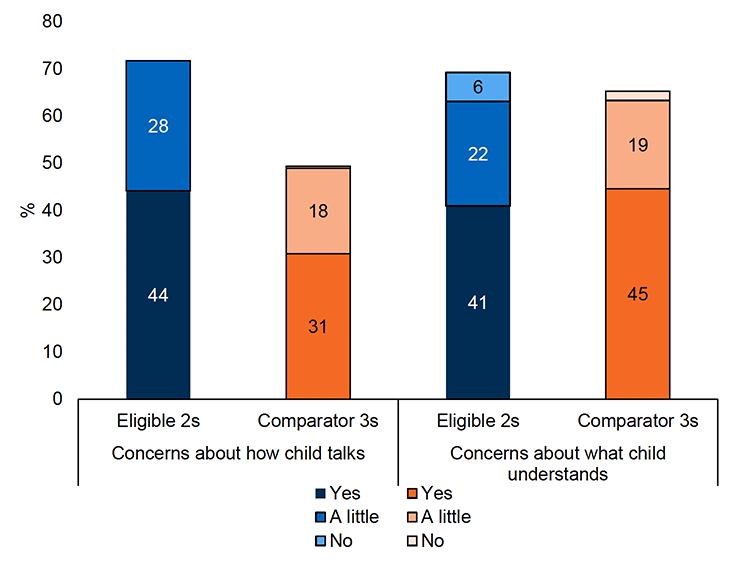
Base: Children who receive specific support for speech and language development (parent questionnaire, Phase 6, weighted)
Ages and Stages Questionnaire
Figure 5.4 shows scores for Eligible 2s at age three and Comparator 3s on each of the five ASQ domains. Across the domains, Comparator 3s were more likely to be on schedule compared with Eligible 2s at age three. The difference was largest for the communication domain, with 63% of Comparator 3s on schedule at Phase 6 compared with just under half (49%) of Eligible 2s. Large differences were also observed for the problem-solving domain (65% for Comparator 3s compared with 52% of Eligible 2s) and fine motor domain (67% for Comparator 3s compared with 55% of Eligible 2s).
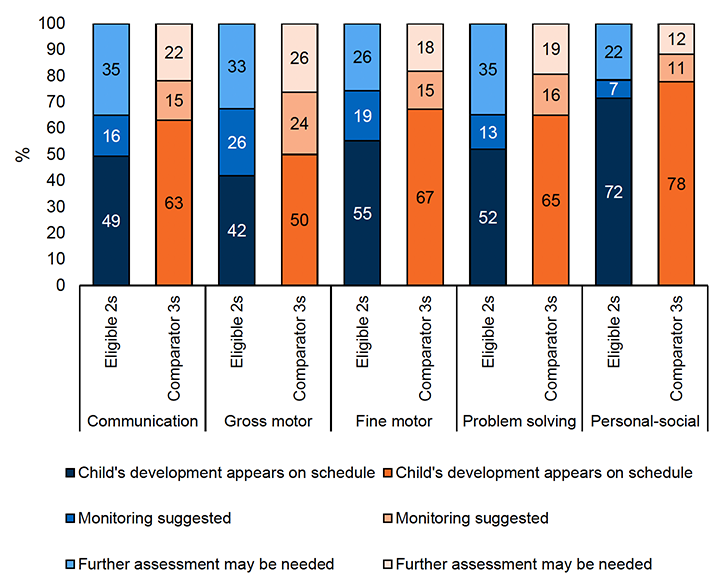
Base: All children (keyworker questionnaire, Phase 6, weighted)
With the exception of the gross motor domain, Eligible 2s boys were more likely than girls to need further assessment across all ASQ domains, with the largest differences observed on the communication (50% of boys and 20% of girls) and personal-social domains (36% of boys and 8% of girls). For Comparator 3s, boys were more likely to need further assessment than girls in the communication, fine motor, and problem-solving domains. The difference between Comparator 3s boys and girls was largest in the fine motor domain (27% of boys compared with 9% of girls).
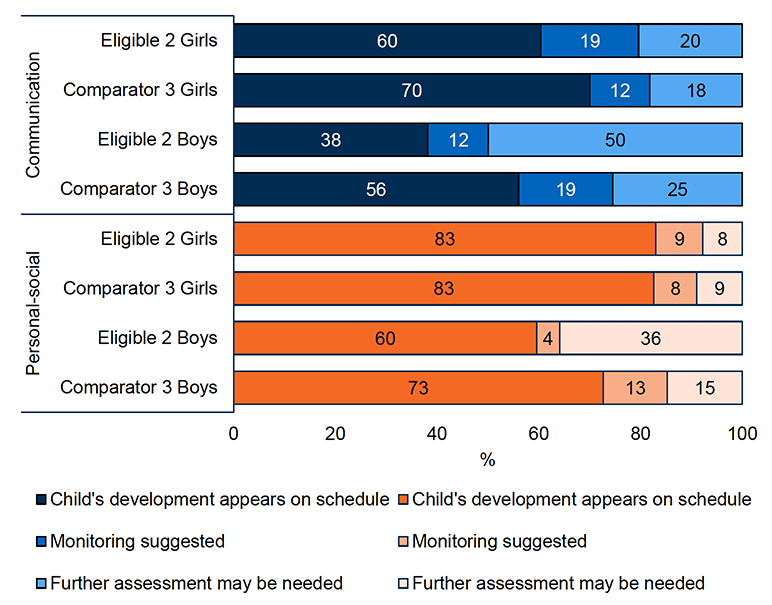
Base: All children (keyworker questionnaire, Phase 6, weighted)
Across all five domains, those in the most deprived areas were less likely than those living elsewhere to be on schedule. This was evident for both Eligible 2s at age three and Comparator 3s. When area deprivation and sex were examined together, the only significant difference was for Comparator 3s in the personal social domain, where boys in the most deprived areas were less likely than all other children to be on schedule (48%) compared with other children (74%-85%).

Base: All children (keyworker questionnaire, Phase 6, weighted)
Strength and Difficulties Questionnaire
Figure 5.7 presents the scores for each SDQ domain as well as total difficulties score. In contrast to the ASQ scores, the proportion scoring close to average was similar for most domains. Around six in ten children scored close to average for SDQ total difficulties (62% of Eligible 2s and 63% of Comparator 3s). There were no statistically significant differences between the scores of Eligible 2s at age three and Comparator 3s across any of the five domains. Across the individual domains, the proportion of children scoring close to average ranged between 53-73% for Eligible 2s at age three and 61-76% for Comparator 3s.
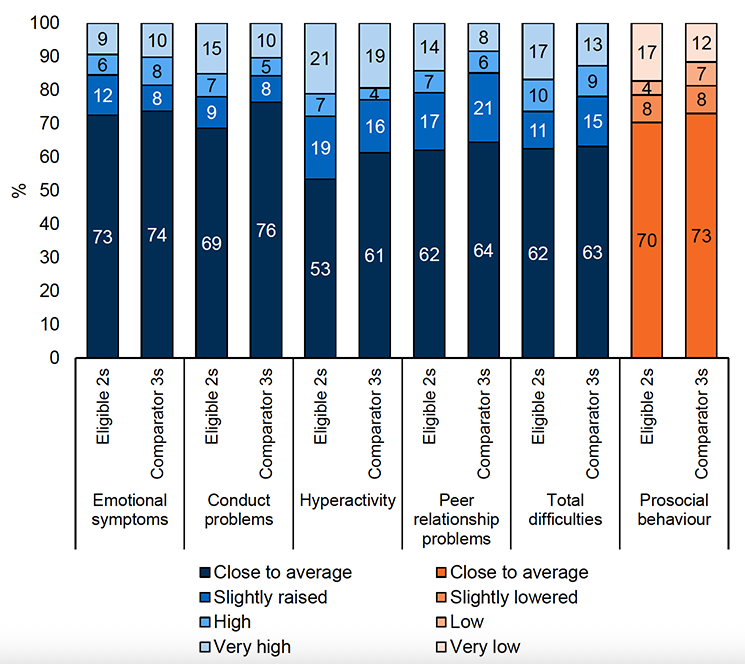
Base: All children (keyworker questionnaire, Phase 6, weighted)
With the exception of the emotional symptoms domain, the proportion of girls scoring close to average across the domains was higher than boys among both groups of children. The gap between boys and girls was most pronounced for Eligible 2s and was particularly evident on the peer relationship problems and prosocial behaviour domains. For prosocial behaviour, 84% of Eligible 2 girls scored close to average compared with 56% of boys (28 percentage points difference). For Comparator 3s, 84% of girls scored close to average compared with 62% of boys (22% difference). A similar sized gap was observed for peer problems (72-75% of girls and 48-57% of boys).
SDQ scores did not vary significantly by area deprivation for either Eligible 2s at age three or Comparator 3s.
Parent outcomes
Economic Activity
Table 5.1 summarises the type of economic activity reported by both Eligible 2s at age three and Comparator 3s’ parents and their partners at Phase 6. Comparator 3s’ parents were much more likely than those of Eligible 2s to have been in paid full time or part time work (75% compared with 42% of Eligible 2s’ parents). The proportion of parents out of work due to long-term sickness or disability was higher among Eligible 2s’ parents (21%) than Comparator 3s (3%).
For both groups, partners (mostly men) were much more likely than parent respondents (mostly women) to be in work. Two-thirds (65%) of Eligible 2s’ partners were working, compared with 42% of Eligible 2 parents. While 92% of Comparator 3s’ partners were working, compared with 75% of Comparator 3s’ parents. As observed for parents, the proportion of partners out of work due to long-term sickness or disability was higher among Eligible 2s partners than Comparator 3s (28% and 2%, respectively).
| Type of economic activity | Responding parent
Eligible 2s (%) |
Responding parent
Comparator 3s (%) |
Partner
Eligible 2s (%) |
Partner
Comparator 3s (%) |
|||
|---|---|---|---|---|---|---|---|
| Working 30 or more hours a week (including if on leave or sick) | 15 | 37 | 50 | 87 | |||
| Working fewer than 30 hours a week (including if on leave or sick) | 27 | 38 | 15 | 5 | |||
| On maternity/parental leave from an employer | 2 | 7 | n/a | 1 | |||
| Looking after home or family | 53 | 45 | 17 | 24 | |||
| Out of work and looking for a job | 4 | 4 | 1 | 0 | |||
| Out of work because of long term sickness or disability | 21 | 3 | 28 | 2 | |||
| In full time education (including on vacation) | 10 | 2 | 2 | 1 | |||
| In part time education (including on vacation) | 3 | 1 | 5 | 1 | |||
| Unweighted base | 158 | 511 | 67 | 432 | |||
Base: All children (parent questionnaire, Phase 6, weighted)
Parents were asked whether they, or their partner, had experienced any change in their employment since their child started funded ELC (see Table 5.2). Around half (46%) of Eligible 2s’ parents had experienced some form of change, similar to that observed for Comparator 3s’ parents (40%). Parents of Eligible 2s at age three were more likely than Comparator 3s to say they had entered or re-entered education or training since their child started funded ELC (14% compared with 3%).
For both groups, partners were less likely than responding parents to report having experienced any changes since their child started funded ELC. As shown earlier, however, partners were more likely to already be in employment. Seven percent of partners of Eligible 2s’ parents said they had entered or re-entered employment. The equivalent figure for Comparator 3s partners was 2%. Eligible 2s partners were most likely to report starting to look for work or a change of job (7%) and entering or re-entering education or training (9%).
| Change in employment or education | Responding parent
Eligible 2s (%) |
Responding parent
Comparator 3s (%) |
Partner
Eligible 2s (%) |
Partner
Comparator 3s (%) |
|---|---|---|---|---|
| Entered / re-entered employment | 15 | 9 | 7 | 2 |
| Change of employer | 4 | 5 | n/a | 2 |
| Change of job / role with the same employer | 5 | 5 | 6 | 3 |
| Change of employment status (e.g. from self-employed to employee) | 1 | 3 | n/a | 0 |
| Started looking for work / a change of job | 7 | 9 | 7 | 1 |
| Increase in usual hours at work | 11 | 14 | 3 | 8 |
| Decrease in usual hours at work | 2 | 4 | 3 | 1 |
| Increase in income / pay | 9 | 16 | 7 | 9 |
| Decrease in income / pay | 2 | 2 | 3 | 1 |
| Entered / re-entered education or training | 14 | 3 | 9 | 2 |
| None of these | 54 | 60 | 73 | 80 |
| Unweighted base | 160 | 483 | 55 | 373 |
Base: All parents (parent questionnaire, Phase 6, weighted)
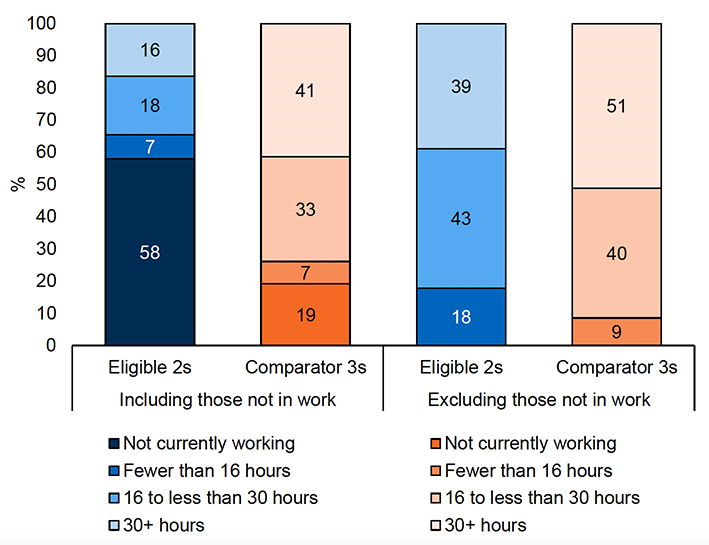
Close to six in ten (58%) parents of Eligible 2s at age three were not in work, significantly higher than the 19% of Comparator 3s’ parents. For both groups, those living in more deprived areas were most likely to not be in work, for example, 71% of Eligible 2s’ parents living in the most deprived areas were not working compared with 48% of parents living in other areas.
Base: All parents (parent questionnaire, Phase 6, weighted)
Eighteen percent of parent of Eligible 2s at age three reported working between 16 and 30 hours or more per week on average. A similar proportion (16%) worked over 30 hours per week. The equivalent figures for Comparator 3s’ parents were notably higher at 33% and 41%, respectively.
The proportion of both female and male Comparator 3s’ parents working 30 hours or more was considerably higher than Eligible 2s’ parents. Around half (46%) of female Comparator 3s’ parents compared with 37% of female Eligible 2s’ parents worked 30 hours or more a week. While 83% of male Comparator 3s’ parents worked 30 hours or more a week compared with 59% of male Eligible 2s’ parents. Eligible 2s’ parents living in the most deprived areas were notably less likely than others be working 30 hours or more per week (8%, compared with 23%). No such difference was observed for parents of Comparator 3s.

Base: All parents (parent questionnaire, Phase 6, weighted)
The average number of hours worked per week by parents was higher for Comparator 3s than Eligible 2s at Phase 6. This was the case when those not in work were included and excluded from the calculations. Employed Eligible 2s’ parents worked an average of 23.8 hours per week, compared with an average of 28.7 for Comparator 3s’ parents. Both female and male parents in the Comparator 3s’ group were working on average more hours than Eligible 2s, for example male Comparator 3s’ parents worked 40 hours on average per week compared with 22.5 hours for female parents (excluding those not in work).
Parents were asked about their and their partners’ working pattern. The most common working types among parents of the Eligible 2s at age three were flexible working (30%), term-time working (24%), and annualised hours contracts (20%). These were also the most common working types for Comparator 3s, although the level of term-time working was significantly less (25% had flexible working; 24% had an annualised hour contract; and 13% did term-time working).
Those not in work at Phase 6 were asked if they would be able to start a job or training opportunity within two weeks, if it became available. Around one in five (17%) Eligible 2s’ parents who were not working said they would be able to start within two weeks. The equivalent figure for Comparator 3s’ parents was 27%.
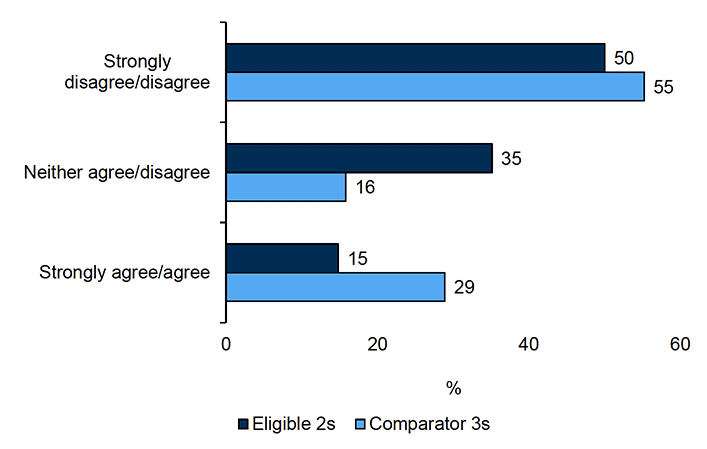
When asked the extent to which a lack of affordable, convenient, good quality childcare was one of the main reasons they were currently not working, around half of parents disagreed that this was the case (50% of Eligible 2s and 55% of Comparator 3s) (Figure 5.10).
Base: All parents (parent questionnaire, Phase 6, weighted)
Effect of ELC on parental time use
Parents were asked how much they agreed or disagreed that they had been able to do a number of things because their child is in nursery (Figure 5.11). The most common responses were the same for both Eligible 2s at age three and Comparator 3s. Eight in ten Eligible 2s’ parents agreed that having their child in nursery meant they had been able to think about what they may do in the future, compared with 66% of Comparator 3s’ parents. Conversely, Comparator 3s were most likely to agree that they have been able to work or look for work (62% compared with 49% of Eligible 2s).

Base: All parents (parent questionnaire, Phase 6, weighted)
Parental general health and wellbeing
Comparator 3s’ parents were more likely than Eligible 2s at age three to rate their general health as ‘very good’ (39%, compared with 17%). While proportions rating their health as ‘good’ were similar for the two groups, three times as many Eligible 2s’ parents said their health was fair compared with Comparator 3s (33% and 11%, respectively).
Eligible 2s’ parents and their partners were more likely than their Comparator 3s counterparts to report having a long-term health condition (45% and 33%, compared with 18% and 9%, respectively for Comparator 3s). Around half (51%) of Eligible 2s’ parents and three-quarters (78%) of Comparator 3s said that at least one other person (other than the study child) in their household had a long-term health condition.
For both groups, it was most common for those with a long-term condition to report that it affected their mental health: reported by 72% of Eligible 2s’ parents and 70% of their partners, and 69% of Comparator 3 parents and 55% of their partners. Around a quarter (27%) of Comparator 3 parents reported that their long-term condition affected their mobility, compared with 17% of Eligible 2 parents.
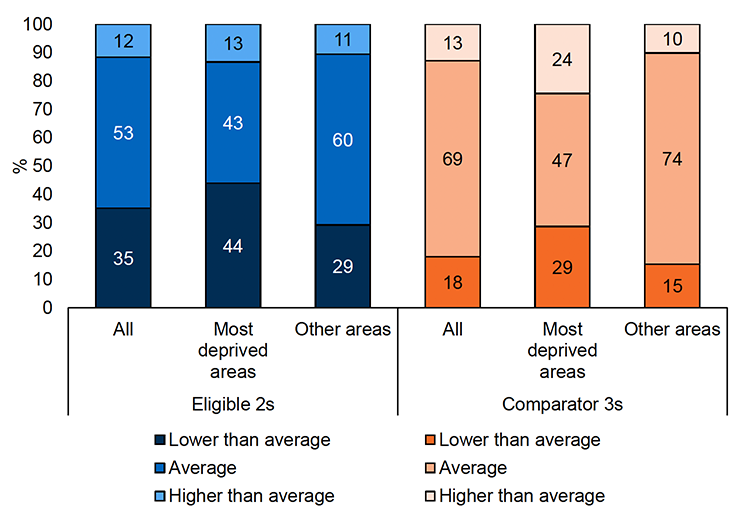
Using SWEMWBS[21] to assess mental wellbeing, Comparator 3s’ parents were shown to have higher levels of wellbeing than parents of Eligible 2s at age three (a mean score of 24.1 compared with 22.8). Around a third (35%) of Eligible 2s’ parents had lower than average wellbeing, compared with 18% of Comparator 3s’ parents. Figure 5.12 shows that parents of Comparator 3 children living in the most deprived areas were more likely than those living in other areas to have lower than average wellbeing (29% compared with 15%). There was no significant difference in average wellbeing by area deprivation amongst the Eligible 2 parents.
Base: All parents (parent questionnaire, Phase 6, weighted)
Parents were asked to score how satisfied they were with their life nowadays on a scale of 0 to 10. Average life satisfaction scores were lower for Eligible 2s at age three than Comparator 3s (7.3 and 7.9 respectively). Just under a quarter (24%) of Eligible 2s’ parents had a score of between 9 and 10 compared with over a third (34%) of Comparator 3s’ parents.
Parental confidence and capacity and home environment
Parent respondents were asked, at Phase 6, how they felt they were coping as a parent. Over half (55%) of parents of Eligible 2s at age three and 64% of Comparator 3 parents said they always felt that they were coping really well or pretty well most of the time. Comparator 3 parents living in less deprived areas were more likely than those in the most deprived areas to say that they always felt that they were coping really well or coping most of the time (67%, compared with 53%). There was no significant difference by area deprivation amongst Eligible 2s’ parents in how they felt they were coping as a parent.
Parents were asked how they felt about the amount of support and help with childcare they received from family or friends living outside of their household. Results for both Eligible 2s at age three and Comparator 3s were similar, with 64% of Eligible 2s and 67% of Comparator 3s feeling they got enough support and 36% of Eligible 2s and 27% of Comparator 3s feeling they didn’t get enough or didn’t get any support.
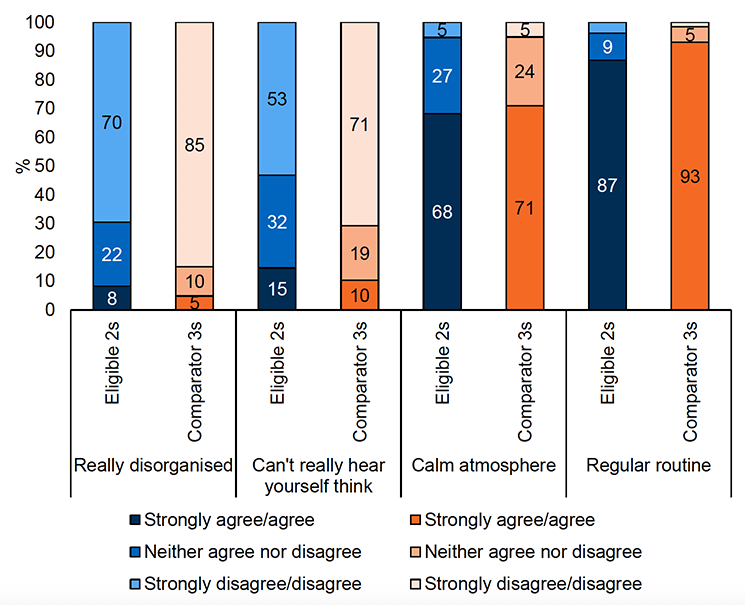
Figure 5.13 shows the findings of the home environment measure, the Confusion, Hubbub and Order Scale (CHAOS), consisting of four questions designed to assess the level of calmness and order within the household. Looking at responses to these questions, for both groups, the majority of households were reported as being fairly calm (Figure 5.13). The only notable differences between the two groups were that Comparator 3s’ parents were more likely than Eligible 2s’ parents to disagree that it’s really disorganised in their home (85% compared with 70%) and to disagree that you can’t really hear yourself think in our home (71% and 53%, respectively).
Base: All parents (parent questionnaire, Phase 6, weighted)
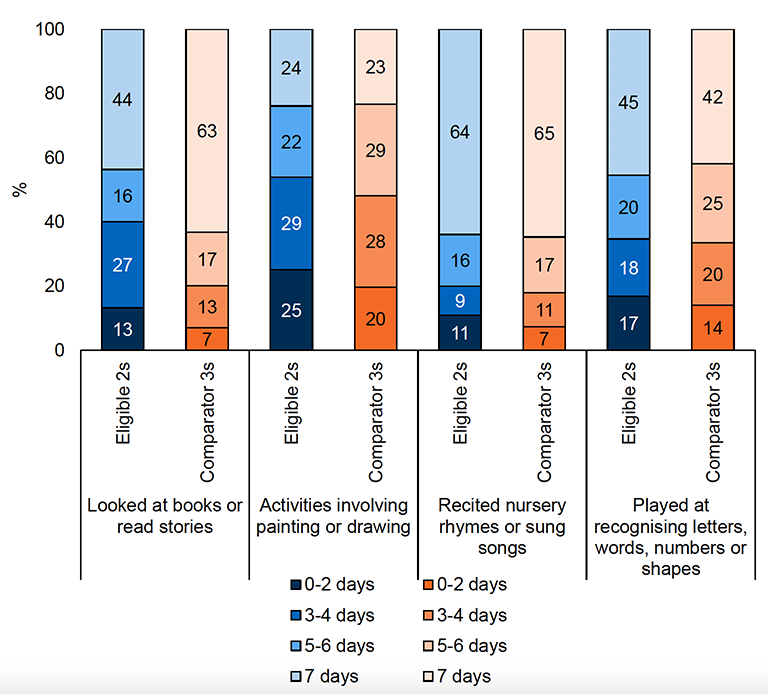
Figure 5.14 shows the number of days in the last seven that parents noted their child had spent on different activities at home. Across most activities, findings were similar for Eligible 2s at age three and Comparator 3s. The largest difference between the two groups was looking at books or reading stories, with 44% of Eligible 2s’ parents recording having done this with their child in the previous seven days, compared with 63% of Comparator 3s.
Base: All parents (parent questionnaire, Phase 6, weighted)
Contact
Email: socialresearch@gov.scot