
Scottish Study of Early Learning and Childcare: Phase 6
This report outlines findings from the 6th phase of the Scottish Study of Early Learning and Childcare (SSELC), focusing on 3-year-olds who were accessing up to 1140 hours of funded ELC. The SSELC forms a major part of the strategy for the evaluation of the expansion of funded ELC in Scotland
Child, parent and household characteristics
Characteristics of the cohorts
This report focuses on findings for two cohorts of three-year-olds and their families.
1. The ‘Eligible 2s’ are a group of three-year-old children, largely from lower income households, who were eligible for and receiving funded ELC at age two. They are followed up one year after they participated in Phase 4 of the study, at age two.
2. The ‘Comparator 3s’ are a random sample of three-year-old children, nationally representative of children aged three to three years six months who are receiving up to 1,140 hours of funded ELC. Most of these children did not receive funded ELC until age three.
This section describes the characteristics of both samples, highlights the extent to which they differ, and confirms that the characteristics observed for Eligible 2s are in line with expectations, given the eligibility criteria for funded childcare for two-year-olds. The figures used in this section are unweighted for both cohorts, so should be taken as only being representative of the sample rather than of the population as a whole.
Keyworker data indicates that the Eligible 2s at age three sample comprised 51% boys and 49% girls, the same split was observed for the nationally representative sample of three-year-old children (Comparator 3s)[17]. The vast majority of parent respondents were female for both groups: 90% for the Eligible 2s and 89% for the Comparator 3s.
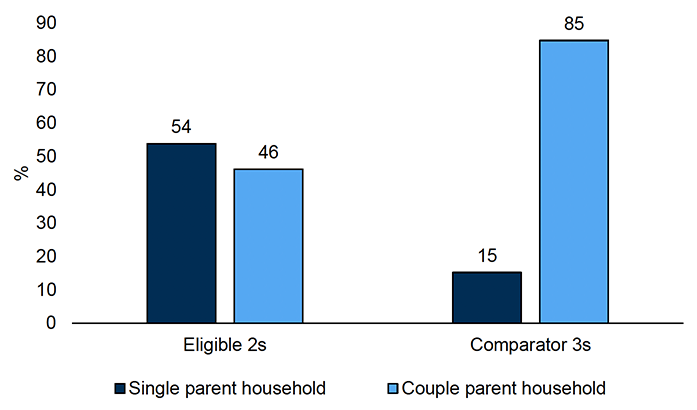
There were noticeable differences in the household compositions of the two samples. As can be seen in Figure 2.1 below, Eligible 2s were more than three times as likely to live in single parent households (54% of Eligible 2s compared with 15% of Comparator 3s). Almost half, 49%, of Eligible 2 households had only one adult aged 16 or above in the household, whereas for the Comparator 3s this figure was 13%. Forty-three percent of the Eligible 2s lived with two adults, 3% lived with three and 6% lived with four or more. For Comparator 3s, 80% lived with two, 6% lived with three, and 1% lived with four or more adults.
Around a third (31%) of the Eligible 2s at age three were the only child under 16 in the household, compared with a quarter (25%) of the Comparator 3s. A further 39% of Eligible 2s lived in households with two children under 16, 21% had three and 9% had four or more. In comparison, 54% of Comparator 3s lived in households with two children under 16, 16% had three and 5% had four or more. The proportion of households with a child under three years of age was higher for the Comparator 3s (22%) than the Eligible 2s at age three (14%).
Base: All respondents (parent questionnaire, Phase 6, unweighted)
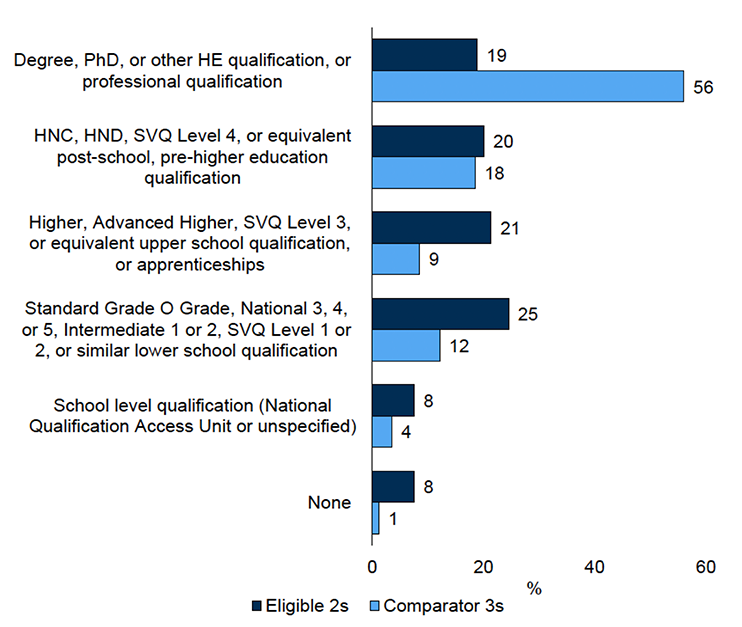
Parents of Comparator 3s had higher levels of education, on average, than parents of Eligible 2s, as seen in Figure 2.2. As the graph shows, more than half (56%) of parents of the Comparator 3s had a university degree or equivalent compared with 19% of the Eligible 2s. At the other end of the spectrum, 8% of parents of Eligible 2s had no formal educational qualifications and a further 33% had lower school qualifications only (such as Standard Grades, or National 3s, 4s or 5s), compared with 1% and 16% of the parents of the Comparator 3s respectively.
Base: All respondents (parent questionnaire, Phase 6, unweighted)
The Eligible 2s at age three were more likely to be living in deprived areas than the Comparator 3s. According to parent data, 39% of the Eligible 2s resided in the most deprived 20% of areas according to the Scottish Index of Multiple Deprivation (SIMD). In contrast the distribution for the Comparator 3s was much more in line with the general population, with only 17% living in the most deprived areas.
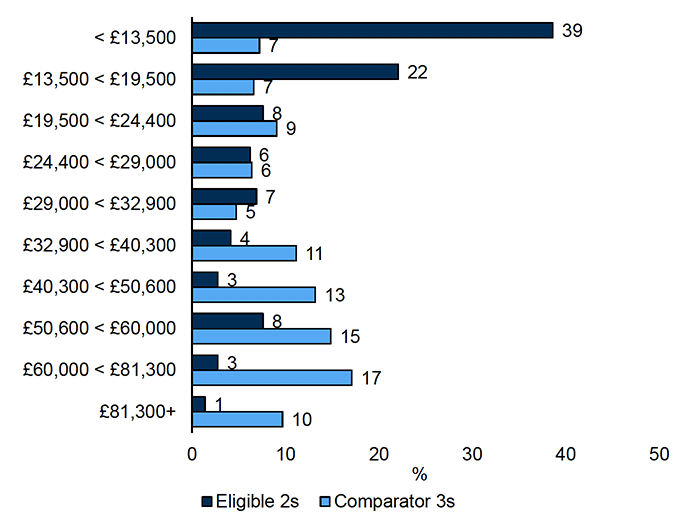
Eligible 2s were also more likely to be living in lower income households than Comparator 3s, reflecting the eligibility criteria for access to statutory funded provision of ELC for two-year-olds. Figure 2.3 shows that 39% of respondents in the Eligible 2s group were in the bottom decile for income (less than £13,500 per year), compared with 7% in the Comparator 3s. A total of 68% of the Eligible 2s were in the bottom three deciles for household income, compared with 23% for the Comparator 3s[18].
Base: All respondents (parent questionnaire, Phase 6, unweighted)
Parent respondents in the Eligible 2s at age three group tended to be younger than those in the Comparator 3s. The median age of parents in the Eligible 2s group was 32, with 33% under the age of 30, including 9% under the age of 25. The median age for parents in the Comparator 3s group was 35, with 15% under the age of 30, including 3% under the age of 25.
There were no notable differences between the Eligible 2s and Comparator 3s when it came to the ethnic background of parent respondents. The majority in both samples were white Scottish – 85% of the Eligible 2s were in this category and 82% of the Comparator 3s. The same proportion of respondents were non-white – 7% for each – with the remainder in both groups being of white origin from other parts of the UK or the rest of the world.
The vast majority of respondents in both samples spoke only English at home: 89% of the Eligible 2s and 88% of the Comparator 3s. Just 2% of the Eligible 2s spoke only other languages at home compared with 1% of Comparator 3s.
Contact
Email: socialresearch@gov.scot