
Scottish Study of Early Learning and Childcare: Phase 6
This report outlines findings from the 6th phase of the Scottish Study of Early Learning and Childcare (SSELC), focusing on 3-year-olds who were accessing up to 1140 hours of funded ELC. The SSELC forms a major part of the strategy for the evaluation of the expansion of funded ELC in Scotland
Use of ELC
Information about ELC received from the primary (study) setting was collected in both the keyworker and parent questionnaires. This included the number of hours the child attended the setting, and how many hours were funded. Data from both sources are presented here separately for Eligible 2s at age three and Comparator 3s.
Parents were also asked about their use of additional childcare, whether that be other formal ELC (such as private nurseries) or informal childcare from family, friends or babysitters. Findings from these questions are also presented separately here for Eligible 2s at age three and Comparator 3s, along with data on the types of childcare used before the participating child was aged three, activities they, as parents, had done at the funded ELC setting and what they thought the main advantages and disadvantages were to having a child in ELC. All figures in this chapter have been weighted.
Formal ELC provision
Using data from the keyworker questionnaire, the mean number of hours children usually attended the study setting was 26.4 per week for Eligible 2s at age three and 26.0 for Comparator 3s. Table 3.1 shows the full distribution of weekly hours attended at the setting.
| Weekly hours attended | Eligible 2s (%) | Comparator 3s (%) |
|---|---|---|
| <16 hours | 7 | 8 |
| 16 to <22 hours | 7 | 16 |
| 22 to <25 hours | 20 | 17 |
| 25 to <28 hours | 8 | 8 |
| 28 to <32 hours | 56 | 41 |
| 32+ hours | 3 | 10 |
| Unweighted base | 245 | 781 |
Base: All respondents (keyworker questionnaire, Phase 6, weighted)
There was no statistically significant difference in the percentage of Eligible 2s at age three and Comparator 3s attending for fewer than 22 hours per week, equating to less than the funded entitlement of 1140 hours if spread over 52 weeks (14% and 24%, respectively). The proportion of children not using their full entitlement may actually be higher than these figures as some settings are open only during term times, so a higher number of funded hours per week are available in these settings.
The mean number of weekly hours that parents had registered for their child to attend the study setting was similar for Eligible 2s at age three and Comparator 3s (27.8 hours and 27.3 hours). The size of the gap between registered hours and mean number of hours usually attended at the setting was also similar for both groups (1.4 hours for Eligible 2s and 1.3 hours for Comparator 3s). The mean number of weekly funded hours was higher for Eligible 2s than Comparator 3s (27.3 and 25.6, respectively). However, the mean number of weekly unfunded (e.g. paid for) hours was higher for Comparator 3s (1.7 hours, compared with 0.6 hours for Eligible 2s).
Mean weekly attendance at the study setting varied little by area deprivation for Eligible 2s. There were, however, notable differences among the Comparator 3s for some of the weekly measures. For both mean weekly hours attended at the study setting and mean weekly registered hours, those living in the 20% most deprived areas in Scotland had a higher mean number of hours than those living elsewhere. For example, the mean number of weekly hours attended for Comparator 3s living in the 20% most deprived areas of Scotland was 28.7, compared with 25.4 for those living elsewhere.
The rest of this chapter presents findings from the parent questionnaire.
Ninety-three percent of parents of Eligible 2s at age three said that the full cost of the time their child spent at their current setting was met by the government. This was significantly higher than the 74% of Comparator 3s’ parents who reported this was the case for them. Comparator 3s’ parents in the highest two household income quintiles (£40,300 or more) were least likely to report that their full costs were met by the government (62-67%, compared with 78-90% for those with lower incomes). Similarly, those living in households with two parents in employment, education or training were less likely than others to report the government met their full costs (69%).
Parents were also asked how many hours in a typical week their child received childcare from different types of formal ELC, including childminders, as well as private, local authority or community crèches, nurseries, playgroups or pre-schools. For the majority of Eligible 2s (97%) and Comparator 3s (95%), the sampled setting was either their main or only provider of funded ELC.
For Eligible 2s, the mean weekly hours attended at all formal ELC was 27.1 and the equivalent for Comparator 3s was 26.5. The mean number of these hours that were funded was higher for Eligible 2s than Comparator 3s (26.6 hours and 23.4 hours, respectively). Whereas the mean number of weekly hours of unfunded formal ELC was higher among Comparator 3s (3.5 hours) than Eligible 2s (0.9 hours).
For Comparator 3s, those living in higher income households had higher mean weekly unfunded hours and higher mean weekly hours attended at all formal ELC, compared with those on lower incomes. There were also differences by economic activity for both mean weekly unfunded hours and mean weekly hours attended at all formal ELC. For example, those living in households with a single adult in work or training or two adults in work or training had the highest mean weekly unfunded hours (4.1 hours and 4.3 hours, respectively).
Use of additional childcare
All parents were asked if they regularly get help with childcare from another service or person (either formal ELC or informal childcare). Based on these parent reports, Comparator 3s were more likely to get childcare from another service or person than Eligible 2s at age three (40%, compared with 19%). Within the Comparator 3s group, uptake of regular childcare from other services or people was highest among those in the two highest household income quintiles (58% in the 4th quintile and 48% in the 5th quintile, compared with 7%, 24% and 39% in the 1st, 2nd and 3rd quintiles) and those with all parents in the household in work or training (47% for both single adult and two parent households in work).
Most parents used no formal ELC other than their current setting (94% of Eligible 2s and 86% of Comparator 3s). Among all Eligible 2s at age three and Comparator 3s, childminders were the most common form of other formal ELC used (3% and 8%, respectively). Among all Comparator 3s, mean hours at a local authority setting (other than their current setting) was highest among households with two parents in work or training (0.5 hours). The same pattern was observed for use of childminders (1.1 hours for two parents in work or training and 1.6 hours for one parent households with the parent in work or training). Mean hours of childcare at a childminder was also higher among those with higher household incomes, compared with others (mean hours ranging from 1.1 – 1.3 hours for those with a household income of £29,000 or above, compared with 0.1 hours for those with an income below £29,000).
Parents of Comparators 3s were more likely than parents of Eligible 2s at age three to report using additional informal childcare. The mean number of hours of any type of additional informal childcare was higher for Comparator 3s (3.9 hours) than for Eligible 2s (1.8 hours). Among those who had used such childcare, figures were similar at a mean of 12.8 for Comparator 3s and 11.8 hours for Eligible 2s at age three. The only observed difference within each of the two groups of children was among Comparator 3s. For all Comparator 3s, mean hours of all informal childcare (including not used) was highest among those in higher household income quintiles ranging from 3.6 hours to 6.5 hours for those with a household income of £29,000 or higher).
Grandparents were the most common type of additional informal childcare used for Eligible 2s at age three (12%) and Comparator 3s (32%). Among all Comparator 3s, mean hours of childcare provided by grandparents was highest among those in higher household income quintiles (ranging from 4.1 hours – 5.8 hours for those with household incomes of £40,300 or above compared with a range of 0.2 hours to 2.7 hours for those with household incomes of below £40,300). Mean hours of childcare provided by grandparents was also higher among Comparator 3s households with a single adult in work or training (4.1 hours) or two adults, both in work or training (3.9 hours) compared with households with a single adult not in work or training (2.6 hours), two adults, one in work and training (0.6 hours) or two adults, neither in work or training (0.0 hours).
The mean hours for all childcare used at Phase 6, both formal and informal and including the current setting, was similar for Eligible 2s at age three and Comparator 3s (28.9 hours per week and 30.5 hours per week, respectively). For Comparator 3s only, there was an association between mean hours for all childcare used and household income, with a higher mean number of hours for those households in a higher income quintile. Figures for those with a household income of £29,000 or more ranged between 29.5 and 33.7 hours. The equivalent figure for those in lower household income quintiles ranged between 24.3 and 26.8 hours.
| Types of informal childcare | Eligible 2s (%) | Comparator 3s (%) |
|---|---|---|
| Grandparents | 12 | 32 |
| Ex-spouse or partner | 2 | 1 |
| Another relative | 2 | 4 |
| Friend or neighbour | 0 | 0 |
| Nanny or babysitter | -n/a | 1 |
| Someone else | 1 | n/a |
| No informal ELC | 85 | 67 |
| Unweighted base | 162 | 512 |
Base: All respondents (parent questionnaire, Phase 6, weighted)
Note: Some parents used more than one type of informal childcare. As such, percentages do not total 100%.
Previous use of childcare
Parents were asked about the types of childcare their child had received before the age of three. Given their eligibility for funded ELC at age two, it is not surprising that Eligible 2s at age three were more likely than Comparator 3s to have used a local authority run crèche, nursery, playgroup or pre-school before the age of three (31% compared with 7% of the Comparator 3s). The child’s grandparents were the most common form of childcare used for Comparator 3s, before the age of three, (49% of the Comparator 3s compared with 35% of the Eligible 2s). The other noticeable difference was that Comparator 3s were less likely than Eligible 2s to have used none of the childcare options listed before their child was three (Figure 3.1).
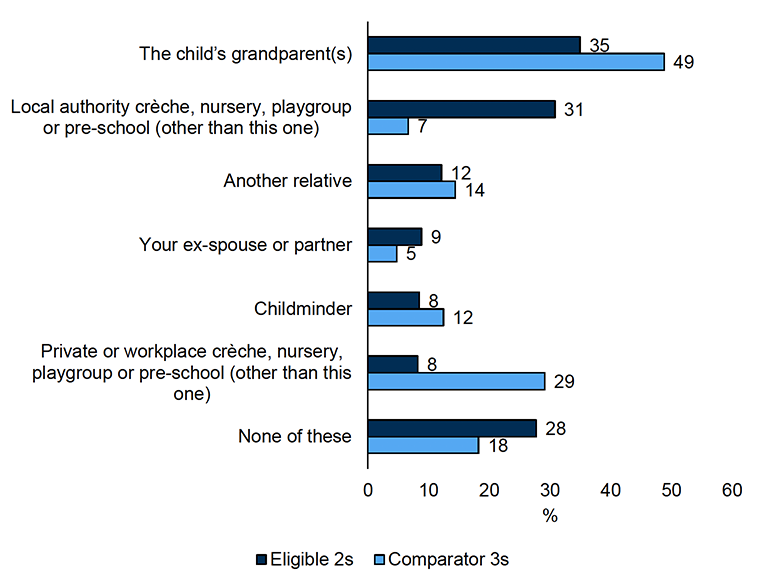
Base: All respondents (parent questionnaire, Phase 6, weighted)
Engagement with ELC setting
To assess engagement with ELC settings, parents were asked if they had participated in a range of different activities at their child’s setting. Most parents had visited their child’s room at the setting (95% for Eligible 2s and 90% for Comparator 3s). While attending a parents’ evening or information meeting, or another type of nursery event was common for all parents, parents of Eligible 2s at age three were more likely than Comparator 3s’ parents to have done both these activities. For example, 72% of parents of Eligible 2s reported attending a parents’ evening or meeting, while the equivalent for parents of Comparator 3s was 60%. No Eligible 2s’ parents and just 4% of Comparator 3s’ parents reported doing none of the listed activities with their child’s setting.
To establish the types of help and support settings offer to parents, a separate question asked about this. Figure 3.2 presents the full results for this question. Almost all parents (97% for Eligible 2s and 94% for Comparator 3s) had talked to their child’s keyworker or another member of staff about their child’s progress. Parents of Eligible 2s at age three were more likely than Comparator 3s’ parents to have: stayed and played with their child (74%, compared with 60%); talked to someone about how to support their child’s learning at home (54% and 29%, respectively) and received advice or information to support their child’s speech, language and communication development (53% of Eligible 2s’ parents reported this, compared with 33% of parents of Comparator 3s).
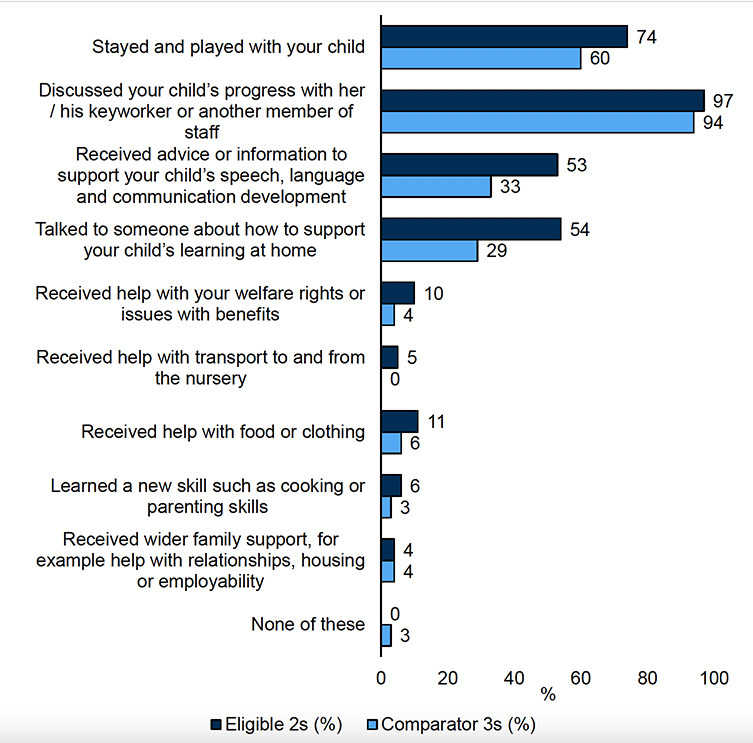
Base: All respondents (parent questionnaire, Phase 6, weighted)
Parents of the Eligible 2s at age three were also more likely to have engaged with some of the wider support some settings are able to provide. For example, 10% of parents of Eligible 2s had received help with welfare rights or issues with benefits food or clothing, compared with 4% among the Comparator 3s.
Advantages and disadvantages of child being in ELC
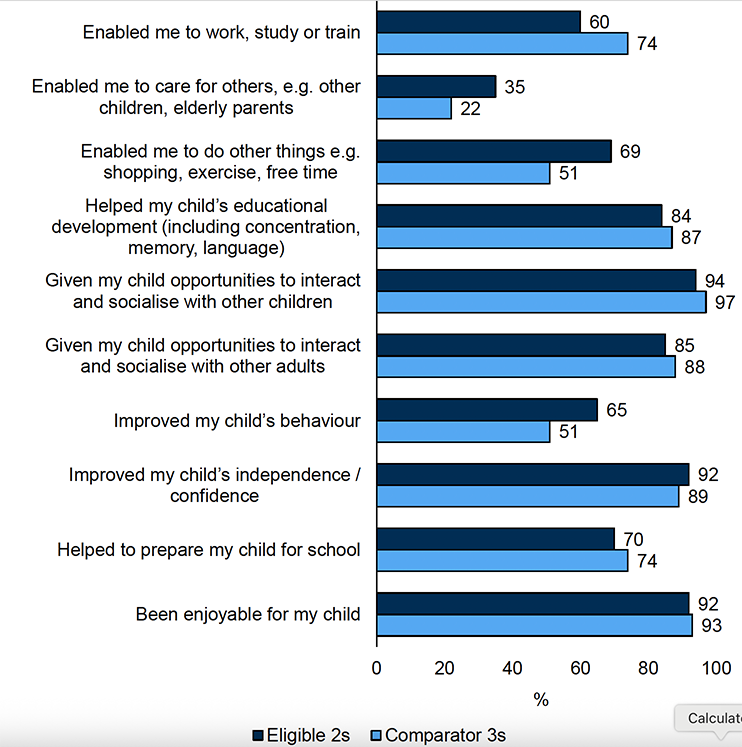
Parents were asked what they thought the main advantages, if any, were of their child attending their nursery. Figure 3.3 presents results from this question. Parents more commonly selected advantages for the child over advantages for themselves, as a parent. This was true both for parents of Eligible 2s at age three and Comparator 3s’ parents. For example, around nine in ten parents cited that attending nursery had given their child opportunities to interact and socialise with other children (94% for Eligible 2s and 97% for Comparator 3s) and improved their child’s independence and confidence (92% for Eligible 2s and 89% for Comparator 3s). In addition, many parents noted improved child behaviour as an advantage of their child attending ELC, particularly parents of Eligible 2s at age three (65%, the equivalent figure for Comparator 3s was 51%).
Base: All respondents (parent questionnaire, Phase 6, weighted)
The proportion of parents reporting that an advantage to their child being in ELC was that it enabled them to work, study or train was higher among Comparator 3s than Eligible 2s (74% and 60%, respectively). Parents of Eligible 2s at age three, on the other hand, were most likely to report that their child being in ELC allowed them time to care for others (35%) and/or do other things (69%).
Among both Eligible 2s at age three and Comparator 3s, those living in the most deprived areas were more likely than those living elsewhere to say that being in ELC had improved their child’s behaviour (72% and 60%, respectively for Eligible 2s and 64% and 48%, respectively for Comparator 3s). Household income and economic activity were also significantly associated with advantages of ELC for Comparator 3s.
Most parents could see no disadvantages to their child attending nursery (76% for Eligible 2s and 77% for Comparator 3s). The most common disadvantages reported were similar for parents of Eligible 2s at age three and Comparator 3s: their child picks up bad habits/behaviour (9% for Eligible 2s and 10% for Comparator 3s) and that nursery hours were not flexible enough (7% for Eligible 2s and 9% for Comparator 3s).
Contact
Email: socialresearch@gov.scot