
Scottish Prisons Assessment and Review of Outcomes for Women (SPAROW): full report
Full research findings on the early impact and emerging outcomes of the application of the Scottish Prison Service Strategy for Women in Custody 2021-2025 in the context of the new Community Custody Units (CCUs).
7. Lived experiences of women in the CCUs
This chapter reports on the views and experiences of women residents in the CCUs. It draws on interviews and group discussions undertaken across all three stages of the research fieldwork. It also draws on observations, photo-elicitation interviews and the arts-based workshops, the latter of which were undertaken in Phase 2 of the research.
As previously stated, during the ‘get to know you’ visits a small number of women were recruited from each CCU to participate in a steering group. The purpose of this approach was to ensure women were included in the research process and more specifically in shaping the direction of the creative research methods. Participative feminist methodologies highlight the importance of inclusivity in the research process and in finding meaningful ways to prioritise and convey women’s experiences (Harding, 2020). Adopting a participative approach allows women to be fully engaged in the research process rather than perceived solely as research ‘subjects.’ A failure to share research findings with participants can also impact on future research as individuals may be reluctant to share their experiences (George et al. 2023).
Interviews, group discussions with the use of photo-elicitation and the arts-based workshops incorporated questions exploring women’s every-day lives in the CCUs. This included their views about the physical and social environments of the CCU; whether and how they thought that their particular needs were being addressed by living in the CCUs and if and how their aspirations were taken into account. Questions also covered the opportunities and support afforded to them in the CCUs (for example, in terms of health, work, education, family contact, community access and preparation for release) and how these were experienced. Women were also asked about their relationships with prison staff – not just their POs but also with other officers working in the CCU, and how they perceive that CCU staff relate to them. The arts-based workshops produced posters which presented a visual representation of women’s views and were useful tools for furthering discussions with women. Posters were produced and presented to each CCU; these posters are reproduced at the end of this chapter.
Dependent upon their length of time in the CCU and, in particular their experience of other prison establishments, women’s perceptions of the CCUs and the extent to which they addressed their needs and concerns varied widely. However, rather than operating as a limitation of the research, the variety of views and differing experiences contributes to the richness of the data.
Chapter 6 highlighted the views of women on the CCU admission processes and, importantly, revealed how little most women knew about the CCUs before arriving. It also flagged up some of the tensions that exist between STPs and LTPs concerning how much ‘easier’ it is for STPs to be admitted to a CCU compared to ‘the hoops’ that needed to be jumped through by LTPs. With these tensions noted, we commence this chapter by presenting women’s first impressions on entering a CCU.
Entering the CCUs
Once in the CCUs, many women’s understandings of their purposes remained relatively limited and cohere around ‘being closer to home’ and a ‘way of progressing’ through the custodial system. Whilst all women knew that the CCUs were designed specifically for women and were not available for men, none had heard of the SPS Strategy for Women in Custody nor what it might mean for them, nor why it had been introduced. This raises questions about the information that women are provided with about the CCUs, which includes information about why they are being moved there and what they might expect once living there. In particular, it suggests that more work is needed around the provision of clear and accessible information about the values and principles underpinning the SPS Strategy for Women. This would allow women to recognise and assess the concrete application of these values and principles as they may experience them. In other words, women need better and more specific information about what the CCUs will do in relation to their individual custodial experience or, for some, how it will support their progression through the prison system. It is crucial that women have greater awareness of CCU purposes in order to properly reflect on whether their aims are likely to, or are being met.
Most women, particularly those interviewed in Phase 1 of the research, held strong views about the type of prisoner likely to be moved into a CCU. For example, one STP woman, who had significant prison experience, both as an LTP and an STP said:
“Before I came, I thought this was a place for trusted prisoners who didn’t need to be in closed conditions. You know, no flight risk, no violence, no drugs… Didn’t need much work to transition to the outside… So there are far more lifers here than anything else at the moment… I’m making assumptions about them but they are people who just want to live their lives without issue or problem… and I think this is a great place for them as they are then removed from the other people that have perhaps on paper committed similar crimes to them but are very different people.” (LR 004 STP).
Interviews with women who came into the CCUs after 12-18 months of their inception (that is, during Phase 2 of the research) revealed that most were aware that there would be women at all progression stages residing there and that most women would be STPs.
Settling in/integrating
Entering into a CCU is a very important part of progression towards community reintegration. However, even with a degree of preparedness it can be a sudden immersion into a very different way of living, particular for those who have been in prison for some time. Women’s prison journeys, and particularly those moving from closed conditions to a more flexible and ‘open’ space as that found in a CCU, reflect some of the gendered tensions and challenges associated with the transition process.
When women arrive in the CCU they are given a short induction and a starter pack comprising of toiletries and other items they may need (see Appendix 3 HMP Bella Centre Induction Checklist which details the ‘tour’ that women are given of the facilities and the provision of a starter pack).
New culture, new living conditions
For longer-term women prisoners in particular, the CCU represents a ‘new world’ whose distinctive characteristics require some getting used to. For most women, their first impressions of the CCUs were very positive; women told us of being ‘blown away’ on entering the shared houses and seeing their rooms, the living spaces and the kitchen. They were particularly impressed about the comfortable nature of the mattresses and bed linen, the sofas, the en-suite facilities and the shared bathrooms:
“I was wow! One hundred per cent. Shocked, a good shock though… It is absolutely lovely. You can't fault it. It is nothing like a prison. Yes, it is a prison and you have got to… see when you are sitting in your house you, kind of, forget that you are in prison because there are no doors, you can open all the... well, most of the doors yourself. You can walk about and you can sit in the Hub, with your family, make them food.” (LR 002 STP).
“It’s a beautiful place. I mean, it’s really... I can’t say anything bad about it. It’s a cracking place. Even the way they treat you, I don’t feel like a prisoner. You feel like you’re moving on, this is your time to move on, you know, that kind of feeling. So I love it.” (LR2 007 top end).
A woman, who had served 15 years in a closed prison before entering a CCU went on to say that she had seen the plans and maps of the CCUs before moving:
“But it doesn’t do it justice. It’s just seeing wee bits. But as soon as you come, it’s like... I mean, your bedroom is like a hotel, you know what I mean? It’s just... and you’re not thinking like you’re in prison, it’s all crime there. Here everybody’s all talking about different things. Here it’s not… you’re just like in everyday living.” (LR2 007 top end).
The Hub space and facilities were generally considered ‘wonderful’ as were the garden spaces and the lack of physical security features in and outside the CCUs:
“You’re not opening your door and looking at another cell. It’s glass. You know, there’s nobody across from you. And that was… that was good, a lot of glass there, eh, daylight and that…” (LR 004:1 STP).
Not all women shared this view of the CCUs. Some were more disparaging:
“The CCU is seen as the golden gates of SPS but other than being allowed to walk around on a loop and a nice bed, there’s not much difference between CCU and closed.” (LR 004:2 STP).
Echoing this sentiment, and when reviewing the finished poster from the arts workshops, several women at HMP Bella focused in on the quote that said ‘the shine comes off’. They also requested that a question mark follow Trauma Informed care on the posters.
The fact that they were able to move freely around the CCU buildings was a big surprise for some women, who were more used to being restricted to prison halls. As one said, pointing to the key lanyard around her neck: ‘I feel free. I’m able to move wherever I want without asking a prison officer.’ (Lilias, fieldnotes).
However other women, and not only long-termers, spoke of how, initially, they found it really difficult to adjust to the new living conditions. They spoke of how, for the first few nights after their arrival, they slept on the floor and were anxious about the degree of ‘freedom’ that moving around the prison brought them:
“The first night I couldn’t sleep, I was so like, I don’t know, un-comfy. So, like I lay right against the wall, which I used to have when I was in single, when I was in single, bed like a bloody gym mat.” (BR 002:1 STP).
This speaks to research about the difficulties those serving long-term sentences face in adapting to new cultures after spending significant periods incarcerated in closed conditions (see, for example, Crewe, Hulley & Wright, 2020).
Women on shorter term sentences found it easier to settle in. As one said:
“Oh, I found it a doddle, just… straight in… another day in your life, right into cooking your own dinners and all that. I mean, it was brilliant. And having a real bed.” (LR 004:1 STP)
On the whole, it was considered easier to settle in a CCU than in a closed prison, partly because there were fewer new people to get used to.
Women recovering from drug addiction were worried about what they perceived as a lack of access to recovery groups in the CCUs as opposed to that available in other establishments. They had not received much information beforehand about how their medication and overall support would be provided in the CCU, which left them feeling anxious and disconcerted.
Women were however very positive about the help and support they had received from CCU staff in assisting them to settle into the CCUs. For the most part, CCU staff were said to have spent considerable time with them in the first few days, answering questions about the regime and workings of the CCU. One long-term woman said that it had taken her two and half months to settle in the CCU as she had lived in closed conditions for such a long time.
“But the staff all really… they were helpful and they still are helpful. They go out their way for you, for anybody. And obviously again doing the lang time, they were speaking to me like, you will get used to it, you will overcome the feelings and they made sure I was alright and, like, if I was just sitting in the living room, not talking and… you know, they were making… going out their way to make sure I was alright.” (BR 001 top end).
The support provided by other women already living in the CCUs was also seen as very valuable for ‘showing us the ropes.’ (BR 003:1 LTP).
Experiences of living in a CCU
As stated earlier, women living in the CCUs are at very different stages of sentence progression. There are STPs, LTPs and national ‘top end’ (NTE) prisoners in preparation for release. Some short-term women residents had been subject to transition to a CCU in the early stages of their sentence having spent relatively little time in closed conditions (i.e. weeks). Other longer-term women had spent a considerable number of years in prison and had progressed through various stages before arriving in a CCU. The significance of these categorisations and the progression stages they signify, should not be underestimated. As several women told us, they play a key determining role in the ways in which living in a CCU is experienced. There are stark differences in what women consider ‘privileges’ that are based on a woman’s categorisation – and these can also be a key site of tension between women who are learning to live together in new surroundings.
Tensions amongst women
As in all prison environments there are clear tensions, strained relationships and a lack of trust between some women. Tensions commonly cohere around the progression status of women. STPs were often positioned as privileged by LTP and top enders, and seen to have easy access to opportunities like unsupervised home leave for which they did not need to ‘work’ or put in any ‘effort’ (BR 002 :2 LTP). This was compared to the ‘hoops’ LTPs had to jump through to get to a CCU and progress through it:
“I’m having to jump through hoops just to get to a work party, or to get out and see my family unescorted. I’m having to jump through hoops for that, but yet you’ve got these short-termers that walk in here, and they’re a couple of weeks into the building and they’re going out on UDRs.” (LR006 LTP).
Women in HMP Bella were particularly vocal about other women who had got UDR after a few weeks. As one said:
‘I done years in Cornton Vale, done all my programmes – but she gets out and about before me – why?’ (Bella, field notes). Another was upset that she would not be eligible for a work party for some months but others ‘came straight in and got jobs in the CCU’ (Bella, field notes).
“Short-termers, some of them are just in two or three weeks when they get into places like this. Where is the deterrent?... I think they should be made to do some sort of programme. Maybe not the full programme itself, but they’ve committed a crime just the same as me… But no, they’ve committed a crime just like me. Maybe not as severe.” (BR 002, top end).
“Me and the other girl we stay with, we had to do SELs first, which is, like, escorted with member of staff and then you work up to UDRs. And you get your placement and that proves that you're reliable and you're not going to, like, go and muck it up or whatever. And then home leaves. But then there’s certain individuals in here that have gone straight to UDR.” (BR 003:2 LTP).
Being awarded home leave is a key aspiration of most women in the CCU and can be a major point of contention between women. In describing how some women obtained home leave, a long-term woman said:
“And now they’re away to get home leaves. They don’t engage in any of the services that come in. They don’t even turn up to, like, the Monday morning meeting. Like, me and (other women) have made efforts… we made an effort to go to every group. Even if it wasn’t for us, we went to every group… We went to every meeting. We made an effort to engage in every single thing. And it really bugs me when other people are getting things but they’re not engaging or they’re not interacting with the other girls… it really annoys me. Their attitude’s stinking as well.” (BR 003:2 LTP).
Within most of the interviews there was a strong sense of frustration and indignation in relation to the ‘unfair’ advantages STPs appeared to have. Several STP women commented that they were aware of feelings of ‘jealousy’ and ‘resentment’ others harboured towards them (LR 004 STP). LTPs believed that STPs were more cavalier with the CCU facilities, the rules, and relationships they had with officers.
“All this shouldn’t be happening, should not be happening, because then what is that teaching these short-termers, and they’ve already had an incident in here where a short-termer got out on a UDR and came back pished, and tried to bring drugs back into the prison, and she’s still here.” (LR 006 LTP).
STPs were seen by some LTPs or top enders as having ‘no respect’, ‘nothing to lose’ and taking the CCUs ‘for granted’ (LR2 001 top end). The tightening of rules was often attributed to their behaviour. Their presence, furthermore, led some of the LTPs to question the legitimacy and purpose of the CCU, which were conceptualised by them as places that were meant to assist re-integration:
“I’ve seen lassies been in closed conditions for two weeks and come down for two weeks and get out. What are they learning… ken? They’re not learning. So, how… in jail, we’ve all… it is a holiday camp for people that’s been in, out, in, out. Or treat it as rehab, kind of thing. But sending somebody down here for two weeks and they get out, I’m like…” (BR2 003 top end).
“It blows my mind how… you know. Why short-term, why are you getting these facilities? It’s not teaching them. There’s a wee lassie here, right, she did three weeks in the jail… And she gets home leave for seven days, she gets everything. She’s out working. I’m, like, wow. What do you know about jail life – nothing. I was in for three weeks, why aye. Try 15 years in. She doesn’t know what jail life is.” (LR2 001)
Many LTPs and top enders felt very strongly that the CCUs should be for LTPs and top-enders only and that STPs, because of their inexperience and lack of understanding of prison life regularly ‘spoilt it for everyone’. Those serving longer sentences suggested that some STPs do not appreciate what the CCU has got to offer, and ‘create a different environment because they don’t have a whole lot to lose’. As a top ender said:
“[STPs] don’t appreciate it. I think it should be for long-termers, no short-termers, because they don’t appreciate it and it kind of builds up… They mess it up sometimes, you know, like they’ll come in, like for instance, there’s another lassie… she got downgraded. But a lifer wouldn't do that, do you know what I mean? It’s too much to lose.” (LR2 007 top end).
“See when the public find out that this place is getting filled up with people that have only been in for a week, their first time in the jail, people are going to… one, prisoners are going to begin to think that this is what the jail is. Two, in the first week in the jail… first two weeks in the jail, you don’t know anybody, so you are quiet. So how can you gauge if somebody is trouble or not? And three, that is not a punishment. It’s not. And it’s not telling people, don’t come back to the jail… Like, and many people who are short-term, there is a revolving door. They're coming in, they're going out, they're coming in, they're going out, they're coming in, they're going out. If you’re putting them in the really nice house in this multiple million pound structure and then you're putting them out in to a hostel, what is that teaching them as well? Like, ‘cause they're getting all this thing and then they're going out to nothing. ‘Cause a lot of people do have more in the jail than not.” (BR2 003:2 LTP).
LTPs and top enders queried why STPs gained access to a CCU so quickly after sentence:
“Like, we’ve had short-termers here that aren't allowed community access. These are for integrating people back in to the community. So why have you got them here? Like… it’s a difficult one. And I get that they're needing to fill it and I understand that, but I feel like there needs to be a guideline or something that people have to… like how I had… my top end date was three years in to my sentence. But it was four years by the time I got here. But I had a closed condition punishment part. So if you're doing three years short-term, well your closed condition punishment part should be three months or whatever.” (BR2 003:1 top end).
Many of the STPs, on the other hand, felt that the CCUs benefitted LTPs and life prisoners more although were grateful for the opportunity of being sent there. Depending on the dynamics of the group of women in the CCUs this could also be disruptive and create an uncomfortable, and sometimes threatening, atmosphere in the CCUs.
Women tend to form friendship groups shortly after arriving in the CCU, and this can compound tensions with other women creating further divisions and alienating those more solitary women who are already socially isolated. Throughout the research, women spoke of the animosities they felt toward one another. The tensions they experienced presented themselves in a variety of different ways. Some women described the CCUs as ‘cliquey’, where there was a lot of ‘gossip’, while a small number spoke of the ‘aggressive’ behaviour of others and the spreading of false rumours:
“And make up a drama out of nothing. And like slam stuff about and make it it’s all our fault… And, like, and [woman 1], the one that is causing all the bother, she said, we’re all guilty of gossiping. But then [woman 2], the short-termer, was taking it round all the houses. Anybody that would listen. And I think it came to a head when [woman 2] said to [woman 1], that I licked her butter and cheese. I mean, absolutely disgusting, you know. Even worse to think that.” (BR2 002 LTP).
The women also described experiencing classist and racist comments from other women within the CCU. They also noted that animosity was also often based on the crimes and offences that the women knew others were in for: “And I could have retaliated and said, well I hate drunk drivers.” (BR2 002 LTP). Some of these tensions also came from views reinforced by experiences women had in closed establishments.
Officers, according to the women, reacted to the tensions in a variety of ways. Some tensions and fights between the women led to officers to ‘split up the house’ and ‘move the women around’. However, in other instances, the officers were seen by the women to be quite dismissive and simply ignore things:
“The lassies, including myself, are very, very bitchy. And it’ll drag for weeks and weeks and weeks. Not like guys. Guys just deal with it then and shake hands and then forget about it. Lassies, no. So, I think with all that nonsense, it’s come down to that... And this place would be even better when all of you get on. And I’m watching all of them and they’re, like… [officer] weren’t even looking at them, they’re like, no, come on.” (BR2 003).
Participation in CCU activities is on a voluntary basis and has no direct bearing on decisions regarding home leave or any other ‘privilege’. There is nevertheless a view that involvement in CCU meetings and being seen to ‘get on’ with other women residents is necessary for progression. Once again, this suggests a need for the provision of clearer and consistent information and discussion with women about the differences between categorisations in the CCU. In particular, there is a need for information about the implications that this has for home leave, UDR, and access to work placements.
Purposeful activities
The CCU model aims for women to engage in activity that is likely to benefit them, including recreational and social activities. Weekly activity planners are placed in the Hub each week listing the activities scheduled for the week ahead.
There were mixed views about the levels of activity afforded women in the CCUs. The women consider there to be a considerable lack of structure as compared to other closed prison establishments they have lived in, and so days can be very long in the CCUs. Typically, women attend a morning meeting at 9am in the Hub areas where the day’s activities are verified, visits are confirmed and work parties may be formed. There are two periods of in-house activity used to undertake a range of house-based activities including cooking, relaxing, and social interaction. There are very few opportunities for work parties given the smaller size of the CCUs and the low numbers of residents. Whilst some enjoyed their work in the CCUs, for example, as a member of a cleaning work party, and felt it kept them ‘busy’, others viewed such work as ‘boring’ and said there was little else for them to do.
Women in the CCUs are certainly not homogeneous and have different views and preferences regarding how they like to spend their time and what they consider to be of benefit to them. Women are supposed to have a say in the type of activities that are available to them in the CCUs, and they do have a choice as to whether or not to attend any activities. However, not all women felt that they were consulted with regards to activities, or if consulted, that their views were taken into account. Several expressed some puzzlement at how activities and delivery partners had been chosen.
A small number did however speak of being given a voice in the kinds of activities they would like, for example:
“Aye, yeah, of course, you can make suggestions. But then everybody’s hopefully going to go through like a partnership through the jail, so they can come in and do stuff. So, obviously, just see what our interests are… And like somebody coming in to do cooking. They’d find that person, do the partnership with them.” (BR 002:1 top end).
During one of the arts-based workshops in HMP Lilias, there was an over-riding opinion that activities are either ‘religion or recovery’, and not much else. Some women enjoyed participating in activities provided by SPS delivery partners – especially the more creative activities such as fabric painting, artwork, cross-stitch, pom-pom making, jewellery and card making which are not common in closed conditions. They also really enjoyed the pet therapy and animals visiting, but felt that all of these activities were not provided regularly enough or were just one-off visits.
Talking about the lack of appealing activities, one woman said:
“There was a group that came in that I had done, it was an eight week course from… we were looking… a business development kind of thing. Fantastic, yes, fantastic, that was really good, but apart from that, the other things is recovery and preaching and recovery and preaching and recovery and preaching, and I’m sorry, not my bag, so for me, I’ve got to make up my own, kind of, activities, so…” (LR2 006 top end).
A small number of women said they preferred to watch television in their houses rather than participate in activities but appreciated the fact that people come in from outside to deliver events and activities. As one said: “we will always go to whatever activity even if it’s a piece of nonsense as people (from outside) have gone to the effort of coming in.” (BR 001:2 top end).
Others were less positive: “and it would be good just to be able to like, if you’re outside, right, if you’re bored, you can get up and go a wee wander or a wee walk. In here you’re walking around that (points to garden). It’s all right for the first two weeks, three weeks, but see after, you’re sick of, you’re like a gerbil.” (BR 002:1 top end).
Others felt ‘there is too much on sometimes’ saying that they would prefer ‘more peace and quiet.’
Residents in HMP Bella felt that the activities were not varied enough and that there were only a few things on each week. Women also reported activities being cancelled last minute and having to be rearranged. When women approached officers to complain about the lack of activities, they were told that the increase in family visits affected what they could arrange due to the space. Women disagreed with this explanation.
Cooking lessons were at one point provided by delivery partners with help given by those women in the CCUs who are good cooks. In Phase 1 of the research CCUs had the services of a professional cook who worked with the women, which they were really positive about. However, by Phase 2 of the research, this person was no longer coming in:
“There was a guy that does healthy cooking, eating, help you with recipes. That was on for a while, then not on and I felt like... I know how to cook, but I know how to cook as in microwave meals or spaghetti bolognaise. I wanted to try new things, maybe get a wee bit more life skills. But he doesn’t come in anymore.” (LR2 003 LTP).
Women who are seeking life skills considered that the activities and learning opportunities did not provide them with what they were seeking.
The lack of structure and routine in the CCU as opposed to closed conditions was difficult for some women to get used to. In Phase 2 of the research, we observed more pronounced disengagement from women, who tended to retreat to their rooms and not engage in activities provided by delivery partners or engage in interactions with other women. For a small number of women this was particularly marked. There were several reasons for this. The CCUs were becoming busier with new women arriving and settling in; tensions arose between some women during this process which sometimes led to arguments and outbursts. Also some found living with different personalities to be be difficult, and preferred to keep to themselves.
Perceptions of differences between CCUs and closed establishments
Women were very forthcoming about the perceived differences between living in the CCUs as opposed to other prisons. All had lived in at least one other prison in the women’s estate; those on longer sentences had lived in two or three women’s prisons.
Virtually all women had strong views about the differences between the CCUs and closed establishments. Key amongst the perceived differences relate to the prison atmosphere which as one woman put it is like ‘night and day.’ She went on to describe the potential within closed conditions for ‘getting lost’ in the system. The risk of this ‘is high if you keep yourself to yourself’ as the staff ratio (prisoner to staff) is ‘so high that no one notices what you are doing or how hard you are trying.’ (BR 003:1 LTP).
Closed conditions were described as ‘intense’ and ‘unsettling’, ‘noisy’ and ‘sometimes frightening’ as ‘it only takes one woman to kick off.’ For example, an LTP told us: “closed conditions are really terrible as you are locked up with mentally ill people, there is a lot of shouting and fighting and you are sometimes locked up for 23 hours a day if you aren’t working.” (LR2 007).
CCUs were described as ‘more relaxed’ with ‘less lock up time’ (LR 003 top-end), ‘more free time’ and ‘the freedom to eat when you want to’ (BR 001:2 LTP). Interviews undertaken with women shortly after they had entered a CCU revealed the value that women placed on the relative quietness of the CCUs. They found this difficult to get used to at first, but then came to deeply appreciate it: ‘it’s very peaceful’; ‘you can hear the birds singing’; and; ‘there’s very little noise here.’
Most women indicated that they had come to value the conditions afforded by the CCUs, especially the ability to cook and to move around the facilities:
“You can cook your own meals at any time… you do get locked up at 8.30 pm but can roam around your own house all night if you want.” (BR 001:1 top-end)
“It is more relaxed. Because you're getting to do your own cooking, your own washing, all the things that you wouldn’t do in closed conditions… Aye, so you've got more responsibility…” (LR2 010 LTP).
Another key difference remarked upon by women was the numbers of, and access to, officers in the CCU as compared to other establishments. It is common to see individual women sitting in close conversation with their PO in the Hub or walking in the garden. As one woman said, commenting on the ratio of staff to women: “there are far fewer women in Bella than in closed conditions so staff listen to CCU women more.” (BR 002:1 top-end).
A key reflection of many women concerned having sole access to a PO who was not shared with lots of other women and could therefore offer them more time. As one woman who was in prison for the first time and had only spent a few weeks in closed conditions before moving to a CCU said: “I have someone to talk to when things get difficult.” (LR2 009 STP).
Some women, particularly STPs, also pointed to what they described as ‘massive’ differences between CCUs and closed conditions in relation to the rapidity with which women are able to progress. There was a widespread belief amongst STPs that they could get community access faster in CCUs than if they had remained in closed conditions. This is not strictly true as progression is managed and decided according to prison rules. Some STPs also believed that home release was simply not a possibility for those in closed conditions. Again, this suggests that women are not given clear information about progression processes within the CCUs nor guidance on what these processes may entail.
It was also generally thought that it was ‘easier’ to access health and social care needs in a CCU than in closed conditions. Several women spoke about the value of having easy access to a housing officer for help with housing needs and being able to self-refer to a nurse and be seen very quickly thereafter. Others spoke of the value of being able to talk to a psychologist and a social worker in the CCU during difficult periods they were experiencing. For example, one woman said that she enjoyed gaining swift access to the psychologist, whereas, “I would have been waiting 8, 9 month on the outside.” (LR2 009 STP).
Whilst it seemed to STPs that some of the women’s needs are being met better in the CCU, often because it is smaller, or better served by services, we also heard from some LTPs that their needs had been better met in closed conditions. This was usually for the opposite reason – that with a larger population with more people who have that particular need, it may be more likely to be attended to. For example: “I had a better package of support in closed conditions and access to a wider variety of activities” (BR 001 top end).
LTPs described how some of the ‘protective factors’ that were meeting their needs in closed conditions, such as the gym and addiction/recovery support groups were either not present in the CCUs or had been removed or reduced. In both CCUs there is a group of women who enjoy keeping fit and like to use the gym facilities, especially the cross-trainer and the weights. They considered the CCU gym rooms to be too small to enable them to train together. They felt that the fitness machines were too crammed together to work out comfortably. This is quite different from women’s experiences in closed conditions where gym areas are generally bigger and provide opportunities both for fitness and for social interaction with other women. Relatedly, women spoke about the erratic nature of CCU fitness classes, as one said: “there was a fitness class, then it was on, and then it was off.” (LR2 003 LTP).
Similarly, LTPs raised the issue of educational opportunities in the CCUs, which were considered very limited. This was the case particularly in Phase 1 of the research where visits by educational providers were seen to be erratic and unreliable. This did improve somewhat in Phase 2, however even then women considered that education was more reliable and more comprehensive in the larger closed establishments.
Many women expressed deep disappointment with the CCUs. Things that they were led to believe would happen or that they might access in the CCUs did not materialise in the way they felt that they had been led to believe. Some things did not materialise at all. The following quote highlights some of the expectations that women held about the move to a CCU:
“The only thing that’s failed me, away back when we got taken out to these mock rooms, we were told when you get to this stage you’ll have computers in your room, you will book your own visits, you’ll do your own shopping, do your education. Well, they sold a good one, we’ve not got that. We’ve not got it. The classroom’s here in this room. The computers are over there, they’ve all been bought by [educational providers], but for some reason SPS headquarters aren’t… There’s no wifi. But they sold it to us two years ago that we would do all this from our room. We would order our messages, we would book our visits, we would, you know, deal with the jobs that they do. But there are no computers in any rooms, you know. And we’ve turned up here for it.” (LR 004: 2 LTP).
The lack of access to computers was a recurrent theme, particularly as the computers were actually in the CCUs, but just not connected:
“The computers… they’re all there, they’ve all been… I don’t know who’s sitting up there in headquarters that’s stalling it, I’m not… for them to come and put them in for us. So, we’ve no computer access at all. We’re not allowed any computers.” (LR 004:1 LTP).
Learning how to use a computer and navigate online is increasingly becoming a necessary life skill and essential preparation for release for many women, especially those who have been incarcerated for some time. The lack of access to computers is a pressing concern and one that requires to be addressed.
Relationships with staff
It is well-established that the development of positive and trusting relationships are particularly important for trauma survivors and women’s relationships with prison officers are critical. Each woman in the CCU has a designated PO whose role is to assist her by constructing and reviewing her support plan in partnership with her, and helping her to access particular services, such as learning providers or health professionals. This requires the woman and the PO to be able to work together. For the most part, women spoke positively of the relationships that have been built with staff, in particular, but not exclusively, with their PO. For the most part, women expressed gratefulness for the respect that they are shown by staff, that they are listened to and that their questions are always answered: ‘staff treat you like people’ (LR 002), and ‘staff go out their way for you.’ (BR 001:1).
Relationships forged with SPS staff, and particularly POs were perceived as largely supportive. There were some exceptions to this, notably where the women felt that they were treated as children by officers: “certain members of staff in here think it’s okay to treat you like a five year old child.” (LR004:1 STP). Relatedly, women found the language used by some officers to be objectionable. Particularly problematic was the use of the word ‘girls’ to describe them, even when some women were old enough to be the grandmother of many of the officers.
But on the whole, women felt that officers cared about them, wanted the best for them, and believed in them – and that some ‘have gone the extra mile’ to help them. Feeling that recognition, receiving positive encouragement and having their strengths recognised was highly valued by women and some reflected that it had made them feel more equipped to move on. This resonates with research on desistance which highlights the importance of respect and positive regard which can in turn inspire confidence and motivation to change (see for example: McNeill & Weaver 2010). These relationships were contrasted with experiences in closed conditions in other establishments where some officers were described as ‘indifferent’, ‘unresponsive’ ‘uncaring’ or just too busy to give the women the time they needed.
It is clear that women perceive that many staff are actively trying to respond to them with sensitivity and respect. Yet these relationships are also characterised by a complexity that is intensified in the prison environment. Officers are, by and large, considered ‘friendly’ and ‘approachable’, but some women, particularly those with more experience of prison life, are wary of this approach and wonder whether this might be used instrumentally against them. This is not without foundation. Research has shown that women’s honesty about their feelings and needs can be used to increase their risk level (Hannah-Moffat & O’Malley 2007). LTPs and top-enders may well be right then in the context of a prison environment not to disclose too much.
This also speaks to the importance of trust and trustworthiness for working with trauma survivors who may find it difficult to trust others (Herman 1992; Covington 1998). Some women are alert to the ways in which (male) prison staff react and interact with them. This stems from that fact that many women in prison have past experience of abuse and victimisation from male partners, ex-partners and male relations, and those in the CCUs are no exception. This, along with the ongoing power and gender imbalance between women (as prisoners) and prison officers, especially male POs, can create challenges for the development of relationships and interactions. This again reflects criminalised women’s gendered experiences and the ways in which their previous experience, both in and beyond the prison, may colour their perceptions and shape their actions.
Prison regimes tend to thwart personal autonomy and prisoners, in general, are reliant on their POs due to the very nature of the penal regime (see for example, Crewe et al. 2020). Many women in prison as a result of their experiences have a fragile sense of autonomy and this is exacerbated by prison regimes. They can become heavily reliant on prison officers; this in turn can be encouraged by officers, running significant risks of infantilisation. This is an emerging theme which we observed whilst in the CCUs and is also reflected in some of the women’s accounts of their relationships with their PO. Responding effectively to address women’s requests and needs whilst simultaneously encouraging their independence and autonomy can be a fine line. There is a risk of what has been called the ‘dependency paradox’ (Haney 2010; Crewe et al. 2020) where, despite being highly reliant on staff, women are expected to act as responsible agents. Encouraging dependence and reliance on officers is at odds with the intentions of the CCU model and so is an issue to which officers and managers need to be attentive.
The research literature on relationships between male officers and female prisoners is quite limited. Carlen (1998a, 1998b) found that female prisoners considered male officers less punitive and less petty than female officers. This was not so evident in women’s narratives in this research, although a small number of women clearly did not get on with their female POs. They variously characterised them as ‘unhelpful’, ‘not really interested’, ‘two-faced’ and ‘bullying’. One woman relayed why she found her PO to be unpredictable and bullying, and gave an example of how this officer presented different sides of herself in different situations: “Aye… she was bullying me, so she comes across all nicey nicey, she would take me [on home leave] and she’d act all nicey nicey, but her personality and her whole attitude is she likes to put you up and then drag you down, strip you down ten minutes later.” (LR2 006 top end).
Another said:
“And the officer who I got, I don’t know if it was a personality clash or what, I felt like she spoke to me like it was something that she… I was something that she trod on. And I was like, no. And I might be quite, like, I do… I am generally quiet but at the same time I’ll not tolerate anything like that.” (LR2 003 LTP).
Women also spoke of how they sometimes get contradictory information from different officers, which can compound their insecurities but also make them angry and frustrated. As described earlier, inconsistent messaging is also a key source of frustration for officers themselves. Consistent communication between officers and women is very important. A key example here concerned the relaying of different information about community access, in particular work placements. Work placements are very sensitive topics and women feel they have worked hard to obtain them. Being given conflicting information is experienced as deeply distressing, as is information being withheld from them. We heard many accounts of from the women of being told they cannot go to their work placement at the very last minute. Community access is highly prized and when women were told they were not able to attend their work placements this inevitably led to them ’kicking off.’
As previously stated, for the most part, women were very positive about the CCUs when they arrived. But as time went on, some women became more critical of the operation of the CCUs, the activities that were available to them and, most of all, the changes that they saw happening around them. Several of these criticisms revolved around the changing relationship between women and officers. In Phase 1, women talked about activities such as playing pool, or board games with officers in the Hub. We frequently saw this happening during research visits. However, this seemed to reduce and/or fluctuate over time, with women often saying that they did not see officers, including their POs, very often. When asked what had caused this shift the women responded that staffing shortages were having an impact on officer/resident relationships. Women reported that officers tended to stay in their offices for longer periods providing little opportunity for any interaction. We also observed this change in officer/resident dynamics when visiting the CCUs.
These changes were described by women as due to the increasingly high levels of staff absence, but also due to a seemingly reduced motivation by officers to spend time with them. Women also indicated that some of the underlying tensions were the result of a top-down management approach which gave officers little autonomy to make decisions and led to a more ‘controlling’ atmosphere. Furthermore, the lack of communication between FLMs could cause problems and women felt that there was little point in raising any concerns due to the delay in having them addressed. It should be noted that the lack of communication between CCU managers was exacerbated by the complicated shift patterns which made collaborative working difficult.
Another issue was the inconsistency in rules which could also arise as a result of different management styles. Women communicated that it was the relaxing and then tightening of rules that had contributed to the change in dynamics between staff/residents. When HMP Bella first opened officers were given the freedom to shape the direction of the Unit but this had changed over the course of the research project and was becoming more restricted and prison like.
“And you can’t cook for [visitors] anymore, and again, you can’t buy stuff off your canteen list, and it’s our money. It’s just… it’s getting more like closed conditions. And the staff hate me saying that, but I’ve been in that long, in the whole… the whole sentence, when you’ve got a jail-head, as I call it, we notice stuff like that, the changes and that… Like, for example, the vending machine. See, as soon as I’ve seen that, I was, like, oh, one closed condition rule. And then we weren’t allowed to go into the Hub’s toilet, only visitors. Stuff like that, it’s just… wee things like that, it’s just, like, oh, by the time I get out it’ll be not this, not this, not this. I’m that used to getting, no, you can’t do that, so… but I just get on with it. I’m just trying to focus on me getting community access. And then when I need to face all these terrible rules and all that nonsense… Just, kind of, keeping your head down and getting on with it. But it’s become more and more, like, restricted and controlled, I was only here for two months and then I was like that, it’s getting more like closed conditions, and it’s getting worse.” (BR2 003 top end).
Particularly in Phase 2 of the research, women routinely said that they were unable to get much one-on-one time with their POs; that their questions were not being answered and they were unable to discuss important issues with them.
“They do numbers three times a day, but it is, like, hi, bye. When I first came, we used to sit and play games a lot and they were interacting with us. Now they just... you never see them. I just think they have got a lot of things to do in the background that we don’t know about, because it wasn't like that when I first came. There were a few, me and another lassie used to come out every day and play games in the hub and see the staff interacting. Now it has all changed.” (LR2 003 LTP).
This has inevitably led to much frustration and anger on the part of some women, and to the disappointment and disillusionment of others. This issue of diminishing officer contact has been exacerbated as the numbers of women sent to the CCUs has grown.
While women had previously shared that they had positive relationships with their POs and staff in general, this changed in the latter stages of the fieldwork.
Independence, autonomy and self-management
An intention of the CCUs is to restore some of the conditions associated with life beyond prison, focusing on the development of independence and autonomy of the women there. The CCU model is intended to provide opportunities to encourage individual choice, support self-management and develop independence. There is an expectation that women will be actively involved in the formulation of their time in custody. Yet, as discussed above, moving to a CCU is experienced as disruptive and adjusting to the new prison culture for many women can be difficult. For long-term and ‘top-end’ women in particular, moving into the distinctive conditions of a CCU following years of living in a highly securitised environment can be a ‘shock’ to the system. It can require women to regain independence and autonomy that may have been eroded during long years inside or worn away even before they entered prison. Prior to coming to the CCUs, some women had spent long periods of time in their cells, becoming accustomed to being alone but also having extremely limited choice over how their time was spent. It takes time to adjust. One woman told us that being in a CCU meant she has to ‘start thinking for myself again’ which she found ‘a scary thought’ (Lilias, fieldnotes).
Several women were critical of CCU officers, saying that they tend to ‘micro-manage’ women’s relationships and don’t allow them to work things out by themselves as they would in closed conditions. For example, by splitting women up and moving women out of one shared house into another.
In Phase 1 of the research, it was much more common for women to talk about working with their PO to input into their own support plans, and for their views and wishes to be taken seriously. Women found this empowering, even if it took some women some time to gain the confidence to convey their views and articulate their wishes to someone in authority. In Phase 2 of the research it appeared less common for women to feed into their support plans, this seemed largely due to reduced contact with POs. One woman said she had not met with her PO for over two weeks.
Moving to a CCU also brought a degree of ambiguity and confusion about ‘the rules’ and what women could and could not do. Several women referred to the contradiction between the more informal CCU physical environment and the fact that SPS rules were very evidently in operation: “it is still prison rules… I thought it would be less strict and more relaxed… Regardless it is still a prison.”
CCU conditions create space for ambiguity which can often compound uncertainty and distrust. The sudden move, along with some uncertainty about how the CCU works and navigating to avoid disciplinary sanctions presented some women with difficulties in adjustment. This led to insecurity, increased anxiety and fearfulness.
Resonating with other findings about women’s imprisonment (see for example: Carlen 1983; Moore & Scraton 2013), the expectations of self-management in the CCUs are considered disconcerting by many of the women. Several spoke of the constant threat of return to closed conditions should they be considered non-compliant. This was considered by women to be a ‘failure’ which they wanted to avoid. The uncertainties can feed into distrust and the anticipation of discipline. Given the CCU aspirations of developing autonomy and trust, these intersecting challenges point to the need to understand the complex realities and gendered experiences in the lives of women in prison. The development of women’s agency to build confidence, encourage engagement and participation are key principles of the SPS Strategy for Women. However, this requires careful consideration and an approach which prioritises working closely with and listening to women to understand their needs.
Attention to gendered needs?
Interviews and arts-based workshops with women also incorporated questions exploring the ways in which their gendered needs and aspirations were addressed in the services delivered and in their interactions with delivery partners.
On the whole women felt that the access to in-house nursing staff and the clinical psychologist was a key positive element of living in a CCU. The opportunity to speak to housing officers about homelessness and housing is also particularly valued, with women believing that they would be provided with appropriate housing on release.
Although considered insufficient in the earlier months of the operation of the CCUs, the level of support provided through addiction/recovery services was seen by women as much improved, and offered them a valuable resource. This was seen as an advantage of living in a CCU. Opportunities to learn about budgeting from CCU officers and some delivery partners were also considered valuable to help women prepare for release.
Women were however unhappy about the level of and nature of educational opportunities available within the CCUs, saying that educational providers were there too infrequently and that their learning opportunities were not tailored to their needs.
Safety and privacy
The SPS Strategy for Women and the conditions within the CCUs are aimed at enabling women to feel safe. Many women entering the CCUs have histories of abuse and victimisation, have been let down many times and their trust in others has been eroded. Trust is distinctively shaped by the prison environment and the approach of staff and peers. Women spoke of their insecurities and safety concerns which accompanied them into prison and how these have been compounded by prior prison experiences. Some women spoke of ‘feeling safer’ in the CCUs than they ever had in closed establishments. For some this was related to the more relaxed environment and the low noise levels; for others it is being able to remove themselves from activities at any time and retreat to their rooms.
Whilst for the most part women commented that they felt physically safe in the CCUs, in the arts-based workshop sessions some women divulged that they did not always feel emotionally safe. This appeared to relate to their sense of anxiety connected to uncertainty about ‘the rules’ that applied in the CCUs and the threat of ’being downgraded’ (Lilias resident) for breaking rules and the lack of clarity around those rules. There was a real fear amongst the women of unintentionally breaking Prison Rules, and this fear shaped their choices and thus impacted on their agency and sense of autonomy.
Privacy is a key concern to women in prison (see for example Moran, Pallot & Piacentini 2013) and the SPS Strategy for Women aims to encourage women to understand the importance of privacy and personal space. Yet privacy is severely limited in prison environments and the CCUs are not that different. Women are keenly aware they are under surveillance at all times from CCTV cameras around the facilities, and it is difficult to find a place to be alone apart from their own rooms. Some women felt more under surveillance in the CCUs because of the more proximate relationships with officers, in particular their POs, who they felt knew everything about them and their lives.
Certainly, women viewed the levels of physical privacy offered by having their ‘own space’ positively and this was reflected in their descriptions of their rooms. Emotional privacy is more elusive. Some women prefer to keep themselves to themselves avoiding anything more than superficial relational interaction. This is something that we observed in both CCUs where some women appeared more solitary and did not engage in activities or interaction. Other women are more open with their peers about their feelings and histories. This can be seen in the interviews where women chose to be interviewed in their friendship groups on the grounds that they ‘know all about one another.’ (BR 001:1 top end).
Trustworthiness
In the context of trauma-informed practice, trustworthiness is a core principle, emphasising transparency, honesty, and reliability to build and maintain trust between individuals. Most women were of the view that a degree of trust had been invested in them by SPS placing them in a CCU. They pointed to the demonstrable lack of safety and security features in the CCU relative to closed conditions and the way that they are able to move around in the grounds and buildings. The key example that virtually all women gave was the open display of sets of sharp kitchen knives in the shared houses and the Hub kitchen area.
When it came to women’s thoughts about the trustworthiness of CCU officers, a range of views were expressed. As noted earlier, Phase 1 interviews indicated the development of trusting relationships where women began to invest trust in officers, particularly their POs. This included opening up to them – to a degree – about their pasts, their concerns and hopes for the futures. On the whole, women felt that their POs looked out for them, answered their questions honestly, provided feedback and generally ‘tried to do their best.’
In Phase 2, as the CCUs began to fill with more women, then levels of trust in officers diminished for some. As described above, officers were seen to have less time, and women’s questions and requests went unanswered. This reflects a situation that seems to have grown more complex as time has gone on. As described by women, the combination of more women coming into the CCUs, rising tensions between women (discussed earlier), the increasing levels of staff absence, and the inconsistent messaging conveyed by management to staff and then on to the women has created an atmosphere of uncertainty. Indeed at times in Phase 2 it gave a strong impression of discord.
Choice and collaboration
Given the inherent power dynamics that exist between staff and prisoners, ensuring that women are supported to make decisions and choices, and indeed have opportunities to do so, can be challenging in a prison environment.
Some women, particularly those serving longer sentences, reported being involved in the setting of their own goals, in collaboration with their PO and their social workers. This did promote a sense amongst these women that they were being treated with respect, that their voices and wishes were being heard, and this in turn bolstered the development of healthy interpersonal relationships with staff. It reassured some of the women that they were being prepared for the decisions they would be required to make upon release.
Women appreciated not having to attend activities in the Hub when they didn’t appeal to them or when they needed some time and space to themselves. They also appreciated the flexibility that was allowed in relation to the scheduling of family visits.
The principle of choice was however somewhat eroded by women not being able to make choices about the ways in which they used their weekly allowance. For example, having to buy items from the very limited choices available on the ‘canteen list’ which offered a very limited section of basic toiletries, snacks, and other goods. The canteen list is a critical component of women’s quality of life and wellbeing, but the available toiletries for purchase were universally considered ‘very limited’, and ‘mainly for men.’ Somewhat similarly (and as discussed in more detail below) women felt they were effectively denied any choice in the purchase of food products that they were able to buy online from one supermarket. A constant gripe was the restricted choice and the fact that all too often, substitute goods arrived, which they either didn’t like or did not know how to cook.
During the last stage of fieldwork, we were told that the weekly allowance that women received to spend on food in one CCU had been reduced. This was on the basis that women were spending that allowance inappropriately by buying ‘expensive’ and/or ‘unhealthy’ food. Yet, without a catering manager in the CCUs as would be the case in closed conditions, and in the absence of the provision of information about healthy eating and food preparation, then women’s food choices may be understandable. As may be expected, the reduction in allowance enraged many women.[4]
Empowerment
For the women we interviewed and spoke with in arts-based workshops, identifying examples of where and when they felt empowered in the CCUs was more difficult, and centred around having their own rooms. Rather they spoke more about their feelings of powerlessness. In this regard, many women returned to the issue of body searching, which was considered demoralising and traumatising:
“The only thing I don’t like is when you get strip-searched. I think that’s more... anything that’s supposed to be trauma-based, you think coming here, you wouldn't go through that again. Don’t get me wrong, it’s only been twice, but it’s still... oh, it’s horrible. It’s embarrassing. And… it’s all them lassies, you know what I mean? Like that. Really doing it. Can they not stop that?... I think yes, if they take drugs or drink, or whatever, but I’ve not had a bad report all through my sentence.” (LR2 007 LTP).
In one CCU, an issue arose concerning access to sanitary products. Once again there had been an unannounced change of practice. Whereas for some months women had been allowed to go to a supplies cupboard which contained cleaning supplies and sanitary products and take what they needed, this was changed overnight with no explanation given. Instead women now had to ask an officer either to get the products for them or accompany them to the now locked cupboard and oversee what they take. This was considered ‘embarrassing’ and ‘belittling.’
Women also found it hard to practice their faith in the CCU; there is no chapel for prayer, reflection or services and the women are unable to attend a church in the community. Some women found this very difficult. Whilst some faith groups visit the CCUs as delivery partners, not all women found these to meet their faith needs.
Community access
The majority of residents believe that a main purpose of the CCUs was to support women to gain community access: “What is the point in me coming here if it’s not for going into the community?” (Bella resident). It is clear from Chapter 6 however, that the numbers of women able to gain access to the community are lower than originally anticipated by SPS when the CCUs were being planned and built. Community access, or rather the lack of it was an ongoing and pervasive theme across all fieldwork stages. It was a major topic of discussion in the group intervews and in the arts-based workshops in particular and we draw on the conversations held during these research encounters in this section.
Before moving to the CCUs many of the women believed they would have much more in the way of community access, for example, exercising at the local gym, doing their own shopping and attending appointments on the outside by themselves: “When we came here, we were told we would get community access to go out to do our shopping.” (Lilias resident).
As mentioned earlier, there was a strong perception that they had been misled by SPS in this respect: “They sold it to me differently like.” (Lilias resident).
There was a belief that the lack of timely access could impact the progression of life prisoners and LTP’s in particular who needed to have their First Grant of Temporary Release (FGTR) in place before they could go out into the community. Women were puzzled as to why gaining community access was prohibited for so many CCU residents: “They could let us out to the library at least but because you are waiting for your first grant that stops you from stepping outside on the gate.” (Lilias resident). The local library is situated around 300 metres from HMP Lilias.
Some STPs, on the other hand, said that they had been told in advance that they would not get community access:
“I was told I wouldn’t get community access when I was coming here and I came because it was better aesthetically and you get a bit more freedom, ken what I mean. In closed conditions you are working and you are in a routine and you don’t need to clean up after officers… you get treated the same, you get taken into the gym.” (Arts workshop, Bella resident).
Some of the women spoke about their frustration over the length and frequency of home leave. One woman on a life sentence with just over a year of her sentence to go is receiving two hours every two months, and asked the question: ‘How is 2 hours every 2 months rehabilitation?’ The women felt this contrasts with what men would receive at the male open prison once at the same stage of progression.
As there are different levels of community access (UDR, SEL, WPs etc.), this can become very confusing and frustrating for women serving longer sentences, who may have done everything that they believe is required to progress, yet are still waiting months for community access. This again speaks to the importance of women being fully informed of the implications for them of moving to a CCU, with specific attention paid to the likelihood of community access.
Lack of clarity over rules
Lack of clarity over ‘the rules’ emerged as a really critical issue throughout all fieldwork stages. Many of the women in both HMP Lilias and HMP Bella spoke of not knowing what the rules were, of the rules changing dependent upon which officers were present, or which FLMs were on duty, or dependent upon decisions made by SPS senior management. The Prison Rules are available, on request, but women did not know where to find them or what they are. Many expressed that they relied on other residents in the CCUs to explain the rules and processes during the initial settling in period.
Food
Despite some really positive examples and intentions of an approach that prioritises autonomy, agency and choice, the research revealed several contradictions. Food purchasing and preparation was one of them. Research and prison inspectorate reports have highlighted the important relationship between food and the social identities of those in prison, and the opportunity that food choices and practices bring to show agency (Food Matters 2024). It has also shown how food contributes to improving the quality of family visits; and more importantly, how this can strengthen ties between women and their families.
However, women described lacking autonomy in the ways in which they had to do their shopping. Whilst a restricted range of goods are obtainable from the prison canteen list, many women found these limited, and limiting. As described earlier, women are supported in making the decisions around ordering food, and operational officers complete an online supermarket order on their behalf, which women find annoying:
“We come in here to do our shopping with an officer. And Tesco is just across the road… It annoys you some weeks, because the shopping comes every Wednesday and you’re on… you’re, like, can I do my shopping for next week. But they say, I’m busy just now, we’ll get you later, we’ll get you later, we’ll get you later. Get you later, get you tonight. I say, no, you’ll not, tonight’s my time. I’m pyjama-ed up so don’t come to me tonight. So, I’ve been asking for the past four days. I said, I could have been to Tesco and back.” (LR 004 LTP).
This often meant a lack of choice in terms of the food and groceries that women were permitted to buy; restrictions on where they could cook, and who they could cook for. Whilst women were appreciative of the opportunity to buy and cook their own food, they all wanted to go out to do their own shopping rather than order it online as ‘they send stuff you don’t want and a lot of stuff is near the sell-by date’ (LR 003 LTP).
In Phase 1 of the research, women were able to use the Hub kitchen to cook for their families. This was something that those women who could cook really appreciated; choosing the food and making meals, even if it was just a sandwich, made them feel ‘normal’ and ‘like a proper mum’ (arts workshop, Lilias researchers). On one occasion researchers visited the CCU just after one of the women had thrown away the sandwich she had just made for her partner. She had understood that she could cook and prepare food in the Hub only to be told having just prepared the sandwich that she should not have done so. Understandably she was annoyed and upset. Several women then described how they would prepare food in their houses in advance to bring over for a visit, rather than cooking anything in the Hub area as they knew that the rules regarding cooking in the Hub had changed. This seemed to defeat the purpose of having the kitchen area in the Hub, as it had potential to be used for women to prepare food with and for their families as they might at home.
There were other rules around food which frustrated the women – one of which concerned families not being able to bring in food for them to eat together in the Hub, as it was considered a security risk. Following the closure of the kitchen Hub for cooking by the women, one of the CCUs installed a food and drink vending machine in the reception area. However, any food or drink bought by family members from the CCU vending machine had to be finished by the women in the Hub area, rather than being allowed to take it back to their houses. The vending machine was also controversial for other reasons – it was very expensive, and only available in one of the CCUs. One incident that researchers were told about by a woman involved food being given to her from the vending machine when some of her family was visiting. Suspicion from officers over this resulted in very negative consequences for the woman, including having to undergo a full body search. Months later this still impacted upon the woman and her family, who were far warier in visits than previously. This took place despite officers describing efforts to make the CCUs a different visiting experience for families than in closed conditions.
Women also described how phone credit for all calls needs to be bought by the women on their canteen sheet. They spend around £10 a week and this always runs out. All calls must be made from this – legal, professional and personal. Some said that it was hard with children who just like to chat or share imaginative stories. One woman talked of how she’d planned to call her young daughter at 10am on her birthday after she would have opened her presents and cards. She had used her last 30p as she needed to call her father to check if he was coming to visit her. When she realised she’d run out of telephone money she explained the situation to her PO but was denied the chance to be given a call for free at that point. Another officer later relented but by then she said she was in floods of tears and that the plan was ruined. As her children do not know that she is in prison, she always has to phone her mother or father to get the children ready first, before she can call them which is a complicated and expensive procedure.
Family visits
A key strategic aim of the CCUs was to support family contact. The importance of family ties, both in terms of women’s wellbeing and rehabilitative ideals, is emphasised in many reviews and reports and reiterated in the SPS Strategy for Women. The aim is to support women to maintain and build positive relationships involving their family and especially their children. For some women, this was a key reason why they wished to move to a CCU, particularly if it was located near to where family reside. For those women, the access to family was the best thing about the CCUs. It allowed them to see family frequently; to spend time with their children and grandchildren, and; have the opportunity to find out more about family news.
“Oh, it’s amazing, because in closed conditions you’ve got the prison officer decides, you’re talking, you can’t really talk to your family. Whereas here it’s a lot more relaxed. You’re in there, you should see how big it is. You can just talk to your family and they bring the grandkids up, now that’s good… they love it... Aye, because they were more anxious than me. They kept phoning up and asking me what’s happening. Aye, it’s just great. The grandweans love it, do you know what I mean? They love playing about in it. They think this is my house.” (LR2 007 LTP).
Other women said that they had not wished to have family visits whilst in closed conditions due to feelings of shame and not wanting to upset their family members, especially children. This resonates with research on the challenges of negotiating motherhood whilst in prison (Umeh 2025). In the following quote, a woman speaks about the relief that she – and her family – felt when coming into the CCUs for the first time and seeing the layout:
“Family been up visiting, what a great… you know, for them to walk into that Hub was like… You know, seeing the height of the fence, my family were like, you know, they’re coming into closed conditions, big iron gates and big high walls, and then they’re walking into that and they’re like, wow, you know, what’s happening here, you know, so it was a shock for my family as well, but a pleasant shock.” (LR2 006 top end).
The opportunity to have more family contact was raised by most women in response to questions about the differences between living in a CCU and other prisons. However, relatively few actually had regular family visits, reflecting the more limited relational support networks of women in prison as opposed to men (Crewe et al 2017). For those that do get family visits, it is considered a major benefit. As one said:
“Visits are important – you have more time with your family. In closed there is always a prison officer standing beside you. You have to stay sitting down in a closed visiting room… can’t take kids into the fresh air like you can here.” (BR 001:1 top end).
Yet as noted, there is a relative lack of family visits to the CCUs. A small number of women said they saw their families regularly. But in all cases, those families lived close by. Other women were more ambivalent about family visits. There were a number of reasons for this: their children had been removed by social services prior to or following their imprisonment; long-time estrangement from their family sometimes predating their arrest; or because they did not want their family to see them in prison. One woman told us that she found it painful to see families visit as she had not seen her own children for many years (LR 003 top end).
During the course of the research, an event took place in one of the CCUs: families had the opportunity to visit for an afternoon, were given a tour around some areas of the unit (but not the shared houses), and enjoy food and live music together with their relative. For some women though this event proved hard and upsetting. For those who did not have family able or willing to attend, or those who were let down at the last minute by their intended visitors, some avoided the Hub and retreated to their rooms. Seeing other women have family visits was deeply upsetting for them, though they said they were happy for those women who did get visits.
The relative lack of family visits is something that we observed whilst in the CCUs and heard about from both women and officers. The CCU’s ability to support women’s relationships with their children, families and others significant to them is an important question. It is important to acknowledge the significant challenges of supporting women to maintain and build positive family relationships, of supporting women who do not have family relationships, and the roles of family members in such endeavours who may be unwilling to participate. However, there did seem to be a paucity of work in place in the CCUs to facilitate family contact.
Getting ‘papped back’
As presented in Chapter 6, women can be sent back to closed conditions if it is considered that they have breached prison rules, behaved badly or are deemed to present a high risk. Officers and women gave several reasons for returning women:
- ‘dirty’ mandatory drug tests (MDTs);
- the presence of alcohol in their system after being let out on day release;
- being late back from a UDR;
- tampering or misuse of mobile phones;
- bad or disruptive behaviour, and;
- taking too much of their medication (in one case this was paracetamol which resulted in the woman being put on report and sent back to closed conditions for three months).
Interviews and observations revealed that women were sometimes penalised for circumstances outside their control when out in the community and, in some cases, for relatively minor incidents. Examples included being late back to a CCU after a UDR due to using public transport for the first time in many years and being unfamiliar with the route. The travelling time that had been allocated to the woman was also insufficient given the distance she had to travel.
This could lead to an Adverse Circumstances Report (ACR) being made by a member of staff, usually the woman’s PO. Under some circumstances it would result in a woman being moved back to closed conditions or losing her community access.
Women were understandably fearful of being ‘papped back’ to closed conditions because of the adverse consequences for them and, in some instances, for their families. Although relatively few women are sent back to closed conditions (as shown in Chapter 6, there were eight women sent back from HMP Lilias between March 2023 and February 2025), the consequences can be immense. For example, a woman who was moved back to closed conditions lost her family home in the process, which had a detrimental impact on her own psychological and emotional wellbeing and her family relationships. It also meant that she could not receive family visits because the closed prison was a considerable distance away from where her familly lived (BR2 006 STP).
The decision on whether to return a woman to closed conditions rests with the duty manager of the CCU and will usually happen immediately as there is no appropriate safe space in the CCU to hold women who are perceived a risk. While there are holding cells in the CCU, as described earlier, they are not fit for purpose because the design does not comply with SPS requirements.
In terms of the ACR process officers explained that many things can be recorded in an ACR and that it is not always used to document serious incidents or perceived by officers as detrimental to a woman’s progression (i.e. putting her place in the CCU or community access at risk). While adverse circumstances could include a positive drug test/being found with drugs or getting into a fight with another woman it might also relate to her personal circumstances. For example, feeing sad, anxious, having a fall out with family, family illness etc.. Women were therefore understandably anxious about the potential for them to be returned to closed conditions if an officer decided to raise an ACR. Women explained that they felt as if their community access could be revoked at any given time or staff would regularly remind them that they could lose their home leave if they broke Prison Rules.
This meant that some women became more guarded about disclosing personal matters to members of staff for fear of it being used against them. For example, a woman with a history of alcohol addiction who was given community access disclosed to officers in advance of leaving the CCU that she was worried she would relapse when out in the community on her own. Officers offered to support her by arranging for her to have a meal on licensed premises and obtained the necessary clearance. It emerged during her Parole hearing that the woman’s license conditions stated she was not permitted to enter licensed premises. As a result she was told by her PO that she may have to go back to closed conditions despite being given clearance and being accompanied by an officer on the day (BR2 001). This indicates that some women are not always aware of their license conditions and it is not clear if this is discussed with women prior to them going out into the community.
The fairness of the decision-making process for returning women was also perceived differently by women and officers. Several women were of the view that officers only do so after giving women ample warnings and that there were usually legitimate reasons for returning them. Then there were examples of women being sent back for, what was perceived by the women, as ‘trivial mistakes’, such as being slightly late returning from a work placement.
Amongst women there was the perception that STPs avoided being sent back to closed conditions for breaching prison rules, although life prisoners/top-enders were returned more promptly. However the SPS data presented in Chapter 6 highlighted that of the eight women in HMP Lilias returned to closed conditions, four were LTPs and three were STPs (the status of one was not provided).
It was also suggested by women that staff may be wary of sending women back to closed conditions as it could evidence that the CCUs were not working in practice.
Those serving longer sentences believed they had more to lose than STPs because of how their progression pathway differed. The threat of being downgraded and sent back to closed conditions or losing their privileges meant that they were ‘more likely to comply with the rules’ (LR 001 LTP). Being put on report would get women sent back to closed immediately. One woman was returned to closed conditions for a day and when she came back to the CCU her home leaves were stopped. She was later told by her PO that there was a likelihood this would affect her eligibility for home detention curfew (HDC). With ‘rules’ changing so often, this added to women’s anxiety about ‘getting things wrong’.
Views of women in a closed establishment
As stated in Chapter 3, part of the research specification developed by the research commissioners was the requirement to include the views of prison officers and women prisoners in a female closed establishment, who may be assessed as potentially likely to move to a CCU.
There were some delays in SPS identifying another prison establishment wherein we might approach women for interview. As a result, these interviews were conducted only in Phase 2 of the research. The prison that we were given access to was originally a male prison but one of the existing residential halls had been given over to women in November 2002, as a result of the high numbers of women prisoners in HMP & YOI Cornton Vale. The prison houses adult male and female prisoners serving short and long-term sentences, as well as those on remand. There were stark differences observed between the CCUs and the physical environment and facilities in the closed establishment. For example, most of the prison is over 100 years old and the fabric of the building quite out-moded. There is no visitor centre and the foyer where visitors wait to enter the visits room is cramped and limited in provision.
Interviews with women were sought to determine their understanding of gender-specific and trauma-informed approaches and their operationalisation in their mainstream prison. Six women prisoners were interviewed. Unlike women in the CCUs, two of these women had heard of the SPS Strategy for Women and had taken part in some discussions with SPS management about it some years earlier. The other four women had no knowledge of the strategy. All women had variable levels of knowledge about the CCUs. They knew they were exclusively for women and believed that women in the CCUs were supposed to be allowed greater community access than they had in closed conditions. However, other than that, they did not have much detail.
All but one of the women interviewed were clear that they had no desire to move to a CCU. Most said that they would be very reticent to leave their current prison, where there is considered to be a stable officer contingent. For example:
“For me, if I need to be in prison, this is probably the best it’s going to get, I would imagine. Like, good relationships with staff, good relationships with cons, so settled. Able to get my head into my sentence. Whereas up there in Cornton Vale, you weren't getting a night’s sleep so there was no settlement.” (GR 001: 1 LTP).
Many also said that they had ‘heard bad things’ about the CCUs, the lack of structure and community connection and the women living there, mainly from women who had moved to a CCU or via the ‘prison grapevine’.
“Certainly from interviews that I’ve been involved in from the women’s strategy, it seems to be that they have this glamourised approach towards moving women into more safer custody units or CCUs, Community Custody Units. And that’s, like, a progression from closed into more semi and open conditions. And they were… we were sold this, kind of, idea that there were not going to be bars, there was going to be a lot more family contact, there was going to be a lot more life skill choices there. There was going to be connections to the community. And certainly from the women that we've spoken to that have either got out or unfortunately come back in, that doesn’t seem to be happening.” (GR 001:2 LTP).
“So we have… we’ve had a few friends that have left and ended up either back downgraded or stuff through things that seem silly, trivial. I think they're super risk averse, that they’re maybe too scared to actually let people do the things that the units were for. So, yeah, they end up mini prisons, where you're not really getting much more freedom that we’re getting now. So it seems like a lot of money that we’ve spent on a strategy that isn't groundbreaking like they thought.” (GR 001:1 LTP).
There were three key reasons why women did not want to move to a CCU. The first cohered around the nature of the prisoner/staff relationships operating in this closed establishment. Staff there were considered ‘approachable’ and seen to take women’s concerns and questions seriously:
“I’ve always found ninety per cent of staff members are approachable. You can talk to them if you have an issue or they do PIAC [Prisoner Information and Advice Council] meetings obviously where… whether that’s about food, canteen sheets, just the general regime of the hall. And I would say as well at the moment [hall] has got good managers that if you do have an issue, you can chap the door and just say, could I get a word, and they don’t turn you away. They’ll listen if it’s… obviously they're not going to give you whatever you want but within reason, if there’s a genuine issue or complaint, then they’ll take it seriously, yeah.” (GR 001:1 LTP).
“I would approach any staff member if I had an issue. And they wouldn't turn you away just because they're not your PO. It was something specific that you needed your PO to deal with, they’d note it and put it onto your narrative so that your PO knew when they came back.” (GR001:2 LTP).
Most highlighted the strength and consistency of officer/prisoner relationships which, for the most part, were more evident in this prison than in others that they had been in. That said, two women were less enthusiastic about their relationships with officers. One said she had only met her after being in the prison for almost a month. Another would much rather speak about personal issues with her friends inside than staff:
“Aye, you’d probably go and talk to another con. I… don’t get us wrong, they’ll say to you are you alright and that, like... like, my pal, her dad just died, they’ve said to her is she alright and that, do you know what I mean, like, they have, and, like, how are you, but they’ve… got other things to do, do you know what I mean. As I’ve said about the start, that rapport, and then there’s the relationship and it’s just not going to happen, is it? You would rather talk to people that you have got a friendship with, and you’ve built a relationship with... opposed to talking to the screws, do you know what I mean.” (GR 003 remand).
The second main reason for wanting to remain in the closed establishment was because of the structured regime. The importance of having a clear structure and a clear understanding of what each day would bring was something all women spoke about:
“Aye, because it's routine in the jail, it's routine… And that’s one of the things that really helps, because you wake up and you know what's happening with your day, do you know what I mean, it's all planned. We get out at nine, for a shower, but we kind of, sit and get a coffee in each other’s cell. And we’re out for an hour 'till ten, and then we’re locked back in our cell. And at half one, quarter to two, we've got another exercise, we can get out then, outside. And then, we have dinner at six, quarter to six, and we’re back in our rooms for half six. And then, we’re out from seven 'till eight. But on the weekend, the routine changes. We’re still allowed our shower, like from nine 'till ten, still exercise half one to two, but rec is like, half three, to four, and then it's an early dinner, at half four. And then, once we come back from our dinner, that’s us dubbed up, we don't get out for the seven 'till eight, at the weekend.” (GR 002 STP).
“I settled in here really quick, to be honest. I just adapted to, like, the routine and stuff like that. I find it easier to have a routine and when I don’t have that routine it’s no good for me. Do you know what I mean? So, I settled in really quickly and really well.” (GR 004 remand).
The third reason concerned the range of activities available to women, and the opportunities that they have to participate in recreational, sporting, religious and cultural activities. Some of these were peer-led. There is an emphasis on the development of peer-led activities in this establishment. Women considered these opportunities to be both empowering and to represent ways in which they can enable initiative on the part of the women.
We did however hear of a range of different initiatives that had been or were in the process of being rolled out by some of the women, which they thought enabled them to have a voice and a choice in the kinds of things that they do in the prison. There is nevertheless some feeling that they are denied some facilities which are provided for men.
There were some women who did not think there were enough peer-led activities and that this could be improved. For example:
“I don’t think there’s enough. I would like to see more peer led opportunities. There are various different women in the hall that have got multiple skills… And I feel that it’s a massive failure on the prison’s part that they're not being utilised.” (GR 001:2 LTP).
There also appeared to be more scope for engagement in work parties, which again is in some contrast to the CCUs:
“There's the laundry, there's the pantry, there's in the factory, and there's the cleaning pass, and the shower pass, and the library.” (GR 002 STP).
“So, as soon as I came down here, I was straight on the pass and my time has flew in. Do you know what I mean?” (GR 004 remand).
Summary
Included in this chapter are the wide-ranging views of women about life in the CCUs. With few exceptions, women were positive about the physical environment and facilities, the relative quietness and the levels of privacy afforded to them, which were seen as so very different from their experiences in closed conditions. Most women felt physically ‘safer’ than in closed conditions. The access to health care, community social work and housing officers were considered to be extremely valuable. The proximity to family and the improved conditions for family visits, for those who had them, were also viewed very positively. However, without the structure found in closed conditions many women felt ‘bored’ and available activities were largely considered insufficient, variable and disjointed.
Women, for the most part, felt ‘respected’ by prison officers and believed that they treated them with sensitivity and candour and provided appropriate support, including recognition of women’s experiences of trauma. There were (limited) opportunities to feed into planning and decision-making. Power imbalances between officers and women were evident, suggesting the need for attentiveness to the development and maintenance of the ‘right’ relationships. Work on tackling some adversely stereotypical views about women by officers would also help here. Relationships between officers and women appeared to deteriorate somewhat as the CCUs became fuller, which seemed to be compounded by high levels of staff absence.
Full body searching, unsurprisingly, was experienced as traumatising, degrading and demoralising for women. Its necessity and the frequency with which it is carried out was questioned.
The limited (or lack of) community access was a significant source of disappointment, frustration and disillusionment for women; many felt they had been misled about this issue. A key source of friction amongst women cohered around the different sentencing profiles of women in the CCUs, and the relative benefits and entitlements that different categories of women were perceived to experience. Other tensions arose around the limitations placed on food purchasing, food preparation and the ‘canteen list’.
In respect of the views expressed by women in the closed establishment, given that such a small number of women were interviewed, our conclusions here are necessarily limited. It is clear though that women are provided with more structure and activities in closed conditions than are available in the CCUs, which the women say that they prefer. Officer/prisoner relationships are considered positive and supportive and there are opportunities for women to exercise agency and autonomy through the development and pursuit of peer-led opportunities, albeit within some tight constraints. Importantly, women have a clearer idea of how their progression status will be managed through the prison, and when – and how – they are likely to gain community access.
It seems clear that more work needs to be done to raise awareness of the CCUs across the women’s estate, to provide clear and accurate explanations about the realities of life in the CCU for both women and for staff.
The two posters below were the product of the arts-based workshops conducted with women in both CCUs. They provide excellent visual summaries of the views and experiences of the women in the CCUs.
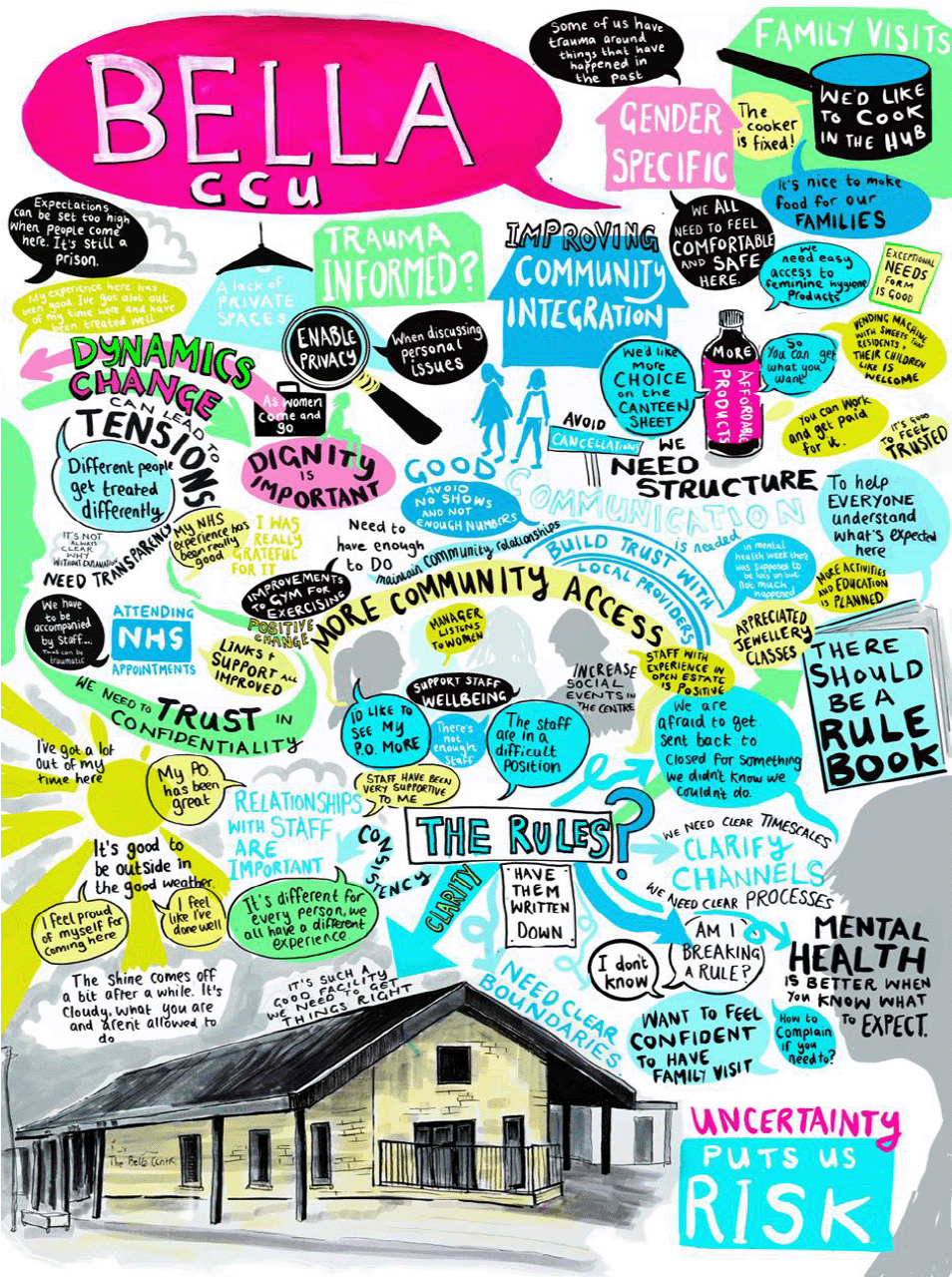
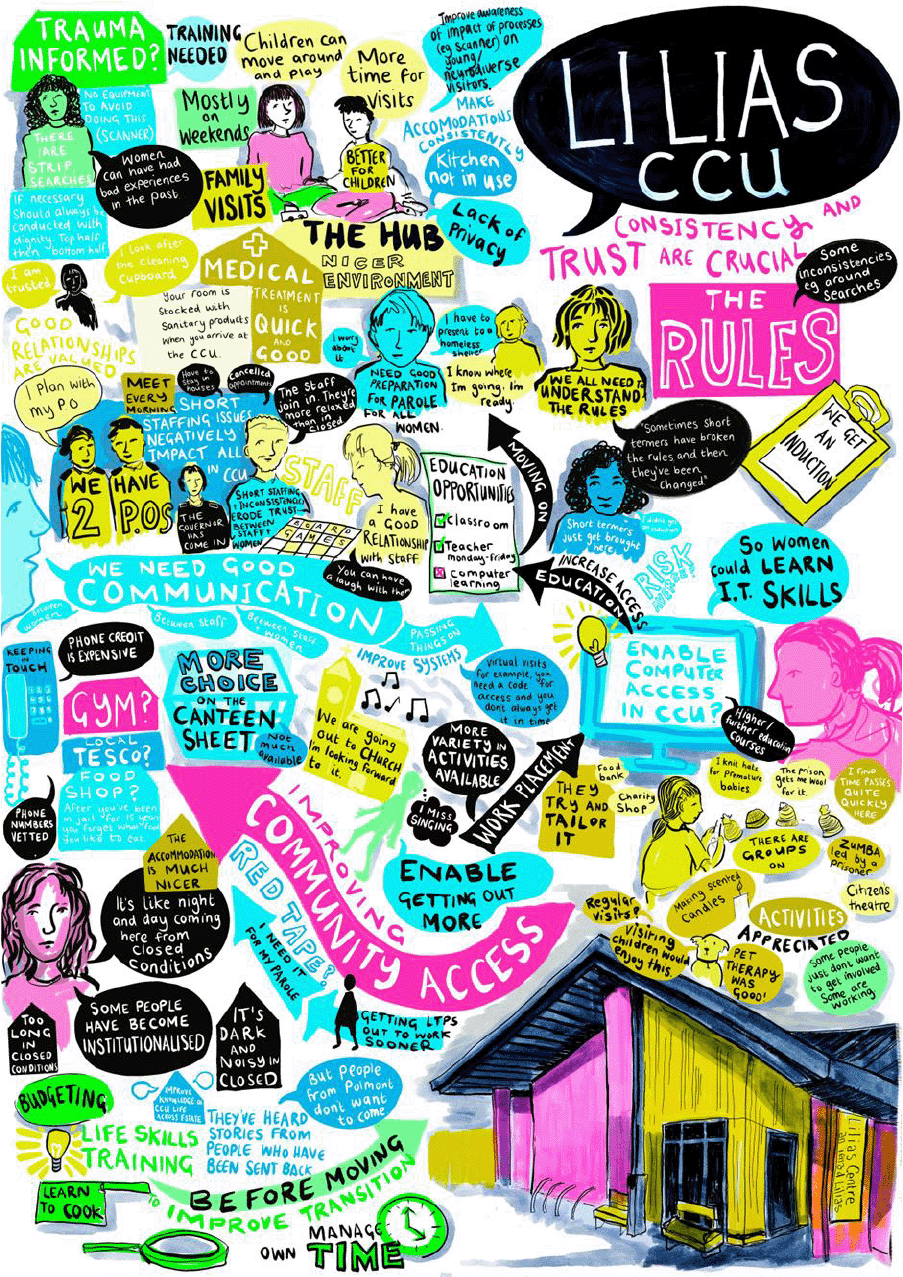
Contact
Email: Justice_Analysts@gov.scot