
Scottish Prisons Assessment and Review of Outcomes for Women (SPAROW): full report
Full research findings on the early impact and emerging outcomes of the application of the Scottish Prison Service Strategy for Women in Custody 2021-2025 in the context of the new Community Custody Units (CCUs).
6. Who are the women in the CCUs?
This chapter describes the processes through which women are identified, assessed and selected for transfer from closed conditions elsewhere in the female prison estate to the CCUs. It describes the risk assessment processes and offers the views of CCU staff and women residents on the transfer processes. The chapter also provides an overview of who the women are that are coming into, and transitioning out of, the CCUs. This is done using data provided by the CCUs during the fieldwork period.
Processes for transferring from closed conditions to a CCU
Identification/selection of women
As a first step in identifying women considered suitable for transfer to a CCU, the Governor of HMP Stirling, along with one or both of the CCU managers, scrutinise the SPS prisoner database. This identifies women who could potentially ‘fit the CCU criteria’ (LM 002). All women who fit the criteria will be reviewed.
Interviews with Strategic Managers and First Line Managers provided information on the processes regarding the identification of women for the CCUs. Women may be put forward for consideration for transfer on the recommendation of their POs. They may also be put forward by CCU staff who visit the women's facilities at HMP Greenock, HMP & YOI Grampian and HMP & YOI Polmont to identify women they consider meet the criteria and/or who wish to move to a CCU.
A woman may be eligible for transfer to a CCU if she satisfies the following:
- is assigned low supervision status;
- has no misconduct reports;
- has no outstanding criminal charges;
- has no positive and at least one negative mandatory drug test, and;
- has served appropriate period of sentence in closed conditions (SPS Community Access Policy 2018: 50).
There are specific categories of prisoner that are exempt from selection to transfer to a CCU. This includes women on remand and those that present a high or medium risk (due to, for example, breached bail conditions, those convicted of sexual offences, or those with license conditions). Where women have an outstanding court appearance or a misconduct report (and are therefore ineligible at that time) they are marked so that they may be considered for review again at a later stage (LM 002 Manager).
There are very few factors that fully disqualify women from being eligible. For example, women with substance abuse issues are eligible and may receive support inside CCUs from both NHS and various third-party providers, and/or outside of the facility, and may continue to receive support upon release.
As ownership of the transfer and progress process lies with HMP & YOI Stirling, the Governor can (and has) used her discretion to accept a woman who falls outside the criteria. Equally, the Governor retains the ability to refuse anyone who is put forward by a CCU manager or a woman’s PO if she deems them unsuitable.
Assessment and admission
The SPS Community Access Policy (SPS, 2018) states that the manager of the Assessment Centre in HMP Stirling alongside the Governor (and with input from CCU managers) share the responsibility for overseeing the process of assessment and admission to the CCUs. A woman’s sentence/progression status dictates the assessment and admission route she must go through.
SPS Progression Pathways define the criteria for progression and minimum period of sentence that each prisoner type is expected to serve in a secure establishment before being eligible for consideration to progress to less secure conditions (HMIP 2024). The recommended timescales differ for each category of offender:
- life sentenced are eligible to transfer no earlier than four years prior to the expiry of the punishment part of their sentence;
- long-term prisoners (LTPs, with sentences of over four years) must have served six months in custody and be within two years of their parole qualifying date;
- short-term prisoners (STPs, with sentences of less than four years) must have served three months in custody and must be serving a minimum of 12 months.
Once a prisoner has met their predefined timeframe in a closed prison, they will be seen as being eligible to progress, subject to meeting certain standard criteria. In terms of risk of reoffending, they must demonstrate that they have taken steps to reduce their risk. There must be sufficient evidence that the risk presented can be managed in the community.
Risk Management Team (RMT)
LTPs are managed through a Risk Management Team (RMT) progression process which is used by all closed establishments. In 2018, the SPS introduced the Risk Management, Progression and Temporary Release Guidance and the Supplementary Guidance for Risk Management Teams (SPS 2018). FLM interviews gave insight into the operation of the RMT, which is a component of the Integrated Case Management (ICM) process that operates in all prisons. ICM is a process whereby other agencies work closely with SPS to give prisoners help and support to deal with any social or personal difficulties, so that they are less likely to re-offend on release. ICM is based on a case-conference model which plots a prisoner’s progress and assesses and manages risk. Information from case conferences relating to individual prisoners are recorded on Prison Records 2 (PR2), which is a database on which details of all prisoners are recorded. Officers (and prison-based social work staff) are able to input data directly into the PR2 system.
The RMT is a multi-disciplinary team comprising professionals from agencies involved in the care and management of all prisoners. Its primary purpose is to consider the assessment, intervention and management needs of prisoners referred via the ICM process (or where local management have a particular concern about an offender’s behaviour or ongoing management that requires immediate intervention). It is also the decision-making body that considers progression to less secure conditions and/or community access.
It is the latter consideration that is most relevant in relation to women’s transfer from closed conditions to a CCU. In making a decision the RMT considers three key areas: the time served in a closed prison, individual levels of risk, and the individual’s behaviour in custody. The RMT’s key role here is to assess the risk that the woman may abscond, pose a danger or cause harm to the public (SPS 2018).
RMTs will also consider the extent to which the prisoner has positively engaged with the prison regime. This will include the prisoner’s supervision level, PO reports, behavioural updates, information held by the intelligence management unit, attendance at purposeful activity (work, education, etc.), Offending Behaviour Programme completions and engagement with ICM processes.
Upon a woman being approved for progression via the RMT, the CCU will review any proposed management plan prior to granting the woman community access. A further condition which applies to LTPs is that they cannot progress to a CCU without a satisfactory Home Leave Report (HLR). This is conducted by a social worker and can take several weeks to complete.
Once a woman is residing in a CCU any subsequent progression, such as community access, is also managed by the RMT. LTPs, and ‘top-enders’ can only be granted community access once they are located within a CCU.
Women’s Case Management Board (WCMB)
STPs are identified and selected through a Women’s Case Management Board (WCMB). This is also a part of the ICM process, bringing together representatives from different agencies to discuss and plan for individual women in the prison estate. Membership of the WCMB includes the CCU Unit Manager and officers familiar with the individual’s case management, as well as other agencies, such as social work. The WCMB conducts an initial assessment to ensure a woman meets the assessment criteria, followed by a determination of whether any risks can be managed safely in the community, and their needs can be met in a CCU.
As part of the admission process, STPs are interviewed by a CCU officer to further assess suitability. They are also subject to a drug test which can be carried out either before, or in some cases, after they transfer to a CCU. STPs can transfer to a CCU without an HLR, however, they must undergo one as soon as they arrive.
It is important to note that the WCMB does not make any decisions in relation to community access as this is the role of the RMT:
“The WCMB will only determine a woman’s suitability for transfer to CCU and in no way contribute to any decisions in relation to community access. Every woman who transfers to CCU will be subject to a period of induction to the facility and a period of supervised community access prior to being assessed for temporary release. This will be decided by RMT within the CCU.” (SPS Community Access Policy 2018).
STPs will only be referred to an RMT if they are on staged access to the community. This is usually done once they are living in a CCU. If a woman chooses to move to the CCU she must sign a residency contract adhering to the rules of the CCU.
The CCUs therefore accommodate women prisoners of mixed custodial sentence lengths: STPs, LTPs, and ‘top-end’ prisoners (i.e. life sentence or long-term prisoners approaching a potential release date). For this latter group, the CCUs aim to function in a similar way to the ‘top-end’ facilities in the male prison estate, which enables a period of ‘testing’ in less secure conditions before accessing the community.
For women approaching the end of a long-term sentence, CCUs are intended to prepare them for transition back into society. For those serving short sentences, CCUs focus more on maintaining ties with the local community.
Views of CCU staff on risk assessment and admission processes
The majority of FLMs and many residential officers had worked in more than one prison establishment. They spoke about the different approaches taken between management teams and the different cultures around risk assessment and progression that had developed. The general feeling was that the priority status given to ICM could be quite different depending on the senior management team in place at that time.
Many officers also found the RMT processes confusing and reported that they were given no formal training or guidance on how it works in practice. As one said: ‘it’s a black box’ (BS 002). Not fully understanding the process had an impact on staff confidence and ability to carry out their role; they also highlighted it as a notable frustration among the women. Officers explained that there were differences as to how an RMT runs in other open establishments in comparison to the CCUs and that this should not be the case where women are assessed low risk category. As one said:
“it’s stuff that managers here should be picking up on…But the problem I had was [male establishment] do them completely differently from us.” (BS2 005 residential).
There was a perception that the RMT process for women ran differently depending on who was chairing it and could be very subjective in terms of risk. It was believed that this could lead to inconsistency in decision making. It could also (inadvertently) lead to tensions between the women who were often keenly aware of how other women were progressing in the CCU, particularly in terms of gaining community access. There was also frustration voiced that despite the CCU officers having greater knowledge of the women than the deputy Governor, that it is the deputy Governor who has the final say in the RMT process.
“When I say inconsistency, that goes like, all, in my opinion, all the way to the top. So, whoever chairs the RMT, whether it be the Governor or Deputy Governor, again, from what I’ve seen, have different opinions. Which then leaves it open to, so one woman will have an RMT that was run by the Governor and she will get X, Y and Z. The next lady will go up and it will be run by the Deputy Governor and she’s maybe a bit more risk adverse and not too familiar with the process.” (BS 007 residential).
Staff saw this as having strong potential to cause tensions if women were denied community access or were experiencing delays in having their First Grant for Temporary Release (women referred to this as their “First Grant”) signed off.
“And that creates an environment where it’s like, ‘why are you picking on me? Why am I not getting this?’ And I can totally understand that.” (LS 003 First line manager).
With regard to the WCMB which oversees STP transfers to a CCU, staff viewed this as a population management tool, with less consideration paid to risk. There were mixed views amongst staff about this:
“I think every female coming here should go through the RMT process… It makes me uncomfortable that they don’t consider risk prior to transferring short-termers here.” (BS2 007 residential).
“...I suppose for me as well I seek much more assurance from my first line managers that everybody has been assessed appropriately or has been considered appropriate.” (LS3 001 Manager).
Other staff were less concerned, reporting that they sought information about STPs from the SPS prisoner record management system (PR2). Their concern was primarily whether the individual woman’s needs could be met within the CCU.
Initially, following the establishment of the CCUs, face-to-face interviews were conducted with women identified as suitable for transferring to a CCU. Two CCU staff went out to the prisons where women were based. This process was viewed very positively by officers who found these meetings useful for explaining the CCUs to women, gauging their interest and answering any questions they might have.
This process changed over time however. Interviews conducted in the 3rd stage of fieldwork reported that CCU officers were going out to meet women in other establishments far less frequently in advance of women moving to a CCU. As an alternative, staff had begun interviewing them over the telephone instead: “because of staffing, and cost, we've not been interviewing them face -to-face, but over the phone.” (BS3 001 (1) residential).
Officers voiced a lot of concerns about this change. They explained that it was not always possible to assess women and their needs properly during a short phone call. This could result in women who were not suitable being transferred into the CCU (BS3 002: 2). Whilst this does not happen often, one officer relayed a case where a woman with psychosis had been assessed as suitable for transfer to a CCU. An STP who had been in custody for just a short time, she had not been seen at all by CCU staff before her arrival, highlighting the importance of the face-to-face interview process.
Views of women on processes of admission
For the most part, LTPs and those at the ‘top-end’ of their sentence viewed the process to progress out of closed conditions from another prison establishment into a CCU to be more protracted and onerous than the process for STPs. They felt that they were subject to more stringent conditions before they could be considered suitable for progression. Some STPs were transferred to a CCU in the early stages of their sentence after having spent relatively little time in closed conditions (i.e. weeks). In contrast, LTPs and ‘top-enders’ had spent a considerable number of years in prison and had progressed through various stages, and were required to complete specific programmes within other prison establishments, before arriving in a CCU. As one said:
“Short-termers get a five-minute interview, a drug test and then on you come. Us, on the other hand, whoa! Psychology, social work, intel, medical, drugs tests, programme work.” (BR2 002).
For the most part, LTPs and ‘top-enders’ considered moving to a CCU as a ‘privilege’ that they had earned after spending years in closed conditions, as well as seeing the move to a CCU as one step closer to release. Tensions arising between LTPs and STPs about the time the former spent in closed conditions before being transferred to a CCU was a recurrent theme throughout the research. There was a wide perception among LTPs that the process for STPs was an ‘easier’ or ‘quicker’ route. This was also the case in relation to their perceptions about the rapidity with which STPs gained community access for unescorted day release (UDR) and eligibility for work placements.
Some LTPs and ‘top-enders’ were particularly vocal about other women who had got UDR after just a few weeks. As one said: “I done years in Cornton Vale, done all my programmes – but she gets out and about before me – why?” (Bella, field notes). Another was upset that she would not be eligible for a work party for some months but others “came straight in and got jobs in the CCU” (Lilias field notes). Often these perceptions were due to a lack of information provision to women of how SPS processes differed for STPs and LTPs. This led, rather inevitably, to tensions between women which flared up when community access was allowed for STPs.
The significance of these categorisations of STP, LTP and ‘top-end’ women and the progression stages they denote, should not be underestimated. As several women told us, they play a key determining role in the ways in which living in a CCU is experienced. There are stark differences in what women consider ‘privileges’ that are based on a woman’s categorisation – and these can also be a key site of resentment between women who are learning to live together in new surroundings. The implications of this mix of residents and, in particular, the tensions that this can give rise to are returned to throughout this report.
Populating the CCUs
The population of the CCUs changed considerably over the duration of the research. Chart 1 below shows changes in the populations of both HMP Lilias and HMP Bella from the point at which they became operational to February 2025. HMP Bella opened first, in August 2022, with HMP Lilias opening in October 2022. Women inevitably reside for different periods of time; some of those with longer prison sentences were living in the CCUs throughout the duration of the research, with others entering, and leaving at different points.
When the first stage of research fieldwork commenced in August 2023, the numbers of women living in the CCUs were low, with 12 women living in HMP Lilias and seven women living in HMP Bella. By the close of the third stage of fieldwork, this had grown to 20 women in HMP Lilias (which has capacity for 24 women) and 14 in HMP Bella (which has capacity for 16 women). Neither CCU reached capacity during the period of the research although numbers in late 2024 and early 2025 neared this.

By the end of 2024, numbers of women living in the CCUs had risen with a significantly higher percentage of STPs in relation to LTPs. This can be seen clearly in Charts 2 and 3, which provide an overview of transfers into the CCUs. The first chart, which shows transfers into HMP Lilias from its inception in October 2022 up to the end of February 2025, shows the very slow increases in numbers of women being transferred in during the earlier months following the opening of the CCUs. It also shows the changing profile, with many more STPs than LTP and ‘top-end’ prisoners being moved there as the months went on.

Taken from: SPS data on women in HMP Lilias, March 2025.
The sentencing profiles of women differ between HMP Lilias and HMP Bella. There is a higher number of life-sentenced women entering HMP Lilias and both CCUs show the increased numbers of STPs transferred in since inception.
Initially STPs would have to spend a period of at least three months in closed conditions before they could be considered eligible for transfer to a CCU. However, CCU staff interviews revealed that, within a relatively short time after opening, this no longer held, and there were instances where STPs were transferred shortly after arriving in a closed establishment. It was suggested that the reason behind this change in approach was due to the low numbers of women coming into the CCUs and a need to increase numbers.
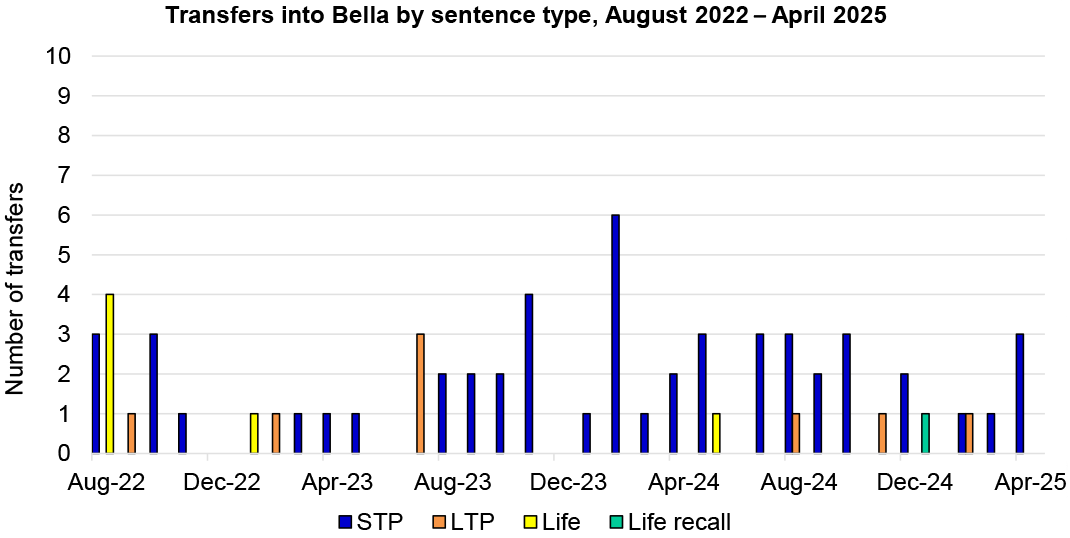
Taken from: SPS data on women in HMP Bella, April 2025.
Moreover, whilst the formal criteria for admission via the WCMB process had not changed since inception, some important changes were made in terms of the selection of women for transfer. For example, whereas at first, women with any outstanding charges were automatically excluded for selection, CCU staff were subsequently told to consider them. The WCMB was tasked with assessing whether women’s needs/risks could be managed within the CCUs.
Women’s journeys into, through, and out of the CCUs
This section describes how women were informed about a prospective move to a CCU and their journeys through it. To do so, it draws on interview data from the women and from ‘raw’ data provided by the CCUs on women’s entry into, and progression through the CCUs.
The data provides information on the numbers of women in each CCU over the period since inception to the end of February 2025 (HMP Lilias) and mid-April 2025 (HMP Bella) and their sentence type. It also specifies the prison establishments from which the women came. Tracing the women’s journeys in and through the CCUs using this data also yields information about the numbers of women who were returned from a CCU back into closed conditions and those who were liberated. The data also reveals the numbers of women who were given community access, work placements and UDR.
Entering a CCU
Women had widely differing journeys into, and through a CCU. In addition to their prisoner status, there were marked differences in the amount of information provided to women in advance of, or at the point of moving. There were also differences in the ways in which that information was conveyed and the amount of time between being informed and actually moving to a CCU.
Prior to moving, particularly in the months following the establishment of the CCUs, women’s levels of awareness about either the existence of the CCUs or their intended purposes were low. Most women interviewed in Phase 1 said they had not heard of the CCUs until they were approached to go there. A small number had heard about the CCUs through INSIDENEWS, a prison radio station. Some heard about the CCUs from other women in prison, others from social workers, or their POs.
One LTP said that it had taken her ‘weeks and weeks and weeks’ to find out anything – all she knew was that ‘women lived in houses and could see their family’ (BR 001: 1). At the same time an STP said that she got a visit from a CCU officer who ‘interviewed’ her and said afterwards ‘see you in Bella’ and she transferred four weeks later (BR 001: 2).
Some women were asked (by their PO in closed conditions or a visiting CCU officer) if they would transfer/progress into a CCU. Others, mainly STPs, were unaware that they were being considered for relocation until informed they were moving by their PO. Some spoke of being provided with ‘the CCU leaflet’ whilst in closed conditions. A small number reported that they were visited by a CCU officer, before moving, who explained more about life in the CCUs.
Theoretically, women were offered familiarisation visits before moving to a CCU so that they could look around the facilities, meet other women, and determine whether they wanted to move there, but this was not always the case.
STPs tended not to be given much warning of when they would be moving. Interviews with this group, in all fieldwork stages, suggested that they were not all given the opportunity to visit the CCU prior to transfer. Once informed they were going, the move happened very quickly. As one woman told us: “I think I came for my visit on the Monday and I got told I was going to be coming here on the Friday” (BR2 002).
For LTPs and life prisoners who had been in a closed establishment for a long time, the move to a CCU was a big adjustment due to the sudden change in regime. Many were overwhelmed by the whole process. This seemed to be the reason why LTP and ‘top-end’ women were offered several visits to familiarise themselves with the new surroundings before the move.
As the CCUs became more established, women became more aware of their existence. Some women were keen and motivated to move and had asked their POs how the process worked and how and when they might be considered for a move. A small number mentioned that the sending establishment could sometimes be slow to complete the paperwork needed to transfer to the CCU, which was experienced as frustrating.
The different routes that LTP and STP residents follow (progression and transfer respectively) and the amount and type of information that women were provided with about the CCUs played an important role in shaping their experience of moving there. Yet this information was not consistently conveyed and was often dependent on individual officers. As such, prior to moving, many women were left with more questions about the CCUs and their purposes than they had answers.
It is well-established that many women in the prison estate have experience of marginalisation and of being ignored or overlooked in decisions that affect them (see, for example: Corston 2007; Prison Reform Trust 2021). The preparation that women underwent in advance of moving to a CCU seems crucial for informing their understandings and expectations of what life might be like in a CCU. It is also important for how it might support their progression towards release. Moreover, such preparation shapes women’s ideas and preconceptions and is therefore vital in managing expectations and setting the framework for future work. Yet the variability of preparedness afforded to women seems at odds with the values and principles of the SPS Strategy for Women.
Women in the CCUs
The following table draws on the ‘raw’ data provided to us by SPS on women in the CCUs. It summarises the total number of women in each CCU by sentence type from the month they became operational in 2022 until February 2025 (HMP Lilias). and mid-April 2025 (HMP Bella).
As Table 4 shows, of the overall total number of women received into HMP Lilias over the period October 2022 to February 2025 (N=70). The majority (N=50 or seventy one per cent) were serving a short-term sentence; N=13 or nineteen per cent were serving life sentences, with one woman on life recall (that is they were recalled to prison following release on licence for breaching the terms of their licence). Four women (or six per cent) were long-term prisoners. The sentence type of two women was not stated.
The picture in HMP Bella was broadly similar. The total number of women received into HMP Bella over the slightly longer period of August 2022 to April 2025 was (N=66). Again the vast majority (N=51 or seventy seven per cent) were serving a short-term sentence; six women (or 9 per cent) were serving life sentences. Eight women (or 12 per cent) were long-term prisoners. Of the 51 women there on short-term sentences, most were serving sentences of up to four years, that is, at the higher end of short-term. Of the long-term (not life) prisoners, just two were serving sentences of longer than 10 years.
| Sentence type | HMP Lilias | HMP Bella |
| STP | 50 | 51 |
| LTP | 4 | 8 |
| Life/Top-end | 13 | 6 |
| Life recall | 1 | 1 |
| Unknown | 2 | 0 |
| Total | 70 | 66 |
The period of time that women resided in the CCUs varied considerably, according to sentence length. Whereas some longer-term sentenced women had been there since the CCU opened, most short-term sentenced women were much more transient, residing for shorter periods of time. For example, in HMP Bella, twenty one per cent of the women there had a maximum sentence of a year. Although we did not specifically ask women to tell us their age, many divulged it, either in interviews or when we were in the CCUs, indicating an age range from early 20s to late 70s. Most were mothers and many had dependent children. Women came from all over Scotland.
Transfers into the CCUs
Most women in both HMP Lilias and HMP Bella were transferred in from HMP & YOI Polmont, a significant number arrived from HMP Stirling and smaller numbers came from the women’s hall in HMP Greenock. In the earlier months of the CCUs opening, smaller numbers of women moved in from the women’s halls in HMP Edinburgh[3] and HMP Grampian, as well as from HMP & YOI Cornton Vale (before it closed in April 2023).
Community access
The CCUs were intended to support the needs of women who would benefit from closer community contact and access to local services. This was a key reason why women agreed to move to a CCU and reflected the initial understanding of CCU staff. Yet, in reality, community access was permitted for just a small proportion of women in the CCUs. The implications of this and the impact this had on women’s experiences of living in a CCU are discussed in more detail in Chapter 7.
SPS national policy sets out risk management and progression guidance for levels of community access. This is best conceived of as a stratified process where women must essentially work their way up, for example, from escorted to unescorted leave varying in both frequency and duration.
As previously stated, the decision-making process for community access sits with the RMT, with input from social work, psychology, health, and other relevant professionals. The RMT determines and regularly reviews the level of community access permitted. The women and their POs can attend the RMT meeting where community access is decided.
LTPs and life-sentenced prisoners can only be granted community access if they are located within less secure conditions. STPs must be serving 12 months (and less than 4 years) to be considered for community access. The following tables present the data on community access decisions in relation to different sentence types. As Table 5 below shows, only 20 women, or twenty eight per cent, gained community access whilst in HMP Lilias.
| Sentence type | Community access | No community access | Unknown |
| STP | 5 | 44 | 1 |
| LTP | 3 | 1 | 0 |
| Life/Top-end | 10 | 3 | 0 |
| Life recall | 1 | 0 | 0 |
| Unknown | 1 | 1 | 0 |
| Total | 20 | 49 | 1 |
According to CCU officers and women interviewed, community access was predominantly granted for STPs whose risk level was considered to be low. Yet, the data from HMP Lilias reveals that a higher number of life-sentenced and top-end women were granted community access. In terms of specific types of community access: eight women in HMP Lilias were given UDR together with temporary release for work, known as Work Placement (WP).
As Table 6 shows, of those, six were ‘top-enders’ and two were LTPs. Another five women were given WP and Home Leave (HL), of which three were LTP and two were STP. Two women were given just HL, both STPs. Four women were given special escorted leave (SEL), all of whom were top-enders. Information on the type of community access was not provided for one woman.
| Sentence type |
Community access |
Total |
||||
| UDR & WP | WP & HL | HL | SEL | Unknown | ||
| Short-term | - | 2 | 2 | - | 1 | 5 |
| Long-term | 2 | 3 | - | - | - | 5 |
| Life/Top-end | 6 | - | - | 4 | 4 | 14 |
| Total | 8 | 5 | 2 | 4 | 5 | 24 |
The data from HMP Bella is more limited in terms of information about community access. It shows that just 11 of the 66 women in the CCU since inception were given community access (16 per cent), although it does not specify what kind of access. These were five STP, three LTP and three life-sentenced women. It suggests that the remaining 55 women had no community access, although we cannot be confident that is an accurate picture.
Return to closed conditions from a CCU
Eight of the 70 women (11 per cent) in HMP Lilias were returned to closed conditions from the CCU. Four of these women were serving life-sentences and three were serving short-term sentences. Sentence status for one woman was not provided in the SPS data.
All of the women that were returned to closed conditions were sent back within two to three months of arriving in HMP Lilias. Of those serving life sentences sent back to closed, two were subsequently transferred back into HMP Lilias after six months and one year, respectively.
In HMP Bella, the data suggests that nine of the 66 women (13 per cent) were transferred back to closed conditions. Most (i.e. six) were transferred back within one month of arriving in HMP Bella. Two of these women were later transferred back into HMP Bella again and one was transferred to HMP Lilias. One of the women serving a long-term sentence who was transferred back to closed conditions returned to HMP Bella after almost seven and a half months.
The main reason that women were sent back to closed conditions was because they were given an Adverse Circumstances Report (ACR) made by a member of CCU staff, usually the woman’s PO. The decision on whether to return a woman to closed conditions rests with the duty manager of the CCU. Once the decision is taken, women are moved quite quickly as there is no safe space in the CCUs to hold women who are perceived as a risk. Women’s view on the risk and implications of being ‘papped back’ are discussed in more detail in Chapter 7.
Figure 2. Women’s pre-release journeys, HMP Lilias and HMP Bella
8 women (Lilias) and 9 women (Bella) were returned to closed conditions following transfer to a CCU.
Of these women:
- 5 women (Lilias) and 1 woman (Bella) were subsequently released from closed conditions
- 1 woman from Bella returned to Lilias
- 2 women (Lilias) and 2 women (Bella) transferred back to a CCU from closed conditions
- 1 woman (Lilias) and 2 women (Bella) subsequently released from a CCU
Release from the CCUs
The SPS data, presented in Table 7 below, reveals women’s journeys out of the CCUs. In total, between March 2023 and February 2025, almost two thirds (N=45 or sixty four per cent) of the 70 women imprisoned in HMP Lilias over that period were liberated. Table 7 highlights that 16 (35 per cent) were liberated at their earliest date of release (EDR). Another seventeen (37 per cent) were released under home detention curfew (HDC), allowing them to serve the remaining part of their sentence in the community, whilst subject to curfew conditions and electronic monitoring (‘tagging’). Five women were released following the recommendation of the Parole Board. Four were released under the Scottish Government’s early release scheme, which allows changes to the release point for those serving short-term sentences. The data for three women were not provided.
In HMP Bella, between August 2022 and mid-April 2025, 44 women (66 per cent) of the 66 women were liberated. As shown in Table 7 below, one third (15 or 34 per cent) were liberated at their EDR. Twenty women (45 per cent) were released under HDC; three women were released on parole, three on appeal, and one was released on bail. Two women were released under the Government’s early release scheme.
| Type of release | HMP Lilias | HMP Bella |
| Early release | 4 | 2 |
| Earliest date of liberation (EDR) | 16 | 15 |
| Home detention curfew (HDC)/bail conditions | 17 | 21 |
| Parole | 5 | 3 |
| On appeal | - | 3 |
| Unspecified | 3 | - |
| Total | 45 | 44 |
Overall then, around two thirds of the women detained in the CCUs were liberated from there, via a variety of means, albeit mainly at their EDL or under HDC.
Women’s post-release journeys
Figure 3 below shows the post-release journeys of the 45 women who were released from HMP Lilias during the period March 2023 – February 2025. Of the 45 released at different points over that period, the majority, 39 women (or 86 per cent), remained in the community as at the end of February 2025.
Six women that were liberated were returned to closed conditions within months post-release, and Figure 3 also shows what happened to them thereafter. Four were transferred back into a CCU for a second time (three were sent back to HMP Lilias and one sent to HMP Bella). Two of those women sent back to HMP Lilias were then subsequently liberated from there on their EDR; one of whom was re-arrested shortly thereafter and sent to closed conditions.
The HMP Bella data suggests that, of the 44 women released into the community, just two were re-arrested thereafter and returned to closed conditions. However, there is a caveat that this data is not comprehensive and that the circumstances of released women were not explored as this was beyond the scope of the research.
Figure 3. HMP Lilias post-release journeys, March 2023 – February 2025
45 women released from HMP Lilias between March 2023 and February 2025.
Of these women:
- 39 women remain in the community as of February 2025
- 6 women returned to closed conditions
- 4 of these women transferred back to a CCU – Lilias (3) and Bella (1)
- 2 of these women subsequently liberated from CCU following return
- 1 woman returned to closed conditions
Summary
This chapter highlights the different transfer/progression stages and assessment and admission processes for women moving into the CCU and the roles played by the RMT and WCMB. It also provides the views of women and staff about these processes and their experiences of entering a CCU. It is evident that there remains some uncertainty and confusion amongst women about the mix of women in the CCUs which colours their expectations about the value of the CCUs for each group.
The chapter also presents some analyses of the SPS data from HMP Lilias and HMP Bella; this shows the growth in numbers coming into the CCUs over time, and the changing profile of women residing there. The data also shows the numbers of women gaining community access, the numbers liberated from a CCU and those returned to closed conditions.
Contact
Email: Justice_Analysts@gov.scot