
Scottish Government People's Panel 2026-27 Event 1: Reform of the National Performance Framework
The People’s Panel 2026-27 brings together 40 members of the public from across Scotland, who meet online to discuss current public policy questions. This report presents findings from the meeting on 26 February 2026, when the Panel discussed the reform of Scotland's National Performance Framework.
1 Introduction
The Scottish Government is committed to increasing public participation in policy making, providing people with opportunities to shape government decisions that will affect them. This is supported through a range of approaches including consultations, citizens’ assemblies and People’s Panels.
In 2022-23 the Scottish Government established a People’s Panel to explore public experiences during the COVID-19 recovery period and other significant issues such as the cost of living and community resilience.[1] An independent evaluation found that participation in the Panel had positive impacts for the panel members, and highlighted strong support within Scottish Government to establish a People’s Panel approach as a regular part of policy making.[2]
As such, the 2026-27 Scottish Government People’s Panel was established to provide policy makers with access to public perspectives on strategic policy questions and policy design issues. It enables members of the public to share their views, experiences and priorities at a stage where these can inform policy development and decision-making.
The 2026-27 People’s Panel takes place against the backdrop of the Scottish Parliament election in May 2026; ongoing public service reform;[3] and a review of Scotland’s NPF[4] which helps shape national priorities and measure progress on wellbeing.
These developments also come at a time when many people continue to face cost-of-living pressures and uncertainty about the future, shaped by wider economic challenges and international events. Together, these factors create a strong case for ensuring that public perspectives help inform government priorities and decision-making. The People’s Panel provides a valuable opportunity to understand people’s experiences, concerns and aspirations, and to ensure these views are reflected in the development of policy.
1.1 About the Scottish Government People’s Panel
The Scottish Government People’s Panel provides a way for the Scottish Government to hear directly from members of the public. The Panel aims to provide policy makers with in-depth lived experience perspectives during policy development. Their views and experiences can help policy makers understand public priorities, identify potential challenges or unintended consequences, and consider how policies may affect different groups. The findings can then be synthesised alongside other sources of evidence to support policy design and development.
Panel members were invited to take part in six online meetings over the course of 2026-27. The first three meetings of the Scottish Government People’s Panel 2026-27 took place in February, March and June 2026, with the remaining meetings scheduled for September 2026, November 2026 and January 2027.
In preparation for each panel session, the research team works with Scottish Government colleagues to develop discussions on key policy questions where public perspectives could help inform current thinking or policy design. The first three Panel discussions focused on:
- Panel 1: Reform of the National Performance Framework;
- Panel 2: Trust in government;
- Panel 3: The cost of living.
Topics selected for the remaining meetings will continue to reflect Scottish Government priorities, Panel interests, and areas where there is current scope and need for public perspectives to contribute to policy development and decision-making.
This report presents findings from the Panel meeting on the reform of the National Performance Framework, which took place in February 2026.
1.2 Approach and method
Dialogue-based research
Dialogue-based research[5] allows people from a wide range of backgrounds to engage with complex policy questions, regardless of their prior knowledge or expertise. Panel members are provided with balanced information to support their understanding of the topic, and are given opportunities to ask questions, explore different perspectives, and provide feedback and challenge. The insights that this kind of process generates can help government understand public views about a policy proposition, as well as generating new ideas or flagging concerns that can support better policy design.
Recruitment
The People’s Panel is a research panel consisting of 40 members of the public, plus a group of reserves, recruited through a democratic ‘random lottery’ approach. This recruitment process was managed by the Sortition Foundation and is designed to ensure fairness and diversity in representation.
The Panel has been designed to broadly reflect the diversity of Scotland’s population in terms of gender, age, geographic spread, socio-economic background, ethnicity, disability, and range of political views – as far as is possible within the limitations of the sample size. Further methodological detail is provided in Annex A.
Panel approach
The Panel is intended to provide qualitative insight into public perspectives on complex policy questions, rather than to produce statistically representative findings. The Panel is not expected to reach consensus during discussions – the emphasis is on sharing and discussing different perspectives.
In advance of each event, the research team works closely with relevant Scottish Government teams to identify discussion topics for the Panel. Topics are selected to reflect current strategic government priorities. Panel members have also been asked what topic areas they would prioritise for discussion. Discussion topics should be broad enough to affect a wide range of people across Scotland. They are also areas where insights from lived experience currently have the potential to make a valuable contribution to policy development and decision-making. This means engaging the Panel at a point where there are clear opportunities for public input to inform future thinking – such as when policy is being developed or under review.
Before each event, panel members receive accessible briefing materials on the discussion topic. Panel members who need additional support are provided with technology or assistance to access online meetings to ensure that they are able to participate fully in the discussions.
Each meeting includes a short presentation on the discussion topic, followed by facilitated small group discussions. Representatives from teams which engaged with the Panel during previous sessions are invited to return to explain how the Panel findings have been used and what difference they have made to policy development or decision-making.
Members explore a series of questions in facilitated small group discussions, followed by a plenary feedback session. Discussions are supported by trained facilitators, with panel members’ views, reactions and responses captured by a note-taker and transcribed using Microsoft Teams.
To thank panel members for their time and commitment, they receive monetary compensation or a shopping voucher for each full meeting that they attend.
Analysis
Following each People’s Panel event, detailed notes and transcripts are used for thematic analysis. This involves systematically coding the data, grouping similar codes together and developing themes that capture important meanings or insights about the research topics. Data, including quotes, are anonymised in the coding process.
Quotes are used throughout this report to illustrate key perspectives from the panel members. Descriptive terms such as ‘some’, ‘many’ or ‘most’ are used to reflect patterns observed within Panel discussions. These terms are intended to convey the prominence of views within the discussions and should not be interpreted as statistical measurements.
Further methodological details are provided in Annex A.
Scope and limitations
While the Panel reflects a wide range of backgrounds and experiences, and is designed to reflect Scotland’s diversity, it nevertheless constitutes a small qualitative sample. The findings should therefore be interpreted as providing in‑depth insight into how this group of participants discussed and reasoned about the topic, rather than as a firm representation of public opinion in Scotland as a whole. Because the participation is designed to be broad, it does not represent the specific opinions of any given target group.
This report reflects the views of the panel members – a group which may represent a higher than average level of interest in politics and government. Some expectations expressed by the panel, for example around cross‑checking information, engaging with evidence, or following detailed explanations, may therefore represent a higher level of policy interest and engagement than might be realistic for all members of the public.
In addition, the session did not seek to test findings against wider public attitudes or existing evidence. The insights should therefore be understood as context‑specific, exploratory and indicative, rather than definitive.
1.3 Focus and context of this report
This report presents findings from the first meeting of the People’s Panel, held on 26 February 2026, which focused on the proposals to reform the NPF. The aim was to assess the clarity, relevance, and credibility of the proposals.
This was the first time that the draft proposals for a reformed NPF, including the proposed National Outcomes, were taken to members of the public, and the session formed part of the wider review process.[6] The proposals presented to the People’s Panel were those considered in the engagement phase. In summary these covered:
- The overall concept, including the name of the framework;
- Six proposed National Outcomes – connected, healthy, prosperous, secure, skilled and sustainable;
- Cross-cutting principles through which the National Outcomes can be viewed – fairness, equality, income and wealth, geography, inter-generational, future impact, and our place in the world;
- Measuring progress, including through national indicators; and
- Ways of working, including how the framework will be implemented and what accountability mechanisms will be put in place.[7]
In order to inform the discussions, panel members were provided with a series of short and accessible inputs including a briefing in advance of the meeting, and a presentation at the start of the meeting. These inputs set out the purpose of the NPF, the proposals for the new outcomes, and proposed ways of working.
Figures 1 and 2 show the draft proposed National Outcomes and cross-cutting principles as they were presented to the Panel members in February 2026.[8]
Panel members explored a common set of questions on: how the NPF relates to people’s lives; what feels clear, jargon-heavy, disconnected or inauthentic; whether the proposed new outcomes and cross-cutting principles make sense to people; reflections on the NPF name and branding; and how a future revised version of the NPF could most successfully be communicated. The discussion questions used in the session are provided in Annex B.
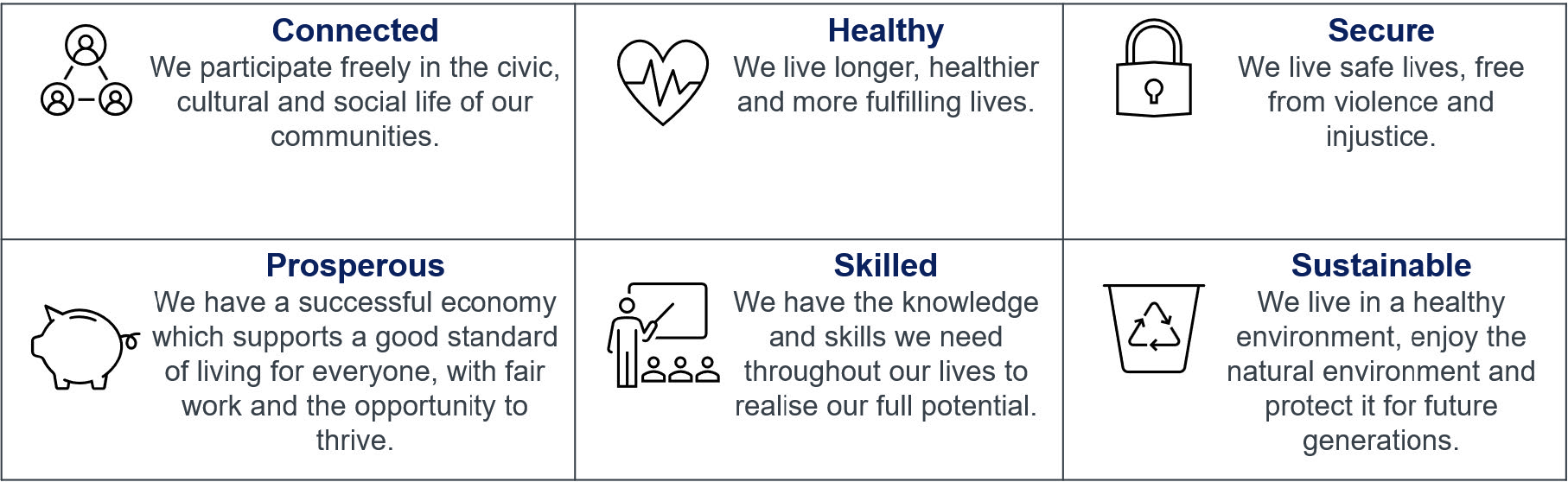
Connected
We participate freely in the civic, cultural and social life of our communities.
Healthy
We live longer, healthier and more fulfilling lives.
Secure
We live safe lives, free from violence and injustice.
Prosperous
We have a successful economy which supports a good standard of living for everyone with fair work and the opportunity to thrive.
Skilled
We have the knowledge and skills we need throughout our lives to realise our full potential.
Sustainable
We live in a healthy environment, enjoy the natural environment and protect it for future generations.
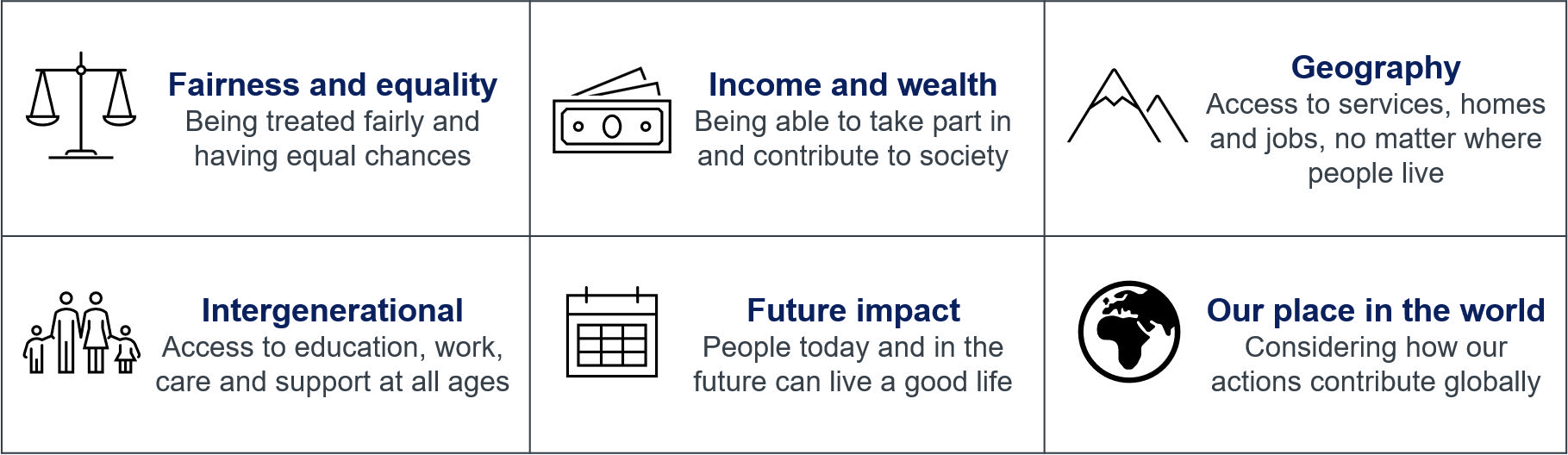
Fairness and equality
Being treated fairly and having equal chances
Income and Wealth
Being able to take part in and contribute to society
Geography
Access to services, homes and jobs, no matter where people live
Intergenerational
Access to education, work, care and support at all ages
Future impact
People today and in the future can live a good life
Our place in the world
Considering how our actions contribute globally
Attendance and participation
A total of 37 of the potential 40 panel members attended all or part of the session. Further details relating to participation in the session are set out in Annex B.
Structure of the report
The report is structured to:
- present the findings from the Panel discussions (Section 2), and
- draw out key considerations for government (Section 3), based on the views expressed during this session.
Contact
Email: peoplespanel@gov.scot