
Publication - Research and analysis
Scottish economic bulletin: November 2025
Provides a summary of latest key economic statistics, forecasts and analysis on the Scottish economy.
Labour Market
Unemployment remains low at 3.7% however the number of payrolled employees fell 0.6% over the year.
Employment, Unemployment, and Inactivity
- There remain challenges in measuring the labour market, with ongoing concerns about data quality for the Labour Force Survey (LFS) and Annual Population Survey (APS), particularly at sub-national levels. On 29 October, the Scottish Government announced that it would be ending the boost to the LFS data collection in Scotland.[12] It is now actively exploring alternative data sources, including administrative financial data and other public and private sector data. This work marks the beginning of a transformation in how labour market data is collected and used in Scotland. Alongside this, the Scottish Government will continue to work closely with the ONS to support the development of the transformed Labour Force Survey (TLFS), a redesigned, digitally focused survey anticipated to launch in late 2026.
- The LFS for July to September shows Scotland’s unemployment rate (3.7%) fell 0.1 percentage points (p.p) over the quarter, but is 0.4 p.p higher than at the same time last year. Alongside this, Scotland’s employment rate (74.3%) fell 0.7 p.p. over the quarter, but was up by 0.9 p.p over the year. The inactivity rate (22.8%) rose by 0.8 p.p over the quarter but was down by 1.1 p.p over the year.[13]
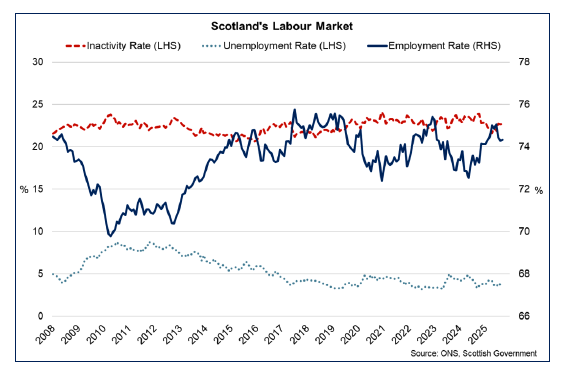
- Unemployment at a UK level rose 0.3 p.p over the quarter and 0.7 p.p over the past year to 5% in July to September. Unemployment rates vary across the UK with the latest data ranging from 2.4% in Northern Ireland to 6.5% in London, with Scotland’s unemployment rate at 3.7%.[14]

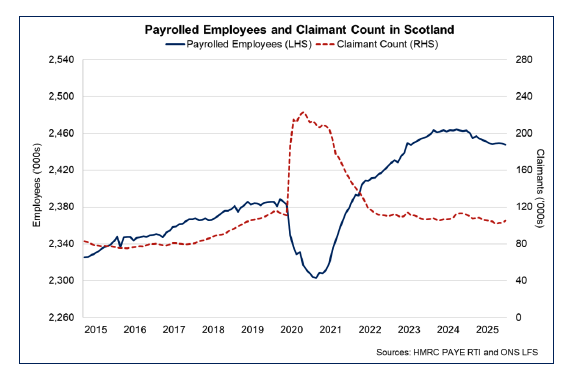
- More recently, Pay as you Earn (PAYE) Real Time Information data indicates that the number of payrolled employees in Scotland (2.45 million) is showing signs of weakening, falling marginally by 0.1% (c. 1,800 employees) over the month of October. Over the past year, the number of payrolled employees has fallen by c. 15,500 (-0.6%) indicating a slight loosening in conditions.[15]
- Furthermore, Scotland’s Claimant Count unemployment rate rose marginally to 3.5% in October (from 3.4% in September), with the number of people claiming unemployment related benefits in Scotland (c. 105,100) up 2.2% over the month, albeit that it is has fallen 6.0% over the past year.[16],[17]
Recruitment Activity
- Demand for labour has been stabilising over the past 18 months from more elevated levels in 2022 and 2023 and most recently has been impacted by a range of factors including increased economic uncertainty and labour costs.
- ONS Textkernel data shows that the number of new online job adverts posted has increased since the start of the year with c. 49,000 new online job adverts posted in Scotland in September, up 8.7% from September last year.[18]

- As set out above, the RBS Growth Tracker indicated that private sector businesses slightly reduced their staffing levels in October. However looking ahead, BICS data also indicates a largely stable outlook for labour demand in the near term, with most businesses (69.1%) reporting that they expect the number of employees to remain unchanged in November; the highest reported rate of this year.
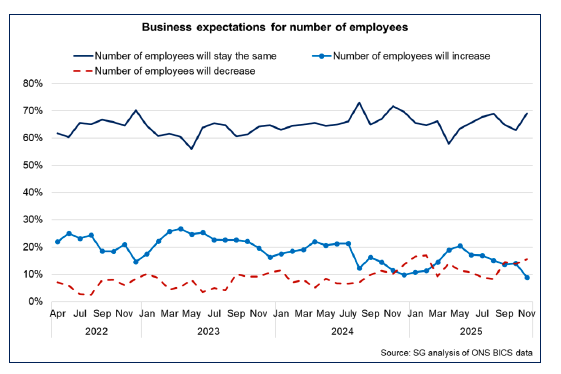
- However, there remains scope for some further softening in conditions. The BICS data indicates that the share of businesses expecting the number of employees to fall has risen to its highest rate since the start of the year (15.6%), partly offset by a decrease in the share expecting employee numbers to rise (8.9%).
Earnings
- Earnings growth has remained robust in 2025, however latest data indicates the pace of growth has slightly softened.
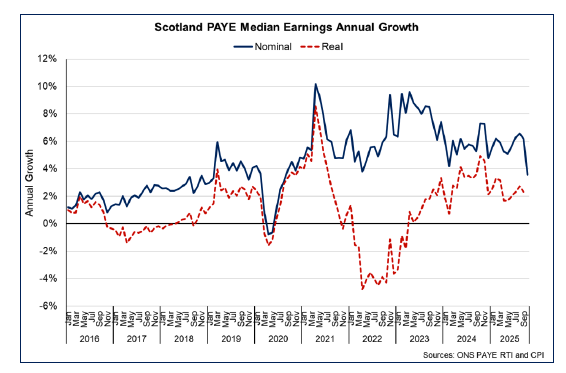
- Nominal median monthly PAYE pay in Scotland (£2,581) grew by 3.6% on an annual basis in October, with the pace of growth falling to its slowest rate since August 2020. In real terms, adjusting for inflation, earnings grew by 2.3% in September, with the average growth over the third quarter (2.4%) slowing from last year, in part reflecting the rise in inflation over this period.[19]
- At a UK level, the Bank of England indicate that earnings growth is likely to slow further over the coming year with latest business survey intelligence suggesting that pay settlements will slow from 3.7% in 2025 to between 2% and 4% in 2026.[20]
Contact
Email: economic.statistics@gov.scot