
Proposal for a National Park in Southwest Scotland: report
Report submitted by NatureScot in its role as Reporter, setting out the findings of the public consultation and providing advice for the Scottish Government regarding the Galloway and Ayrshire National Park proposal.
Section 3: The principle of a National Park in Southwest Scotland
46. This section of the advice considers the support and opposition for and against the proposed National Park. While it presents the overall response figures from the consultation, its main purpose is to provide an assessment of the underlying arguments made to support these positions and the case made for alternatives.
The case for a proposed Galloway National Park
47. Scotland’s existing National Parks are two of the nation’s most special places where nature is thriving and enjoyed by many; where sustainable use and enjoyment of the area are at the heart of community wellbeing and prosperity; and where some of the urgent action needed to tackle climate change is realised on the ground. As the Scottish Government’s policy memorandum to the Natural Environment Bill notes: “Scotland’s National Parks are more important now than ever before. Scotland, in common with the rest of the UK, has experienced a continuing decline in biodiversity over the last 20 years and tackling the climate and nature crises is a national priority”.
48. Like other National Park areas across the UK, the hills and coasts of Galloway and Ayrshire are a living and working landscape whose valued natural and cultural heritage has been shaped by people over many centuries. More uniquely (though not exclusively), it is also an area of significant economic importance for its farming, commercial timber and renewable energy production and it is also rightly recognised as the ‘dairy capital’ of Scotland. All these sectors are an important component of local employment and community life, but they are also of national significance in terms of tackling climate change, moving to a more sustainable circular economy and increasing food security. Despite this important economic base, parts of the area are performing less well than other rural areas in Scotland, with lower average wages, an ageing population and pockets of high child poverty. Average occupancy rates for visitor accommodation are low and the tourism season is also shorter than elsewhere.
49. The strategies and plans of the South of Scotland Regional Economic Partnership already place high value on the importance of the area’s natural capital in tackling these issues, as signalled by the development of the natural capital innovation zone for Southern Scotland. The new responsible tourism strategy 2024-34 also seeks to grow the visitor economy sustainably by inspiring more visitors to come to the south of Scotland in ways which do not undermine the special qualities of the area or the infrastructure and services that communities depend on. While focusing on community development needs, similar aspirations are picked up in many of the local place plans which are being developed by local communities across the area.
50. The establishment and expansion of the Galloway and Southern Ayrshire UNESCO Biosphere Reserve indicates the desire from South of Scotland Enterprise (SOSE) and the three local authorities across the area to find solutions to these challenges by focusing on action that protects the core of this area and seeks more sustainable approaches in its buffer and transition zones. The management plans previously drawn up for the three coastal National Scenic Areas of Fleet Valley, East Stewartry Coast and the Nith Estuary also had similar aspirations. The area is also unique in terms of the scale of public land managed by Forestry and Land Scotland (FLS), and to a much lesser extent NatureScot, on behalf of the Scottish Government. This brings significant opportunities for landscape scale approaches to nature recovery and sustainable land management.
51. As the recent consultation on the new regional land-use framework highlighted, there are tensions and potential conflicts between these land uses and the natural and cultural heritage of the area. Such issues are set to rise with the increasing trend towards afforestation of its upland areas, the future pipeline of wind farm developments and related grid infrastructure projects being considered for parts of the area, the growing intensification of lowland farming and pressures for tourism particularly on the coast.
52. The joint bid prepared by the GNPA and GSA Biosphere Reserve suggested that a National Park bespoke to Galloway could help address these challenges and meet the special needs of the area by:
- Driving innovation and partnership: a new style Galloway National Park will address our area’s competing demands for conservation, communities and commerce with creativity, cohesion and respect. Its location in the national Natural Capital Innovation Zone places the Park in a leadership position to address biodiversity loss and climate change at a scale that will attract responsible private investment. It will:
- Delivering landscape scale change in response to biodiversity goals and climate change targets: Galloway has small-scale land ownership with few large estates. Producing change at scale requires the Park to bring individual landowners and managers together to enhance and expand existing nature networks. The Park will provide an opportunity for strategic spatial planning across 3 local authority areas that is essential if we are to address the rapid rate of land use change.
- Providing a testbed for innovative nature-based solutions: The Park contains landscape types and land uses which differ from existing NPs in terms of scale and diversity. This mosaic creates unique opportunities for solutions to be trialled and for knowledge transfer to other rural communities as exemplars of good practice. Building on the experience of the UNESCO Biosphere, and relationships with secondary and tertiary educational facilities across Scotland, robust partnerships are already in place. This Park would hit the ground running.
- Supporting the Wellbeing Economy: Despite decades of economic investment in agriculture, forestry and renewable energy Dumfries and Galloway has stubbornly languished at the bottom of the income league for Scotland, unlike other rural areas. Our innovative Park will focus on the regeneration of communities, economy and the environment, building on existing initiatives developed by the Biosphere and others.
53. The Scottish Government expert panel that appraised the Galloway bid also recognised many of these issues and opportunities, noting in particular:
a) the high natural and cultural heritage value of the area;
b) the important socio-economic context – an area doing less well than other rural parts of Scotland;
c) an opportunity for nature recovery, to grow sustainable tourism and for greater co-ordination of existing land-uses in keeping with the regional economic strategies for the area, the borderland inclusive growth deal, and natural capital innovation zone; and,
d) a clear contrast to existing Scottish National Parks (hill, lowland and coastal character, SW location) which provides opportunities for further demonstration and exemplars.
54. In making its proposal for a National Park in Galloway, the Scottish Government recognised that the area met - or was likely to meet subject to the detail of the area selected - the legislative conditions for National Park status. They also expected a new National Park in Galloway to actively contribute to its key priorities of growing the economy, tackling the climate emergency and improving public services. Alongside a step change in the care and enhancement of the natural and cultural heritage of the area, a new National Park would need to help deliver economic growth by supporting the visitor economy and working closely with the highly important land uses of the area. Perhaps most critically, its design and operation would need to take account of local circumstances and the views of local communities and have a positive impact on people’s social, mental and physical health and wellbeing.
55. Against this background, the consultation sought to gauge the level of support for, or opposition to, a National Park and also to understand the arguments that underpinned these positions.
Level of support for or opposition to the National Park
56. The following tables and map provide an overview of the level of support for or opposition to the National Park recorded in written responses to the consultation and the public consultation events (see paragraph 25 for explanation of the detailed survey formats).
| Capacity of Response | Summary Survey | Paper Survey | Technical Survey | Overall | ||||
|---|---|---|---|---|---|---|---|---|
| As an individual | 3200 | 71% | 186 | 60% | 264 | 59% | 3650 | 70% |
| As a household | 937 | 21% | 98 | 32% | 57 | 13% | 1092 | 21% |
| As a business | 296 | 7% | 20 | 6% | 85 | 19% | 400 | 8% |
| As an organisation or group | 37 | 1% | - | 0% | 39 | 9% | 76 | 1% |
| Blank | 8 | 0% | 4 | 1% | - | 0% | 12 | 0% |
| Total | 4477 | 100% | 308 | 100% | 445 | 100% | 5230 | 100% |
| Survey Type | Strongly support | Tend to support | Tend to oppose | Strongly oppose | Undecided | Blank | ||||||
|---|---|---|---|---|---|---|---|---|---|---|---|---|
| Paper | 78 | 25% | 41 | 13% | 21 | 7% | 159 | 52% | 4 | 1% | 5 | 2% |
| Summary | 1484 | 33% | 457 | 10% | 263 | 6% | 2116 | 47% | 143 | 3% | 14 | 0% |
| Technical | 119 | 27% | 50 | 11% | 22 | 5% | 229 | 51% | 20 | 4% | 5 | 1% |
| Overall | 1681 | 32% | 548 | 10% | 306 | 6% | 2504 | 48% | 167 | 3% | 24 | 0% |
| Stance | Summary | Paper | Technical | Overall | ||||
|---|---|---|---|---|---|---|---|---|
| Support | 102 | 35% | 4 | 20% | 25 | 28% | 131 | 32% |
| Oppose | 179 | 61% | 15 | 75% | 55 | 64% | 249 | 62% |
| Undecided | 13 | 4% | - | 0% | 6 | 7% | 19 | 5% |
| Blank | 1 | 0% | 1 | 5% | 1 | 1% | 3 | 1% |
| Total | 295 | - | 20 | - | 87 | - | 402 | - |
| Relationship to area | No. of responses | % of total | Strongly Opposed | Tend to oppose | Undecided | Tend to support | Strongly support | Blank |
|---|---|---|---|---|---|---|---|---|
| Live in proposal area | 4028 | 77.0% | 51.4% | 5.6% | 2.9% | 10.2% | 29.6% | 0.3% |
| Work in proposal area | 1904 | 36.4% | 54.8% | 4.6% | 3.1% | 10.1% | 27.1% | 0.4% |
| Farmer or forester, or work in these sectors | 672 | 12.8% | 76.3% | 5.8% | 2.8% | 4.6% | 10.2% | 0.3% |
| Landowner / land manager | 747 | 14.3% | 65.5% | 4.7% | 2.9% | 7.3% | 18.9% | 0.7% |
| Local councillor / other elected representative | 90 | 1.7% | 39.6% | 5.5% | 5.5% | 11.0% | 38.5% | 0.0% |
| Business owner | 940 | 18.0% | 55.9% | 3.2% | 3.7% | 8.1% | 28.7% | 0.5% |
| Retired | 1748 | 33.4% | 46.0% | 7.0% | 3.6% | 11.2% | 32.0% | 0.1% |
| Student / in full-time education | 159 | 3.0% | 38.7% | 12.3% | 9.2% | 10.4% | 28.2% | 1.2% |
| Frequent visitor to area | 746 | 14.3% | 37.4% | 5.9% | 2.3% | 10.0% | 44.3% | 0.3% |
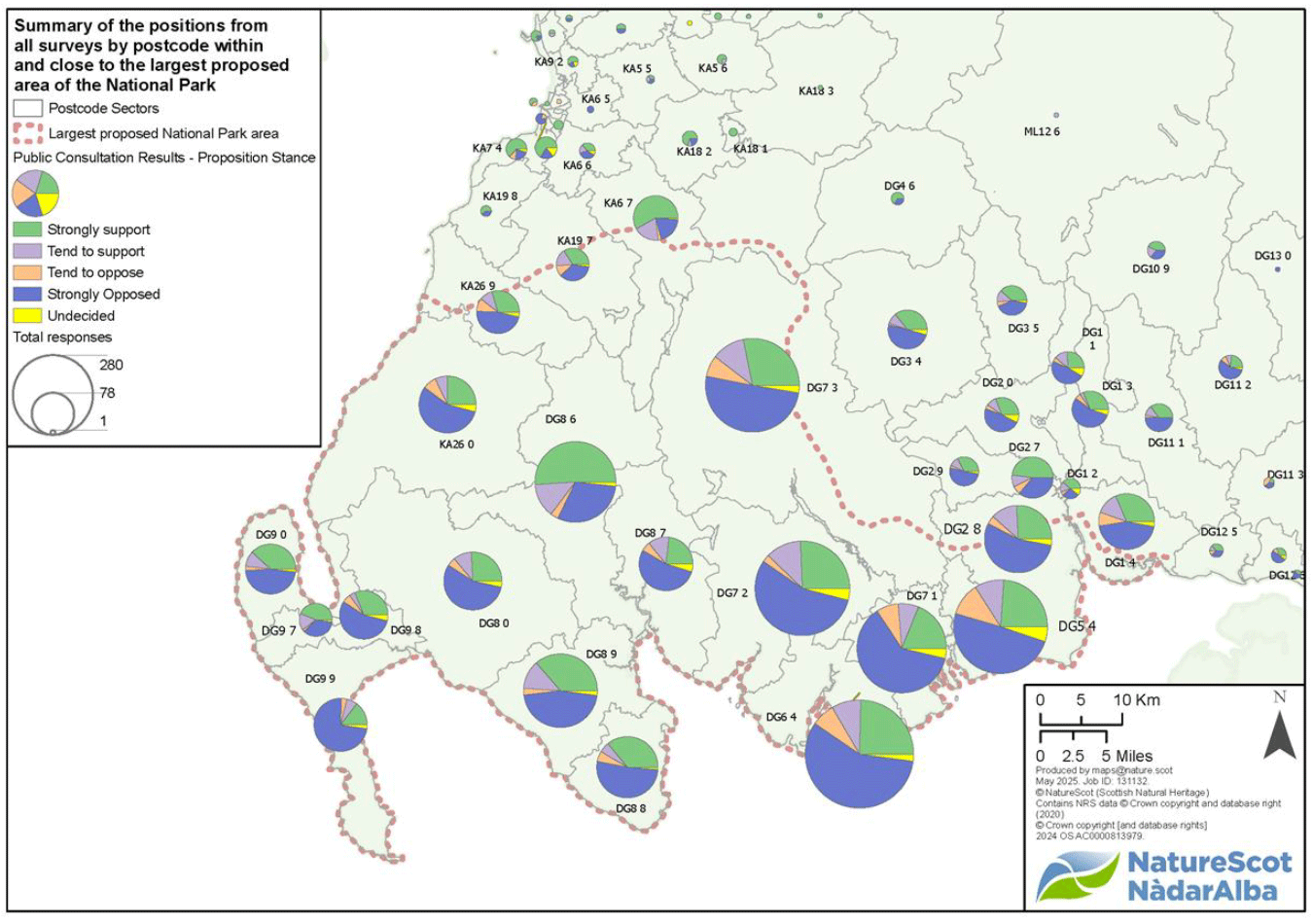
57. In terms of the public consultation events, the key headlines as reported by Outside the Box were as follows:
- The people attending the consultation events like living in the area and in Southwest Scotland and this included families that had lived there for generations and people who had chosen to live there.
- Everyone agrees the area needs improved infrastructure and services – especially roads and health services, economic regeneration, business investment, better employment opportunities for young people, affordable housing and environmental conservation.
- Comments in favour of a National Park embrace it as a way to bring what is needed to the area, and the concerns are that without it, the area will continue to decline.
- Comments not in favour of a National Park say that it will not only fail to deliver the positive changes people want to see but will negatively impact the local community, economy and environment for current and future generations.
- People want more information on how a National Park would run in reality and what it would mean for the area in terms of the issues noted above (infrastructure, employment, etc.)
- They want to be kept informed and for local people and communities to be involved in decision-making so that decisions are made with them, not for them.
58. Table 7 below provides an overview of the results provided by Outside the Box in percentages from the H-diagram exercise from the programme of consultation meetings. Given the methodology used, the public nature of this exercise, and the role it was specifically designed to play in helping people attending these meetings with strong opinions to express their views, care is needed interpreting these results. We would also note that of the 1,158 people who registered at these events, 329 or nearly 30% of people did not contribute to this exercise.
Table 7: How do you feel about the proposals for a Galloway National Park? Summary of the results of the “H-diagram” exercise from the programme of consultation meetings.
Meetings where more than 30% of people did not contribute to the exercise are marked with an asterisk[2]
Meeting locations which opposed the park
Dalry *
Carsphairn*
Girvan Hub*
Lendalfoot
Pinwherry
Sandhead
Portpatrick*
Stranraer 2*
Ballantrae*
Dumfries 1
Castle Douglas*
Dalbeattie*
Kirkcudbright 1+2*
Kipford*
Gatehouse of Fleet*
Whithorn
Port William
Newton Stewart 1
Meeting locations which were neutral
Stranraer
Leswalt
Meeting locations which supported the park
Cumnock
Straiton
Bellsbank*
Dalmellington
Girvan CG
Dumfries 2
Wigtown
Newton Stewart 2
No results
Cairnryan
59. Figure 1 below provides a summary of some of the key stakeholder positions. Two other Community Councils responded with results from community surveys but no organisational position.
Figure 1: Summary of positions from key stakeholder organisations
Strongly oppose
- CONFOR (Confederation of Forest Industries)
- Corsock & Kirkpatrick CC
- Gatehouse of Fleet CC
- NFUS (National Farmers Union Scotland)
- No Galloway National Park Campaign
- Scottish Renewables
- Scottish Land & Estates
Undecided
- Strongly Support
- Cycling UK
- Dumfries and Galloway Council
- Galloway Static Gear Fisherman’s Association
- Southwest Scotland Transport Alliance
Strongly Support
- Association for the Protection of Rural Scotland
- Belmont & Kincaidston CC
- Blue Marine
- Galloway National Park Association
- GSA Biosphere Reserve
- John Muir Trust
- Landscape Institute
- Loch Doon Association
- National Trust for Scotland
- RSPB (Royal Society for the Protection of Birds)
- Scottish Campaign for National Parks
- South Ayrshire Council
- Visit Scotland
Tend to oppose
None
No position
- Crown Estate Scotland
- MOD (UK Defence Estates)
- NHS Ayrshire and Arran
- NHS Dumfries and Galloway
- Regenerative Farming Network
- South of Scotland Destination Alliance
Support alternative
- South of Scotland Enterprise
Tend to support
- Ayrshire Fisheries Trust
- Cree Valley CC
- Dumfriesshire & Galloway Natural History and Antiquarian Society
- East Ayrshire Council
- Forest Policy Group
- Galloway Conservation Society
- Galloway Fisheries Trust
- Galloway Wildlife Conservation Trust
- Historic Environment Scotland
- James Hutton Institute
- Network Rail
- Ramblers Scotland
- Scottish Countryside Rangers Association
- Scottish Wildlife Trust
- Scotways
- Southern Upland Partnership
- Wildfowl and Wildlife Trust
While we did receive a number of national and UK responses to the consultation, 94% of all responses were from within the area or within 30km of it. An understanding of where public opinion is on this issue nationally is found in the following 2024 results of the NatureScot Omnibus Survey (NatureScot, forthcoming):
- NET support for a new national park being established in Scotland: 86%, 4% opposed (89% and 3% in 2022);
- NET support for a new national park in the Southwest of Scotland: 83% (new question);
- 39% of people said they had heard of the current proposal for a new national park in southwest Scotland (new question); and
- 50% said they had visited at least one national park for leisure in the last 12 months, whereas only 21% said they had visited the Galloway area (new question).
Meeting the conditions of the Act
60. Any area proposed for National Park status is required to meet the conditions of the Act, namely:
a) that the area is of outstanding national importance because of its natural heritage or the combination of its natural and cultural heritage,
b) that the area has a distinctive character and a coherent identity, and
c) that designating the area as a National Park would meet the special needs of the area and would be the best means of ensuring that the National Park aims are collectively achieved in relation to the area in a co-ordinated way.
In the Scottish Government evaluation of the bid which led to the proposal, it was considered that this area did, or was likely to, meet each of these conditions. In preparing geographic options for consultation, the analysis we had undertaken had reached a similar conclusion.
61. Nevertheless, views on this in relation to the three geographic options we consulted on were mixed in line with respondents’ views on whether they supported or opposed the National Park. Overall, over 45% of respondents agreed the general area met conditions 1 and 2 of the Act while under 25% considered it did not and 17% considered it did partially. In contrast only 33% of respondents considered it met condition 3 while 45% considered it did not with only 7% considering it met this condition in part. The balance of these views was broadly consistent across the geographic options.
62. Both the natural beauty of the area (including aspects of its landscape variety, sense of ‘wildness’, dark skies, geological significance and species and habitat diversity) and its rich history and historic environment were seen to contribute to the area’s national importance and distinctive identity and coherence. Many responses, including a roughly equal number of opponents and supporters of the proposal, also suggested that the region’s agricultural heritage contributed significantly to meeting these two legislative conditions. In contrast, several responses suggested that Galloway was no more special or distinct than other areas of Scotland, a view much more widely held among opponents of the proposal than supporters.
63. Much less commentary was received on the special needs of the area. Those in favour of a National Park tended to conclude a National Park was needed to address the special needs of the area. Those who were not in favour of the proposal or undecided challenged this, or argued the costs of a National Park were not justified to tackle the issues facing the area; or that existing mechanisms and approaches were adequate. Little was said directly on the issues facing the natural and cultural heritage which a National Park could address.
Views on possible alternatives to National Park status
64. Around 20% of responses proposed no alternative to a National Park and this was the most common category of response overall.
65. Opponents of the proposal offered more alternatives than supporters. These respondents particularly favoured direct investment in local infrastructure and services, as well as supporting existing mechanisms perceived to be currently doing the job of a National Park including the Biosphere Reserve and the Galloway Forest Park. SOSE made the case for developing a new place-based mechanism for delivering the South of Scotland natural capital innovation zone. Reasons for these alternatives included less bureaucracy, greater local control over decision making, increased community involvement in the protection and regeneration of the area and the lack of consensus over the National Park proposal.
66. In contrast, two-fifths of respondents who supported the proposal argued that there was no alternative available as strong as a National Park.
67. Nearly 20% of both opponents and supporters were also in favour of a stronger role for the Biosphere Reserve whether a National Park was established or not.
Reporter assessment of the findings of the consultation
68. From this survey data, we would draw out the following points:
a) Opinion on the proposal is highly polarised and the results are not as conclusive as the headline data may suggest. The inclusive way the three-survey approach was designed means that there is some double counting of responses from the same respondents across the three surveys. The open nature of the National Park proposal and the options we consulted on for it also mean that treating these results as definitive is problematic.
b) Across the surveys and public consultation events, it is notable that the strongest in principle position was held by opponents to the proposal, which could suggest a more value-based judgement about the principle of National Park, whatever its final location and form may take. In contrast, those more minded to support a National Park were more nuanced in their position and were generally keener to see the final detail of what it would entail in practice. In that sense, those in support of the National Park were more aligned with those who were undecided.
c) A small overall majority “strongly” or “tend to” oppose the proposal – circa 51% of responses from individuals to the summary leaflet and 54% of all responses (the bulk of whom are individuals living or working in the area). In the public consultation events, 64% of participants who expressed a view using the H-diagram were opposed to the National Park though this represented 46% of the total number of people attending these meetings (with 54% being neutral or positive or deciding not to take part in this exercise).
d) In the survey responses, the balance between public support for and opposition to the proposal varied across and near to the proposed area of the National Park, with support stronger in central, northern and more urban postcode areas and strongest opposition in the eastern parts of the area and southern parts of the Rhins. A similar geographic pattern in opinion can be observed from the public consultation events.
e) There were relatively few responses to the surveys from students or people in full-time education with responses generally reflecting the overall survey trends. Through our work with schools and youth panels, we did engage with a significant proportion of young people of school age across the area (over 1500 in total), thus raising awareness and understanding of the issues raised by the proposal. The outputs from the engagement covered a similar range of issues and opportunities to the general debate; economic topics were more evident than environmental or social ones. The young people we met and heard from were engaged and courteous, open to exploring the issues, mature in expressing their views and respectful in listening to the views of others, which bodes well for the future of the area irrespective of whether a National Park is designated or not.
f) Some 400 (8%) of all responses were reported from businesses with support ranging from 20% to 35% and opposition ranging from 61% to 75% of all responses depending on the survey type. Farms and other land-use related businesses represented 60% of business responses and had a significantly higher level of opposition to the National Park proposal than other types of businesses with 15% supporting the proposal and 81% opposed. Business responses, other than those from those working in farming, forestry or land indicated an aggregated support of 58% in favour of the National Park.
g) The complex mixture of views in the public responses to the proposal is matched by the key stakeholders. Two of the three local authorities supported the proposal (East and South Ayrshire) and sought a larger part of their areas to be included. The third (Dumfries and Galloway) are undecided pending the final detail of the National Park proposed by Scottish Government. A supporter of the original National Park bid, SOSE, now advocate an alternative and innovative approach that “looks to build and invest in what is already working, maximising the social, environmental and economic impact to deliver growth and benefit nature”.
h) In terms of other stakeholders, support is greatest among the environment, recreation and tourism sectors while opposition is strongest from landowners, land managers and the farming, forestry and renewables sector.
i) In supporting the proposal Scottish Environment Link and other national and local organisations championed the role that National Parks play in tackling the climate and nature emergencies through supporting sustainable integrated land management, nature recovery, climate action and the improved wellbeing of local communities. Likewise, the Forest Policy Group saw National Park designation as an opportunity to make the region a centre for Forestry Excellence through enhanced resilience, diversification of the regional bioeconomy and wider appreciation of the multi-functional value of woodland and natural heritage.
j) VisitScotland provided insight from the existing National Parks into the opportunities for growing the visitor economy and responsible tourism that this designation could bring to Southwest Scotland. In supporting the proposal, they also welcomed the significant role a new National Park could play in educating visitors, in the investment of visitor infrastructure and “in helping deliver a joined plan to encourage the respect, protection and enjoyment of the southwest of Scotland.”
k) South of Scotland Destination Alliance (SSDA), Scottish Land and Estates (SL&E) and the National Farmers Union Scotland (NFUS) carried out their own polling of members. While not providing a position itself, SSDA noted that two thirds of the members who responded to their survey were supportive of the proposal seeing the benefits for them from growth in the tourism-related economy of National Park status. In contrast, the SL&E and NFUS polls emphasised the significant opposition to the proposals by over three quarters of their members who responded underpinned by concerns over what they saw as additional bureaucracy and regulation and the uncertainties about what it would mean in practice for their business.
l) The responses from both CONFOR and Scottish Renewables provided economic data on what they saw would be significant negative impacts for their sectors and associated Scottish Government targets for the economy and climate that they considered would result from National Park designation. The former highlighted the 20% drop in commercial Sitka production in the existing National Parks since designation. The latter suggested that in their predicted worst case with strict restrictions on new wind farm development, up to 1.7GW of onshore wind capacity; £543 million Gross Valued Added (GVA) and 467 jobs per year would be at risk.
m) While we consulted on a terrestrial area for the National Park, a number of comments were also received on coastal and marine issues, emphasising the need for a National Park to engage positively in the management of this zone and work closely with fishing interests. Dumfries and Galloway Council also suggested extending the boundary into the marine environment to the 3nm limit.
n) While not providing a formal position on the proposal, both health boards submitted responses to the consultation. NHS Ayrshire & Arran “welcomed the aspirations of a National Park given the combined potential benefits for our population and planet.” The detailed Health Impact Assessment (HIA) they provided raised a range of potential benefits for public health and their operations but also noted potential impacts on service delivery which would need careful consideration, including increasing demand for A&E and longer travel times for ambulances and care services. NHS Dumfries & Galloway noted a similar range of issues, and argued that should a National Park be designated, “it will be critical that this becomes an opportunity to innovate with other Community Planning partners to address the challenges the region faces.”
o) Comparatively little detailed comment was generated on possible alternatives to a National Park with those more in favour of considering this option tending to oppose a National Park. While awareness of the Biosphere Reserve is generally quite low, both opponents and supporters were also in favour of a stronger role for the Biosphere Reserve whether a National Park was established or not.
Reporter assessment on the views expressed on the potential benefits and drawbacks of a Galloway National Park
69. Both support for a National Park and opposition to it have been passionately made, and in the accompanying reports which detail the responses across the three surveys, we have selected a range of quotations to try to illustrate the key points made. A small selection is provided in Annex D.
70. The possible advantages and disadvantages identified in the responses to the consultation mainly build on the ones identified during the pre-consultation phase of work. Information and briefings provided by organisations on both sides of the debate have also influenced the range and presentation of the arguments presented in the responses. First-hand experience – particularly of the nearby Lake District National Park – as well as material drawn from English and Welsh experience of National Parks more generally have also influenced some of the public views expressed, even though the National Park approach in Scotland is distinct to the UK as a whole.
71. In terms of the arguments made for a National Park, the key themes from the consultation were mainly based around the enhanced action it would deliver to protect and restore the natural and cultural heritage of the area, the range of economic and social benefits it would bring, the stronger local voice it would provide in decision making and the positive recognition it would bring to this part of Scotland.
72. In terms of the arguments made against the proposed National Park, some of the key themes from this consultation can be summarised as follows:
a) Community concerns focus on the impact of more visitors on existing infrastructure and services – with the capacity of the A75 and health services being specifically cited; the impact of more visitors on the area both on the natural and cultural heritage and the quietness of the area (which is particularly valued by both residents and visitors alike); and concerns over another level of administration which they have limited influence on, and funds being invested in a National Park administration which would be better invested in existing organisations to address these problems.
b) Land management concerns focus on the perception of increased regulation, delays to decision making, more visitors impacting on their operations, more visitor traffic on roads impacting on their operations and possible future planning constraints by the National Park Authority or Scottish Government. For the commercial forestry sector, there are concerns that this would result in this area losing its economic competitiveness with knock-on implications for timber production and the viability of the ecosystem of sawmills and wood manufacturing businesses. The impact on the positive interrelationship between public and commercial forestry production in this area also needs to be considered.
c) The renewables sector described the risks to the future supply of renewable projects that they saw arising from a National Park in this area. In their view, the scale of this threatened climate change targets for reducing carbon emissions, undermining the case for a National Park on environmental grounds.
73. The focus on social and economic issues presented in the case both for and against is notable with less attention overall given to the case for and against in natural heritage terms. Some of those opposing the National Park consider the current model as potentially damaging to the very natural and cultural heritage it has been designated to look after and enhance, based on the increasing popularity that may come with National Park status. Taken out of context, and without any timeframe on it, the original bid’s reference to 500,000 extra visitors has also caused significant concern. This number is in keeping with trends in visitor numbers over 20 years in the Cairngorms, the aspirations of the current responsible tourism strategy for South of Scotland and more general increases in countryside recreation and tourism that have already taken place across Scotland, particularly post Covid-19, including in Galloway itself.
74. Based on the consultation paper, Table 8 and Table 9 below provide a summary of the main positions “for” and “against” the National Park and both provides our commentary as Reporter on what the evidence available suggests on each theme, and our assessment of its significance to the consideration of this proposal. The tables draw on our knowledge and experience of the existing National Parks in Scotland but also require a judgement by the Reporter of its potential relevance to Southwest Scotland.
75. For several reasons, this is not a precise science, nor is there much longer-term quantitative evidence to draw on especially for some of the possible negative impacts. Other key factors in such assessment which are unknown at present are the choice of the geographic area for the National Park, the detailed arrangements for the Park Authority and how this new body would seek to plan and manage this area once designated. Conversely, it is also important to consider what would happen in the area without the designation. For example, if realised, the widely desired improvements to the A75 and other trunk roads will increase accessibility to the area, potentially exacerbating existing visitor management issues irrespective of National Park status. Equally, economic factors will lead to further changes in land-use resulting in further intensification of dairy production, upland afforestation replacing upland farms and a further step change in the number and size of wind farms and related grid infrastructure. While difficult to quantify, the role of a future National Park in helping to manage these predicted changes also needs to be considered.
Table 8: The perceived benefits of National Park status for Southwest Scotland
Environmental benefits
Key themes raised by respondents to the consultation
Increased action to help tackle the climate emergency, reverse biodiversity loss and protect the valued natural and cultural heritage of the area
Frequency cited in responses (high-medium-low[3])
High
Reporter commentary on the evidence base and its relevance to Southwest Scotland
There is good evidence that this specific focus of National Parks and their ability to develop effective partnerships and bring in funding facilitates a range of action for key species, habitats and landscapes. The typical condition of nature designations in the two Scottish National Parks is currently the same or better than the national picture (in comparison to the rest of the UK). Both Parks also have two of the largest landscape scale nature recovery projects in the UK, with ambitions to do more. In contrast, there is little evidence available on the specific contribution of the existing National Parks to the historic environment beyond normal expectations of most local planning authorities. A better evaluation of long-term state of nature trends would be needed to assess the difference the National Park designation makes both for biodiversity and the historic environment.
Action to tackle the climate emergency is primarily being delivered though peatland restoration expanding woodland cover in National Parks. Both Scottish National Park Authorities are also investing in active and public transport infrastructure and are part of the UK National Park initiative to become carbon sinks. As well as improving the carbon absorbing capacity of key habitats, this will require significant effort to reduce car-based visits. The Strategic Environment Assessment (SEA) undertaken by Scottish Government suggests that a larger area would bring more benefits both for nature and climate, though this has been challenged by the renewable sector on the assumption that any National Park area would restrict onshore windfarm development.
Reporter assessment of its significance for the consideration of the National Park proposal (high-medium-low)
High (high for action for nature but lower for action on the historic environment and climate)
Key themes raised by respondents to the consultation
Better promotion, provision and management of access, outdoor recreation and education, and sustainable tourism
Frequency cited in responses (high-medium-low[3])
Medium
Reporter commentary on the evidence base and its relevance to Southwest Scotland
There is significant evidence of a range of action that National Park Authorities deliver in this area which is over and above what is happening in other parts of Scotland. Examples include branding and marketing of the area; strategic planning and investment in infrastructure; provision of large ranger services and funding for others within the area; active collaboration with Police Scotland; and the use of bylaws. The Loch Lomond & the Trossachs National Park was specifically established to address visitor management issues while post Covid-19 this has become a more important operational issue within the Cairngorms National Park. A National Park in Southwest Scotland would help tackle some of the existing issues the area faces and address any new ones that may arise from increasing number of visitors/visitor behaviours predicted by the regional tourism strategy.
Reporter assessment of its significance for the consideration of the National Park proposal (high-medium-low)
High
Key themes raised by respondents to the consultation
Better long-term regulation and planning of key land-uses including forestry, farming and renewables
Frequency cited in responses (high-medium-low[3])
Medium
Reporter commentary on the evidence base and its relevance to Southwest Scotland
The evidence base is mixed and likely to be specific to each National Park area depending on the mix of land-uses and the issues and opportunities that have arisen. The changes for EIA regulations with National Parks are very limited for agriculture but more significant for forestry operations which may have contributed to some of the decline in commercial forestry reported in both existing National Parks – though this may also have led to more planting in other areas of Scotland. More generally, both National Park Authorities have higher performance standards than most planning authorities and approve a higher proportion of development proposals for built development. Both the existing National Parks are regional land-use pilots, with the National Park Plan and forestry strategies prepared for the existing Park areas seen as key tools for the better longer-term planning and co-ordination of land-uses.
Reporter assessment of its significance for the consideration of the National Park proposal (high-medium-low)
Medium
Social and Economic Benefits
Key themes raised by respondents to the consultation
Economic recovery through increased trade and opportunities for existing and new businesses
Frequency cited in responses (high-medium-low[3])
High
Reporter commentary on the evidence base and its relevance to Southwest Scotland
There is good evidence on economic benefits of National Park designation, especially through developing the visitor economy, with the existing National Park areas estimated to generate over £700 million of economic impact per annum in their visitor economies alone, more than 30 times the £22 million invested in them by the Scottish Government each year.
The research does not currently consider alternative scenarios or compare with other similar areas. The impacts on established land-use sectors have also not been specifically reviewed though diversification of farm business is generally supported in both existing National Parks
Reporter assessment of its significance for the consideration of the National Park proposal (high-medium-low)
Medium
Key themes raised by respondents to the consultation
Direct and indirect jobs and external investment in the area
Frequency cited in responses (high-medium-low[3])
High
Reporter commentary on the evidence base and its relevance to Southwest Scotland
A range of direct and indirect jobs are created by National Park designation, and this would likely be the case for a National Park in Southwest Scotland. The existing National Park Authorities employ a total of circa 250 staff directly, with many requiring professional qualifications and experience, such as countryside rangers, planners, ecologists, archaeologists or education officers. While the scale may be different, a similar range of skills and expertise would be needed for a new National Park bringing much needed professional jobs to the area. It is likely that new jobs and external investment in nature recovery would also be created.
The impact on jobs in established land-use sectors has not been reviewed. Some concerns have been noted over the potential impact on existing organisations seeking to recruit similar professional roles as the National Park Authority though this could equally be positive in terms of expanding the pool available.
Reporter assessment of its significance for the consideration of the National Park proposal (high-medium-low)
Medium
Key themes raised by respondents to the consultation
Opportunities for more young people to stay in the area
Frequency cited in responses (high-medium-low[3])
Low
Reporter commentary on the evidence base and its relevance to Southwest Scotland
The evidence base on the impact of Park status on young people in the area is limited. Nevertheless, both National Park Authorities are very active on this issue with youth members on their boards and youth councils to ensure the voice of young people is heard in decision-making. The Cairngorms National Park Authority has supported the development by young people of a youth manifesto for their National Park while both have put in place programmes of training and employment for young people.
Reporter assessment of its significance for the consideration of the National Park proposal (high-medium-low)
Low
Key themes raised by respondents to the consultation
Positive support for land managers
Frequency cited in responses (high-medium-low[3])
Low
Reporter commentary on the evidence base and its relevance to Southwest Scotland
There is good evidence of a range of action by both National Park Authorities including advice, networks, funding and support for diversification and the development of strategies to encourage more woodland. However, the mainstream funding for agriculture and forestry remains with Scottish Government with a national approach taken which generally does not give any additional support for land managers in National Park areas.
Reporter assessment of its significance for the consideration of the National Park proposal (high-medium-low)
Medium
Added Value of a National Park
Key themes raised by respondents to the consultation
Elevated status of the area and increased funding for its improvement
Frequency cited in responses (high-medium-low[3])
High
Reporter commentary on the evidence base and its relevance to Southwest Scotland
There is good evidence of a range of action by both existing National Park Authorities and others which increases direct and indirect funding to their areas to deliver a range of projects across the four Park aims. The Cairngorms National Park Authority has secured over £35 million of additional funding into the Cairngorms over the past two decades, over and above core grant in aid from Scottish Government. It is currently in the 2 nd year of its 10-year Horizon 2030 project with circa £12.5 million of support from National Heritage Lottery Fund (NHLF)
Reporter assessment of its significance for the consideration of the National Park proposal (high-medium-low)
Reporter assessment of its significance for the consideration of the National Park proposal (high-medium-low)
High
Key themes raised by respondents to the consultation
A stronger local voice in planning and managing the area
Frequency cited in responses (high-medium-low[3])
Low
Reporter commentary on the evidence base and its relevance to Southwest Scotland
There is significant evidence of a range of action within National Parks which supports local empowerment including direct representation on the Park Board, active community engagement in the preparation of the Park Plan and related initiatives such as community action plans and place planning. Both existing National Park Authorities have also established a range of topic-based fora and groups that involve a wide range of local people.
Reporter assessment of its significance for the consideration of the National Park proposal (high-medium-low)
Medium
Key themes raised by respondents to the consultation
A greater spotlight on community development aspirations
Frequency cited in responses (high-medium-low[3])
Low
Reporter commentary on the evidence base and its relevance to Southwest Scotland
There is significant evidence in both existing National Parks of greater recognition for community aspirations provided by the Park Plan and related initiatives such as community action plans, place planning and visitor management bylaws. Both existing Scottish National Parks have National Park Trusts which distribute funding to community projects across their areas – for example, the Cairngorms Trust has delivered circa £12m of funding and supported 44 projects over the last two rounds of its Community Led Vision Fund.
Reporter assessment of its significance for the consideration of the National Park proposal (high-medium-low)
Medium
Table 9: The perceived dis-benefits of National Park status for Southwest Scotland
Environmental dis-benefits
Key themes raised by respondents to the consultation
More pollution, littering and irresponsible/illegal visitor behaviours
Frequency cited in responses (high-medium-low)[4]
High
Reporter commentary on the evidence base and its relevance to Southwest Scotland
While an important issue, the evidence base to support this is limited. While National Parks are not immune to these issues, there is nothing to suggest that these are any better or worse in these areas compared to any other comparable areas such as the NC500 or on Skye. What National Park status does bring is a renewed focus, powers and funding for proactively addressing access and recreational and visitor management which can both prevent many issues arising and address them when they do. This focus will be required for this proposal given the range of access and visitor management issues already reported in parts of the proposed area and the aspirations of the responsible tourism strategy to grow the visitor economy.
Reporter assessment of its significance for the consideration of the National Park proposal (high-medium-low)
Medium
Key themes raised by respondents to the consultation
No greater constraints on further wind farm developments
Frequency cited in responses (high-medium-low)[4]
Medium
Reporter commentary on the evidence base and its relevance to Southwest Scotland
Uncertain - Depends on Scottish Government policy and choice of area given that parts of the Galloway Forest Park and all three National Scenic Areas (NSAs) already have existing restrictions. While the current pattern of wind farms has been well planned from a biodiversity and landscape perspective, there is pressure for further significant development of new ones and additional grid infrastructure which could transform parts of the largest area being considered. On the other hand, evidence presented by the renewables sector could suggest significant negative impacts on climate targets if a National Park was designated.
Reporter assessment of its significance for the consideration of the National Park proposal (high-medium-low)
High
Key themes raised by respondents to the consultation
Not enough recognition given to protecting the natural and cultural heritage
Frequency cited in responses (high-medium-low)[4]
Low
Reporter commentary on the evidence base and its relevance to Southwest Scotland
The evidence base to support this is limited and given the aims, powers and funding of existing National Parks they are more often accused of doing too much on this rather than too little. As noted above better evaluation of long-term trends in the state of nature and the built environment in National Park areas would be useful to consider this further. Specific concerns which would need to be addressed through the planning and management of this area include the quiet and unvisited character of much of the proposed area and its attractiveness to larger scale wind farm development.
Reporter assessment of its significance for the consideration of the National Park proposal (high-medium-low)
Medium
Economic and Social dis-benefits
Key themes raised by respondents to the consultation
Additional bureaucracy and restrictions on land managers
Frequency cited in responses (high-medium-low)[4]
High
Reporter commentary on the evidence base and its relevance to Southwest Scotland
There is some evidence of impacts on forestry operations but very limited evidence of impacts on farming operations in the existing National Parks because of changes to the EIA regulations. This is very likely to be the case for Southwest Scotland given the commercial scale most of the dairy farms are already operating at which will mean that many of their activities are already covered by the EIA requirements which apply nationally. Regulation and funding remain with national government though some farm specific issues and opportunities were identified around planning, traffic and visitor management, though impacts on business viability is unknown and further research would be useful.
Reporter assessment of its significance for the consideration of the National Park proposal (high-medium-low)
Low (medium for forestry operations)
Key themes raised by respondents to the consultation
Increase in house prices/decrease in affordable housing
Frequency cited in responses (high-medium-low)[4]
High
Reporter commentary on the evidence base and its relevance to Southwest Scotland
The evidence base is limited on the actual impact of designation on the housing market in Scotland, though both National Park Authorities recognise the issue and are very active in trying to address the housing issues in their area, working closely with the local (housing) authority and others to increase the provision of affordable homes. Further research would be useful to look at the specific impact in Southwest Scotland, where there is a higher proportion of second homes.
Reporter assessment of its significance for the consideration of the National Park proposal (high-medium-low)
Medium
Key themes raised by respondents to the consultation
Busier roads, congestion and road traffic accidents with implications for businesses
Frequency cited in responses (high-medium-low)[4]
High
Reporter commentary on the evidence base and its relevance to Southwest Scotland
The evidence base is limited. While the area would attract more visitors, experience from the existing National Parks suggests that this is likely to be gradual and can be planned for given sufficient funding. However, given that in 2022, there are currently 6.04 road casualties per 10,000 population in Dumfries and Galloway, compared to 3.58 for Scotland as whole this would need careful consideration. The volume of forestry lorry movements in the area is also significant and interactions with visitor traffic may need specific attention. Transport Scotland has indicated that from a national perspective the pressures on the trunk road network and specifically the A75 and A77 were not extraordinary and could be addressed as they arise (as is the case for the implications of other major developments). They also saw benefits of Park status for the retention and development of public transport services.
Reporter assessment of its significance for the consideration of the National Park proposal (high-medium-low)
Medium
Key themes raised by respondents to the consultation
Restrictions on further wind farm developments
Frequency cited in responses (high-medium-low)[4]
Medium
Reporter commentary on the evidence base and its relevance to Southwest Scotland
Uncertain - Depends on Scottish Government policy and choice of area given that parts of the Galloway Forest Park and all three NSAs already have existing restrictions. Evidence presented by the renewables sector could suggest significant negative economic impacts if a National Park was designated with an associated loss of community funding, though this is based on modelling of an unspecified number and location of future developments which may or may not come forward or be consented and developed in a future National Park area.
Reporter assessment of its significance for the consideration of the National Park proposal (high-medium-low)
High
Key themes raised by respondents to the consultation
Increased pressure on local health services
Frequency cited in responses (high-medium-low)[4]
Medium
Reporter commentary on the evidence base and its relevance to Southwest Scotland
The evidence base to support this is limited. Both NHS Boards noted potential benefits in terms of health outcomes but also potential impacts on A&E services and on their ability to recruit and retain staff in the area which is already challenging. The Loch Lomond & the Trossachs National Park Authority has noted that work of emergency services at some hot spot locations can occasionally be impeded by congestion and irresponsible parking though given the popularity of parts of the area, it is likely that this could be happening irrespective of National Park status.
Reporter assessment of its significance for the consideration of the National Park proposal (high-medium-low)
Low
Key themes raised by respondents to the consultation
Impact on jobs - increase in low skilled, seasonal jobs, decrease in skilled employment i.e. agriculture
Frequency cited in responses (high-medium-low)[4]
Medium
Reporter commentary on the evidence base and its relevance to Southwest Scotland
The evidence base to support this is limited both in terms of the impacts on low paid job creation, but also on more skilled land-use jobs. Further research would be useful to look at the specific impact in Southwest Scotland given this area’s reliance on the farming, forestry and renewable sectors and also its existing low wages. The research commission by Scottish Renewables also needs to be considered carefully.
Reporter assessment of its significance for the consideration of the National Park proposal (high-medium-low)
Medium
Lack of added value with the National Park model
Key themes raised by respondents to the consultation
Time and money better spent elsewhere (in existing services and enforcing existing policies)
Frequency cited in responses (high-medium-low)[4]
High
Reporter commentary on the evidence base and its relevance to Southwest Scotland
The evidence base to support this is limited. Public funding would need to be invested in the proposed National Park. However, in practice the additional environment funding from Scottish Government which comes through Park designation is not likely to be made available to existing planning and other service budgets of local authorities and public bodies if a National Park was not designated.
We note this is an issue for the Scottish Government to consider not the Reporter.
Reporter assessment of its significance for the consideration of the National Park proposal (high-medium-low)
Low
Key themes raised by respondents to the consultation
Greater national control over local decision making
Frequency cited in responses (high-medium-low)[4]
Medium
Reporter commentary on the evidence base and its relevance to Southwest Scotland
The evidence base to support this is limited. National Park designation brings more national interest and involvement in this area but also greater local influence over national funding and priorities. How a Park is run and governed and how it works alongside and for its communities and in partnership with others would be critical for its long-term success.
Reporter assessment of its significance for the consideration of the National Park proposal (high-medium-low)
Medium
Key themes raised by respondents to the consultation
National Park status will perpetuate the idea that the area is ‘natural’ which it isn’t
Frequency cited in responses (high-medium-low)[4]
Low
Reporter commentary on the evidence base and its relevance to Southwest Scotland
The evidence base to support this limited. Farming, forestry and estate management are fundamental to the special qualities of Scotland’s existing National Parks and are equally if not more important for this proposed area and a National Park Authority would need to reflect this in its planning, management and marketing of the area.
Reporter assessment of its significance for the consideration of the National Park proposal (high-medium-low)
Low
Reporter conclusions on the principle of a National Park in Southwest Scotland
Discussion
76. The engagement and the consultation work we have undertaken have demonstrated the considerable polarisation of views within and beyond the proposed area on the proposal. These positions also strongly influenced views on whether alternative options to a National Park were either more desirable or less effective. We are also mindful that we have yet to hear directly from a significant number of people across the area.
77. Support for the proposed National Park is widespread among environmental, recreation and tourism organisations, and many households and individuals across the proposed area. From our national survey, we know that wider public opinion nationally is strongly in favour both of new National Parks in general and also of one specifically in the Galloway area. Both South and East Ayrshire Councils are supportive, while Dumfries and Galloway Council have reserved their position until they see the detailed arrangements proposed by Scottish Ministers. Many who expressed support for the proposal expressed similar caveats while those who remain undecided are seeking greater clarity about how a National Park would operate in this area and what it would seek to do. We would also note that the significant opposition to the National Park proposal has created a challenging environment for individuals and some organisations who wanted to engage in the discussion of this proposal to consider the issues it raises and to make their voices heard. From the anecdotal evidence we have heard both from businesses and other stakeholders in the area, as well as experience of the public consultation events, we strongly suspect that support for the National Park proposal is underrepresented in the consultation responses. This is also confirmed by the reports prepared for us by Outside the Box and SCDC.
78. At the same time, there is clearly significant and well organised opposition in principle to the proposed National Park, especially from land managers and businesses associated with the farming, forestry and renewables sectors. Many households and individuals are also strongly opposed to the National Park proposal, fearing significant impacts on their everyday lives.
79. The core of this opposition is based on concerns over the potential negative economic impact to these key sectors, fears of overtourism, the impact on local infrastructure and services and concerns over the appropriateness of a National Park solution for the area. We would note that many of these issues raised in the responses to the consultation are not supported by strong evidence of how existing National Parks in Scotland operate, or more detailed consideration of how a National Park could be tailored to Southwest Scotland to address these concerns. Nevertheless, it is clear the level of opposition in principle is significant and is something that Scottish Ministers need to give careful consideration to as they consider next steps.
80. Following the consideration of this advice, the next step is for Scottish Ministers to determine whether to proceed or not with the designation process for the proposed National Park. On the basis of the consultation, we consider that Ministers have three scenarios they can now consider:
a) Maintain existing arrangements
b) Strengthen existing arrangements or develop new ones
c) Prepare and consult on a draft designation order.
Scenario A: Maintain existing arrangements
81. As part of this scenario, Scottish Ministers could consider putting in place a mechanism for further discussion of the issues facing the area highlighted by the consultation. This might include a citizen’s panel or assembly which would allow a more positive and constructive dialogue to take place, with a wider focus on the development of a strategy for the just transition of the area to net zero in ways which better support nature recovery and community wealth-building. Citizen’s panels in particular offer an opportunity for considered debate and opportunity for participants to hear and question contrasting perspectives on issues and have been effective in developing common ground when complex choices and trade-offs are being considered. This may be particularly helpful if Scottish Ministers consider that the most pressing issues raised during the consultation are largely outwith the scope of a National Park to address.
82. This option leaves existing mechanisms to tackle the range of deep-seated economic, social and environmental issues the area increasingly faces that led to the submission of the bid and were key parts of the debate on it.
Scenario B: Strengthen existing arrangements or develop new ones
83. A number of changes to the existing arrangements could be made to strengthen the management of the area to tackle some of the issues which have featured in the discussion over the National Park proposal, including the following:
a) a stronger role for the Biosphere Reserve – this would require the strengthening of national policy recognition and a more long-term funding arrangement put in place;
b) a more integrated and inclusive approach to the planning and management of the Galloway Forest Park to deliver multiple benefits through a Park wide plan with additional funding allocated to nature restoration and provision for recreation and tourism; and,
c) the preparation and implementation of refreshed management strategies by Dumfries and Galloway Council for the coastal National Scenic Areas or the coast as whole, with a particular emphasis on visitor management and community development.
84. New approaches could also be considered, including mechanisms to take forward the action on the ground that is needed to implement the natural capital innovation zone, the regional land use framework or one of the landscape scale restoration projects identified in the Scottish Biodiversity Strategy Delivery Plan. Each of these new approaches would need an organisation to lead and bring together a partnership to plan and deliver it.
85. This option has many of the benefits and some of the drawbacks of the first but would show positive action to tackle the issues facing the area. Using a non-statutory approach or approaches could be more cost effective, flexible and quicker to progress, though additional funding would still be needed to implement them. However, unless planned and funded well, the option could be perceived as an additional initiative or partnership approach when the area already has many in operation, though none have the impact that the statutory basis, policy footing, significant funding and longer-term approach of a National Park brings. Any of the alternatives would also have weaker brand recognition than National Park status brings so may bring less benefit to the visitor economy or in terms of raising the profile of the area more generally.
Scenario C: Prepare and consult on a draft designation order
86. This option would mean that Scottish Ministers were now minded to designate a National Park, subject to the successful outcome of further consultation on the draft designation order. Progressing to this step would enable a more detailed examination of specific options which many of those consulted felt would have facilitated more constructive discussion and examination of the impact of a National Park on their areas of interest. In providing clarity on the Scottish Government’s views, it would enable a detailed test of the merits of a proposed National Park.
87. Such an approach would acknowledge the existing support for a National Park at this stage though it will also certainly be criticised by some communities and stakeholders. It would require more budget than the other options, but the strong track record of the existing National Parks clearly suggests it would deliver more for nature and for people. It would also provide the benefits of the National Park brand and help raise the status of the area nationally and more widely.
88. If the consultation on a draft designation order is progressed, it would be important to provide a simple “prospectus” for the National Park alongside the draft designation order on the Government’s thinking on its vision, mission and funding. This should include clearer policy signals on how a National Park would work to support farming, forestry and renewables in the area. In developing the detail of the draft designation order, Scottish Government should also begin to work closely with staff from key organisations such as Forestry and Land Scotland, SOSE and the three local authorities. More detailed environmental and economic impact assessments would be required at this stage too, and we would propose that this is expanded to include the preparation of a Health Impact Assessment with close involvement of both health boards.
Reporter Advice
89. In considering the complexity of the issues raised by the proposal and the consultation we have undertaken on it, we are, as the Reporter, very mindful of the balance needed to ensure our advice is seen as fair, evidence-based and practical.
90. From the detailed discussions during the consultation, we remain of the view that the proposed area would meet the legislative conditions of the Act. In particular, we would note the following:
a) The high natural and cultural heritage value and coherent identity of the area which while different to existing National Parks is special and of significance in the Scottish context.
b) The challenges that nature increasingly faces given the scale and intensity of farming, forestry and renewables and opportunities for achieving more sustainable outcomes.
c) The important socio-economic context – an area of considerable significance for food, timber and energy security but one which is doing less well than other rural parts of Scotland.
d) The added value that a National Park could bring in terms of addressing the special needs of the area:
- the significant potential for nature recovery across the area;
- helping the transition to sustainable forestry practice in keeping with the route map to resilience for forests and woodlands;
- improving co-ordination of existing land-uses and land-users to deliver economic, social and environmental outcomes;
- realising the ambitions for sustainable and responsible tourism, the regional economic and health strategies for the area and the natural capital innovation zone; and
- providing a stronger platform for realising community ambitions.
91. The analysis of the consultation exercise we have undertaken has shown that the outcome is more inconclusive than the headline data from the surveys may suggest. Nevertheless, while two of the three local authorities are supportive of it, the largest is now undecided. It is also clear that there is significant nervousness about the proposal, or direct opposition to it, across many communities and businesses which was not as evident in the reporter consultation for Scotland’s first two National Parks.
92. The decision on whether to proceed or not is ultimately a choice for Ministers, though it should be informed by the available evidence. Of the three scenarios outlined above, we consider that B or C have the strongest potential for meeting the Scottish Government’s priorities for tackling the nature crisis, taking the action needed on climate change, growing the rural economy and realising more value from public services. Putting in place a mechanism as proposed in Scenario A such as a regional citizen’s panel for further discussion of the issues raised by the consultation does not appear to deliver many or any benefits quickly, though, if led well, it could have a useful role in bringing the communities and stakeholders together after what has been a polarising debate to date.
93. As the Reporter, our assessment suggests that while the case for a National Park in Galloway remains a strong one in terms of the conditions of the Act, our analysis of the issues raised and of the range of views expressed during the consultation suggests that the proposal has not at this stage garnered sufficient support locally. Our recommendation is therefore not to proceed with the designation but instead to strengthen existing arrangements.
94. Further discussion with the local authorities and a range of public bodies would be needed to make sure a proposal for this was agreed with sufficient long-term funding of five to ten years made available to make it happen. In view of the range of issues raised by the proposal and the consultation on it, key elements of the strengthened arrangements which should be considered would include:
- a strengthened and better resourced GSA Biosphere Reserve with a stronger focus on nature recovery and community wealth-building;
- the development of a new strategic plan for the Galloway Forest Park area which placed greater emphasis management for people and nature alongside commercial forestry operations;
- a renewed commitment to the management strategies for three National Scenic Areas and for the completion of the coastal path as a key visitor attraction for the area;
- sustained investment in access and visitor management across the area building on the existing community led approaches such as Whithorn and Loch Doon;
- progress with the implementation of the regional land-use strategy for the area; and
- on-going support for the work of the Solway Firth Partnership.
Given both the urgency of the climate and nature emergencies and the considerable interest and energy generated by the proposal, the action to deliver these strengthened arrangements should be put in place as soon as possible.
Contact
Email: Nationalparks@gov.scot