
Programme for Government 2026 to 2031
This Programme for Government lasts for five years. The focus of this programme for government is eradicating child poverty, growing the economy, tackling the climate emergency, delivering high quality and sustainable public services.
4. Delivering a stronger NHS and Public Services
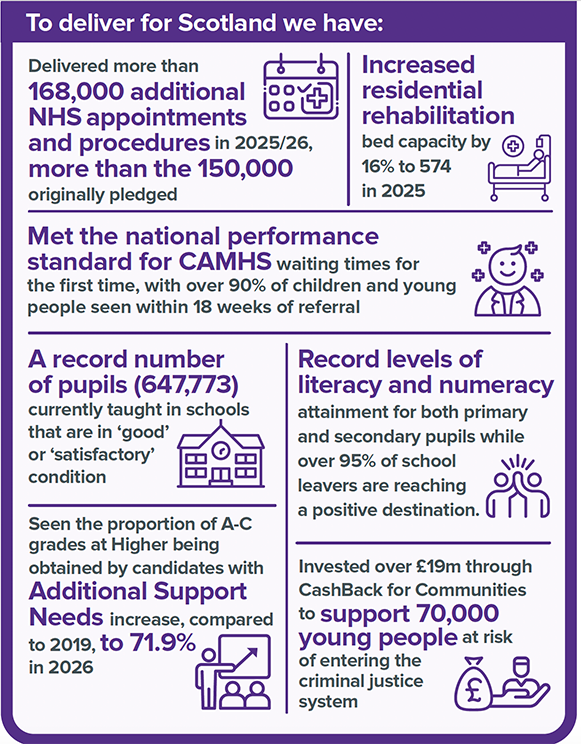
To deliver for Scotland we have:
- Delivered more than 168,000 additional NHS appointments and procedures in 2025/26, more than the 150,000 originally pledged
- Increased residential rehabilitation bed capacity by 16% to 574 in 2025
- Met the national performance standard for CAMHS waiting times for the first time, with over 90% of children and young people seen within 18 weeks of referral
- A record number of pupils (647,773) currently taught in schools that are in ‘good’ or ‘satisfactory’ condition
- Record levels of literacy and numeracy attainment for both primary and secondary pupils while over 95% of school leavers are reaching a positive destination.
- Seen the proportion of A-C grades at Higher being obtained by candidates with Additional Support Needs increase, compared to 2019, to 71.9%
in 2026 - Invested over £19m through CashBack for Communities to support 70,000 young people at risk of entering the criminal justice system
National renewal through public sector reform
No problem in Scotland is solved by one public body, or one policy choice. We will make most progress when we work together – and that starts with reform of public services. We are taking our next steps in our plans to simplify the public sector landscape to best deliver for the people of Scotland, with more effective delivery by removing unnecessary duplication and overlap, providing clearer lines of decision-making and accountability, and getting resources more directly to the frontline services people rely on, rather than being confined by current structural or bureaucratic barriers.
Change is necessary and it cannot wait: if we are to deliver the modern, responsive, person-centred public services that people in Scotland expect we need to agree the vision and turn our collective capacities to implementation. This will require support from others in parliament, leadership from within local government, and commitment from delivery partners, looking beyond individual, institutional and sectoral interests to focus on the collective outcomes we seek to achieve for Scotland. Through our Public Service Reform Strategy, we committed to setting out a shared vision of great public service leadership through a Public Service Leadership Statement. The Statement, and its implementation, will be critical in shaping the leadership behaviours and organisational cultures needed to deliver the transformational change Scotland requires. We will invite leaders across local government, public bodies, trades unions, and delivery partners to join us now in shaping a clear vision for our future governance and planning for its realisation through a programme of reform:
Empowering regions and communities
Rewiring the state requires decision-making and service delivery to sit at the level best placed to understand and improve people’s lives. Over the next three months we will convene a dialogue with partners across Parliament, local government, and beyond about the future of local governance in Scotland. This will include how resources may be pooled at a regional level while also strengthening community level governance, empowering people to influence local decision making. By the end of the year, we will seek a shared direction for reform – enabling the focus to move from debate to delivery and ensuring early decisions and progress can be made through the first Budget of this Parliament.
We will learn and build from the leadership already evident through the work led by Councils across Scotland, including work on integrated service delivery being led by Falkirk, Clackmannanshire and Stirling Councils and the three Ayrshire Councils, as well as drawing from the progress led by our city-regions in Regional Economic Partnerships. Through reform we remain committed to enabling bespoke solutions for our island communities recognising their unique characteristics, including exploration of the Single Authority Model.
Community empowerment and community wealth building will remain at the heart of a new model of governance. This will include implementing our Democracy Matters work to give communities the means to articulate their priorities, and the tools they need to build community assets and services. Because strong communities are an essential part of delivering the Scotland we seek.
Delivering reform of social care
Scotland faces increasing demographic challenges, placing growing financial pressures on health and social care and affecting people’s experience of services. Right now, the arrangements we have in place to manage and deliver social care in Scotland are too often inconsistent in their delivery.
With improvement of outcomes for people and financial sustainability at the core of this programme, reform of both the National Health Service and local government must also include examining all options for the future governance and delivery of social care. We will use these next three months to engage with local authorities, trades unions, and healthcare and service providers to reach agreement on reform of social care which makes best use of the funding in the system, delivers fairer and more efficient services and achieves economies of scale, while enhancing the focus on community need.
Empowering school leaders, raising standards and reducing variation
Scotland’s children and young people flourish when education enables them to realise their potential and pursue their ambitions. Decision making should be as close to the classroom as possible. Empowering our school leaders and ensuring they have the tools and support as the professional leaders of learning will be critical. Schools are focal points of our communities and engagement with parent councils will ensure the aspirations of local communities can be achieved.
As part of our reforms, we will work closely with local government, school communities and headteachers to maximise the opportunities that reform of governance and service delivery will bring – to raise attainment, close the poverty-related attainment gap, reduce variation in outcomes, strengthen data and system-wide improvement, and support the journey through early childhood development and early learning into school.
Making early progress in healthcare
The pressures facing our public services are acute, and all options must be on the table for serious discussion, including new forms of collaboration, changes to structures, and more strategic regional models of local government with the powers, permission, and flexibility to drive economic growth and support wellbeing – but we cannot sit back in the face of the significant pressures facing some of our most precious services, particularly healthcare right now.
We will simplify the NHS by replacing the current 14 territorial Health Boards with two Strategic Health Boards and build on planned reforms to further reduce the number of special Health Boards. Alongside other measures to improve patient experience, including the National Flow Plan, this will deliver more efficient use of resources across Scotland, freeing up more time and capacity for treatment, and improve patient access through more joined up care. It will also support efforts to improve further the integration of health and social care services.
Simplifying and decluttering delivery
We will substantially reduce the number of public bodies to create a system that is integrated by design and that improves service delivery. We will undertake this work to deliver the following changes to public bodies and consider further opportunities during this Parliamentary term as they arise, we expect these proposals to bring in other relevant bodies as they develop:
- Bring the national environment public bodies (SEPA, NatureScot, Zero Waste Scotland and potentially Scottish Forestry) into a single overarching environment body to remove unnecessary barriers and make our environmental interventions more impactful.
- Integrate the Scottish Food Commission and the Scottish Pubs Code Adjudicator into Food Standards Scotland, while maintaining their independent scrutiny functions.
- Embed Architecture & Design Scotland within More Homes Scotland.
- Bring Transport Scotland back into the Scottish Government.
- Consult on transferring the Mobility and Access Committee into the Scottish Government.
- Review the functions of the National Smart Ticketing Advisory Board to ascertain if they should transfer to the Scottish Government, or elsewhere in the public sector.
- Undertake reform activity with the National Records of Scotland and Registers of Scotland.
- Work with Parliament to build on the previous Committee reviews into the Parliamentary Commissioner landscape with a view to consolidating their number while protecting their functions.
- Explore options to improve efficiency in public sector payment systems, call handling systems and shared services including considering simplifying the number of bodies engaged in this work.
- Explore opportunities for Revenue Scotland to take on a broader set of revenue functions which build on the progress made as Scotland’s devolved tax authority.
- Simplify the health and care assurance landscape to support integrated services, focusing on citizens’ experiences.
- Review remaining transport bodies to identify opportunities for mergers.
- In line with the PSR Strategy, work with Audit Scotland to review the audit and scrutiny landscape and identify opportunities for simplifying and integrating processes and bodies whilst maintaining a robust assurance system.
- Remove the First Tier Tribunal and Upper Tribunal from public bodies directory as these are judicial bodies supported by the Scottish Courts and Tribunals Service. We will collaborate with SCTS and other justice partners to explore opportunities to ensure a whole system approach to redesign of the criminal justice process.
- Explore the establishment of a single ferries body for the Clyde and Western Isles ferry routes and consider further reform options that best benefit communities.
- Rationalisation of the number of public bodies which perform inspectorate functions.
- Assess the potential to simplify the management of our national cultural assets.
- Investigate consolidation of all public bodies involved in the management of public land assets.
- Review all remaining public bodies for efficiency, and exploring the opportunities for joint working or merger.
We will take forward underpinning improvements to support public bodies and improve service delivery for people, including:
- Digital services designed with a ‘tell us once’ approach, including development of digital/ data platforms and shared data definitions and data sets
- Consolidation of functions, such as estates and procurement, to establish a whole system approach
We will build on a range of improvement activity being undertaken across public services, including:
- Launch the Scottish Government ScotGov App in Autumn which is intended to be a common platform which enables citizens to engage with multiple services without having to use multiple logins and websites.
- Increasing the pace of the roll-out of the ePass common licensing programme - an existing model of taking a function, such as payments or casework, and standardising to reduce cost to deliver and improve speed of delivery, quality and user experience.
- Building on existing work to reduce costs and delivery timescales by using the ePass approach or similar as a template for common approaches to outbound payments and to casework.
- Increase the availability of self service and automated solutions through innovative approaches via the ‘Support Service Challenge’ in CivTech 12.
- Accelerating work on Data Exchange which is designed to make data held by one organisation available to other organisations while protecting both privacy and security; in order to improve service delivery.
We have the opportunity across this Parliament to make lasting reform which empowers areas, fully utilises our collective strengths, and improves outcomes for people. As we deliver these changes people in Scotland will notice clear improvements in their lives and in their experience of public services. We will have more modern public services, with new technologies and ways of working which make them more accessible and more responsive. National priorities will be delivered right across the country, and communities can be empowered to bring new life into the places they love.
But Government also does not have a monopoly on good ideas. We will ensure, through these reforms and beyond, that we work with and listen to communities, the third sector, the workforce and trade unions about their vision for change to help us design a system that delivers for everyone.
Ambitious for Scotland: Shorter waiting times for the treatment you need
We have made significant progress to increase activity and bring down long waits for operations and procedures. Despite increasing pressure, last year hospitals carried out an average of 768 operations every day.
Across this Parliament, we will build on that and ensure that, by the end of 2031, no one waits more than 26 weeks for treatment. Through the Health and Care Improving Flow Plan published in our first 100 days, we will create one connected system with one simple route to care, ensuring people receive the most appropriate response as quickly as possible – improving throughput and patient experience from admission to discharge.
For elective care, NHS Boards will be required to work collectively to take a more coordinated approach to managing waiting lists, ensuring those most in need are seen the quickest, regardless of where they live, starting with a new National Orthopaedics Plan. We do not intend to stop there - we will learn from this approach and extend this to all specialisms to ensure we have an elective care system that is in balance and that people most in need are seen the quickest.
We will make it easier to access support, deliver more care closer to home, strengthen continuity of care, improve the flow of patients through hospital and tackle delayed discharge, focusing immediately on overcrowding and corridor care, so people spend less time waiting and more time receiving care, including:
- A new Community First approach will strengthen local multidisciplinary services and shift more care into communities, supporting you earlier and reducing the risk of ill health.
- New Integrated Navigation Centres ensuring NHS 24, the Scottish Ambulance Service and wider system partners provide coordinated triage and advice. These will provide 24/7 access to a senior clinician and a smoother patient journey that helps you access the right care, in the right place, first time, and avoid A&E attendance where possible.
- Delivering frailty services, which now exist in every Emergency Department, to help more vulnerable patients receive care in the right place.
- Increasing units designed to deliver the same day care without admission to hospital and ensuring where admission is required that discharge is within 3 days for most people.
- Discharge planning beginning on day one of a hospital stay, through the Discharge Without Delay approach, to ensure people are supported to get home quickly and safely.
A world class health system built on world class resources
Our health system can only be as strong as the investment we make in its facilities and workforce – both of which are central to people receiving the best care, in the best settings, from the best professionals. There are now more staff working in our NHS than when this Government first took office, we have avoided the industrial action seen in England through pay settlements that recognise and reward our cherished workforce, and we are investing in improved capacity across Scotland.
Over this Parliament, healthcare settings will be modernised through the MyCare app which will be the most comprehensive health and social care app in the UK once fully rolled out. It will enable the online management of prescriptions, booking of appointments and receiving letters about care. It will be complemented by a new Digital Health and Care Record for every person in Scotland. We will accelerate the adoption of proven innovations and bring transformational technologies into everyday use, for example using digital technology to support people in preventing type 2 diabetes. We will maximise the use of Virtual Wards, so people can receive high-quality care from the comfort of their own home. And we will ensure our health and care workforce is central in shaping our future NHS, as well as working with partners to explore how a new jobs guarantee could meet the needs of NHS Scotland over the course of this Parliament.
Starting now and across 2026-27, we will:
- Continue to pass on every penny of health resource consequentials to health and care services.
- Progress investment of at least £10 billion capital spending over the next 10 years – funding new and renewed facilities, including building new Community Health and Care hubs across Scotland, with the first tranche focused in Lochgelly, East Calder and East Livingston, and Port Glasgow.
- Tackle long waiting times by investing at least £200 million each year to grow elective capacity, meaning more operations can take place.
- Improve and expand entry to the nursing profession, particularly for those looking to enter the profession later in their career. Over the course of this Parliament, we will also improve pathways to progression from band 5 to band 6 for nurses.
- Invest more than £530 million in a deal with GPs, with a focus on recruiting more family doctors.
- Develop an affordable and deliverable design for a new University Hospital Monklands at Wester Moffat, with proposals expected by mid-2027 and an ambition to commence construction in 2028.
- Develop an AI Hub to accelerate safe adoption of AI across the health and care system and continue rollout of services on MyCare.scot.
- Provide an extra £175 million to enable adult social care workers providing direct care in commissioned services to earn at least the Real Living Wage alongside £13.9 million for those who provide direct care to vulnerable children and young people.
- Introduce sectoral pay bargaining into social care and empower employers and trade unions to build good relations and drive sector-specific progress.
Shifting more care closer to home
Fundamental to improving hospital throughput is people having access to the care they need closer to home. That can reduce pressures in A&E by giving people easier access to urgent, same-day care, and unnecessary stays in hospital by putting more care in homes and communities. We have already taken decisive action – such as introducing new GP walk-in services which have seen over 10,500 cases in the first months of their operation and expanding the number of people cared for at home and in their community. We will work across this Parliament to scale that up further, improving primary and community care centres to support modern, integrated models of care in the community.
Bolstering primary care
Primary care is the bedrock of our health system. Most people who urgently require to be seen can see a nurse or doctor at their GP practice within 2 working days, but we know for some that access can still feel distant or challenging. We will continue bringing more services into communities so that care is provided in the right place, at the right time. Local services, such as diagnostic testing, are also an important first port of call in assessing and diagnosing a range of issues and then transferring patients to the most appropriate place, meaning we cut down on unnecessary trips to hospital and free up resources for critical care.
Across this parliament, we will improve access to community-based healthcare by expanding diagnostics, hearing and vision services and dental and mobile services in rural areas while using digital innovation and new care models to reduce pressure on hospitals and improve outcomes.
Starting now and across 2026-27, we will:
- Develop a delivery plan that sets out how thrombectomy services will be expanded to achieve our commitment to provide a 24/7 thrombectomy service with national coverage, building on the valuable work done by stakeholders and campaigners, including the family of Anthony Bundy, and ensuring thrombectomies for those who suffer a stroke are available regardless of geography.
- Establish a national network of new walk-in GP services, open 7 days a week – with a further 5 having opened in our first 100 days and setting out plans for the locations of at least 24 more. We will expand this programme over the next 3 years, delivering services in more areas.
- Support workforce planning in rural and island communities, including reviewing the ‘Golden Hellos’ initiatives to attract more GPs, consultants and dentists to those communities.
- Invest up to £20 million via Scotland’s Independent Living Fund to help people with learning disabilities and complex support needs to live well in their communities and helping to reduce delayed discharge and free up hospital beds for those who need acute care.
- Increase the volume of people receiving hospital-level care at home through Hospital at Home services from 7,500 to more than 10,000 people over this winter, including for paediatric care.
- Invest £144 million this year in community eyecare, as well as additional investment to support design and development work for a community low vision service.
- Work with the NHS, Third Sector and other stakeholders to deliver an audiology improvement plan, focused on the creation and implementation of more community-based models of care.
- Improve cancer care by increasing the number of radiographers, working with Healthcare Improvement Scotland to consider how to best expand Rapid Cancer Diagnostic Services, and rolling out phase 1 of national lung screening in 2027/28.
- Develop our national infrastructure for genomics, including early development of a registry for people at increased genetic risk of cancer.
Ambitious for Scotland: Getting people discharged without delay
As we shift more care into the community through increased investment and capacity, we will help prevent some hospital admissions, support more people to receive care closer to home and reduce long waits. While 97% of discharges already happen without delay, we recognise that too many people have been waiting to be discharged from hospital. Our new hospital flow plan will ensure more people can get discharged on time and back into a setting that works best for them.
Across this Parliament, we will ensure sustained reductions in delayed discharge, with action across health providers, local government and social care services, and housing associations which ensures people can get home or cared for in a setting that best meets their needs. Underpinned by the Health and Care Improving Flow Plan, we will:
- Create one connected system with one simple route to care, ensuring every person receives the most appropriate response as quickly as possible.
- Make it easier to access support through one conversation, strengthening continuity of care, improving hospital flow and discharge, and tackling overcrowding and corridor care, so people spend less time waiting and more time receiving care.
- Transform the way unscheduled care is delivered, simplifying things for patients and protecting A&E for those in need of the most urgent and life-threatening care.
- Deliver digital innovation alongside structural reform, improving access and delivering care as close to home as possible – transferring activity out of hospitals and into communities.
Early intervention and prevention throughout life
Since 2007, the number of avoidable deaths per head of the population have fallen by over a fifth with decreases across all deprivation quintiles – meaning more ill-health is being treated and prevented. But Scotland still has persistent inequalities which can too often impact on health and life chances. We will ensure more ill-health is caught and reduced early, before it becomes a health emergency, justice issue or long-term social problem, and that people can live healthier and longer lives.
Ambitious for Scotland: Treating drug and alcohol misuse as a public health emergency
Every life lost to alcohol and drugs is a tragedy, and one that could have been prevented. We have bolstered support in recent years through our national mission, recognising that substance misuse is often just one of several, complex challenges a person might be facing: investing an additional £250 million through our national mission on drugs, taking a public health and human rights-based approach, increasing residential rehabilitation beds, introducing rigorous treatment standards, building on the MAT approach, and supporting the UK’s first safer drug consumption facility.
That has put foundations in place but there is more to do. We will work to reduce drug and alcohol related deaths over the course of this Parliament – ending Scotland’s record of having some of the highest rates of drug-related deaths in Europe and significant levels of alcohol-related harm – taking an approach that:
- Prevents harm: targeting support towards communities most at risk and addressing wider factors such as poverty, trauma and inequality – alongside support for children, young people and families through education, early intervention and whole-family services – and building on our public heath approach to alcohol harm, improving prevention and early intervention.
- Promotes recovery: expanding access to high-quality treatment, increased residential rehabilitation placements, trialling new Alcohol Care Teams in hospitals and supporting recovery services within communities so that they are joined up with housing, employment, health and justice services to help people sustain long-term recovery.
- Saves Lives: working with partners including Police Scotland to respond directly to changing drug trends, by expanding harm reduction measures like naloxone distribution, identifying people at highest risk of drug-related harm and supporting rapid assertive outreach alongside improved crisis care for particularly high-risk groups including those experiencing homelessness and in prisons.
- Responds to emerging threats: strengthening our RADAR early warning system, establishing new drug checking facilities to help people make safer decisions and provide vital information on emerging substances, and using data, evidence and innovation to ensure services can adapt quickly to new threats and protect people and communities.
Catching and minimising ill-health early
Primary prevention – investing in the building blocks of health to stop problems arising in the first instance – will always be a core focus of our approach, ensuring better outcomes for future generations and yielding long-term benefits. But for many people, that will come too late. Secondary and tertiary prevention – detecting problems early and minimising health harms – must be equal partners. We will work to ensure they are so people live longer, healthier lives.
Across the next five years we will expand access to blood borne virus and HIV testing in A&Es, strengthen support for children with long-term conditions and improve patient safety by rolling out Martha’s Rule across Scotland, ensuring patients, families and staff have a dedicated 24/7 number to call if they feel concerns about a worsening health condition are not being listened to. We will also consider all recommendations made by the Scottish Hospitals Inquiry and the Eljamel Inquiry. We will introduce new measures including progressing proposals for a Vape Display Ban and a new Diet and Healthy Weight Management Plan, to ensure every child and young person grows up in a country that promotes healthy, active lifestyles, free from the harms of tobacco, vaping and addiction. In this Parliament we will also target support to communities at greatest need, delivering up to 1,250 more defibrillators by 2029 to improve community capacity to respond to cardiac arrests.
Starting now and across 2026-27, we will:
- Build on the success of cardiovascular disease prevention programme in primary care and invest in ‘health MOTs’ with third sector partners, including Chest, Heart & Stroke Scotland. These will begin in Tayside, Grampian and Glasgow.
- Deliver ‘Isla’s Principles’ – supporting healthcare professionals to reassess persistent or unexpected symptoms and provide clear next steps for young patients with potential cancer and their families so they know what to expect and when.
- Work to understand the causes and find solutions to younger people being increasingly affected by bowel cancer, having called on the UK National Screening Committee to review the lower age range for bowel screening. If they decide not to do so, we will gather our own evidence.
- Deliver action to eradicate cervical cancer by 2040, launching a national campaign to increase uptake of HPV vaccination and cervical screening, and expanding the use of self-sampling kits.
- Implement Scotland’s “OK Question” screening tool to support healthier pregnancies.
- Develop Christina’s Card, to be sent to every woman resident in Scotland shortly after their 50th birthday, which will share vital information about checking for lumps and bumps, accessing menopause support and their eligibility for various screening and testing programmes.
- Allocate £4.5 million annually to support NHS Boards to develop new specialist support for people with Long COVID and Myalgic Encephalomyelitis (ME/CFS).
- Implement the second phase of our Women’s Health Plan and the National Plan for Gynaecology, backed by £13 million of investment to reduce waits, and invest in research in women’s health, funding new research into menstrual health and recognising endometriosis as a chronic condition.
- Deliver an independent review of maternity services in Scotland, which will report in Summer 2027. This will include a specific focus on care for women living in remote communities like Caithness, Elgin and Wigtownshire, as well as women at risk of poorer outcomes, including Black and Asian women, Gypsy/Traveller Community and women with multiple disadvantages.
Dignity towards the end of life
We are determined that everyone receives compassionate and high-quality care – and that should be no different at the end of life. Across this parliament we will explore with key stakeholders how we will best deliver financial support for people with electricity costs relating to life-saving equipment in their homes and further support the energy costs of those with a terminal illness.
Starting now and across 2026-27, we will:
- Deliver a new Paediatric Palliative Care Suite - ‘Molly’s Suite’ - building on Molly Cuddihy’s legacy to offer a more private space for children and their families in the Royal Hospital for Children in Glasgow.
- Support NHS pay parity for hospice staff with an increase of funding to £9.4 million in 2026/2027 and help ensure that pay parity is maintained throughout this Parliament.
- Develop new Palliative Care Guidelines to support clinical teams across Scotland.
- Provide free palliative care education resources for Scotland’s health and social care workforce.
Improving mental health
Good mental health underpins not just good health outcomes but also this Government’s wider priorities – it can make the difference in being able to access and keep a job, the ability to focus and do well at school, and shape positive relationships. We have consistently met our CAMHS standard for more than a year and we now have record numbers of mental health staff, providing more varied support and services to a larger number of people than ever before. We have significantly expanded grassroots projects working to improve mental health and wellbeing in local communities, and we will continue to prioritise mental wellbeing within our broader approach to good health across this parliament.
Starting now and across 2026-27, we will:
- Support the expansion of walk-in mental health hubs across Scotland, including the five ‘Nooks’ planned by SAMH.
- Expand 24/7 mental health support by rolling out Mental Health Triage Cars which are currently operating in Glasgow, Inverness and Dundee to every region in Scotland.
- Expand Scotland’s NHS 24 Mental Health Hub to include Psychological Therapies and invest an additional £3.5 million to make it easier for people to get the help they need – reducing pressure on A&E and other emergency services – including developing emergency mental health responses through our new Crisis Framework for Children and Young People, and Crisis Intervention Fund.
- Continue to invest in community-based third sector support services through the Communities Mental Health & Wellbeing Fund for Adults.
- Work in partnership through the Suicide Prevention Scotland collective to ensure any child, young person or adult who has thoughts of taking their own life, or are affected by suicide, receive safe compassionate support that is free of stigma, expanding funding to £3 million.
- Adopt the Royal College of Psychiatrists’ 4-tiered national pathway for neurodevelopmental conditions for adults and continue to implement the Children & Young People’s National Neurodevelopmental Specification, to ensure anyone with or without a formal neurodevelopmental diagnosis can access the support they need when and where they need it.
- Publish our new Mental Health and Wellbeing Delivery Plan, setting out the further actions we will take to improve access to support and services over the next 3 years.

Investing in Scotland’s sporting potential
Ensuring people can access and enjoy sporting activities plays a huge role in boosting physical and mental health. Across this Parliament, we will build on Scotland’s successful summer of sport by continuing to provide free and low-cost sporting opportunities for children and young people, removing barriers to participation so they can get active, stay active, and enjoy the benefits that physical activity brings.
Starting now and across 2026-27, we will:
- Roll out the phased introduction of free school swimming lessons in partnership with sportscotland, Scottish Swimming and COSLA.
- Work with stakeholders on the development of a new Sports Taster Fund, to tackle barriers to participation and encourage more children and young people to try new sports and activities.
- Expand the football Fan Bank to 2031 to support more communities to acquire a share or control of their local sports club.
- Invest £500,000 to support the development of the Club Academy Scotland (boys) and Next Gen (girls) elite youth programmes to improve pathways for our potential international football players of the future.
Ambitious for Scotland: Creating positive futures for children and young people
We are committed to making Scotland the best place in the world to grow up and ensuring all children and young people can succeed in life and are ready for a positive future. The Getting It Right for Every Child approach is how Scotland as a nation supports every child to thrive now and throughout their lives. This starts in the critical pre-birth to age three period where the foundations for success in life are laid down.
We have seen record levels of literacy and numeracy attainment for primary and secondary pupils and over 95% of school leavers are reaching a positive initial destination – a reduction of two-thirds in the poverty related attainment gap for initial positive destinations. But there is more to do.
Across this Parliament, we will work with partners to ensure children and young people can participate fulsomely in learning to achieve academic and vocational excellence and reach their full potential regardless of background or need. We will do this by reforming our school curriculum, ensuring post-covid development concerns for children are overcome, reducing the poverty-related attainment gap, and keeping The Promise. Working with partners on the ABCs, we will:
- Maintain our commitment to closing the poverty related attainment gap through the Scottish Attainment Challenge with funding of up to £200 million in 2026-27, including Pupil Equity Funding allocated directly to schools to implement local approaches and meet specific needs.
- Reduce absence and improve attendance, though increased understanding of the underlying issues, improved data, professional learning and bespoke support.
- Ensure that every child with additional support needs has access to appropriate support including specialist support where required regardless of where they attend school in Scotland.
- Implement the joint action plan on relationships and behaviour, providing clarity on recording and monitoring of incidents and the use of exclusion, responding to the independent review of actions taken to tackle gender-based violence and furthering the evidence on the experience of pupil behaviour in schools through independent research.
- Implement the biggest update to Scotland’s curriculum and qualifications in a decade building on the recommendations of the OECD and Independent Review of Qualifications and Assessment – strengthening the place of knowledge, clarifying progression through curriculum levels and refreshing the offer of qualifications.
Ensuring young people get the best education
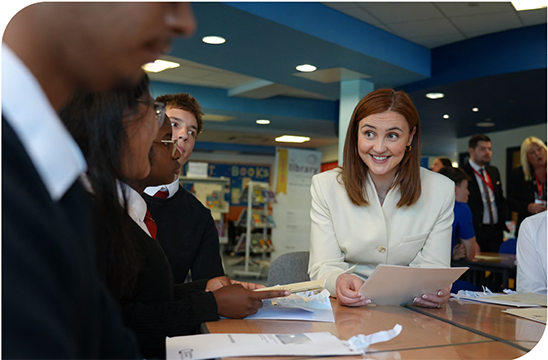
Our comprehensive education system is recognised internationally for the opportunities it provides for young people to thrive. To ensure we can adapt to modern challenges and opportunities, we must equip our young people with the qualifications, skills and resilience they need to succeed in a changing world. That success starts from birth, through our early learning settings, and follows into our classrooms.
We already spend more on education per head of population and have the lowest pupil-teacher ratio in the UK, but we will work across the course of this Parliament to give children and young people, their families, teachers, and schools, the support and resources they need to succeed – including improvements to the curriculum, creating new employment opportunities for teachers by creating the conditions for a Teacher Jobs Guarantee and new accreditations and better job security for Pupil Support Assistants. We will build on the success of our Learning Estate Investment programme, ensuring all schools are in at least a good condition, if not excellent. We will also work with universities and others to explore the potential for developing programmes, such as IntoUniversity, to support more disadvantaged young people to access bespoke support to raise their grades and attainment.
Starting now and across 2026-27, we will:
- Create a more stable teaching workforce and address teacher recruitment challenges by supporting more primary teachers to retrain into employment in secondary schools and addressing specific challenges in recruitment in rural and island communities.
- Consult on legislation to ensure that there are national restrictions on mobile phone use in Scotland’s classrooms, with a Bill expected to be introduced to the Scottish Parliament as soon as possible thereafter.
- Begin implementing the routemap for a new National Staged Intervention Model for children with additional support needs and progress implementation of the wider McManus Review recommendations.
- Build on our investment in the Digital Discourse Initiative and work with local authorities to ensure the programme is rolled out to every school, so that all young people have the opportunity to learn about the risks of online harm, including violent, misogynistic and hateful content.
- Support further expansion of dedicated Gaelic Medium Schools and units, including GME teacher supply and support, alongside implementation of the Scottish Languages Act and GME out-of-school activity.
- Support professionals working in early years to improve children’s early speech and language development.
- Expand our early literacy Bookbug programme to reach an additional 20,000 families and, in this new Parliament, partner with the Dollywood Foundation to deliver a nationwide Imagination Library programme, ensuring that every child can foster a love for reading.
- Begin a review of the provision of modern languages in schools and look to expand the opportunities for young people to learn a new language, including Gaelic and Scots.
- Continue the national approach to LGBTQI+ Inclusive Education across all primary and secondary schools, ensuring age-appropriate integration within the curriculum.
- Continue the work of the Gender Equality Taskforce in Education and Learning and build on the range of work currently available in schools to tackle misogyny through the Gender Based Violence framework. This will include further investment in Equally Safe at School and Mentors in Violence Prevention Programme.
- Engage with the profession and schools on the provision of BSL training for teachers and specialist deafblind teachers to support those children who are blind, partially sighted, deaf or deafblind.
- Progress a new dyslexia passport that school leavers can use to access support in their post-school destination.
- Continue to support online learning provision through e-Sgoil to reduce barriers to learning.
Keeping children safe, supported, and loved
Childhood should be a time when children are surrounded by the support, safety and love that they need to thrive, play, learn, and grow. That means taking a strong preventative approach from the earliest years, identifying and addressing risk at the earliest opportunity, and strengthening and improving public protection systems and practice, so that children and young people at risk of harm are identified, supported and protected more consistently across Scotland.
Across this Parliament we will continue our work to keep The Promise by 2030. From 1 April 2026 care leavers have been eligible for the £2,000 Care Leaver Payment and we will build on the significant progress and change under way at a national and local level, strengthening our support to the care experienced community by implementing the Children’s (Care, Care Experience and Services Planning) (Scotland) Act. This includes strengthening the involvement of families in decisions that affect them through Family Group Decision Making; increased support for all care experienced people through whole life advocacy; extension of support for young people leaving the children’s care service; and addressing profit-making in the care of children in Scotland. We will embed a strengthened approach to child protection across Government and relevant funded bodies, legislate to make reporting of harm mandatory by adults tasked with safeguarding children and young people, and implement child-centred justice reforms including the redesign of the children’s hearing system, the modernisation of laws to tackle child abuse, and within our devolved powers, improvement of online safety, including addressing harmful online content and technology-enabled exploitation.
Starting now and across 2026-27, we will:
- Take a public health approach to online safety – supporting children, parents, and schools to be better equipped to deal with online safety challenges including through an online safety and wellbeing marketing campaign.
- Continue to push UK Ministers to take stronger action on online harm, including measures such as a Social Media Levy to be reinvested into programmes for young people and tougher punishments via Ofcom for social media platforms that fail to keep children safe.
- Continue reforming foster, kinship and adoption, helping ease placement pressures and providing increased support for carers.
- Publish an updated Implementation Strategy that demonstrates the progress made, and the key actions that the Scottish Government will lead, to keep The Promise by 2030.
- As part of our work on Whole Family Support, ensure that learning about the value of intensive family support is appropriately embedded as part of our ongoing work to keep The Promise.
- Support babies, children, and families in the foundational early years of their life, ensuring Whole Family Support includes sufficient focus on the pre-birth to 3 period, so families feel supported, prepared, and confident to provide the care their children need from before birth.
- Support the national roll out of Bairns’ Hooses across Scotland through multiyear funding.
- Ensure the highest scrutiny into group-based child sexual abuse and exploitation in Scotland by launching a statutory inquiry with Professor Alexis Jay as the independent chair.
- Continue our work to strengthen public protection systems across Scotland, recognising violence against women and girls as a key public protection issue and ensuring coordinated responses to the multiple, interconnected risks, harms and adversities that can affect individuals, families and communities.
- Support effective information sharing and multi-agency decision-making where there are concerns about harm or risk.
- Enhance workforce learning and development to improve responses to harm, exploitation and coercion.
Ensuring safer communities
Scotland is a safer place since this government took office with recorded crime down 35% since 2006-07 – including a 58% fall in attempted murder and serious assault, and a 77% fall in housebreaking. But that does not lessen people’s fears or the realities of those who are victims of crime. Across this Parliament, we will work to ensure people feel safe where they live and are protected from violence, exploitation, antisocial behaviour and avoidable harm. We will continue to work with justice partners to create a more efficient, accessible and user-centred justice system, including improving information sharing, reducing duplication, taking a trauma-informed approach and delivering seamless digital services that improve outcomes for victims, witnesses and court users.
Ambitious for Scotland: Strong on punishment; effective on prevention and rehabilitation
A rising prison population reflects action we have taken to strengthen the justice system, resulting in more convictions for serious and organised crime, as well as historical and recent sexual offences. But a high prison population does not automatically mean a safer society. Overcrowding in prisons undermines their ability to operate safely and to effectively rehabilitate prisoners.
Prison will always be necessary, particularly for those who pose a significant risk to public safety, and we are rapidly developing plans to expand the prison estate to ensure that they can operate safely and effectively. However, we also agree with the conclusions of the independent Sentencing and Penal Policy Commission which emphasised the need for a greater focus on the use of community-based interventions while robustly protecting victims and the wider public.
Over this Parliament, we will work to achieve a sustainable prison population – focusing on offering alternatives to custody and taking a preventative approach to crime, while continuing to prioritise the safety of women and the wider community, and the need for survivors’ voices to be heard.
Our approach will seek to combine an expansion of the prison estate with more robust community alternatives and reforms to how release and parole are managed, including:
- Opening two new prisons – HMP Highland and HMP Glasgow – to expand and modernise the prison estate, as well as developing plans to further increase capacity and ensure those in custody can be safely and effectively rehabilitated.
- Investing in justice social work, third sector, and related services to deliver effective community sentences and early interventions, and expand the use of electronic monitoring, including GPS technology.
- Exploring a range of reforms to reduce the demand for prison places and prevent reoffending, with a focus on reducing the use of remand, ensuring community sentences are flexible and robust, and improving how long-term prisoner release operates. This will include considering responses to the consultation on penal reform, to inform decisions on what legislative changes are necessary.
Prevention and reducing reoffending are critical here. Our priority is to intervene early to prevent people entering or returning to the justice system. Working across government, local authorities, health services and the third sector, we will seek to address the underlying causes of offending, including substance dependency, poor health, poverty, homelessness, and unemployment.
Protecting local communities
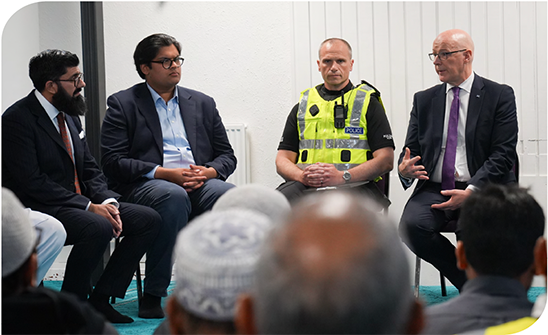
Scotland has made good progress in making our communities safer and giving people greater peace of mind with most adults feeling safe walking alone in their neighbourhood after dark. But we recognise that can also be dependent on place and context, and the perception of crime can be shaped by a wide range of factors. We will always take a strong approach to reducing crime. That includes maintaining a visible police presence, which is why we have invested in more officers per head of population, and better paid officers, than elsewhere in Britain. However, enforcement alone is not enough. We are also working to strengthen communities, give young people a greater sense of belonging and opportunity, and invest in preventative measures that steer people away from crime and towards positive futures.
Across this parliament we will continue to work closely with our key partners to protect our communities. This includes using social impact investment to reduce rates of reoffending; preventing young people from becoming involved in crime through our Cashback for Communities programme; investing in support for Police Scotland’s crackdown on retail crime; supporting the roll out of bleed kits in community settings; creating a ‘Safer Nights Design Champion’ to help improve the safety of public spaces, particularly around transport hubs; and increasing police powers to confiscate and retain e-bikes and e-scooters that are being used anti-socially or criminally.
Starting now and across 2026-27, we will:
- Take forward our commitment to increase police powers to confiscate and retain e-bikes and e-scooters that are being used anti-socially or criminally.
- Take forward legislation to ensure Football Banning Orders can be effectively used for a wider range of football related offences.
- Provide £10 million over the next three years to tackle retail crime through Police Scotland’s Retail Crime Taskforce.
- Take forward the development of a new Violence Prevention Strategy to establish a clear approach and actions to tackle violence and reduce reoffending.
- Deliver the recently announced Justice Social Impact Partnership, provide a £200,000 fund this year to allow Social Impact Partners (SIPs) to bring forward ideas for preventative and early intervention programmes in justice. If successful, we will establish a £10 million Social Impact Investment Fund.
- Start Phase 7 of the Cashback for Communities Programme providing £26 million funding over the next three years.
- Respond to the ‘future of secure care’ consultation to ensure that Scotland’s future plans, resourcing arrangements, and legislative landscape deliver full accessibility to secure care for those children who need those specialised services to keep them, or others, safe.
Of particular concern, Scotland has seen several high profile and distressing examples of youth violence, including deaths from knife crime, which have a profound impact on families and communities. Whilst of little comfort to victims, the number of homicide victims aged 13 to 19 fell by 63% between 2005 and 2025, and homicides in Scotland are at the lowest level since comparable records began in 1976 – but any level of violence is unacceptable and a tragic loss for families impacted. While sentencing in each case is for the independent courts to determine, we will continue to work with partners to tackle and prevent youth violence and in particular knife crime, including effective consequences for offences, through a three-pronged approach:
- Education programmes on the danger and the unacceptability of carrying a knife and taking part in violence: Supporting organisations and initiatives such as No Knives, Better Lives, the Youth Navigators project, and Mentors in Violence Prevention programme, supporting young people at risk of, or impacted by, violence and crime.
- Effective punishment: The young person’s sentencing guidelines make it clear all sentencing options, including a custodial sentence, remain open to the court following a conviction. This sits alongside higher maximum penalties for carrying a knife in a public pace since 2016.
- School and community engagement: With efforts to develop citizens in Scotland and address underlying issues such as glorification and broader societal discourse on crime and violence, to try to prevent a person picking up a knife in the first instance. We will also roll out bleed kits to community settings.
Supporting victims and survivors
While Scotland continues to be a safer country for most people, that can never undo the harm to victims of, or witnesses to, crime. Informed by the tireless efforts of victims and survivors, this Government brought forward, and Parliament passed, landmark legislation to place victims and witnesses at the heart of the justice system last year.
Over this Parliament, we will implement and build upon that, changing culture, process and practice to ensure victims are heard, supported, protected, and treated with compassion, including through the appointment of Scotland’s first Victims and Witnesses Commissioner, as well as the establishment of a trauma-informed sexual offences court. We will also enhance protections for women by recognising pregnancy as an aggravating factor in domestic abuse cases and provide support for those leaving abusive partners. We will drive a more integrated public protection approach across Scotland, recognising that violence against women and girls often intersects with other public protection concerns, and supporting better coordination around the complex and cumulative harms experienced by individuals and families.
Starting now and across 2026-27, we will:
- Extend the right to make a victim statement to all solemn cases and consider ways to give more victims the opportunity to have their voice heard by the court.
- Commence legislation which will improve how courts consider protective orders and ensure protective orders imposed elsewhere in the UK can be enforced in Scotland.
- Consult on changes to the Victim Notification Scheme including increasing the information provided to victims.
- Continue working with the Scottish Civil Justice Council on a proposal for court rules so that, when dealing with civil cases, courts have full information about domestic abuse and strengthen processes to deal with misuse of family court processes, particularly in contact cases, as a means of coercive control and ongoing abuse.
- Provide emergency funding to those organisations under significant pressure, e.g. the ASSIST domestic abuse court advocacy service, the National Advocacy Service, and rape crisis centres providing justice advocacy who have closed their waiting lists for that form of support.
- Ahead of a new fund being established, enhance arrangements under the Delivering Equally Safe Fund, ensuring clarity and stability for organisations over the remainder of the fund’s lifetime.
- Work with the National Public Protection Leadership Group to promote stronger alignment between VAWG priorities and public protection approaches, enhancing understanding of gender-based violence within safeguarding and protection arrangements.
- In the NHS, provide support to people who have experienced rape, sexual assault or child sexual abuse, regardless of when the assault took place.
- Progress work to strengthen NHS leadership, governance, workforce capability and assurance in relation to violence against women and girls by embedding VAWG within the NHS Public Protection Accountability and Assurance Framework, aligning expectations with existing child protection and adult support and protection arrangements, and supporting a more consistent, evidence-informed response across Scotland.
- Ensure the NHS in Scotland focuses its efforts to provide pathways for those at risk and survivors of violence against women and girls, and promote a coherent, connected and mutually reinforcing approach to Health Boards’ wider public protection and safeguarding responsibilities.
An equally safe Scotland
We are committed to ensuring a strong and flourishing Scotland where all individuals are equally safe and respected, and where women and girls live free from all forms of violence, coercive control, abuse and exploitation, and the attitudes that help perpetuate such behaviours. New forms of violence against women are growing out of our increasingly digital world. But while the technology is new, the issue of violence against women and girls is old, and we will keep pace with the change that these new threats pose. We will sustain a whole-government approach to challenge the attitudes and societal inequalities which allow violence against women and girls to persist.
Across this Parliament, we will take forward the necessary action in line with our Equally Safe approach and the Istanbul Convention. We are committed to the development of a new multi-year funding model for specialist third sector services, responding to what organisations need to sustain vital services and ensure collective efforts across the public and voluntary sectors are appropriately resourced. Work is underway to create a blueprint for a Scottish Centre for Gender Equality in Social Attitudes to develop and test robust and evidence-led approaches to changing public attitudes towards women and girls and towards gender equality. And we will learn from lived experience, carrying out a review of measures put forward by survivors or families bereaved through domestic abuse to ensure that all options have been considered.
We will end the postcode lottery of service provision to ensure every woman and girl, regardless of where she lives, has access to safe and sustainable services. That includes developing a new multi-year fund for specialist third sector organisations, responding to what organisations need to sustain vital services and deliver critical preventative activities, allowing them to respond flexibly to local need and participate fully in local partnership arrangements. In addition, we will strengthen the role of multi-agency Violence Against Women Partnerships by investing in local infrastructure to drive forward improvements for victims and survivors, building on current work in development around the VAWG Needs Assessment Tool and Equally Safe Measurement Framework.
Starting now and across 2026-27, we will:
- Implement and embed the Equally Safe primary prevention framework tackling VAWG as a public health issue.
- Develop a sustained multi-year public health campaign to address attitudes towards misogyny and VAWG.
- Commission an evaluation of current delivery of the Caledonian programme for men who have been convicted of domestic abuse, to inform future development, with a particular focus on island communities and suitability for delivery in prisons.
- Invest in targeted interventions to challenge and change problematic misogynistic attitudes and behaviour in boys and young men so they understand harmful influences and behaviour, before it escalates and women and girls are harmed.
- Ensure effective legal and justice responses that hold perpetrators to account and improve victims’ experiences of the justice system, bringing forward a Misogyny Bill to ensure harassment and abuse based on misogyny is outlawed, consulting on implementing Domestic Abuse Protection Orders, and engaging with Police Scotland on training needs on domestic abuse.
- Continue to make improvements to the bail system: we have already made electronic monitoring available across bail, which can help to enforce curfews and exclusion zones, and we will build on that work to deliver a geographical pilot of GPS technology.
- Ensure our public health approach to online safety contains a clear focus on the different harms experienced by boys and girls, including a clear focus on misogyny.
- Develop an approach to technology-facilitated VAWG. This will include conducting research on survivors’ experiences of tech-enabled abuse in daily life. We will also bolster investment in the technology-facilitated VAWG knowledge exchange network, and work with UK and international partners to seek the regulation of online platforms to prevent VAWG that happens online.
- Increase investment in the technology-facilitated VAWG knowledge exchange network, to ensure that we are learning from partners who are tackling this issue.
- Explore operational or legislative options that help ensure justice social work are provided with victims’ details in order to inform risk assessment.
As we work to improve outcomes, boost life chances, and take new approaches to preventing harm and reducing poverty, the social work workforce is at the forefront of our response and critical in achieving better outcomes, helping to:
- Keep people safe from harm, being at the forefront of identification of risk and the protection of children and adults in our communities, including through delivery of The Promise.
- Reduce delayed discharge, undertaking assessments and co-ordinating social care provision to ensure people can get the necessary home or community care.
- Ease pressure on other public services by providing early help to reduce crisis responses, particularly for people with complex mental health needs.
- Achieve a sustainable prison population, working with partners to deliver a wide range of early interventions and alternatives to custody, taking a preventative approach to crime and addressing underlying causes through effective rehabilitation.
- Tackle substance misuse and drug related deaths, being a vital element of the multi-agency response to help people coping with a complex range of needs.
Recognising the unique role social workers play, the Scottish Government established the National Social Work Agency (NSWA) earlier this year, to coordinate national policy and drive improvements in professional education and practice across the profession. Now it is established and given the centrality of the profession to our ambitions, we will work with NSWA and partners, including local government, to ensure a sustainable social work workforce and the best support for them to help deliver on our shared priorities.
Cohesive communities built on rights and equality
This Government aspires to a Scotland that is proudly outward facing and welcoming – built on a shared Scottish identity and sense of belonging; one which respects and values everyone, underpinned by human rights and dignity for all. However, recent events have shown that can be a fragile ambition, undermined by pockets of hatred fuelled by disinformation. Community cohesion is fundamental to building strong, inclusive and safe communities and is inseparable from the action we take to eradicate poverty, improve access to services, and ensure shared prosperity.
Across this Parliament we will not shy away from that challenge and ensure our action improves opportunities and outcomes for all while taking specific steps to protect those most at risk from harm – bolstering community cohesion, supporting those fleeing persecution or facing the devastation of conflicts in their own countries. Our aim will be to protect and enhance the rights of everyone, including by the development of a Human Rights Bill, aiming for introduction in Year 2 of the Parliament.
Building on the investment in community health infrastructure, the development of health and care hubs will start to bring together health and care providers to meet specific local needs, strengthening links with housing, education, welfare and other community services to provide more joined-up support which meets individuals’ whole life needs. These approaches may be most helpful for disadvantaged communities, where people can benefit the most from joined-up support, with the potential to enable delivery of our wider social justice priorities such as whole family support. We will take forward action to address discrimination and inequality experienced by LGBTQI+ people through legislation, policy and partnership working. And we will invest £3.5m each year in our Disability Equality Plan.
Starting now and across 2026-27, we will:
- Establish a Ministerial Taskforce on Community Cohesion to strengthen preventative action.
- Increase investment in the Community Cohesion Fund to £500,000, supporting grassroots community initiatives across Scotland to address shared challenges such as social isolation, the cost-of-living crisis, inclusion, employment and housing support and community dialogue.
- Support the Scottish Violence Reduction Unit and partners to deliver projects that provide safe spaces and practical help for young people from Scotland’s minority ethnic communities.
- Take action to address the root causes of hate crime, strengthening reporting and support for victims, and drawing on robust evidence and experience, as part of the refreshed Hate Crime Strategy Delivery Plan, to be published by the end of 2026.
- Continue to address interpersonal and institutional racism in education through the Anti-Racism in Education Programme.
- Through the Gender Equality Taskforce in Education and Learning, the National Approach to LGBTQI+ Inclusive Education and the Digital Discourse Initiative, continue to build an education system that promotes belonging, mutual respect and understanding, in line with the rights and principles of the UNCRC.
- Publish a refreshed New Scots Delivery Plan to ensure the actions of the Scottish Government and its partners remain relevant to the challenges being faced by refugees and people seeking asylum.
- Continue our work to end conversion practices in Scotland in partnership with the Welsh and UK Governments, strengthening our collective efforts to end these harmful practices and protect LGBTQI+ people from the lasting harms they cause. Should the UK Government fail to deliver we will not hesitate to bring forward Scottish legislation.
A safe and resilient Scotland
Scotland faces an increasingly complex risk environment, including climate change, geopolitical instability, cyber threats, infrastructure dependencies and societal pressures. But resilience is not simply emergency response. It is the ability of Scotland’s services, infrastructure, institutions, communities, and people to withstand disruption, recover effectively and adapt to change. We will also continue to invest in ensuring that our responder network is able to adapt to changing risks and demands and keep communities safe. This will include investing in the Scottish Fire and Rescue Service, as a leading responder to emergencies and by expanding the role of firefighter by the end of this parliament to ensure this service can address the nature of the incidents we are now seeing. Overall, we will strengthen Scotland’s resilience by renewing and modernising the systems, structures and capabilities that support preparedness, response and recovery across the country, to:
- Strengthen national preparedness for future emergencies.
- Improve coordination and crisis response arrangements across government and public services.
- Provide a modern framework for resilience planning and emergency management.
- Support communities, businesses, and critical infrastructure to become more resilient.
- Embed lessons identified from emergencies, exercises and public inquiries.
- Improve public understanding of risks and how people and communities can prepare for them.
Global engagement, local impact
Events overseas, such as the ongoing conflict in the Middle East and Russia’s war with Ukraine have a direct impact at home, affecting economic resilience and communities across Scotland. Higher energy and food costs, supply chain disruption and wider inflationary pressures all impact household finances, businesses and public services. Strong international relations are vital to drive growth, attract investment, support our transition to net zero and enhance Scotland’s resilience in this increasingly volatile world – and they underpin our moral obligations.
Ours is a government re-elected on a commitment to rejoining the European Union. With the world changing rapidly around us, for the sake of our prosperity and our security, Scotland returning as swiftly as possible to membership of the EU must be a national priority, and a shared national purpose. We will never give up on that opportunity and will work to ensure Scotland retains a strong presence on the world stage – standing up for countries facing aggression and hostility, utilising our domestic strengths to bolster our international standing, and being a good global neighbour, including:
- Continue to strengthen Scotland’s relationship with the European Union by influencing UK EU negotiations – seeking closer relations in areas including energy security and electricity, agrifood trade, youth experience, and EU programmes including Erasmus+.
- Work with Universities of Sanctuary to explore how we can further support students from Gaza, including through the development of a postgraduate Scottish Gaza Scholarship Programme.
- Increase the International Development Fund by 25% and in doing so review our existing programmes while developing new modes of funding and partnership, including the development of an Aid Match scheme.
- To ensure the right coverage and relationships globally, to bolster our domestic and international ambitions, we will bring together Scottish Government and Scottish Development International offices into a more effective Scotland House network, expanding the number of Scotland Houses to more than 40 locations.
- Continue to provide support and sanctuary for Ukrainian people displaced by Russia’s illegal war and aggression.
- Continue support for tackling global emergencies and conflicts through the Humanitarian Emergency Fund, including continued support for the people of Palestine and give particular focus on supporting the efforts related to United Nations Security Council Resolution 1325, which recognises the disproportionate impact of conflict on women and girls.
Contact
Email: pfg@gov.scot