
Programme for Government 2026 to 2031
This Programme for Government lasts for five years. The focus of this programme for government is eradicating child poverty, growing the economy, tackling the climate emergency, delivering high quality and sustainable public services.
1. Eradicating child poverty
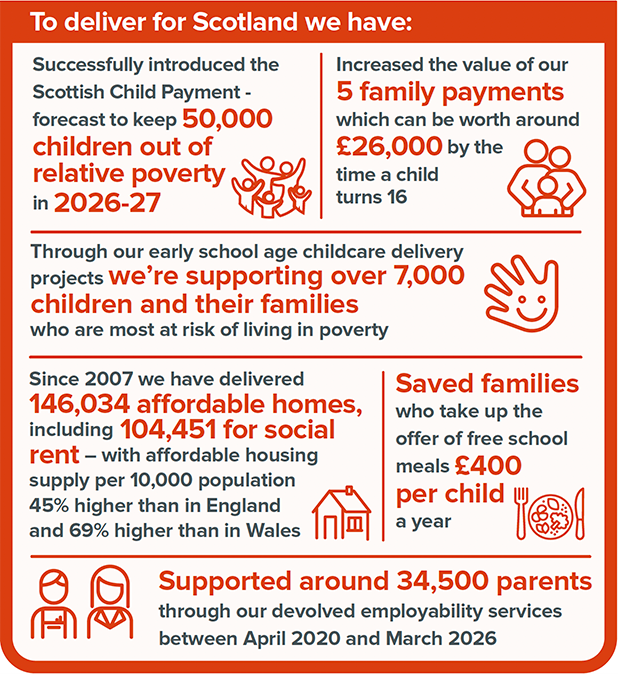
To deliver for Scotland we have:
- Successfully introduced the Scottish Child Payment - forecast to keep 50,000 children out of relative poverty in 2026-27
- Increased the value of our 5 family payments which can be worth around £26,000 by the time a child turns 16
- Through our early school age childcare delivery projects we’re supporting over 7,000 children and their families who are most at risk of living in poverty
- Since 2007 we have delivered 146,034 affordable homes, including 104,451 for social rent – with affordable housing supply per 10,000 population 45% higher than in England and 69% higher than in Wales
- Saved families who take up the offer of free school meals £400
per child a year - Supported around 34,500 parents through our devolved employability services between April 2020 and March 2026
Eradicating child poverty: Our defining mission
Eradicating child poverty is this Government’s defining mission. Despite not having the full levers necessary, we are making good progress and a real difference to the lives of families. The proportion of children living in relative poverty is six percentage points lower here than the UK average.
Bringing Hope, Building Futures (BHBF), the Government’s delivery plan to tackle child poverty, was published earlier this year, underpinned by the incorporation of the United Nations Convention on the Rights of the Child into devolved law, helping ensure that children and young people are at the heart of decisions that affect them and that they have the confidence and skills they need. This sets out how we will go even further to help parents to increase their incomes and reduce the burden of everyday costs, with action in the plan estimated to help keep 100,000 children out of relative poverty this year.
Across this Parliament, we will build on that foundation and go further, faster, with a concerted cross-government effort to increase incomes and bring down costs. We will prioritise multi-year funding for actions demonstrating the highest impact on child poverty where possible. BHBF also explicitly recognised that children’s poverty is inextricably linked to women’s poverty, with violence against women and girls often a driver of that, and we will continue to invest in the Financially Included Project, helping survivors regain financial independence.
Ambitious for Scotland: Putting more money in families’ pockets
We are using our full powers to protect families from the cost-of-living crisis with the most generous package of support in the UK. The Institute for Fiscal Studies estimate some of the lowest income households with children are around £2,760 per year better off because of our progressive approach to income tax and benefits, including our Scottish Child Payment.
We will work to tackle the cost-of-living crisis so that by the end of this Parliament real household incomes are rising, particularly for the lowest income groups by:
- Reducing essential household costs: through a radical expansion of childcare, lower public transport fares, consulting on legislation to establish legal price ceilings on some essential food items and continuing to provide support to eligible households with their fuel bills.
- Getting and staying in work: Helping more people to enter and stay in work and ensuring our child poverty and economic growth agendas have a mutually beneficial outcome of increased wages and fair work.
- Strengthen support through social security: including increasing the Scottish Child Payment to £40 per week for eligible babies under one – supporting around 12,000 children in their critical first year.
- Maximise take-up of benefits: through tackling stigma, improving awareness of entitlements, including of qualifying and relevant UK Government benefits, and identifying opportunities with partners, such as referrals and data sharing, to help ensure individuals access the full range of financial support they are entitled to.
- Making money and debt advice more accessible: investing in proven local advice services through our Advice in Accessible Settings Fund – supporting up to 7,500 people per year to access the financial support they are entitled to.
Ensuring people need only ‘ask once’
The problems people face in their everyday lives are often complex and don’t fit neatly into one area. They need support that fits around their lives and makes things simpler. That is at the heart of our vision for whole-family support, ensuring people get the right support, at the right time and in the right place, for as long as they need it.
Across this Parliament, we will work with local partnerships to ensure support that is person-centred and accessible, delivered in an environment people feel comfortable in, on a ‘No Wrong Door’ basis, so they are not deterred from seeking it out. We will support partners to take a preventative approach, scaling successful approaches so that more families get support that is co-ordinated across services and wraps around their individual needs before things escalate into crisis. Recognising the critical role of the third sector, we will co-design a Partnership Agreement that formalises the relationship between the Scottish Government and the third sector, founded on trust, collaboration and mutual respect, strengthening and embedding the sector’s contribution to delivering key priorities.
Starting now and across 2026-27, we will:
- Support the expansion of Children First’s National Support line, offering a one-step gateway to support up to 7,500 families across Scotland, backed by £2 million.
- Deliver our £20 million Whole Family Support Third Sector Delivery Fund, increasing capacity to deliver relational, community-based support in areas of greatest need, with this funding continuing over the Parliament.
- Work with partners to build on existing best practice to progress an integrated Whole Family Support programme. From April 2027, this will provide multi-year change funding to better enable partners to meet the needs of communities and tailor support to individual families.
- Work with local and national partners to maximise the opportunity lawful data sharing offers to deliver for families.
Helping with the cost of living
Across this Parliament, we will go further to protect and expand our cost-of-living package. Putting more money into pockets – through maximising the support they are entitled to or cutting everyday costs – is one of the most direct ways we can tackle poverty, protect people from the cost crisis and ensure they have the resources they need to thrive. That aim is built on a solid foundation, with Scotland having the most generous cost-of-living package anywhere in the UK – reducing council tax costs for over 100,000 households with children, funding free bus travel for over 2.4 million people, helping households save an estimated £450 a year on energy bills, and much more.
Starting now and across 2026-27, we will:
- Deliver a £2 bus fare cap across the Strathclyde Partnership for Transport (SPT) area, building on our pilot in the Highlands and Islands and implementing a national rollout of £2 bus fares across Scotland by the end of this Parliament.
- Consult on legislation to establish legal price ceilings on some essential food items, improving affordability of food for households facing cost of living pressures.
- Help write off School Meal debt for families impacted by the ongoing cost-of-living crisis by making up to £2.8 million available to Local Authorities.
- Further expand Free School Meals in primary school.
- Continue to invest in the Financially Included Project which helps survivors of abuse and coercive control regain financial independence.
- Conclude the review of joint and several liability rules for council tax debt and how they impact victim-survivors and consider any changes required to make council tax debt recovery processes fairer.
- Invest £205 million to continue delivering winter heating payments to pensioners, families with disabled children and the households struggling the most.
- Develop the systems and legislation needed to increase our Scottish Child Payment to £40 per week for children under the age of 1 during 2027-28 – with around 12,000 children a year expected to receive support.
Ambitious for Scotland: Ensuring more people get an affordable home
We are supporting housing investment across all tenures – building and bringing more homes into use. Since 2007 this Scottish Government has delivered 146,034 affordable homes, including 104,451 for social rent – with affordable housing supply proportionately 45% higher than in England and 69% higher than in Wales, per 10,000 population.
Across this Parliament, we will work to ensure everyone can secure and keep a home, rather than cycling through insecurity, homelessness or long periods in temporary accommodation. We will deliver 110,000 affordable homes by 2032 – of which at least 70% will be available for social rent and 10% will be in our rural and island communities. This will be underpinned by investment of up to £4.9 billion, including a record £4.1 billion of public sector funding, to support delivery of 36,000 affordable homes and our wider all-tenure ambition over this Parliament. To deliver this, we will:
- Work with local and regional partners to ensure the right mix of housing in the right places: aligned to housing need and our broader ambitions on regional growth and with housing provision supporting areas of new jobs and investment.
- Reform the planning system: to speed up developments and make it easier to get projects to completion and families into homes.
- Phase in the establishment of a new Scottish housing agency, More Homes Scotland, from 1 April 2027: bringing together funding, expertise and delivery tools under one roof. It will remove barriers and accelerate housing delivery, improving the use of public investment, unlocking private finance and supporting more homes, faster.
- Develop a strategic partnership between More Homes Scotland and the Scottish National Investment Bank (SNIB): leveraging further private commercial capital and investment into housing - supporting new entrants, growth and delivery of more high-quality housing across all tenures, including Build to Rent and affordable and social housing.
Ensuring the right housing mix for Scotland
While affordable housing underpins our efforts to give families and children a safe and secure future and tackle poverty, it also sits at the heart of growing the economy – ensuring the right profile of housing in areas of job creation and improving public services, so that people have a good quality home in their local community and live better and healthier.
Across this parliament, we will boost home ownership, increase affordable housing, strengthen tenants’ rights, and help young people to build homes within their communities through our Youth Built initiative. Planning and regulatory reforms will streamline housing delivery, speed up decision making and remove barriers to building new houses across the country. Through More Homes Scotland, we will provide a stronger national focus to support the delivery of the right homes, in the right places, across all tenures, so every area can benefit from good quality housing.
Starting now and across 2026-27, we will:
- Build on the support we have already provided first-time buyers through our new ‘First Homes Fund’, part funding their mortgage deposit with a joint equity contribution of up to £10,000. This will run every year of this parliament, backed by up to £100 million, open to everyone buying homes up to £300,000 who have not previously owned their own home.
- Engage with stakeholders on our proposal to enable private rental tenants to purchase the property they rent if the owner chooses to put it up for sale.
- Work at pace to provide financial support to owners of buildings affected by dangerous cladding – so that as quickly as practicable appropriate action has been taken in relation to every high-risk residential building over 18 metres, and that those over 11 metres are on a pathway to resolution.
Ending homelessness for good
No one deserves to live in unsafe housing or risk being trapped in homelessness or with an abusive partner. Our approach to homelessness will shift from crisis management to prevention and rapid rehousing so that everyone has a safe, secure and affordable home in which they can thrive.
We will do all we can over this Parliament to help people off the streets and end the use of unsafe and harmful temporary accommodation for children. Support for care-experienced young people to access secure long-term housing will be strengthened and, under new standards, we will ensure homes are designed and adapted to meet people’s needs, reducing physical barriers and enabling disabled people to participate more fully in daily life.
We will transform how public services work together and embed housing stability as a shared responsibility, ensuring people receive the right support at the right time and increase the supply of affordable homes in the places they are needed to end homelessness for everyone.
Starting now and across 2026-27, we will:
- Roll out our ‘Homelessness Prevention Fund’ of £50 million over 10 years. Introduced in our first 100 days, this has immediately provided £1 million to the Scottish Federation of Housing Associations and Homeless Network Scotland to strengthen tenancy sustainment activity by registered social landlords in Glasgow.
- Support up to an estimated 15,000 families impacted by the UK Government’s freeze to Local Housing Allowance rates, reducing housing-related poverty and helping prevent homelessness.
- Make our £2 million ‘fund to leave’ scheme permanent, offering support for women and children to leave an abusive partner. Increased investment will allow the fund to reach even more women and children, helping them take the first steps towards a secure and independent future, free from abuse.
- Support local authorities to deliver 1,500 Housing First tenancies over five years.
- Continue growing the Independent Living Fund, giving more disabled people access to life-changing support to live independently, with investment of £88.6 million.
- Support Social Bite with £2 million for the expansion of their efforts to address homelessness
Ambitious for Scotland: Getting more people in good, secure work
Helping people into good, secure, and well-paid work can provide an enduring route out of poverty. Fair work also underpins sustainable economic growth. Scotland has the highest proportion of employees in the UK paid the real Living Wage or more, with almost 90% of workers aged 18 and over receiving it.
We will work to boost the number of people securing and progressing in work, particularly those who face barriers to work through long-term illness and disability so that economic inactivity rates fall and employment rates increase, with a coordinated programme of work to:
- Support people who are inactive or at risk of being so: working across health and employability to help people to enter and sustain employment.
- Encourage and support good jobs that best serve people and local communities: improving employer practices, workplace conditions and job availability in places and priority sectors, contributing to business productivity and higher real incomes.
- Develop the skills needed for Scotland’s economy to thrive: addressing skills and workforce challenges and supporting employers to develop and fully utilise their workforce’s skills.
- Support young people to engage in the labour market: with improved pathways from education into training and employment through strengthened partnerships, expanded work-based learning opportunities, improved transition support, and effective employability services.
Equipping people with skills and opportunities
A high-skilled workforce underpins this Government’s ambitions – helping reduce poverty through good work; contributing to economic growth in all areas and regions; and being at the forefront of the green industrial transition. Scotland’s employment rate is significantly higher than 15 years ago, but we are determined to go further by growing the working population, supporting people into work, and ensuring those leaving education or seeking new careers have the skills to be ready and able to take up those opportunities.
Across this Parliament, we will provide national coordination of a skills and employability programme that delivers for workforces and employers across Scotland. We will expand apprenticeships, funding at least 150,000, grow the opportunities provided by Graduate Apprenticeships, and develop a new Apprenticeship Accelerator Grant focused on supporting businesses, particularly SMEs. We will build on the record levels of young people already going into positive destinations when they leave school by investing in apprenticeships for disabled young people and uprating bursaries for paramedics, midwifery and nursing students. And we will focus on improving the digital and vocational skills of our working-age population and create new schemes to support disabled people into work.
Starting now and across 2026-27, we will:
- Produce a single national skills plan for Scotland by Spring 2027, aligning skills investment with economic need and opportunities, supporting the green and digital transitions, boosting productivity and creating clearer pathways into well paid and sustainable jobs.
- Publish a Careers Ambitions Framework and work with users of all ages, the Scottish Careers Collaborative, employers and key partners to improve digital careers information, expand work-based learning, and strengthen pathways from education into employment.
- Commence new powers for the Scottish Funding Council in April 2027 to consolidate responsibility for securing and funding the delivery of national training programmes, apprenticeships, and work-based learning with the rest of tertiary education.
- Fund and progress the pre-commercialisation stage of CivTech Challenge 11.4, the development of a digital solution to better support economically inactive people with musculoskeletal challenges to remain in and return to work.
- Increase awareness and uptake of Working Health Services Scotland, supporting more people with health challenges to remain in and return to work.
- Work with the UK Government, alongside Public Health Scotland, to increase Scotland’s influence on the Keep Britain Working programme, supporting Scottish employers to address workplace health, help people return to work after illness, and increase disabled people’s employment.
- Support Regional Economic Partnerships to deliver regional interventions that respond to employers’ skills needs and support people into training and job opportunities.
- Invest in a programme to develop engineering and maritime skills in Glasgow City Region, regionally focused skills programmes supported by the Growth Deals, and 10-year regional skills programmes in Scotland’s two investment zones to address critical skills shortages key sectors.
- Invest £22 million to help parents access the skills and training they need through the new Colleges RISE, Training Access Fund and Flexible Workforce Development Fund.
- Protect free tuition and work to ensure our tertiary education sector meets the needs of the people of Scotland and our economy, including by delivering and responding to two reviews we have commissioned for the future of the sector.
- Continue our commitment to multiyear funding for No One Left Behind and finalise a review of Employability Support to focus on breaking down the barriers to work, with key recommendations delivered in the next Scottish Budget.
- Explore options to recognise employers who provide fair, flexible and healthy work, through access to funded training via the new Flexible Workforce Development Fund, and use the evaluation of Fair Work First, alongside Trade Union led efforts, to future-proof workplaces.
- Call on Westminster to fully devolve Employment Law to Scotland whilst continuing to support the interests of Scottish workers and businesses in the implementation of the Employment Rights Act (2025).
Helping children to flourish and parents to work
Good quality, affordable and accessible childcare is essential to meeting our ambitions of growing the economy, through increased work opportunities, and tackling poverty, by boosting incomes and reducing costs. Our universal funded early learning and childcare offer is the most generous in the UK; but we are going to go further.
By the end of this Parliament, we will transform the childcare offer for families, providing support 52 weeks a year for children from 9 months old to the end of primary school. This will be a more flexible system that changes from a focus on 3 and 4-year-olds, to provide childcare support earlier in life and extended to primary school children, making it easier for parents to get to work and get the support they need during holiday periods. Delivery will be phased across the Parliamentary term, with families able to access breakfast clubs for all primary schools from August 2027, and a new after school and holiday childcare offer for primary school children available from August 2029.
Starting now and across 2026-27, we will:
- Publish and consult on a blueprint for a new childcare offer which is focused on what matters most to families.
- Deliver a national breakfast club offer, with provision for all primary schools from August 2027, backed by £44 million each year.
- Fund a range of targeted childcare support for low-income families, including our Extra Time programme with the Scottish Football Association, and our childcare Early Adopter Communities.
- Support high quality, sustainable early learning and childcare (ELC), investing a further £13.4 million to enable childcare professionals delivering funded ELC in the private and third sectors to continue to be paid at least the real Living Wage, benefitting up to 13,000 childcare professionals.
Contact
Email: pfg@gov.scot