
Programme for Government 2026 to 2031
This Programme for Government lasts for five years. The focus of this programme for government is eradicating child poverty, growing the economy, tackling the climate emergency, delivering high quality and sustainable public services.
3. Tackling the Climate Emergency
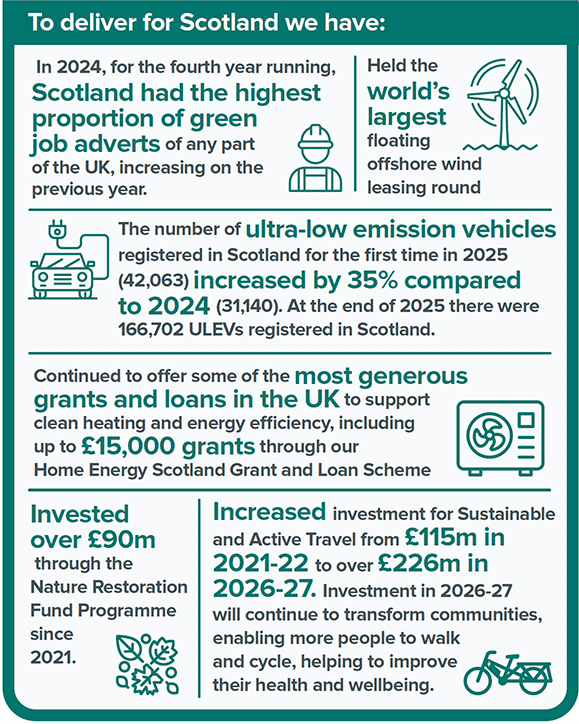
To deliver for Scotland we have:
In 2024, for the fourth year running, Scotland had the highest proportion of green job adverts of any part of the UK, increasing on the previous year.
Held the world’s largest floating offshore wind leasing round.
The number of ultra-low emission vehicles registered in Scotland for the first time in 2025 (42,063) increased by 35% compared to 2024 (31,140). At the end of 2025 there were 166,702 ULEVs registered in Scotland.
Continued to offer some of the most generous grants and loans in the UK to support clean heating and energy efficiency, including up to £15,000 grants through our Home Energy Scotland Grant and Loan Scheme.
Invested over £90m through the Nature Restoration Fund Programme since 2021.
Increased investment for Sustainable and Active Travel from £115m in 2021-22 to over £226m in 2026-27. Investment in 2026-27 will continue to transform communities, enabling more people to walk and cycle, helping to improve their health and wellbeing.
Meeting the challenge of a changing climate
Scotland has a huge contribution to make in the global battle against climate change. With our vast renewable resources, expertise and ingenuity, we can lower our own climate impact and help others move to net zero, while ensuring Scotland becomes more climate resilient and prosperous, creating jobs, warmer homes and lowering costs for households.
Tackling the climate emergency is a critical moral obligation. The devastating wildfire witnessed in the Cairngorms, as well as those which ravaged parts of Europe – alongside flooding events in coastal communities and water scarcity in some parts of the country – shows that the impacts of climate change are real and being felt by communities across Scotland now.
Across this Parliament, we will work to ensure a credible pathway to net zero by 2045 through ongoing delivery of our Climate Change Plan which will create jobs, lower costs, and restore nature as part of a just transition. We will also respond and adapt to immediate risks and opportunities by rapidly increasing our climate resilience through ongoing delivery of Scotland’s National Adaptation Plan, investing now in the conditions that will pave the way for long term certainty, stability and quality of life which will help this and future generations.
Ambitious for Scotland: Ensuring our economy, climate, and communities all benefit from thegreen industrial transition and are resilient to the impacts of climate change
With our immense natural resources, Scotland is uniquely placed to grasp the twin benefits of reducing emissions and growing our economy. Between 1990 and 2024, Scotland’s economy grew by 68.5% in real terms, at the same time as we cut our greenhouse gas emissions in half - showing how tackling climate change and growing a thriving, green economy go hand in hand.
Across this Parliament, we will continue realising those twin benefits – with reduced emissions and increased employment in green industries across Scotland. We will implement Scotland’s first carbon budget, delivering on the Climate Change Plan, which contains 150 actions that will reduce greenhouse gas emissions over the next 15 years and bring potential for over £42.3 billion financial benefits and savings, underpinned by a range of key delivery indicators, including:
- Decarbonising heat in buildings by 2045.
- Increasing woodland creation so that, by 2029-30, 18,000 hectares are planted every year, of which at least 40% will be native, so that we reach 21% woodland cover in Scotland by 2032.
- Restoring more than 400,000 hectares of degraded peatland by 2040.
Driving Scotland’s just transition to a net zero, nature positive, and climate resilient future cannot rest alone with Government; it requires a range of partners across the public, private and third sectors, and the buy-in and support of people and communities. To deliver on our ambitions, we will work collaboratively with partners by:
- Improving the sustainability of key industries to reduce emissions, pollution and waste, and ensure they do not take from nature faster than it can regenerate itself.
- Helping business to understand and manage nature-related impacts and risks, and to embrace net zero, circular economy business models, harnessing the benefits this transition will create for innovation, resilience, competitiveness and inward investment.
- Embedding sustainability throughout supply chains.
- Using a range of policy levers across government to support a just transition, investing in public and private finance, innovation, infrastructure and green skills.
Supporting communities in a changing climate
Climate change is already underway; how well Scotland adapts to these changes will be central to our future prosperity. We are committed to ensuring that disruption to daily life is minimised in the face of increasing extreme weather events. Increasing our resilience to climate impacts will mean less disruption to travel and more secure supply chains - keeping supermarkets stocked, homes that are not repeatedly flooded, our beautiful and valuable landscapes not destroyed, and industries able to grow with confidence.
Starting now and across 2026-27, we will:
- Invest in a transport network that is more resilient, and work with other infrastructure owners to make sure investment focuses on the areas most at risk.
- Strengthen coordination across critical infrastructure, supporting the Climate Ready Infrastructure Scotland Forum’s interdependencies project, while supporting locally owned adaptation projects across all regions of Scotland through the Climate Ready Regions initiative.
- Allocate an additional £15 million in flood mitigation and prevention, with resources targeted in areas most impacted by flooding.
- Invest an additional £14 million in a Coastal Change Adaption fund by the end of the Parliament to support local authorities to adapt our coasts to better respond to the rise in sea levels, publish their coastal change adaptation plans and reduce the risks associated with coastal erosion.
- Review and successfully deliver the Wildfire Strategic Action Plan to prevent, prepare and respond to the new reality of increased wildfire risk.
- Establish a Scottish Marine Recovery Fund and develop strategic environmental compensation, securing investment in Scotland’s marine environment, helping to expedite offshore wind deployment and unlocking investment, job creation and accelerate progress towards net zero.
Decarbonising where it matters
Emissions reduction is central to how we respond to the climate emergency – working now to create a climate-positive future will ensure that our communities are supported to become more resilient, and address the issues of poverty and energy security. As we look to 2045, we are making positive progress – Scotland is now more than halfway to net-zero and continues to be ahead of the UK in delivering long-term emissions reductions.
During this Parliament we will deliver the actions covering the first five years of our Climate Change Plan, and we will move towards a circular economy, where materials and goods are valued and kept in use for as long as possible, setting national circular economy targets to drive progress. We will establish a Deposit Return Scheme for drinks containers, alongside systems in England, Wales, and Northern Ireland, and deliver more consistent and higher quality local services through a new statutory code of practice for household waste recycling.
Starting now and across 2026-27, we will:
- Engage with stakeholders to identify changes that could be made through our planning reform programme to make it easier to install public EV chargers - supporting the ongoing move to electric vehicles, better connecting communities and stimulating economic growth.
- Work with stakeholders to encourage private sector investment in the decarbonisation of heavy-duty vehicles.
- Invest £28 million to restore 10,000 hectares of peatland, as well as publishing a new Peatland ACTION Skills Plan and Peatland Standard to support consistent, high-quality restoration.
- Introduce a Heat in Buildings Bill, while also supporting clean heating and energy efficiency measures for around 100,000 properties in Scotland, enabling the scale up of heat networks.
- Respond to Environmental Standards Scotland’s Improvement Report which recommends an increase to fines for vehicle idling and, subject to Parliamentary approval, consult on this change.
- Set the rates for our Private Jet Tax through the 2027-28 Scottish Budget development to ensure that those who choose to travel by private jet, which produce significantly more emissions per head than commercial aircraft, make a fair contribution to public finances.
Protecting and restoring nature
Scotland, as globally, faces a twin climate and nature crisis; neither can be tackled in isolation. Scotland’s land and nature is essential for sustaining the ecosystems that provide food, fuel, health, opportunities to enhance wellbeing, and wealth, and underpins our resilience to global shocks and the impacts of climate change already being felt. This summer’s wildfires show the impacts of climate change risk devastating Scotland’s natural assets.
Scotland’s natural capital – our biodiversity, forests, fisheries, clean and healthy air, water, and soils – is also immensely valuable, estimated at £230 billion. Across this Parliament, we will deliver on our Biodiversity Strategy and implement the Natural Environment (Scotland) Act 2026, including its statutory targets. We will enhance climate resilience and biodiversity through coastal adaptation measures and increasing tree canopy cover across our towns and cities. And we will protect important green spaces and explore how to better use the urban waterways within communities.
Starting now and across 2026-27, we will:
- Continue and increase our Climate Justice Fund, up from £36 million, over the course of this Parliament and, following an independent evaluation, deliver new programmes that support communities in the Global South to build resilience and address loss and damage.
- Give our farmers and crofters the tools and support they need to help us deliver on our climate and biodiversity objectives through our four-tier targeted support system.
- Consult on fisheries management measures for inshore marine protected areas and priority marine features.
- Commission feasibility studies on the viability and cost of bringing urban waterways like the Govan Graving Docks in Glasgow, and Wardie Bay and sections of the Water of Leith in Edinburgh, into safe usage.
- Bring together private, public and third sector organisations to maximise the opportunities for nature restoration associated with the unprecedented investment in infrastructure development.

Boosting green growth across Scotland
The transition to net zero is one of the single greatest economic opportunities for Scotland if we get the timing right. We have competitive advantages in multiple sectors at the forefront of the transition and associated supply chains – generating growth and economic activity across the country while increasing climate resilience and supporting emissions reduction.
Powering a renewables revolution
Scotland is a global powerhouse in renewable energy. Our offshore energy sector, with a highly skilled workforce, is vital to both our economy and the energy transition. A record 39.0 TWh of renewable electricity was generated in Scotland in 2025 – equivalent to powering 16.5 million homes a year. We will work across this Parliament to ensure that billpayers, communities, the economy, and nature all benefit from a future of clean, affordable, and secure power. We will act to accelerate delivery of offshore, solar and pumped storage renewables technologies, particularly where they can sit off grid, strengthening our energy resilience. We will invest in workforce skills and community energy projects, so that communities can benefit from their natural resources. We will also establish a ScotWind Wealth Fund by the end of this Parliament, ensuring investment that brings a fair return to the public purse and that all of Scotland receives the benefits our renewable energy resources can offer.
Starting now and across 2026-27, we will:
- Make the case for the transfer of energy powers to Holyrood – using those to end the practice of gas setting the price for an energy system dominated by renewable energy, to lower bills.
- Publish a refreshed Energy Strategy which will look beyond this Parliament to provide long-term certainty.
- Help more people benefit from the energy transition to net zero emissions through increased funding of £15 million for the Community and Renewable Energy Scheme (CARES) – supporting up to 70 community energy projects, up to 110 community buildings to decarbonise, and providing significant support to several community shared ownership projects.
- Continue to explore options to expand solar panels in underused spaces such as rooftops and car parks, while supporting the uptake of plug-in solar panels for domestic use where suitable.
- Build on the action we have taken to prioritise the community use of public land through mechanisms like Community Asset Transfer. This will include updating Community Asset Transfer guidance in early 2027, so that relevant authorities are supported and encouraged to grant community requests for renewable leases and ownership.
- Work closely with the offshore wind sector to target our investment and policy support, with a focus on floating offshore wind, ports and supply chain projects, to grow well paid, sustainable jobs, bring the benefits of renewables to communities, and improve our energy security.
- Make sure that communities who host renewable energy developments benefit from those developments, including through increased investment, fairer distribution of funding, and stronger community involvement in decision-making, by refreshing the Good Practice Principles for Community Benefits from Onshore Renewable Energy Developments.
- Explore ways we can grow demand for renewable electricity to maximise the local use of Scotland’s renewable energy resources.
- Continue to modernise and strengthen the planning, consenting and regulatory framework for offshore wind in Scottish waters, using robust evidence to support timely decision-making, sustainable deployment, and increased certainty for investors and developers.
Securing green jobs and investment
Scotland is well placed to be at the forefront of industrial transition, building on the skills, excellence and innovation of our renewables and oil and gas sectors and in turn supporting the creation of new jobs and businesses. That is, new, green jobs in every corner of Scotland to help ensure climate action goes hand in hand with our commitment to grow the economy, develop all regions, and ensure the right infrastructure in the right places so local communities can capitalise on those opportunities.
Across this parliament we will continue to support a just transition through our significant investment in the skilled workforces of Mossmorran, Grangemouth and the North East, and the world class industrial sites in those communities. We will establish a new Just Transition Commission to build on its predecessor’s work and support delivery, including a fresh focus on climate resilience. And, working with key partners like the Wood Foundation, we will leverage public and private funding to support sustainable employment opportunities and the long-term prosperity of regions that have delivered, and continue to deliver, so much for the Scottish economy.
Starting now and across 2026-27, we will:
- Call on the UK Government to take an evidence-led and case-by-case approach to decisions on North Sea projects, with climate compatibility and energy security as primary considerations.
- Advocate for the Energy Profits Levy to be replaced with a fairer system that taxes excess profits and protects the jobs, energy security and investment in our energy sector.
- Work with the UK Government and industry partners to advance the Acorn project in the North East, while supporting the broader deployment of Carbon Capture, Utilisation and Storage (CCUS) technologies where they can deliver decarbonisation and industrial growth.
- Support workers and businesses in the North East and Moray, through the £500 million Just Transition Fund – which is already supporting hundreds of jobs and will create and support at least 500 jobs, with the potential for a further 200 jobs, from the newly announced round of projects.
- Deliver 15 new Just Transition Fund community projects, to ensure that the benefits and opportunities of the Just Transition are felt across every community in the region.
- Start the process of match funding £40 million from the Wood Foundation to support opportunities and transition in the North East, with delivery over this parliament, seeking other partners who would also engage in match funding initiatives to secure a just transition.
- Support our highly skilled oil and gas workforce with careers advice and funding for training through the Oil and Gas Transition Training Fund, backed by £3 million. This will ensure the emerging opportunities across a number of sectors, including the net zero economy, are accessible to our existing workforce.
- Invest £9 million over the next three years in and around Mossmorran to support the workforce, local communities, and to secure a long-term future for the site, including working closely with Fife College to provide skills training for displaced workers.
- Continue to invest in supporting employment opportunities in Grangemouth, including through the Grangemouth Investment Taskforce and Grangemouth Future Industry Board.
Contact
Email: pfg@gov.scot