
Pesticide Usage in Scotland: Rodenticides on Arable Farms 2024
This report presents survey results of rodenticide use on arable farms in Scotland in 2024. Almost 46 tonnes of rodenticides were applied on an estimated 39% of all arable farms in 2024. Rodenticide use in 2024 shows a significant downward trend compared to the previous ten years.
Appendix 5: Survey methodology
Sampling and data collection
Using the June 2024 Agricultural Census (11), a sample was drawn representing arable cultivation in Scotland.
The country was divided into 11 land-use regions (Figure 17). Each sample was stratified by these land-use regions and according to holding size. The holding size groups were based on the total area of arable crops grown. The sampling fractions used within both regions and size groups were based on the areas of relevant crops grown rather than number of holdings, so that smaller holdings would not dominate the sample.
The survey covered rodenticide use during the 12 month period January to December 2024. Following an introductory letter and telephone call, data were collected by telephone interview, email or post. When rodenticides were applied by a pest control professional (PCP) the data were obtained from either the farm rodent control record book or by e-mail/post survey with the contractor. If it was recorded that rodenticides were used but product data were not obtainable this was recorded as unspecified rodenticide use.
In total, information was collected from 272 holdings (Table 6). These 272 holdings represent 3% of the total arable holdings in Scotland, and 8% of the arable area (Table 7). The data collected were; who conducted the baiting, product(s) used, bait type, weight applied, target and season of use. Information about use of non-chemical rodent control methods was also recorded.
All farmers and PCPs encountered in the survey were also asked to respond to a simple questionnaire containing questions relating to whether they had received training in use of rodenticides, their self-reported compliance with elements of best use practice for rodenticides and their knowledge of rodenticide stewardship. Farmers were also asked to provide operation details about their farm, such as whether they kept livestock or had a grain store, to allow comparison in farm operation in relation to whether they used rodenticides. They were asked about encountering rodenticide resistance and whether they undertook any open area baiting.
It should be noted that, in relation to all data collected, responses are as reported by the rodenticide users and no attempt has been made to check their accuracy.
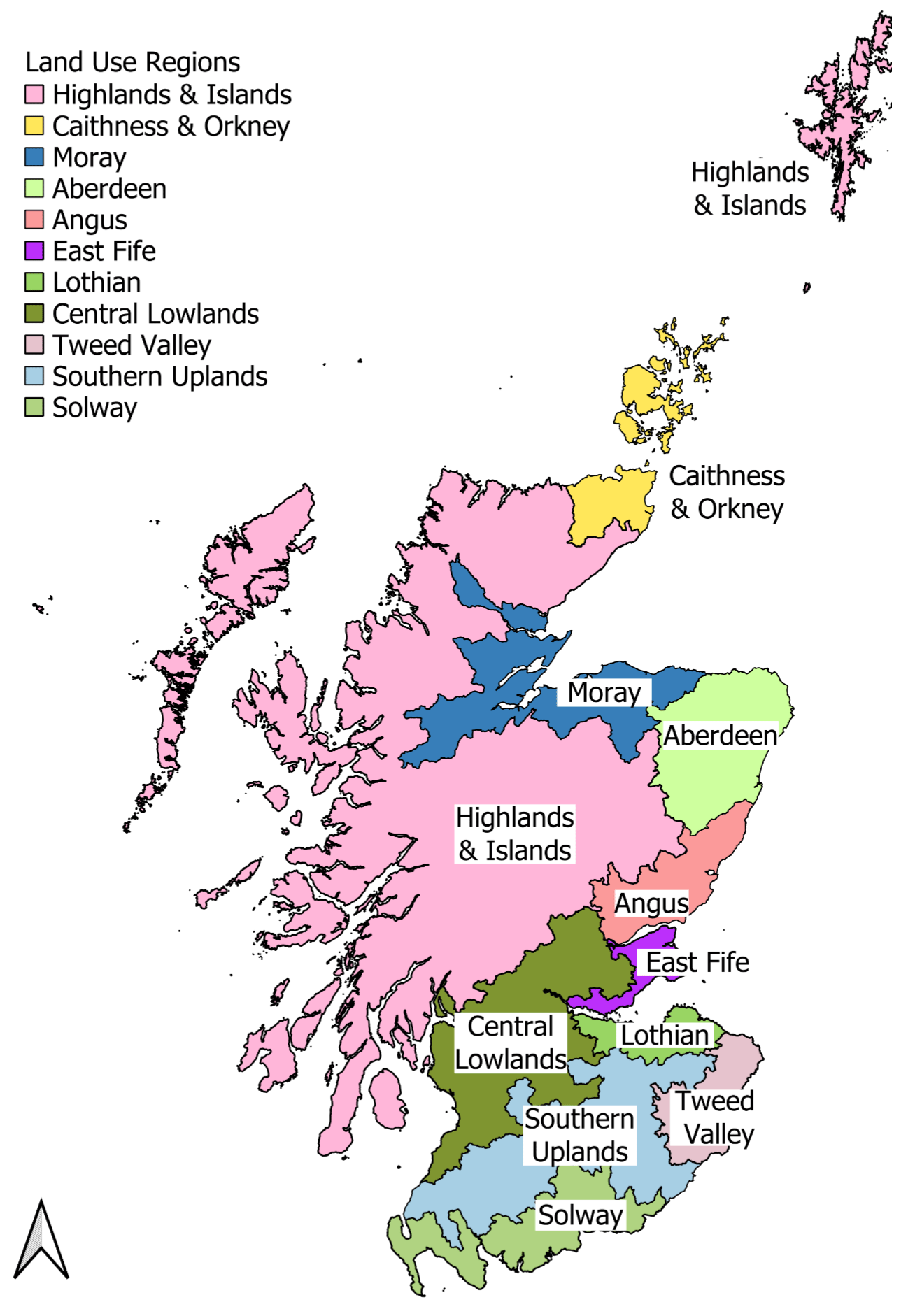
A colour-coded map of Scotland’s eleven land use regions.
Estimation of national rodenticide use
The figures presented in this report are produced by surveying a sample of holdings rather than conducting a census of all the holdings in Scotland. Therefore, the figures are estimates of total rodenticide use for Scotland and should not be interpreted as exact.
National rodenticide use (holdings using rodenticides, rodenticide occurrence and weight) was estimated from the sample data by ratio raising. This is a standard statistical technique for producing estimates from a sample. It is the same methodology used in previous rodenticide usage reports in this series, allowing comparability over time. This method involves multiplying the sample data by a factor dependent on the number of farms within each region and size group to match the data recorded in the relevant Agricultural Census data for arable crops. Due to small sample sizes the data from some regions were merged and a secondary adjustment factor was applied to the raising factors to account for region and size groups for which no holdings were sampled. Details of regions, size groups, raising and adjustment factors are presented in Table 8.
The remainder of the data (use of non-chemical control methods, details of farm operation, compliance with best practice and knowledge of rodenticide stewardship) are unraised and represent the information collected from the sample.
Changes from previous years
This report uses a similar structure to previous reports in the series, additional comparative data from previous reports (2014 to 2022) has been included in Appendix 3 to aid the reader in examining longer-term trends in the data, particularly in relation to the introduction of rodenticide stewardship, these are discussed in the text.
Data are primarily collected by non-visit methods in order to reduce burden on farmers. Every effort was made to achieve a robust sample.
For this report and other reports prior to 2022, the June Agricultural Census was used to draw a sample of farmers growing relevant crops to participate in the survey. National rodenticide use was then estimated by ratio raising, by comparing the sample area to the areas recorded in the June Agricultural Census data. However, there was no June Agricultural Census in 2022. Instead the May 2022 Single Application Form data was used to draw the sample and estimate national pesticide use (see the 2022 report for full details). This should be taken into account when comparing 2024 data with the previous survey in 2022.
In this survey while weights of product and active substance are both discussed, when comparing total weight of rodenticide used between years the weight of product has been chosen rather than weight of active substance as year to year use of alphachloralose and cholecalciferol can strongly affect the overall total due to the much higher concentrations of active substance relative to ARs. When discussing non-chemical methods, in 2024 these are presented as percentage of holdings using each method. In previous years, they were expressed as percentage share of total occurrence of non-chemical methods.
Statistical analysis
As estimates are based on a random stratified sample of farms in each survey year and individual farms may be sampled more than once in the time series, there is no simple method of statistical comparison for estimated rodenticide use on arable farms over time. However, the percentage of farms using rodenticides, the percentage of farms on which baiting was conducted by PCPs and the percentage occurrence of first- and second-generation compounds have been analysed using Pearson’s chi-squared test. The percentage occurrence of first- and second-generation compounds was analysed using the number of holdings as a base. These conservative analyses do not take into account the stratification, finite population sampling or common farms between years and are therefore less likely to find significant differences. All significant differences are highlighted in the text and tables of this report.
Data quality assurance
The dataset undergoes several validation processes as follows; (i) checking for any obvious errors upon data receipt (ii) checking and identifying inconsistencies with use and pesticide approval conditions once entered into the database (iii) 100%checking of data held in the database against the raw data. Where inconsistencies are found these are checked against the records and with the farmer if necessary. Additional quality assurance is provided by sending reports for independent review. In addition, the Scottish pesticide survey unit and SASA Wildlife Management unit are accredited to ISO 9001:2015. All survey related processes are documented in Standard Operating Procedures (SOPs) and output is audited against these SOPs by internal auditors annually and by external auditors every three years.
Main sources of bias
These surveys may be subject to measurement bias as they are reliant on respondents recording and relating data accurately. As surveys are not compulsory, they may also be subject to non-response bias, as some farmers and PCPs may be more likely to respond than others. However, the use of a random stratified sample is an appropriate survey methodology, and reserve lists of farms are held for each stratum to allow non-responding farms to be replaced with similar holdings.
Experience indicates that stratified random sampling, including reserves, coupled with personal interview technique, delivers the highest quality data and minimises non-response bias.
Contact
Email: wildlifeunit@sasa.gov.scot