
Pesticide Usage in Scotland: Rodenticides on Arable Farms 2024
This report presents survey results of rodenticide use on arable farms in Scotland in 2024. Almost 46 tonnes of rodenticides were applied on an estimated 39% of all arable farms in 2024. Rodenticide use in 2024 shows a significant downward trend compared to the previous ten years.
Supplementary Data
In addition to the collection of rodenticide usage data, farmers were also asked a series of supplementary questions relating to aspects of their farm operation, their use of non-chemical rodent control, rodenticide stewardship and their compliance with best practice in rodenticide use.
In contrast to the rodenticide usage data presented in the previous sections of this report, this information is not raised to provide national estimates and is presented as responses from the sample surveyed.
Non-chemical rodent control
Farmers were asked about non-chemical methods employed for rodent control. A range of measures were conducted, with some farmers employing more than one method (Figure 10).
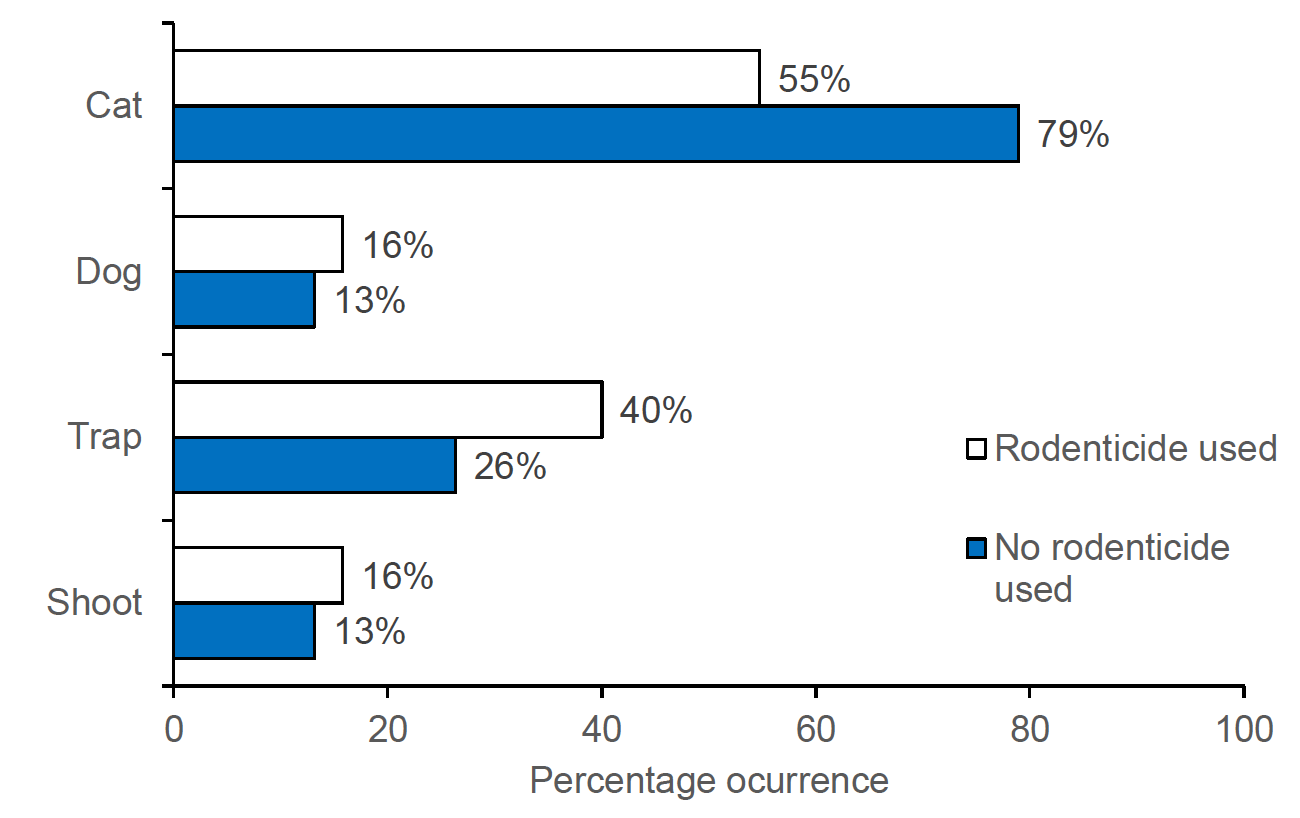
A bar chart showing percentage use of non-chemical control methods on arable holdings using and not using rodenticides in 2024.
On holdings on which rodenticides were not used (n=70), just over half (54%) of the farmers reported using one or more non-chemical controls. The most commonly encountered methods were use of cats and traps (79% and 26% of holdings respectively). Shooting and dogs were also used to control rodents. On holdings using rodenticides (n=202), 47% reported that they used additional non-chemical methods of rodent control. Again, the most common methods used were cats and traps (55% and 40% of holdings respectively) with much lower use of dogs or shooting.
Most of the traps reported across both farms using and not using rodenticide were concussive (spring or ‘snap’ traps) (87% of those who specified trap type) but live trap and glue traps were also used (both 4% of trap users), live traps included one user of cage traps and another using a “diving board live trap”.
On holdings where rodenticides were used, the percentage of farmers reporting that they also employed non-chemical rodent control was slightly higher in 2024 than in 2022 but lower than 2020 (47%, 46% and 52% respectively). For holdings where no rodenticides were used the percentage reporting the use of non-chemical rodent control was higher in 2024 than in both 2022 and 2020 (47%, 46% and 51% respectively).
Compliance with rodenticide best practice
All farmers and PCPs who were responsible for rodenticide baiting on the surveyed farms were asked about their training history and their compliance with the principles of best practice of rodenticide use (9) (Table 3). These data are expressed as percentage of respondents giving a positive answer to each question. The number of responses varied between questions, but overall responses were provided by 50 farmers. This represented 96%of those farmers who conducted their own rodenticide baiting. Responses were also received from 16 PCPs, representing 44% of the contractors encountered during the survey and they collectively conducted baiting on 67%of those farms using a PCP. Where statistically significant differences in the response between farmers and PCPs were found these are noted.
Almost all (94%) of PCPs and 44% of farmers had attended a training course on rodenticide use. The uptake of training was significantly different between farmers and PCPs (p-value <0.001). All PCPs and 96% of farmers stated that they recorded the quantity and location of baits. 4% of farmers and 19% of PCPs reported carrying out open area baiting. This may give an indication of how changes in the approvals for open area baiting (7) might impact on users. Given that only 4% of farmers said that they undertake open area baiting, and that it is only likely to comprise a small proportion of their bait use, then it is likely that the approval changes will have minimal impact on baiting by farmers as a group. However, the greater use of this approach by PCPs may lead to greater impact on them, requiring them to move to cholecalciferol bait or consider alternate methods such as trapping, shooting and dogs.
All PCPs and all farmers stated that baits were protected from non-target animals. Bait was reported to be regularly inspected by all farmers and 94% of PCPs. Baits were removed after targeted baiting periods by 63% of PCPs and 68% of farmers. Levels of permanent baiting are much higher than that recorded in 2022 when all PCPs and 80% of farmers removed bait after targeted baiting periods, but similar to 2020, when 64% of PCPs and 65% of farmers respectively removed bait. The CRRU UK Rodenticide Stewardship regime published updated permanent baiting guidance in 2019 following changes to make the rules around permanent baiting more prescriptive, and then updated them again in August 2025 (11). Permanent baiting, particularly if outside, may increase the risk of wildlife contamination due to populations of non-target species such as field mice and field voles potentially accessing bait over a prolonged period.
All PCPs and 71% of farmers stated that they searched for and removed rodent carcasses, with evidence of a significant difference (p-value 0.03). Farmers who did encounter carcasses employed a range of disposal methods; primarily burying and landfill, but also incineration, broadly similar to the methods employed by PCPs (refer to Table 3 for details). Non-toxic indicator baits were used to monitor rodent activity on farms by 50% of PCPs and 2% of farmers. This use of indicator baits was significantly different between farmers and PCPs (p-value <0.001). The higher level of use by PCPs may be reflective of a wider awareness of the CRRU code of practice (9) through greater levels of training but may also indicate a difference in attitude towards the purpose of baiting between Farmers and PCPs.
The pattern of responses to these questions, both by farmers and PCPs, are similar to those provided in the 2022 and 2020 arable crop surveys. The levels of training and use of non-toxic indicator baits show a significant difference between farmer and PCP response in all three surveys, with 2024 also showing a significant difference in carcass searching.
Farmers were asked if they had ever encountered or suspected resistance to rodenticides. Of the 51 farmers who responded to this question four (8%) confirmed that they had. Three of the four farmers responded to their concerns by changing the bait formulation used. Three (19%) of 16 PCPs who responded said they had encountered resistance; Two said that they made changes to their approach in response (e.g. changing from bromadiolone to brodifacoum), the other provided no details on the changes made.
Evidence from resistance monitoring shows that resistance to FGARs is common across Scotland, however this should have no significant impact on control using SGAR or non-AR products. A mutation that confers resistance to the SGARs bromadiolone and difenacoum has been detected in Southern Scotland (the Borders and Lanarkshire) in recent years although the full geographic extent of this mutation is not yet known (8). It is important to note that signs indicating the presence of resistance can often have other causes and can be misinterpreted, particularly by inexperienced users. In this survey all three of the PCPs who said they had experienced resistance operated in the Tweed Valley area of the Borders where SGAR resistance has previously been identified. Farmers who said they encountered resistance were in the Tweed Valley, Angus and Moray. However, resistance monitoring coverage in Scotland is sparse and therefore reports of resistance outside known areas should not be discounted.
Farm operation data
Farmers were asked a series of questions relating to aspects of farm operation which might affect rodenticide use pattern (Table 4). Responses were provided by all 272 farms sampled.
The majority of respondents (93%) were a member of one or more quality assurance schemes, similar to the 95% and 96% recorded in 2022 and 2020 respectively. A range of assurance schemes were encountered; the most common were Scottish Quality Crops (SQC) and Quality Meat Scotland (QMS) (85% and 42% respectively of those belonging to a scheme). Both of these schemes specify that effective rodent control measures must be in place, although the use of anticoagulant rodenticides is not mandatory. Membership of both QMS and SQC also permits purchase and use of rodenticide products authorised under stewardship conditions. More farms that practiced rodenticide baiting were members of a quality assurance scheme (91%) than farms that did not use rodenticides (80%) and this difference was significant (p-value <0.001). From the beginning of 2026, due to changes in the in the rodenticide stewardship scheme brought in voluntarily by rodenticide manufacturers, farmers will no longer be able purchase professional products due to membership of an assurance scheme and will have to demonstrate that they have been trained to an appropriate standard, equivalent to that of PCPs and other professional users.
Although all the farms surveyed grew arable crops, some were also mixed farms and 57% of those surveyed kept livestock on their holding, higher than the 49% observed in 2022 but similar to the 55% observed in 2020. Only 2% of farms had a pig unit and just 3% had poultry; these two livestock production sectors tend to be greater users of rodenticides due to storage of large volumes of feed and concern about feed spoilage and rodent related disease.
Lastly, 63% of holdings surveyed had an on-farm grain store, and a significantly greater number of farms using rodenticides had a grain store (54%) than farms that did not use rodenticides (36%) (p-value <0.001). In 2024, as in 2022 and 2020, statistically significant differences between those farmers using and not using rodenticides were found in relation to quality assurance scheme membership and presence of a grain store. As in 2022, there was also evidence that a significantly greater number of farms using rodenticides also kept livestock (p-value 0.046).
Rodenticide approval and stewardship
EU and UK regulatory risk assessments have concluded that the use of first and second generation anticoagulant rodenticides outdoors present a higher level of risk to non-target animals (such as predatory birds and mammals) than would normally be considered acceptable. As a result, outdoor use of these rodenticides would not usually be approved. However, the UK Government recognises that, despite these risks, outdoor use of anticoagulant rodenticides is necessary for rodent control.
In order to be able to renew the authorisations for these rodenticides for use outdoors, the Government must be assured that the risks relating to their use will be properly managed to minimise unacceptable effects to non-target species. This has been addressed by an industry-led stewardship scheme, managed by the Campaign for Responsible Rodenticide Use (CRRU) (10), which was launched in 2015.
With the launch of the stewardship scheme providing environmental risk mitigation measures for rodenticide use, HSE from 2016, re-approved anticoagulant rodenticide product authorisations. As part of this re-authorisation the approval conditions for some products were amended, notably in relation to the outdoor use (around buildings only) of active substances that were previously restricted to use inside buildings only (brodifacoum, flocoumafen and difethialone). Since the introduction of the scheme CRRU has continued to consider ways to strengthen the regime. The CRRU Code of Best Practice (9) was revised in September 2021 and 2024 to take into account further changes in permitted practical uses of professional rodenticides. For example, in the 2021 updated code, rodenticide use for permanent, pulsed or burrow baiting, or in covered and protected bait stations, became legal only if the product label permits these ‘non-standard’ scenarios specifically.
The updated code also includes new information about two active substances returning to the UK market, cholecalciferol and hydrogen cyanide, including their roles in rodenticide resistance management. The 2024 update takes account of the withdrawal of the ‘open area’ pattern of use for SGARs (7), as it became illegal to use SGARs in outdoor locations unless connected to a building from 1st January 2025, the updated CoBP delivers greater clarity on rodenticide use terminology, as well as updated references to bait availability. When first published in 2015, the legal status of the code was guidance. Since then, the Biocidal Products Regulation governing rodenticide authorisations has determined that “biocidal products shall be used in compliance with the terms and conditions of authorisation”. These are summarised on product labels, thereby placing a legal obligation on pest controllers, farmers and gamekeepers to adhere to them. The current Code of Best Practice also contains details for using a risk hierarchy to plan effective rodent control at minimum risk to people, non-target animals and the environment. Pre-control environmental risk assessments are also recommended (9).
Changes to the Code of Best Practice may influence rodenticide usage patterns. As discussed earlier, it is possible that decreased rodenticide usage, both in the percentage of farms using rodenticide and in the amounts being used, and increased adoption of non-chemical control reported in most surveys from 2016 onwards may have been influenced by the introduction of the stewardship scheme and increased adherence to best practice.
Farmers who conducted their own rodenticide baiting were asked a series of questions to investigate knowledge and participation in the rodenticide stewardship scheme (Table 5). Although 52 farmers conducted their own baiting, they did not all answer every question. All percentages given in the following two paragraphs are based on total number of respondents to each question.
Almost two thirds (63%) of responding farmers were aware of the rodenticide stewardship scheme’s existence in 2024, a decrease from 2022 and 2020 when 80% and 87% respectively claimed awareness. Training courses had been attended by 44% of farmers and 6% of those that had not been trained stated that they intended to complete training in future. Only 23% had attended a stewardship compliant training course which provided certification acceptable for point of sale purchase of professional rodenticide products. In both 2022 and 2020, 28% in each year had completed stewardship compliant rodenticide use training and 30% and 9% respectively intended to complete training in the future. The proportion of farmers that were stewardship trained has decreased in this survey, and the number that say they intend to undertake relevant training has also declined since 2022.
Farmers were also asked how they last purchased rodenticides. Of those answering, the majority (90%) obtained rodenticides by demonstrating membership of a stewardship compliant quality assurance scheme (78% in 2022). Only 8% produced a stewardship compliant training certificate, compared to 20% in 2022. An estimated 6% of farmers reported buying amateur products, compared to 3% in 2022.
Given the introduction of a requirement to undertake stewardship-compliance training in 2026, we would have expected a greater proportion of farmers in 2024 to indicate that they had completed, or intended to complete, training. It should be noted that farmers were not asked why they were not intending to train and it is possible that many that currently undertake their own rodenticide baiting may consider employing a PCP in the future rather than undertaking training themselves, or perhaps they believe they can continue to control rodents effectively using only amateur products and or non-chemical methods. The sample size is also small and may not reflect the sector as a whole.
Contact
Email: wildlifeunit@sasa.gov.scot