
Peatland ACTION five year partnership plan 2025 – 2030
This plan is the first in a series of rolling five-year plans designed to deliver Scotland’s long-term vision for peatland restoration. It aims to help the partnership focus on the right priorities, at the right time as we progress toward our proposed 2040 restoration target.
Theme 3: Better – Improve how we work and solve technical challenges
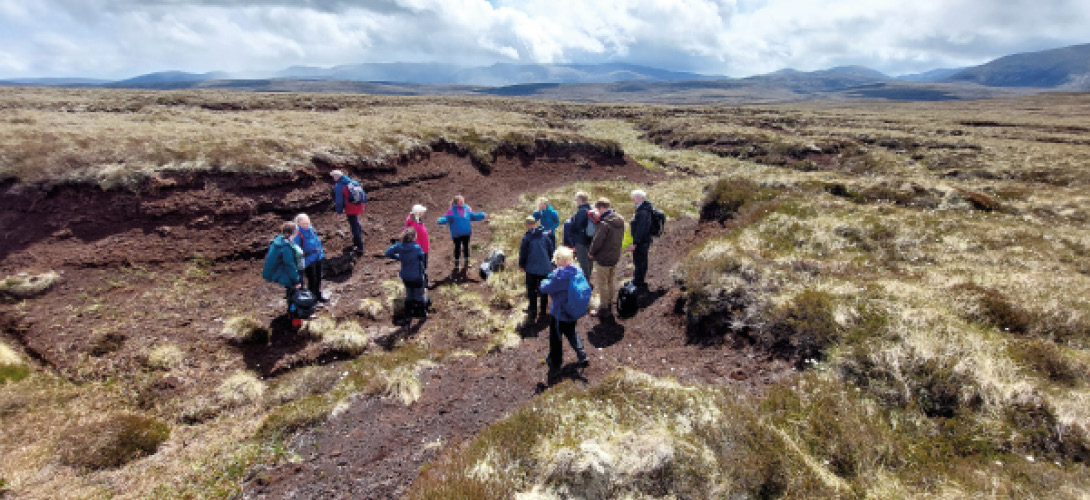
The Peatland ACTION partnership is committed to continuous improvement - prioritising actions that simplify processes, increase funding certainty, and build a long-term pipeline of investible restoration projects. This work is being shaped by ongoing conversations and stakeholder feedback, including insights from Peatland ACTION’s Conversation on Change.[15]
Successes and improvements
Since 2020, the Peatland ACTION programme has:
- restored nearly 45,000 hectares of degraded peatland across Scotland with over £90 million invested, contributing to a total of 90,000 hectares restored since 1990
- launched the Peatland ACTION Data Portal, providing open access to restoration project data
- delivered two rounds of the Project Development Support Scheme (PDSS) to boost project development capacity
- commenced pilot of Carbon Contracts to attract responsible private investment and enhance public funding impact
- published key technical guidance, including the Technical Compendium and Bird Breeding Guidance
- worked with the land management sector to advocate for peatland restoration benefits through events and case studies, raising awareness of both environmental and business advantages
- developed a Peatland Skills Action Plan to guide skills development initiatives and activities, launched a New Entrants Scheme, and supported sector growth to deliver 15,000 hectares of restoration annually
- supported around 380 jobs,[16] 34 contractor companies, and multiple project developers across the partnership
- published Annual Reports and a suite of case studies showcasing peatland restoration work across Scotland
- released the Peatland ACTION Partnership Monitoring Strategy to assess restoration effectiveness and guide future improvements
Continuous improvement
We will continue to improve our ways of working across the Peatland ACTION partnership, taking on board stakeholder feedback, working to simplify processes, increasing funding certainty, and building a strong pipeline of investible restoration projects.
Scotland’s Peatland Standard
Scotland’s Peatland Standard is being developed by the Peatland ACTION partnership to provide technical information that will guide and promote the protection, restoration, and management of peatlands across the country. It will set out legal, essential and good practice requirements and a set of overarching principles which will guide activities, while promoting efficiencies and consistency. The principles and the requirements will support regulators, land managers, and practitioners by providing a shared framework for decision-making.
Scotland’s Peatland Standard will define clear distinctions between aftercare and management. Aftercare is the minimal upkeep of restoration work during the early stages of recovery. Management is the land use activities carried out to support peatland function or to achieve other land use objectives without compromising peatland function. It will also help align practices across incentive and regulatory systems including planning, forestry, agriculture and sporting management and will clarify roles and responsibilities for mitigating impacts of a changing climate.
Peatland restoration costs
Costs vary across the Peatland ACTION partnership depending on the type of land, site access and restoration techniques used.
We want to build a clearer picture of the costs involved in peatland restoration across Scotland. By identifying typical costs and what drives them, we can make better funding decisions and help ensure restoration is delivered efficiently and sustainably through the Peatland ACTION partnership.
Blended finance
The Natural Capital Market Framework[17] embeds Scotland’s six principles for responsible investment, including integrated land use, engagement and collaboration, community benefit, and high environmental integrity. Well-designed natural capital projects like peatland restoration can deliver significant economic outcomes such as enhanced local employment opportunities, particularly in rural areas where sectors of the economy are heavily reliant on natural capital. The voluntary Peatland Code currently offers financial incentives for landowners, while further blended finance models are being explored to reduce landowner risk and help ease public funding demands. The expectation is that private finance is going to contribute more to funding peatland restoration over time.
The Peatland ACTION programme is piloting Carbon Contracts as a complementary funding mechanism to Peatland ACTION grants, aimed at accelerating peatland restoration and supporting Scotland’s net zero targets. The pilot offers selected projects applying for 2026/27 Peatland ACTION funding the option to sell a portion of future carbon credits to the government at a pre-agreed price, in exchange for reduced grant funding. This approach seeks to increase private investment, improve funding certainty, and build a pipeline of investible projects. Managed under the IUCN Peatland Code, the pilot will test the viability, market appeal, and value-for-money of Carbon Contracts, with learning informing future approaches to blended finance.
Evaluation and monitoring
We will strengthen how we measure the impact of Peatland ACTION by deploying national-scale monitoring and integrating with complementary initiatives such as LiDAR. This will enable us to evidence the benefits of restoration across Scotland. The Scottish Land LiDAR Programme will deliver the first ever national LiDAR map of Scotland.
Our approach will combine data from project records, surveys, carbon markets, and science to understand what’s working and where we can improve. This evidence-led strategy will build trust, guide future decisions, and ensure our restoration efforts deliver maximum benefits for climate, nature and people.
Case Study: Loch Katrine research, Scottish Water
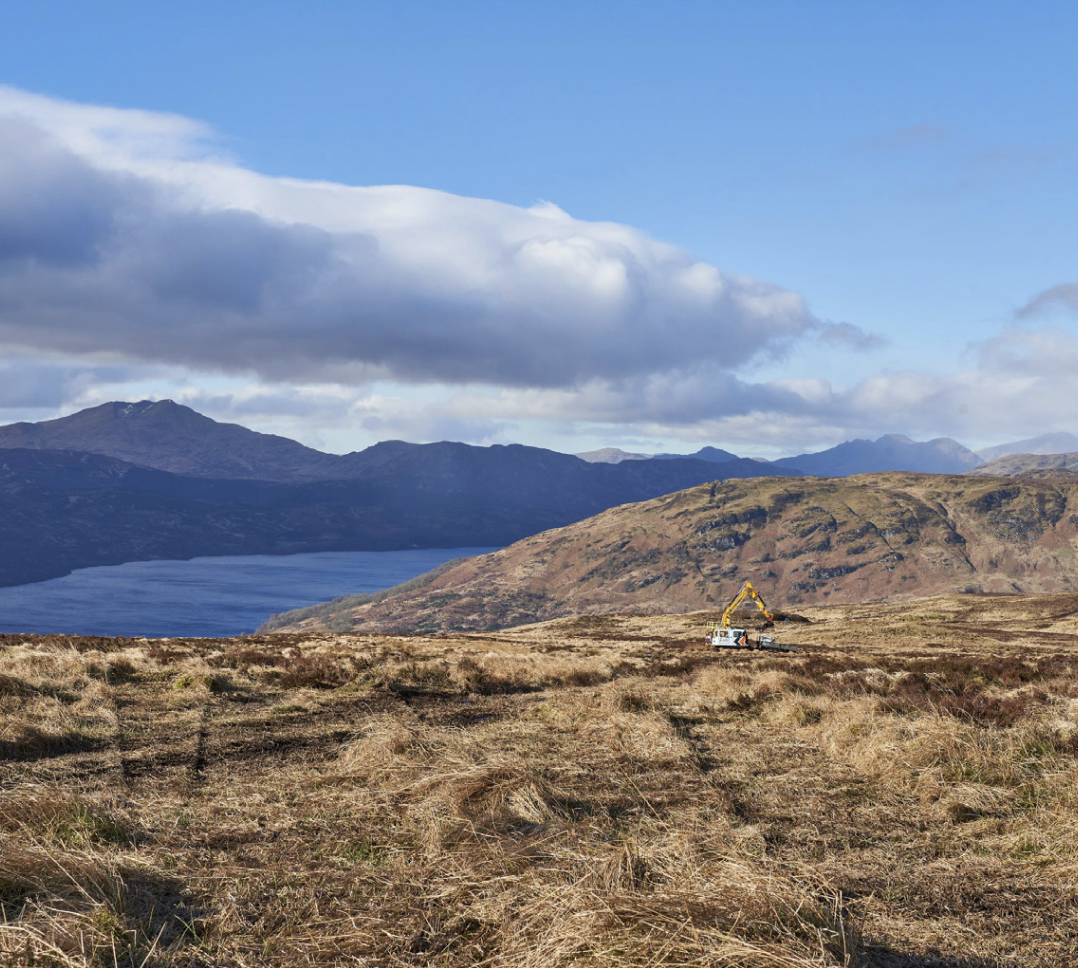
Researchers at the University of Stirling, in collaboration with Scottish Water, are leading a two-year study to evaluate the climate and water quality benefits of peatland restoration at Loch Katrine and develop longer term monitoring approaches. Supported by Peatland ACTION and the Flow Country Green Finance Initiative, the project uses advanced field based monitoring equipment together with remote sensing to compare carbon levels in healthy versus degraded peatlands and assess dissolved carbon in the loch. The work is part of the Hydro Nation Chair Research and Innovation Programme, hosted by the University of Stirling and funded by Scottish Water, and contributes to the wider land management plan in partnership with Forestry and Land Scotland. It also aligns with the Loch Lomond and Trossachs National Park Partnership Plan, aiming to build evidence for restoration effectiveness and support Scotland’s net zero goals.
For the full story, please visit Loch Katrine Research - Scottish Water
Our actions within Theme 3 are set out below.
Continuous improvement
3.1 We will support the development of a pipeline of restoration projects through:- expanding the availability of support for designing and delivering projects across Scotland
- making the pipeline of restoration projects visible
- further workforce development in the design sector through skills initiatives led by our Peatland ACTION Skills Plan
- defining funding criteria beyond September 2026
- collaborating on and streamlining the application process across Scotland
- exploring ways to streamline or simplify planning processes in relation to peatland restoration
- collaborating with the IUCN to strengthen alignment with the Peatland Code and explore opportunities to integrate forest-to-bog restoration within its framework
Scotland’s Peatland Standard
3.3 In 2026, we will consult on and launch Scotland’s Peatland Standard to support consistent, high-quality restoration across the sector.
3.4 Following the development of Scotland’s Peatland Standard, we will consider if there is a need to introduce a compliance system for peatland restoration.
Peatland restoration costs
3.5 We will carry out targeted research to gain a comprehensive understanding of peatland restoration costs across Scotland.Private finance
3.6 We will continue working with partners and the sector through the peatland carbon contracts pilot to test the effectiveness of this approach as an intervention.
3.7 We will continue working with partners and the sector to encourage uptake of the IUCN Peatland Code across Peatland ACTION projects and work with the sector to consider how to stimulate demand for these credits.
Evaluation and monitoring
3.8 We will commission work to explore and strengthen our approach to evaluating and monitoring the benefits for climate, nature and people of Peatland ACTION. This will help us better understand the long-term impact of our national restoration activities to articulate contributions to the Climate Change Plan and Scottish Biodiversity Strategy.
3.9 We will continue implementation of the Peatland ACTION Monitoring Strategy to assess the success of restoration projects. We will collate and share reported restoration data across the partnership through the Peatland ACTION Data Portal to evaluate the effectiveness of techniques in practice.
3.10 Scottish Government’s Rural and Environment Science and Analytical Services Division (RESAS) will develop regular official statistics on Scotland’s peatlands, which would aim to provide a comprehensive, up-to-date source of basic information on peatlands in Scotland in a single place. This will include information on peatland extent, condition and restoration across Scotland.
3.11 We will continue to work with the Scottish Land LiDAR Programme to map Scotland’s landscapes with 100 times more accuracy than traditional Ordnance Survey maps, making restoration delivery quicker and more efficient.
Regulation
3.12 As announced in the budget 2025/26[18] we will continue working with the Scottish Land Commission to develop the evidence necessary to identify and assess options for a carbon land tax.
For more details and supporting resources, please visit our webpages at:
Peatland ACTION / NatureScot Email: peatlandaction@nature.scot Website: Peatland ACTION | NatureScot
Peatland ACTION / National Park AuthoritiesIf your project is located within either of Scotland’s National Parks you should contact the relevant national park authority to discuss your proposals:
- Cairngorms National Park Authority:
- Loch Lomond and the Trossachs National Park Authority:
Peatland ACTION / Scottish Water Sustainable Land Management
- Email: protectdwsources@scottishwater.co.uk
- Website: Peatland ACTION Scottish Water Sustainable Land Management
Peatland ACTION / Forestry and Land Scotland
- Email: Contact us
- Website: Peatland ACTION FLS
Contact
Email: peatlanddelivery@gov.scot