
Heat Networks Delivery Plan Review Report 2026
The Heat Networks (Scotland) Act 2021 requires that the Heat Networks Delivery Plan (HNDP) is reviewed every two years, and that Scottish Ministers prepare a report of our progress towards meeting the provisions of the Act. This is the second report, with the first published in 2024.
1. Action: implementing the 2021 Act and associated policies
1. On 31 March 2022, following a full public consultation, we published the Heat Networks Delivery Plan (HNDP), as required by the Heat Networks (Scotland) Act, 2021 (the 2021 Act). The 2021 Act also requires that the HNDP is reviewed every two years, and that the Scottish Ministers prepare a report of our progress towards meeting the provisions of the 2021 Act and other supporting policies. This document fulfils the requirement to review and report on the HNDP.
2. The HNDP sits in the context of wider heat decarbonisation policy, in particular, the Heat in Buildings Strategy, which highlights that over the coming years the Scottish Government proposes a focus on strategically important technologies to decarbonise our homes and buildings, of which heat networks are one. Detail on the other technologies that will play a role in the transition and the approach to those can be found in the Strategy and subsequent publications. For example:
- the draft Climate Change Plan confirms our target to decarbonise the heat in Scotland’s buildings by 2045, in a manner consistent with our commitment to reduce fuel poverty by maintaining our vital support for those who need it most
- the draft of the Buildings (Heating and Energy Performance) and Heat Networks (Scotland) Bill (the Heat Networks aspects of which are summarised below)
- new Energy Performance Certificate (EPC) regulations which will bring an improved EPC rating system into force in the second half of 2027
- the consultation on minimum energy efficiency standards in the private rented sector, helping us to develop regulations that are fair, affordable and achievable.
3. Section 2 sets out our best estimates on the supply of heat with the limitations of existing data currently available to us. Estimated heat supply via heat networks has increased from an estimated 1.36 TWh in 2022 to an estimated 1.57 TWh in 2025. Section 2 also covers the significant limitations of the data, and so these estimates, and work to improve data so that we can more accurately report in future.
4. In Section 1 (this section) we set out at a high level the progress that has been made on implementing the 2021 Act, our significant delivery programmes and wider policies. It does not report on every single action in the 2022 HNDP and the 2024 Review Report (which included some amended or new actions).
5. Some regulations from the 2021 Act have been in place for less than 3 years and others are yet to be made. The timetable for developing these regulations was adjusted to take into account the developing UK regulations covering consumer protection and authorisation which apply across Great Britain (GB). Focusing first on inputting into these UK regulations allows us to ensure that Scottish regulations can dovetail with, rather than duplicate, requirements which are developed in UK regulations.
6. Our funding programmes (see Section 1.5) are the main contributors, at present, to increased deployment of heat networks. Attributing increases in use of heat networks to specific regulations under the 2021 Act, or specific wider policies, is challenging and would likely be unreliable. We have made good progress in a number of areas and set out below key progress. We also set out in broad terms, how these actions support heat network development.
7. We also continue to engage with the UK Government on wider measures that are in their control and could have a significant impact on deployment of renewable heat networks, such as the price of electricity.
1.1 Building assessment reports
8. To be efficient, economically viable and deliver value for money, heat networks need to be well located. Better information about potential anchor loads, such as that provided from building assessment reports, supports the development of heat networks.
9. Over 700 building assessment reports have been submitted by over 20 public sector bodies[1] since regulations required owners of non-domestic public sector buildings to produce these in May 2023. We are commissioning a digital platform to facilitate the submission of Building Assessment Reports – including for bulk uploads. The platform is expected to be available by end of 2026, subject to procurement.
1.2 Identifying potential heat network zones and designating zones
10. All local authorities have now produced Local Heat and Energy Efficiency Strategies (LHEES) and Delivery Plans as per their duty[2]. The review of LHEES carried out in 2024 and ongoing policy development will feed into any update of LHEES guidance. Local authorities are required to update their LHEES Strategy and Delivery Plan every five years.
11. The Scottish Government continues to provide multi-year funding of £75,000 per local council, per year, to resource the development of their LHEES, which has been agreed in partnership with COSLA. This began in 2022-23 and is committed up to 2027-28.
12. Many of the LHEES produced to date identify significant opportunities for heat networks. Over 300 potential heat network zones were identified by local councils which if fully developed could provide around 15.9 TWh of heat per year, equivalent to 23% of Scotland’s non-electrical heat consumption[3]. This provides investors, developers and potential heat customers a greater indication of the potential pipeline of heat network projects.
13. Strategic heat network support from the Heat Network Support Unit (HNSU, see below) includes both funding and advisory functions. It helps local councils build on LHEES to develop a strategic and commercial approach to deploying large scale heat networks in their respective areas. The first round of support has been provided as a pilot scheme and has supported seven local councils, rising to eight in its second year. Every one of these councils has received customised support to complete a range of technical and delivery model work packages. Emerging themes across the strategic projects include heat network zone refinement, inter-connection of multiple networks, links to wider energy planning, development of market prospectuses, identification of investment opportunities and delivery model options appraisals.
14. Designating heat network zones can both attract investment from heat network developers and inform building owners and heat users of the potential for a heat network in the area, and whether potential legislation relating to zones (see Section 1.4) may affect them.
15. Local councils, such as Fife and Perth and Kinross, have been progressing heat network zones in line with the legislation and guidance for local authorities to review and decide whether to designate these zones. Taking heat network zones into account in Local Development Plan (LDP) reviews, should contribute to heat network development in the area.
16. The Fourth National Planning Framework (NPF4), published in February 2023 sets out that LDPs should take into account the area’s LHEES. The spatial strategy should take into account areas of heat network potential and any designated heat network zones. Policy 19 a) and c) in NPF4 part 2 states:
- that development proposals within or adjacent to a heat network zone identified in a LDP will only be supported where they are designed and constructed to connect to the existing heat network
- that where a heat network is planned but not yet in place, development proposals will only be supported where they are designed and constructed to allow for cost-effective connection at a later date.
Box 1: Case study - Strategic Heat Network Support
The City of Edinburgh Council completed a feasibility review and refinement of the prospective heat network zones identified in their LHEES, shown below, to inform decisions around future heat network delivery. The prospective heat network zones have been reviewed to encompass larger, more strategic areas of the city and they are expected to undergo further analysis. The HNSU continues to engage with the City of Edinburgh Council to support on the next steps of heat network deployment in Edinburgh.
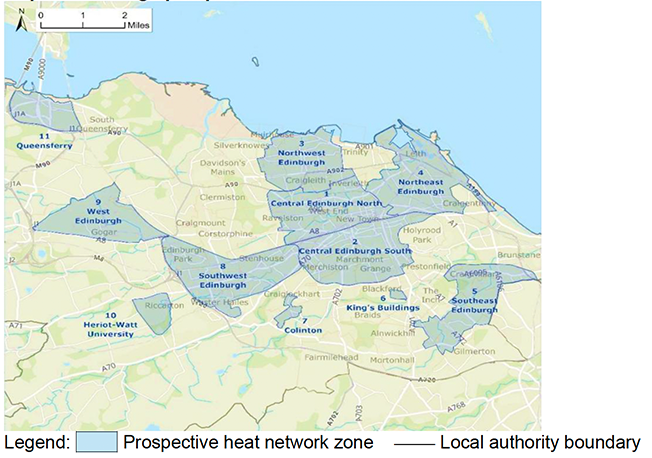
Legend: Prospective heat network zone ______ Local authority boundary
Copyright: Contains National Statistics data © Crown copyright and database right 2024; Contains Scotland Heat Map Data © Scottish Government
Notes: This map produced in February 2025 represents a snapshot using the most recent data available. It should be read with the limitations and assumptions provided in the associated report. The image has been adjusted slightly to make it more accessible. Originally produced by WSP and Turner & Townsend as part of Strategic Heat Network Analysis for the City of Edinburgh Council.
1.3 Protecting consumers: working with the UK Government and Ofgem
17. We continue to work with the UK Government and Ofgem during the development of regulations under the Energy Act 2023 on new consumer protections and technical standards they will provide.
18. The phase in[4] of consumer protection and authorisation regulations applying across Great Britain has already begun, as follows:
- Advice and advocacy services[5] started for consumers in April 2025, with the Energy Ombudsman dealing with complaints that have not been resolved with the heat supplier.
- On 27 January 2026, Ofgem’s formal role as regulator of heat networks began, with the initial set of rules in place. Existing heat network operators and suppliers have been given a ‘deemed authorisation’ and have until 26 January 2027 to register with Ofgem. After this date, new heat networks must apply to Ofgem to receive authorisation.
- Ofgem will collect data through the registration process to inform their work to develop pricing benchmarks and implement Guaranteed Standards of Performance.
- Over time, these new protections will give consumers greater confidence in heat networks as they will have a more consistent standard of service across the sector. Importantly, they will have a clear route to hold operators and suppliers accountable if their heat network fails to meet these expectations.
19. The authorisation regime mentioned above will apply across GB, but Scotland and the rest of GB will have different licensing regimes to confer rights and powers which will support heat network development and maintenance. Our proposals for licensing and powers of licence holders are outlined below. We continue to work with the UK Government and Ofgem to make the GB-wide and Scottish regimes interoperable as well as aiming to minimise duplication where possible.
20. We have been working with the UK Government on introducing regulatory technical requirements and a Heat Network Technical Assurance Scheme (HNTAS) to help heat network operators demonstrate compliance with these requirements.
21. HNTAS draft technical specifications and assessment procedures have been published for both new build and existing heat networks. These documents cover various elements of heat networks, such as the energy centre(s), district distribution network, substation(s), communal distribution network(s), consumer connection and consumer heat system(s). They identify the proposed performance outcomes to be achieved by existing networks at various improvement milestones and the technical requirements to be achieved by new build networks at design and construction gateways. In this way, they help heat network developers and operators demonstrate compliance and so gain HNTAS certification.
22. The Heat Network Technical Standard (TS1) and Metering and Monitoring Standard (MMS) have also been published in draft form. These documents contain the standards to which the draft Code documents refer. The draft Code and Standards documents will be open to wider industry comment through a technical feedback process before they are iterated and final versions are published.
23. UK Government’s consultation on HNTAS opened on 21 January 2026. It is seeking views on proposals regarding: the scope of technical standards regulation; the HNTAS governance structure; overarching technical, assessment and certification requirements; the role of assessors and certifiers in the scheme; enforcement, appeals and complaints; and support and incentives to facilitate heat network compliance. The consultation will close on 15 April 2026.
24. The Building Engineering Services Association (BESA) has been appointed to the role of HNTAS Shadow Training Provider, to develop and deliver HNTAS training courses. The first HNTAS courses are now live. The UK government is developing a Digital Service, part-funded by the Scottish Government, for the submission and storage of heat network compliance data.
25. Technical and assurance requirements are expected to be mandated in regulation in 2027.
1.4 Consulting on new Scottish legislation
Draft Buildings (Heating and Energy Performance) and Heat Networks (Scotland) Bill
26. The Scottish Government aims to de-risk investment in heat networks by requiring certain buildings, within a heat network zone, to end their use of polluting heating systems when a heat network connection is available. Powers applying to a smaller set of certain buildings, most likely public sector buildings, requiring that they connect to a local heat network, could further de-risk investment. To allow for full scrutiny of the Bill by Parliament, with all the latest information, especially the UK Government's Warm Homes Plan, we announced we wouldn't introduce the Bill until this was available. This means that we won't introduce the Bill until after the Scottish Parliament returns following the Scottish Election in May 2026. In accordance with democratic processes, this will need to take into account the outcome of the 2026 Scottish election.
27. The draft of the Buildings (Heating and Energy Performance) and Heat Networks (Scotland) Bill published alongside this announcement includes provisions regarding heat networks, including:
- A regulation-making power that may be used, in particular, to require qualifying buildings within a heat network zone to decarbonise their heating system by connecting to the heat network or using an alternative solution; or requiring certain buildings, such as public sector buildings, to connect to a heat network
- A regulation-making power to provide for opt in heat network installation and maintenance licences and
- Changes to the Heat Networks (Scotland) Act 2021 to streamline its regulatory regime following GB-wide provisions made in the Energy Act 2023.
Licensing and powers of licence holders
28. It is our intention to develop a regulatory process which complements, rather than duplicates the GB-wide authorisation system. To achieve this, we have developed proposals for an opt-in licensing system that enables licensees to exercise the additional powers they require for installation and maintenance activities, such as roadworks and wayleave rights.
29. In March 2026, we launched a consultation on installation and maintenance licensing, setting out our proposals and seeking feedback. The consultation covers the objectives and scope of licensing, the powers of licence holders, the licence regulator, licence applications, licence conditions and limitations and modifications of licences, duration of licences and their revocation and licence fees. We have also held a stakeholder workshop to encourage engagement. The consultation remains open until 5 June 2026.
1.5 Pre-capital and capital support to bring on projects
30. We continue to support the development of heat networks by:
- addressing key challenges in the pre-capital stages of heat network development and building capacity across the public sector to deliver successful projects through the HNSU
- providing financial support through Scotland’s Heat Network Fund.
31. We launched the HNSU in 2022. Since then, the HNSU has formally supported 55 pre-capital projects in 18 local council areas[6]. Support is provided through advice and funding, and the Scottish Government has committed around £3.2 million of financial support.
32. Since launching Scotland’s Heat Network Fund in 2022, we have awarded approximately £14.5 million grant funding to seven heat network projects in Scotland[7]. This builds on the momentum created by its predecessor, the Low Carbon Infrastructure Transition Programme, with the total value of grant funding awarded across these two funds being over £62 million[8]. Scotland’s Heat Network fund has evolved with it now offering multi-year funding to unlock large heat network projects that take longer than 12 months to construct. In 2025, the Scottish Government committed to extending Scotland’s Heat Network Fund until at least 2030.
33. The projects receiving pre-capital and capital support are included in our Heat Network Projects quarterly reports to give potential investors, the supply chain and building owners considering connecting to a heat network a clear view on the pipeline of projects the Scottish Government is supporting.
1.6 Financial support for buildings connecting to heat networks
34. In November 2025 we announced that grant support will be introduced for homeowners to enable connections to heat networks through the Home Energy Scotland Grant and Loan scheme. Applications opened in December 2025. Up to £7,500 of grant funding is now available to homeowners, in addition to an optional £7,500 interest free loan. For those that qualify for the rural uplift, an additional £1,500 of grant funding is available.
35. Business Energy Support, the Scottish Green Public Sector Estate Decarbonisation scheme[9], Community and Renewable Energy Scheme (CARES) and Social Housing Net Zero Heat Fund (SHNZHF) continues to include support for buildings to connect to nearby district heating networks.
1.7 Recovering and using wasted heat
36. Recovering heat currently wasted in various industries and commercial activities has the potential to increase the reach of viable heat networks. Heat recovery can reduce heat network running costs and costs charged to consumers. We have supported a number[10] of district heating heat recovery projects through our capital and pre-capital funding.
37. In 2025, we commissioned guidance jointly with the UK Government which aims to facilitate effective discussions between owners and potential users of recoverable waste heat, and to support action by relevant authorities. The work has four main outputs on recoverable heat. The outputs are information on costs, negotiation considerations, technical considerations and the regulatory pathway. It is due to be published in Spring 2026.
38. The draft Bill (see Section 1.4) also includes powers for information to be provided about sources of thermal energy, to assess the potential for heat recovery for use by heat networks.
1.8 Strategic review
39. We have started a strategic review of the Scottish Government’s approach to supporting the deployment of heat networks. We expect it to conclude in 2026. The review will help inform any further action the Scottish Government could take to support the successful delivery of more heat networks across the country.
40. To support this review, in 2025 we appointed independent consultants to undertake an economic assessment of a range of delivery options which look at the role of the Scottish Government and local authorities, delivery models, the fuel mix and more. As part of this work, our consultants will gather evidence through discussions with those involved in planning, developing and operating heat networks.
1.9 Work by and with stakeholders
41. While this report focuses on the implementation of the 2021 Act and wider policies, the work by all stakeholders is key to developing and deploying heat networks in Scotland, decarbonising them and improving the services they provide to customers. Significant examples in the reporting period which have not been mentioned above include:
- the establishment of Scotland’s first dedicated district heating education centre in Dalkeith near Edinburgh
- an annual programme of support for 20 local authorities in Scotland through the District Heating Mentoring Scheme. This scheme, delivered by the HNSU, in collaboration with the Danish Board of District Heating, the Royal Danish Embassy in London and the Danish Energy Agency, has been well received for building skills and capacity. 2025 marks the first GB-wide District Heating Mentoring Programme, delivered jointly with the UK Government, bringing together Scottish and English local authorities to strengthen cross-border relationships, encourage shared learning and deepen understanding of the wider UK heat network market.
- Glasgow City Council has launched a Community Municipal Investment scheme, opening investment opportunities to citizens, communities and businesses for climate action projects. The first run in Autumn 2025 was for solar panels on council buildings with further offers for other purposes planned.
42. We continue to engage with stakeholders through various opportunities including the formal consultations, attending relevant meetings and events and establishing the Heat Networks Advisory Forum, which will hold its first meeting in Spring 2026 and will run initially for an 18 month period to inform developing policy such as:
- the strategic review noted above
- proposals for future legislation
- regulations to support heat network connections, zoning
- the forthcoming Heat Network Delivery Plan (HNDP, see below).
1.10 Next steps for the Heat Network Delivery Plan
43. The HNDP was published in 2022, with amended actions identified in the 2024 HNDP Review Report. This Review Report has not included amended actions as we would like any amendments to the HNDP to be informed by the work of the Heat Networks Advisory Forum and the findings of our ongoing strategic review. We plan to consult on a substantially updated HNDP in the financial year 2026-27.
Contact
Email: heatnetworks@gov.scot