
First National Good Food Nation Plan
The first national Good Food Nation Plan. It sets out six over-arching Outcomes; the range of targets and indicators used to gauge progress towards achieving them; and details of food-related policies and initiatives from across the Scottish Government.
Part One – What Will a Good Food Nation Look Like?
Context: the current state of the Scottish food system
Scotland’s food system[1] [2] is a source of incredible success and offers much to celebrate.
We are fortunate to enjoy wonderful natural assets: Scotland’s forests, fields, lochs, rivers, and seas produce an abundance of food. Farmers, crofters and fishers use their generational knowledge and husbandry skills to produce food and drink of global renown.
As well as a diverse natural larder we boast a varied business base: the Scottish food and drink industry makes a significant contribution to our economy, with the turnover value of Scotland’s 17,000 food and drink business reaching £19 billion and generating £7.5 billion in terms of exported product. The sector employs 123,000 people across fishing, farming, aquaculture and manufacturing – providing high-value employment in rural areas.
Scotland’s food and drink has an established reputation, domestically and globally, with a recognised brand focused on quality and provenance. We have access to a world-class research base driving innovation and supporting the sector to be more resource-efficient, profitable and sustainable.
We also benefit from the activity of a wide range of community food groups. Their invaluable support comes in many forms, from facilitating food-growing projects that support environmental action and food security to organising communal meals that address social isolation and health inequalities. Sharing food is an act of care that brings our communities together.
These are some of the great strengths in Scotland’s food system. However, we must recognise that there are also still some deeply rooted flaws in that system.
For example, there has been little progress towards meeting our Scottish Dietary Goals for the last 20 years and diets remain too high in calories, fats, free sugars and salt, and too low in fruit, vegetables, fibre and oily fish. A key aim of our work to be a Good Food Nation is to shift the dial, and create a food system that enables and promotes a healthy population.
There are significant inequalities in our food system that must be addressed. Many households in Scotland experience food insecurity on a regular basis or are intermittently worried about being able to access food. Diet-related conditions[3] are also more pervasive in communities experiencing deprivation. In pursuing our goal to achieve Good Food Nation ambitions it is essential that we do not do so at the expense of any community. When creating future food policy that aligns with the overarching Outcomes consideration of such inequalities needs to be at the forefront to avoid unintended consequences. Some of the actions we have taken in recent years are already moving us in the right direction, such as the roll out of free school meals to all pupils in primary 1 to primary 5.
It is important to acknowledge that making important and necessary long-term systemic changes to our food system and achieving ambitious food-related goals will take time. We cannot ignore the fact that, as things stand, the Scottish Government does not have full control of all of the levers that can be used to influence the direction of the food system. For example, employment law remains a reserved area, which limits the actions that we can take in Scotland to improve fair work standards in the food and drink industry. The importance of making these changes to the food system is reflected in the fact that both devolved and national governments in the UK are setting out how they intend to tackle this[4] [5] [6].
Scotland is part of a global food system. The food we consume in Scotland is not limited to that produced in Scotland, or even within the UK. Domestic food production relies on the import of inputs from abroad such as fertilisers and seeds. We also export some of our food. Policymakers must consider food policy in a global context and seek to engage positively with international best practice.
An independent Scotland would have full control over all the levers in food policy, which would have a material effect on what we can achieve and how quickly. Future iterations of the national Good Food Nation Plan will of course be influenced by the constitutional situation at the time they are compiled.
Scotland’s food system faces many challenges. However, it also has enormous potential to offer the solutions. Although we have begun to realise this, there is much more that can be harnessed: to advance prosperity; to provide secure livelihoods; to support healthier diets; to strengthen our communities; and to protect our natural environment and animal welfare standards.
Life in a Good Food Nation – The Vision
The preceding section outlines the current state of Scotland’s food system, and offers an honest appraisal of the weaknesses in that system. However, we must not lose sight of what we are aiming to achieve with our original vision for Scotland to be “a Good Food Nation, where people from every walk of life take pride and pleasure in, and benefit from, the food they produce, buy, cook, serve, and eat each day”.
The series of short narratives that follow describe in greater depth how the Good Food Nation vision might look in practice for different groups of society. Whilst the scenarios described might appear far removed from the current state of Scotland’s food system, they can help all of us to envision a better future. They can also help to generate discussion among policymakers. These narratives were created using feedback we received during the consultation on the draft of this Plan, and should be considered as a companion piece to the Good Food Nation Outcomes and the original Good Food Nation Vision. A visual representation to highlight some of the many actors involved in the food system is provided in Figure 1.
Childhood in a Good Food Nation – The Vision
Children in a Good Food Nation grow up with access to healthy, safe, and nutritious foods that are appropriate to their age, developmental stage, and cultural background. Parents and carers are easily able to access advice and support about feeding infants and young children. The food environment in Scotland supports parents and carers to provide children with a healthy diet, essential to support growth and development.
Women are supported with their diet, nutrition and weight before, during, after and between pregnancies to nurture their own health and the health and development of their children from conception.
Children do not experience persistent hunger as everyone has sufficient money to access the food they need with dignity and choice.
Enjoyment of food is key: it is normal for children to experience and take pleasure in eating a diverse and healthy variety of foods. Schools, early learning and childcare settings foster this enjoyment by providing meals that children and young people are excited to share. Eating together in these settings is normal practice, helping to set positive habits and offering learning opportunities. Education about food, from the basics of cooking to the complex nature of the food system, is embedded in the education sector. Children have frequent opportunities to participate in a variety of food-related educational experiences and activities. They are learning the skills and knowledge required to understand and operate within our food system.
Adult life in a Good Food Nation – The Vision
Positive early experiences with food mean that people in Scotland are able to maintain a healthy relationship with food throughout their lives, enjoying a variety of foods appropriate to their tastes and cultural backgrounds.
Inequalities that prevent people from accessing healthy and nutritious food have decreased, with financial support easily available to those that need it. Rates of experienced food insecurity are at an all-time low, with advice and support readily available to ensure that everyone is able to access food in a dignified manner.
Diet-related health outcomes have improved. As a result of better diets, Scotland is experiencing a decline in the rates of obesity and associated conditions. Most adults are able to maintain a healthy weight.
The food environment in Scotland supports healthy and sustainable food choices. Information about the environmental, social and nutritional impacts of food and its provenance are widely understood and easily available. Equality of access to healthy and sustainable food options is maintained across all areas of Scotland, including rural areas and islands.
Out of Home in a Good Food Nation – The Vision
Food retailers and restaurant owners in Scotland are excellent employers who meet Fair Work First criteria and, where applicable, enter fair and equitable procurement contracts. They play an important and active role in supporting a strong local food economy. Careers in the hospitality and retail sector are seen as attractive options.
Retail store environments promote safe, healthy and nutritious options, making them affordable and appealing. Information to help consumers understand the nutritional quality and provenance of the food on sale is easily available.
The food available in public catering settings such as schools, hospitals, prisons and canteens is safe, healthy, fresh, in-season, makes the most of our excellent Scottish produce and is appealing to the varied population of Scotland. Menus promote healthy, sustainable and enjoyable options. Caterers make procurement choices that support a variety of producers, and smaller producers are able to participate in public contracts.
Restaurants and cafes are inspired to celebrate fresh, seasonal produce on their menus and create meals that customers enjoy. The range of public and private options available to choose from create a thriving and exciting food environment, where people are enabled to choose from a wide range of healthy and delicious foods when eating outside of the home.
Retailers, restaurant owners and public caterers all work to minimise food waste wherever possible, for example through creative menu design. Food packaging is designed to reduce waste.
Food Production and Processing in a Good Food Nation – The Vision
The food and drink sector continues to have an important role in Scotland’s economy. Scottish products are widely enjoyed at home and abroad, and are a source of pride for the people of Scotland.
Farmers, crofters and fishers in Scotland help to build resilient supply chains and contribute towards our food security. They feel that their work is respected, and that they both benefit from and create a safe and fair working environment. They are able to obtain a fair price for their produce/catch, and to sell it locally where they wish to do so.
Careers in the food production sectors, whether they be in farming, fishing, processing or manufacturing, are seen as viable and desirable options. Apprenticeships and other educational and training programmes to prepare people for careers throughout the food sector are widely available.
Farming and land management practices are designed to reduce environmental impact, increase biodiversity, and ensure high standards of animal welfare. Sustainable fishing practices support the marine environment and ecosystem.
Farmers, crofters and fishers are able to benefit from a variety of support, training and advice to aid them in running successful and sustainable businesses.
Food manufacturers and processers in Scotland also work to ensure resilience along the whole supply chain, whilst minimising waste and environmental impact. Food manufacturers are empowered to reformulate their products to improve the nutritional content whilst maintaining a diverse portfolio of options. They use fresh and seasonal ingredients wherever possible to make healthy and sustainable products. The workforce is supported to develop and enhance its skills in a safe and fair working environment.
The importance of an excellent food safety system in Scotland is critical in keeping the Scottish population safe when eating out or buying pre-packaged foods, and good hygiene practices help to reduce demand on critical services within other health and social care settings. Food Safety Officers and Environmental Health Officer roles within local authorities are vital in the inspection and enforcement of food hygiene standards across food production premises and play a key role in preventing bad practice and ensuring compliance.
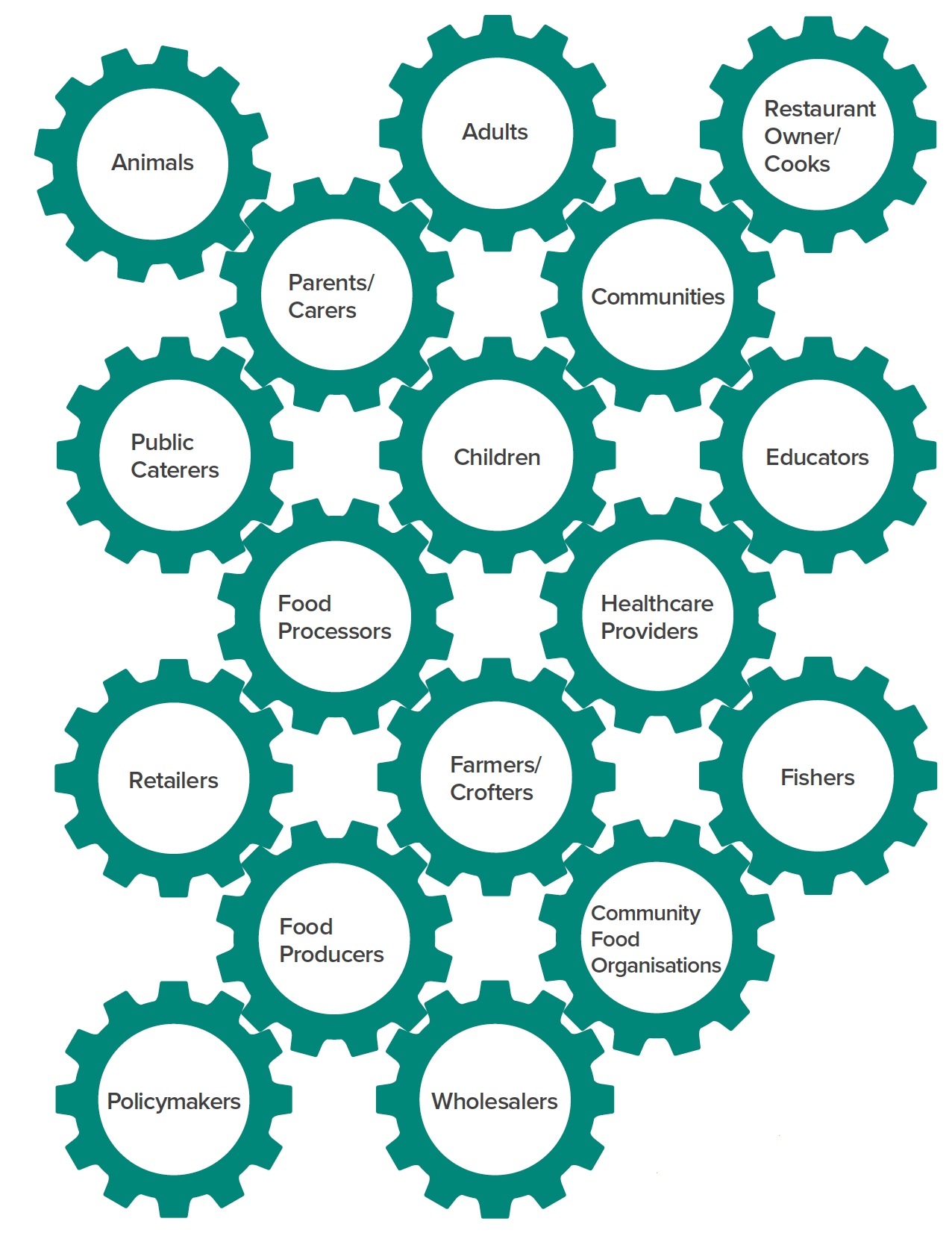
* This is just a subset of relevant actors, there are many more that contribute to, participate in and are impacted by the Scottish food system.
Graphic text below:
The image shows a series of interlinked cogs demonstrating how different actors work together to create the food system. Each cog lists an actor in the food system including animals, adults, restaurant owners/cooks, communities, parents/carers, public caterers, children, educators, food processors, healthcare providers, retailers, farmers/crofters, fishers, food producers, community food organisations, policy makers and wholesalers. This is a subset of relevant actors, there are many more that contribute to, participate in and are impacted by the Scottish food system.
Inequalities in the food system
The national Good Food Nation Plan aims to drive accountability in tackling food-related issues and inequalities. To achieve our Good Food Nation ambitions, we must look across the food system and consider inequalities through a broad lens. The food system in Scotland is complex and so are the inequalities within it.
In order to achieve the Outcomes set out in the Good Food Nation Plan they must be considered as a whole. This will mean taking a joined-up approach to developing food policy and working across a range of policy areas to ensure as wide an input as possible is given to the consideration of inequalities.
The impact assessments for the national Good Food Nation Plan identified a number of key themes, the detail of which is provided in the assessments themselves. It is not possible to include every aspect here, but the aim is to provide a high-level overview and to act as a prompt for the kinds of inequalities policymakers will need to think about when developing new food related policy.
An important consideration when dealing with inequalities in relation to food is the intersectional nature of inequalities. Multiple kinds of inequality can overlap to create unique, compounded experiences for individuals. This should be taken into consideration when undertaking engagement with people with lived experience, collating evidence to inform the impact assessments and when involving relevant groups in the policymaking process.
The national Good Food Nation Plan makes clear that it is the food environment that impacts people’s ability to access good food, rather than it being solely individual choice. Socio-economic inequalities can mean that people from lower socio-economic backgrounds or living in areas of high deprivation experience inequalities across many aspects of the food system, from access to consistent and sufficient food provision, to being able to follow a healthy diet. Diet-related conditions[7] are also more pervasive in communities experiencing deprivation.
Certain groups are at higher risk of experiencing poverty, including families with three or more children, families with children aged under one, lone parent families, families with mothers aged under 25, minority ethnic families and families with a disabled person.[8]
There are several age-related inequalities to consider. Children and young people living in deprived areas or experiencing high levels of household food insecurity face inequalities in access to good food and healthy diets, which can lead to further inequalities as they grow up. Older adults are a group that experience particular challenges in the food system that are often overlooked, some of these relate to their socio-economic status, while others relate to their particular needs as an age group. For example, older adults are at higher risk of malnutrition, and while poverty is a significant cause, the factors contributing to this go beyond poverty.
Rural-based industries are vital to our food system and so addressing the issues facing those industries is essential to achieving a Good Food Nation. These issues range from childcare challenges, to the limited availability of land and housing for those working, or wishing to work, in rural food-based industries.
Communities across Scotland face a diverse range of barriers to accessing good food, with smaller, rural or island communities facing particularly unique challenges. Policy initiatives to improve diets and encourage healthy eating may not always be accessible for these communities if barriers are preventing them from accessing the food they would like or need.
There are also impacts to consider in relation to gender. For example, the health of mothers can impact significantly on their babies. In agricultural industries, women are often underrepresented – barriers such as access to childcare can prevent women getting into rural-based work. Pay is also an area where inequalities still exist – for example, the gender pay gap in 2025 for the manufacture of food products was 13.3%, which was higher in comparison to other industries and services.[9]
Disability can affect how people in Scotland access and interact with the food system and it is important to consider wider groups, such those with addictions or mental health issues, who may require additional support to access new policy initiatives.
Asylum seekers and those with no recourse to public funds are more at risk of experiencing food insecurity and can face barriers in accessing support.[10] There is an evidence gap on the intersection of ethnicity and diet, which could be further explored when developing relevant new policy.
These are some examples of where the inequalities lie in the food system, but there is much more to consider and explore that is not possible to set out in this national Plan. This is why we are developing a range of tools for policymakers to use when they are having regard to the national Good Food Nation Plan, such as building up an evidence bank which can be drawn on when considering inequalities in the context of the food system. Providing these resources will help inform consideration of inequalities and increase the likelihood of positive impacts on diverse communities across Scotland through the implementation of the national Good Food Nation Plan.
You can find more information on how we have considered inequalities and human rights in our impact assessments.
Good Food Nation Outcomes
At the heart of the national Good Food Nation Plan are the six overarching Good Food Nation Outcomes. These Outcomes reflect the subject areas and principles that are set out in the Act; a table illustrating how this has been done can be found in Annex A. These ambitious Outcomes are of long-term strategic importance to Scotland; as food policy continues to develop domestically and globally, we will continue to evaluate and revise the Outcomes to ensure that they remain relevant and sufficiently stretching. The Outcomes should be considered as a coherent set, with no Outcome being considered more, or less, important than the others.
The Outcomes do not describe the current situation in Scotland; instead they are a description of the Good Food Nation we are aiming to build. They are not merely a set of instructions for the Scottish Ministers, but are intended to guide aspirations for everyone in Scotland. As a result, they do not focus on actions for the Scottish Ministers but instead aim to paint a more general picture of a Good Food Nation. They are necessarily broad in nature: details of the policies and approaches that will be used to achieve them sit elsewhere in the Plan and not within the Outcomes themselves.
- Outcome 1: The food environment in Scotland enables people to eat well. Everyone benefits from reliable and dignified access to safe, nutritious, affordable, enjoyable, sustainable and age-appropriate food.
- Outcome 2: Scotland’s food system is sustainable and contributes to a flourishing natural environment on our land and in our waters. It supports our net zero and climate adaptation ambitions and plays an important role in protecting and improving animal health and welfare and in restoring and regenerating biodiversity.
- Outcome 3: Scotland’s food environment and wider food system enables and promotes a physically and mentally healthy population. This leads to the prevention of, and a reduction in, diet-related conditions.
- Outcome 4: Our food and drink sector is prosperous, diverse, innovative, and vital to national and local economic and social wellbeing. It is key to making Scotland food secure and food resilient, and creates and sustains jobs and businesses underpinned by fair work standards throughout food supply chains.
- Outcome 5: People and communities are empowered to participate in, and shape, their food system. Scotland has a thriving food culture with a population who are educated about good and sustainable food.
- Outcome 6: Decisions we make in Scotland contribute positively to local and global food systems transformation. Scotland actively engages in learning and exchanging knowledge and best practice internationally.
Developing the Good Food Nation Outcomes
The Outcomes reflect that there is a continued need to adjust how food is produced, processed, distributed, and disposed of in Scotland to address the undeniable challenges of climate change and environmental degradation. The transition to a more sustainable food system also needs to be managed in a just and fair manner. This includes taking the people who work to put food on our tables along with us.
In an effort to ensure connections between policy areas can be made easily, when defining these Outcomes we have considered the food system as a whole. The Outcomes have been drafted with regard to the matters, principles and international instruments listed in sections 1(6), 2 and 5 of the Act[11] but they are also a reflection of the key challenges and opportunities that exist within the Scottish food system.
The Act recognises the importance of human rights. Section 5 stipulates that in preparing this national Plan, the Scottish Ministers must have regard to the following international human rights instruments:
- Article 11 (so far as it concerns adequate food) of the International Covenant on Economic, Social and Cultural Rights (“ICESCR”) [12]
- Article 24(2)(c) (so far as it concerns the provision of adequate nutritious foods) of the United Nations Convention on the Rights of the Child (“UNCRC”)[13]
- Articles 27(1) and (3) (so far as they concern nutrition) of the UNCRC
- Article 12(2) (so far as it concerns adequate nutrition during pregnancy and lactation) of the Convention on the Elimination of All Forms of Discrimination Against Women (“CEDAW”)[14]
These human rights instruments are woven into the Outcomes. The Scottish Government is committed to respecting, protecting and fulfilling internationally recognised human rights. The right to adequate food is a human right, as part of the right to an adequate standard of living under article 11 of the International Covenant on Economic, Social and Cultural Rights, and essential to the realisation of other human rights.
The right to adequate food can only be fully guaranteed by addressing the accessibility, availability, acceptability, and quality of food in an integrated and systemic manner, and by recognising the indivisible, interdependent and interrelated nature of all human rights which are underpinned by dignity.
The United Nations Committee on Economic, Social and Cultural Rights considers the key components of the right to adequate food include[15]:
- Availability:
- Food should be culturally acceptable
- Food must satisfy dietary needs, taking into account the individual’s age, living conditions, health, occupation, etc.
- Food should be safe for human consumption
- Food should be available from natural resources, either through the production of food by cultivating land or animal husbandry, or through other ways of obtaining food (such as fishing, hunting, or gathering)
- Food should be available for sale in markets and shops
- Food should be available for future generations through sustainable production, considering factors such as the impact of possible climate change
- Accessibility:
- Food should be physically accessible for all, including individuals who live in very rural areas; and individuals who are physically vulnerable (such as children, people with ill health, disabled people, or older people)
- Food should be economically accessible for all. Everyone should be able to afford food for an adequate diet without compromising on any other basic needs such as heating or housing
- The accessibility of food should be sustainable for present and future generations
The Outcomes were also developed within the context of the National Performance Framework (NPF)[16] and the United Nations Sustainable Development Goals (SDGs).[17] The National Performance Framework and the Sustainable Development Goals share the same aims. The National Performance Framework is Scotland’s way to localise the Sustainable Development Goals and apply them in a way that is most relevant to Scotland.
Table 1 below illustrates how the six overarching Outcomes are linked to human rights instruments; the National Performance Framework; and the United Nations Sustainable Development Goals.
Table 1: How the Good Food Nation Outcomes link to the National Performance Framework, the UN Sustainable Development Goals and the Right to Food
Outcome 1:
The food environment in Scotland enables people to eat well. Everyone benefits from reliable and dignified access to safe, nutritious, affordable, enjoyable, sustainable and age-appropriate food.
National Performance Framework Outcome:
- We respect, protect and fulfil human rights and live free from discrimination
- We tackle poverty by sharing opportunities, wealth and power more equally
- We grow up loved, safe and respected so that we realise our full potential
UN Sustainable Development Goals:
1 No Poverty
2 Zero Hunger
3 Good Health and Well-Being
5 Gender Equality
10 Reduced Inequalities
International Instruments: [18]
Article 11 of ICESCR
Article 24(2)(c) of the UNCRC
Articles 27(1) and (3) of the UNCRC
Article 12(2) of CEDAW
Outcome 2:
Scotland’s food system is sustainable and contributes to a flourishing natural environment on our land and in our waters. It supports our net zero and climate adaptation ambitions and plays an important role in protecting and improving animal health and welfare and in restoring and regenerating biodiversity.
National Performance Framework Outcome:
- We value, enjoy, protect and enhance our environment
- We have a globally competitive, entrepreneurial, inclusive and sustainable economy
UN Sustainable Development Goals:
6 Clean Water and Sanitation
12 Responsible Consumption and Production
13 Climate Action
14 Life Below Water
15 Life on Land
International Instruments:
Article 11 of ICESCR
Article 24(2)(c) of the UNCRC
Outcome 3:
Scotland’s food environment and wider food system enables and promotes a physically and mentally healthy population. This leads to the prevention of, and a reduction in, diet-related conditions.
National Performance Framework Outcome:
- We are healthy and active
- We grow up loved, safe and respected so that we realise our full potential
UN Sustainable Development Goals:
3 Good Health and Well-Being
10 Reduced Inequalities
International Instruments:
Article 11 of ICESCR
Article 24(2)(c) of the UNCRC
Articles 27(1) and (3) of the UNCRC
Article 12(2) of CEDAW
Outcome 4:
Our food and drink sector is prosperous, diverse, innovative, and vital to national and local economic and social wellbeing. It is key to making Scotland food secure and food resilient, and creates and sustains jobs and businesses underpinned by fair work standards throughout food supply chains.
National Performance Framework Outcome:
- We have thriving and innovative businesses, with quality jobs and fair work for everyone
- We have a globally competitive, entrepreneurial, inclusive and sustainable economy
- We live in communities that are inclusive, empowered, resilient and safe
- We are well educated, skilled and able to contribute to society
UN Sustainable Development Goals:
8 Decent Work and Economic Growth
9 Industry, Innovation and Infrastructure
10 Reduced Inequalities
11 Sustainable Cities and Communities
International Instruments:
Article 11 of ICESCR
Outcome 5:
People and communities are empowered to participate in, and shape, their food system. Scotland has a thriving food culture with a population who are educated about good and sustainable food.
National Performance Framework Outcome:
- We are well educated, skilled and able to contribute to society
- We live in communities that are inclusive, empowered, resilient and safe
- We are creative and our vibrant and diverse cultures are expressed and enjoyed widely
- We grow up loved, safe and respected so that we realise our full potential
UN Sustainable Development Goals:
4 Quality Education
11 Sustainable Cities and Communities
12 Responsible Consumption and Production
Outcome 6:
Decisions we make in Scotland contribute positively to local and global food systems transformation. Scotland actively engages in learning and exchanging knowledge and best practice internationally.
National Performance Framework Outcome:
- We are open, connected and make a positive contribution internationally
- We have a globally competitive, entrepreneurial, inclusive and sustainable economy
UN Sustainable Development Goals:
9 Industry, Innovation and Infrastructure
12 Responsible Consumption and Production
17 Partnerships for the Goals
International Instruments:
Article 11 of ICESCR
Contact
Email: goodfoodnation@gov.scot