
Fair Work Action Plan: indicator report 2025
Report setting out the most recent data available for the Fair Work Action Plan's (FWAP) medium-term indicators. These are used to monitor progress towards the outcomes set out in the FWAP.
Part of
6. Employers are supported to offer Fair Work
Key findings
- In each of the last four years at least 450 employers in Scotland gained real Living Wage accreditation. The Construction sector has the highest number of accredited employers.
- Living Hour accreditation is increasing each year but from a small base.
- Most employees aged 18+ in Scotland earn the real Living Wage or above.
Available Indicators
- Real Living Wage and Living Hours accreditation
- Sectoral approach to Fair Work
Indicators undergoing data quality assessment
- Trade Union membership in Fair Work sectors
6.1 Real Living Wage and Living Hours accreditation
Data for the number of real Living Wage accreditations and real Living Wage/Living Hours accreditation data for sectors is from the Poverty Alliance.
Impact on Fair Work: Attribution
Real Living Wage employers in Scotland
As at 30 July 2025 there are currently more than 3,900 Living Wage employers in Scotland, with more than 16,000 in the UK overall. The number of real Living Wage accreditations since 2015 can be seen below in Figure 17. The highest number of accreditations were in 2023, with a slight fall in 2024.
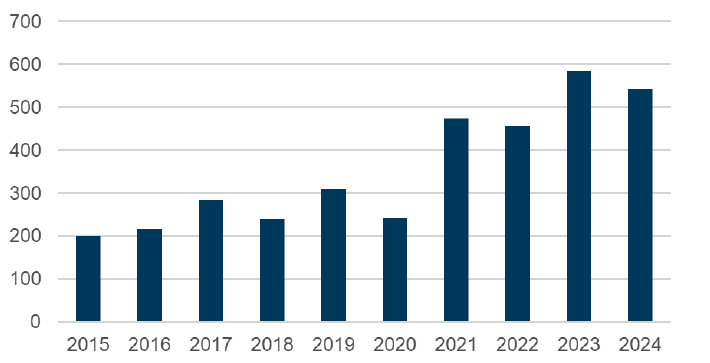
The number of real Living Wage accreditations in Scotland has had an upward trend since 2015
Source: Real Living Wage accreditations, Poverty Alliance
Real Living Wage sectors in Scotland
Out of the retail, construction, care, hospitality and culture sectors, the sector with the highest number of employers with real Living Wage accreditations is the construction sector with just under 400 accredited employers as at 30th July 2025. A breakdown of the number of real Living Wage accreditation by sector can be seen in Figure 18.
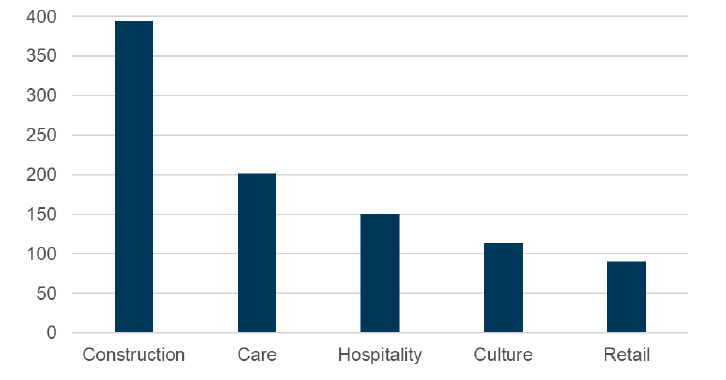
Construction is the sector with the largest number of employers with real Living Wage accreditations
Source: Real Living Wage accreditations, Poverty Alliance
Living Hours employers in Scotland
The number of employers receiving Living Hours accreditation has been increasing yearly since 2020, with over 100 employers in Scotland having received accreditation as at 30th July 2025.
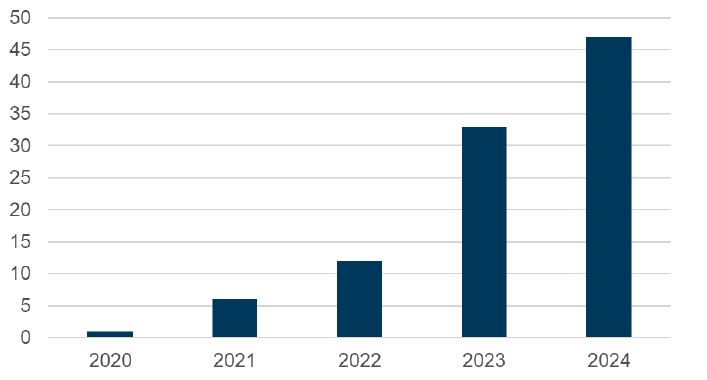
The number of Living Hour accreditations in Scotland has been increasing annually since 2020, although from a low base
Source: Living Hour accreditations, Poverty Alliance
6.2 Sectoral approach to Fair Work
This indicator looks to understand how Fair Work is being applied across different sectors of the economy. Currently it is measured using data from the Scottish Government Analysis of the ONS Annual Survey of Hours and Earnings: 2024 on the real Living Wage. Information on the proportion of employees aged 18 and over earning the real Living Wage in Scotland, as well as by industry sector, is provided.
Impact on Fair Work: Attribution
Real Living Wage coverage in Scotland
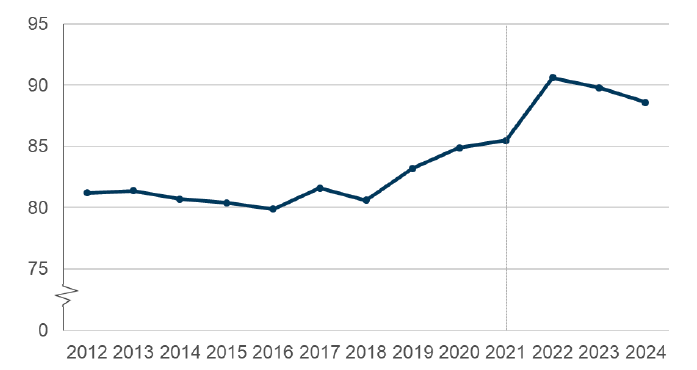
Overall the proportion of employees aged 18+ in Scotland earning the real Living Wage or more in 2024 was estimated at 88.6%, 1.2 percentage points lower than in 2023 (89.8 per cent). However, it has typically been on an upward trajectory since 2016.
The proportion of employees earning the real Living Wage or more in Scotland remained relatively constant between 2012 to 2016 before gradually increasing, as shown in Figure 20.
The proportion of employees aged 18 or over earning the real Living Wage or more has typically been on an upward trajectory since 2016
Source: Scottish Government analysis of Annual Survey of Hours and Earnings (ASHE), ONS
Notes:
1. 2024 estimate is provisional.
2. Employees on adult rates whose pay was not affected by absence unless furloughed.
3. Dashed line represents a discontinuity in the series in 2021 due to a change in the occupational coding from SOC 2010 to SOC 2020.
4. Due to methodological changes, data for 2023 and 2024 might not be directly comparable to data for 2022 and earlier years.
5. Data for 2020 and 2021 are subject to more uncertainty and should be treated with caution because of the impact of the coronavirus (COVID-19) pandemic on the data and collection.
Real Living Wage coverage in Scotland by sex
The proportion of women (employees aged 18+) earning the real Living Wage was estimated at 87.3% in 2024, lower than in 2023 (88.5%) and also lower than the proportion of men (employees aged 18+) earning the real Living wage in 2024 (90.0%).
Real Living Wage coverage in Scotland by industry sector
The proportion of employees aged 18+ in Scotland earning the real Living Wage or more in 2024 varies by industry sector. An estimated 96.7% of employees in the Education sector earned the real Living Wage or more in 2024 compared to 53.6% of employees in the Accommodation and food service activities sector[15], as can be seen in Figure 21.
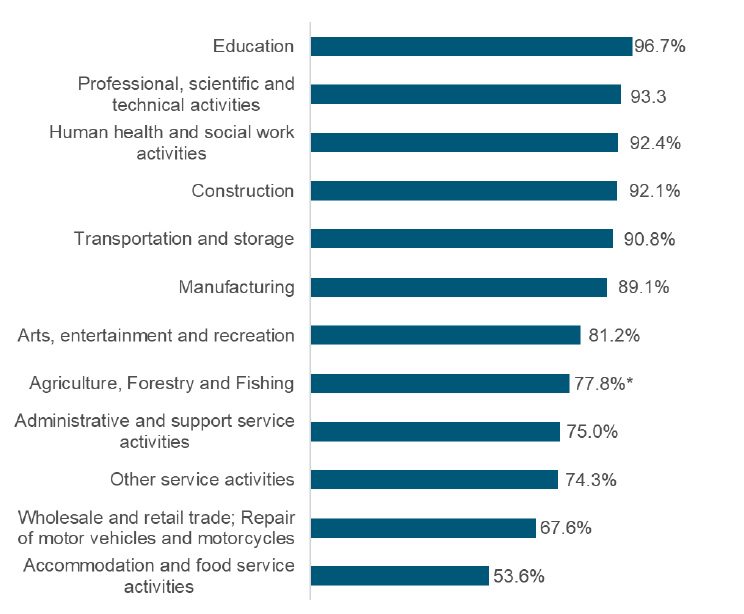
The proportion of employees aged 18 or over earning the real Living Wage or more varies by industry sector. For the available sectors, the proportion of employees earning the real Living Wage or more was highest in Education and lowest in Accommodation and food services in 2024
Source: Scottish Government analysis of Annual Survey of Hours and Earnings (ASHE), ONS
Notes:
1. 2024 estimates are provisional.
2. Employees on adult rates whose pay was not affected by absence.
3. Analysis is based on the real living wage rate of £12.00 in 2024.
4. Industry sectors are defined using the Standard Industrial Classification (SIC) 2007.
5. Statistical robustness - all estimates are considered precise except the estimate for the * Agriculture, Forestry and Fishing sector which is considered to be of reasonable quality
6. Estimates for the following industry sectors are not available - Mining and quarrying; Electricity, gas, steam and air conditioning supply; Water supply, sewerage, waste management and remediation activities; Information and Communication; Financial and insurance activities; Real estate activities; Public administration and defence and compulsory social security.
Contact
Email: susan.anton@gov.scot