
Five Family Payments: evaluation
This report details findings from an evaluation of the Five Family Payments.
Findings
In this chapter of the report, the data sources outlined in the methodology chapter are used to evaluate progress towards the Five Family Payments’ immediate, short-term and medium-term policy outcomes. Based on this, likely progress towards the Scottish Government’s long-term outcomes are assessed.
Achievement against immediate Five Family Payment policy outcomes
This section evaluates the Five Family Payments against the following policy outcomes, which are relevant to one or more of the benefits:
- The benefits are well promoted (All benefits)
- The benefits and their eligibility criteria are well understood (All benefits)
- The benefits are taken up (All benefits)
- Making an application is clear and easy (All benefits)
- Applications and payments are processed in a timely manner (All benefits)
- Awareness is raised about other forms of support (All benefits)
- Clients feel they have been treated with dignity, fairness and respect (All benefits)
- Card reduces stigma and is easy to use (Best Start Foods)
- Card provides access to a range of retailers (Best Start Foods)
- Card provides access to a range of healthy foods (Best Start Foods)
It uses data from a range of sources, primarily Official Statistics, estimated take-up rates of Scottish benefits, the Social Security Scotland Client Survey, and bespoke commissioned research. Where appropriate, findings from the previous evaluations of the Five Family Payments are also cited. The section ends with a recap of achievement against immediate Five Family Payments policy outcomes, based on a summary of key findings.
Please note that, throughout this section, notable differences in how subgroups of Client Survey respondents answered questions have been presented. As explained in the Methodology chapter, these are reported in cases where the difference between the subgroups was more than 5 percentage points.
The benefits are well promoted
This outcome is relevant to all of the Five Family Payments benefits. There are a number of indirect ways to evaluate whether the Five Family Payments are well promoted. One indirect method is to look at overall take-up of the benefits, which could be impacted by promotional activity.[22] Take-up refers to the extent to which people receive the benefits they are eligible for. This can be estimated by measuring the ‘take-up’ rate, which is the number of benefit recipients divided by the number of people eligible to receive the benefit.
Take-up estimates are provided for the Five Family Payments in the annual Take-up rates of Scottish benefits publication. The most recent estimates show:
- Take-up for Scottish Child Payment was 89% in 2023-24
- Take-up for Best Start Grant Pregnancy and Baby Payment was 87% in 2022-23
- Take-up for Best Start Grant Early Learning Payment was 87% in 2021-22
- Take-up for Best Start Grant School Age Payment was 97% in 2023-24
- Take-up for Best Start Foods was 84% in 2023-24.[23]
These figures show that most people who were eligible for the Five Family Payments received the benefits. While it is not possible to isolate the impact of promotional activity on take-up, promotions are likely to have contributed to these figures to some extent, as indicated by the findings in Table 3 below. However, further steps are still needed to maximise take-up of the Five Family Payments.
Another way to evaluate the promotion of the Five Family Payments is to consider how people found out about them. The Client Survey asks respondents how they first found out about the benefit(s) they applied for. The findings in Table 3 show respondents found out about the Five Family Payments in a range of ways.[24] For all application types, the most common responses were word of mouth (25%), online or social media (13%), and the health service (11%).
Notably, those who made an application which included Best Start Grant and Best Start Foods were most likely to say they found out about the benefits via the health service. For example, 25% of those who made a joint application for Best Start Grant and Best Start Foods found out about them via the health service, compared to 5% who applied for Scottish Child Payment only. This reflects findings from the previous evaluation of Best Start Foods, which showed recipients commonly heard about it from healthcare professionals they were in regular contact with, such as family nurses and health visitors. It also reflects the differing nature of the policies and their eligibility criteria – i.e. Best Start Foods and Best Start Grant can be claimed during pregnancy, and are for younger children only, whereas Scottish Child Payment can only be claimed once children are born, and is available to older children (up to 15 years old).
| Response option | Joint application for Best Start Grant, Best Start Foods, and Scottish Child Payment | Joint application for Best Start Grant and Best Start Foods only | Application for Scottish Child Payment only | All applications |
|---|---|---|---|---|
| Social Security Scotland contacted me (for example, phone call or letter) | 9% | 6% | 6% | 7% |
| Advert (for example, TV, radio, newspaper) | 3% | - | 6% | 4% |
| Online or social media (for example, Twitter, Facebook) | 11% | 14% | 14% | 13% |
| News article or programme (including radio) | 1% | # | 2% | 1% |
| Word-of-mouth | 21% | 20% | 28% | 25% |
| Citizens Advice | 7% | 5% | 8% | 7% |
| Department for Work and Pensions (DWP), including Jobcentre Plus | 9% | 6% | 10% | 9% |
| Health service (for example, NHS worker, GP, Health Practitioner, Psychologist) | 18% | 25% | 5% | 11% |
| Community or social care service | 4% | 3% | 5% | 4% |
| Leaflet, pamphlet or poster | 3% | # | 1% | 2% |
| Other | 14% | 19% | 18% | 17% |
| Total number of respondents | 1,489 | 293 | 2,129 | 3,911 |
There were notable differences in how respondents found out about the Five Family Payments benefit(s). With regards to the priority families at risk of poverty:
- Families from white ethnic backgrounds were more likely than families from minority ethnic backgrounds to have found out about the benefits via word of mouth (28% compared with 18%)
- Families with a mother aged under 25 were more likely than families without a mother aged under 25 to have found out about the benefits via the health service (30% compared with 11%)
- Families with children aged under 1 were more likely than families without a child aged under 1 to have found out about the benefits via the health service (25% compared with 7%).
Additionally, respondents with an unsuccessful application outcome were more likely than respondents with a successful outcome to have found out about the benefits via the health service (16% compared with 10%).
The commissioned research also provides an insight into the promotion of the benefits. In qualitative interviews, participants were asked how they became aware of the Five Family Payments. Their answers broadly reflect the findings in Table 3 above. They specifically said they found out about the benefits:
- Through word of mouth, such as from friends, family and colleagues
- From conducting their own research online
- From their midwife, family nurse or health visitor
- From other professionals they were in contact with
- From social media platforms and national news
- From their children’s schools
- From their local council and through communication from Social Security Scotland.
Participants were also asked about possible barriers to claiming Five Family Payments, based on their own experience of claiming them. They commonly cited a lack of knowledge and awareness about the benefits, perceiving there to be a lack of promotion within local communities. The qualitative evidence also demonstrated that awareness of the Five Family Payments can be mixed, with some parents saying they missed the chance to receive payments at an earlier date, or receiving certain payments altogether. Examples included claiming Best Start Grant but not being aware of Scottish Child Payment at the time, and only finding out about Best Start Grant and Best Start Foods after their child was born.
I just found out about [Scottish Child Payment] about a year and a half ago. It’s not a payment everyone knows about and it’s helped me with day to day living so I’ve lost so many years as it’s not an advertised payment.
(Survey respondent)
She [family nurse] asked me if I was receiving [Best Start Foods] and I was like, 'No, I didn't even know about it.' Then she was like, 'Oh, you could've been getting it this whole time,' and I was like, 'Oh great.' At least I found out later than never. Better late than never.
(Parent and carer interview)
Also in qualitative interviews, stakeholders acknowledged that take-up of the Five Family Payments was high in general. However, they felt that awareness was low amongst specific groups, such as families with older children, women who were pregnant with their first child, survivors of domestic abuse, those with English as a second language, and lone parent fathers.
Stakeholders also perceived there to be a lack of media coverage of devolved benefits, which they felt made them less well-known than reserved benefits. They also felt the complexity of the benefits system (i.e. having devolved and reserved benefits administered by different agencies) was a barrier to the Five Family Payments. For example, they said Child Benefit and Scottish Child Payment were commonly confused, with families receiving Universal Credit and Child Benefit assuming they were already receiving all of their benefit entitlements. Having two benefit systems was cited as a particular issue for migrant families with the Right to Reside or Habitual Residency, who it was said were often preoccupied with Universal Credit claims and therefore unaware of devolved benefits. There was also a perception amongst stakeholders that the DWP do not explicitly advertise Social Security Scotland benefits to Scottish clients, and vice versa.
I would say they’re [parents who have migrated] definitely the biggest percentage of parents that haven’t claimed benefits and have absolutely no idea and because usually once they get the Right to Reside and Habitual Residency and they’re claiming Universal Credit they’re so focused on claiming Universal Credit because that’s the benefit that is going to keep them going. They don’t realise there’s other things, and the problem is when it comes to advertising or information, the DWP won’t tell you about Social Security Scotland and Social Security Scotland won’t tell you about the DWP benefits.
(Stakeholder interview)
The benefits and their eligibility criteria are well understood
It is intended that the Five Family Payments and their eligibility criteria should be understood by potential applicants. This outcome is relevant to all of the Five Family Payments benefits. Previous evaluations of Scottish Child Payment and Best Start Foods found that, overall, people understood that the purpose of the benefits was to help with the costs of raising a family and to buy healthy foods, respectively. In the commissioned research undertaken for the current evaluation, findings on how people used the Five Family Payments also demonstrate that recipients understand the purpose of the benefits. (For more detail on how people used the benefits, see the ‘Achievement against short-term policy outcomes’ section below.)
However, previous evaluations of Scottish Child Payment and Best Start Foods also showed that there was some confusion over the eligibility criteria for the benefits amongst applicants. One way to assess whether the Five Family Payments eligibility criteria are understood is by looking at the proportion of applications that have been denied. This is because benefit applications are denied in cases where applicants are ineligible, which, in some cases, could be due to a misunderstanding of the eligibility criteria.[25] Official Statistics provides the following information about denied applications in the 2024/25 financial year:
- 28% of Scottish Child Payment applications were denied
- 34% of Best Start Grant and Best Start Foods applications were denied
These statistics show that around 1 in 3 Five Family Payments applications were denied in the 2024/25 financial year, which indicates that there is still some confusion around the eligibility criteria amongst applicants. Notably, however, evidence from the commissioned research indicates that people who have applications denied are not always ineligible for the Five Family Payments. In the qualitative interviews, parents and carers who went on to claim payments spoke about having their initial applications denied, despite being eligible at the time. This was often a result of not providing enough supporting evidence. One recipient said that when this happened to them they did not know why their application was denied until they contacted Social Security Scotland.
[…] it was a lot of unnecessary anxiety that it caused, because twice they were like, 'We can't offer you it', instead of looking at it and being like, 'Oh, we could offer you it, if you give us this evidence.' But both times, it was a solid no and I'm sitting there thinking, 'But I meet all the criteria. How are you saying no to me?'
(Parent and carer interview)
The Client Survey also provides evidence on the clarity of eligibility rules. It asks respondents who looked up the Social Security Scotland website if it made their eligibility clear or not. Amongst Five Family Payments applicants, 80% strongly agreed or agreed the information made it clear if they were eligible or not, whilst 11% neither agreed nor disagreed, and 9% strongly disagreed or disagreed (n=2,246). With regards to the priority families at risk of poverty, the following subgroups were more likely than others to agree the website made their eligibility clear:
- Families from minority ethnic backgrounds (88%) compared to families from white ethnic backgrounds (78%)
- Families with three or more children (87%) compared to families with one or two children (79%)
- Families with no child aged under 1 (82%) compared to Families with children aged under 1 (75%).
Respondents with a successful application outcome (88%) were also more likely to agree the website made their eligibility clear compared to respondents with an unsuccessful outcome (60%).
The benefits are taken up
Take-up rates and potential barriers to take-up
Take-up refers to the extent to which people receive the benefits they are eligible for. This outcome is relevant to all of the Five Family Payments benefits. A direct way to assess progress on this outcome is to estimate the ‘take-up’ rate, which is the number of benefit recipients divided by the number of people eligible to receive the benefits. As mentioned above, take-up rates are provided in the annual Take-up rates of Scottish benefits publication. The most recent take-up estimates for the Five Family Payments were as following:[26]
- 89% for Scottish Child Payment in 2023-24
- 87% for the Best Start Grant Pregnancy and Baby Payment in 2022-23
- 87% for the Best Start Grant Early Learning Payment in 2021-22
- 97% for Best Start Grant School Age Payment in 2023-24
- 84% for Best Start Foods in 2023-24.
Notably, for Scottish Child Payment, the take-up rate in 2023-24 was 97% for children aged under 6 and 85% for children aged 6 to under 16. Additionally, analysis of quarterly Scottish Child Payment take-up rates throughout 2023-24, for June, September, December and March, show estimated take-up rates for children aged 6 to under 16 steadily increasing over that time. Furthermore, take-up rate estimates for Scottish Child Payment are also now published by local authority. In 2023/24 they ranged from the lowest estimates of 84% for Aberdeenshire, East Dunbartonshire and East Renfrewshire, to the highest estimate of 94% for Falkirk.
These figures show that take-up was generally high for the Five Family Payments, and was especially high for Scottish Child Payment (for families with children aged under 6) and the Best Start Grant School Age Payment. Notably, automated payments were introduced for the latter in November 2022 for families who already received Scottish Child Payment. [27] However, despite these positive findings, further steps are still needed to maximise take-up of the benefits.
The commissioned research provides some evidence on potential barriers to take-up. In the qualitative interviews, Five Family Payments recipients and stakeholders were asked, based on their own experience, what factors could prevent take-up of the benefits. As mentioned above, a lack of awareness was commonly raised, with some recipients saying they personally missed the chance to receive payments at an earlier date because they did not know about them at the time – e.g. only finding out about Best Start Foods after their child was born. A perceived lack of promotion and issues around the complexity of the benefits system were offered as reasons for low awareness.
Stakeholders also said some claimants needed benefit advisors with in-depth knowledge of reserved and devolved benefits to ensure they get all of the benefits they are entitled to, and felt there was a lack of trained advisors in Scotland who were able to do this, citing a perceived prevalence of non-specialist support workers relying on benefits calculators. Parents and carers also described instances of receiving incorrect information and advice regarding their eligibility to apply for the Five Family Payments.
I think nowadays if you were to go into loads and loads of advice agencies and ask somebody to sit down with a pen and a bit of paper and do a benefit check with the rates, I don’t think they would be able to do it. I think people now are relying on benefit calculators and if you’re relying on a benefit calculator you don’t understand the system so you’ll maybe no’ necessarily understand what could make a difference in this person’s circumstances…I think in Scotland there is a real lack of people that can do an in-depth benefit check in that respect.
(Stakeholder interview)
[A third sector staff member] told me that I wasn't entitled to it when I was entitled to it, and that's as well how people would maybe not be able to get these payments, because they maybe go to the wrong person for advice and get the wrong advice, and that's put a stop to it.
(Parent and carer interview)
Stakeholders frequently cited issues faced by minority ethnic families with limited English, which was described as a ‘massive barrier’, as they could be unable to read application forms or find it challenging to contact organisations for support. They also flagged that, in some cases, people are illiterate in their own language, or speak rare dialects of their native language, meaning they also struggle to read translated information. Furthermore, stakeholders said that it could be difficult for some ethnic minority families to make claims due to a lack of documentation e.g. photo ID and children’s birth certificates.
Other issues flagged by stakeholders that could be affecting take-up of the Five Family Payments were:
- Having initial applications denied (e.g. due to a lack of supporting evidence, or applying before becoming eligible), which can put people off applying again
- Digital poverty, with claimants not having access to a computer and/or limited data on their phones
- Digital illiteracy and general issues with literacy, with cases of parents and carers being unable to read their address, NI number, or passport information, and struggling to navigate the Scottish Government website
- The mental burden of poverty giving some people limited capacity to think about benefit applications, because they are often in crisis mode
- The stigma that can be associated with receiving benefits, especially if it is the person’s first time needing help
- For survivors of domestic abuse, concerns around sharing personal details and potentially putting themselves at risk of harm.
Notably, a secondary analysis of open-text responses to the Client Survey highlighted a small number of cases where survivors of domestic abuse faced barriers when applying for the Five Family Payments. More detail than is available in the open-text responses would be required to fully interpret these cases. However, respondents mentioned difficulties providing paperwork that would be accepted as supporting information by Social Security Scotland.
There is information on your website regarding extra support for second child [for Best Start Grant Pregnancy and Baby Payment] if you have experienced domestic abuse. Unfortunately after disclosing information…I am unsure what relevant documents would be needed to support this. I was unfortunately declined the ‘double payment’ and my case was closed at the re decision stage. […] Unfortunately I was previously told by an advisor that I was 100% eligible for the double payment.
(Client Survey open-text response)
The application itself was relatively simple. However, it did not allow for my circumstances of abuse to be considered thoroughly and therefore left me in an unfortunate position. Had it been taken into consideration, I feel my initial outcomes would have been different. […] there wasn’t/isn’t really much room for this as part of the process.
(Client Survey open-text response)
In the commissioned research interviews, stakeholders and recipients suggested measures they felt could increase take-up of the Five Family Payments, relating to the barriers mentioned in the bullet points above. For example, tackling stigma in promotions by avoiding the word ‘benefit’ or focusing on how the payments can help children. Suggested measures can be read in full in Chapter 8 of the commissioned research report (see Annex A).
Lastly, although not directly related to estimated take-up, stakeholders felt that having Universal Credit as a qualifying benefit could be a barrier to the Five Family Payments for some families. This is because the Universal Credit application form was perceived by these stakeholders to be challenging and onerous, with the result that in their experience, some clients some did not complete it, whereas others were rejected initially due to errors in their application. However, the DWP does not provide an estimated take-up rate for Universal Credit.[28] This means it is not clear how many people in Scotland are affected by this issue, including those that would also meet the other eligibility criteria for the Five Family Payments.
The profile of Five Family Payments applicants
Beyond take-up estimates, Official Statistics and Social Security Scotland client diversity and equalities analysis provide information on applications and applicants by each of the equalities groups. This provides an insight on the profile of Five Family Payments applicants.
- · Table 4 presents a secondary analysis of Official Statistics on approved applications by the age-group of applicants in the financial year 2024/25.
- · Tables 5-12 present a secondary analysis of client diversity and equalities data on applicants who applied for a benefit in the financial year 2024/25 and filled out an equalities monitoring form. [29] They present the proportion of applicants approved within the category, as a proportion of all applicants that were approved. [30] The data used in these tables represents applicant outcomes at 27 May 2024.
As mentioned in the methodology chapter, data is presented to zero decimal places. ‘0%’ should therefore be interpreted to mean less than 0.5%. If no responses were given then this is denoted by ‘-’.
| Age-group | Scottish Child Payment (%) | Best Start Grant and Best Start Foods (%) |
|---|---|---|
| Under 18 | 1% | 1% |
| 18-24 | 14% | 22% |
| 25-34 | 40% | 53% |
| 35-44 | 33% | 22% |
| 45-54 | 10% | 2% |
| 55+ | 2% | 0% |
| Gender | Scottish Child Payment (%) | Best Start Grant and Best Start Foods (%) |
|---|---|---|
| Woman | 80% | 86% |
| Man | 12% | 6% |
| In another way | 0% | 0% |
| Preferred not to say | 8% | 8% |
| Physical or mental health condition or illness | Scottish Child Payment (%) | Best Start Grant and Best Start Foods (%) |
|---|---|---|
| Yes | 20% | 19% |
| No | 67% | 68% |
| Preferred not to say | 13% | 13% |
| Ethnicity | Scottish Child Payment (%) | Best Start Grant and Best Start Foods (%) |
|---|---|---|
| White | 81% | 83% |
| Asian | 4% | 4% |
| African | 2% | 2% |
| Mixed or Multiple ethnic groups | 1% | 1% |
| Other ethnic group | 2% | 1% |
| Caribbean or black | 0% | 0% |
| Preferred not to say | 9% | 9% |
| Sexual orientation | Scottish Child Payment (%) | Best Start Grant and Best Start Foods (%) |
|---|---|---|
| Heterosexual | 85% | 86% |
| Gay & lesbian | 0% | 0% |
| Bisexual | 2% | 2% |
| In another way | 0% | 0% |
| Prefer not to say | 13% | 12% |
| Transgender | Scottish Child Payment (%) | Best Start Grant and Best Start Foods (%) |
|---|---|---|
| Yes | 0% | 0% |
| No | 91% | 91% |
| Prefer not to say | 9% | 9% |
| 6-fold Urban Rural Classification[31] | Scottish Child Payment (%) | Best Start Grant and Best Start Foods (%) |
|---|---|---|
| Large urban area | 39% | 40% |
| Other urban area | 35% | 36% |
| Accessible small town | 8% | 7% |
| Remote small town | 3% | 3% |
| Accessible rural area | 11% | 10% |
| Remote rural area | 4% | 3% |
| SIMD quintile[32] | Scottish Child Payment (%) | Best Start Grant and Best Start Foods (%) |
|---|---|---|
| 1 (most deprived) | 37% | 43% |
| 2 | 25% | 26% |
| 3 | 17% | 15% |
| 4 | 13% | 11% |
| 5 (least deprived) | 7% | 5% |
| Residence on mainland or island communities | Scottish Child Payment (%) | Best Start Grant and Best Start Foods (%) |
|---|---|---|
| Scottish Mainland | 98% | 99% |
| Scottish Island | 1% | 1% |
As outlined in the introduction to this report, the Five Family Payments are a strategic commitment in the Scottish Government’s plan to address child poverty. The tackling child poverty delivery plan identified six priority families who are especially vulnerable to poverty. Data is not routinely collected and/or published on these groups in Official Statistics. However, estimates on the proportion of Five Family Payments applicants in each priority family will be provided in the forthcoming Social Security Scotland Client Survey, to be published in November 2025.[33] The estimates will be based on an analysis of data collected from Client Survey respondents.
Making an application is clear and easy
This outcome is relevant to all of the Five Family Payments. As outlined in the Introduction chapter, there are three types of application forms for the Five Family Payments: (i) a standalone Scottish Child Payment application form, (ii) a joint Best Start Grant and Best Start Foods application form, and (iii) a joint Scottish Child Payment, Best Start Grant and Best Start Foods application form.[34]
Official Statistics provides information about how people make applications for the Five Family Payments. It shows:
- Of the 414,700 applications received for Scottish Child Payment to 31 March 2025, 91% were made online, 7% were made on the telephone, 2% were paper-based, and <0.5% were made through other channels.
- Of the 537,215 applications received for Best Start Grant and Best Start Foods to 31 March 2025, 90% were made online, 8% were made on the telephone, 2% were paper-based, and <0.5% were made through other channels.
The Client Survey provides evidence on people’s experience completing Five Family Payments application forms. It asks respondents how they found different aspects of the process. As shown in Figure 2:
- 90% strongly agreed or agreed that the application process was clear, whilst 5% strongly disagreed or disagreed
- 89% strongly agreed or agreed that the application process did not take too long, whilst 5% strongly disagreed or disagreed
- 89% strongly agreed or agreed that it was easy to provide supporting information, whilst 4% strongly disagreed or disagreed.
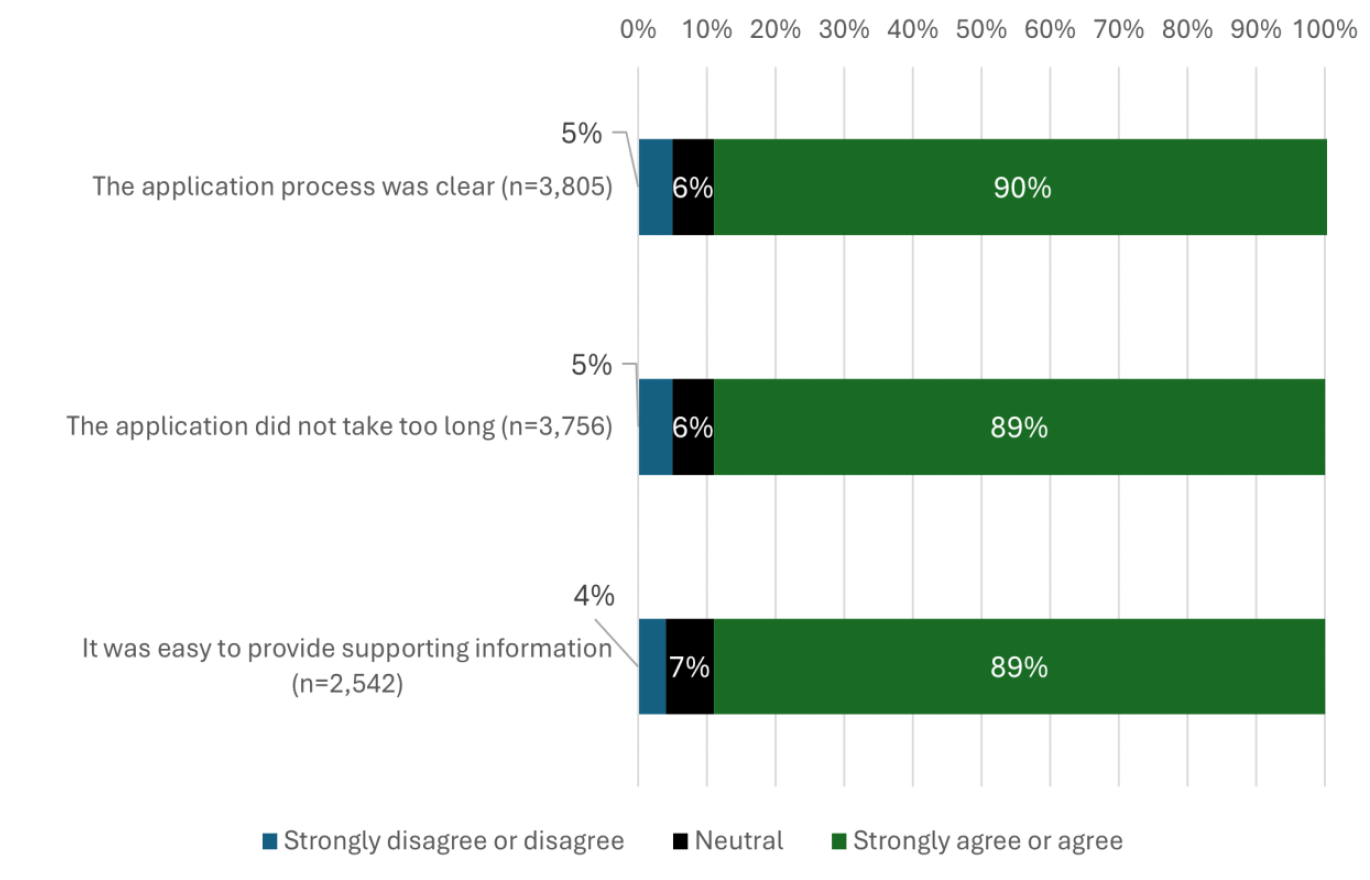
The only notable subgroup differences related to application outcome. Respondents who had a successful application outcome were more likely than those with an unsuccessful application outcome to strongly agree or agree:
- The application process was clear (94% compared with 79%)
- The application did not take too long (92% compared with 83%)
- It was easy to provide supporting information (91% compared to 83%).
The commissioned research also provides evidence on the experience of completing applications. It reflects the Client Survey findings in that, overall, parents and carers had a positive experience applying for the Five Family Payments. In the qualitative interviews and open-text survey responses, participants said they appreciated being able to apply online, the form was easy to complete, and the language used was easy to understand. They often compared their experience with other benefits like Universal Credit, saying they would usually seek out support to complete other forms, but did not need support when applying for the Five Family Payments.
Usually, I have to get people to help us fill out forms, especially if it's on paper because sometimes I don't understand the questions and stuff, but I never struggled. I think maybe it helps because it's on your phone. It's a lot easier to fill things out on your phone than it is to write them down on a bit of paper. I never had any problem. I found the process for all of the applications really easy.
(Parent and carer interview)
The participants that did receive support from Social Security Scotland when applying had a positive experience of doing so, describing staff as helpful and friendly. They also spoke positively about being able to make joint claims for the benefits on a single application form, and said it was easy to add a new child to their Scottish Child Payment account, because it did not involve completing a new application form for them. However, despite the generally positive feedback, some participants said the application form was too long, experienced some challenges completing the form. Some also reported challenges communicating with Social Security Scotland, such as not having enough time to phone and wait to speak to staff and issues reaching staff through the live chat.
Applications and payments are processed in a timely manner
Application processing times
Application processing times are relevant to all of the Five Family Payments benefits. Official Statistics provides information on application processing times, which are calculated from the point of initial benefit application until a decision on the application is made, and includes time spent waiting to receive copies of documents or evidence requested from applicants. On that basis, a yearly breakdown of application processing times is shown in Tables 13 and 14. [35] [36]
The data in Tables 13 and 14 show that both Scottish Child Payment application processing times, and that Best Start Grant and Best Start Foods application processing times, have improved in recent years. For example, in 2024/25:
- Scottish Child Payment applications were processed in 11 working days on average, which was quicker than in all previous years
- Best Start Grant and Best Start Foods applications were processed in 10 working days on average, which was quicker than in all previous years except 2018/19 and 2019/20.
| Financial year | Number of processed applications (excluding redeterminations) | Percentage of applications processed within 10 working days | Percentage of applications processed in 41 or more working days | Average (median) processing time in working days |
|---|---|---|---|---|
| 2020-2021 | 80,795 | 6% | 42% | 37 |
| 2021-2022 | 65,505 | 22% | 21% | 25 |
| 2022-2023 | 153,530 | 17% | 31% | 29 |
| 2023-2024 | 61,520 | 44% | 19% | 13 |
| 2024-2025 | 42,745 | 49% | 7% | 11 |
| Financial year | Number of processed applications (excluding redeterminations) | Percentage of applications processed within 10 working days | Percentage of applications processed in 41 or more working days | Average (median) processing time in working days |
|---|---|---|---|---|
| 2018-2019 | 17,930 | 55% | 3% | 9 |
| 2019-2020 | 120,665 | 56% | 3% | 9 |
| 2020-2021 | 111,700 | 23% | 15% | 19 |
| 2021-2022 | 82,460 | 29% | 19% | 20 |
| 2022-2023 | 88,335 | 6% | 43% | 39 |
| 2023-2024 | 61,705 | 46% | 16% | 12 |
| 2024-2025 | 47,025 | 52% | 6% | 10 |
The Client Survey asks applicants about their experiences after submitting an application form. Specifically, if they felt (a) their application was handled within a reasonable time frame, and (b) they got enough updates on the progress of their application. The findings in Figure 3 show that:
- 81% strongly agreed or agreed that their application was handled in a reasonable timeframe, whilst 10% strongly disagreed or disagreed
- 76% strongly agreed or agreed they got enough updates on the progress of their application, whilst 13% strongly disagreed or disagreed
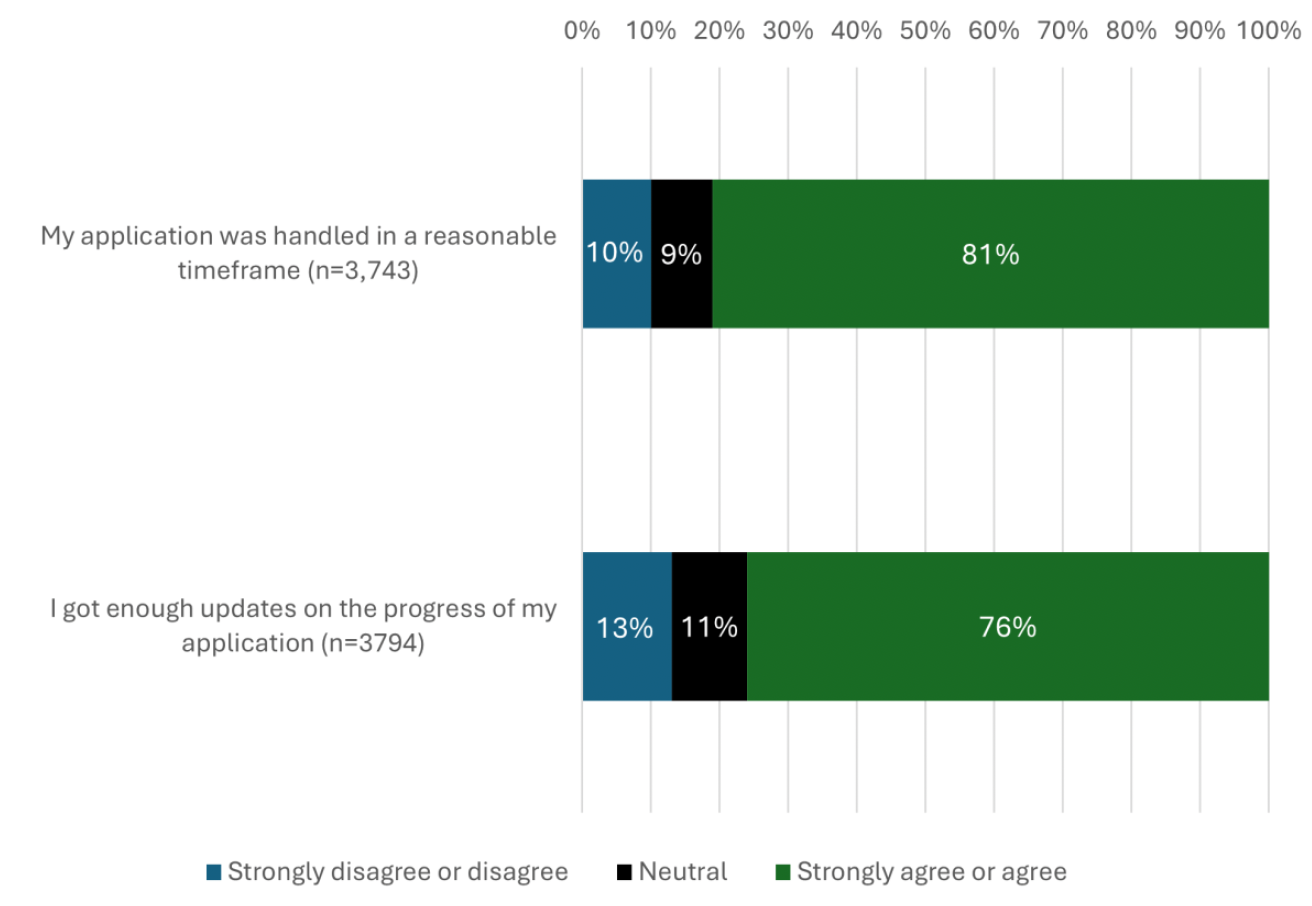
There were notable subgroup differences relating to priority families at risk of poverty. Specifically:
- Families from minority ethnic backgrounds were more likely than families from white ethnic backgrounds to agree their application was handled in a reasonable timeframe (86% compared to 80%) and they got enough updates on their application (83% compared to 74%).
- Households without a disabled family member were more likely than those with a disabled family member to agree they got enough updates on their application (79% compared to 73%)
- Families without a mother aged under 25 were more likely than families with a mother aged under 25 to agree they got enough updates on their application (77% compared to 71%)
Regarding other subgroup differences, respondents who had a successful application outcome were more likely than those with an unsuccessful application outcome to agree their application was handled in a reasonable timeframe (86% compared to 72%), and they got enough updates on the progress of their application (83% compared to 63%).
The commissioned research also provided evidence about people’s experiences after submitting a Five Family Payments application form. While qualitative interview participants were generally positive about their experience of the application process, some said they experienced a long wait for an application decision. This reflects the Official Statistics presented in Tables 13 and 14, showing a small proportion of applications were processed in 41 days or more. It also reflects the Client Survey findings in Figure 3 that 10% of respondents strongly disagreed or disagreed their application was handled in a reasonable timeframe.
Payment processing
The processing of payments is also relevant to all of the Five Family Payments. Official Statistics provides a range of information on payments made to Five Family Payments recipients. For Scottish Child Payment, 209,200 individual clients were paid in the financial year 2024/25. Also, as of 31 March 2025, the number of children benefitting from Scottish Child Payment was 326,225. For Best Start Grant and Best Start Foods, 69,285 individual clients were paid in the financial year 2024/25. Official Statistics also show the following about payments since the benefits were introduced:
- 7,456,725 payments were administered to Scottish Child Payment recipients between February 2021 and March 2025, with a total payment value of £1,133,678,377.
- 104,120 Best Start Grant Pregnancy and Baby Payments were administered between December 2018 and March 2025, with a total payment value of £46,483,056
- 135,900 Best Start Grant Early Learning Payments were administered between May 2019 and March 2025, with a total payment value of £37,362,030
- 123,760 Best Start Grant School Age Payments were administered between July 2019 and March 2025, with a total payment value of £34,282,276
- 2,210,895 Best Start Foods payments were administered between September 2019 and March 2025, with a total payment value of £69,303,084.
As mentioned in the Introduction chapter, auto-awarded payments for Best Start Grant Early Learning Payment and School Age Payment were introduced in November 2022 for parents and carers who already receive Scottish Child Payment. Official Statistics show that up to 31 March 2025, a total of 43,305 auto-awards have been made for Early Learning Payment, and 43,705 for School Age Payment, with payment values of £12,977,794 and £13,358,821, respectively.
The Client Survey asks respondents about their experience of receiving payments. Amongst Five Family Payments recipients:
- 90% received their payment when Social Security Scotland said they would, whilst 2% did not, and 8% could not remember/did not know (n=3,293)
- 90% received the right amount first time, whilst 3% did not, and 7% could not remember/did not know (n=3,299)
- 92% received the right amount every time, whilst 3% did not, and 6% could not remember/did not know (n=3,236).
Social Security Scotland conducted a survey of Five Family Payments recipients (n=569) who had received auto-awarded payments of Best Start Grant Early Learning Payment and School Age Payment.[37] It found:
- 95% said their overall experience of receiving an auto-awarded payment was good or very good, whilst only 1% said their experience was poor or very poor
- Over half of respondents had previously applied for a payment they were auto-awarded (e.g. for another child), and 95% of these respondents agreed they preferred receiving the payment automatically.
In written responses, whilst some respondents said it would have been more useful receiving the payment at a different time, most said the payment came at a useful time. Additionally, respondents often commented they preferred the automatic payments because they were easier, saved time, were less hassle and prevented worry about applying at the right time.
I love the system. I didn't know about the payment. It was a very pleasant and welcome surprise and even better that I didn't need to fill out more forms. Getting a text was great as piles of letters in the post isn't just bad for the environment, they give me anxiety. Can't fault it.
(Auto-award survey respondent)
Stakeholders who took part in the commissioned research spoke about the auto-awarded Best Start Grant payments in qualitative interviews. They felt that these were a positive development, helping to simplify the claims process and ensuring more families were receiving their entitlements.
Awareness is raised about other forms of support
Clients who interact with Social Security Scotland when making a benefits application can be informed about other forms of support. This outcome is relevant to all of the Five Family Payments.
The Client Survey asks respondents who have been in touch with a member of Social Security Scotland staff if they were told about (a) other benefits they might be entitled to, and (b) other sources of additional help (e.g. Citizens Advice). The findings for Five Family Payments applicants are presented in Table 15. They show:
- 37% said they were told about other benefits, whilst 38% who were not told about other benefits (but would have liked to have been told) [38]
- 31% said they were told about other sources of additional help, compared to 29% who were not told about other forms of additional help (but would have liked to have been told).
| Survey question | Number of respondents | Yes | No, but I would have liked them to | Not applicable/relevant |
|---|---|---|---|---|
| Did staff tell you about other benefits you might be entitled to? | 1,775 | 37% | 38% | 26% |
| Did staff tell you about other sources of additional help | 1,534 | 31% | 34% | 35% |
There were notable subgroup differences relating to priority families at risk of poverty:
- Families with a mother aged under 25 were more likely than families with no mother aged under 25 to say they were told about other benefits they might be entitled to (53% compared to 36%) and other sources of additional help (53% compared to 30%).
- Families with a child aged under 1 were more likely than families with no child aged under 1 to say they were told about other benefits they might be entitled to (47% compared to 32%)
- Families from minority ethnic backgrounds were more likely than families from white ethnic backgrounds to say they were told about other benefits they might be entitled to (43% compared to 34%)
Respondents with a successful application outcome were also more likely than those with an unsuccessful outcome to say they were told about other benefits they might be entitled to (39% compared to 29%) and other sources of additional help (34% compared to 23%).
Clients are treated with dignity, fairness and respect
Social Security Scotland aims to treat all clients with dignity, fairness and respect.[39] This outcome is therefore relevant to all of the Five Family Payments. The Client Survey asks respondents about their experiences with Social Security Scotland, including how they felt they had been treated by the organisation. As shown in Figure 4, amongst those who applied for at least one of the Five Family Payments:
- 90% strongly agreed or agreed they were treated with dignity, whilst 2% strongly disagreed or disagreed
- 88% strongly agreed or agreed they were treated with fairness, whilst 4% strongly disagreed or disagreed
- 90% strongly agreed or agreed they were treated with respect, whilst 2% strongly disagreed or disagreed.
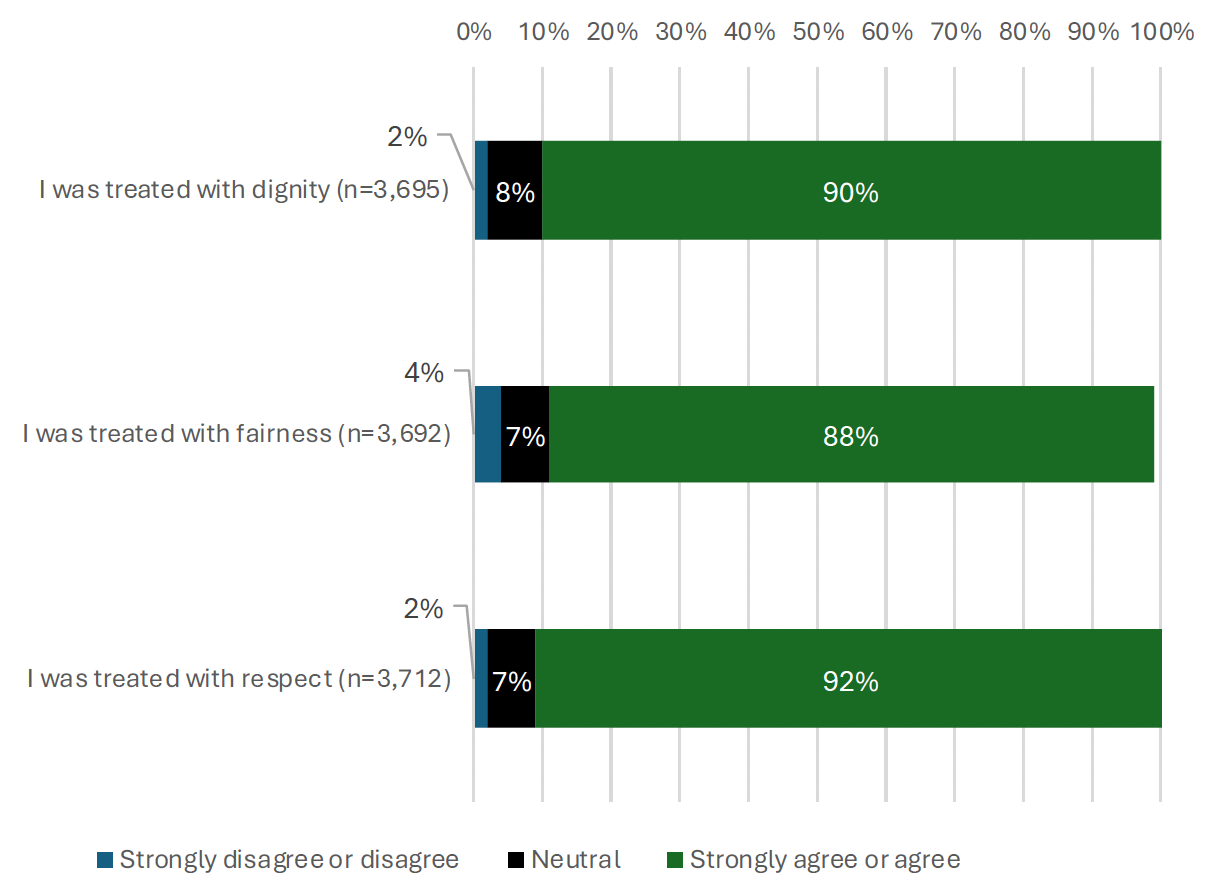
The only notable subgroup differences related to application outcome. Respondents with a successful application outcome were more likely than those with an unsuccessful application outcome to agree that they were treated with dignity (94% compared with 80%), fairness (94% compared with 73%), and respect (96% compared to 82%) by Social Security Scotland.
The commissioned research evidence from qualitative interviews and open-text survey responses reflects the Client Survey findings presented above. Those who got support with their applications from Social Security Scotland were largely positive about these interactions. They described being given helpful advice and guidance, and being treated well by staff.
It has been a great experience and the staff I’ve spoken to on the phone when setting up were all fantastic, especially when it came to adding my new baby to the claim. It has definitely helped us to be less stressed about money.
(Survey respondent)
It was very easy to apply for my application was dealt with easily and quickly. I have been treated with respect and kindness from staff.
(Survey respondent)
Card is easy to use and reduces stigma
This outcome relates specifically to Best Start Foods. As mentioned in the Introduction chapter, Best Start Foods payments are made every four weeks via payment card, which can be used like a normal bank card with contactless or Chip & Pin features. The Client Survey asks respondents about their experiences using the Best Start Foods card. The findings show that:
- 92% strongly agreed or agreed it was clear how to use the card, whilst 5% neither agreed nor disagreed, and 3% strongly disagreed or disagreed (n=702)
- 88% strongly agreed or agreed they were able to use the card without any difficulties, whilst 7% neither agreed nor disagreed, and 6% strongly disagreed or disagreed (n=682).
The only notable subgroup difference related to the priority families at risk of poverty. Specifically, families from minority ethnic backgrounds were more likely than families from white ethnic backgrounds to say they could use the Best Start Foods card without any difficulties (92% compared to 86%).
In the commissioned research, survey respondents were asked why they did not spend the money on their Best Start Foods card, and they could select more than one option. As shown in Table 16, most respondents (64%) said this was not applicable to them, as they always spent most or all of the money on their card. Others selected options which are not indicative of issues with the card itself - i.e. sometimes forgetting the card (12%), having no reason for not spending the money (7%), saving the money on the card (6%), and not needing help to buy healthy foods (1%)
However, some respondents selected options that are indicative of issues with the card. These included that it did not always work (8%), it was hard to use (3%), and that it was not accepted where they shop (1%). Additionally, those who selected ‘another reason’ (6%) could explain their response, and the most frequent comment related to difficulties splitting payments between foods they were buying with the card and other shopping. Lastly, 7% of respondents said they did not spend all of the money on the card because they felt embarrassed using it, indicating that some Best Start Foods recipients feel there is a stigma associated with the card.
Table 16 Reasons why Best Start Foods recipients did not spend all of the money on the card, where applicable
Response option
Not applicable – I always spend all or most of the money on my card
Proportion of respondents
64%
Response option
I sometimes forget my card
Proportion of respondents
12%
Response option
My card does not always work
Proportion of respondents
8%
Response option
No reason – I just don’t spend it all
Proportion of respondents
7%
Response option
I feel embarrassed using the card
Proportion of respondents
7%
Response option
I am saving the money on my card
Proportion of respondents
6%
Response option
I find the card hard to use
Proportion of respondents
3%
Response option
The card is not accepted where I shop
Proportion of respondents
1%
Response option
I do not need help to buy healthy foods
Proportion of respondents
1%
Response option
Another reason
Proportion of respondents
6%
Total number of respondents
522
Also in the commissioned research, the qualitative interviews and open-text survey responses provided more detail on experiences with the Best Start Foods card. There were parents and carers who did not have issues with the card, and some who said having a separate card for food shopping helped with budgeting. However, some participants reported the following difficulties:
- Receiving payments irregularly
- Cards expiring or being blocked, and delays receiving the card
- Card errors like not being able to use cards in certain shops and online, contactless payments not working, or the card not working in general
- Certain supermarkets or shops in the local area not accepting the card
- A lack of clarity where the card can be used and how it can be spent.
Specifically regarding stigma, the initial evaluation of Best Start Foods found that, generally, the card reduced stigma when compared with the DWP Healthy Start Vouchers system it replaced in Scotland. However, as shown by the survey findings above, 7% of recipients said they felt embarrassed using the card. In qualitative interviews and open-text survey responses, parents and carers reported embarrassment when having the card declined or rejected, and at having to separate shopping items in order to use the card. There were therefore suggestions to receive the payment into their own bank account.
I do sometimes think that me and other people, I think they find it embarrassing with the card, because everyone knows what that card is, because they all look the same. […] I think it's an internal thing where you think, 'Oh, I should be able to get this without needing help.' But then I suppose if it was put in people's banks, they might not spend it on the right thing, so there is ups and downs to it.
(Parent and carer interview)
Other issues raised by survey and interview respondents included damaging or losing their card, forgetting their pin, difficulties with checking their balance and views that what you can buy with the card were too restricted.
Card provides access to a range of retailers
This outcome also relates specifically to Best Start Foods. As mentioned in the Introduction chapter, the payment card works in all supermarkets or local shops that sell food and accept bank card payments, and can also be used online.
The Client Survey asks respondents if it was clear where the Best Start Foods payment card could be used. The findings show 88% strongly agreed or agreed it was clear where they could use the card, whilst 6% neither agreed nor disagreed, and 6% strongly disagreed or disagreed (n=693). With regards to the priority families at risk of poverty, the following subgroups were notably more likely to say it was clear where to use the Best Start Foods card:
- Families from minority ethnic backgrounds (95%) compared to families from white ethnic backgrounds (85%)
- Households without a disabled family member (91%) compared to households with a disabled family member (82%).
In the commissioned research, participants in qualitative interviews described using their Best Start Foods card in a variety of supermarkets and local shops. This reflects findings from the initial evaluation of Best Start Foods, which also found the card was being used in a wide range of shops, including large and small supermarket chains, smaller franchises and local independent shops. However, as shown in Table 16 above, a small proportion of survey respondents (1%) said the card was not accepted where they shop. This issue was also highlighted by recipients in qualitative interviews and open-text survey responses.
Card provides access to a range of healthy foods
This outcome also relates specifically to Best Start Foods. While actual spend is not monitored, the following items are prescribed to purchase via Best Start Foods:
- Fresh eggs
- Milk – plain cow’s milk and first infant formula
- Fruit/vegetables – fresh, frozen or tinned (those with added salt and sugar are excluded)
- Pulses (e.g. peas, lentils and beans) – dried, fresh, frozen or tinned.
In the commissioned research, participants in qualitative interviews said they used their Best Start Foods payment card to buy a range of foods and essential non-food items for their children. Participants also mentioned using Best Start Foods to pay for healthy foods in bulk, and generally to buy more fruit and vegetables than they did previously. However, some felt that the prescribed range of healthy food items is too restrictive. This reflects findings in the initial Best Start Foods evaluation. It found that, while some recipients felt the range of prescribed foods was appropriate and reasonable, others felt that expanding the range would be beneficial – for example, to include other sources of protein such as meat and poultry.
Recap of achievement against immediate outcomes
The evidence presented throughout this section shows that:
- People find out about the Five Family Payments in a range of ways, particularly word of mouth, online and social media, and via health professionals
- Take-up of the Five Family Payments benefits is generally high, and is especially high for families with children aged under 6 receiving Scottish Child Payment and Best Start Grant School Age Payment
- Five Family Payments application forms are generally considered to be easy and quick to complete
- Five Family Payments application processing times have improved in recent years, and most recipients are satisfied with the experience of receiving payments
- Five Family Payments applicants feel they were treated with dignity, fairness and respect by Social Security Scotland
- The Best Start Foods payment card is generally found to be easy to use, and provides access to a range of retailers and healthy foods.
The evidence also highlights some issues relating to immediate outcomes, notably that around 1 in 3 Five Family Payments applications were denied in 2024/25, which indicates there is some confusion over eligibility criteria amongst applicants. A minority of people also face issues such as take-up barriers, not being told about additional benefits or forms of support by Social Security Scotland, and problems with the Best Start Foods payment card.
However, overall, the findings demonstrate that immediate Five Family Payments outcomes are being achieved. According to the Five Family Payments theory of change, this makes it possible for short-term policy outcomes to be achieved. Actual achievement against short-term policy outcomes is explored in the section below.
Achievement against short term Five Family Payment policy outcomes
This section evaluates the Five Family Payments against the following policy outcomes, which are relevant to one or more of the benefits:
- Increased child-related spend (All benefits)
- Reduced pressure on household finances (All benefits)
- Reduced money-related stress (All benefits)
- Children able to participate in social and educational opportunities (Scottish Child Payment and Best Start Grant)
- Improved position of main carers within households (Scottish Child Payment)
- Grant reaches people at key transition points in child’s life (Best Start Grant)
- Families financially supported at key transition points (Best Start Grant)
- Healthy foods are more affordable (Best Start Foods)
- Mothers and children eat more healthy foods (Best Start Foods)
- Supports healthier shopping habits and meal planning (Best Start Foods)
It uses data from the bespoke commissioned research. As outlined in the methodology chapter in this report, the commissioned research involved (i) a survey of Five Family Payment recipients and (ii) qualitative interviews with Five Family Payments recipients and stakeholders who support low income families. The section ends with a recap of achievement against short-term Five Family Payments policy outcomes.
It should also be noted that, throughout this section, notable differences in how commissioned survey respondents answered questions in the survey have been presented. As explained in the Methodology chapter, subgroup differences are reported in cases where the difference between the subgroups is statistically significant. The subgroup differences are discussed in more detail in the ‘discussion of progress towards Five Family Payments outcomes’ section.
Increased child-related spend
It is intended that the Five Family Payments increase child-related spend. This outcome is therefore relevant to all of the Five Family Payments benefits. The commissioned research addressed this topic in the survey and qualitative interviews. The findings are presented below for each of the individual benefits.
Scottish Child Payment and child-related spend
The commissioned research asked Scottish Child Payment recipients questions about child-related spend. In the survey, recipients were asked what they spent their payments on. They were presented with a range of options, and could select more than one option. With regards to child-related spend, the findings show:
- 78% used Scottish Child Payment to buy things for their child (such as toys, clothes, or bedding)
- 53% used Scottish Child Payment to pay for activities for the child or the whole family (such as day trips, or visits to family or friends)
- 18% used Scottish Child Payment to buy things for their pregnancy or baby (such as breast pads, nappies, or formula milk)
- 9% used Scottish Child Payment as savings for their child or the family.
Respondents also said they used Scottish Child Payment for day-to-day household costs and essentials such as food and bills (66%), and larger household costs such as furniture and car expenses (5%).
The survey also asked respondents what they spent Scottish Child Payment on the most, and they could choose only one option. As shown in Figure 5, 44% said they spent Scottish Child Payment mostly on things for their child, which was the most common response. A smaller proportion of respondents selected activities for their child or whole family (9%) or things for pregnancy or baby (6%). The second most common response was using Scottish Child Payment for day-to-day household costs and essentials (39%).
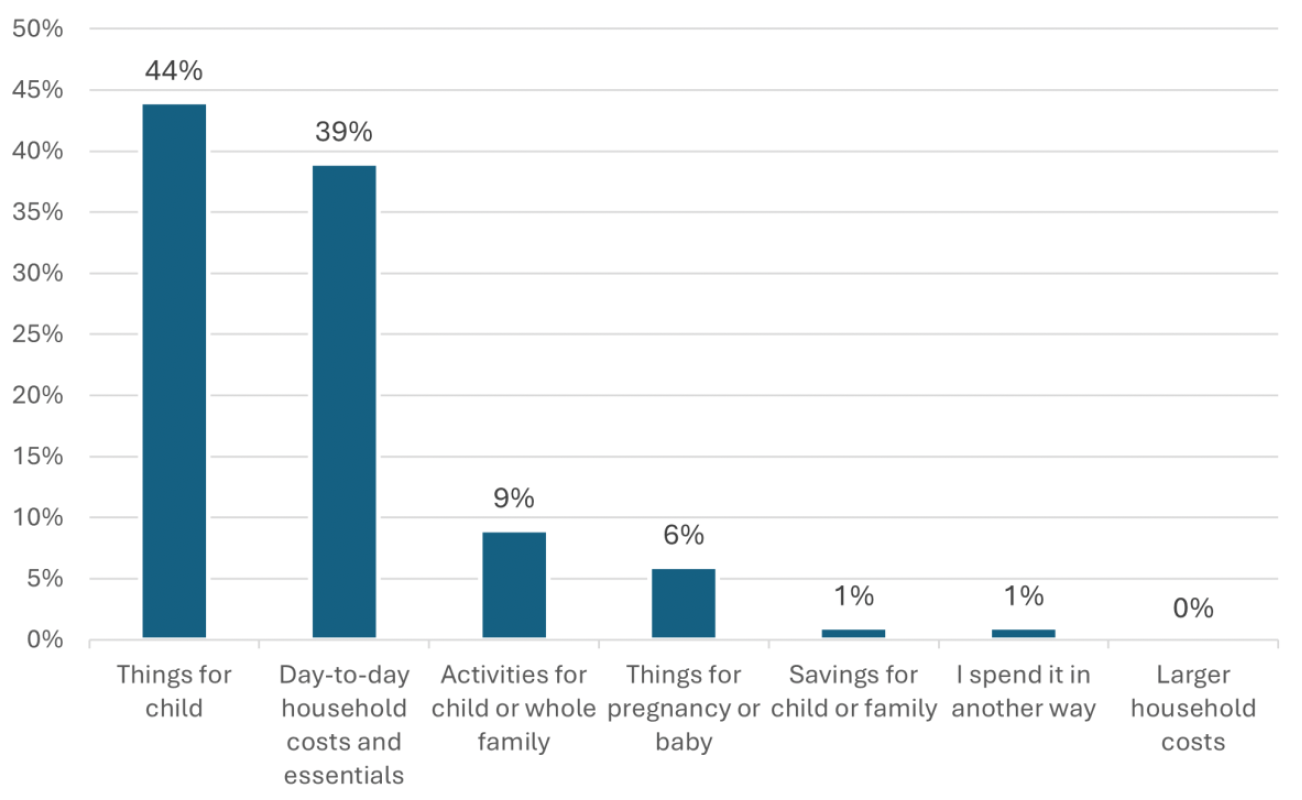
With regards to mostly spending Scottish Child Payment on things for their child (such as toys, clothes, or bedding), the only statistically significant difference related to the priority families most at risk of poverty. Specifically, households without a disabled family member were more likely than those with a disabled family member to say they mostly spent the money on things for their child (46% compared with 42%).
The qualitative interviews and open-text survey responses largely reflect the survey findings presented above. There were parents and carers who said, where possible, they used Scottish Child Payment specifically to buy things for their child. In some of these cases, participants said that they treated income from wages or other benefits as being for household costs, whilst Scottish Child Payment was for child-related spend. However, other participants said they pooled their income and spent it on whatever their child or family needed at the time.
…I like opened a children’s account for both of my kids because like to try and be organised with funds and make sure that I’m allocating it towards them now when those specific funds come through.
(Parent and carer interview)
I very much concentrated on the money needs to go towards what we need, which is food for the house, nappies for the baby, her toiletries, things like that. It was very much decided through what is essential to spend this money on.
(Parent and carer interview)
In the survey, Scottish Child Payment recipients were also asked, on a scale of zero (‘not at all’) to five (‘a lot’), how much the payments helped them with different types of child-related spend. As shown in Table 17:
- 75% rated Scottish Child Payment five (helped a lot) for helping to buy their child essential items such as clothes, food, and medicine. Overall, 94% gave a higher rating of three to five, and 4% gave a lower rating of zero to two.
- 57% rated Scottish Child Payment five (helped a lot) for helping to buy their child school items such as pencils, a bag, and a uniform. Overall, 84% gave a higher rating of three to five, and 9% gave a lower rating of zero to two.
- 50% rated Scottish Child Payment five (helped a lot) for helping to buy their child treat items such as toys, ice cream, and magazines. Overall, 79% gave a higher rating of three to five, and 17% gave a lower rating of zero to two.
| Survey measure | Total respondents | 0 – not helped at all | 1 | 2 | 3 | 4 | 5 – helped a lot | Net lower (0-2) | Net higher (3-5) |
|---|---|---|---|---|---|---|---|---|---|
| Helped buy my child essential items | 3,404 | 1% | 1% | 2% | 8% | 11% | 75% | 4% | 94% |
| Helped buy my child things they needed for school | 3,402 | 3% | 2% | 4% | 13% | 14% | 57% | 9% | 84% |
| Helped buy my child treat items | 3,402 | 4% | 4% | 9% | 17% | 12% | 50% | 17% | 79% |
There were statistically significant differences relating to the priority families most at risk of poverty. Specifically:
- Families with three or more children were more likely than families with one or two children to say it helped ‘a lot’ buying their child essential items (79% compared with 74%) and school items (63% compared with 56%)
- Families from white ethnic backgrounds were more likely than those from minority ethnic backgrounds to say it helped ‘a lot’ with buying their child essential items (76% compared with 68%) and school items (58% compared with 51%)
- Households with a disabled family member were more likely than those without disabled family member to say it helped ‘a lot’ with buying their child essential items (77% compared with 72%).
Regarding other subgroups with statistically significant differences:
- Families who had been receiving Scottish Child Payment for over 12 months were more likely than those who had been receiving it for up to 12 months to say it helped ‘a lot’ with buying their child school items (60% compared with 53%) and treat items (53% compared with 44%)
- Families from the 20% most deprived areas were more likely than those from the 20% least deprived areas to say it helped ‘a lot’ with buying their child treat items (54% compared with 45%).
In the qualitative interviews and open-text survey responses, parents and carers indicated that food and clothing were key areas of essential child-related spend. For some, these were the main, or only, items they spent Scottish Child Payment on. This reflects the survey findings above, which show that the majority of respondents gave Scottish Child Payment a high rating for helping to buy their child essential items such as clothes, food and medicine. With regards to clothing, some participants said they had to frequently replace clothes because their child was growing so fast.
…my grandson of 11 he got his school shoes in August and he got his feet measured and everything and they’re too tight for him now. So after school today I’ve got to go down the town and get him new shoes because he was complaining that they were tight this morning. […] And the oldest one who’s 15 he’s a size 10½ in a shoe so he’s men’s prices for his shoes and things like that.
(Parent and carer interview)
Essential spend also varied by the circumstances of the child and family. For example, parents of newborns reported using payments for essentials like formula milk and nappies. Others said Scottish Child Payment helped them meet the needs of their disabled child, which could be expensive. This also reflects the survey findings above, which show that households with a disabled family member were particularly likely to give Scottish Child Payment a high rating for helping them to buy their child essential items.
My son had a lot of hospital visits as he grew until recently and it helped us get to them and buy him specific foods that fit his dietary needs.
(Survey respondent)
It was also common for respondents to say they used Scottish Child Payment for school clothes, including clothing for school clubs, which also had to be replaced regularly due to the child growing quickly, or because they got mucky or torn at school. Other school-related costs included lunches, bags, supplies, fees, trips and events.
[Scottish Child Payment] Helps me to provide essential items my child needs for day to day, uniform, clothing, school trips to prevent exclusion from friends, would be a huge struggle to manage without it.
(Survey respondent)
Some parents and carers shared that Scottish Child Payment helped them to buy treats for their children. Examples they gave included toys, money to go out with friends, and birthday and Christmas presents. Some also said that Scottish Child Payment enabled them to pay for treats despite the cost of living increases.
Very grateful for the additional money. With the recent impact of inflation, that has increased the cost of daily living and taking more of our family income, this extra money helps the kids still get the extras that they need and softens the impact of the price increases.
(Survey respondent)
However, some participants said they used Scottish Child Payment for basic needs and were unable to use it for treats at all, or could do so very rarely. This also reflects the survey findings, which show that fewer respondents rated Scottish Child Payment five (helped a lot) for buying their child treat items (50%) compared with buying their child essential items (75%).
Best Start Foods and child-related spend
The commissioned research asked Best Start Foods recipients about child-related spend. The findings demonstrate that Best Start Foods has led to increased child-related spend on healthy food items. However, as most of these findings are partially related to child-related spend, they are covered later in the Findings chapter, specifically in relation to the outcomes ‘Healthy foods are more affordable’, ‘Mothers and children eat more healthy foods’, and ‘Supports healthier shopping habits and meal planning’.
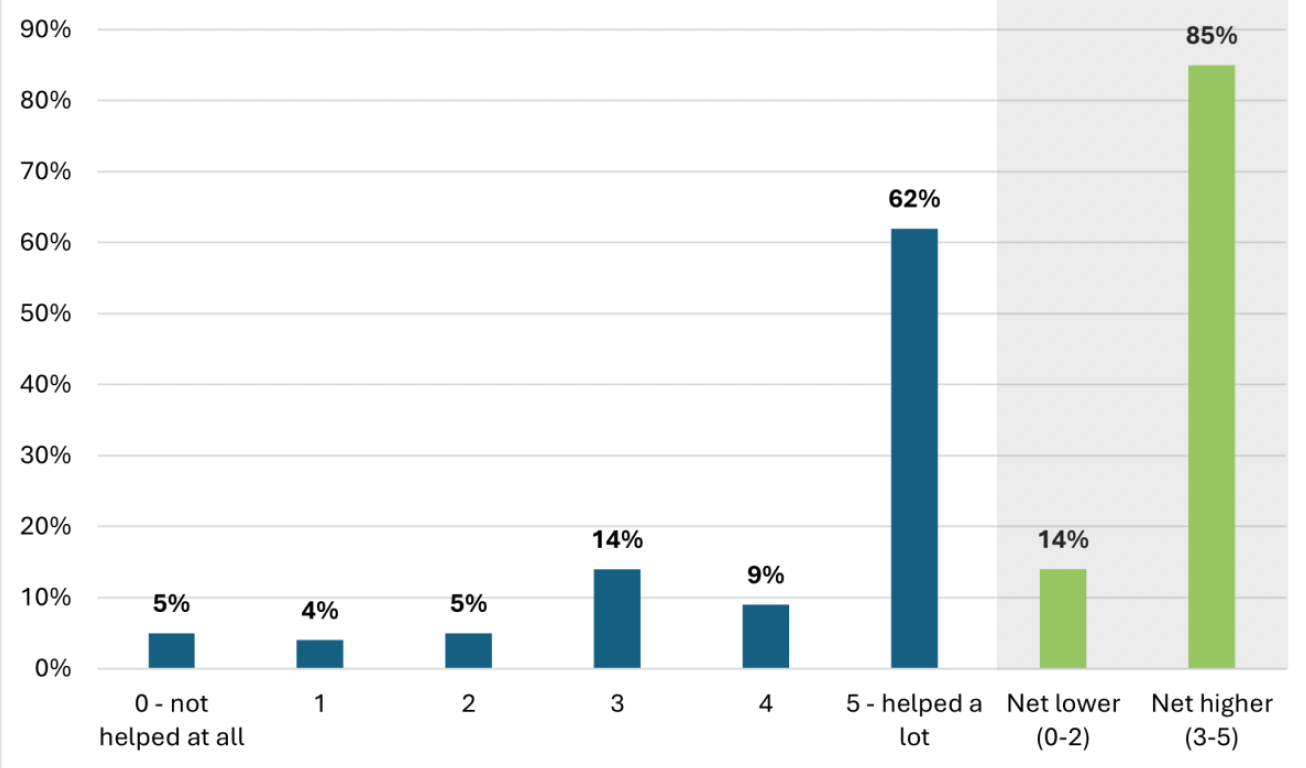
However, the survey did ask about child-related spend directly regarding first infant formula milk. Best Start Foods recipients were asked if they used the payments to buy first infant formula milk for any children aged under one in their household. Those who did were asked on a scale of zero (‘not at all’) to five (‘a lot’) how much the payments helped them to buy first infant formula milk. The findings in Figure 6 show that 62% rated Best Start Foods five (helped a lot) for helping to buy first infant formula milk. Overall, 85% gave a higher rating of three to five, and 14% gave a lower rating of zero to two. There were no statistically significant differences between subgroups of respondents.
In the qualitative interviews and open-text survey responses, participants emphasized how much Best Start Foods helped them pay for first infant formula milk, which was described as being expensive. Some also felt they would have to borrow money or skip bills to afford formula if they did not have Best Start Foods.
It’s [Best Start Foods] taken the pressure off of paying certain bills because again I would skip a bill to buy her formula. […] it is handy for essentials and it probably makes a bigger impact to people who are more disadvantaged than me you know. It does help.
(Parent and carer interview)
[If didn’t receive Best Start Foods] I would have borrowed off my parents. My dad can’t really afford it but he would give me the money for formula for her because she needs it and again he would sacrifice a meal so she could eat because he did that when I was a kid.
(Parent and carer interview)
Best Start Grant and child-related spend
The commissioned research asked Best Start Grant recipients about child-related spend. In the survey, those who had received at least one Best Start Grant payment were asked what they had spent the payments on. They were presented with a range of options, and could select more than one option. With regards to child-related spend, the findings show that:
- 71% used Best Start Grant to buy things for their child (such as toys, clothes, or bedding)
- 59% used Best Start Grant to buy things for their pregnancy or baby (such as breast pads, nappies, or formula milk)
- 23% used Scottish Child Payment to pay for activities for child or the whole family (such as day trips, or visits to family or friends)
- 4% used Best Start Grant as savings for their child or the family.
Respondents also said they used Best Start Grant for day-to-day household costs and essentials such as food and bills (29%), and larger household costs such as furniture and car expenses (5%).
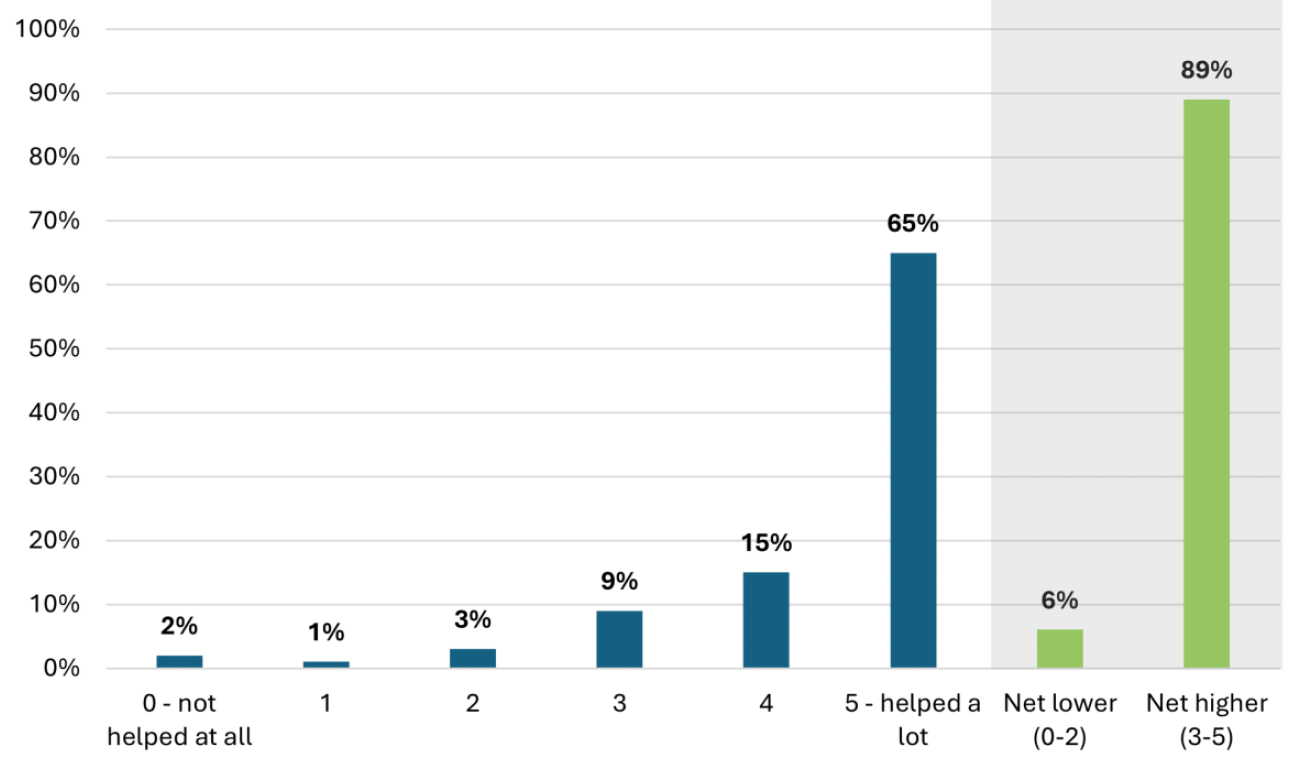
Best Start Grant recipients were also asked on a scale of zero (‘not at all’) to five (‘a lot’) how much the payments helped them to buy the things their child needed, such as when they were born, or started nursery or school. As shown in Figure 7, 65% rated Best Start Grant five (helped a lot) for helping them to buy the things their child needed. Overall, 89% gave a higher rating of three to five, and 6% gave a lower rating of zero to three.
There were statistically significant differences relating to priority families most at risk of poverty. Specifically, the following subgroups were more likely than others to rate Best Start Grant five (helped a lot) for helping them to buy the things their child needed, such as when they were born, or started nursery or school:
- Respondents from two or more parent/carer households (69%) compared with those from one parent/carer households (64%)
- Households with a disabled family member (68%) compared with those without a disabled family member (62%).
- Families from white ethnic backgrounds (68%) compared with those from minority ethnic backgrounds (50%).
In the qualitative interviews and open-text survey responses, Best Start Grant recipients explained how the payments helped them with child-related spend. Pregnancy and Baby Payment recipients said the large one-off payment enabled them to buy expensive essential items such as a pram, cot, car seat or bedroom furniture. Some parents and carers also used the payment for items they needed as a new mum, such as maternity clothing, breast pumps and breast pads. While the pregnancy and baby payment did not always cover all the new child costs, overall it helped families to buy what they wanted, when they needed it.
It went quick because the cot was £200, the pram was near enough £300, then obviously the movers and my breast pumps and the bottles, so I don’t think it actually covered all of that but it covered the majority of it. So it allowed me to get the things I needed so it was…it’s a good whack of money that really does help.
(Parent and carer interview)
Early Learning Payment recipients described using the payment to buy nursery clothes, such as a uniform or clothes suitable for nursery activities, like wellies, waterproofs, hats and gloves to be bought and left at nursery. Parents and carers also said the value of the payment helped them to buy better quality items such as shoes that would last longer, or clothing as and when their child needed it, citing their child growing quickly or their clothes being worn out from play and activity.
I went out and bought her some Clarks trainers because they're obviously really good trainers. They don't get scuffed up as quick as what cheaper trainers do. And I went and bought her loads of spare clothes that she could just wear for nursery because obviously, you can imagine their clothes get ruined at nursery. A hat and gloves, a bag, lunchbox, stuff like that. So that really helped out too.
(Parent and carer interview)
School Age Payment recipients mostly described using the payment for school uniforms and other school-related costs. As with the other Best Start Grant payments, while some parents and carers used the payment for the eligible child only, others used it for multiple children where necessary. For example, those with large families highlighted the expense of clothing multiple children. There were also examples of the School Age Payment helping parents and carers meet the needs of a child with sensory needs linked Autism. This reflects the survey findings above, which show that households with a disabled family member were more likely than those without a disabled family member to say Best Start Grant helped ‘a lot’ to buy the things their child needed.
He just started school in August, yeah August, so yeah we received that [School Age Payment] which was amazing and we obviously used that for things like his school uniform, for his first school haircut […] he has sensory difficulties, so we had to make sure that the uniform we bought was okay with his skin and kind of checked the labels and things like that. […] you’d have to maybe get the bus because I don’t drive and go to different supermarkets and try out different clothes and see how he reacted with the textures when he had them on.
(Parent and carer interview)
Reduced pressure on household finances
It is intended that the Five Family Payments lead to reduced pressure on household finances. This outcome is therefore relevant to all of the Five Family Payments benefits. The commissioned research addressed this topic in the survey and qualitative interviews. This section focuses specifically on how the payments helped with the cost of household essentials. The findings are presented below for each of the individual benefits. However, other relevant findings are covered later in the Findings chapter, specifically in relation to the outcomes ‘Reduced money-related stress’ and ‘Reduced incidence of debt’.
Scottish Child Payment and pressure on household finances
The commissioned research explored the impact of Scottish Child Payment on paying for household essentials. As shown earlier in this report, 66% of survey respondents who received Scottish Child Payment said they used the payments for day-to-day household costs and essentials, whilst 39% said this is what they used Scottish Child Payment for the most. There were statistically significant differences relating to the priority families most at risk of poverty. Specifically, the following subgroups were more likely to say they mostly used Scottish Child Payment for day-to-day household costs and essentials:
- Households with a disabled family member (43%) compared to those without a disabled family member (33%).
- White ethnic families (42%) compared to minority ethnic families (24%)
- Families with no child under 1 year old (41%) compared to those with a child under 1 year old (21%).
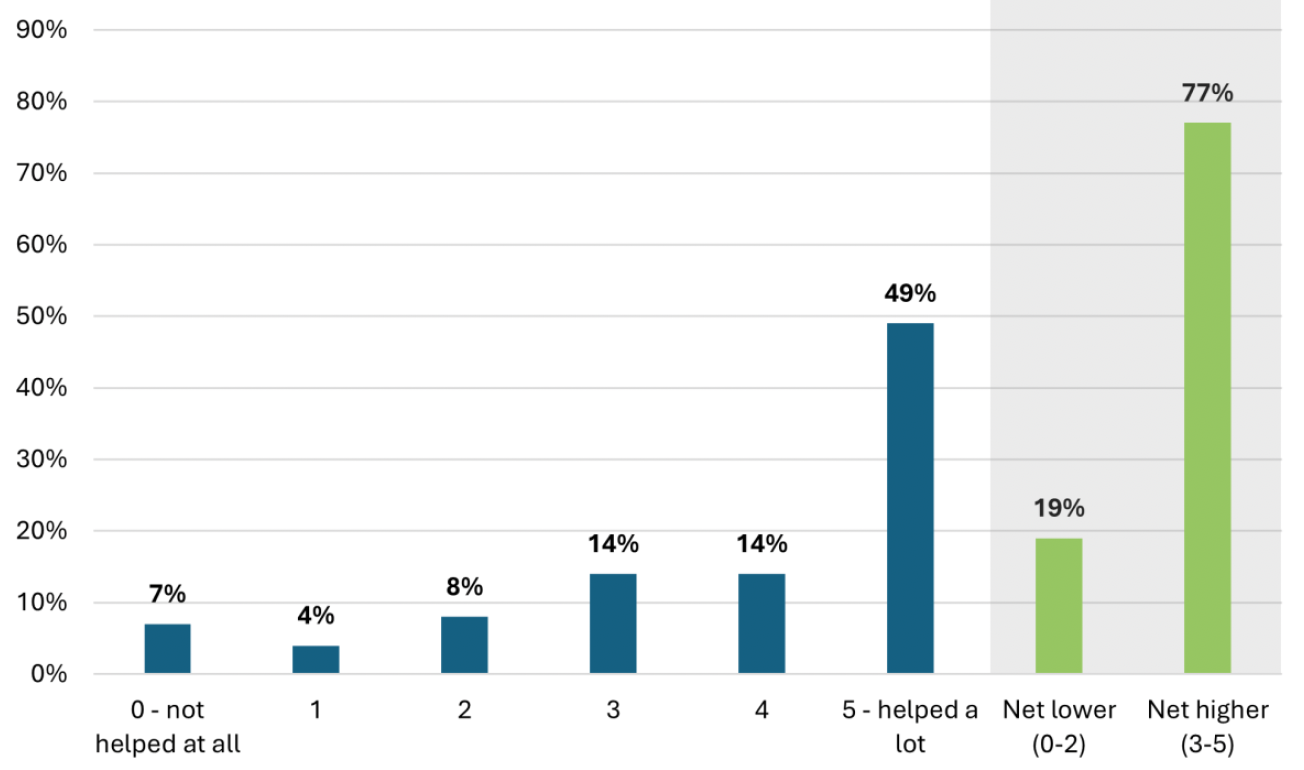
Respondents were also asked, on a scale of zero (‘not at all’) to five (‘a lot’), how much the payments helped them to pay for household essentials like food, rent, gas and electricity. As shown in Figure 8, 49% rated Scottish Child Payment five (helped a lot) for helping to pay for household essentials. Overall, 77% gave a higher rating of three to five, and 19% gave a lower rating of zero to two.
With regards to the priority families at risk of poverty, the following subgroups were more likely than others to rate Scottish Child Payment five (helped a lot) for helping them to pay for household essentials:
- Families with three or more children (54%) compared to those with one or two children (47%)
- Households with a disabled family member (51%) compared to those without a disabled family member (45%)
- Families from white ethnic backgrounds (51%) compared to those from minority ethnic backgrounds (38%).
- Families with no children under 1 year old (49%) compared to those with a child aged under 1 (41%).
Notably, as shown above, three of these subgroups (households with a disabled family member, families from white ethnic backgrounds, and families with no children under 1 year old) were also more likely to say they spent Scottish Child Payment on household essentials. These findings appear to be linked, suggesting those who spent the payments mostly on household essentials were therefore more likely to find them helpful when it came to buying household essentials.
Regarding other subgroups with statistically significant differences:
- Those who had been receiving Scottish Child Payment for over 12 months were more likely than those receiving it for less than 12 months to say it helped ‘a lot’ to pay for household essentials (51% compared with 44%).
The commissioned research also provides qualitative evidence about Scottish Child Payment being used for household essentials. In open-text survey responses, hundreds of respondents said they used Scottish Child Payment to help with household essentials, particularly food, housing and utility bills. Some said they relied on the payments to pay for these essentials, especially due to the cost of living increases, which Scottish Child Payment helped to mitigate.
This payment has been a life saver, especially since the cost of living crisis. I used to be able to get a decent amount of shopping and essentials every week without worrying too much, but the cost of shopping is unbelievable. Without this payment we would be eating much worse, less fresh and nutritious foods and be relying on cheap frozen food instead.
(Survey respondent)
I rely heavily on the payment to help with weekly household costs which are constantly increasing.
(Survey respondent)
Parents also said they relied on Scottish Child Payment for essentials because their personal circumstances (such as being a lone parent, having a large family, caring for a disabled family member, or being out of work) made their finances challenging. This reflects the survey findings above, which show that those with three or more children or a disabled family member were more likely to say Scottish Child Payment helped them ‘a lot’ to pay for household essentials.
I have 6 kids. The Scottish payments very helpful because without Scottish payments I can’t manage living crisis. I like to say many thanks.
(Survey respondent)
Stakeholders felt that Scottish Child Payment was important for large families for whom they said payments could make the difference between being in poverty or not, with one stakeholder citing the impact of the two-child limit for Child Tax Credits and Universal Credit.
[Scottish Child Payment] definitely makes an impact financially, especially where you have families who have more than 2 children right because of the 2-child rule. So, if you’ve got 4 kids right and you’re not getting the child element payment for 2 of them […] that £53 a week can go towards food bills, can go towards ongoing clothes that they need...
(Stakeholder interview)
However, some recipients said they struggled with the cost of living despite the assistance of Scottish Child Payment. In some of these cases, parents mentioned that increasing the payment amount would help them meet essential costs and reduce financial pressure.
Scottish Child Payment mainly goes toward groceries and keeping our house running. It would be groceries and electricity, would be the main things that that would go on. Every month I rely on it. I'm usually waiting for it to come in. […] I wouldn't say the payments would always cover my electricity. They'd either cover my groceries and not my electricity, or just my electricity and maybe some of my groceries.
(Parent and carer interview)
The Scottish Child Payment is helpful, but if the amount were higher, it would have a greater impact on covering daily expenses and improving the financial situation of families. Increasing the payment could provide more support and reduce financial pressures.
(Survey respondent)
The qualitative evidence also indicates the administration of Scottish Child Payment can affect its financial impact. For example, four-weekly payments were generally viewed positively by recipients, who described being able to manage their outgoings according to when they received Scottish Child Payment and other benefits like Universal Credit. However, some said the four-weekly payments made it difficult for them to budget and pay bills before receiving the money. Additionally, there were respondents who said Scottish Child Payment arriving on a different date each month increased pressure on their household finances.
Changing the dates of the Scottish Child Payment had a massive impact in finances as the payment was being paid around the 13th of the month this then changed to the first few days of the month then changed again to the 23rd of the month. This all happened without warning, no emails, letters, national information of change of dates! How can you keep track of your money, organise payments, direct debits, standing orders, school trips, etc if you don’t know when you are being paid? Changing dates without warning can put people into financial hardship!
(Survey respondent)
Best Start Foods and pressure on household finances
The commissioned research explored the impact of Best Start Foods on paying for household essentials. In the survey, Best Start Foods recipients were also asked on a scale of zero (‘not at all’) to five (‘a lot’) how much the payments helped them to pay for household essentials like food, rent, gas and electricity. As shown in Figure 9, 32% rated Best Start Foods five (helped a lot) for helping to pay for household essentials. Overall, 55% gave a higher rating of three to five, and 32% gave it a lower rating of zero to two.
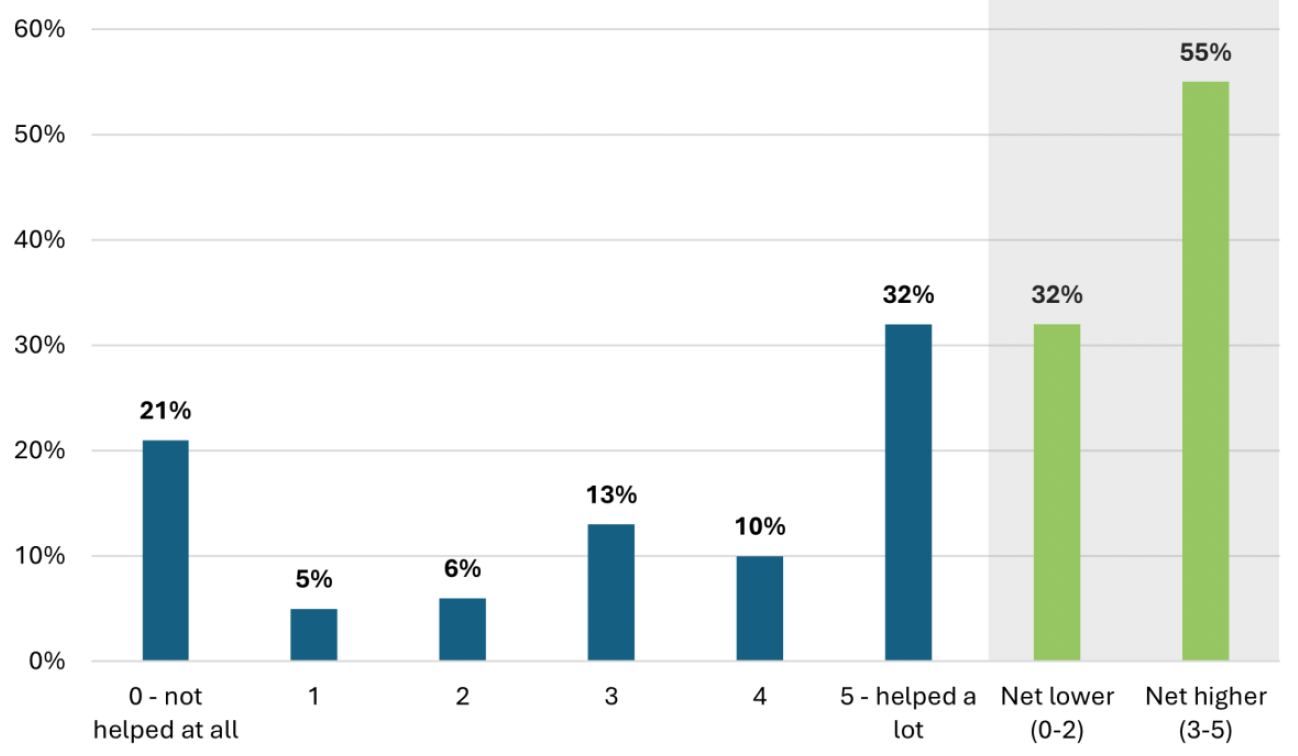
The only statistically significant differences related to the priority families at risk of poverty. Specifically, the following subgroups were more likely than others to rate Best Start Foods five (helped a lot) for helping them to pay for household essentials.
- Families with three or more children (39%) compared to families with one or two children (29%)
- Families with a child under 1 year old (39%) compared to families with no child under 1 year old (29%).
In qualitative interviews and survey open-text responses, parents and carers said receiving Best Start Foods helped them to pay for household essentials such as food, rent and utilities by providing dedicated income for food for their children, which freed up other income for household costs.
Best Start Grant and pressure on household finances
The commissioned research explored the impact of Best Start Foods on paying for household essentials. As shown earlier in this report, 29% of survey respondents who received at least one Best Start Grant payment said they used the payment(s) for day-to-day household costs and essentials. The only statistically significant differences related to the priority families at risk of poverty. Specifically, the following subgroups were more likely than others to say they used Best Start Grant for household essentials.
- Households with a disabled family member (32%) compared to those without a disabled family member (25%)
- Families from white ethnic backgrounds (31%) compared to those from minority ethnic backgrounds (21%)
- Families without a child under 1 year old (30%) compared to families with a child under 1 year old (22%).
In the survey, those who had received at least one Best Start Grant payment were also asked on a scale of zero (‘not at all’) to five (‘a lot’) how much the payment(s) helped them to pay for household essentials like food, rent, gas and electricity. As shown in Figure 10, 34% rated Best Start Grant five (helped a lot) for helping to pay for household essentials. Overall, 65% gave a higher rating of three to five, and 22% gave it a lower rating of zero to two.
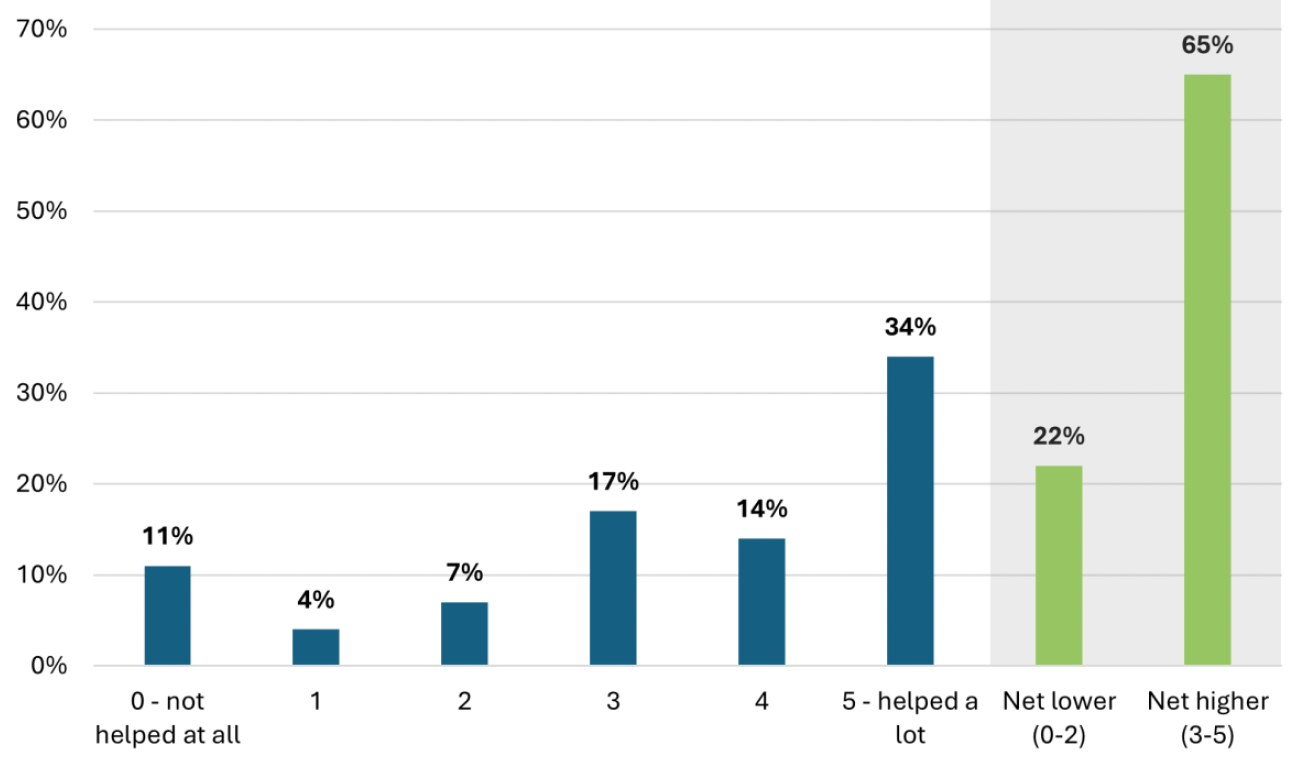
The only statistically significant difference between subgroups related to the priority families most at risk of poverty. Specifically, families from white ethnic backgrounds were more likely than those from minority ethnic backgrounds to say Best Start Grant helped ‘a lot’ with buying essential items (36% compared with 28%).
In the qualitative interviews, participants said that Best Start Grant helped with essential costs primarily because it allowed them to purchase what their child needed at key points, thereby freeing up other income to pay for food, housing and bills. However, some parents and carers who used Best Start Grant to pay for essentials directly, either completely or in part, said this was not how they planned to use the payments, but how they needed to use them at the time, often leading to feelings of guilt.
That’s money for the children you know so I think I would have probably wanted to buy them things that they were needing or even things that they would have liked, even just a wee toy or something […]. But that’s just not even on the radar when every penny is needed you know. So I think I always felt guilty getting money for the children and then having to spend it on something that was like [for the] household.
(Parent and carer interview)
Reduced money-related stress
It is intended that the Five Family Payments lead to reduced money-related stress. This outcome is therefore relevant to all of the Five Family Payments benefits. The commissioned research addressed this topic in the survey and qualitative interviews. The findings are presented below for each of the individual benefits.
Scottish Child Payment and money-related stress
The commissioned research explored the impact of Scottish Child Payment on money-related stress. In the survey, Scottish Child Payment recipients were asked if the payments made them feel less worried about money. As shown in Figure 11, 81% of respondents either strongly agreed (40%) or agreed (41%) that Scottish Child Payment made them less worried about money. 5% either disagreed (4%) or strongly disagreed (1%).
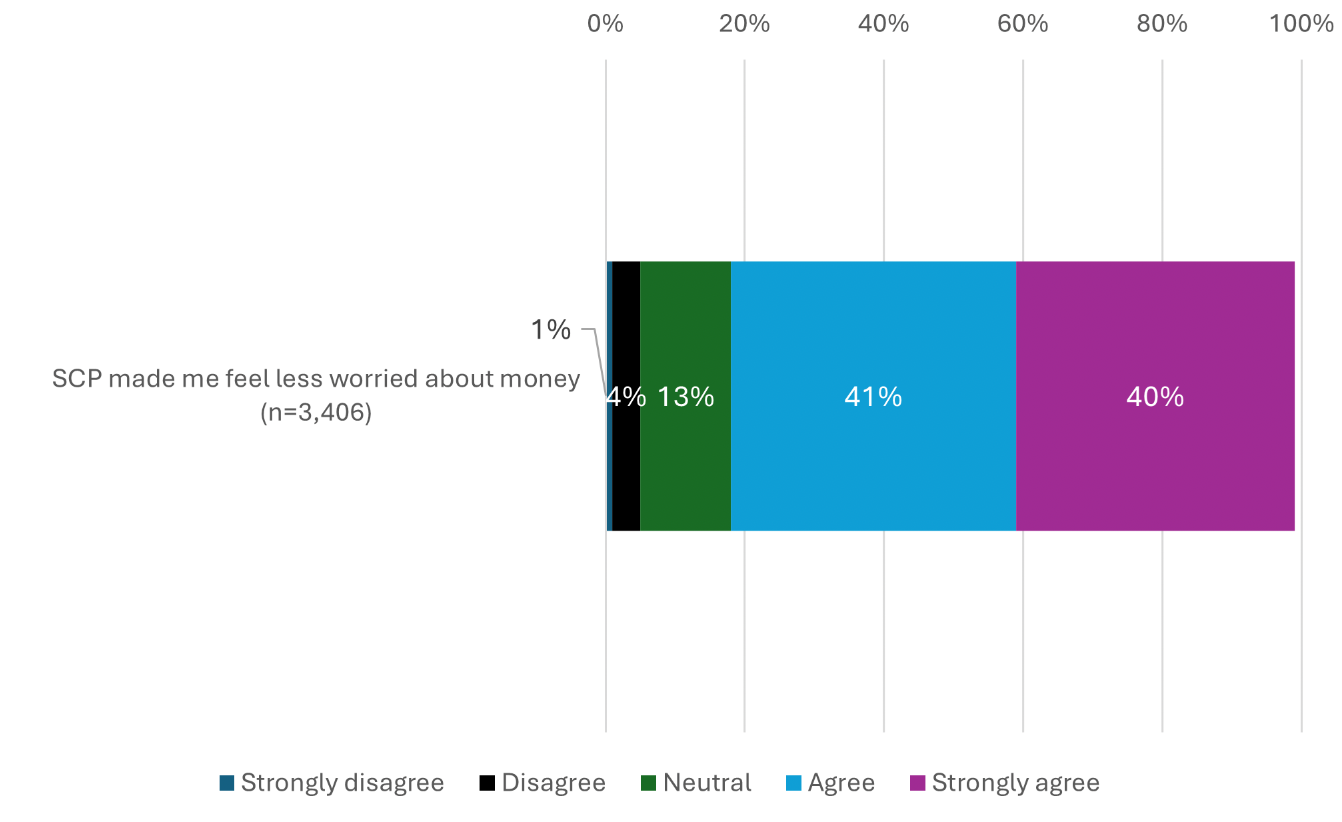
The only statistically significant difference related to the priority families at risk of poverty. Specifically, families with three or more children were more likely than families with one or two children to ‘strongly agree’ or ‘agree’ that Scottish Child Payment made them feel less worried about money (87% compared with 80%).
In the qualitative interviews and open-text survey responses, it was common for parents and carers to say that Scottish Child Payment reduced their money worries. Participants who used payments for household essentials said it reduced their financial stress by providing a ‘safety net’ if an unexpected cost came up. Scottish Child Payment helped some parents to budget or save, making them feel more in control of their finances and less worried about either expected or unexpected costs.
Before payments when new shoes, jackets or other more expensive clothing items would cause stress and need to cut back on other things for a few weeks to be able to afford items, I feel now I can buy those items when needed without the stress and worry.
(Survey respondent)
Some participants cited their personal circumstances (such as being a lone parent, having a large family or caring for a disabled family member) when describing how Scottish Child Payment helped to relieve some of the financial pressure they faced. This reflects the survey findings above, which show that families with three or more children were especially likely to ‘strongly agree’ or ‘agree’ that the payments made them feel less worried about money. It is also notable that, in the survey, families with three or more children and households with a disabled family member were especially likely to say Scottish Child Payment helped them to pay for household essentials.
The Scottish Child Payment has helped contribute towards a reduction in financial pressures after moving to a one income, one parent household with three young children. It is the difference between being able to do my monthly food shop and pay for my […] child’s lunches in cash rather than having to pay for it on my credit card and be constantly chasing my tail.
(Survey respondent)
However, some participants still struggled with their finances, often due to the cost of living crisis, and this meant that they worried about their finances.
With rising costs child payment is doing a little to help with the constant worry of money.
(Survey respondent)
Best Start Foods and money-related stress
The commissioned research explored the impact of Best Start Foods on money-related stress. In the survey, Best Start Foods recipients were asked if the payments reduced their money worries. As shown in Figure 12, 70% of respondents either strongly agreed (28%) or agreed (42%) that Best Start Foods made them less worried about money, while 7% either disagreed (5%) or strongly disagreed (2%).
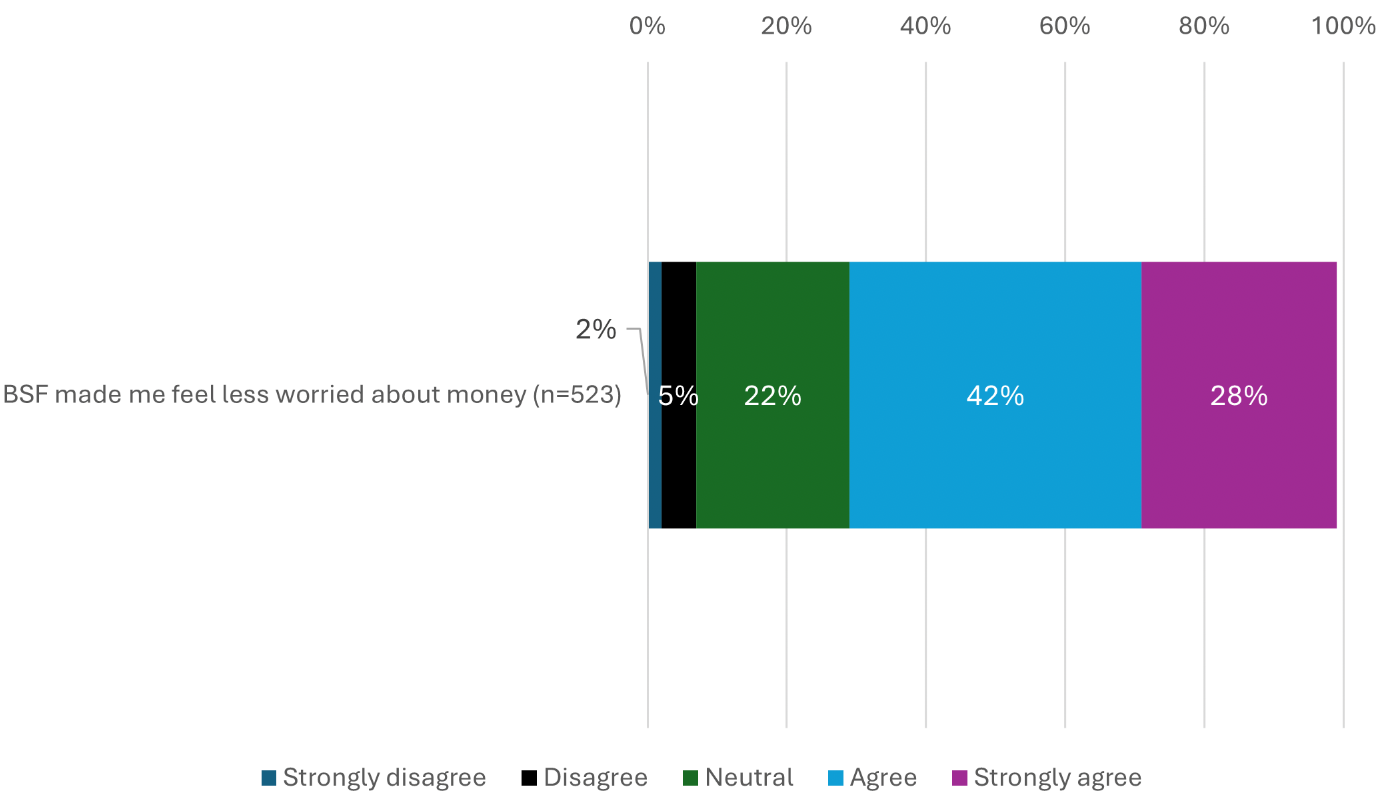
The only statistically significant differences related to the priority families at risk of poverty. Specifically, the following subgroups were more likely than others to ‘strongly agree’ or ‘agree’ that Best Start Foods made them feel less worried about money:
- Families from minority ethnic backgrounds compared to families from white ethnic backgrounds (80% compared with 67%).
- Families with a child aged under 1 year old compared to families with no child aged under 1 (78% compared with 65%).
In the qualitative interviews and open-text survey responses, parents and carers who received Best Start Foods said the payments helped them to afford food for their children, which let them use other income for unexpected costs, thereby easing financial strain. Best Start Foods also reduced worry amongst parents and carers of children with health conditions that restricted what their child could eat, because it helped them to afford specific foods their child required.
I honestly don’t know where we would be if we didn’t have that extra little bit of help…if he doesn’t like something right that’s okay we’ve got a little bit extra money so we can go and try something else for him. There are just so many things that he maybe doesn’t like because of the texture so that then enables us to go out and buy something else and he can try something else. It’s helped massively.
(Parent and carer interview)
Best Start Grant and money-related stress
The commissioned research explored the impact of Best Start Grant on money-related stress. In the survey, Best Start Grant recipients were asked if the payments reduced their money worries. As shown in Figure 13, 76% of respondents either strongly agreed (38%) or agreed (38%) that Best Start Grant made them less worried about money. 4% either disagreed (3%) or strongly disagreed (1%).
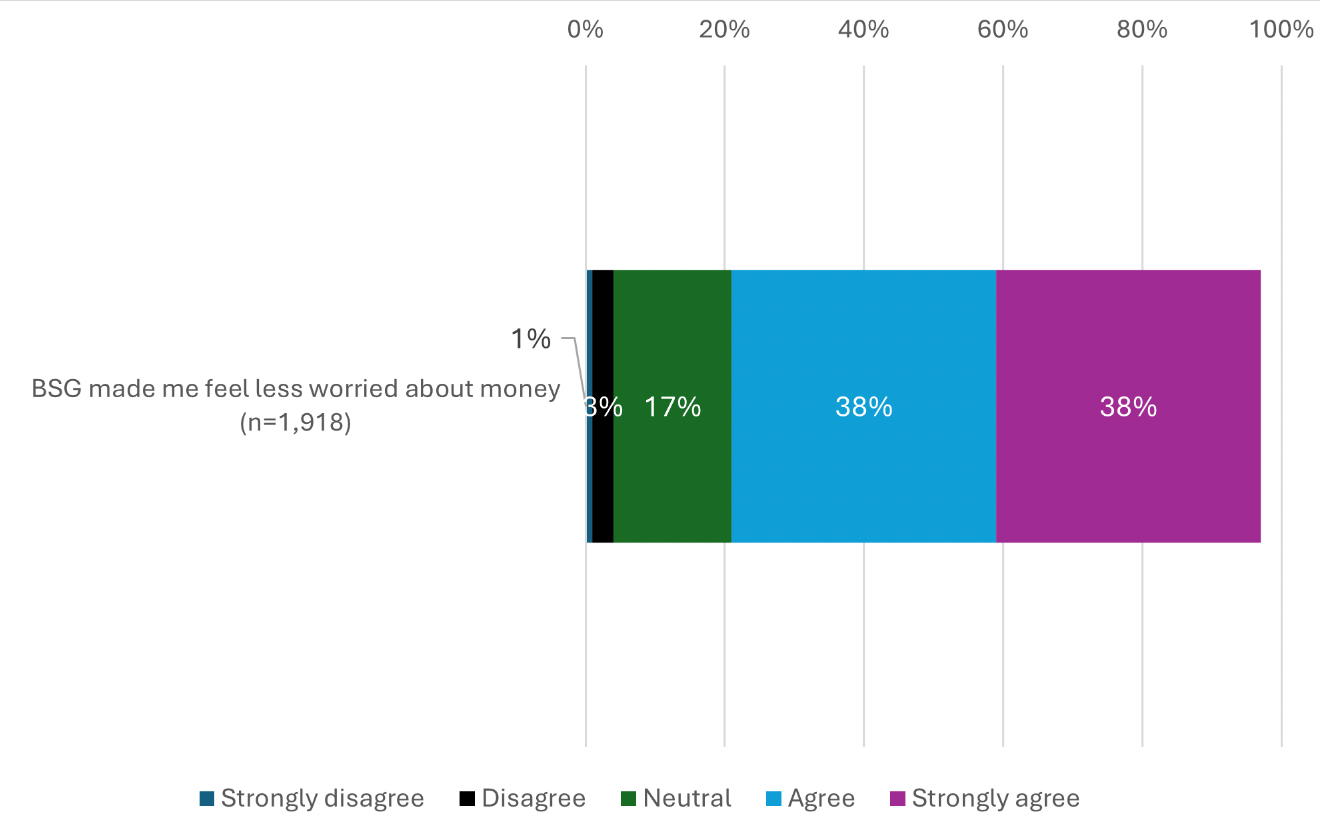
There was one statistically significant difference relating to the priority families at risk of poverty. Specifically:
- Families with two or more parents or carers were more likely than families with one parent or carer to ‘strongly agree’ or ‘agree’ Best Start Grant made them feel less worried about money (81% compared with 74%).
With regards to other subgroups:
- Respondents from the 20% least deprived areas were more likely than those from the 20% most deprived areas to ‘strongly agree’ or ‘agree’ that Best Start Grant made them feel less worried about money (81% compared with 74%).
In the qualitative interviews and open-text survey responses, participants said Best Start Grant made them feel less worried about money because it arrived at a time when spending on children could be higher (such as at birth, or going to nursery or school). Some said they would have stressed about meeting their child’s needs without the payments, potentially going without items or waiting until they had saved more money before buying them. Others said Best Start Grant gave them flexibility with their other income, meaning they could still do things with their child even if unexpected costs arose.
Obviously, before I got it [Best Start Grant]...I was struggling to be able to afford to buy stuff for her. I obviously didn't realise how expensive babies were or how expensive baby stuff was. Then when I got the maternity grant and I managed to buy her bedroom furniture that was a weight lifted off my shoulders for that.
(Parent and carer interview)
Children able to participate in social and educational opportunities
It is intended that Scottish Child Payment and Best Start Grant enable children to participate in social and educational opportunities. This outcome is therefore relevant to Scottish Child Payment and Best Start Grant specifically. The commissioned research addressed this topic in the survey and qualitative interviews. The findings are presented below for each benefit.
Scottish Child Payment and participation in social and educational opportunities
The commissioned research explored whether Scottish Child Payment had enabled children to take part in social and educational opportunities. In the survey, Scottish Child Payment recipients were asked on a scale of zero (‘not at all’) to five (‘a lot’) how much the payments helped their child to take part in social or educational activities such as clubs, classes, and trips out with other children or families. As shown in Figure 14, 48% rated Scottish Child Payment five (helped a lot) for helping their child to take part in social or educational activities. Overall, 76% gave a higher rating of three to five, and 18% gave a lower rating of zero to two.
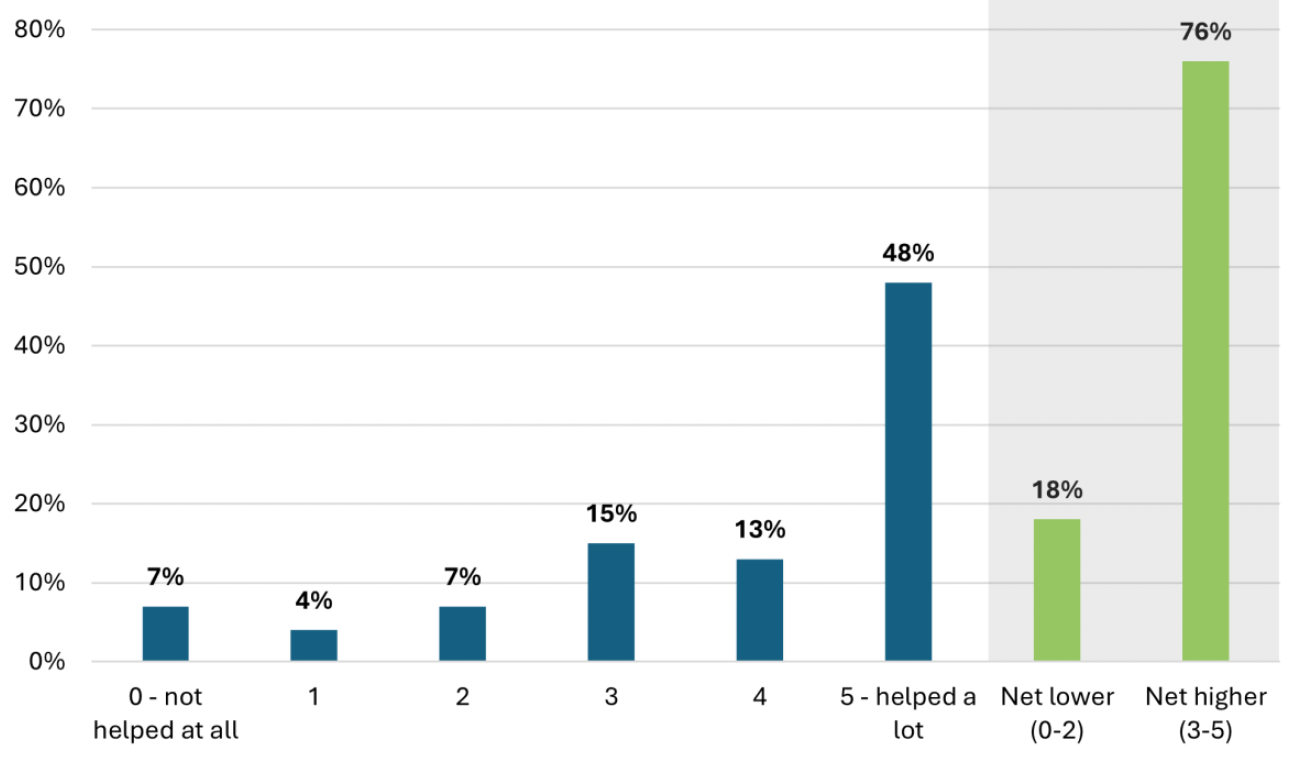
There was only one statistically significant difference between subgroups. Respondents who had been receiving Scottish Child Payment for over 12 months were more likely than those who had been receiving it for under 12 months to rate Scottish Child Payment five (helped a lot) for helping their children to take part in social and educational activities (51%, compared with 44%).
In the qualitative interviews and open-text survey responses, parents and carers said that Scottish Child Payment helped their child take part in activities such as sports (e.g. gymnastics, football), martial arts, music, drama, and clubs such as Scouts or Brownies. The payments also enabled whole families to take part in activities such as trips to the theatre, cinema, museum, and trips to visit family or friends, or to go on holiday. Participants who had children with additional support needs spent Scottish Child Payment on sensory educational items which they said could be expensive.
The extra money has helped my kids to do things we normally struggle with. Hobbies - both boys enjoying boxing club memberships, youth clubs and we were able to buy the boys new bikes for their birthdays this year…we have never been on holidays but days out and even extra money for Halloween costumes, good food, attending their friends birthday parties with a gift…It’s a massive blessing for our family.
(Survey respondent)
My eldest daughter, the one with autism, there are other things that she needs as well, just things to do with her autism, so that [SCP] all goes mainly for that. Yes, I think, because I now pay, as I say, for my daughter's drama course and for her music lessons, it's just stuff that I just never thought I would have been able to afford […] and it didn't happen without the Scottish Child Payment.
(Parent and carer interview)
Notably, some participants said they would have been able to afford these activities without Scottish Child Payment, though they may have had to do without something else. Others reported that without Scottish Child Payment they would not have been able to pay these costs of these activities at all - in some cases highlighting the impact of the cost of living increases - so their children would have done without.
Best Start Grant and participation in social and educational opportunities
The commissioned research also explored whether Best Start Grant had enabled children to take part in social and educational opportunities. The survey asked those who had received at least one Best Start Grant payment, on a scale of zero (‘not at all’) to five (‘a lot’), how much the payment(s) helped their child to take part in social or educational activities such as clubs, classes, and trips out with other children or families. As shown in Figure 15, 35% rated Best Start Grant five (helped a lot) for helping their child to take part in social or educational activities, whilst 64% gave it a higher rating of three to five. Around one in five respondents (20%) gave it a lower rating of zero to two.
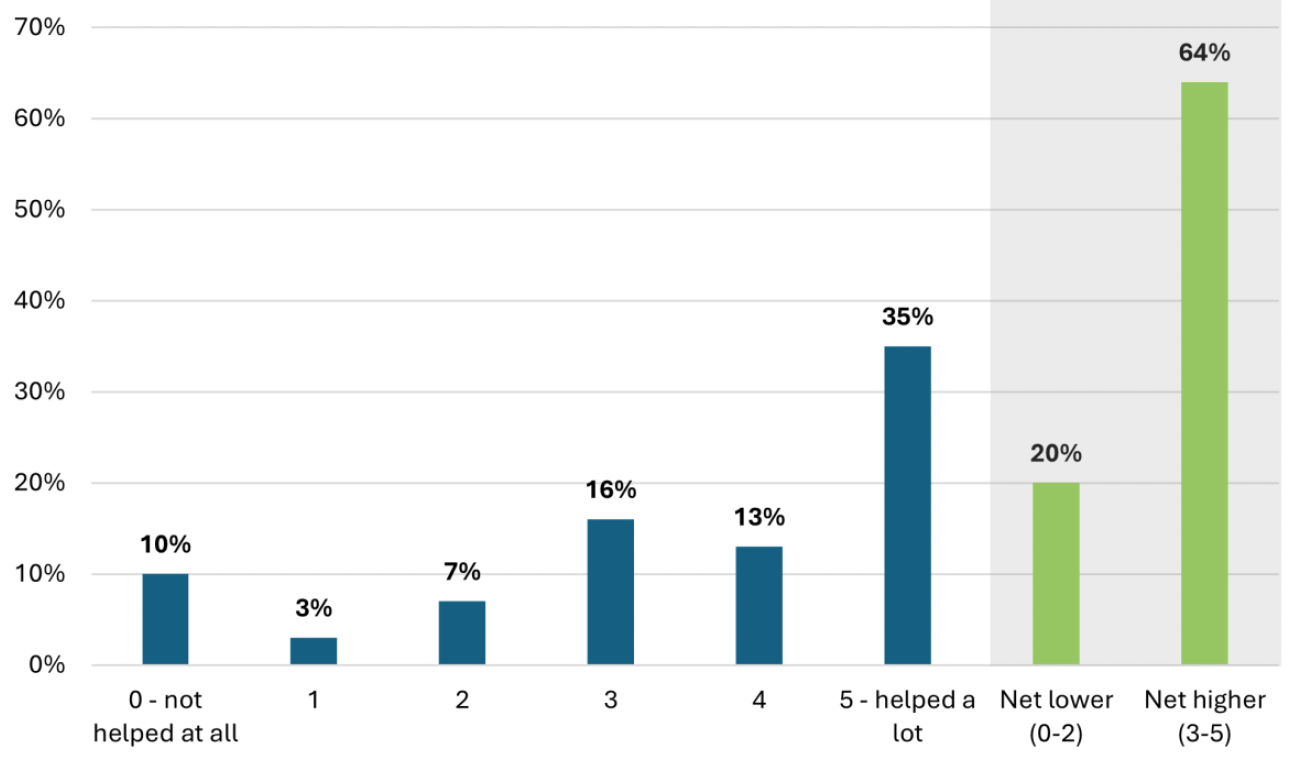
There was only one statistically significant difference between subgroups, and it related to a priority family at risk of poverty. Specifically, families with three or more children were more likely than families with one or two children to rate Best Start Grant five (helped a lot) for helping their children to take part in social and educational activities (40%, compared with 33%).
In the qualitative interviews and open-text survey responses, participants explained how they used Best Start Grant to pay for social and educational activities for their children. They said the Early Learning Payment was one they primarily used for this purpose, both for the child and the whole family. For example, some used the payment towards purchasing annual passes for local activity centres or places like the zoo. Some also used the payment to take their children on days out or to buy them toys.
Improved position of main carers within households
It is intended that Scottish Child Payment improves the position of main carers within households. This outcome is therefore relevant to Scottish Child Payment specifically. The Scottish Child Payment page on the Scottish Government website suggests the following to potential applicants: ‘The main person looking after your child (if any) might want to complete the application form, or use their bank details for payment.’ This is encouraged due to evidence suggesting child-related benefit payments being made to the children’s main carer (typically women) can reduce vulnerability to financial abuse within households,[40] and increase the likelihood the money will be spent on children.[41]
The commissioned research addressed this topic. In the survey, all respondents were asked about their gender identity, with 91% of respondents who answered the question (n=3,921) identifying as a woman. Respondents were also asked who had main caring responsibility for the children in their household. Amongst those who answered the question (n=3,522), two thirds (67%) said they alone had main caring responsibility, whilst a third (33%) said they shared main caring responsibility with someone else. Less than 0.5% (n=13) said that someone else in the household had main caring responsibility for their child.
The survey also asked Scottish Child Payment recipients whose bank account the payments were made into. Overall, of those who answered the question (n=3,406), 93% reported that Scottish Child Payment was paid into their own bank account. The results also show:
- 99% of those who alone had main caring responsibility for their child said Scottish Child Payment was paid into their own bank account (98%) or a joint account with their partner (1%)
- 97% of those who shared main caring responsibility of their child said Scottish Child Payment was paid into their own bank account (84%) or a joint account with their partner (13%)
- 2% of all respondents with some level of main caring responsibility for their child (i.e. alone or shared) said Scottish Child Payment was paid into their partner’s bank account
- 0.5% of all respondents with some level of main caring responsibility (i.e. alone or shared) said Scottish Child Payment was paid into another person’s bank account.
With regard to the final point above, a small number of respondents explained that by ‘another person’s’ bank account’ they meant payments were made directly into their child’s bank account, or the bank account of a family member. Some shared that Scottish Child Payment was paid into a family member’s bank account because that family member was their appointee, or had main caring responsibilities for their child.
Grant reaches people at key transition points in child’s life
It is intended that Best Start Grant payments reach families at key transition points in their children’s lives. This outcome is therefore related to Best Start Grant specifically. In the commissioned research, interview participants were asked what they thought about the timing of the Best Start Grant payments. Generally, those who had received at least one of the payments felt that the timings were appropriate, citing the essential and expensive items they needed to buy for their child at the time, such as prams, clothes for nursery and school uniforms.
I think the timings are really good for them yes, the whole pregnancy bit and then the nursery and then the school because that’s…its big major points in their life you know that you want it to go as smoothly as possible for them.
(Parent and carer interview)
Families financially supported at key transition points
It is intended that Best Start Grant payments support families at key transition points in their children’s lives. This outcome is therefore related to Best Start Grant specifically. The commissioned research asked questions to determine if Best Start Grant supports families at key transition points in their child’s life. The findings already presented in this report demonstrate that, overall, Best Start Grant does make families feel financially supported at key transition points. To recap relevant findings from the survey:
- 65% rated Best Start Grant five (helped a lot) for helping them to buy the things their child needed such as when they were born or started nursery or school. Overall, 89% gave a higher rating of three to five
- 34% rated Best Start Grant five (helped a lot) for helping to pay for household essentials. Overall, 65% gave a higher rating of three to five
- 76% strongly agreed or agreed that Best Start Grant made them less worried about money.
Evidence from the qualitative interviews and open-text survey responses shows that Best Start Grant payments helped parents and carers by freeing up other income for essential household costs. It also made recipients feel less worried about money because it arrived when spending on children can be higher, such as when they started nursery or school.
Healthy foods are more affordable
It is intended that Best Start Foods makes healthy foods more affordable to recipients. This outcome is therefore related to Best Start Foods specifically. In the commissioned survey, Best Start Foods recipients were asked on a scale of zero (‘not at all’) to five (‘a lot’) how much the payments helped them to buy healthier food for their family. The findings in Figure 16 show that 57% rated Best Start Foods five (helped a lot) for helping to buy healthier food for their family. Overall, 88% gave a higher rating of three to five, and 10% gave a lower rating of zero to two.
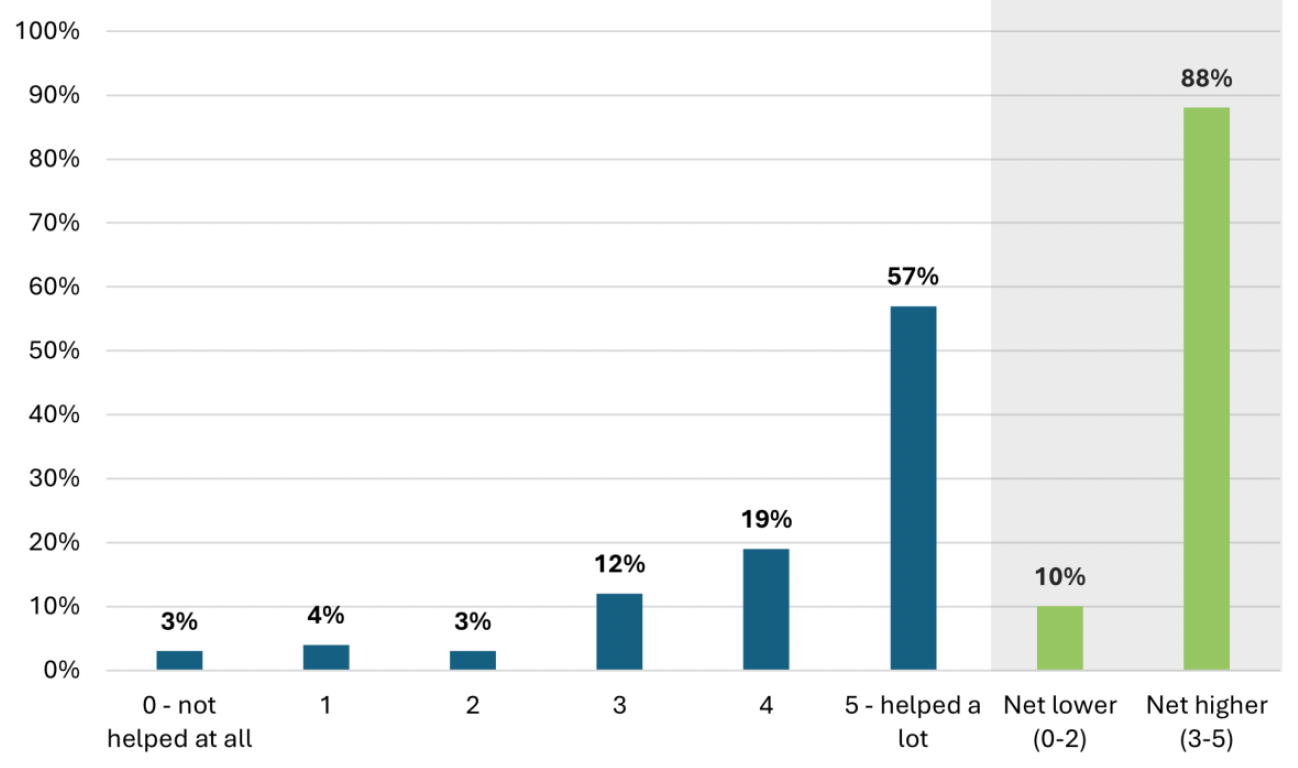
There was only one statistically significant difference relating to the priority families most at risk of poverty. Specifically:
- Families with three or more children were more likely than families with one or two children to say Best Start Foods helped ‘a lot’ with buying healthier food for their family (66% compared with 53%).
Regarding other subgroups with statistically significant differences:
- Families who had been receiving Best Start Foods for over 12 months were more likely than those who had been receiving it for up to 12 months to say it helped ‘a lot’ with buying healthier food for their family (63% compared with 52%).
In the qualitative interviews and open-text survey responses, Best Start Foods recipients spoke about how the payments had been particularly helpful to pay for first infant formula milk, which was described as expensive. Parents and carers also said that without Best Start Foods they would have had to cut down on the amount (or quality) of healthy foods they bought for their children. This was the case for some participants whose payments had stopped.
[If didn’t receive Best Start Foods] I'd probably need to put a limit on certain things, like I don't know, maybe make [child] not drink as much milk, so the milk could last a bit longer, or just shorten things that we're using, just so it can maybe last that bit longer, until I next get paid, or whatever.
(Parent and carer interview)
I was sad when it [Best Start Foods] stopped to be honest with you, I mean we never starved, the children never starved or anything like that, we never lacked, we just…we must have just…pulled our belts tighter. […] if you run out of milk you run out of milk that’s it for a few days until the next payment.
(Parent and carer interview)
Mothers and children eat more healthy foods
This outcome is specifically relevant to Best Start Foods. As mentioned in the Introduction chapter, Best Start Foods is a weekly sum of £5.40 available to pregnant women and families with children aged one and two, while families with children aged under one receive a double weekly payment of £10.80 to support both the mother and the child. It is therefore intended that Best Start Foods enables mothers and children to eat more healthy foods.
Participants in the commissioned research were asked questions to determine if Best Start Foods helps mothers and children eat more healthy foods. In the survey, Best Start Foods recipients were asked on a scale of zero (‘not at all’) to five (‘a lot’) how much the payments helped them, and their children, to eat more healthy foods. As shown in Table 18:
- 57% rated Best Start Foods five (helped a lot) for helping their child to eat more healthy food. Overall, 88% gave a higher rating of three to five, and 9% gave a rating of zero to two.
- 48% rated Best Start Foods five (helped a lot) for helping themselves to eat more healthy food. Overall, 81% gave a higher rating of three to five, and 13% gave a rating of zero to two.
| Survey measure | Total | 0 – not helped at all | 1 | 2 | 3 | 4 | 5 – helped a lot | Net lower (0-2) | Net higher (3-5) |
|---|---|---|---|---|---|---|---|---|---|
| Helped my child to eat healthier food | 519 | 2% | 2% | 4% | 13% | 18% | 57% | 9% | 88% |
| Helped me to eat healthier food | 519 | 5% | 4% | 4% | 15% | 18% | 48% | 13% | 81% |
There was one statistically significant difference relating to the priority families most at risk of poverty:
- Families with three or more children were more likely than families with one or two children to say Best Start Foods helped ‘a lot’ with eating more healthy food themselves (55% compared with 44%).
Regarding other subgroups with statistically significant differences:
- Respondents who had been receiving Best Start Foods for over 12 months were more likely than those who had been receiving it for up to 12 months to say it helped ‘a lot’ with their child eating more healthy food (63% compared with 51%).
Supports healthier shopping habits and meal planning
It is intended that Best Start Foods supports healthier shopping habits and meal planning. This outcome is therefore relevant to Best Start Foods, specifically.
As shown in the findings above, Best Start Foods has made healthy foods more affordable for recipients, and has helped mothers and children eat more healthy food. Participants in the commissioned research were also asked questions to determine if Best Start Foods supports healthier shopping habits and meal planning. The survey asked Best Start Foods recipients on a scale of zero (‘not at all’) to five (‘a lot’) how much the payments helped them to make healthier meals for their families. The findings in Figure 17 show that 52% rated Best Start Foods five (helped a lot) for helping to make healthier meals for their families. Overall, 83% gave a higher rating of three to five, and 12% gave a lower rating of zero to two.
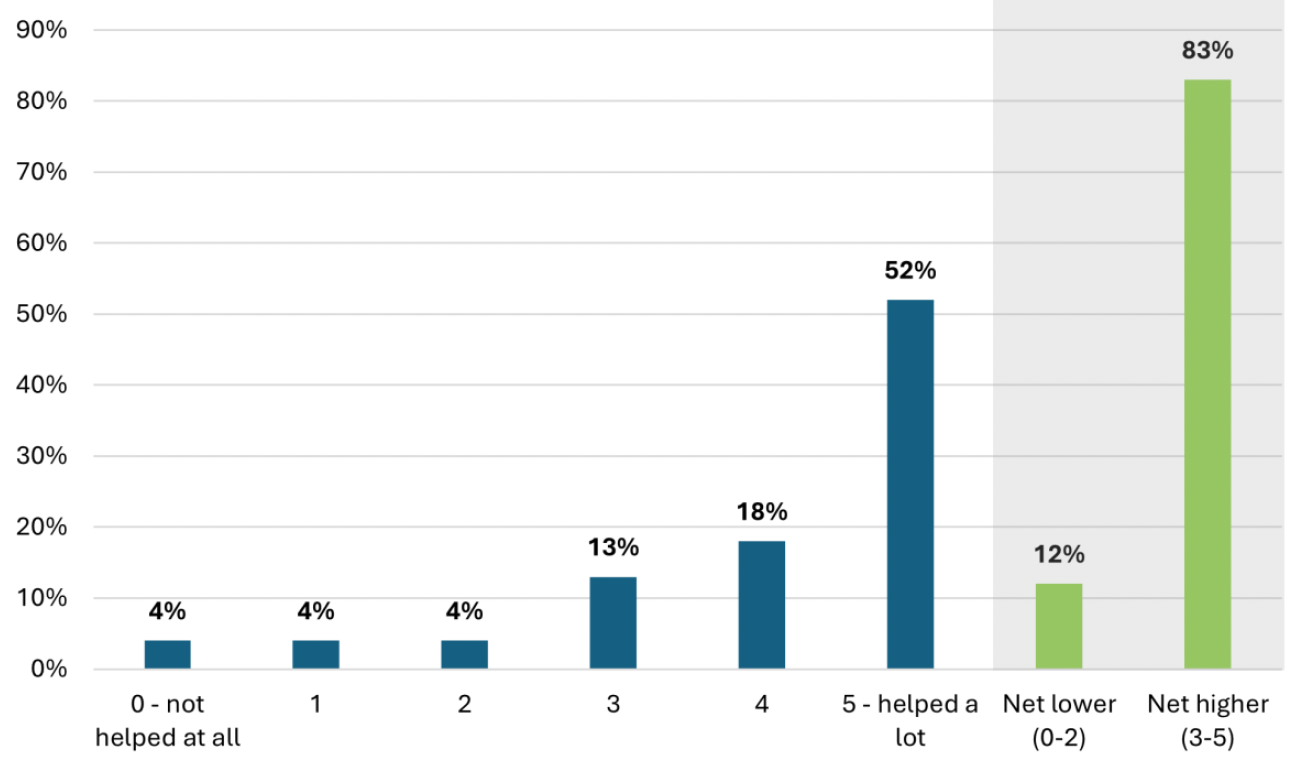
The only statistically significant difference between subgroups related to the length of time receiving Best Start Foods. Respondents who had been receiving Best Start Foods for over 12 months were more likely than those who had been receiving it for up to 12 months to say it helped ‘a lot’ with making healthier meals for their families (57% compared with 47%).
Recap of achievement against short-term outcomes
This evidence presented throughout this section shows that for most recipients:
- The Five Family Payments benefits have helped to increase child-related spend, reduce financial pressure on households, and relieve money-related stress
- Scottish Child Payment and Best Start Grant helped children to take part in social and educational opportunities
- Scottish Child Payment was paid directly to the vast majority of main carers
- Best Start Grant payments arrived, and supported them financially, at key transition points, enabling them to buy what their child needed
- Best Start Foods helped to make healthy foods more affordable, enabled children and their mothers to eat more healthy foods, and supported them to make healthier meals.
It is also clear from the evidence that the individual Five Family Payments benefits had a distinct impact on recipients. For example, Scottish Child Payment recipients said the payments made them feel relieved at being able to afford essential items on an ongoing basis (e.g. clothes for their child), while Best Start Grant and Best Start Foods recipients said the payments made them feel relieved because having those payments for a designated purpose freed up income to meet other expenses. It is therefore likely that the payments have a positive cumulative effect for those who receive more than one of the benefits.
Despite these positive findings, the evidence also highlights some issues faced by Five Family Payments recipients. Notably, some parents reported that despite the benefits they still faced financial difficulties and struggled to meet essential costs. However, overall, the findings indicate that short-term Five Family Payments outcomes are being achieved. According to the Five Family Payments theory of change, this makes it possible for medium-term policy outcomes to be achieved. Actual achievement against medium-term policy outcomes is explored in the section below.
Achievement against medium term Five Family Payment policy outcomes
This section evaluates the Five Family Payments against the following policy outcomes, which are relevant to one or more of the benefits:
- Reduced incidence of debt (All benefits)
- Reduced incidence of food insecurity (Scottish Child Payment and Best Start Foods)
- Reduced incidence of material deprivation (Scottish Child Payment and Best Start Grant)
- Improved health and wellbeing (All benefits)
- Increased healthy eating behaviours (Best Start Foods)
- Reduced barriers to labour market and education (Scottish Child Payment)
- Positive impact on the Scottish economy (All benefits)
It uses data from the bespoke commissioned research, which involved (i) a survey of Five Family Payment recipients and (ii) interviews with Five Family Payments recipients and stakeholders who support low income families. It also cites findings from labour market analysis conducted by the Scottish Government, and research from external organisations. The section ends with a recap of achievement against medium-term Five Family Payments policy outcomes.
Throughout this section, notable differences in how commissioned survey respondents answered questions in the survey have been presented. As explained in the Methodology chapter, subgroup differences are reported in cases where the difference between the subgroups is statistically significant. The subgroup differences are discussed in more detail in the ‘discussion of progress towards Five Family Payments outcomes’ section.
Reduced incidence of debt
As shown in the previous section, the Five Family Payments helped to reduce financial pressure on households and helped families to buy their children essential items. It can therefore be reasonably expected that each of the Five Family Payments benefits will have reduced incidence of debt. The commissioned research addressed this topic in the survey and qualitative interviews. The findings are presented below for each of the individual benefits.
Scottish Child Payment and debt
The commissioned research explored the impact of Scottish Child Payment on incidence of debt. In the survey, Scottish Child Payment recipients were asked if the payments meant they did not need to borrow money to pay for essentials such as rent, food and bills. As shown in Figure 18, 58% of respondents either strongly agreed (25%) or agreed (33%) Scottish Child Payment meant they did not need to borrow money to pay for essentials, while 15% strongly disagreed (3%) or disagreed (12%).
The only statistically significant difference related to the priority families at risk of poverty. Specifically, families with three or more children were more likely than families with one or two children to ‘strongly agree’ or ‘agree’ Scottish Child Payment meant they did not need to borrow money for essentials (67% compared with 57%).
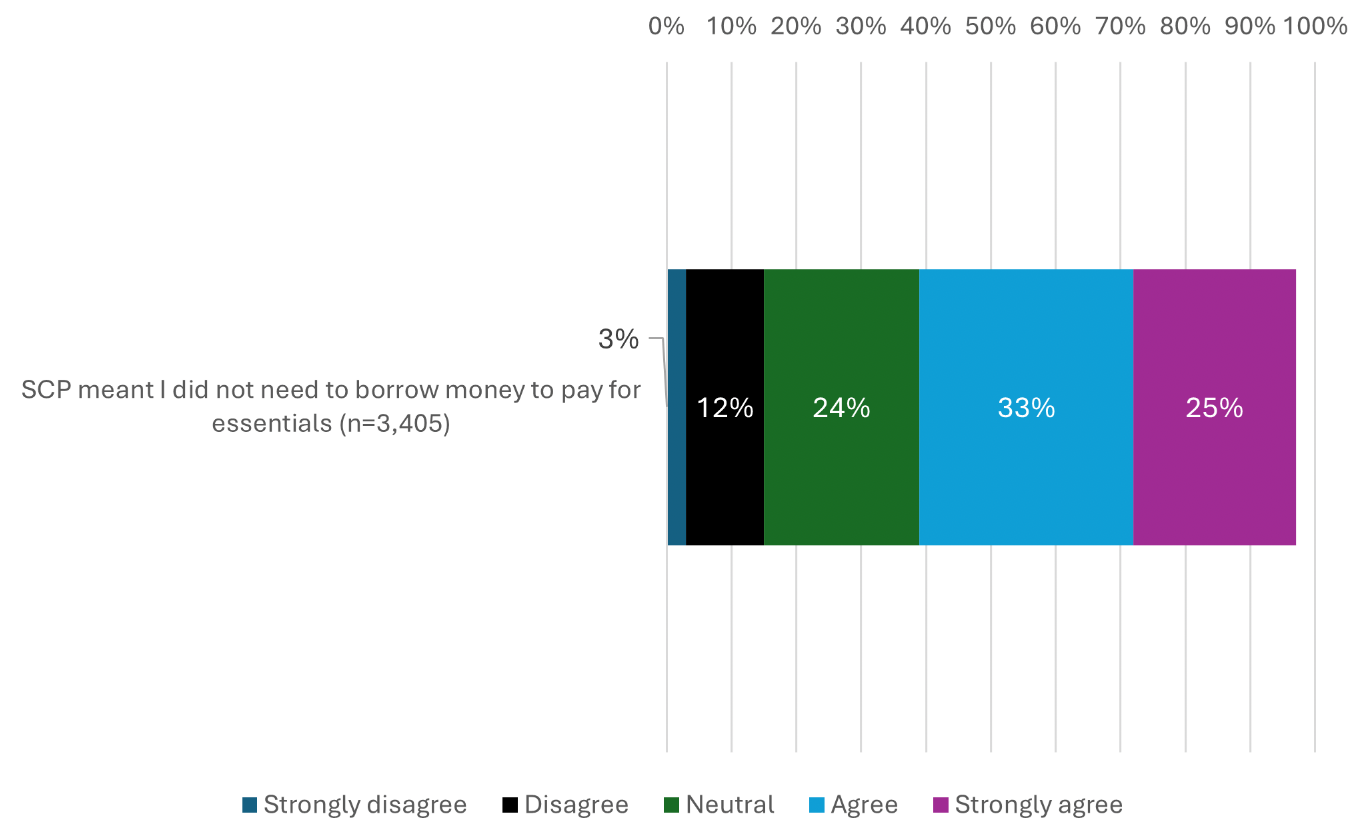
In the qualitative interviews and open-text survey responses, parents explained how Scottish Child Payment impacted their need to borrow money for essentials. For example, some said the payments meant they did not need to borrow money from family, credit cards or loan companies. Others said they needed to borrow less frequently as a result of the payments, or were able to borrow in a more planned way, paying off a certain amount each month. Some also said Scottish Child Payment was helping them to pay off existing debt.
The payment has helped immensely it could be rent or food or that’s unexpected new shoes or wow holiday let’s have a treat at the weekend without it we would be in more debt than what we are.
(Survey respondent)
The money has help my wee family a lot it has took a strain off myself worrying how I can afford clothes and shoes for my son. And helped dig me out a hole with debts.
(Survey respondent)
There were parents and carers who said Scottish Child Payment meant they could save money, either for unexpected expenses like a boiler breakdown, or for larger costs like a new car or house deposit. Some also said Scottish Child Payment gave them an opportunity to teach their children about budgeting, or to put money in their child’s bank account for the future.
I pay full rent, don’t qualify for school meals, school uniforms and my son doesn’t get Education maintenance allowance as I earn more than £26k. Without SCP I wouldn’t be able to save for a deposit- I have £5k saved.
(Survey respondent)
Receiving Scottish Child Payment has helped my children to understand budgeting and prioritising spends. I use a part of this money to provide my children pocket money and both are proving to be very money savvy.
(Survey respondent)
However, some parents and carers also said that, even with Scottish Child Payment, they still need to borrow money from family or formal credit sources. This reflects the survey findings above, which show 15% disagreed Scottish Child Payment meant they did not need to borrow money to pay for essentials. In the open-text survey responses and interviews, ‘Buy now, pay later’ providers such as Zilch, Clear Pay and Klarna were all mentioned by participants.
Sometimes what I actually do is I use an app called Zilch and if things are really bad. […] So when my £100 goes in my Child Payment if I’ve got other things to pay or say I know that maybe my son has got something that he really needs that week I would use the Zilch […] It just helps ease it a wee bit because you’re able to pay it over your 6 weeks.
(Parent and carer interview)
Best Start Foods and debt
The commissioned research explored the impact of Best Start Foods on incidence of debt. In the survey, Best Start Foods recipients were asked if the payments meant they did not need to borrow money to pay for essentials such as rent, food and bills. As shown in Figure 19, 50% of respondents either strongly agreed (20%) or agreed (30%) Best Start Foods meant they did not need to borrow money to pay for essentials, while 20% strongly disagreed (5%) or disagreed (15%)
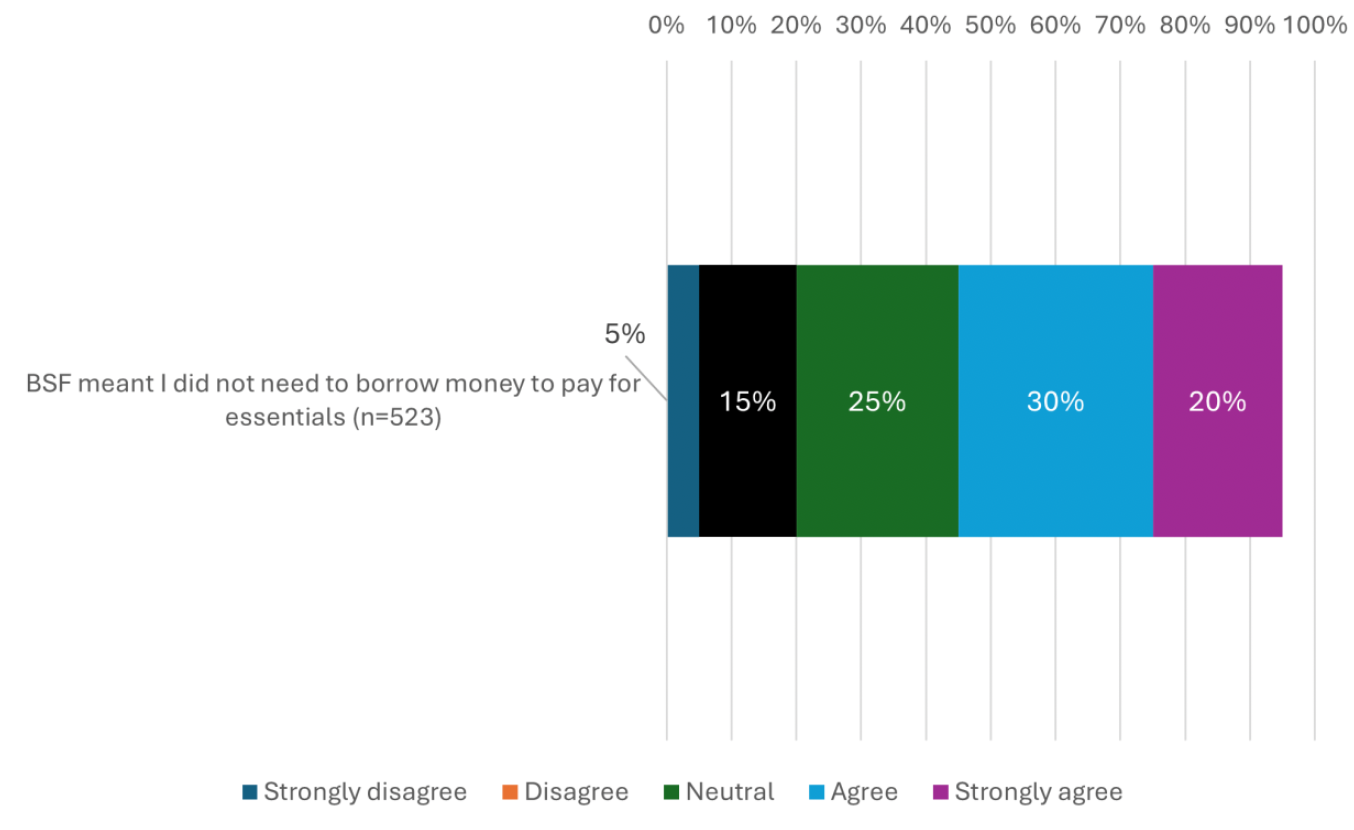
In the qualitative interviews and open-text survey responses, Best Start Foods recipients said the payments helped them pay for essential items, and this reduced their need to borrow money, or gave them some financial security if they faced unexpected costs.
It [Best Start Foods] has helped in a positive way because it obviously does relieve some stress about food. Say one month I got less Universal Credit, or I did have to spend more on something, like, with Christmas coming up, then I know, well, if I really needed to, I can go and get fruit, veg, eggs, milk, and bread with the card. […] I know that if something came out my bank unexpectedly…I can still go to the shop and get food without having to phone my mum.
(Parent and carer interview)
Best Start Grant and debt
The commissioned research explored the impact of Best Start Grant on incidence of debt. In the survey, Best Start Grant recipients were asked if the payments meant they did not need to borrow money to buy things for their child when they were born, or when they started nursery or school. As shown in Figure 20, 69% of respondents either strongly agreed (32%) or agreed (37%) Best Start Grant meant they did not need to borrow money to pay for essentials, while 8% strongly disagreed (2%) or disagreed (6%).
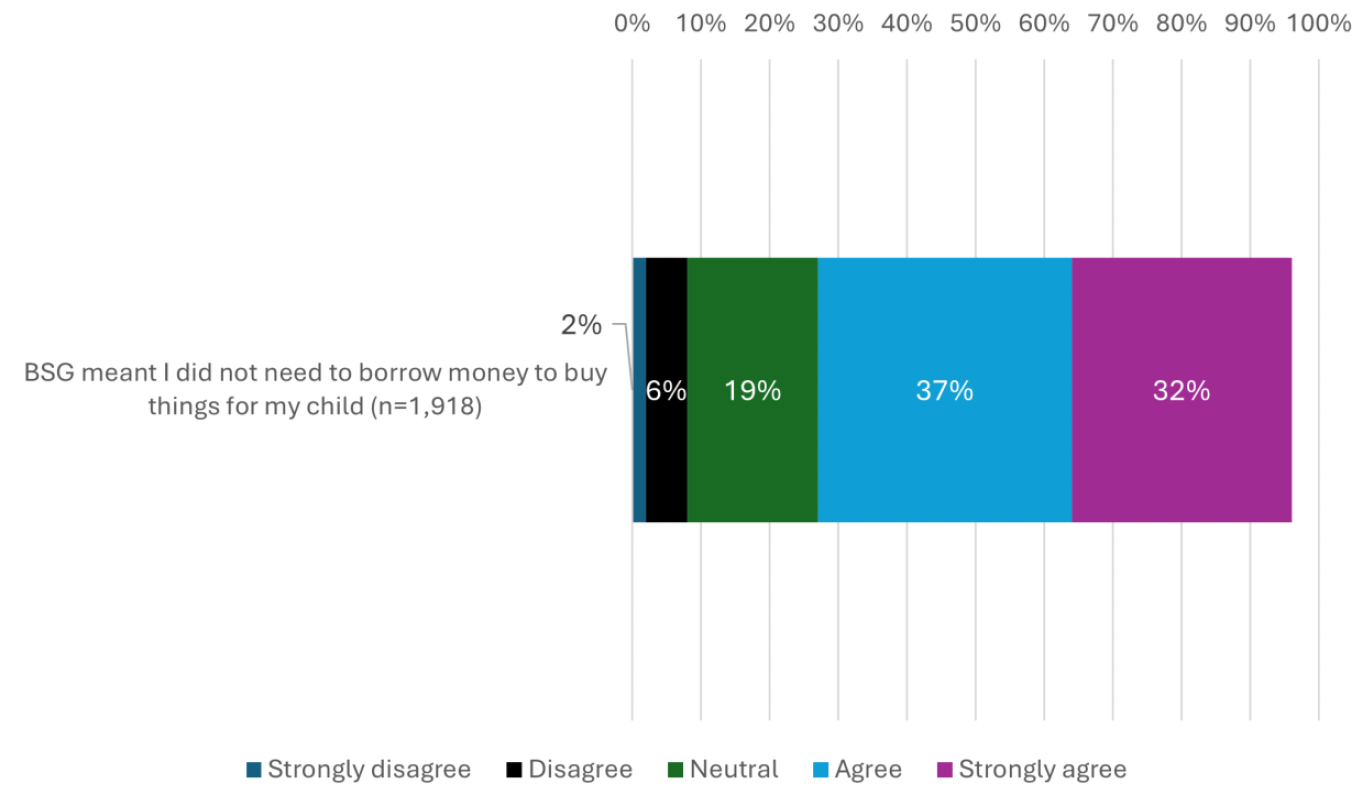
The only statistically significant difference related to the priority families at risk of poverty. Specifically, families with three or more children were more likely than families with one or two children to ‘strongly agree’ or ‘agree’ Best Start Grant meant they did not need to borrow money to buy things for their child when they were born, or when they started nursery or school (76% compared with 67%).
In the qualitative interviews and open-text survey responses, Best Start Grant recipients were clear that without the payments they would have had to borrow money to pay for what their child needed. Some parents and carers said they would have borrowed from family members who were themselves struggling financially, whilst others said they would have had to use credit cards or loan providers, or would have gone into debt with utility providers to cover the costs.
I would probably have had to borrow money for like the pram and that at the time or try to get it on credit or something. […] I would have eventually got it but it would have been paying it up over time. It was easier obviously being able to buy it outright.
(Parent and carer interview)
Probably not paid my rent for a couple of months. […] it would have increased my long term costs because I would have said to them right, I can’t…I’m not going to pay my rent, I’m not going to pay my gas and electric this month. Robbing Peter to pay Paul. […] It would have been a higher monthly cost […] Like so it would have eventually had a knock on effect leaving me not able to pay anyone.
(Parent and carer interview)
There were participants who said Best Start Grant prevented them going into debt to pay for unexpected costs. For example, one parent said their car broke down and they used Best Start Grant for the repair, which meant they did not use it to buy their child clothes and days out, as planned. However, they needed the car to drive their child to activities and go shopping, so the repair benefitted the whole family.
Reduced incidence of food insecurity
As shown earlier in this report, Scottish Child Payment and Best Start Foods have helped recipients to pay for food, both for themselves and their children. It is therefore expected that these benefits will have reduced incidence of food insecurity amongst recipients. This topic has been addressed in external research by the Fraser of Allander Institute and in the commissioned research.
The Fraser of Allander Institute conducted a preliminary evaluation on the impact of Scottish Child Payment on food bank use. It found Scottish Child Payment had a statistically significant impact on food bank use for some (but not all) household types with children. Specifically, it found decreased food bank usage for single-adult households with children aged 0-4, and households with children aged 5-16 without younger children. There was also limited evidence of a decrease in food bank use for larger households (with three or more children) with children aged under 5. The effects were largest in late 2022 and early 2023 after Scottish Child Payment rose to £25 per week.[42]
The commissioned research explored the impact of both Scottish Child Payment and Best Start Foods on food security. In the survey, recipients were asked if they agreed or disagreed the benefits meant they did not need a food bank or food parcels. As shown in Figure 21:
- 64% of respondents either strongly agreed (29%) or agreed (35%) that Scottish Child Payment meant they did not need a food bank or food parcels, while 11% strongly disagreed or disagreed.
- 60% of respondents either strongly agreed (27%) or agreed (33%) that Best Start Foods meant they did not need a food bank or food parcels, while 13% strongly disagreed or disagreed.
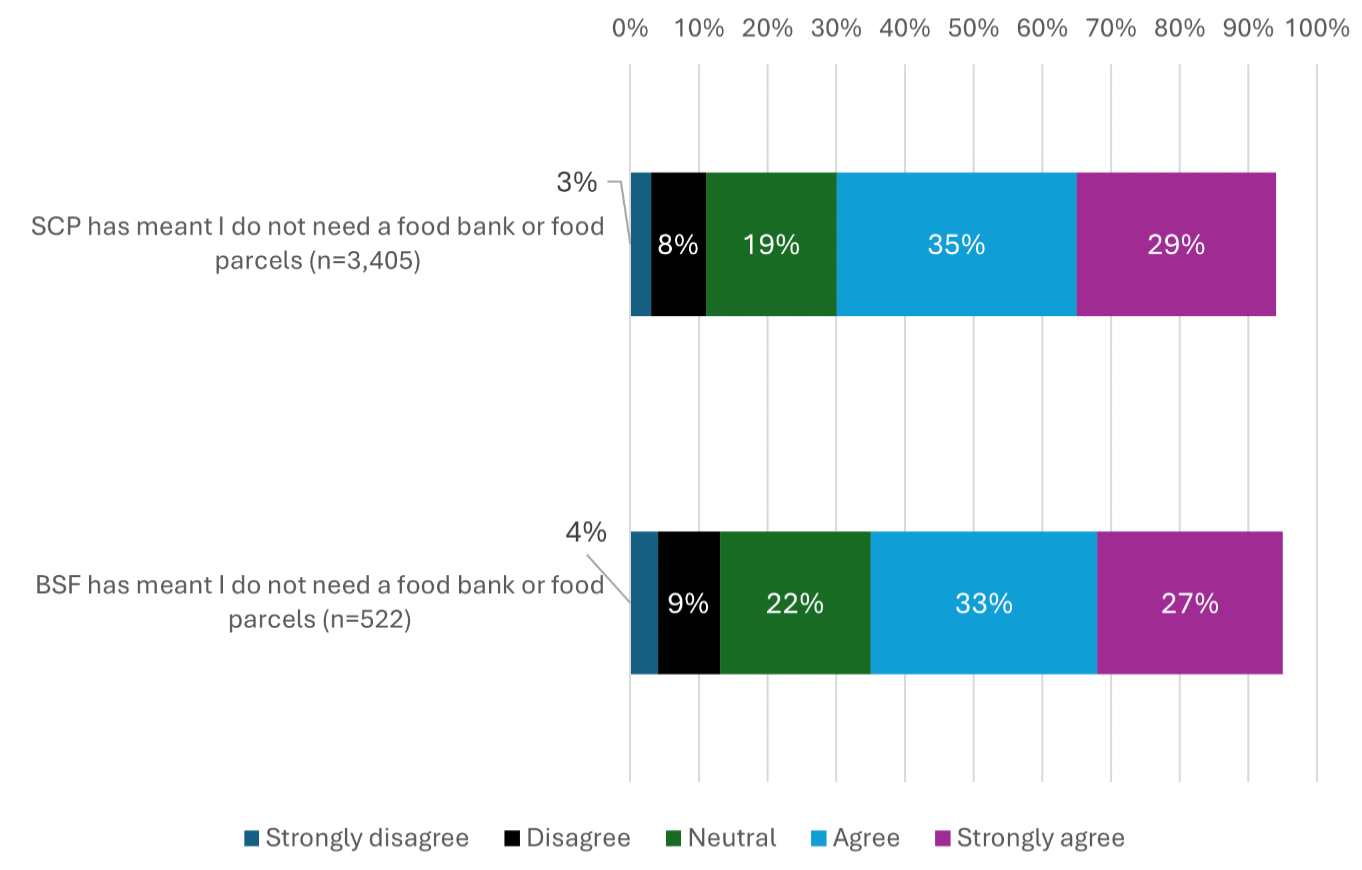
There were statistically significant differences relating to the priority families at risk of poverty. Specifically, families with three or more children were more likely than families with one or two children to:
- ‘Strongly agree’ or ‘agree’ that Scottish Child Payment meant they did not need a food bank or food parcels (70% compared with 63%).
- ‘Strongly agree’ or ‘agree’ that Best Start Foods meant they did not need a food bank or food parcels (67% compared with 56%).
These findings reflect those from the Fraser of Allander Institute research, cited above, which provided limited evidence that food bank use decreased for larger households (with three or more children) with children aged under 5.
Regarding other subgroups with statistically significant differences in the commissioned survey:
- Respondents who had been receiving Best Start Foods for over 12 months were more likely than those who had been receiving it for up to 12 months to ‘strongly agree’ or ‘agree’ the payments meant they did not need a food bank or food parcels (65% compared with 55%).
Responses from qualitative interviews and open-text survey questions on food bank use mostly related to Scottish Child Payment. For some recipients, Scottish Child Payment stopped them from needing a food bank, or from cutting back on food. Others said it helped to reduce anxiety around providing food for their children.
It had helped to stop using food banks and being able to buy healthier food instead of all ultra processed or dried noodles...it's also stopped gas and electricity being cut off.
(Survey respondent)
It [Scottish Child Payment] did make a massive difference because it was able to nudge things over so that food security was one hundred per cent improved […] So for me, it made a massive difference for the variety of food, so for my eldest daughter, it helped.
(Parent and carer interview)
However, as indicated by the survey findings above, Scottish Child Payment did not prevent food insecurity for all families. Some reported having to cut back on their own meals to ensure that their children could eat.
I think I would have had to rely on food banks if [Scottish Child Payment] didn’t come. I’ve got to say I have been very very very very close to having to get a food bank parcel just recently. That’s why I had to get this job at [supermarket], I had to get it because I am really really struggling for food. I always made sure she was eating, I cut my meals down to one a day. […] I was hungry all the time too but I’m fine now.
(Parent and carer interview)
Reduced incidence of material deprivation
It is intended that the Five Family Payments lead to reduced incidence of material deprivation. This outcome is therefore relevant to all of the Five Family Payments benefits. Material deprivation refers to the inability to afford basic resources and services considered necessary for an acceptable standard of living. These basic resources and services relate to households in general, and also to individuals (adults and children) within households. They include, but are not limited to:
- The ability to pay bills on time and save money
- Being without regular money worries
- Being able to eat three meals a day
- Being able to afford school trips (child)
- Having enough clothes which are comfortable to wear (child)
- Having age suitable toys/games (child).[43]
The cumulative findings from the commissioned research, which have been presented throughout this report, demonstrate that the Five Family Payments have helped to reduce material deprivation for families and children. In the survey, most respondents said the payments helped them with child-related spend, including essentials such as clothes and food, which were cited as key areas of spend by parents. Most also said the payments helped them with school-related costs, buying their child treat items, and enabling their child to take part in social and educational activities. The qualitative evidence indicates that recipients would have struggled to afford certain child-related costs without the benefits, and in some cases may have gone without items, or made cut backs elsewhere to afford them.
According to the survey, the Five Family Payments also helped most families to pay for household essentials (such as rent, food, and bills) and reduced money-related stress. They also reduced the need for borrowing to pay for essential items, and helped families cope with unexpected costs. The findings also show that Scottish Child Payment and Best Start Foods have helped to reduce the need for food banks. A prelimiary evaluation by the Fraser of Allander Institute also found that Scottish Child Payment led to decreased food bank usage across some, but not all, groups of households with children.
However, while it is not a policy outcome of the Five Family Payments to end material deprivation for families with children (rather to reduce material deprivation), the evaluation shows there are recipients who still experience financial difficulties, money worries, and challenges paying for essential items. Also, in the interviews and open-text survey responses, some recipients said that they worried about the payments ending when their child was no longer eligible. In some cases they called for Scottish Child Payment and Best Start Foods to be extended to older children.
I’ve had a letter to say SCP for my daughter will stop soon as she turns 16 in December. I strongly disagree with this as she will still be in full time education and not working so she is still dependent on me. This will have a huge impact on my finances.
(Survey respondent)
Best Start Foods has been a huge help but actually it would be good to have money to cover older children too so I can use it for ingredients to make healthy dinners.
(Survey respondent)
Improved health and wellbeing
As shown throughout the Findings chapter, the Five Family Payments have helped recipients with a range of child-related and household costs (e.g. essentials such as food and medicine, and social and educational activities), and reduced money-related stress. It is therefore expected that the Five Family Payments will have improved health and wellbeing for recipients. This topic was addressed in the commissioned research survey and interviews. The findings are presented below for each of the individual benefits.
Scottish Child Payment and health and wellbeing
The commissioned research explored the impact of Scottish Child Payment on recipients’ own health and wellbeing. In the survey, Scottish Child Payment recipients were asked if they agreed or disagreed that the payments improved (a) their own mental health and/or happiness, and (b) their own physical health. The findings in Figure 22 show that:
- 69% of respondents either strongly agreed (29%) or agreed (40%) that Scottish Child Payment improved their own mental health and/or happiness, while 7% strongly disagreed or disagreed.
- 44% of respondents either strongly agreed (17%) or agreed (27%) that Scottish Child Payment improved their own physical health, while 11% strongly disagreed or disagreed.
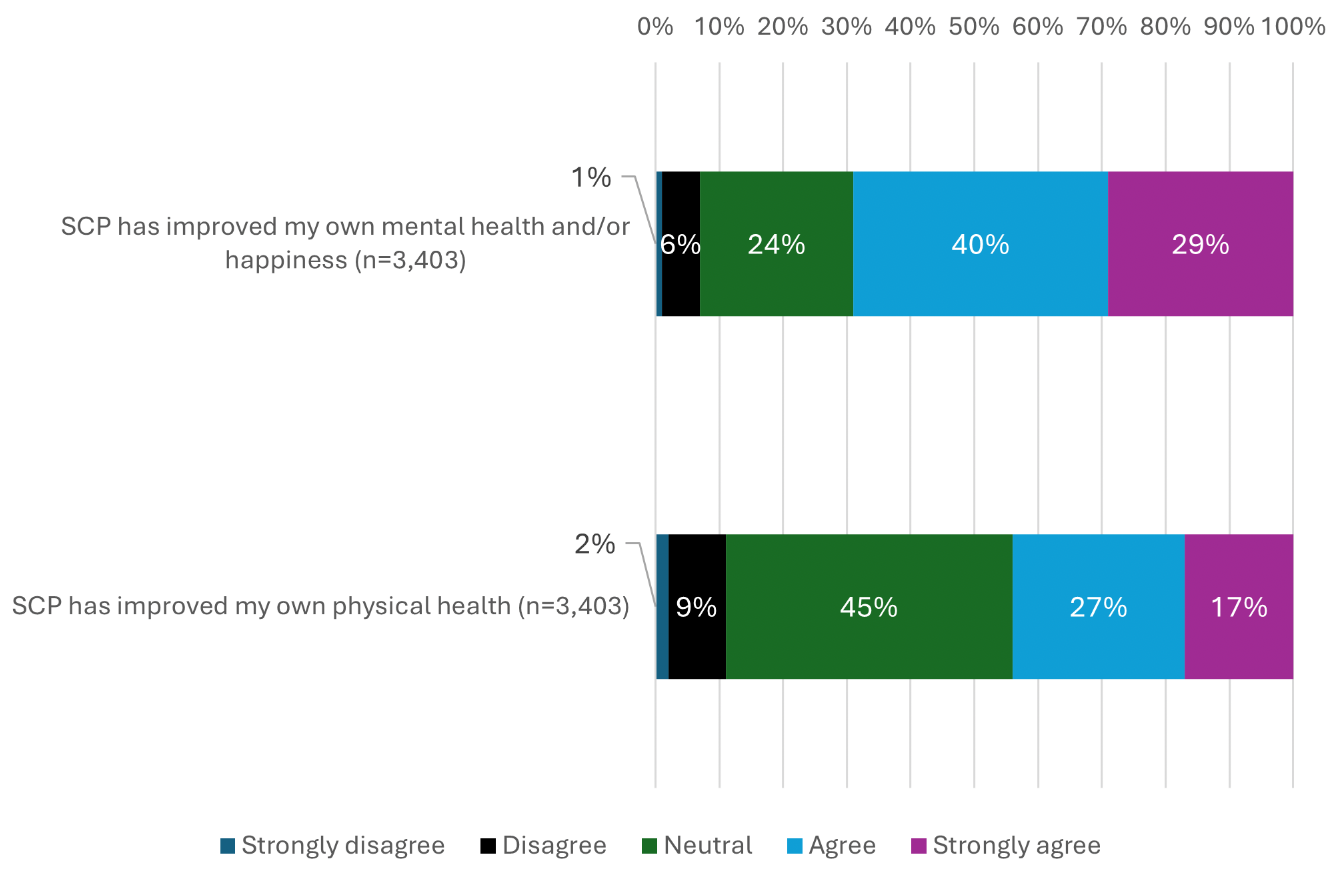
There were statistically significant differences relating to the priority families most at risk of poverty. Specifically:
- Families with three or more children were more likely than families with one or two children to ‘strongly agree’ or ‘agree’ Scottish Child Payment improved their own mental health and/or happiness (75% compared with 68%), and physical health (52% compared with 42%)
- Families from minority ethnic backgrounds were more likely than families from white ethnic backgrounds to ‘strongly agree’ or ‘agree’ Scottish Child Payment improved their own mental health and/or happiness (75% compared with 68%), and physical health (63% compared with 41%)
- Families with two or more parents or carers were more likely than families with one parent or carer to ‘strongly agree’ or ‘agree’ Scottish Child Payment improved their own mental health and/or happiness (74% compared with 67%), and physical health (48% compared with 42%)
- Households without a disabled family member were more likely than those with a disabled family member to ‘strongly agree’ or ‘agree’ Scottish Child Payment improved their own physical health (57% compared with 48%) and mental health (71% compared with 68%).
In the qualitative interviews and open-text survey responses, participants largely spoke about the positive impact Scottish Child Payment had on their mental health, as opposed to their physical health. This reflects the survey findings above, which show recipients were more likely to agree the payments had impacted their mental health and/or happiness, compared to their physical health. Parents and carers said the payments provided intense relief knowing they could afford household essentials like food, rent and utility bills. Knowing they could buy essentials for their child also helped to reduce anxiety. Lone parents specifically said Scottish Child Payment reduced the strain of having only one income.
Just it always being such a struggle, and that mental load of, ‘Can I - what can I buy?’ So, every time you go into the supermarket, every single time, having to count everything in your basket so that you know exactly how much things are going to come to, and that you know that you don't take too much out of your account, so that one of your bills is going to bounce. Just that breathing space that I suddenly got when the Scottish Child Payment started. I genuinely can't describe what that was like for me, and the amount of anxiety that it removed. It was just incredible to feel that you could almost take that deep breath.
(Parent and carer interview)
Obviously if you’re struggling financially, it’s a massive stress on you and I didn’t need to worry too much about that before when I was…with two parents, but then when you’re on your own you’re just like…any help is really…[Scottish Child Payment] takes a massive weight off your shoulders.
(Parent and carer interview)
Parents and carers indicated Scottish Child Payment positively impacted their relationship with their children. Some participants said the payments helped shield their children from their own financial distress. Others said the payments meant they did not always have to say no when their child asked to do something, and allowed them to spend more quality time together as a family. Others said they used Scottish Child Payment for treats to incentivise positive behaviour.
I am so infinitely grateful that, however tight our income is on a monthly basis, that I know without any doubt, that between what I earn from my salary and what comes in the Scottish Child Payment, Universal Credit, and Child Benefit, covers all the direct debits, the household bills, our food, and my petrol, which means that even if there's no money for holidays or anything like that, those things being there, having a roof over our heads, having that security, it's priceless. I didn't grow up with that security. So having that and being able to make sure that my boys don't ever know the strain, and the stress, or the poverty that I knew when I grew up, that's the difference that it makes.
(Parent and carer interview)
I mean it’s definitely a positive one for sort of like our own wellbeing, definitely. I mean I’m able to say yes more often, which then builds a better relationship with the kids, and they’re pleased because they’re hearing yes.
(Parent and carer interview)
The commissioned research also explored the impact of Scottish Child Payment on children’s health and wellbeing. In the commissioned survey, Scottish Child Payment recipients were also asked if they agreed or disagreed that the payments improved (a) their child’s mental health and/or happiness, and (b) their child’s physical health. The findings in Figure 23 show that:
- 53% of respondents either strongly agreed (21%) or agreed (32%) that Scottish Child Payment improved their child’s mental health and/or happiness, while 8% strongly disagreed or disagreed.
- 51% of respondents either strongly agreed (19%) or agreed (32%) that Scottish Child Payment improved their child’s physical health, while 8% strongly disagreed or disagreed.
There were statistically significant differences relating to the priority families most at risk of poverty. Specifically:
- Families with three or more children were more likely than families with one or two children to ‘strongly agree’ or ‘agree’ Scottish Child Payment improved child’s mental health and/or happiness (63% compared with 51%), and physical health (60% compared with 49%)
- Families from minority ethnic backgrounds were more likely than families from white ethnic backgrounds to ‘strongly agree’ or ‘agree’ Scottish Child Payment improved their child’s mental health and/or happiness (70% compared with 50%), and physical health (70% compared with 48%)
- Families with two or more parents or carers were more likely than families with one parent or carer to ‘strongly agree’ or ‘agree’ Scottish Child Payment improved their own mental health and/or happiness (56% compared with 51%), and physical health (57% compared with 48%).
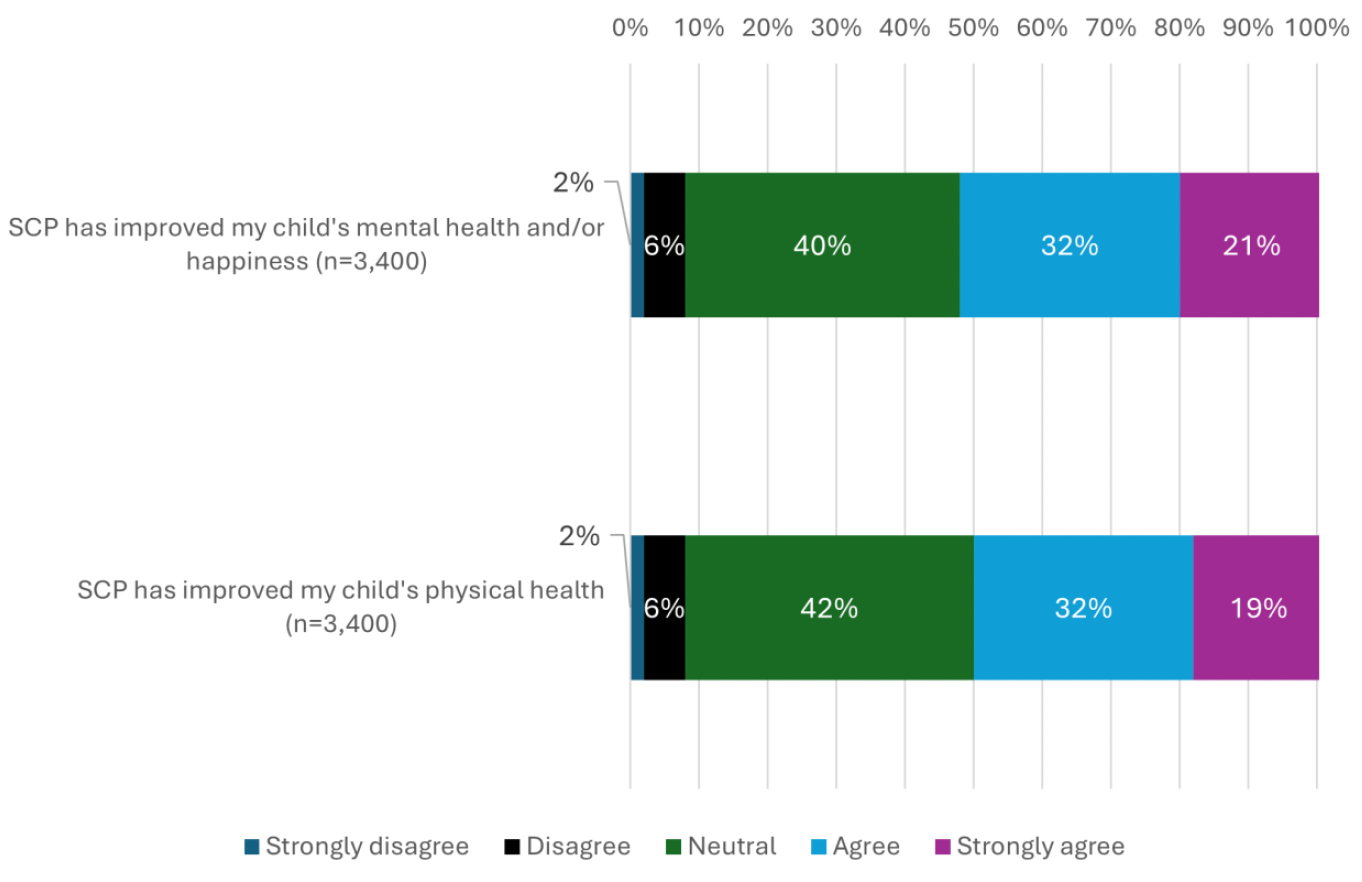
In the qualitative interviews and open-text survey responses, participants described various ways Scottish Child Payment impacted their child’s health and wellbeing. For example, parents and carers said Scottish Child Payment helped their child to fit in with their peers. This involved everyday things like meeting friends and buying the occasional lunch during the school day. For teenagers, it meant having the ‘right’ clothes and shoes, which was highlighted as being important for their confidence and self-esteem, and reduced their risk of being bullied for looking different. One participant said that, as a result of this, their child’s engagement with school had improved.
[My son] just wants to be like everybody else, because he's been bullied an awful lot, and wouldn't go to school and everything. So just to build up his confidence, I bought him some nice clothes and some nice trainers, and it did wonders for him because he did start going back to school. So, I did need it for that […]. You could see, the way he walked, he was feeling a bit more proud of himself.
(Parent and carer interview)
Participants frequently mentioned how Scottish Child Payment enabled their child to take part in activities, which they identified as being important for developing their confidence and mental wellbeing, and for reducing feelings of social isolation. Some parents and carers also spoke about the potential longer-term impact of taking part in activities. They felt that the skills and development associated with these activities helped them in other areas of their lives, such as with school attainment.
…[the increase in Scottish Child Payment] was what allowed the one group a month to be two groups a month […] which had a massive or is having a massively positive impact […]. She now has that small confidence boost that she'll now take part in something at school like a drawing contest or she'll try a bit harder with her assignments and we've noticed this and with her report. So, she'll realise that she can achieve something if she tries, so she does try.
(Parent and carer interview)
Because of SCP, my daughter attends gymnastics, is learning to play basketball and attends art class which has improved her social, mental and physical health. Her teacher told me she's doing great at parents evening, and I know it's because of the joy she gets from extra-curricular activities listed above.
(Survey respondent)
Parents and carers also said Scottish Child Payment helped to improve their child’s physical health. They said payments enabled them to pay for clubs and activities outside of school, which helped their child to be physically active. Participants also spoke about using their payments to buy healthy food for their children, which positively impacted their health.
Scottish Child Payment really helped me to stop going to friends’ houses and beg for food before me and my baby can survive. Before the Scottish Child Payment I usually sort for used clothes and things to care for my baby, but now I usually get anything my baby wants. He is looking more lovely, healthy and handsome. It really helped me to stop crying and thinking of how we can survive. It stops insults and it gives me joy when people look at my baby and say you look healthy and beautiful.
(Survey respondent)
Best Start Foods and health and wellbeing
The commissioned research explored the impact of Best Start Foods on recipients’ own, and their child’s, health and wellbeing. In the survey, Best Start Foods recipients were asked if the payments improved their own, and their child’s, mental and physical health. The findings in Figure 24 show that:
- 55% of respondents either strongly agreed (22%) or agreed (33%) that Best Start Foods improved their own mental health and/or happiness, while 6% strongly disagreed or disagreed
- 49% of respondents either strongly agreed (21%) or agreed (28%) that Best Start Foods improved their own physical health, while 8% strongly disagreed or disagreed
- 49% of respondents either strongly agreed (22%) or agreed (27%) that Best Start Foods improved their child’s mental health and/or happiness, while 5% strongly disagreed or disagreed
- 59% of respondents either strongly agreed (23%) or agreed (36%) that Best Start Foods improved their child’s physical health, while 5% strongly disagreed or disagreed.
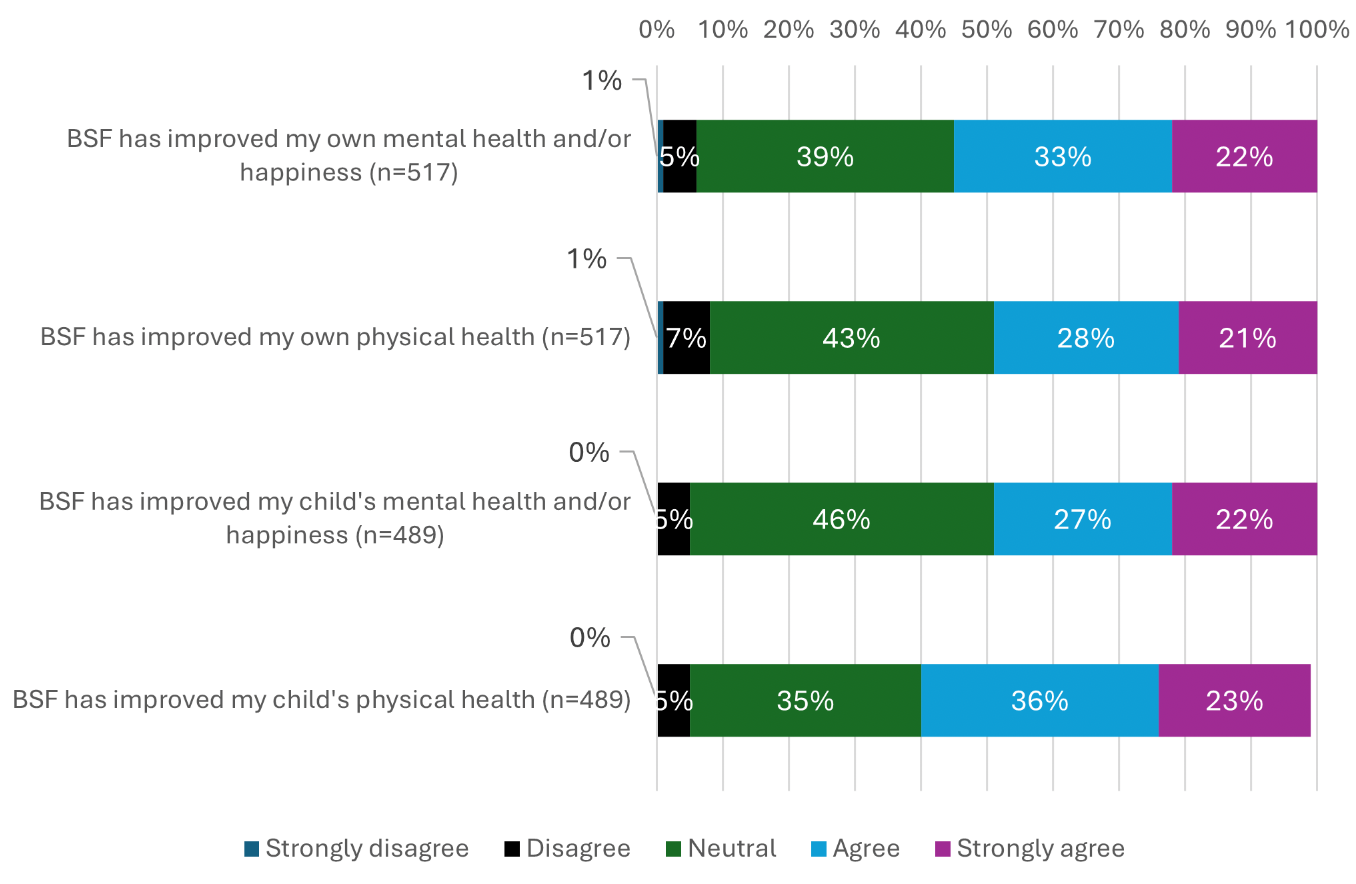
There were statistically significant differences relating to the priority families most at risk of poverty. With regards to how Best Start Foods impacted their own health:
- Families with three or more children were more likely than families with one or two children to ‘strongly agree’ or ‘agree’ Best Start Foods improved their own mental health and/or happiness (63% compared with 51%)
- Families from minority ethnic backgrounds were more likely than families from white ethnic backgrounds to ‘strongly agree’ or ‘agree’ Best Start Foods improved their own mental health and/or happiness (67% compared with 53%), and physical health (65% compared with 46%).
With regards to how Best Start Foods impacted their child’s health:
- Families with three or more children were more likely than families with one or two children to ‘strongly agree’ or ‘agree’ Best Start Foods improved their child’s mental health and/or happiness (56% compared with 44%)
- Families from minority ethnic backgrounds were more likely than families from white ethnic backgrounds to ‘strongly agree’ or ‘agree’ Best Start Foods improved their child’s mental health and/or happiness (81% compared with 55%), and physical health (81% compared with 55%).
In the qualitative interviews and open-text survey responses, participants described how Best Start Foods impacted their own health. With regards to mental health, parents and carers said Best Start Foods helped to reduce their anxiety about being able to afford food. Some participants also said the payments enabled them to bulk-buy healthy long-life foods or access deals when they visited cheaper shops.
I do have a bit of anxiety with money, and I think with a food shop you can kind of control how much you spend, whereas with your mortgage or rent that money is fixed, you can’t like budget a mortgage or whatever because that’s like a fixed outcome. […] But with that extra money sitting there I’m not having to be like…I’m nowhere near as anxious about spending the money.
(Parent and carer interview)
Participants also described physical health benefits. Those who were pregnant said Best Start Foods helped them to buy foods that supported their health. One parent shared that Best Start Foods had encouraged her to eat more food while pregnant after years of food poverty had left her with little appetite. Those who were not pregnant also said that having plenty of fruit and vegetables in the house helped them to eat more healthily, making it easier to maintain a healthy weight.
[Best Start Foods] just means there’s a little extra money there and I’m quite a bad eater, well I was a very bad eater before I got pregnant. Sometimes I would go a day without eating, either I couldn’t afford it, or I didn’t have the…the mental fortitude to want to eat. When you get into a habit of fasting because you can’t…you maybe can’t afford it or you want your food to last a bit longer, you actually lose your appetite.
(Parent and carer interview)
Absolute amazing benefit that has helped me throughout my breastfeeding journey. I can buy plenty of fruits, nuts, oats all things that support breastfeeding that otherwise I may not afford.
(Survey respondent)
With regards to their child’s health, participants said Best Start Foods enabled them to buy more fruit and vegetables, which helped them to maximise their child’s intake of fruit and vegetables. One parent described making vegetable-packed pasta and curry sauces using fresh and frozen vegetables bought with the payments. Participants also frequently said Best Start Foods meant they were less anxious about wasting money, and could take risks buying new fruits and vegetables for their child.
[Best Start Foods] was amazing because it helped us because, with kids, you have to try…sometimes they eat it, sometimes they don’t eat it. You have to try, try, try, try. Like one day if I bought potatoes if you don’t like it, I’m going to change to carrot, if you don’t like it, I’m going to change to another veg or fruit.
(Parent and carer interview)
Best Start Grant and health and wellbeing
The commissioned research explored the impact of Best Start Grant on recipients’ own, and their child’s, health and wellbeing. In the survey, Best Start Grant recipients were asked if the payments improved their own, and their child’s, mental and physical health. The findings in Figure 25 show that:
- 64% of respondents either strongly agreed (29%) or agreed (35%) that Best Start Grant improved their own mental health and/or happiness, while 7% strongly disagreed or disagreed.
- 49% of respondents either strongly agreed (23%) or agreed (26%) that Best Start Grant improved their own physical health, while 8% strongly disagreed or disagreed.
- 49% of respondents either strongly agreed (22%) or agreed (27%) that Best Start Grant improved their child’s mental health and/or happiness, while 7% strongly disagreed or disagreed.
- 49% of respondents either strongly agreed (22%) or agreed (27%) that Best Start Grant improved their child’s physical health, while 7% strongly disagreed or disagreed.
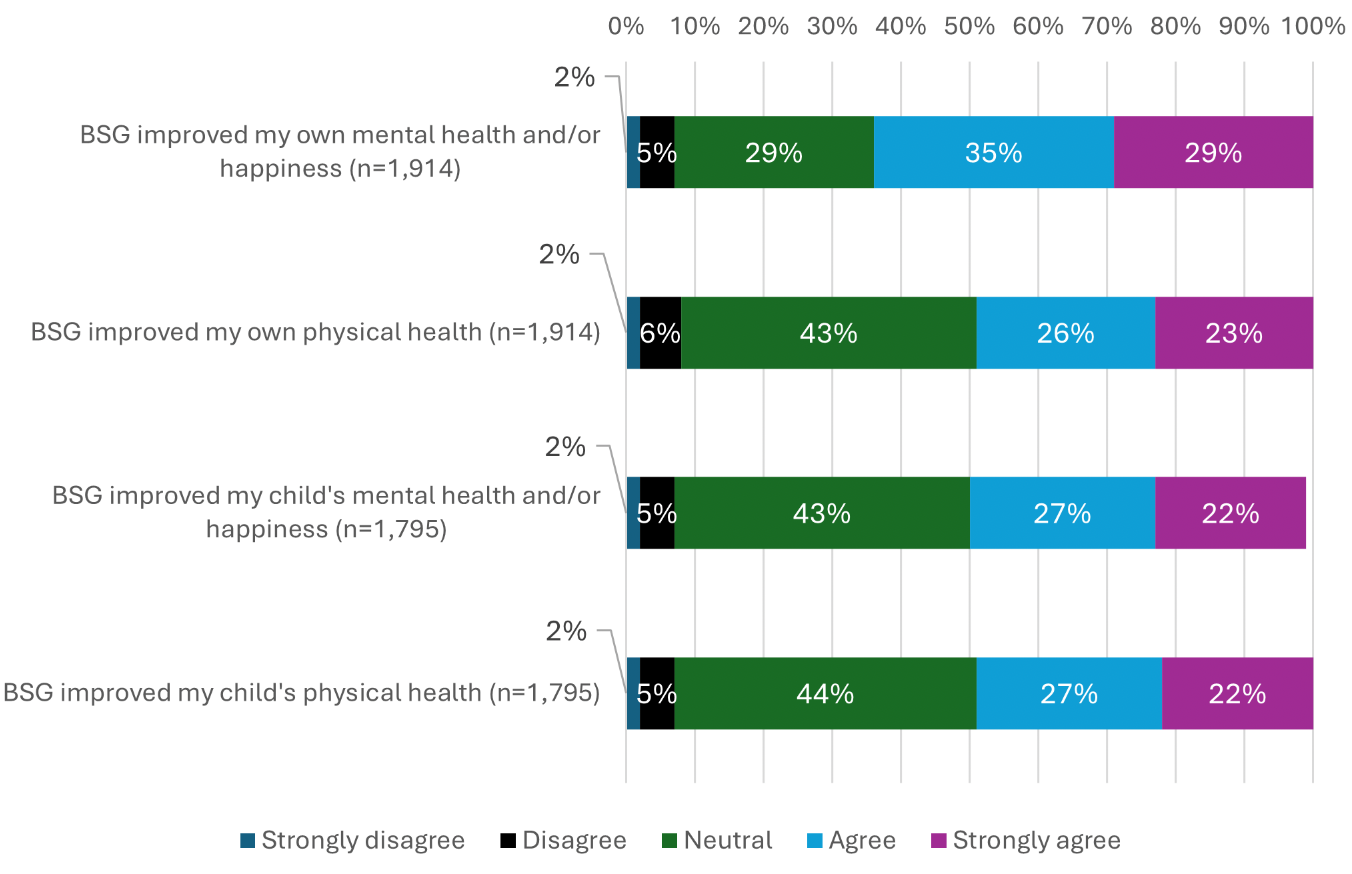
There were statistically significant differences relating to the priority families most at risk of poverty. With regards to how Best Start Grant impacted their own health:
- Families with three or more children were more likely than families with one or two children to ‘strongly agree’ or ‘agree’ Best Start Grant improved their own mental health and/or happiness (68% compared with 62%)
- Families from minority ethnic backgrounds were more likely than families from white ethnic backgrounds to ‘strongly agree’ or ‘agree’ Best Start Grant improved their own mental health and/or happiness (73% compared with 63%), and physical health (68% compared with 46%)
- Families with two or more parents or carers were more likely than families with one parent or carer to ‘strongly agree’ or ‘agree’ Best Start Grant improved their own mental health and/or happiness (69% compared with 61%), and physical health (53% compared with 47%)
- Households without a disabled family member were more likely than those with a disabled family member to ‘strongly agree’ or ‘agree’ Best Start Grant improved their own physical health (52% compared with 47%).
With regards to how Best Start Grant impacted their child’s health:
- Families with three or more children were more likely than families with one or two children to ‘strongly agree’ or ‘agree’ Best Start Grant improved their child’s mental health and/or happiness (57% compared with 47%), and physical health (55% compared with 47%)
- Families from minority ethnic backgrounds were more likely than families from white ethnic backgrounds to ‘strongly agree’ or ‘agree’ Best Start Grant improved their child’s mental health and/or happiness (71% compared with 46%), and physical health (70% compared with 46%)
- Families with two or more parents or carers were more likely than families with one parent or carer to ‘strongly agree’ or ‘agree’ Best Start Grant improved their child’s mental health and/or happiness (53% compared with 48%).
In the qualitative interviews and open-text survey responses, participants described how Best Start Grant impacted their own health, and their child’s health. Those who took part in interviews talked about feeling less socially isolated as the payments enabled them to take their children out to meet friends. Some also described positive impacts on their child’s development through, for example, having new experiences and better toys.
I was able to get better toys for his learning, I suppose he has benefited from being able to develop maybe better than if I didn't have the payment and I wasn't able to get those, like certain toys or expose him to different days out.
(Parent and carer interview)
Increased healthy eating behaviours
This outcome is specifically related to Best Start Foods. It is intended that Best Start Foods should lead to increased healthy eating behaviours amongst recipients in the medium-term. This topic has been addressed in the commissioned research survey and interviews. Specifically, survey findings that were presented earlier in this report show that, on a scale of zero (‘not at all’) to five (‘a lot’):
- 57% of respondents rated Best Start Foods five (helped a lot) for helping their child to eat more healthy food. Overall, 88% gave a higher rating of three to five, and 9% gave a rating of zero to two.
- 48% of respondents rated Best Start Foods five (helped a lot) for helping themselves to eat more healthy food. Overall, 81% gave a higher rating of three to five, and 13% gave a rating of zero to two.
- 52% of respondents rated Best Start Foods five (helped a lot) for helping to make healthier meals for their families. Overall, 83% gave a higher rating of three to five, and 12% gave a lower rating of zero to two.
Evidence from the qualitative interviews and open-text survey responses, presented in the ‘improved health and wellbeing’ section above, also indicates that Best Start Foods has increased healthy eating behaviours. It shows that people use payments to bulk buy healthy foods, and generally buy more fruit and vegetables, meaning both recipients (including those who are pregnant) and their children eat a more nutritious diet. For some, it means they can let their children try different types of healthy food, without worrying about wasting money if they do not like it.
Reduced barriers to labour market and education
Having an inadequate income can act as a barrier to work. For example, people may struggle to meet the costs associated with job searching .[44] It is therefore anticipated that the additional financial support provided to low income families by Scottish Child Payment could reduce barriers to the labour market and education amongst recipients. The impact of Scottish Child Payment on the labour market and education has been evaluated using labour market analysis by the Scottish Government and evidence from the commissioned research. The findings are presented below.
Scottish Child Payment and labour market barriers
In 2024, the Scottish Government published a report summarising available evidence on how Scottish Child Payment interacts with the labour market, on the basis that the payments could be influencing recipients’ labour market decisions.[45] For example, if a recipient’s earnings from work increased, meaning they no longer qualified for Universal Credit (the main Scottish Child Payment qualifying benefit), their Scottish Child Payment award would also stop. This could make them financially worse off in some cases, and, in theory, discourage them from doing more paid work.
The report presents an analysis of available labour market data which concluded that Scottish Child Payment is not negatively affecting labour market participation at scale in the economy. It also presents qualitative evidence from recipients indicating that, in cases where the payments do affect labour market behaviour, the impact is highly dependent on individual circumstances, and can operate in both directions. For example, Scottish Child Payment helped recipients pay for childcare, enabling them to work full-time. For others, it helped them reduce working hours and spend more time with their children.
The commissioned research also explored the impact of Scottish Child Payment on labour market outcomes. In the survey, recipients were asked how the payments helped them with work. Additionally, those in two parent or carer households were asked how the payments helped their partner with work. In both cases they were presented with a range of options, and could select more than one option. The majority of respondents selected ‘not applicable/no impact’ for both themselves (69%) and, where applicable, their partner (72%).
For the minority of respondents who reported an impact on themselves (29%), or their partner (28%), the findings indicate Scottish Child Payment mostly reduced barriers to labour market participation. As shown in Table 19:
- In cases where it had an impact, 45% said Scottish Child Payment helped with their own work related costs (e.g. travel or clothing), and 40% said it helped with their partner’s work related costs[46]
- In cases where it had an impact, 23% said Scottish Child Payment helped them to stay in work, and 25% said it helped their partner to stay in work
- In cases where it had an impact, 12% said Scottish Child Payment helped them to look for work or start work, and 14% said it helped their partner to look for work or start work.
The findings also indicate Scottish Child Payment meant some people reduced labour market participation. Specifically:
- In cases where it had an impact, 12% said Scottish Child Payment helped them stop work or work fewer hours, and 10% said it helped their partner stop work or work fewer hours
- In cases where it had an impact, 11% said it helped them take a longer parental leave, and 10% said it helped their partner take a longer parental leave.
| Response option | Respondent | Respondent’s partner |
|---|---|---|
| With work costs (e.g. travel or clothing) | 45% | 40% |
| Staying in work and working more hours | 23% | 25% |
| Looking for work or starting work | 12% | 14% |
| Stopping work or working fewer hours | 12% | 10% |
| Taking a longer parental leave | 11% | 10% |
| Helped in another way | 19% | 12% |
| Total number of respondents | 1,050 | 282 |
The qualitative interviews and open-text survey responses provide more detail on the impact of Scottish Child Payment on the labour market, for those recipients who reported an impact. With regards to reducing labour market barriers, the payments helped some participants pay for their lunches without using money they would otherwise spend on things for their child. Others said the payments helped them with commuting expenses, by covering car, petrol, and bus fare costs.
It [Scottish Child Payment] is a needed income to pay for essentials needed by my daughter and to ensure I can cover car/petrol costs to enable me to work and earn an income. This payment means we are just managing to keep out of poverty and debt. A life saver. Thank you Scottish Government.
(Survey respondent)
Parents and carers also said that Scottish Child Payment helped them or their partner to continue or return to work by covering childcare costs. Some said they always intended to or would like to return to work, and Scottish Child Payment motivated them to improve their financial circumstances through education and employment.
This payment has been a lifeline to me. It's meant I can pay toward my child being in ELC [Early Learning Care] so I can work more hours, or we'd be in the red.
(Survey respondent)
It helped me go back to work in the terms of self-actualisation of I want to keep doing these really nice things for my kids […] I love having this life that I can like pay for gymnastics and pay for swimming and not have to worry about it. So it really helped motivate me to get to my goal and graduate and get a really good job and live that life.
(Parent and carer interview)
While some participants said Scottish Child Payment was not sufficient to replace income from employment, it meant others could afford to reduce labour market engagement by giving them more choice around their working hours. This could mean working more flexible hours, working part-time, choosing not to increase hours, or stopping work altogether. In these cases, the payments meant participants could afford to spend more time with their children, look after a disabled child, or work around the needs of their children.
It has meant I have been able to remain on my 28hr contract, working hours around caring for my children, since my separation. Without it I would have had to increase to full time hours and due to lack of child care availability in our area (rural) and cost, the boys would have had to be left home alone for a few hours before/after school.
(Survey respondent)
One of my children is disabled and I’ve had to give up my career to provide them with the care they need. Without the payment this would not have been possible and it is unlikely she would be engaging in education or be able to undertake schoolwork.
(Survey respondent)
The findings also highlight that due to the interaction between Scottish Child Payment and Universal Credit eligibility, some Scottish Child Payment recipients who are close to no longer qualifying for Universal Credit due to their earnings from work, do face trade-offs when engaging with the labour market. For example, parents and carers reported declining pay increases, or diverting pay into pension contributions, as increasing their monthly pay would have a detrimental effect on their overall household income. Parents and carers also shared that having a single income was financially more beneficial for their families, as the increased income of two wages could affect their receipt of Universal Credit, and consequently Scottish Child Payment and other benefits.
So I know that even the slightest movement in my salary could impact it. It wouldn't just be a case of losing that £50 on the Universal Credit, it would then impact on the Scottish Child Payment. So there is that feeling of anxiety round about it. Actually, this year I even asked my line manager not to move me up my annual pay award band because it would have meant maybe a £30 or £40 a month addition on my salary for myself, but it would have cost me around £300 in benefits. So it actually made more sense to not take the band increase.
(Parent and carer interview)
Scottish Child Payment and education barriers
The commissioned research also explored the impact of Scottish Child Payment on education outcomes. In the survey, recipients were asked how the payments helped them with education and training. Additionally, those in two parent or carer households were asked how the payments helped their partner with education and training. In both cases they were presented with a range of options, and could select more than one option. The majority of respondents selected ‘not applicable/no impact’ for both themselves (86%) and, where applicable, their partner (89%).
For the minority of respondents who reported an impact on themselves (14%), or their partner (11%), the findings in Table 20 indicate Scottish Child Payment helps to reduce barriers to education and training. Specifically:
- In cases where it had an impact, 38% said Scottish Child Payment helped with their own study costs (e.g. travel or equipment), and 37% said it helped with their partner’s study costs
- In cases where it had an impact, 30% said Scottish Child Payment helped them to stay on a course or spend more time studying, and 29% said it helped their partner to stay on a course or spend more time studying
- In cases where it had an impact, 27% said Scottish Child Payment helped them to look for a course or start a course, and 29% said it helped their partner to look for a course or start a course
| Response option | Respondent | Respondent’s partner |
|---|---|---|
| With study costs (e.g. travel or equipment) | 38% | 37% |
| Staying on a course or spending more time studying | 30% | 29% |
| Looking for a course or starting a course | 27% | 20% |
| Helped in another way | 19% | 22% |
| Total number of respondents | 452 | 113 |
The qualitative interviews and open-text survey responses provide more detail on the impact of Scottish Child Payment on education, for those recipients who reported an impact. Combined with work income and Universal Credit, the payments enabled some parents and carers to start or continue their further or higher education. While doing this affected their Universal Credit amount, participants said Scottish Child Payment offset the loss to some extent. Others said the payments helped them to pursue an education by helping with the costs of household essentials.
I have obviously dropped money going back to Uni but then I’ve then still been getting the Scottish Child Payment which has definitely helped. […] I am kind of like living day to day but it is…it has definitely helped. I had been wanting to do this for a long time, I just financially couldn’t do it […] So yeah I would definitely say it has probably helped me being able to go back and try and better myself for the future for me and my kids.
(Parent and carer interview)
Again helped survive as there is no help in Scotland for single parents going back to full time education.
(Survey respondent)
Positive impact on the Scottish economy
Increases in government expenditure, for example on benefits, can produce multiplier effects in the economy, as that expenditure leads to further rounds of economic activity. So it is anticipated that the Five Family Payments could have a positive impact on the Scottish economy as recipients spend that income. This outcome is relevant to all of the Five Family Payments benefits. The evaluation findings, presented throughout this report, have shown that the Five Family Payments have generally allowed parents and carers to spend money they would not have otherwise spent – e.g. on social and educational activities, or on a wider range of healthy foods for their children. The commissioned survey also shows the vast majority of people spent Scottish Child Payment and Best Start Grant, with only a small proportion saying they saved some of the money. Additionally, most Best Start Foods recipients said they spend most or all of the money on the card.
The updated Social Security Scotland Programme Business Case[47] published in February 2023 also includes distributional analysis using HMT Green Book guidance that sets out the higher true value to the economy of government expenditure when spent on lower income households compared with higher income households. However, this higher true value can be offset by behavioural responses and it should be recognised that there is also an opportunity cost to government of spending money on benefits that cannot be spent elsewhere.
Some of the potential economic benefits associated with the Five Family Payments would be expected to accrue in the longer-term. For example:
- Income from social security can improve a child’s health in their early years, which can reduce a child’s risk of experiencing metabolic syndrome (which includes obesity, high blood pressure, heart disease and diabetes) in later life.[48]
- Studies have also shown a positive relationship between social security expenditure and educational test scores in a child’s early years[49] and adult human capital and economic self-sufficiency in their later life[50]
These improvements in later life, brought about from social security investment in their early years, can have long-term benefits for the economy and government. For instance, they can raise the person’s earning potential, which could in turn increase tax revenue and reduce social security expenditure. They could also reduce their use of health services, lowering costs to government. However, it would require a full economic evaluation[51] to measure the extent of this impact. This would be out-with the scope of this work and not possible until many years after the investment.
Recap of achievement against medium-term outcomes
This evidence presented throughout this section shows that:
- The Five Family Payments benefits have helped to reduce incidence of debt and borrowing for most recipients
- The Five Family Payments benefits have helped to reduce material deprivation for most recipients
- Scottish Child Payment and Best Start Foods have helped to reduce food insecurity for most recipients
- The Five Family Payments benefits had a generally positive impact on health and wellbeing – e.g. with most recipients agreeing the benefits improved their own mental health and/or happiness
- Best Start Foods have helped to increase healthy eating behaviours for most recipients and their children
- Scottish Child Payment reduced barriers to education and the labour market for a minority of recipients and/or their partners, and enabled some parents to spend more time with their children
- The Five Family Payments benefits are likely to have had positive effects on the Scottish economy, with further possible benefits to accrue in the longer-term.
It is also clear from the evidence that the individual Five Family Payments benefits had a distinct impact on recipients. For example, Scottish Child Payment recipients spoke about the payments helping them to save money and therefore deal with unexpected costs, while Best Start Grant recipients were clear that the large value of those payments helped them to avoid debt when buying their children expensive items at key transition points. It is therefore likely that the payments had a positive cumulative effect for those who received more than one of the benefits.
Despite these positive findings, the evidence also highlights some issues faced by Five Family Payments recipients. Notably, some parents reported that they still had to borrow money or skip meals despite the assistance of the Five Family Payments. Additionally, some recipients said they chose not to increase income from work because it would mean they no longer qualified for Universal Credit, which in turn would make them ineligible for Scottish Child Payment and financially worse off overall.
However, despite these issues, the findings indicate that medium-term Five Family Payments outcomes are largely being achieved. According to the Five Family Payments theory of change, this means the benefits could contribute towards longer-term government outcomes for children and families being achieved. Actual achievement against long-term government outcomes is explored in the section below.
Evidence of progress towards long-term outcomes for children and families
As set out in the tackling child poverty delivery plan, the Scottish Government has been delivering support for families and children across a range of policy areas, including social security. [52] These actions are intended to contribute to the following long-term government outcomes:
- Reduced child poverty
- Reduced inequality of outcomes for children
- Reduced incidence of social exclusion
- Reduced health inequalities
The Five Family Payments make an important contribution towards these targets. However, they do not play an exclusive role, because the benefits are part of a package of Scottish Government policies which are expected to have a cumulative impact on child poverty. Measuring the long-term impact of the Five Family Payments would also require (a) suitable time to have passed since the payment was introduced, and (b) access to more robust and suitable quantitative data than is currently available. It should also be noted, however, that isolating the specific role of Five Family Payments would be challenging even with additional data.
Nevertheless, the Scottish Government does publish child poverty statistics, which can be used to monitor general progress towards its stated targets. The most recent child poverty statistics and child poverty targets are shown in Table 21.[53] With regards to single-year estimates, the data shows:
- Relative child poverty was lower in 2023/24 (22%) than it was in 2017/18 (24%), but missed the 2023/24 target of 18% by 5 percentage points
- Absolute child poverty was lower in 2023/24 (17%) than it was in 2017/18 (22%), but missed the 2023/24 target of 14% by 3 percentage points.
Table 21 also shows three-year averaged child poverty statistics, which can be better than single-year estimates for seeing trends as they are less subject to sample volatility in individual years. These figures also indicate that relative child poverty and absolute child poverty have reduced in recent years, albeit marginally (by one percentage point and two percentage points, respectively).
| Poverty measure | 2017/18 actual | 2023/24 actual | 2023/24 target | 2015-18 actual (three-year averaged) | 2021-24 actual (three-year averaged) |
|---|---|---|---|---|---|
| Relative poverty (Children living in low income households, compared to the UK average household) | 24% | 22% | 18% | 24% | 23% |
| Absolute poverty (Children living in low income households where living standards are not increasing) | 22% | 17% | 14% | 22% | 20% |
Overall, progress towards child poverty targets is likely to have been affected by the recent cost of living crisis. After a period of low inflation post pandemic, Consumer Price Index (CPI) inflation began to rise in the UK in 2021, peaked at 11.1% in October 2022 and remained above the Bank of England’s 2% inflation target until Spring 2024.[54] There was also evidence that low income households were particularly impacted by high inflation through for example increasing energy and food prices. [55] This is generally reflected in the findings presented in this report, which show that Five Family Payments recipients have struggled financially as a result of inflation.
It is also notable, however, that relative child poverty rates are substantially lower in Scotland than the UK average, which was 30% in 2021-24.[56] Additionally, modelling by the Scottish Government estimates that Scottish Child Payment alone will keep 40,000 children out of relative poverty in 2025/26, with the relative child poverty rate four percentage points lower than it would be without the policy in place.[57]
Further to the above, it can also be reasonably expected that success against the Five Family Payments’ immediate, short-term, and medium-term policy outcomes could contribute to the Scottish Government achieving its long-term objectives. Based on the evidence presented throughout this report, an overall summary of progress against the Five Family Payments outcomes is presented in the section below.
Discussion of progress towards Five Family Payments outcomes
Progress towards immediate outcomes
Promotions and take-up
The evidence indicates that promotion of the Five Family Payments has been largely effective. According to the Client Survey and commissioned research, people found out about the benefits through a range of sources, primarily word of mouth, online and social media, and via health professionals. Official Statistics showed that people across Scotland with a range of demographic and equalities characteristics have applied for the Five Family Payments. Also, while the exact impact of promotions on take-up is not known, recent estimates showed the majority of people who were eligible for the payments had taken them up. However, despite these positive findings, recent estimates also showed that for some of the Five Family Payments, around 1 in 10 eligible people did not receive the benefit, which suggests further promotional work may be needed.
In the commissioned research, the qualitative evidence indicated that low awareness is a reason some people do not apply for the Five Family Payments. For example, some parents said they claimed certain benefits at a later date than they could have done because they did not know about them initially, or did not claim them at all. Additionally, stakeholders said that awareness of the Five Family Payments can be low amongst specific groups – i.e. families with older children, women pregnant with their first child, survivors of abuse, and lone parent fathers. Notably, recent research also identified a number of these groups as being at risk of marginalisation from the Scottish social security system.[58]
Stakeholders also said minority families with limited English face ‘massive barriers’ which could be affecting take-up. For example, struggling to read application forms or contact organisations for support, struggling to read translated materials (e.g. due to low literacy in their own language), and/or lacking documentation needed for claims (e.g. photo ID and birth certificates). Other potential barriers to take-up raised by stakeholders included the complexity of the benefits system, a lack of advisors in Scotland with in-depth knowledge of the benefits system, having initial applications denied (e.g. as a result of not providing enough supporting evidence), digital poverty, low levels of literacy, being a survivor of domestic abuse, and stigma. Stakeholders and parents also suggested measures to reduce barriers to the Five Family Payments, which can be read in full in Chapter 8 of the commissioned research report (see Annex A).
Applying for and receiving the Five Family Payments
The Client Survey showed that most Five Family Payments applicants find the application forms easy and quick to complete. This is reflected in qualitative evidence from the commissioned research, which showed recipients compared the application process favourably to other benefits they have applied for such as Universal Credit. However, Official Statistics showed that around 1 in 3 people who applied for the Five Family Payments in 2024/25 had their applications denied. As applications are denied in cases where applicants are ineligible for the benefit(s), this suggests there is some confusion over eligibility criteria amongst applicants.
Official Statistics also showed that Five Family Payments application processing times have improved in recent years, with average application processing times having generally decreased. The Client Survey showed the majority of people who applied for the Five Family Payments felt their applications were processed in a reasonable timeframe, and the majority of recipients felt their payments were made efficiently. However, the Client Survey also showed around 1 in 10 claimants felt they waited a long time for an application decision and that they did not get enough updates on the progress of their application.
According to the Client Survey, the majority of Five Family Payments applicants also felt they were treated with dignity, fairness and respect by Social Security Scotland, and reported positive interactions with staff. However, of those who came into contact with staff, around 1 in 3 said they were not informed about other benefits or additional forms of support when making an application, but would have liked it if they had been. Finally, the Client Survey showed that - regarding most aspects of the application process and interactions with Social Security Scotland – those who made successful claims for the Five Family Payments were much more likely to provide positive feedback about the process than those who made unsuccessful claims. Minority ethnic applicants were also more likely to provide positive feedback on various aspects of the application process compared to white ethnic applicants. However, further evidence would be required to explain why this trend exists.
Using the Best Start Foods card
Generally, Best Start Foods recipients have a positive experience with the card. In the commissioned survey, the majority of recipients said they spent most or all of the money on the card. Qualitative evidence from the commissioned survey also suggested the card provided access to a range of retailers and healthy foods. Additionally, according to the Client Survey, the vast majority of Best Start Foods recipients said it was clear how and where to use the card, and they were able to use it without difficulties. However, despite these positive findings, the commissioned survey showed 1 in 3 recipients did not use all or most of the money on the card, and almost 1 in 10 reported issues with it, including technical problems (e.g. contactless payments not working), finding it hard to use, and embarrassment using the card.
Progress towards short-term outcomes
Child-related spend
The commissioned research evidence shows the Five Family Payments have helped to increase child-related spend. The survey found the majority of Scottish Child Payment recipients used the money for their child. Respondents were also asked how much Scottish Child Payment helped them with different types of child-spend - i.e. essentials (e.g. food, clothes and medicine), school-related items, and treat items. The majority found the payments helpful for all of these types of child-related spend. However, they were most likely to find them helpful for buying their child essential items, and least likely to find them helpful for buying their child treat items.
These findings were reflected in the qualitative evidence. Parents said food and clothes were key items of essential child-spend. Some said this is what they spent most (or all) of the payments on, citing, for example, how quickly their child grew out of clothes. They also described a range of school-related spend, such as lunches, bags and supplies. Regarding treat items, some parents said Scottish Child Payment enabled them to buy their child treats despite cost of living increases. However, others said they needed the money for basics, and used it to buy their child treats rarely, if at all.
The survey also found the majority of Best Start Grant recipients used the payments for child-related spend, and found them helpful for buying the things their child needed when they were born, or started nursery or school. According to the qualitative evidence, the large one-off payments helped with expensive items such as prams, car seats or bedroom furniture, which some parents said they would have gone without or delayed buying otherwise. Regarding Best Start Foods, the qualitative evidence showed that parents use the money to buy a range of healthy foods for their child. Additionally, according to the survey, the majority of Best Start Foods recipients found the payments helpful for buying their child first infant formula milk (where applicable).
Participation in social and educational activities
The commissioned survey found that Scottish Child Payment and Best Start Grant helped the majority of recipients’ children to take part in social and educational activities. However, overall, a higher proportion of Scottish Child Payment recipients than Best Start Grant recipients reported that the payments helped their child take part in social and educational activities. According to the qualitative evidence, Scottish Child Payment enabled children to take part in activities such as sports, martial arts and music, which some parents said they could not have afforded without the payments. The qualitative evidence also indicated that, compared to the other Best Start Grant payments, the Early Learning Payment was the one parents used the most for social and educational activities. For example, they used the payments for items such as annual passes for local activity centres, or for trips to the zoo.
Buying and eating healthier foods
Best Start Foods has a range of positive impacts in relation to healthy foods and healthy eating. According to the commissioned survey, the majority of Best Start Foods recipients found payments (a) helped them to buy healthy foods for their family, (b) helped their child and themselves to eat healthier foods, and (c) helped them to make healthier meals for their families. According to the qualitative evidence, some parents said they would have cut back on healthy foods without the payments.
Financial pressure and money-related stress
The commissioned research shows that the Five Family Payments have helped to reduce financial pressure on households and money-related stress on recipients. The survey found the majority of Scottish Child Payment recipients used at least some of the payments for household essentials, and that most found payments helpful for buying household essentials. According to the qualitative evidence, many parents relied on Scottish Child Payment to afford household essentials, with some expressing gratitude for the assistance it provided them (e.g. calling it a ‘life saver’). However, some parents said they still struggled financially despite Scottish Child Payment, citing increases in the cost of living, and in some cases called for the payment amounts to be increased.
The survey also showed most Best Start Grant and Best Start Foods recipients found the payments helpful for buying household essentials. However, recipients were less likely to have found them helpful for buying household essentials compared to Scottish Child Payment. According to the qualitative evidence, Best Start Grant and Best Start Foods provided dedicated income for specific costs (i.e. to buy what their child needed at key stages, or to buy healthy foods), and this released other income for recipients to spend on household expenses.
Also according to the survey, the majority of Scottish Child Payment, Best Start Grant and Best Start Foods recipients agreed the payments made them less worried about money. The qualitative evidence showed that Scottish Child Payment made parents feel more in control of their finances and able to meet unexpected costs. Best Start Grant made parents less worried about paying for expensive items their child needed. Additionally, both Best Start Grant and Best Start Foods reduced recipients’ money worries by freeing income for other costs.
Progress towards medium-term outcomes
Debt and borrowing
The Five Family Payments have helped to reduce incidence of debt and borrowing amongst recipients. In the commissioned survey, the majority of Scottish Child Payment recipients, and half of Best Start Foods recipients, agreed the payments meant they did not need to borrow money to pay for essentials. The survey also shows the majority of Best Start Grant recipients agreed the payments meant they did not need to borrow money to buy what their child needed at key transition points (e.g. when they were born or started school).
Qualitative evidence from the commissioned research shows Scottish Child Payment stopped parents borrowing from family, credit cards or loan companies. Some recipients also said the payments meant they borrowed less frequently, were able to pay off debts, or were able to save money for unexpected costs. However, other parents said they still needed to borrow money despite Scottish Child Payment.
Also according to the qualitative evidence, Best Start Grant recipients were clear that without the payments they would have borrowed to pay for what their child needed at key transition points. Additionally, Best Start Foods recipients said the payments helped them buy essential items, reducing their need to borrow. Those who used the card for first infant formula milk said it was expensive, and some parents said they would have borrowed money to afford it without the help of Best Start Foods.
Food insecurity and material deprivation
The Five Family Payments have helped to reduce incidence of food insecurity for families. Exploratory analysis by the Fraser of Allander Institute found that Scottish Child Payment had a statistically significant impact on food bank usage for single adult households with children aged under 5 and households with children aged 5-16 without younger children. There was also limited evidence that food bank use decreased for larger households (with three or more children) with children aged 0-4. These findings were reflected in the commissioned survey to some extent. It shows (a) the majority of Scottish Child Payment and Best Start Foods recipients agreed the payments meant they did not need a food bank or food parcels, and (b) for both benefits, recipients with three or more children were more likely than those with one or two children to have agreed the payments meant they did not need a food bank. According to qualitative evidence from the commissioned research, Scottish Child Payment recipients said the benefit stopped them using food banks or from cutting back on food, and/or reduced their anxiety about providing food for their child. However, some recipients said they still had to cut back on food so their children could eat.
The evaluation evidence also shows that, overall, the Five Family Payments have helped to reduce material deprivation for families. As summarised throughout this section, the benefits have increased child-related spend, helped families to pay for household essentials, reduced the need for borrowing to cover essentials, reduced recipients’ money worries, and reduced incidence of food insecurity. However, despite these positive findings, the evaluation findings also shows that some families still experienced material deprivation despite the assistance of the Five Family Payments, and to some extent this was exacerbated by the cost of living crisis. Some parents also expressed concerns about Scottish Child Payment and Best Start Foods ending when their children were too old to be eligible for the payments, and felt they would still need financial assistance due to the ongoing costs of looking after older children.
Health and wellbeing and healthy eating behaviour
The Five Family Payments have helped to improve the health and wellbeing of recipients and their children. The commissioned survey shows a substantial majority of Scottish Child Payment and Best Start Grant recipients, and over half of Best Start Foods recipients, agreed the payments improved their own mental health and/or happiness. According to the qualitative evidence in the commissioned research:
- Scottish Child Payment recipients said the payments provided intense relief at being able to afford household essentials and essential items for their child, and some parents also said the payments improved their relationship with their child, as they enabled them to spend more quality time together as a family
- Best Start Grant recipients said the payments helped them to feel less socially isolated, as the money enabled them to take their children out to meet with friends
- Best Start Foods recipients said the payments helped to reduce their anxiety about being able to afford food, and mentioned how it enabled them to bulk-buy healthy long-life foods or access deals when they visited cheaper shops.
The commissioned survey also shows just under half of Scottish Child Payment, Best Start Grant and Best Start Foods recipients agreed the payments improved their own physical health. The qualitative evidence shows that Best Start Foods recipients, including those who were pregnant, said the payments enabled them to buy food such as fruit and vegetables which supported their physical health.
With regards to children, the commissioned survey found that around half of Scottish Child Payment, Best Start Grant and Best Start Foods recipients agreed the payments improved their child’s mental health and/or happiness. The qualitative evidence shows Scottish Child Payment has improved children’s self-esteem and confidence, and reduced their social isolation. This is because, for example, it has helped them fit in with their peers (e.g. by enabling them to meet with friends and buy occasional lunches) and take part in activities. Some parents said that, as a result, their child’s engagement at school had improved.
The commissioned survey also showed a majority of Best Start Foods recipients, and around half of Scottish Child Payment and Best Start Grant recipients, agreed the payments improved their child’s physical health. According to the qualitative evidence, Best Start Foods enabled parents to maximise their child’s intake of fruit and vegetables. Parents also frequently said that, because of the payments, they were less anxious about wasting money, and could take risks buying new fruits and vegetables for their child. Scottish Child Payment recipients said the payments helped them buy healthy foods for their child, or pay for clubs and activities outside of school, which positively impacted their physical health.
Finally, Best Start Foods has helped to increase healthy eating behaviours for families and their children. As summarised above, most recipients said the payments made healthy foods more affordable, helped their child and themselves to eat more healthy foods, and helped them to make healthier meals for their families. Additionally, parents said they use Best Start Foods to bulk buy healthy foods, and generally buy more fruit and vegetables.
Labour market and education barriers
The relationship between Scottish Child Payment and the labour market is complex. According to the commissioned survey, most recipients said the payments had no impact on their (or their partner’s) work situation. However, almost 1 in 3 recipients did report a work-related impact. The most commonly reported work-impacts indicate Scottish Child Payment has reduced barriers to labour market participation – e.g. by helping recipients (or their partners) with work-related costs, or helping them to work more hours. The qualitative evidence showed the payments contributed to lunch costs, travel costs and/or childcare costs, enabling parents to continue or return to work.
Other work-impacts reported in the survey indicate Scottish Child Payment meant some recipients could afford to reduce labour market participation – e.g. by helping recipients (or their partners) to reduce hours or take longer parental leave. The qualitative evidence showed that, as a result of Scottish Child Payment, there were cases where recipients were able to reduce their hours to spend more time with their children – with some highlighting that it was helping them to look after their disabled child. The qualitative evidence also showed that some recipients who were close to losing eligibility for Universal Credit due to their earnings from work faced challenges to labour market participation. For example, increased pay from work could make them ineligible for Universal Credit and consequently Scottish Child Payment, making them worse off financially overall. However, separate Scottish Government analysis of labour market data indicates that Scottish Child Payment has not negatively affected labour market participation at scale in the economy.
The commissioned survey also showed that Scottish Child Payment had no impact on the majority of recipients’ (or their partners’) education. However, around 1 in 10 recipients did report an education-related impact, including that Scottish Child Payment helped with study-related costs (e.g. travel) and helped them to stay on a course. The qualitative evidence showed the payments helped parents to pursue an education by covering the costs of household essentials.
Differences between subgroups of Five Family Payments recipients
The commissioned research findings show that the Five Family Payments can impact subgroups of recipients differently. Notable trends emerged relating to families with a disabled person, families with three or more children, minority ethnic families, and the length of benefit receipt. These are discussed below.
Families with a disabled person
Families with a disabled person are a priority family at risk of poverty. The qualitative evidence indicated they can face high costs (e.g. due to their child’s additional support needs). The survey showed they were more likely than families without a disabled person:
- To spend Scottish Child Payment and Best Start Grant on household essentials (e.g. food, rent, bills)
- To say Scottish Child Payment and Best Start Grant helped them ‘a lot’ to pay for child essentials
- To say Scottish Child Payment helped them ‘a lot’ to pay for household essentials.
Families with a disabled person were also more likely to say they were experiencing financial difficulties (see Appendix A) and to have used a food bank in the last 12 months (see Annex A, Appendix B). Overall, the evaluation evidence indicates that the Five Family Payments helped families with a disabled person to meet their essential costs, which could be expensive. However, they were still particularly likely to be experiencing issues such as material deprivation despite the Five Family Payments.
The survey also showed that families with a disabled person were less likely than families without a disabled person to agree Scottish Child Payment and Best Start Grant improved their own physical health, and that Scottish Child Payment improved their own mental health. These findings are likely to reflect respondents’ own health conditions. The survey also showed that families with a disabled person were more likely than those without a disabled person to say their own health was ‘very bad’ or ‘bad’ (see Annex A, Appendix B).
Families with three or more children
Families with three or more children are a priority family at risk of poverty. The qualitative evidence indicates they can face high costs (e.g. having to buy several items of clothing for their children) that the benefits help them to meet. The survey showed they were more likely than families with one or two children:
- To say the payments helped ‘a lot’ to pay for child essentials and school-related items (Scottish Child Payment)
- To say the payments helped ‘a lot’ to pay for household essentials (Scottish Child Payment and Best Start Foods)
- To say the payments helped ‘a lot’ to buy healthy foods and make healthy meals (Best Start Foods)
- To agree the payments meant they did not need to use a food bank (Scottish Child Payment and Best Start Foods) or to borrow money (Scottish Child Payment and Best Start Grant)
- To agree the payments improved their own, and their child’s, mental health (Scottish Child Payment, Best Start Foods and Best Start Grant).
Notably, families with three or more children were not more likely than smaller families to say they were experiencing financial difficulties (see Appendix A) or to have used a food bank in the last 12 months (see Annex A, Appendix B). Overall, the evaluation indicates that the Five Family Payments have had helped families with three or more children substantially with regards to material deprivation, finances, and health and wellbeing.
Minority ethnic families
Minority ethnic families are a priority family at risk of poverty. The survey showed that, with regards to ethnicity:
- White ethnic families were more likely to spend Scottish Child Payment and Best Start Grant on household essentials (e.g. food, rent, bills)
- White ethnic families were more likely to say Scottish Child Payment and Best Start Grant helped them ‘a lot’ to pay for household essentials and child essentials
- Minority ethnic families were more likely to agree that Scottish Child Payment, Best Start Foods, and Best Start Grant improved their own mental and physical health, and their child’s mental and physical health.
Notably, the survey showed that white ethnic respondents were more likely to be in a family with a disabled person (see Appendix A). Additionally, subgroup findings for white ethnic families are similar to those for families with a disabled person (e.g. in relation to essential costs), whilst findings for minority ethnic families are similar to those for families without a disabled person (e.g. in relation to health). It is therefore likely that, to some degree, having a disabled person in the household accounts for findings relating to the ethinicity of respondents.
Length of benefit receipt
Length of benefit receipt relates to how long survey respondents had received Scottish Child Payment and Best Start Foods. The survey showed respondents receiving the payments for more than 12 months were more likely than those receiving them for less than 12 months:
- To say the payments helped ‘a lot’ to pay for school-related items, treat items, and social and educational opportunities for their children (Scottish Child Payment)
- To say the payments helped ‘a lot’ to buy healthy foods, make healthy meals, and to enable their child to eat healthier foods (Best Start Foods)
- To agree the payments meant they did not need to use a food bank (Best Start Foods)
Notably, the survey showed respondents who had received both benefits for over 12 months were less likely to have a child aged under one (see Appendix A). For Scottish Child Payment, it is probable these respondents were more likely to say the payments helped a lot to pay for school items, treat items and social and educational activities because these costs are more relevant for older children. However, further research would be needed to explain the association between receiving Best Start Foods for over 12 months and the outcomes listed above.
Conclusion on progress towards Five Family Payments outcomes
The discussion above shows that positive progress has been made against the immediate, short-term, and medium-term Five Family Payments outcomes, which in many cases are largely being achieved. In combination, it can be said that the Five Family Payments are contributing to the Scottish Government’s long-term aims for children and families such as reduced child poverty. Furthermore, the findings also highlight that the individual Five Family Payments benefits have distinct impacts on recipients. As such, it is likely that the benefits have a positive cumulative effect on those who receive more than one of them. However, despite these positive findings, the evaluation has also highlighted that there are some outstanding issues with the benefits. Considerations for policy are discussed in the conclusion chapter below.
Contact
Email: socialresearch@gov.scot