
Environment strategy: global environmental impacts of consumption and production
Independent report from the James Hutton Institute on behalf of the Scottish Government on global impacts of consumption and production in Scotland. This research is being used to inform the forthcoming Scottish Government environment strategy.
4. Overview of environmental impacts
The Scottish Government (2022) estimated the environmental footprint of the total materials used directly or indirectly by Scottish consumers (Figure 1), totalling 112 million tonnes in 2018. Findings show the largest category of use of materials to have been Non-metallic minerals (e.g. construction materials), of c. 55 million tonnes sourced globally to meet Scottish demand. The second largest class was Biomass (e.g. food, wood), with a value of 29 million tonnes, followed by Fossil fuels (21 million tonnes), and Metal ores (6 million tonnes).
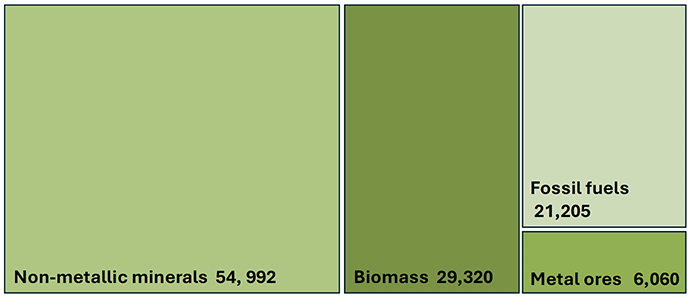
Conde et al. (2023) for Zero Waste Scotland (ZWS) reports that “tracking extraction taking place abroad is undoubtedly tricky”. Reasons include the volume of resources embodied in goods at stages in their production prior to their importation to Scotland, and the waste and emissions associated with production processes taking place in the country of origin. They note that “distinguishing between these various paths is impossible”. The reasons include: i) processes for extracting one product being inherently linked to the extraction of other materials with one or other being bi-products (e.g., cobalt as a bi-product of copper and nickel mining); ii) flows of materials which include recycling or waste disposal may include inefficient production processes used by trading partners. However, changes due to regulatory and technological advances will, progressively, provide more specific information. For example, the German Federal Agency for Earth Sciences and Raw Materials uses an analytical fingerprint method to verify the origins of materials such as tin. This reflects pressures from the United Nations for tools to verify the origins of raw materials and products in combatting the supply of ‘conflict minerals’ (Watzel, 2022; OECD, 2016a).
An indication of the types of environmental impacts created by consumption in Europe is provided by Sala et al. (2019). Their analysis of data provides an indication of the levels of impact from household consumption profiles (per person), using a categorisation of environmental impacts of the European Commission Joint Research Centre (JRC). The classification and the scientific underpinning of the evidence of those impacts are provided in Appendix 1.
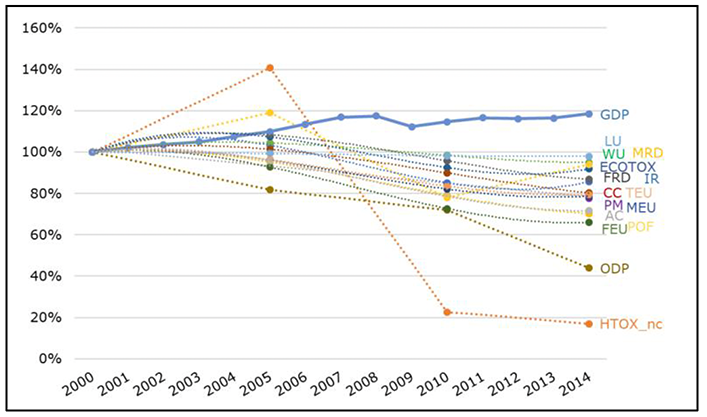
Figure 2 shows the relative change in environmental impacts between 2000 and 2014. The analysis shows that, for some environmental impact categories, there is a correlation between the total volume of household consumption and the total associated environmental impacts. This correlation is strongest for acidification, eutrophication (terrestrial, marine and freshwater), climate change and resource use and fossil fuels. In comparison, there is minor or no correlation regarding human toxicity (cancer and non-cancer), freshwater ecotoxicity, particulate matter and resource use, minerals and metals.
Findings indicate a decrease of greater than 20% in the impacts for eight of sixteen impact categories, including the environmental impact categories of particulate matter, photochemical ozone formation, ozone depletion potential, acidification, and marine, freshwater, and terrestrial eutrophication. However, smaller decreases are evident for environmental impact categories of resource use, minerals and metals, and land use.
A further analysis by Beylot et al. (2019), using the EXIOBASE3, identified the top 10 products and services which contribute to six categories of environmental impacts. Their analysis shows that food products, in particular meat and dairy products, are significant in their contributions to acidification, eutrophication, land use, water use, and climate change (Crenna et al., 2021). Notarnicola et al. (2016) conclude that food consumption is responsible for 20% to 30% of the environmental burdens of total consumption. These analyses are discussed further in Section six.
Scottish Enterprise set out the benefits of mapping supply chains for products. These include risk assessments and development of mitigation strategies. They provide extensive links to business sectors of the Scottish economy including to databases of exporters. The Scottish Parliament Economy and Fair Work Committee report on Scotland's Supply Chain notes benefits of gaining insight and understanding of those chains, noting that “issues affecting supply chains are multi-faceted and can shift rapidly” Scottish Parliament (2022). They identify potential environmental benefits of reducing distances for transporting products (e.g. carbon miles). However, the report does not cover other environmental impacts of supply chains. Details of sources of some imported goods appear to be available in commercial databases of supply chains of economic sectors, but not publicly available. However, the EXIOBASE3 is an example of a database which has been used to assess environmental impacts associated with the final consumption of product groups (e.g. Stadler et al., 2019; Steinmann et al., 2018; Beylot et al. 2019).