
Techscaler Programme 2022-2024: early evaluation - main report
Independent early evaluation of the Scottish Government’s Techscaler Programme (2022 to 2024), examining programme design, delivery, participation, early outcomes and impacts, and setting out evidence‑based recommendations.
Appendix A: Recommended actions from this evaluation
Strategic focus and direction
Priority recommendation: Targeting of support and resources
Key actions for consideration include:
- the Techscaler Programme could adopt a more selective, “picking winners” strategy that concentrates support in sectors, regions, or founder profiles with the greatest potential to scale and generate broader economic returns. For example:
- emerging thematic and sectoral (and sub sector) opportunities and horizon scanning — identifying where Scotland can lead and backing sectors where IP is hard to replicate (a key criteria for investors) and USPs can be built.
- diversity-focused human capital development by increasing outreach and tailored support for founder profiles, where untapped potential remains under-supported.
Priority recommendation: Realign the Techscaler Programme brand and marketing strategy to support growth and scalable businesses
Key actions for consideration include:
- update branding and messaging — refresh the Techscaler Programme’s brand narrative and marketing materials to align with the new focus on growth and scalable businesses. The messaging should emphasise the longer term impacts and outcomes of the programme, growth pathways, and availability of tailored support for growth and scaling companies.
- leverage champions and community — harness successful founders, mentors, and community figures as brand ambassadors, particularly those involved in the growth and scaling cohorts (direct experience of starting and scaling businesses). Involve them in events, content, and outreach to raise visibility and credibility of the offer.
- clarify the distinction between CodeBase and the Techscaler Programme — define the Techscaler Programme as the government-funded support programme, and CodeBase as the delivery partner. While CodeBase currently use wording such as 'Techscaler is a Scottish Government programme delivered by CodeBase' or 'delivered in partnership with CodeBase' across its materials the evaluation feedback suggests there remains an element of confusion in some quarters.
Operations and delivery
Priority recommendation: Develop the offer
Key actions for consideration include:
- investment readiness — provide more targeted support on how to pitch for investment, and how to meet investor expectations around risk.
- team building and organisational design — help founders understand how to build out leadership teams, recruit for scale, and design staffing structures that support sustainable growth.
- market and customer development — support companies in identifying scalable market opportunities, refining market strategies, and deepening customer engagement to drive revenue growth — domestically and internationally.
Priority recommendation: Align staffing and recruitment with growth and scaling focus
Key actions for consideration include:
- conduct a staffing and mentor audit — CodeBase should carry out a comprehensive review of current staff and its mentor pool to assess fit for the renewed focus on growth and scaling companies.
- targeted recruitment strategy — undertake a recruitment plan aimed at attracting high-calibre candidates with real-world scaleup experience — including founders, operators, and growth specialists.
- relationship managers — see recommendation below.
Priority recommendation: Redesign the regional hub model
A more flexible, user-centric model is needed. There are two key options for consideration:
- revise the user model to drive engagement — continue operating physical hubs but shift to a subsidised or free-to-use model to lower barriers and encourage higher usage.
- revise the delivery format — explore agile alternatives such as pop-up spaces, rotating locations, mobile units, or virtual hubs to better meet regional needs and drive participation.
Both options could be piloted/tested regionally, and a hybrid approach may be appropriate. Of critical importance, under both models there should be a continued focus on building community and networking opportunities, especially for underrepresented groups.
Recommendation: Establish a Curation Board to identify and promote emerging talent
Key actions for consideration include:
- creating a ‘Curation Board’ to enhance the ‘Ones to Watch’ initiative. The board would act as a strategic panel that applies judgment beyond the numbers to identify founders and ventures with the greatest scaling potential, helping focus resources where impact is most likely. This board should include experienced operators (for example, enterprise agencies, industry bodies, innovation centres, universities, mentors, investors) and ecosystem leaders.
- introducing a ‘People to Watch’ category — investor and mentor feedback underscores the importance of backing individuals, not just companies. A ‘People to Watch’ category would highlight emerging founders (at both ideation/early stage and beyond) and future leaders within the tech ecosystem.
- strategic engagement — the board can also advise on which companies and individuals are best positioned for targeted investor engagement, international opportunities, and government-backed support — improving transparency, aligning efforts, and deepening ecosystem trust.
Recommendation: Establish a formal relationship or customer management structure
Key actions for consideration includes:
- appoint relationship managers for the high-potential cohort — assign experienced relationship managers to proactively support a defined group of growth and scaling companies and emerging leaders (see recommendation above regrading ‘Ones to Watch’ and ‘People to Watch’). The role will include coordinating engagement, outreach, and connecting them with relevant opportunities, partners, and support.
Management, governance, and administration
Priority recommendation: Stakeholder mapping and engagement
Key actions for consideration include:
- mapping the ecosystem — undertake a mapping of relevant stakeholders/ partners, including public sector agencies, investors, industry bodies, academic institutions, and ecosystem partners to identify existing relationships, gaps, and opportunities.
- defining engagement metrics — develop metrics to assess the strength and value of stakeholder relationships. This will help prioritise stakeholder engagement efforts and resources (strategic, collaborative, opportunistic, and transactional).
- allocating dedicated resource — appoint a dedicated stakeholder engagement lead or team to manage relationships and ensure continuity.
- develop processes for cross referral and ongoing communication to update partners on progress of referred companies/founders.
Recommendation: Clarify current logic model and theory of change
Key actions for consideration include:
- define what success looks like — Scottish Government and CodeBase should more clearly articulate the core objective of the Techscaler Programme — including the long-term economic impact and the specific change it aims to drive in the ecosystem.
- set SMART objectives — ensure that goals are Specific, Measurable, Achievable, Relevant, and Time-bound. These should guide programme design, delivery, and evaluation, and provide a benchmark for impact.
- further clarity on the boundaries for the Techscaler Programme and linkages to other parts of the ecosystem — what the programme is, but importantly what it is not.
Priority recommendation: Develop a robust monitoring and evaluation framework
Key actions for consideration include:
- develop outcome-focused indicator metrics — define a clear set of indicators aligned with outcomes and economic impact as detailed in the logic model. These should complement existing service-level data and track progress meaningfully — but not be used as rigid KPIs or targets. Instead, they should serve as directional tools (thresholds and RAG assessments) that evidence progress but safeguards the Techscaler Programme’s flexible delivery model.
- as noted by some stakeholders, an appropriate approach might be the inclusion of so called ‘flywheel’ indicators as an approach to describing and evidencing self-reinforcing cycles of growth. Where the flywheel effect describes how small, consistent pushes show whether the reinforcing loop is working — eventually building momentum and reaching the “tipping point”. An example is provided below, however, these should be developed and refined by partners and with reference to the logic model.
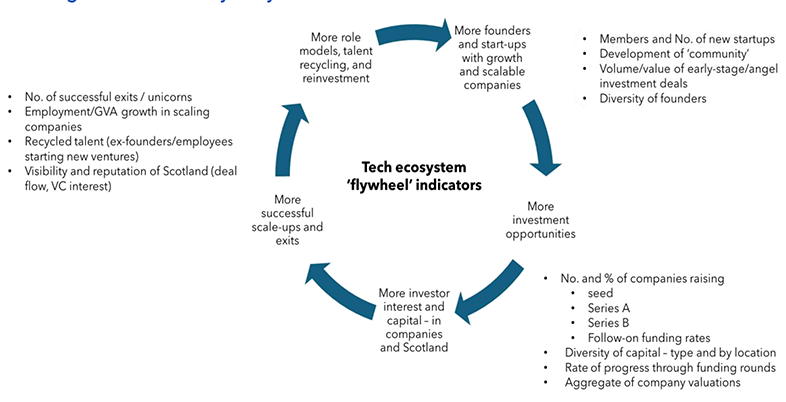
- other indicators of progress — strengthen qualitative data and storytelling — the Techscaler Programme should:
- collect richer qualitative data through interviews, testimonials, and deep dives.
- identify and support “Techscaler Champions” — participants who can credibly share their experiences and serve as voices of the community.
- use these stories for evaluation, marketing, and to reinforce the sense of community and ‘giving back’.
Recommendation: Strengthen financial reporting
A key action for consideration includes:
- enhance clarity on resource allocation and expenditure — break down financial reports to show how and where resources are being deployed across programme areas, regions, and delivery activities.
Contact
Email: DLECONBOCEAESBITE@gov.scot