
Funded early learning and childcare in private, third sector and childminding settings: delivery costs
This report presents findings from a national data collection exercise commissioned by the Scottish Government to understand the costs of delivering funded Early Learning and Childcare (ELC) in private, third sector, and childminding settings.
Pricing and Fees
This chapter explores how providers structure fees for non-funded hours and the costs associated with session delivery and meals. It presents reported fees by age group and session type, average session lengths, and meal costs. The chapter also discusses strategic considerations in pricing, including cost recovery, affordability, and the impact of funding constraints on service delivery and parental choice.
Session Lengths
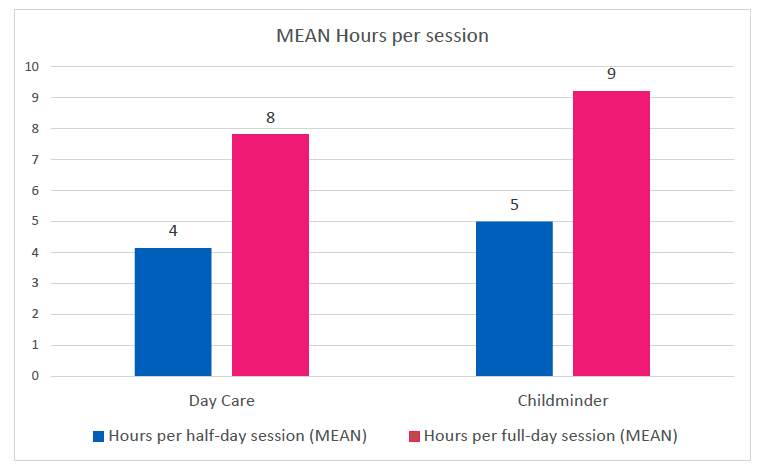
The survey also captured data on the average length of sessions offered by providers. For day care of children settings, the mean length of a half-day session was 4 hours, and the mean full-day session was 8 hours. For childminders, the average session lengths were longer: 5 hours for a half-day and 9 hours for a full-day (see Figure 9).
Reported Fees by Age Group and Session Type
Providers were asked to report the fees they charge for non-funded hours, broken down by age group and session type. These figures offer insight into how providers structure their pricing outside the funded entitlement and help contextualise the financial pressures they face. The figures provided below are for day care of children providers only.
For children under 3 years old, the median fee reported was:
- £35 per half-day session
- £61 per full-day session
- £287 per week
For children aged 3 and over, the median fee was:
- £36 per half-day session
- £60 per full-day session
- £285 per week
These vary by type of provider, with the median weekly fee for a private provider for under 3s being £318 compared to £225 for third sector providers. Similarly, for 3 and over this is £311 for private providers and £238 for third sector providers.
Taking a simple average of the average fee for day care of children providers by day and average hours, the average hourly fee is around £7.63 per hour for a full day session and £8.75 for a half day session. These figures suggest that fees are broadly similar across age groups, with slightly higher charges for younger children.
However, the narrow difference in fees also suggests that many providers apply a standardised pricing model, potentially due to market expectations, administrative simplicity, or the fact that many do not differentiate costs across different age groups. Where costs are not differentiated, this is likely to influence fee-setting practices.
This analysis suggests that hourly rates embedded within session fees vary significantly depending on provider type and session length. It also highlights that shorter sessions tend to carry a higher hourly cost, which may reflect the fixed costs associated with staffing, premises, and administration that are incurred regardless of session duration. It may also indicate that providers are ensuring they can sell enough hours, so that they do not have to sell remaining hours each day.
Providers noted that session lengths are shaped by parental demand, staffing availability, and local authority funding models. Some expressed concern that the current funding model, which is based on hourly rates, does not fully account for the operational realities of session-based delivery. Others highlighted that longer sessions can help spread fixed costs more effectively, but may not be viable for all families or settings.
Sources of income
The survey also collected information on how sources of income were divided across a range of measures by asking providers to provide what percentage of their income could be allocated to funded ELC payments, private fees from parents, other government funding, non-government funding, donations and other sources.
This question was offered as optional and therefore the vast majority of providers did not provide this information.
Contact
Email: elc@gov.scot