
Carbon Neutral Islands: financing roadmap
Financing roadmap for the Carbon Neutral Islands Project sets out future initiatives for the Project and different avenues to finance these.
Island Annex – Barra & Vatersay
Island Context
This section outlines the proposed developments in Barra and Vatersay, coordinated by Local Anchor Organisations and Community Development Officers who are responsible for leading the implementation of the CNI project at the local level.
Island Context for Barra & Vatersay.
Economic Activity:
Top Sectors (2011 Census). These industries employ 47.5% of the population:
- Agriculture and Fishing
- Mining and Quarrying
- Manufacturing
The total Greenhouse Gas Emissions (tCO2e) is 36,839.
This is comprised of emissions from the following sources:
- Agriculture: 1,210
- Energy: 6,564
- LULUCF: 14,970
- Transport: 13,197
- Waste: 898
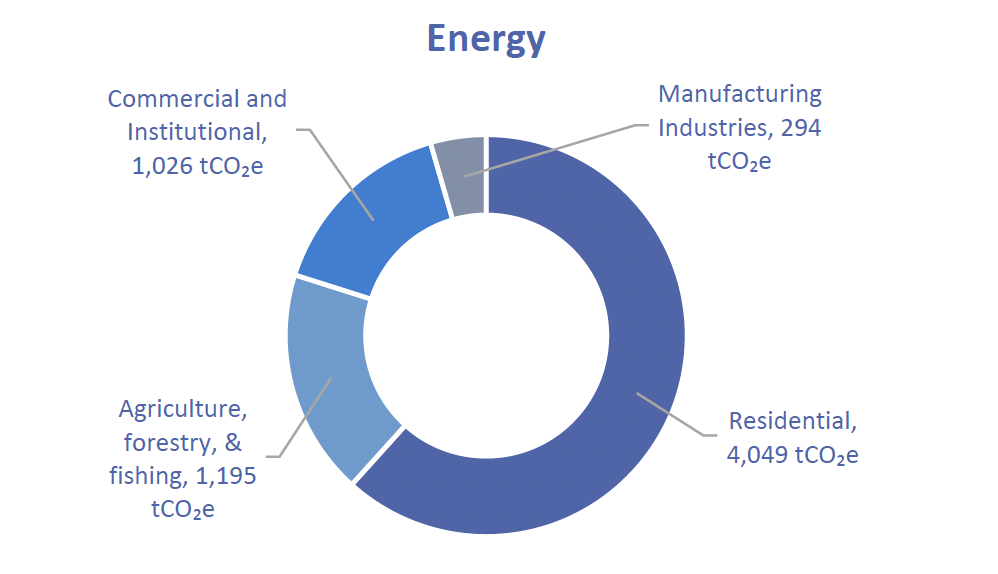
The total Greenhouse Gas Emissions from Energy (tCO2e) is 6,564. This is comprised of the following:
- Commercial and Institutional: 1,026
- Manufacturing Industries: 294
- Agriculture, forestry & fishing: 1,195
- Residential: 4,049
Projects
Vatersay Hall Community Buildings Renewables
Location: Isle of Vatersay
Capital cost: £250,000 capital
Financial year: 2025/2026
Context: Community halls are important centres of activity locally and help address social isolation and the cost-of-living crisis. They can also be used to exchange information on and demonstrate energy efficiency measures. Recently the cost of heating the community halls on Vatersay has limited their usage as they are becoming too expensive to heat.
To address this situation, it is proposed that a SD turbine (9kW), Hybrid Solar (25kW) & Battery Storage (30kW), Energy Monitoring and all necessary installation materials are installed in Vatersay Community buildings.
Local stakeholders: Vatersay Community Association
Key risks: Grid connection challenges (limited capacity for new installs). Financial cost.
Northbay Hall Community Buildings Renewables and energy efficiency
Location: Townships within the Northbay Community Council area, Isle of Barra
Capital cost: £30,000 capital
Financial year: 2025/2026
Context: Community halls are important centres of activity locally and help address social isolation and the cost-of-living crisis. They can also be used to exchange information on and demonstrate energy efficiency measures. Recently the cost of heating the community halls has limited their use as they are becoming too expensive to heat.
To address this situation, a combination of energy efficiency measures, a low carbon/energy efficient space-and-water heating system to reduce energy bills and carbon emissions will be installed. The system will utilise power from the battery storage associated with Garadh a Bagh a Tuath (GaBaT) which stores excess energy from the 3 SD turbine (9kW) jointly operated with GaBaT.
Local stakeholders: Northbay Hall Committee
Key risks: Challenges from ongoing maintenance of the wind turbines in a remote geographic location – this can be mitigated by establishing an annual maintenance schedule and entering into a maintenance contract. Ideally, sufficient distributed energy resources (DERs) would be established to result in it being economically viable for this service to be provided by a company based in Uist or Barra.
Energy Local Club
Location: Barra and Vatersay and potential for neighbouring island of Eriskay as the Energy Local club is downstream of the primary substation.
Capital Cost: Approximately £35,000 resource. Capital: TBC
Financial year: 2025/2026
Context: Establishment of an Energy Local club will result in lower overall energy payments through the implementation of a two-tariff system – a lower tariff when the demand matches renewable supply and another higher one when there is no local renewable supply.
It is proposed that one such club is established in Barra and Vatersay with potential for expansion into Eriskay.
Local stakeholders: Community generator: Barra & Vatersay Wind Energy Ltd
Key risks: Residences and businesses in the area demarcated by the substation. Uptake/involvement in club too great for level of generation. Limited uptake reducing overall financial benefits.
Micro Grid for Uist and Barra
Capital cost: £10 million per project or if multiple projects aggregated together
Financial year: 2034/2035
Context: A smart grid-tied microgrid has the potential to help address concerns regarding the reliability of the local energy grid and support the transition to an electrified energy system.
Overdependency on a single energy vector will result in a system susceptible to single-point failure. Coupled with an increased incidence of extreme weather events as a consequence of climate change this advocate for the deployment of a resilient system of energy supply in respect of subsea cables, increased renewable penetration of the local supply, and greater self-sufficiency in energy.
Such an approach has the ancillary potential benefits of helping to address fuel poverty, offset a proportion of grid-reinforcement costs and promote the development of a multi-vector, low carbon energy vector supply to reduce exposure to single point failure. A shift of the focus from export to local supply would also potentially foster the development of innovative energy storage solutions such as hydrogen, pumped storage and the use of tidal lagoons as mediated by magnitude frequency of the demand response.
Local stakeholders: Sneider Electric Ltd.
Key risks: Challenges in capital raising for such a large-scale project. Ensuring community buy-in to a project of this scale.
Conversion of Craigston Schoolhouse and School Project an Incubation Units, Remote Workers Hubs and Passivhaus / Renewable Technology Demonstrator
Capital cost: £650,000 capital
Financial year: 2026/2027 (initiation with possibility to phase)
Context: This project proposes the conversion of four self-contained leasable interior areas, two serviced external areas and a communal area for the business startup, project incubation and remote workers hub.
This will address some of the demand for space whilst at the same time generating income to cover operating costs. It will also use the building as a whole as a demonstration of the in-situ interface of energy efficiency measures and multi-vector renewable technologies with the shared common room being intended to help address the isolation of lone workers and capitalise upon synergies between individuals working on different projects and lines of employment.
Local stakeholders: Barra & Vatersay Community Ltd – Voluntary Action – Barra & Vatersay – Barra Learning Centre/UHI NWH (incl. Uist Archaeology Project Team Cnoc Sollier) – Buth Bharraigh.
Key risks: Local authority sale of asset: the local authority decide to put the property on the open market prior to the asset transfer request being submitted.
Issues with the title not being ‘clean’ in respect of crofting tenure burden.
Contact
Email: peter.brearley@gov.scot