
Carbon Neutral Islands: financing roadmap
Financing roadmap for the Carbon Neutral Islands Project sets out future initiatives for the Project and different avenues to finance these.
Financing Options
A range of funding streams beyond those offered by the Scottish Government will be required to allow the islands to reach net zero by 2040. It is acknowledged that the funding landscape is challenging with opportunities to take up private finance requiring significant upfront preparatory work that, in some cases, may take several years.
The project is relatively mature in understanding community aspirations for carbon-reducing initiatives. However, to leverage financing opportunities and create more avenues for project delivery, a more robust approach is needed to develop projects that can deliver both financial returns and broader socio-economic benefits.
The flowchart below demonstrates the process for developing a project from initial concept to implementation.
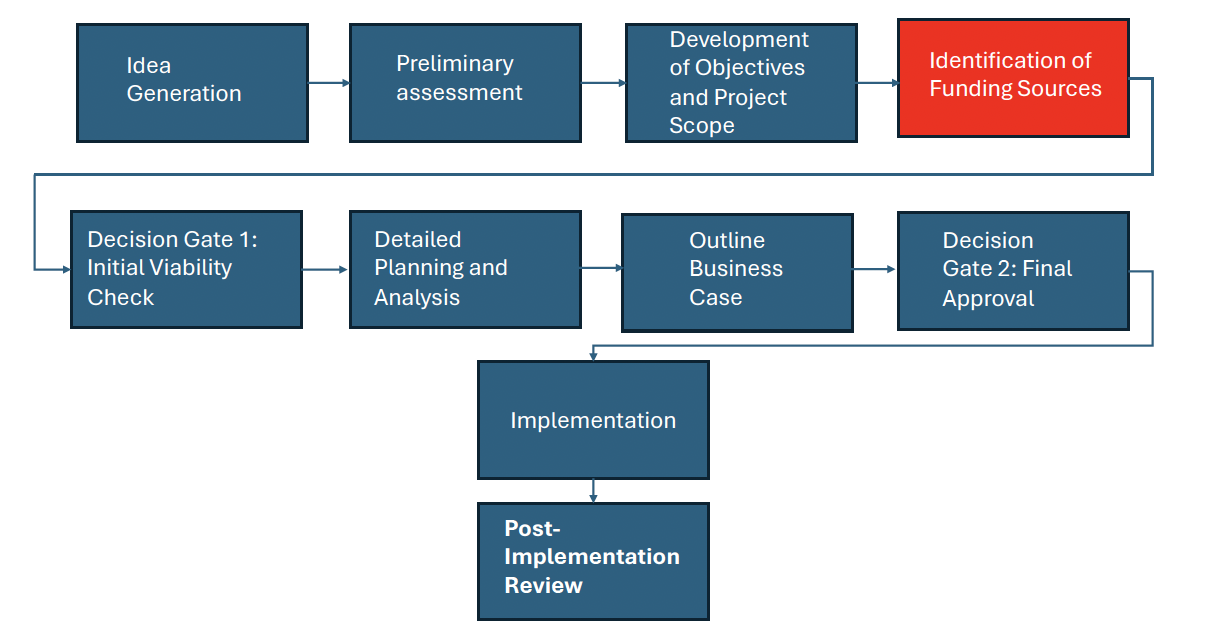
The process for developing a project flows from the initial concept to implementation.
The below steps are required for developing a project:
- Idea generation
- Preliminary assessment
- Development of Objectives and Project Scope
- Identification of funding Sources. This is a key step for the CNI Project Financing Roadmap.
- Decision Gate 1: Initial Viability Check
- Detailed Planning and Analysis
- Outline Business Case
- Decision Gate 2: Final Approval
- Implementation
- Post-implementation Review
Funding Sources
There are differing funding pathways available to projects depending on a number of factors including their area of focus, scale, location and timescales for delivery. Different projects will require different approaches to financing, influencing their design and implementation from an early stage. By understanding and leveraging these different finance options, projects can make the most of them – maximising emissions savings, value for money and community benefits.
There are many potential vehicles for financing; as such, a list of potential investors is not provided in this Financing Roadmap. However, where there are specific opportunities, these are highlighted in the island-level annexes.
Broadly, funding opportunities for the CNI projects fall into the following categories:
Grant Financing
A wide variety of grants are available to support decarbonisation initiatives and broader community economic and social development. Grants are usually provided by organisations seeking to achieve specific objectives, and are generally non-repayable, subject to conditions of the grant being met by the grantee. Whilst being non-repayable is a clear advantage to this funding approach, there are routinely conditions associated with grant funding, including for example, conditions relating to the future use of assets. A large proportion of grant funds originate in the public sector, resulting in detailed due diligence requirements and application of a range of national policy requirements. Often, grant funds only open for short periods of time, with funding windows potentially changing in response to fiscal and political pressures. Grant funds are routinely competitive in nature, meaning Community Development Officers cannot necessarily rely on securing funding in this way. This can be a particular issue when seeking match funding, or when bidding for a range of funds to achieve the total funding requirement for a particular project. Time constraints often associated with grant funding make large-scale multi-year projects challenging.
Debt Financing
Debt financing is a means of raising capital for projects by borrowing money, most regularly through loans or by issuing bonds. The borrower agrees to repay the lender the amount borrowed, plus an agreed rate of interest, over a specified time period. An advantage of debt financing is that the borrower (for example the local anchor organisation) does not give away ownership of any part of the organisation or asset, meaning that control is retained. Another advantage is that interest payments on debt may be tax-deductible, reducing the overall cost of borrowing. Of course, debt financing requires interest to be repaid, and as such, this approach is only appropriate for projects or initiatives which will deliver a return on investment. Furthermore, the lender may specify a requirement for securities or collateral, potentially placing community assets at risk, should debt not be repaid as agreed.
Equity Financing
Equity financing is the process of raising capital by selling shares of a legal entity to investors. Unlike debt financing, there is no requirement to repay capital raised through equity financing; this could be of particular benefit to local anchor organisations seeking to deliver projects which will not provide an immediate return on investment. Another potential advantage to equity investment is that investors may bring with them significant expertise relevant to the investment (for example, renewable energy production), and industry relationships which could be of significant value to the project (for example, relationships with distribution network operators or equipment manufacturers). Whilst there are many advantages to equity financing, this approach does reduce the overall ownership of an entity or asset, potentially resulting the dilution of control, which might not be suitable or palatable for some community-led projects.
Match Funding/Hybrid Finance Options
The funding sources discussed above can be combined to varying degrees depending on the nature of the project. For example, match funding can be used to combine resources from two or more grants. Alternately, equity and debt financing can be used to bolster grants and expand the reach of a project. Hybrid models provide flexibility in financing, allowing projects to cover initial setup costs through grants while attracting private investment for long-term sustainability and scalability.
However, utilising different financing sources in one project can lead to issues. A project dependent on match funding can face challenges if one of its funding streams falls through. Alternatively, it can be challenging to apply debt finance to a project that already receives grant funding and has a security arrangement in place.
To date, several CNI projects have made good use of match funding. For example, on Raasay a project to retrofit three affordable homes with energy efficiency measures has been funded through a variety of sources including the Scottish Land Fund and Skye and Lochalsh Housing Association. We will continue to support the islands in securing appropriate match funding to maximise opportunities wherever possible.
Private financing options are limited in the project’s current phase – this is due to a number of factors including the need to build private investment on pre-existing feasibility work and challenges in ensuring infrastructure is in place for large scale decarbonisation. Consequently, the focus of the projects in the immediate future is largely to utilise grant funding (including Scottish Government funding granted through the project) to maximise medium term opportunities for private financing. It is crucial that projects remain flexible and adaptable to changing funding opportunities as funding priorities can shift, and being reactive to available funds ensures that projects can secure the necessary resources.
Revenue Generation
It is also worth highlighting the potential for revenue generating initiatives. These may be funded through any of the above funding streams but any revenue gained can be fed back into the local anchor organisation increasing available funding for future projects. Options for this are wide ranging including the commercialisation of community-owned electric vehicles, selling of bioenergy products from woodland renewal/biodiversification projects or private use of retrofitted community halls.
Example Financing Models
There are a vast number of potential options and combinations of different project finance approaches. A number of speculative potential options are set out below.
- Initiatives focused on biodiversification, land use and reforestation should explore grants, most likely from the Scottish Government, and funding streams separate to the CNI Capital Fund. For example projects aimed at peatland restoration might find funding opportunities through Peatland ACTION.
- Investment in community renewable energy generation could be undertaken and/or scaled up using equity finance which, depending on the project partner, may bring in expertise in regards to installing, maintaining and monetising such technologies. Potential partners could range in size from local development bodies to larger-scale funds. There is also the potential to utilise community benefit from local generation (where available) to support development in this area. In addition, buying into local renewable energy development opportunities could be explored.
- Debt financing (through a mortgage) could be used to purchase local buildings for community retrofit.
- Community heating technologies – for example, local heat networks, potentially using ground source heat pumps, could be funded through equity finance with repayments being supported through users’ energy bills.
Contact
Email: peter.brearley@gov.scot