
Carbon Neutral Islands: financing roadmap
Financing roadmap for the Carbon Neutral Islands Project sets out future initiatives for the Project and different avenues to finance these.
The Carbon Neutral Islands Project
History
Throughout the life of the CNI Project, the Scottish Government has allocated funding each year to ensure the communities can drive forward climate action. This has enabled the employment of Community Development Officers (CDOs) through local anchor organisations, who have used their local expertise to lead the project on the ground. The CDOs have acted as a vital link between the government and communities by building engagement and developing key project outputs.
During 2022/2023, the islands received specialist support to complete early-stage work in determining their path toward net zero. Firstly, in-depth carbon audits were produced setting out emissions from energy, transport, waste, land use, land use change and forestry and agriculture. These provide a baseline for reductions in emissions from each island and help to identify target areas for decarbonisation.
The islands then developed Community Climate Change Action Plans (CCAPs) to respond to local priorities and set out key areas for action. These were published in June 2023, and have since informed the development of projects delivered to date across the islands. The recently published progress report provides more detailed information on these projects.
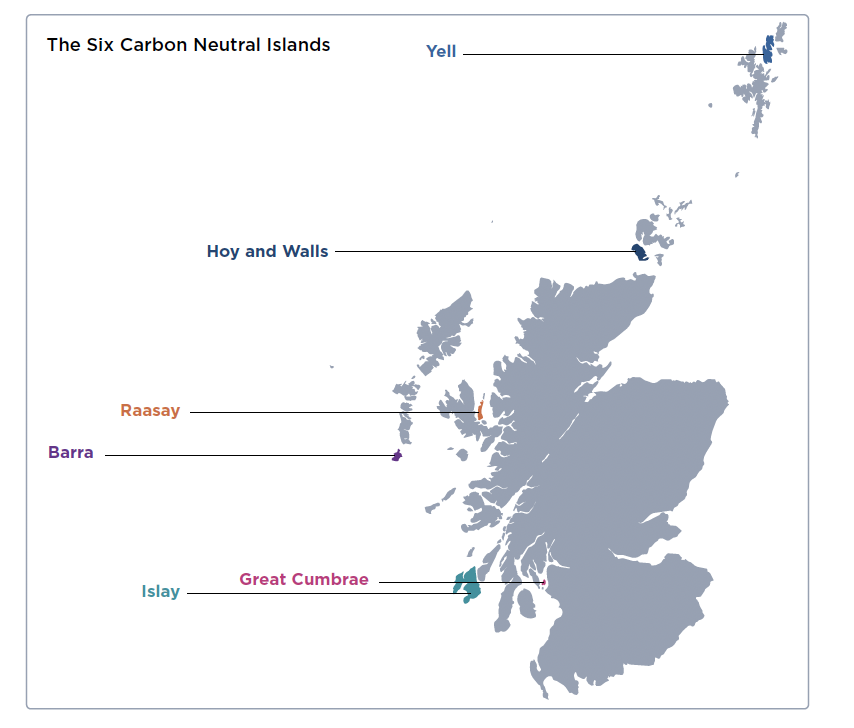
In the 2023/2024 financial year, resource funding continued to support local anchor organisations and the project’s network of stakeholders. £1 million capital funding was allocated to support initial delivery of the CCAPs. A range of projects were supported to tackle carbon emissions reduction across different sectors. These include an e-bike scheme on Hoy, energy efficiency improvements for Raasay Community Hall, a solar farm on Islay, in-home energy monitoring on Cumbrae, the setting up of a resilience hub on Yell and a tree planting scheme on Barra.
In 2024/25, the Scottish Government reinforced its commitment to the Carbon Neutral Islands Project in its Programme for Government, with a new promise to develop pathways to finance for the six islands. This work, of which this Financing Roadmap is the first deliverable, will ensure forward thinking project development whilst diversifying the funding base for these projects. In 2024/2025 the project received a £900,000 resource budget and a £1.3 million capital budget. The Scottish Government in partnership with the Scottish Futures Trust (SFT) delivered a £1 million capital fund. This utilised a bidding model with local authorities acting as the lead applicant working in collaboration with communities. In addition, £50,000 was awarded to each local anchor organisation as a direct grant to fund smaller-scale projects to support the delivery of the CCAPs.
The successful project are as follows:
1.Millport 130 Project (Great Cumbrae) – £136,500
This project aims to install roof-mounted solar PV systems to 130 homes in Millport in a phased approach.
2.Forestry Initiative (Islay) – £142,285
CNICF will support Phase 3 of the Islay Forestry Initiative to develop a 3 acre tree nursery alongside a community orchard and local fuel wood supply chain infrastructure.
3.Decarbonisation of Community Buildings (Islay) – £246,444
This project will improve renewable energy developments for seven community buildings across the island. Including a range of solar PV, batteries and heating sources.
4.Cobhair Bharraigh Decarbonisation (Barra) – £127,022
This project will decarbonise a vital hub for a large portion of the Barra & Vatersay community that acts as day care, a support centre and ‘warm space’ during winter time.
5.Habitat Restoration (Raasay) – £75,000
This project will restore habitats through the removal of invasive species from priority areas using local contractors to combat the issue of seasonal employment of Raasay.
6.Inverarish Housing Retrofit (Raasay) – £251,633
This project will deliver three affordable rental properties with zero direct emission heating systems through the deep retrofit of vacant homes.
Project Structure
As the CNI project had progressed, its supporting structures have adapted to ensure the islands are enabled to drive forward climate action at the community level. As of 2025, the project is structured as follows:
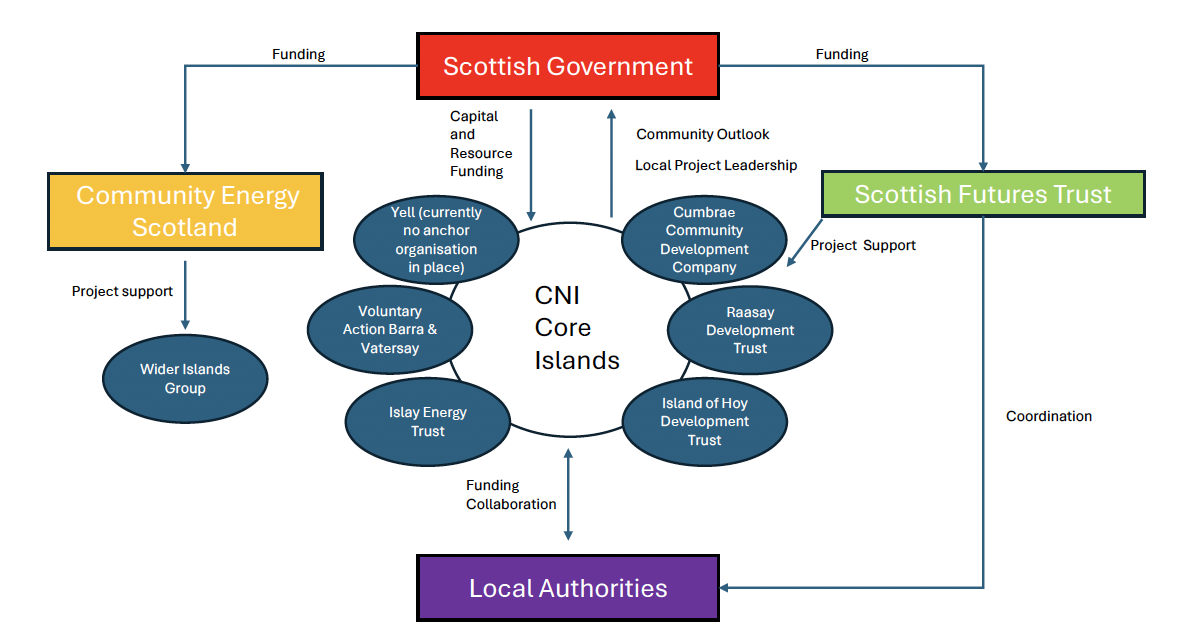
CNI Project Structure. The Scottish Government provides Capital and Resource funding to the CNI Core Islands who in turn provide Community Outlook and Local Project Leadership. The CNI Core Islands have funding collaboration with the Local Authorities. The Scottish Government provides funding to Scottish Futures Trust who provide project support to the Core Islands and coordinate with the Local Authorities. The Scottish Government provides funding to Community Energy Scotland who provide project support to the Wider Islands Group.
The Scottish Government continues to fund local anchor organisations to deliver the project on each island. Local knowledge and trusted relationships are key to effective community engagement and help to ensure the project is driven by, and reflects, the concerns of the island communities themselves.
The Scottish Futures Trust holds responsibility for the development, delivery and monitoring of the Carbon Neutral Islands Capital Fund. They support the direct allocation of capital funding to the islands and provide valuable wider project support in relation to strategy and governance.
Local authorities are the lead applicants for the CNI Capital Fund, working closely with local organisations and communities to put forward applications and deliver projects.
Community Energy Scotland continue to engage with a number of other islands across Scotland helping them to take steps towards decarbonisation informed by the experiences gained through the CNI project to date.
2024/2025 has seen a change for Yell – one of the core six islands. In November 2024, North Yell Development Council stepped away from the project.
Prior to this, the CNI project has seen a number of successes on Yell including:
- The retrofit of the Cullivoe Galley Shed – bringing a historic building on the island up to a high standard of energy efficiency. Annually, this shed houses Yell’s galley as it is built for the Up Helly Aa Festival – a Shetland tradition in which galleys are burned every year in January.
- The development of a reuse centre/scrap store – promoting the development of a circular economy on the island.
- The installation of a resilience hub network – seven resilience hubs have been created across Yell in local halls. CNI funding supported the purchase of emergency equipment in the event of power cuts and extreme weather.
The next steps for the ongoing delivery of the CNI project in Shetland are currently being evaluated with our local authority partners. As a result, a project prospectus for Yell has not been included at this time.
Opportunities
In addition to emissions reductions, the project has, and will continue to deliver a number of wider benefits and opportunities across the island communities involved:
- Economic growth – creating jobs and stimulating local economies through new green initiatives.
- Innovation and development – the project can drive innovation in renewable energy and low-carbon technologies, through a variety of different funding models, to the benefit of businesses and residents.
- National and International collaboration – sharing knowledge and technology with other regions and countries, fostering global partnerships.
- Technological advances – the islands can serve as living laboratories for testing and deploying cutting-edge technologies which reduce energy costs, the savings from which can be reinvested into communities.
- Enhanced resilience – building climate-resilient infrastructure can protect communities from future climate impacts.
Contact
Email: peter.brearley@gov.scot