
Bringing Hope, Building Futures: Tackling child poverty delivery plan 2026-2031 – annex 5: Cumulative Impact Assessment
This report is an annex to Bringing Hope, Building Futures: the third tackling child poverty delivery plan 2026 to 2031 and assesses the cumulative impact of a package of our policies on child poverty.
6. UK Government Welfare policies
6.1 Current policies
This section presents analysis on the impacts of a selection of UK Government welfare policies that are currently in place or have been reformed since the last cumulative impact assessment, namely changes to the standard allowance and health element of Universal Credit (UC), the two-child limit, the benefit cap, and the freeze to Local Housing Allowances at the 2024-25 rate. These policies all change UC income directly, including for many households with children.
The Scottish Government has already set aside over £1.3 billion mitigating the impact of 15 years of UK Government policy. In 2026-27, the government will invest a further £159 million to mitigate UK Government policies using Discretionary Housing Payments and the Scottish Welfare Fund. This includes direct mitigation of the benefit cap and bedroom tax, and additional funding to mitigate the freeze to Local Housing Allowance rates for households with children.
6.1.1 Recent reforms to the standard allowance and to the health element
The Universal Credit Act 2025 introduces above inflation increases to the standard allowance from 2026/27 to 2029/30. At the same time, the health-related element (LCWRA) will be halved for most new clients, with protection only for those meeting new “severe conditions” criteria.
Above inflation increases to the standard allowances of Universal Credit will reduce the incidence and severity of child poverty in Scotland, with the value of these allowances affecting all households in receipt of UC. However, due to the relatively small change in the cash value of benefits as a result of the increase, our modelling suggests only a small impact on overall child poverty rates.
While changes to the health element of Universal Credit will have a significant impact on some households on UC, the modelled impact of this change on overall poverty rates is negligible. This is because only households newly claiming UC are affected, and they will represent only a small proportion of clients for several years. Furthermore, out of 260,000 households with the health element in Scotland, fewer than a quarter (55,000) have children.
Note that these two policies have opposing effects on child poverty.
6.1.2 The benefit cap
The benefit cap limits the total amount of income from certain benefits that each household can receive by reducing either its UC or Housing Benefit (HB), though some households are exempt.[11] Originally introduced in 2013 at a rate equivalent to £26,000 per year (£18,200 for a single person with no children), the cap was lowered to £20,000 (£13,400) in 2016. It was then frozen until 2023, when it was uprated by inflation to £22,020 (£14,753), but has since remained frozen again, significantly reducing its real-terms value. In Scotland, the policy is mitigated through DHPs.
The benefit cap affects only around 3,200 households, but these are overwhelmingly families with children (98% as of August 2025) , and tend to be larger families with single parents. As shown in Table 8, the level of the benefit cap is below the relative poverty threshold for a large majority of affected households. These gaps will widen over time as the poverty line rises while the benefit cap remains indefinitely frozen.
| Household type | Composition of households on the benefit cap | Projected poverty threshold before housing costs | Minimum difference between benefit cap and poverty threshold |
|---|---|---|---|
| Single, no children | 2% | £15,758 | -£1,005 |
| Couple, no children | 0% | £23,520 | -£1,500 |
| Single, one child | 1% | £20,462 | £1,558 |
| Couple, one child | <1% | £28,224 | -£6,204 |
| Single, two children | 15% | £25,166 | -£3,146 |
| Couple, two children | 9% | £32,928 | -£10,908 |
| Single, three children | 29% | £29,870 | -£7,850 |
| Couple, three children | 9% | £37,632 | -£15,612 |
| Single, four children | 17% | £34,574 | -£12,554 |
| Couple, four children | 7% | £42,336 | -£20,316 |
| Single, five children | 8% | £39,278 | -£17,258 |
| Couple, five children | 3% | £47,040 | -£25,020 |
| All | 100% | N/A | N/A |
Notes: Percentages as of August 2025. All children are assumed to be aged fourteen or younger. As older children attract a higher weighting in calculating when equivalising incomes, the poverty thresholds shown here – and therefore the gaps between the benefit cap and those thresholds – are labelled as minimums. In addition, households with five or more children are assumed to have five children – the gaps will be larger for households with more children. The table excludes other forms of income besides benefits. Whereas poverty is measured on a household basis, the benefit cap is applied at the level of the benefit unit, so some households with multiple benefit units may have incomes above the benefit cap and above the relevant poverty thresholds. These thresholds have been calculated using uncalibrated data and therefore the gaps described here are not derived on the same basis as our child poverty rate estimates. Composition of households based on Universal Credit claimants only. Source: SG analysis using UKMOD; DWP Stat-Xplore
Figure 5 shows the number of households and the estimated number of children affected by the benefit cap over time. As of August 2025, around 3,200 households containing over 10,000 children were subject to the cap. The figure also shows how the affected population tends to grow when the benefit cap is frozen or reduced – particularly when benefit rates are uprated or increased – and tends to fall when the benefit cap is uprated. We estimate that, in the 12 months from September 2024 to August 2025, the benefit cap will have withheld a total of £8.6 million in UC from Scottish households. The vast majority of this income was withheld from households with children.
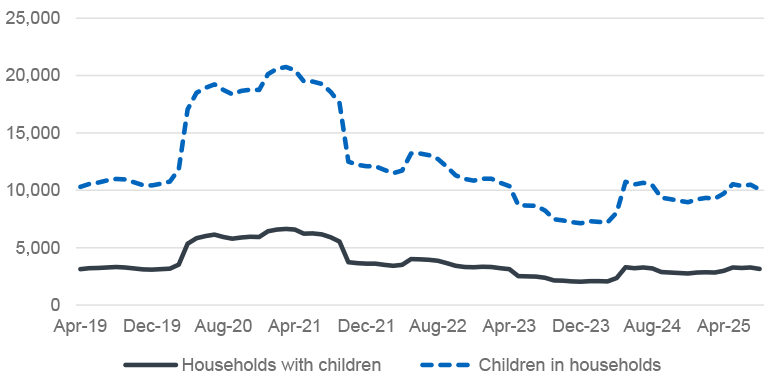
Notes: This includes households with children claiming either Universal Credit or Housing Benefit. By March 2025, the number claiming housing benefit had fallen to zero, reflecting the migration from legacy benefits to Universal Credit. For further details see Section 7.3.1. Source: SG analysis of DWP, Stat-Xplore
We expect the removal of the two-child limit to increase the cost of mitigating the benefit cap, and the number of households affected. The Scottish Fiscal Commission have forecast that spending on DHPs will increase by £8 million in 2026-27 due to new or larger DHPs payments, and our own analysis suggests that the number of capped households will increase by around 40% in 2026-27 as a result of this change.
6.1.3 Using DHPs for mitigation of the benefit cap
The Scottish Government uses DHPs to mitigate the benefit cap. However, there may be instances where this mitigation is constrained because DHPs can only be applied to housing costs for capped households. While this limitation will not affect the majority of capped households, a share of the capped amount for some households cannot be mitigated through DHPs. This includes households with limited housing costs - as of September 2025, DWP statistics indicate that 89 capped households in Scotland do not have a housing entitlement, and it is likely that for some of these households a DHP is not applicable at all.
At present, the implications for child poverty are modest, given the relatively small number of affected households. However, if the number of capped households increases, and if the size of cap deductions rises - particularly after the removal of the two-child limit - these constraints may become a more material driver of child poverty over time.
6.1.4 Local Housing Allowances freeze
Local Housing Allowance (LHA) rates determine the maximum level of support available for private rented sector housing costs within Universal Credit and Housing Benefit. As we have set out in detail in previous iterations of this publication, when LHA rates do not keep pace with market rents, households face increasing shortfalls between their housing support and their actual rents. Following extended periods of caps and freezes - and with LHAs now fixed at their 2024–25 levels - these shortfalls have widened as rents have continued to rise. Although DHPs can be used by councils to mitigate these shortfalls, there is no expectation that local authorities do so in the systematic way required for the bedroom tax or the benefit cap. The resulting divergence between LHAs and market rents has therefore become a growing, though uneven, source of financial pressure for households relying on housing support.
The scale and distribution of this divergence varies significantly across Scotland because rental growth differs. In some areas, where rents have risen more rapidly, the LHA gap has become relatively pronounced; in others it remains limited or does not exist at all.
For example, the gap between the market rent at the 30th percentile and the LHA for a 4-bedroom home in West Dunbartonshire is now 30% (£92 per week). However, there are relatively few affected households with children in this area. In Edinburgh rents have increased to a smaller extent, but this affects a large number of households with children.[12]
Given the detailed, household-level geographic data required, it is not currently possible to produce a robust estimate of the effect of these LHA shortfalls on national child poverty measures. On present evidence, the overall scale of the impact does not appear large enough to be a major driver of child poverty. However, we recognise that in specific areas and circumstances - particularly where rent growth has been acute - LHA divergence may already be having a marked impact on the financial position of some low-income households with children.
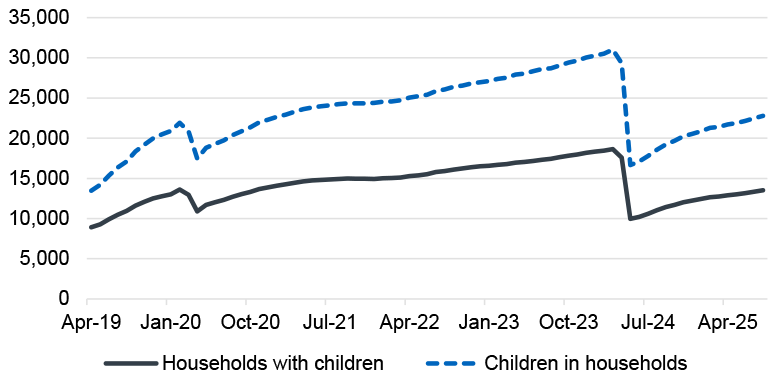
Notes: This graph does not show the number of children in households who would have had their rents covered by LHAs had they not been frozen. A household may have rents higher than the LHA even had it not been frozen. Households with children on housing benefit rather than Universal Credit are not included in this graph, which means that the graph understates the number of households affected earlier in this period. The number of households with children on housing benefit is now very small following the migration from legacy benefits. Source: DWP, Stat-Xplore
6.1.5 The two-child limit
The two-child limit restricted support through UC to the first two children in a family. The policy was introduced on 6 April 2017 and applied to all third and subsequent children born from that date onwards, though there were exemptions in specific circumstances.[13] A key feature of the two-child limit is that an increasing proportion of children were affected over time, and that number would have continued to grow into the mid-2030s, having an impact on progress to child poverty targets.
The Scottish Government had previously committed to introducing a mitigation payment for families affected by the UK Government’s two-child limit from 2026. Previous Scottish Government analysis found that removing or mitigating the limit would be a highly cost-efficient method for reducing child poverty.[14] However, following the UK Government’s decision to abolish the two-child limit, the devolved mitigation payment will no longer proceed.
The removal of the limit at source has material mechanical differences compared to the originally proposed devolved mitigation payment. Under the Scottish Government’s proposal, payments would have been provided to UC claimants in Scotland with three or more children who were not covered by an exemption. This approach would not have altered UC eligibility, the value of UC awards, or entitlement to other devolved benefits.
In contrast, removal of the limit at source does affect these elements. Because UC awards increase for eligible households, the cost saving to the Scottish Government from no longer delivering the mitigation payment is partly offset by higher spending on linked devolved benefits, including the Scottish Child Payment, because more households are made eligible for UC after taking into account a larger initial award (before application of the earnings taper). In addition, higher UC awards mean that some households move above, or move further above, the Benefit Cap threshold. As the Scottish Government mitigates the Benefit Cap through Discretionary Housing Payments (DHP), this creates additional spending pressures. On the other hand, removing the limit at source means that UC earnings taper rules apply to additional child element awards, reducing their value - an effect that would not have occurred under a separate devolved mitigation payment.
Taking these various interactions into account, our modelling indicates that the overall impact of removing the two-child limit at source is similar, in child poverty terms, to the previously proposed mitigation payment. In both cases, around 20,000 children are estimated to be kept out of relative child poverty in 2026-27. By 2030-31, the impact of the two-child limit would have grown as more children were affected, and thus removal at source is estimated to keep 30,000 children out of relative child poverty, while the proposed mitigation payment would have kept 40,000 out of relative child poverty. The larger impact estimated for the mitigation payment compared with the removal at source by 2030-31 reflects the mechanical differences in the payments described above.
In terms of the relative child poverty rate for large families specifically, this represents a 10 percentage point and 14 percentage point reduction in 2030-31 respectively, and 7 and 9 percentage points in 2026-27. Large families are identified as a priority group within the Scottish Government’s child poverty strategy. More generally, policies that constrain benefit entitlement for households with more than two children can be expected to have disproportionately large effects on child poverty rates, given the typically lower equivalised income for larger families and their greater reliance on social security support.
Contact
Email: TCPU@gov.scot