
Bringing Hope, Building Futures: Tackling child poverty delivery plan 2026-2031 – annex 5: Cumulative Impact Assessment
This report is an annex to Bringing Hope, Building Futures: the third tackling child poverty delivery plan 2026 to 2031 and assesses the cumulative impact of a package of our policies on child poverty.
5. Other policies not modelled in the CIA
The list of modelled policies noted in Section 7.2 does not include all the child poverty related policies undertaken by the Scottish Government, but rather is restricted to those with reliable data or where assumptions can be supported with robust evidence. As such, the current projections may be overestimating child poverty rates and underestimating the impact of Scottish Government policies, as current qualitative evidence indicates that many of these policies are effective. This section provides indicative modelling that assumes quantitative impacts informed by the qualitative evidence available.[10]
5.1 Scenario assumptions
Two scenarios have been created to showcase the uncertainty of the modelled projections. Each scenario utilises a set of assumed outcomes which together provide a potential range of child poverty impacts. These are not evidenced assumptions but rather are presented to indicate child poverty impacts based on the potential outcomes from these policies.
These assumptions have been restricted to changes in employment rates for parents and changes in the take-up rate of benefits, which are the most likely ways policies currently not incorporated in the CIA could be having an impact on child poverty rates. For example place-based policies such as the Fairer Future Partnerships and Whole Family Support could see both an increase in take-up of eligible benefits in the short term, as people are connected to services, and an increase in employment in the longer term, as challenges to returning to the workforce are reduced.
Similarly the benefit take-up strategy, combined with improved access and trust in services by parents, could see an increase in take-up of benefits. Many of these programmes in combination can help reduce the barriers to entering the workforce, for example the new transport to employment offer, which could lead to higher success rates for existing employability programmes. There is also a potential increase in employment from the expansion of funded Early Learning and Childcare, whose impacts are likely only captured in some of our baseline years. As UKMOD is a static model, longer term behavioural changes from such support can only be included in the model through assumed outcomes changes. Table 7 details the various assumed outcome changes for each scenario.
Table 7: Assumed outcome changes made for each scenario
Scenario A - Benefit take-up
Increase the take-up estimate of a selection of benefits by 25% of the difference between the current take-up rate and the maximum take-up rate
Scenario A - Employability complements
Increase the proportion of parents who achieve a sustained employment outcome through employability support by 2 percentage points
Scenario A - Childcare adjustment
Minor adjustment to the employment rate for mothers of 4-5 year olds
Scenario B - Benefit take-up
Increase the take-up estimate of a selection of benefits by 50% of the difference between the current take-up rate and the maximum take-up rate
Scenario B - Employability complements
Increase the proportion of parents who achieve a sustained employment outcome through employability support by 4 percentage points
Scenario B - Childcare adjustment
Minor adjustment to the employment rate for mothers of 4-5 year olds
Note: Further details behind these assumptions, along with a selection of major child poverty policies not currently included in the model, can be found in Section 7.2.
5.2 Target measures
Figure 3 summarises the results of our analysis in terms of relative child poverty in 2030-31, with the results for absolute child poverty shown in Figure 4. Figures are only presented for 2030-31 as the assumptions are fixed for any year.
In 2030-31 Scenario A does not see any additional percentage point impacts compared with the current Scottish Government policies seen in Section 3 (although this does not mean there is “no impact”). However, Scenario B estimates a further 10,000 children kept out of relative poverty by Scottish Government policies, for a child poverty rate one percentage point lower than current projections.
In terms of absolute child poverty, both Scenario A and B are estimated to have no visible percentage point impacts compared with the current Scottish Government policy projections.
These estimates only provide an indicative range of potential impacts. The policies not included in the model could range from having no visible impact relative to the projection, or range up to Scenario B. However, these figures indicate that the policies not currently included in the model could have a material impact on future relative and absolute child poverty rates, indicating the uncertainty in the final projection. Further evidence is needed on the impacts of these policies to say with confidence what their impacts may be and how the behavioural shifts may be best modelled in this static model.
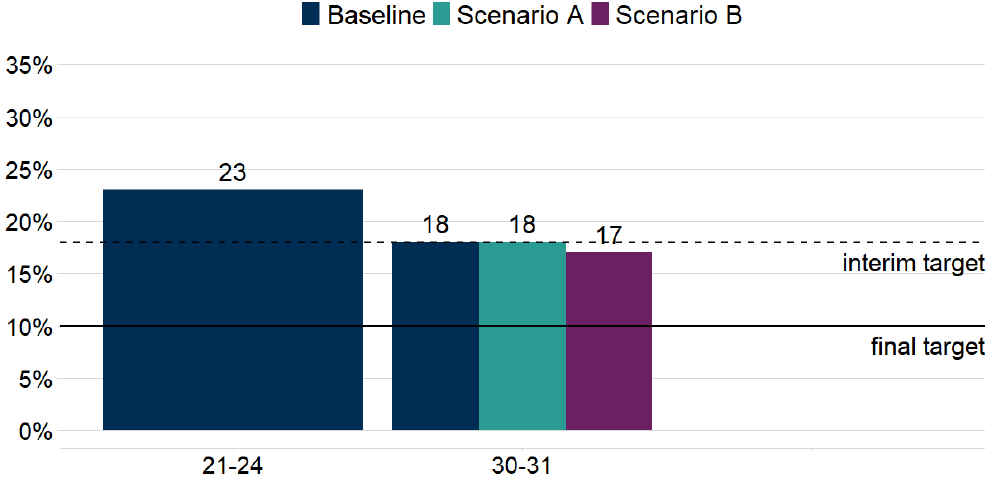
Notes: The counterfactual scenarios represent an indicative range, from baseline to Scenario B, of potential child poverty impacts based on different assumptions. See Section 7.2 for further details. Source: SG analysis using UKMOD
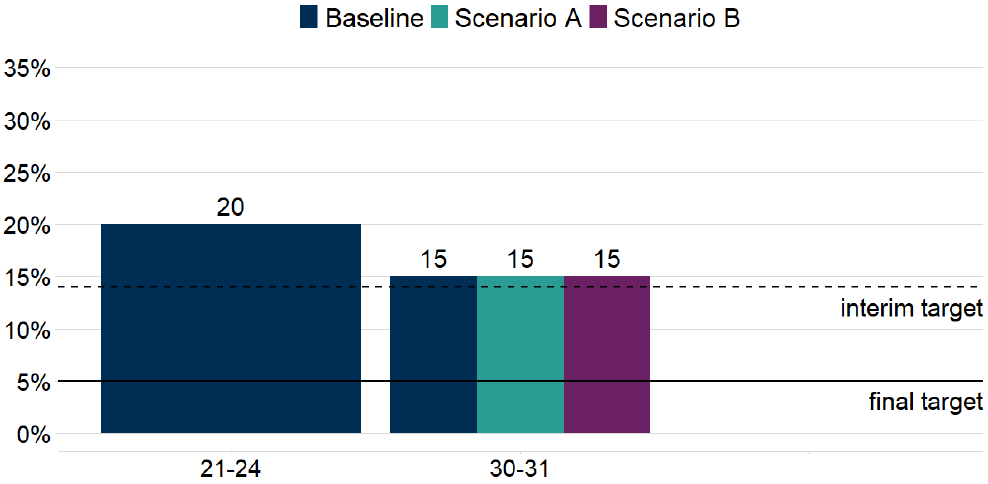
Notes: The counterfactual scenarios represent an indicative range, from baseline to Scenario B, of potential child poverty impacts based on different assumptions. See Section 7.2 for further details. Source: SG analysis using UKMOD
Contact
Email: TCPU@gov.scot