
Bracken presence and management practices on Scottish grassland farms - 2025
Survey of bracken distribution, and how it is managed, in Scottish agricultural grassland.
Data and methodology
Sampling and data collection
Using the June 2025 Agricultural Census [5], a sample was drawn representing grassland and fodder cultivation in Scotland. The bracken survey was sent out alongside the 2025 grassland postal survey.
The questionnaire consisted of two parts. The first was a section consisting of questions about the presence of bracken on the holding and the area and land type on which bracken was present. The second collected information about previous, current and future bracken management practices. The questionnaire also contained qualitative questions regarding the effectiveness of treatments and the comparison of current practices to Asulox. Qualitative responses were categorised during analysis.
The intention of this voluntary survey was to attempt to collect information regarding the presence and management of bracken from a representative sample of holdings with agricultural grassland across Scotland. Unlike the Scottish Government’s agricultural pesticide usage surveys, no attempt has been made to produce a statistical estimate of total Scottish bracken area or management practices from this sample.
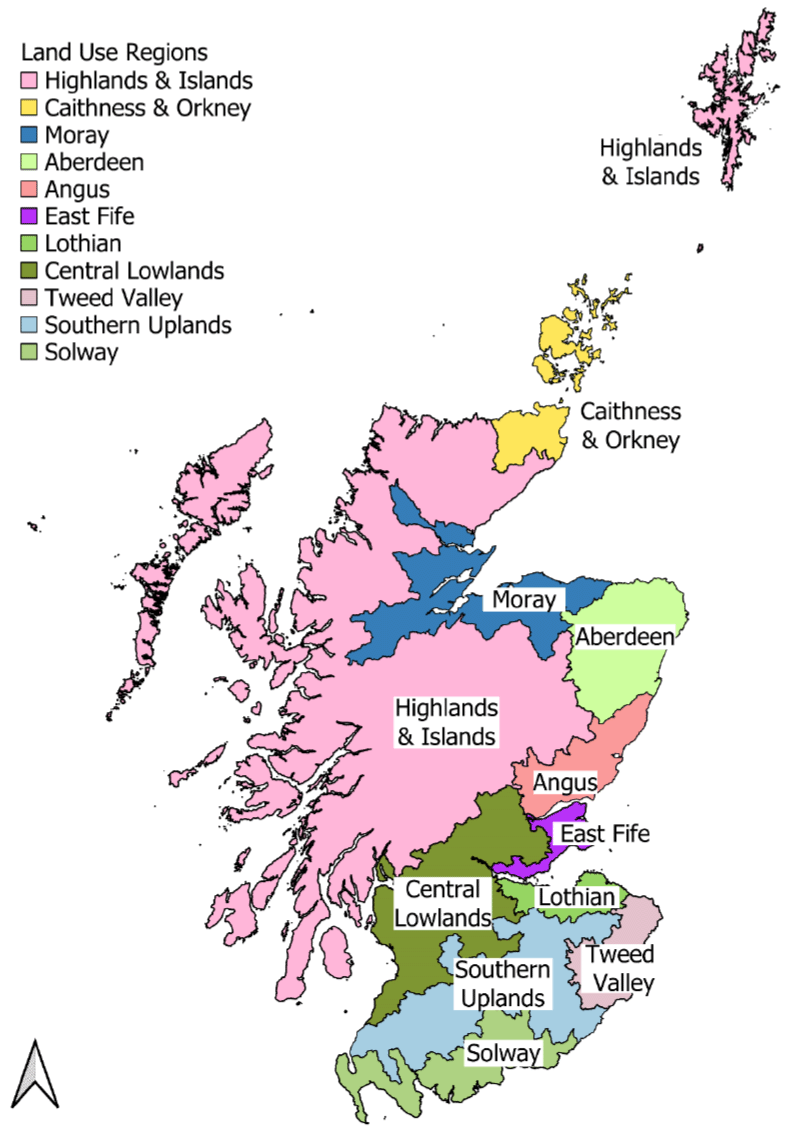
The country was divided into 11 land-use regions (Figure 12). Each sample was stratified by both these land-use regions and holding size. The holding size groups were based on the total area of grassland crops grown. The sampling fractions used within both regions and size groups were based on the areas of relevant crops grown rather than number of holdings, so that smaller holdings would not dominate the sample.
Postal questionnaires were sent to holdings selected in the grassland sample. Of 1,339 questionnaires sent out there were 373 useable responses, 111 holdings had bracken present and 262 did not. Details of the distribution of the survey sample across land regions in Scotland can be found in Table 6 in the supporting documents.
Detailed data tables and data used to create the charts in this report are available in Excel format in the supporting document.
Figure 12: Land use regions of Scotland [6]
Data quality assurance
The dataset underwent several validation processes as follows; (i) checking for any obvious errors upon data receipt (ii) checking and identifying inconsistencies in the data during data entry (iii) checking of the final data set against the raw data. Where inconsistencies were found these were checked against the records and with the respondent if necessary. Additional quality assurance is provided by sending reports for independent review. In addition, the Scottish Pesticide Survey Unit is accredited to ISO 9001:2015. All survey related processes are documented in Standard Operating Procedures (SOPs) and output is audited against these SOPs by internal auditors annually and by external auditors every three years.
Main sources of bias
The use of a random stratified sample is an appropriate survey methodology. A stratified random sample, grouped by farm size and region, is used to select holdings used in this survey. Sampling within size groups is based on area rather than numbers of holdings, so that smaller size groups are not over-represented in the sample. The bracken survey may be subject to measurement bias as it is reliant on land managers recording data accurately. As this survey is not compulsory it may also be subject to non-response bias, as growers on certain holdings may be more likely to respond to the survey than others.
Response rates
See supporting document (Table 7) which summarises the number of holdings contacted during the survey.
Financial burden to land managers
The bracken survey was provided alongside the grassland survey, this was carried out by postal questionnaire, with a limited number of follow-up telephone calls.
All respondents to the bracken postal survey were asked how long it had taken for them to fill out the survey form. Out of 373 respondents, 116 provided this information (31%) The median time taken to provide the information for the bracken survey was 5 minutes.
The following formula was used to estimate the cost of participating:
Burden (£) = No. surveyed x median time taken (hours) x typical hourly rate*
(* using median “Full Time Gross” hourly pay for Scotland of £20.26) [7].
The total financial burden, accounting for all land managers’ participation in the 2025 bracken survey was £195.85.
Contact
Email: Jackie.hughes@sasa.gov.scot