
Devolved disability benefits: decision making – commissioned research report - annex A
Overall, there is evidence that the policy principles of decisions being person-centred and trust-based are being met, however, client experience tended to vary depending on their circumstances.
Annex
Policy principles and desired outcomes
Theme: Approach to decision-making process is justifiable and free from bias
Explored with staff as policy principles:
- Making informed judgments while acknowledging and addressing biases
- Using balance of probabilities throughout the decision-making process, including when handling conflicting information
- ADP only: consultations:
- You understand why a consultation was needed
- You understand the outcome of the consultation and that it was necessary for the determination
Explored with clients as desired outcomes:
- Your experience is in line with dignity, fairness, and respect
- Public services treat people with dignity, fairness and respect
- You understand that, where entitled, receiving disability benefits is a human right
- There is reduced stigma regarding disabled people and people with long-term health conditions
- Reviews:
- You understand the need for a review or why no review is necessary
- ADP only: consultations:
- Are audio-recorded as standard
- Individuals can respond to informal observations
- Practitioners’ reports provided to individuals
Theme: Decision-making process is person-centred, and trust-based
Explored with staff as policy principles:
- Trusting the individual's account and supporting information (SI)
- Considering how the individual’s condition affects them
- Considering supporting information on its merits
- Taking into account the client's full circumstances and information provided by their support network
- Reviews:
- Relevant existing information is used
- New information is only requested when a change of circumstances relates to a new condition and is likely to change the level of entitlement, symptoms worsen to an extent that is not expected, or the level of needs is reported to be the same where this is not expected
- Collaborative approach and good cause established when gathering supporting information
- Review periods:
- Indefinite awards possible for eligible clients – ADP: Only when needs highly unlikely to change and if on highest rate of daily living and mobility components / PADP: Only when needs highly unlikely to change (awards can be at either lower or higher rate)
- Review dates are based on individual circumstances
- Awards do not have a fixed end date
- Review periods range from 2 to 10 years and determined by when individuals’ overall circumstances are likely to change
- Review period begins on date of determination
- Time for recovery and adjustment are considered when setting review periods
- ADP only: consultations:
- Used when only way to gather the necessary information to make a determination
- At a time and in a format suiting individuals’ needs
- Trust-based discussion between individual and practitioner
- Individual can request consultation
Explored with clients as desired outcomes:
- You feel your experience was person-centred
- You feel you are trusted
- You do not feel undue stress or worry
- Reviews:
- You feel the review was light touch and avoided unnecessary burden
- Review periods:
- You feel that your review period is appropriate for you
- ADP only: consultations:
- You feel that your consultation was proportionate, trust-based, and in line with your needs
Theme: Decision-making process is transparent, clear and accurate
Explored with staff as policy principles:
- Case managers:
- Case Managers record the steps they have taken to make a decision
- The decision letter is set out clearly (formatting)
- The reasoning for the decision is clear in the decision letter (justification)
- All:
- The disability benefit rules are understood and applied
- Support is sought, where needed
- The right decision is made first time
- Reviews:
- Decision-making tools are used
- ADP only: consultations:
- Carried out by Health and Social Care Practitioners
Explored with clients as desired outcomes:
You understand the decision and why it was made
- You feel that the right decision was made first time
- You understand what is happening and why at each stage of decision-making
- Reviews:
- You understand your responsibilities and report any change in circumstances in good time
- You understand the review process and engage with it
Theme: Decision-making process alleviates financial pressures
Explored with clients as desired outcomes:
- You have greater financial security and stability
- You feel more in control of your finances and can plan accordingly
- Indefinite awards and person-centred review periods allow for financial planning
Theme: Decision-making process encourages a positive relationship between applicants and Social Security Scotland
Explored with clients as desired outcomes:
- You trust in Social Security Scotland’s decision-making
- You have a positive relationship with Social Security Scotland
- You have a positive attitude towards Social Security Scotland and the Scottish social security system
The Logic Model
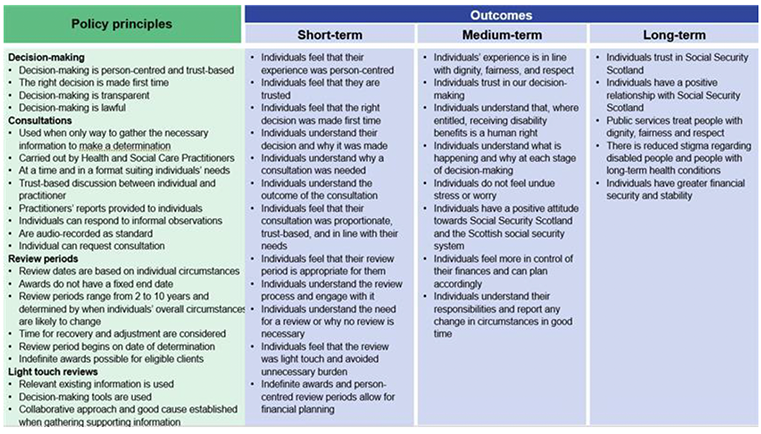
The Logic Model plain text version
Policy Principles:
Applications and overall decision-making
- Decision-making is person-centred and trust-based
- The right decision is made first time
- Decision-making is transparent
- Decision-making is lawful
Consultations
- Proactively used when this is the only way to gather the necessary information to make a determination
- Carried out by Health and Social Care Practitioners
- At a time and in a format suiting individuals’ needs
- Trust-based discussion between individual and practitioner
- Practitioners’ reports provided to individuals
- Individuals can respond to informal observations
- Are audio-recorded as standard
- Individual can request consultation
Review periods
- Review dates are based on individual circumstances
- Awards do not have a fixed end date
- Review periods range from 2 to 10 years and determined by when individuals’ overall circumstances are likely to change
- Time for recovery and adjustment are considered
- Review period begins on date of determination
- Indefinite awards possible for eligible clients
Light touch reviews
- Relevant existing information is used
- Decision-making tools are used
- Collaborative approach and good cause established when gathering supporting information
Outcomes
Short-term outcomes:
- Individuals feel that their experience was person-centred
- Individuals feel that they are trusted
- Individuals feel that the right decision was made first time
- Individuals understand their decision and why it was made
- Individuals understand why a consultation was needed
- Individuals understand the outcome of the consultation
- Individuals feel that their consultation was proportionate, trust-based, and in line with their needs
- Individuals feel that their review period is appropriate for them
- Indefinite awards and person-centred review periods allow for financial planning
- Individuals understand the review process and engage with it
- Individuals understand the need for a review or why no review is necessary
- Individuals feel that the review was light touch and avoided unnecessary burden
Medium-term outcomes:
- Individuals’ experience is in line with dignity, fairness, and respect
- Individuals trust in our decision-making
- Individuals understand that, where entitled, receiving disability benefits is a human right
- Individuals understand what is happening and why at each stage of decision-making
- Individuals do not feel undue stress or worry
- Individuals have a positive attitude towards Social Security Scotland and the Scottish social security system
- Individuals feel more in control of their finances and can plan accordingly
- Individuals understand their responsibilities and report any change in circumstances in good time
Long-term outcomes:
- Individuals trust in Social Security Scotland
- Individuals have a positive relationship with Social Security Scotland
- Public services treat people with dignity, fairness, and respect
- There is reduced stigma regarding disabled people and people with long-term health conditions
- Individuals have greater financial security and stability
Detailed policy points
Decision-making
- Person-centred and trust-based
- Right first time, ensuring fairness and reducing the occurrence of errors
- Transparent, where case managers show a clear justification for their decision
- Lawful, and respecting individuals’ rights
Consultations (ADP only)
- These are not an automatic part of the decision-making process and should only be conducted if they are the only way of gathering information necessary to make a determination of entitlement
- Consultations are carried out by health and social care practitioners employed by Social Security Scotland
- They are conducted at a time and in a format that suits the individual’s needs
- Consultations are a discussion between the individual and the practitioner based on trust
- Practitioners’ reports made during a consultation will always be provided to clients
- Individuals will be made aware of any informal observations made by practitioners during the consultation and will have the opportunity to respond to them at the time
- Consultations are audio recorded as standard
- Individuals can request a consultation if they feel it is the best way of articulating their needs
Review Periods
- Awards of disability assistance do not have a fixed end date so awards will be reviewed regularly to ensure that the individual continues to receive the right amount of assistance
- A review date should be set based on when the individual’s circumstances are likely to have changed, a holistic, person-centred approach should be taken here
- Where there is more than one condition, Case Managers should take into account the effects of all the conditions as well as how they interact with each other to impact on the individual
- Review periods range from 2 to 10 years and based on when a person’s overall individual circumstances are likely to change
- Time for recovery and adjustment is factored in when determining the review period
- The start date of any review period must always be the date of the determination, rather than the date of the application / submission of the change of circumstances form
- Indefinite awards are awarded to clients for whom a review period is inappropriate because their needs are highly unlikely to change (clients who are on enhanced rate of both ADP components as well as eligible PADP clients)
Reviews
- Existing information on an individual is used where still relevant, including using previous decisions to avoid asking unnecessary questions
- Decision-making tools (case discussion, consultation, guidance, requesting supporting information) are used where appropriate to further reduce the need for intrusive questions
- When gathering supporting information, include a collaborative approach and establish good cause if it is unavailable, where appropriate
Contact
Email: Stefania.Pagani@gov.scot