
Wild Wrasse Fishery – Summary up to and including 2024
An update to the 2021 and 2022 data, and an overview of the available data for 2023/24.
Wild Wrasse Fishery – Summary up to and including 2024
This report provides an update to the 2021 and 2022 data, and an overview of the available data for the wrasse fishery in 2023 and 2024. This publication will be the final annual wrasse update in this format. Ahead of the 2025 fishery opening, substantial changes were made to the management of the fishery, including the completion of a Fisheries Assessment, which sets out the evidence base and updated approach to regulating activity. In future, all information and updates to existing data will be published exclusively through the Inshore Fisheries Dashboard, providing a more timely and accessible platform for accessing these data.
The landings data (weight in tonnes) summarised in this report were provided by the Marine Directorate’s Marine Analytical Unit (MAU). These figures were extracted from the Compass database rather than IFISH because of differences between the two systems, particularly in relation to wrasse species codes and historical amendments. However, published data on wrasse landings by Scottish vessels (Scottish Sea Fisheries Statistics) are very similar at an overall level to the Compass extract for derogated vessels.
In 2023, 72 permissions (derogations) were issued to vessels, allowing those vessels to fish for wrasse in Scottish waters: 60 of these derogated vessels reported landings through the FISH1 form process (with the data entered into Compass). In 2024, 64 derogations were issued (one of which was revoked due to the vessel being sold) and 59 of these derogated vessels reported landings. For 2023 and 2024 all derogated vessels with reported landings submitted science data sheets (as required as part of the derogation) (Table 1).
| Year | Fishing Season* | Derogations issued | Derogations revoked | Vessels reporting landings | Vessels submitting scientific data |
|---|---|---|---|---|---|
| 2017 | N/A | - | - | 33 | - |
| 2018 | N/A | - | - | 41 | - |
| 2019 | N/A | - | - | 51 | - |
| 2020 | N/A | - | - | 66 | - |
| 2021 | 1 May – 30 Nov | 61 | 0 | 48 | 43 |
| 2022 | 1 May – 30 Nov | 71 | 7 | 47 | 39 |
| 2023 | 1 May – 30 Nov | 72 | 0 | 60 | 60 |
| 2024 | 1 May – 30 Nov | 64 | 1 | 59 | 59 |
* Mandatory management measures were introduced to the wild wrasse fishery in 2021.
Monitoring of the wrasse fishery involves fishers providing details of the number of fish caught, alongside standard commercial protocols which require fishers to report landings by weight. However, because wrasse are landed live for use in aquaculture, most fishers estimate weights, making the reported weight figures uncertain—though they remain the best available via current systems. Alternative data sources, such as aquaculture companies, may offer more accurate removal figures and will be investigated further.
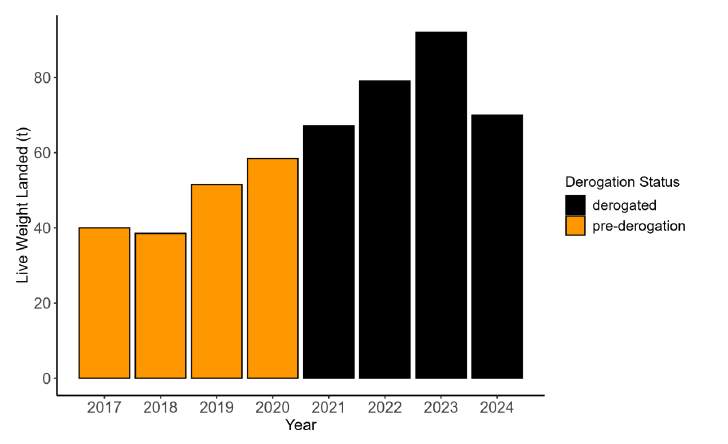
Total annual landings of live wrasse (all species, all reporting vessels in Scottish waters) increased steadily from 2018, peaking at 91.9 tonnes in 2023, then declined to 70 tonnes in 2024 (Figure 2).
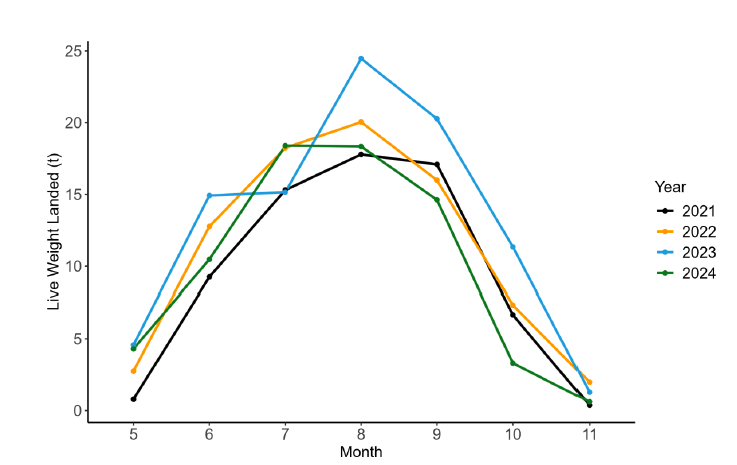
Details of the wild wrasse fishing season in Scottish waters, for derogated vessels, can be found in Table 1. Since derogations began in 2021, reported landings have consistently peaked in August (Figure 3).
Five species of wrasse are fished under the derogation: ballan (Labrus bergylta), corkwing (Syphodus melops), cuckoo (Labrus mixtus), goldsinny (Ctenolabrus rupestris) and rock cook (Centrolabrus exoletus). Ballan wrasse was the most commonly landed species of wrasse by weight, accounting for 71.7% (average annual %) of the landings between 2017 and 2024 (Table 2).
| Species | 2017 | 2018 | 2019 | 2020 | 2021 | 2022 | 2023 | 2024 | Mean |
|---|---|---|---|---|---|---|---|---|---|
| Ballan | 75.0 | 66.5 | 58.3 | 65.8 | 72.1 | 80.7 | 74.4 | 80.7 | 71.7 |
| Corkwing | 6.3 | 10.8 | 17.7 | 13.8 | 15.4 | 11.5 | 18.1 | 12.3 | 13.2 |
| Cuckoo | 3.9 | 5.6 | 10.4 | 8.0 | 2.5 | 2.4 | 2.1 | 1.8 | 4.6 |
| Goldsinny | 13.9 | 13.8 | 11.4 | 9.7 | 7.6 | 4.3 | 4.0 | 3.8 | 8.6 |
| Rock Cook | 0.8 | 3.0 | 2.1 | 2.5 | 2.4 | 1.2 | 1.2 | 1.3 | 1.8 |
| Wrasse misc. | 0.2 | 0.3 | 0.1 | 0.1 | 0.1 | 0 | 0.2 | 0 | 0.1 |
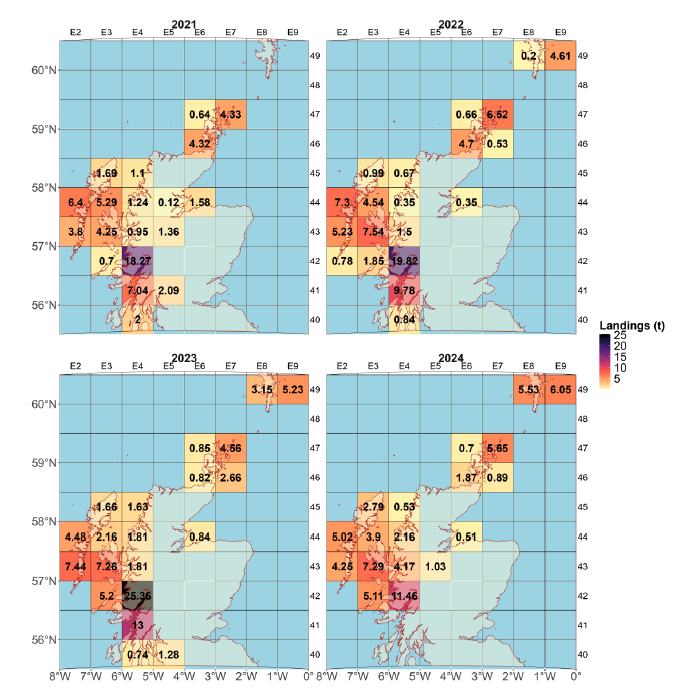
Between 2021 and 2024, the highest reported annual wrasse landings by derogated vessels came from ICES rectangle 42E4, near Oban on Scotland’s west coast. Moderate landings were recorded around the Outer Hebrides and Orkney, with increased activity around Shetland in 2023 and 2024 (Figure 4).
Contact
Email: inshore@gov.scot