
Wild Wrasse Fishery – Summary up to and including 2024
An update to the 2021 and 2022 data, and an overview of the available data for 2023/24.
Science data returns (numbers)
Under the terms of the wrasse fishery derogation, fishers must report the number of individual wrasse landed per species per trip. In 2021 and 2022, not all derogated vessels submitted these science data returns. In 2023 and 2024, all derogated vessels that reported landings provided at least one science data form, however there are still inconsistencies between the reported weights (via FISH1) and the number of fish recorded in science returns. Science and Compliance teams are working together to improve the quality of submitted data.
Science data returns reported 976,440 individual wrasse in 2023 and 865,241 in 2024 (Table 3). Ballan wrasse consistently made up the largest share (between 58.7% and 67.6% of reported individuals), while cuckoo wrasse contributed less than 1% annually (Figure 5). These totals are likely to be underestimates, as not all derogated vessels consistently submitted data for each fishing trip.
| Wrasse Species | 2021 | 2022 | 2023 | 2024 |
|---|---|---|---|---|
| Ballan | 359,956 | 488,367 | 565,119 | 584,787 |
| Corkwing | 73,758 | 120,051 | 269,479 | 162,863 |
| Cuckoo | 5,879 | 6,009 | 5,937 | 4,008 |
| Goldsinny | 71,115 | 70,233 | 82,762 | 74,374 |
| Rock Cook | 52,820 | 62,414 | 53,143 | 39,209 |
| Wrasses | 49,525 | 0 | 0 | 0 |
| Total | 613,053 | 747,074 | 976,440 | 865,241 |
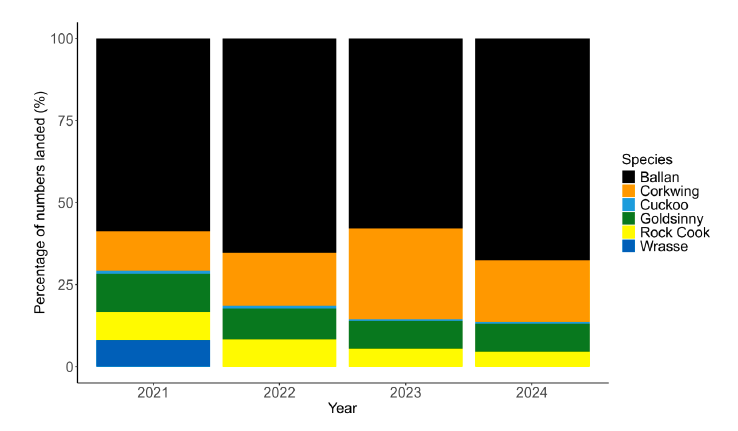
Fishers must also report the number of wrasse (by species) caught in the first 20 pots lifted on each trip, including whether fish were retained or returned, and if returned, their size category (undersize, permitted, or oversize). In 2023 and 2024, submitted datasheets recorded 42,730 and 32,319 individual wrasse, respectively (Tables 4 and 5). Ballan wrasse were the most frequently reported species by number, making up 37.9% in 2023 and 37.1% in 2024. Of all wrasse caught in the first 20 pots, 42.4% in 2023 and 44.2% in 2024 were of permitted size and retained.
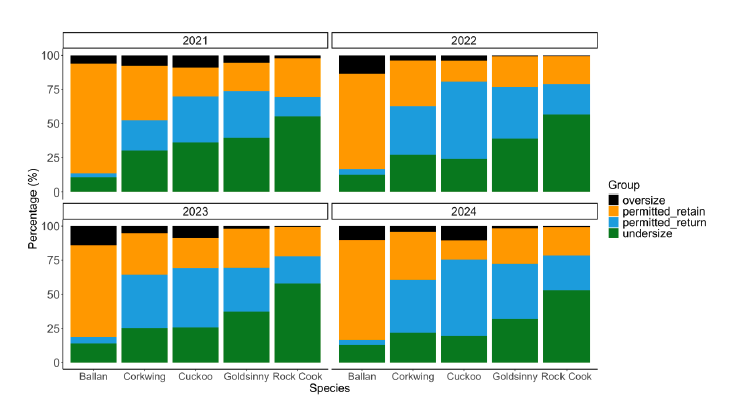
In 2023 and 2024, ballan wrasse had the highest retention rates, with 67.3% and 73.2% of individuals retained at permitted size (Tables 4 & 5, Figure 6). Rock cook wrasse had the highest proportion of individuals that were undersized and returned (57.8% in 2023 and 53% in 2024). Cuckoo wrasse showed the highest percentage of total individuals that were of permitted size and returned: 43.3% in 2023 and 55.9% in 2024 (Table 4 and 5, Figure 6).
| Species | Number of fish | Retained % permitted size | Returned % undersize | Returned % oversize | Returned % permitted size |
|---|---|---|---|---|---|
| Ballan | 16,197 | 67.3 | 14.1 | 14.0 | 4.7 |
| Corkwing | 9,099 | 30.4 | 25.3 | 5.2 | 39.1 |
| Cuckoo | 1,579 | 21.9 | 25.9 | 8.9 | 43.3 |
| Goldsinny | 9,985 | 28.7 | 37.3 | 1.9 | 32.1 |
| Rock Cook | 5,870 | 21.7 | 57.8 | 0.4 | 20.1 |
| Species | Number of fish | Retained % permitted size | Returned % undersize | Returned % oversize | Returned % permitted size |
|---|---|---|---|---|---|
| Ballan | 11,985 | 73.2 | 12.8 | 10.2 | 3.8 |
| Corkwing | 6,280 | 35.4 | 21.8 | 4.1 | 38.7 |
| Cuckoo | 1,037 | 14.1 | 19.6 | 10.4 | 55.9 |
| Goldsinny | 8,274 | 26.1 | 32.2 | 1.5 | 40.2 |
| Rock Cook | 4,743 | 20.9 | 53.0 | 0.5 | 25.5 |
Contact
Email: inshore@gov.scot