
Waste Reprocessing Infrastructure in Scotland
A report on the waste reprocessing infrastructure in Scotland in accordance with section 23 of the Circular Economy (Scotland) Act 2024.
Material Chapters
The following chapters set out material-specific analysis for fifteen materials in Scotland which comprise the majority of waste arisings in Scotland. An overview of material specific waste arisings and reprocessing capacity in Scotland is provided based on published SEPA data, alongside discussion of any potential capacity gap.
6. Plastic
Plastic waste arisings
Scotland produced an estimated 278 kt of plastic waste in 2023[57]. Approximately 90 kt of this material was recycled, with 49 kt collected separately and 41 kt separated through processing of other waste, such as at Material Recovery Facilities (MRFs - see chapter 21). Up to an additional 188 kt of plastic could be available for reprocessing if household residual waste was sorted fully for recycling, of which 87 kt is dense plastic and 101 kt is plastic film and flexibles[58]. This estimate excludes unsorted plastic waste present in residual waste and ‘household and similar wastes’ from Commercial & Industrial (C&I) and Construction & Demolition (C&D), for which data are not currently available, which could significantly increase the total tonnage of plastic waste.
Reprocessing capacity
Of the 90 kt of Scotland’s plastic waste that was recycled in 2023, approximately 12.2 kt was recycled in Scotland and around 77.5 kt exported for recycling elsewhere. While there was variation in the proportion of domestic recycling over the preceding decade, the overall amount of material recycled in Scotland has shown an upward trend. The tonnage recycled within Scotland increased by 200-300% between 2016 and 2023, but the majority of plastic waste arising in Scotland, and management in the annual variation of those arisings, remains managed by export (Figure 5).
Infrastructure capacity for plastics includes both sites which clean, sort or treat material for further processing, and sites which offer final reprocessing (that is, recycling of material such that it no longer constitutes a waste product). It is not possible to ascertain specific treatment activities undertaken by each facility from SEPA Waste Sites and Capacity Tool data.
There were a total of 211 licensed sites in Scotland that handled waste plastic in 2023. This includes sites which specialise only in processing plastics, and sites which manage plastics as part of wider sorting and processing activities, such as civic amenity sites and MRFs.
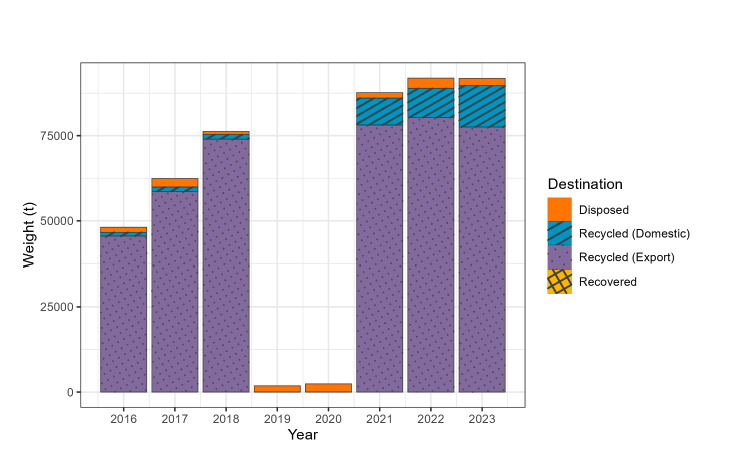
The overall available (separately collected or sorted) amount of this material has increased over time. The majority of plastic material available is exported for recycling.
A total of 44 licensed sites reported the treatment of plastics to SEPA in 2023[59] (Figure 6). Treatment may include sorting and baling for recycling elsewhere and also the production of plastic flake or pellets ready to be extruded into new products. In 2023, 10 of the 44 sites noted above were accredited sites under the producer responsibility scheme for packaging.
The above reprocessing tonnages do not include plastics collected mixed with other recycling. In 2023 Materials Recovery Facility (MRF) output for plastics was 26 kt tonnes as detailed in Chapter 21.

Gap analysis
There is likely to be a significant domestic capacity gap for reprocessing plastic waste generated in Scotland. The exact size of the capacity gap cannot be assessed on this data, as material could be exported for other reasons beyond reprocessing capacity. However, approximately 78 kt of plastic waste is currently exported for processing outside of Scotland. An estimated additional 188 kt of plastics is likely to be present in residual waste from households. Whilst there appears to be sufficient sorting and transfer capacity for plastic wastes in Scotland, plastic reprocessing infrastructure in Scotland processes approximately 14% of the 90 kt of plastic waste available for recycling. Expanding reprocessing infrastructure for plastic film and flexibles ahead of the introduction of soft plastic collection in 2027 is a particular priority given limited existing capacity in Scotland and across the UK.
7. Aluminium
Aluminium waste arisings
Scotland produced an estimated 201 kt of aluminium waste in 2023[60]. Approximately 180 kt of this material was recycled, with 129 kt collected separately and 51 kt separated through processing of other waste, such as at Material Recovery Facilities (MRFs - see chapter 21). Up to an additional 21 kt of aluminium could be available for reprocessing if household residual waste was sorted fully for recycling, of which 7.5 kt is aluminium drinks containers and 13.7 kt is other aluminium packaging[61]. This estimate excludes unsorted aluminium waste present in residual waste and ‘household and similar wastes’ from Commercial & Industrial (C&I) and Construction & Demolition (C&D), for which data are not currently available, which could significantly increase the total tonnage of aluminium waste.
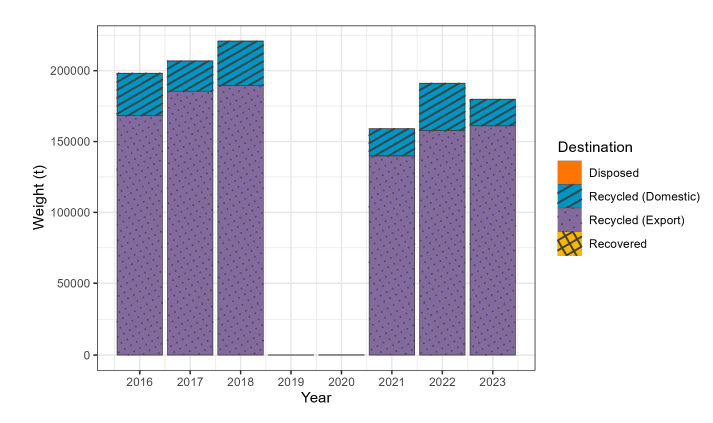
The overall available (separately collected or sorted) amount of this material has slightly decreased over time. The majority of aluminium material available is exported for recycling.
Reprocessing capacity
Of the 180 kt of Scotland’s aluminium waste that was recycled in 2023, approximately 19 kt was recycled in Scotland and around 161 kt exported for recycling elsewhere. There was significant variation in both the amount of waste arising and the amount processed in Scotland over the preceding decade. The majority (90%) of aluminium waste arising in Scotland is managed by export (Figure 7).
Infrastructure capacity for aluminium must be considered jointly between those sites which clean, sort or treat material for further processing, and those which offer final reprocessing (that is, recycling of material such that it no longer constitutes a waste product).
A total of 376 licensed sites in Scotland handled waste aluminium or mixed metals or metal packaging that may contain aluminium in Scotland in 2023. These include sites which specialise in metals and others which manage metals as part of a wider operation, such as a civic amenity sites and MRFs.
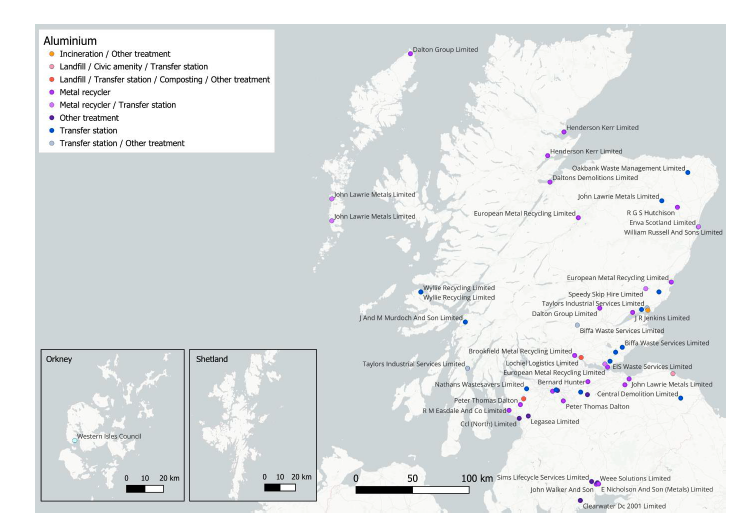
A total of 54 licensed sites reported the treatment of aluminium or mixed metals or metal packaging that may contain aluminium to SEPA in 2023[62] (Figure 8). Treatment may include cutting or sorting as well as shredding to produce manufacture ready scrap suitable for export. There are no accredited reprocessors for aluminium in Scotland under the producer responsibility scheme for packaging. However, Scotland is home to the UK’s last remaining aluminium smelter in Lochaber, which plans to introduce a billet and recycling facility equipped with re-melt furnaces that can utilise pre- and post-consumer scrap in 2026/27[63].
Gap analysis
There is likely to be a significant domestic capacity gap for reprocessing aluminium waste generated in Scotland. The exact size of the capacity gap cannot be assessed on this data, as material could be exported for other reasons beyond reprocessing capacity. However, aluminium waste arisings and recycled tonnages indicate that approximately 161 kt of aluminium waste is currently exported for processing outside of Scotland. An estimated additional 21 kt of aluminium is likely to be present in residual waste from households, with a further unknown quantity of aluminium arising from the C&I and C&D sectors. Whilst there appears to be sufficient sorting and transfer capacity for aluminium wastes in Scotland, aluminium reprocessing infrastructure in Scotland processes approximately 10% of the 180 kt of aluminium waste available for recycling.
8. Steel
Steel waste arisings
Scotland produced an estimated 424 kt of steel waste in 2023, excluding unsorted steel waste present in residual waste/‘household and similar wastes’ from Commercial & Industrial (C&I) and Construction & Demolition (C&D) which could significantly increase this tonnage. If this wider scrap steel from other sources is accounted for, ZWS estimates that between 620 and 930 kt of steel scrap is generated in Scotland each year[64]. Up to an additional 12 kt of steel could be available for reprocessing if household residual waste was sorted fully for recycling, of which 0.5 kt is steel drinks containers and 11 kt is other ferrous packaging.
Approximately 412 kt of this material was recycled, with 93 kt collected separately, and 319 kt separated through the processing of other waste in Scotland such as at Material Recovery Facilities (MRFs), and other industrial processes such as the shredding end-of-life vehicles and managing oil and gas decommissioning.
Reprocessing capacity
Of the 412 kt of Scotland’s steel waste that was recycled in 2023, approximately 33 kt was recycled in Scotland and around 379 kt exported for recycling elsewhere. The total amount processed remained fairly consistent from 2016-2018, with a slight decrease in 2021 and 2022 and a larger decrease in 2023. The tonnage recycled within Scotland has remained fairly consistent over the period 2016 to 2023, but the majority of steel recycling (92%) is managed by export (Figure 9). Of material exported, an estimated 41% is exported directly to Europe and 56% exported to the rest of the UK. Steel exported to the UK may be recycled within UK steel mills or further exported to a range of destinations.
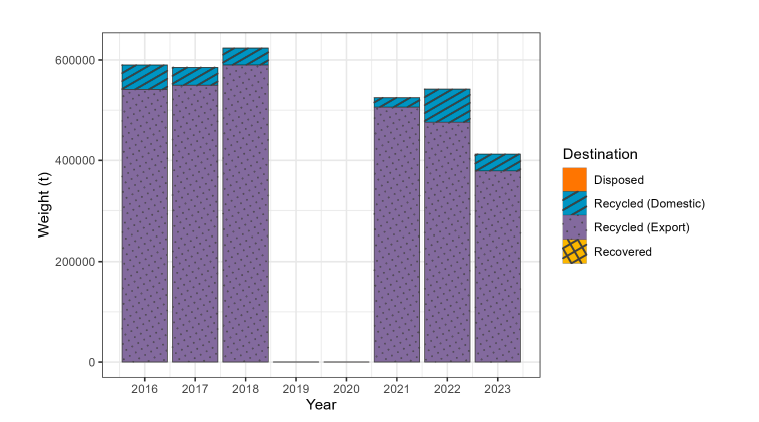
The overall available (separately collected or sorted) amount of this material has slightly decreased over time. The majority of steel waste is exported for recycling.
A total of 410 licensed sites in Scotland handled waste steel or mixed metals or metal packaging that may contain steel in Scotland in 2023. These include sites which specialise in metals and others which manage metals as part of a wider operation, such as a civic amenity sites and MRFs.
A total of 67 licensed sites reported the treatment of such metals to SEPA in 2023[65] (Figure 10). Treatment may include cutting or sorting as well as shredding to produce furnace ready scrap suitable for export. There are no accredited reprocessors for steel in Scotland under the producer responsibility scheme for packaging.

Gap analysis
There is a domestic capacity gap for reprocessing steel waste generated in Scotland. The exact size of the capacity gap cannot be assessed on this data, as material could be exported for other reasons beyond reprocessing capacity. However, steel waste arisings and recycled tonnages indicate that approximately 379 kt of steel waste is currently exported for processing outside of Scotland, and steel reprocessing infrastructure in Scotland processes approximately 8% of the 412 kt of steel waste available for recycling. An estimated additional 12 kt of steel is likely to be present in residual waste from households. While the exact quantity of steel waste arising from the C&I and C&D sectors is unknown, previous analysis estimate that this could be in the region of 100 – 400 kt per year.
A domestic capacity gap for steel does not necessarily suggest there is a business case for expanding domestic reprocessing, for example an Electric Arc Furnace (EAF) plant for scrap steel. Previous analysis by Natural Capital Analysis suggests that there is unlikely to be an economic case for new steel reprocessing in Scotland[66]. There is already a high recycling rate for steel scrap, including well established UK-wide and European supply chains, and steel reprocessing requires significant economies of scale to be viable.
9. Paper and Card
Paper and card waste arisings
Scotland produced an estimated 377 kt of paper and card waste in 2023. Approximately 210 kt of this material was recycled, with 130 kt collected separately and 80 kt separated through processing of other waste, such as at Material Recovery Facilities (MRFs - see chapter 21). Up to an additional 167 kt of paper and card could be available for reprocessing if household residual waste was sorted fully for recycling, the composition of which is set out in Table 2. This estimate excludes unsorted paper and card waste present in residual waste and ‘household and similar wastes’ from Commercial & Industrial (C&I) and Construction & Demolition (C&D), for which data are not currently available, which could significantly increase the total tonnage.
| Waste Category | Waste Type | Tonnes (2023) | |
|---|---|---|---|
| Household and similar wastes | Newspaper, magazines and directories | 10,000 | |
| Other recyclable paper | 11,900 | ||
| Recyclable paper packaging | 5,800 | ||
| Non-recyclable paper | 81,000 | ||
| Thin (Grey) Card Packaging | 27,700 | ||
| Thick (Brown) corrugated cardboard packaging | 9,800 | ||
| Cartons and other card/plastic laminate packaging | 4,900 | ||
| Other card | 900 | ||
| Heavily contaminated card & other composite card | 15,400 | ||
| Total | 167,000 | ||
Reprocessing capacity
Of the 210 kt of Scotland’s paper and card waste that was recycled in 2023, 96% was exported for recycling elsewhere, with an estimated 8.4 kt reprocessing in Scotland. The amount of paper & card waste arising has varied without a clear trend on arisings since 2016 (Figure 11), but appears to have generally been lower since 2021.

The overall available (separately collected or sorted) amount of this material has slightly decreased over time. The majority of this material is exported for recycling.
Infrastructure capacity for paper & card must be considered jointly between those sites which clean, sort or treat material for further processing, and those which offer final reprocessing (that is, recycling of material such that it no longer constitutes a waste product).
A total of 281 licensed sites handled waste paper and cardboard waste in Scotland in 2023. These include sites which specialise in paper and cardboard and others which manage paper and cardboard as part of a wider operation, such as a civic amenity sites and MRFs.
A total of 46 licensed sites reported the treatment of paper and cardboard to SEPA in 2023 (Figure 12). Treatment may include sorting and baling to produce a material suitable for recycling elsewhere. Whilst there are currently two paper mills operating in Scotland (UPM Caledonian in Irvine and Fourstones in Leslie), it is understood that they are currently not using recycled stock. There are no accredited reprocessors for paper packaging in Scotland under the producer responsibility scheme for packaging.

Gap analysis
There is a domestic capacity gap for reprocessing paper and card waste generated in Scotland. The exact size of the capacity gap cannot be assessed on this data, as material could be exported for other reasons beyond reprocessing capacity. Paper and card waste arisings and recycled tonnages indicate that approximately 202 kt of paper and card waste is currently exported for processing outside of Scotland. An estimated additional 167 kt of paper and card is likely to be present in residual waste from households, with a further unknown quantity of paper and card arising from the C&I and C&D sectors. Whilst there appears to be sufficient sorting and transfer capacity for paper and card wastes in Scotland, almost all paper and card collected in Scotland for recycling is exported for reprocessing.
Forecast demands for paper and card are subject to varying trends. Traditional sources of paper, for example newspaper, are in decline. However, there has been an increase in the use of paper and card based packaging associated with the rise of home deliveries and a move away from plastic packaging, which could be accelerated by packaging extended producer responsibility. Previous analysis by Natural Capital Analysis suggests that there is unlikely to be an economic case for new paper and card reprocessing in Scotland[67].
10. Glass
Glass arisings
Scotland produced an estimated minimum of 207 kt of glass waste in 2023. Approximately 131 kt of this material was recycled, with 112 kt collected separately and 19 kt separated through processing of other waste, such as at Material Recovery Facilities (MRFs - see chapter 21). Up to an additional 74 kt could be available from household residual waste if sorted properly for recycling. This estimate excludes unsorted glass waste present in residual waste and ‘household and similar wastes’ from Commercial & Industrial (C&I) and Construction & Demolition (C&D), for which data are not currently available.
Reprocessing capacity
Of the 131 kt of glass waste recycled in Scotland in 2023, 99 kt was recycled in Scotland and around 32 kt exported for recycling elsewhere. This follows a similar trend since 2016 with the majority of glass being recycled in Scotland. The annual reduction in glass waste is partly due to “light-weighting” of glass packaging and changes in the choice of packaging material used by manufacturers (Figure 13).
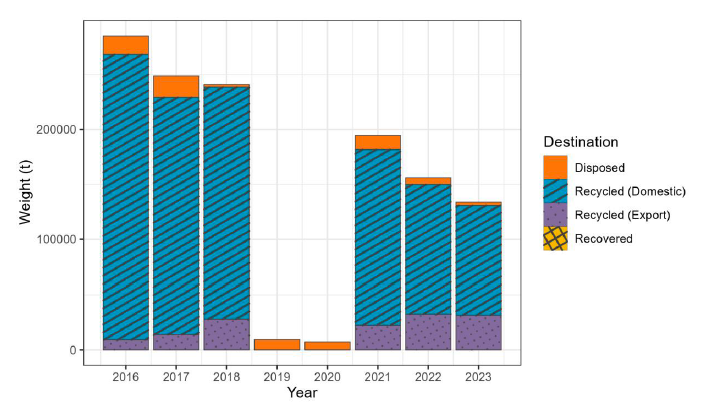
The overall available (separately collected or sorted) amount of this material has decreased over time. The majority of this material is recycled in Scotland.
Infrastructure capacity for glass must be considered jointly between those sites which sort material for further processing and those which offer final reprocessing (that is, recycling of material such that it no longer constitutes a waste product).
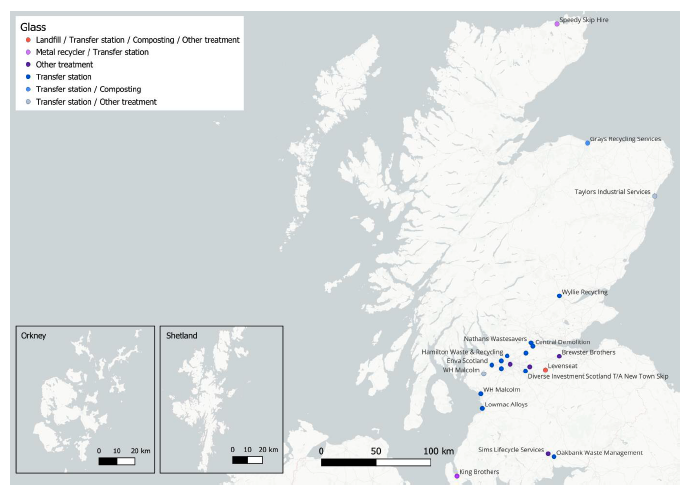
In 2023, 211 licensed sites handled glass waste in Scotland, which may include sorting, crushing or the production of aggregates or glass cullet for remelt. 19 sites reported the treatment of glass waste, including those making new products such as aggregates, cullet or new glass products such as filter media and glass bottles (Figure 14).
Gap analysis
There does not appear to be a domestic capacity gap for glass reprocessing in Scotland. There is sufficient sorting and transfer capacity for glass wastes, as well as recycling infrastructure capable of treating the majority (74%) of glass waste available for recycling in Scotland. Nevertheless, 32 kt of glass waste (24% of available material) was exported for recycling outside of Scotland in 2023; this analysis is unable to comment on why glass is exported for recycling, given the available recycling capacity in Scotland.
There is opportunity to divert up to an estimated 74 kt of glass waste from disposal for reprocessing, though it is also possible that the observed downward trend in glass arisings will continue and whether additional capacity will be needed in future years. Since the majority of glass waste is already reprocessed in Scotland, it is not possible to tell whether existing sites are at capacity, or could take on additional material if supply increased.
11. Wood
Wood waste arisings
Scotland produced an estimated 568 kt of wood waste in 2023[68]. Approximately 548 kt of this material was either recycled (200 kt) or sent for energy recovery (348 kt), with 238 kt collected separately and 310 kt separated through processing of other waste, such as at Mixed Recycling Facilities for construction, commercial and bulky wastes (MRFs - see chapter 21). 99% of all wood packaging placed on the market is non-consumer, and 84% of non-consumer wood packaging is flat wooden pallets[69].
Up to an additional 19.5 kt of wood could be available for reprocessing if household residual waste was sorted fully for recycling, of which 3.2 kt is wooden packaging and 16.3 kt is non-packaging wood[70]. This estimate excludes unsorted wood waste present in residual waste and ‘household and similar wastes’ from Commercial & Industrial (C&I) and Construction & Demolition (C&D), for which data are not currently available, which could significantly increase the total tonnage of wood waste. The data also do not differentiate between clean wood waste suitable for recycling or composting, and treated wood suitable for energy recovery.
Reprocessing capacity
Of the 200 kt of Scotland’s wood waste that was collected for recycling in 2023, approximately 182 kt was recycled in Scotland and around 18 kt exported for recycling elsewhere. Approximately 348 kt of wood waste was sent for energy recovery in Scotland (incineration and biomass energy recovery) in 2023 (Figure 15). Scotland also imported 109 kt of wood wastes for energy recovery in 2023. The Wood Recycler’s Association estimates that over 97% of waste wood is processed within the UK[71], which aligns with assessment in this report that the majority of Scottish wood waste arisings remain in Scotland.
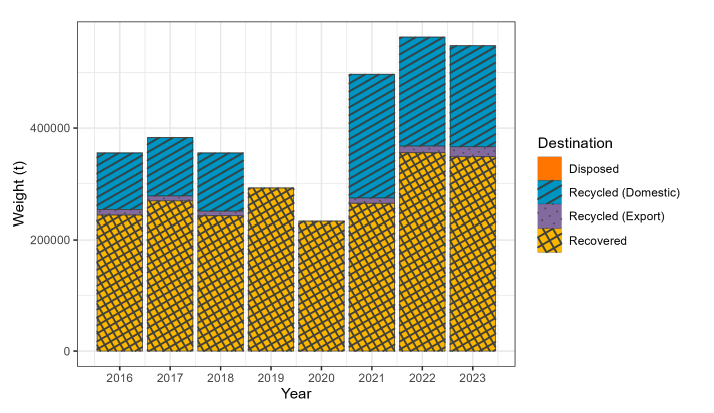
The overall available (separately collected or sorted) amount of this material has increased over time. The majority of this material is subject to domestic energy recovery or recycled in Scotland.
Infrastructure capacity for wood must be considered jointly between those sites which sort material for further processing, and those which offer final reprocessing (that is, recycling of material such that it no longer constitutes a waste product). It has not been possible to ascertain from SEPA Waste Sites and Capacity Tool data the specific nature of treatment undertaken by each facility.
A total of 396 licensed sites in Scotland handled waste wood in 2023. These include sites which specialise in wood and others which manage wood as part of a wider operation, such as a civic amenity sites and construction and demolition wastes.
A total of 79 licensed sites reported the treatment of wood in 2023[72] (Figure 16). Treatment may include sorting, shredding and chipping in order to produce material suitable for animal bedding, panel board manufacture or energy recovery. If UK end markets are similar in Scotland, it would suggest around two thirds of collected wood is used in large-scale biomass energy production, one quarter used in panel board and most of the remainder as animal bedding and surfaces[73]. Although approximately one quarter of the tonnage treated is considered recycled, the specific nature of wood wastes could mean that it is not viable to reprocess the material for onwards use, and energy recovery is the most appropriate end of life destination. Wood waste arisings data do not differentiate between clean wood suitable for recycling or composting and treated wood suitable for energy recovery, and so it has not been possible to assess this in more detail.

Gap analysis
There does not appear to be a capacity gap for the processing of wood waste in Scotland. There is already significant sorting and transfer capacity for wood wastes, as well as treatment infrastructure of various types, in the region of 500 kt. Since the majority of wood waste is already reprocessed in Scotland, it is not possible to tell from available data whether existing sites are at capacity, or could take on additional material if supply increased.
12. Fibre based composite packaging
Fibre based composite packaging waste arisings.
Fibre-based composite packaging (FBC) is packaging primarily made of paper or paper fibres and laminated with plastic. Common examples include drinks cartons and disposable beverage cups. FBC arisings do not map onto the EWC-stat system and so assessment of this waste is limited. While EWC codes relevant to fibre based composite packaging were considered, only 14 tonnes of waste were reported as being handled under these specific EWC codes, of which 5 tonnes was recycled in Scotland.
Compositional data from the Zero Waste Scotland Household Waste Composition Analysis Report[74] suggest that there may be up to 8 kt of fibre-based composite waste in Scotland. This aligns with independent estimates for carton (4.8 kt[75]) and FBC beverage cup (3.5 kt[76]) waste in Scotland, which together comprise that majority of FBC waste arisings.
Reprocessing capacity
Due to the above data limitations, the tonnages identified as FBC are several orders of magnitude lower that those estimated to be present within residual waste streams. It is assumed that the majority of FBC waste arisings available for recycling in Scotland are exported for reprocessing, or potentially subject to recovery or disposal.
Infrastructure capacity for FBCs must be considered jointly between those sites which clean, sort or treat material for further processing, and those which offer final reprocessing (that is, recycling of material such that it no longer constitutes a waste product).
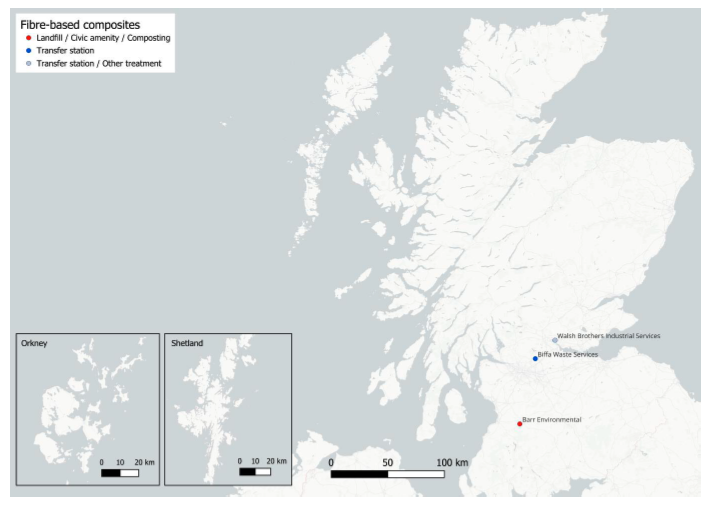
Based on SEPA Waste Sites and Capacity Tool, 2 sites treated 14 tonnes of fibre-based composite waste from Scotland on site in 2023[77]. 5 tonnes of this was reported to be recycled, with the remainder subject to “other” treatment (Figure 17).
It is likely that any unreported tonnages of FBC collected for recycling are exported for reprocessing. The only plant in the UK at that time which recycled this material was ACE UK, in England. Of all UK FBC arisings, around 29% (17.5 kt) are recycled[78], and around two-thirds of this activity takes place outside the UK.
Gap analysis
It is not possible to assess the capacity gap for fibre-based composite packaging due to a lack of data to identify this material. However, as the only major reprocessing facility handling this material in the UK is based in England, it is assumed that there is a domestic capacity gap for reprocessing this material, though it is not known whether the size of this gap is sufficient for commercially viable domestic reprocessing of FBCs.
13. Electronic waste
Waste Electrical and Electronic Equipment (WEEE) arisings
Scotland produced an estimated 62 kt of electronic waste in 2023[79], of which approximately 40 kt of this material was recycled. Up to an additional 13.3 kt of electronic waste could be available for reprocessing if household residual waste was sorted fully for recycling, of which 10.7 kt is small domestic appliances and cables, 0.3 kt light bulbs and tubes, and 2.6 kt other WEEE and associated consumables. This estimate excludes electronics present in residual waste and ‘household and similar wastes’ from Commercial & Industrial (C&I) and Construction & Demolition (C&D), for which data are not currently available.
Reprocessing capacity
Of the 40 kt of electronic waste recycled in 2023, approximately 15 kt was recycled in Scotland and around 25 kt exported for recycling elsewhere. The data does not show how the remaining 22 kt of electronic waste generated in Scotland is managed. There has been significant annual fluctuation in the tonnage of electronic waste managed since 2016 (Figure 18), partially caused by site closures due to fire.
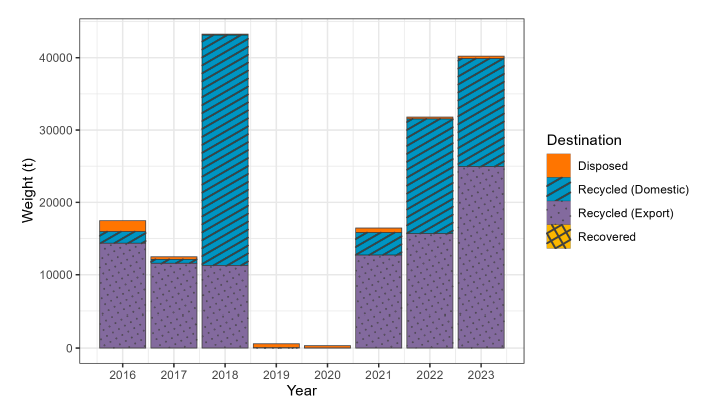
The overall available (separately collected or sorted) amount of this material has fluctuated over time. Just over one third of material was reprocessed in Scotland in 2023, with the rest exported.
Infrastructure capacity for electronic waste must be considered jointly between those sites which sort material for further processing, and those which offer final reprocessing (that is, recycling of material such that it no longer constitutes a waste product).
A total of 18 sites accepted electronic waste from Scotland for treatment on site in 2023[80] (Figure 19). There are 21 companies listed as SEPA accredited reprocessors for WEEE with active registration, six of which are noted as carrying out recycling or physical treatment in the site returns[81] (and therefore included in the total number treating electronic waste above).

Gap analysis
There is likely to be a domestic capacity gap for reprocessing electronic waste generated in Scotland. Recycling and physical treatment capacity in Scotland is estimated to be limited to around 20 kt, with 25 kt of electronic waste exported for recycling in 2023.
Waste electronics are expected to increase in quantity, both due to consumer demand and due to the roll-out of net zero infrastructure including electric vehicles and renewable energy systems such as solar panels (see Chapter 15)11. Electrical products contain a variety of critical raw materials including lithium, magnesium, copper and rare earth elements, which are highly valuable to the economy and can be subject to volatile international supply chains. The environmental risks associated with WEEE are also amplified if poorly managed.
These drivers, coupled with further reforms of the WEEE producer responsibility scheme under consideration by the four nations, are expected to increase in the tonnage of materials available for recycling and reuse and potentially strengthen demand for domestic reprocessing.
14. Batteries
Batteries waste arisings
Scotland produced an estimated 14 kt of battery waste in 2023[82], of which approximately 7.7 kt was recycled. Up to an additional 1.6 kt of waste batteries could be available for reprocessing if household residual waste was sorted fully for recycling. This estimate excludes batteries present in residual waste and ‘household and similar wastes’ from Commercial & Industrial (C&I) and Construction & Demolition (C&D), for which data are not currently available.
Reprocessing capacity
Of the 7.7 kt of waste batteries recycled in 2023, 1.6 kt was recycled in Scotland and 6 kt exported for recycling elsewhere. This varied significantly over the preceding decade, but both the total amount of material recycled, and the proportion reprocessed domestically showed a slight upward trend to 2022, before falling in 2023. The majority of battery arisings are still managed by export (Figure 20).
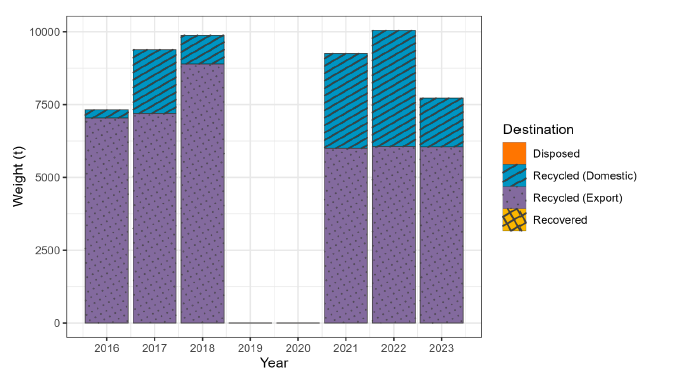
Overall sorted amounts of this material have increased over time, though fell in 2023. The majority of this material is exported for recycling.
Infrastructure capacity for batteries must be considered jointly between those sites which clean, sort or treat material for further processing , and those which offer final reprocessing (that is, recycling of material such that it no longer constitutes a waste product).
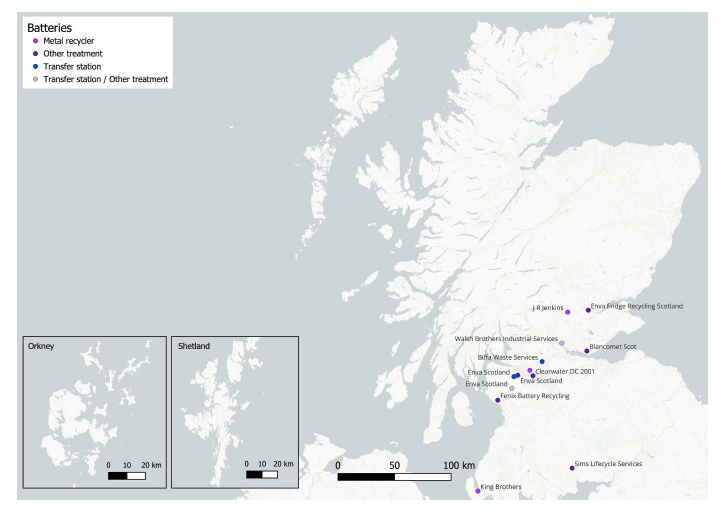
A total of 11 sites treated battery waste from Scotland in 2023[83] (Figure 21). Most recycling was undertaken by WEEE Solutions Limited (Paisley) and most physical treatment was undertaken by Blancomet Scot Limited (Dunfermline) and Fenix Battery Recycling Limited (Kilwinning).
There are four companies listed as accredited reprocessors for batteries[84]. Two of these companies are included in the SEPA site returns table detailing batteries recycled and undergoing physical treatment. Not all reprocessors are subject to site returns, hence it has not been possible to ascertain tonnages recycled by them in this report.
Gap analysis
There is very likely to be a domestic capacity gap for reprocessing waste batteries generated in Scotland. Whilst there appears to be sorting and transfer capacity for battery wastes, recycling infrastructure in Scotland appears to be insufficient to deal with domestic arisings, with over 6 kt of battery waste (78%) exported for recycling outside of Scotland.
This capacity gap covers battery arisings at 2023 levels, which are relatively small by tonnage relative to other material types. However, batteries contain high volumes of critical raw materials, meaning that the value of reprocessing this material is disproportionately greater than tonnage alone would suggest. Battery technologies are also essential to the UK's decarbonisation strategy, underpinning technologies in electric vehicles (EVs) and renewable energy storage, as well as continued increased use in portable electronics and other devices. Global demand for batteries is increasing rapidly and is set to increase 14 times by 20304, and the UK Battery Strategy (2023)9 predicts that by 2040 nearly 200 GWh of capacity will be required to satisfy UK battery demand for cars, commercial vehicles, heavy goods vehicles, buses and grid storage. The capacity gap for battery waste is therefore expected to grow rapidly in coming years.
15. Renewable energy installations
For the purposes of this report, renewable energy installations are considered to include offshore and onshore wind turbines and solar panels. Grid connection and transmission, as well as other energy infrastructure such as heat infrastructure or decommissioning waste from oil and gas infrastructure and hydropower are excluded.
Net zero infrastructure does not map onto the EWC-stat system and therefore cannot be determined using the published SEPA WFAS data. EWC codes used in site returns data contain multiple different types of waste assigned to them and are not exclusive related to net zero infrastructure waste. Waste arisings are therefore taken from the following reports:
- Offshore Renewable Energy Catapult, July 2022: End of life materials mapping for offshore wind in Scotland. Report from Phase 1 of the ELMWind project.
- Zero Waste Scotland, July 2023: Energy infrastructure materials mapping
- Zero Waste Scotland, 2025: The future of onshore wind decommissioning in Scotland.
Onshore wind: waste arisings
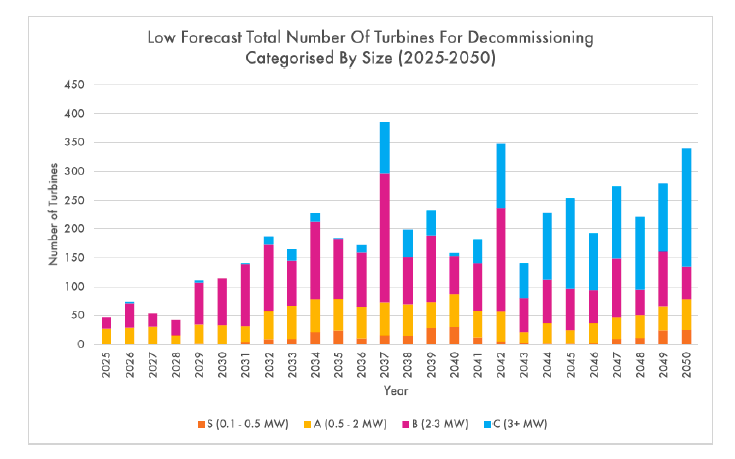
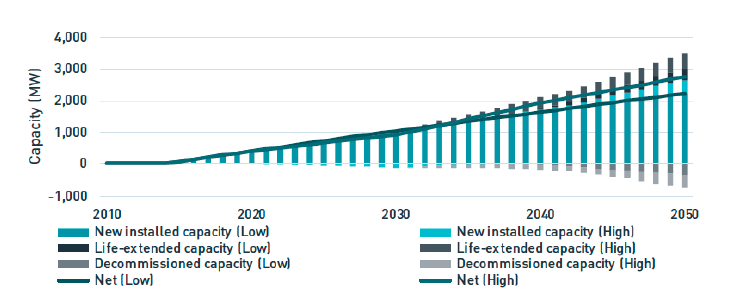
Some onshore wind capacity installed in the 1990s began coming to the end of operational life in 2015, at which point around 40% were decommissioned and 60% had their life extended. Further assets are expected to reach end of life and require decommissioning / life extension from early 2030s with requirement building up to 2050. Zero Waste Scotland (2025) estimates that 4,956 - 5,656 onshore wind turbines will be decommissioned from 2025 to 2050, with total weight of materials of 1.2-1.4 million tonnes. The estimated timescales for decommissioning of onshore wind turbines are shown in Figure 22 and Figure 23 for low and high decommissioning forecast (Zero Waste Scotland, 2025).

On average, concrete and aggregate used in the foundations make up 83% (by weight) of an onshore wind asset, followed by steel (14%), which is used as rebar in the bases, in the turbine tower and in components within the nacelle. Iron and steel are both major components in the gearbox. Copper is used in the generator and cabling, and rare earth elements such as neodymium and dysprosium are used in the generator. Blades are typically composed of lightweight composite materials including carbon fibre, fibreglass and aluminium. Error! Reference source not found.Table 3 sets out the total waste arisings of the highest volume materials from decommissioning for a low and high forecast; data are not available on rare earth elements which arise in smaller quantities but are of high value for reprocessing. Tonnages exclude bases which in most cases are unlikely to be removed as part of decommissioning due to the cost removal and low value of materials.
| Forecast | Iron | Steel | Copper | Fibreglass | Resin | Silica | Total |
|---|---|---|---|---|---|---|---|
| Low forecast | 120,533 | 959,877 | 20,241 | 53,083 | 79,625 | 13,560 | 1.2 million |
| High forecast | 136,110 | 1,083,934 | 22,857 | 59,944 | 89,915 | 14,561 | 1.4 million |
Reprocessing capacity
Life extension, refurbishment and reuse are the optimal treatment options for full turbines and components. Specialist refurbishment of wind turbine parts is available in Scotland, for example services provided by Renewable Parts located in Lochgilphead[85], but these activities are out of scope of this report. Whilst 85-90% of components are theoretically recyclable, approximately 60% of turbine blade waste including fibre reinforced plastic is currently landfilled, with the rest incinerated or recycled for lower value applications. There is existing infrastructure for some of the materials, such as steel and iron, but specialised reprocessing capacity is still under development for wind turbine blades made of fibre glass. Some blades are reused, including use as structural components in bridges, whilst other decommissioned blades have been put into storage until a solution can be found.
Any materials that are recycled or reused have predominantly been exported. However, a wider domestic market for refurbished wind components[86] is emerging as wind power generators seek to move away from the landfilling or incineration of turbine blades and parts (Zero Waste Scotland, 2023). ReBlade, based in Dumfries, is the UK’s first dedicated wind turbine decommissioning service. The company has developed innovative processes and blade-handling protocols aimed at maximising circular outcomes for decommissioned blades. These efforts focus on repurposing blades into practical structures such as bus shelters and bike sheds.
Offshore wind: waste arisings
ORE Catapult (2022) estimate that by 2050 between 161 and 492 offshore turbines could be decommissioned in Scotland, generating approximately 1.5-2.4 million tonnes of materials, with steel being the largest contributor. This is likely to be an underestimate due to the rapid expansion of offshore installed capacity: by 2022 432 turbines were installed, with another 484 turbines having received authorised consent, each with a 25–30-year lifespan.
The first offshore turbines are expected to reach end of life in the 2030s, but decommissioning of offshore wind turbines at scale is not expected until the 2040s (see Figure 24). As an example, Robin Rigg[87] (58 turbines), Scotland’s first offshore commercial wind farm began generation in 2010 and is estimated to reach end of life around 2035.
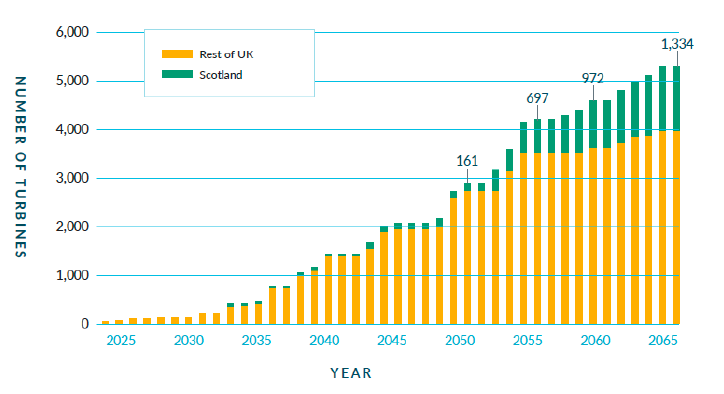
A total of 26 million tonnes of material is expected to be generated as waste for consented installations, not including any future consents. Table 4 sets out estimates of material volumes for turbines installed prior to 2023 and the quantities of materials required for complete consented offshore turbines. Tonnages include foundations, although these may not be removed as part of decommissioning (ORE Catapult, 2022).
| Material | Total installed (kt) | Total required (kt) |
|---|---|---|
| Steel | 1,040 | 14,630 |
| Concrete | 0 | 8,350 |
| Synthetic mooring | 0 | 115 |
| Copper | 7 | 70 |
| Plastic-insulation | 12 | 110 |
| Lead | 5 | 20 |
| Optic fibre | 0.6 | 3 |
| Carbon fibre | 7 | 140 |
| Fibre glass | 30 | 540 |
| Ductile iron casting | 80 | 1,540 |
| Neodymium | 5 | 90 |
| Resin/adhesive | 12 | 230 |
| Total | 1,194.6 | 25,839 |
Reprocessing capacity
Current expectations are that decommissioned offshore wind turbines may be sold as parts for recycling or exported for reuse, although this may not create and maximise the value chain that can benefit Scotland’s socio-economic and environmental conditions (Zero Waste Scotland, 2023). There is an anticipated capacity gap between currently available reprocessing domestic infrastructure and expected demand. This may be addressed over the next decade as market conditions and material availability drive reprocessing opportunities, particularly if policies or market conditions support local demand for the use of reprocessed materials.
Solar panels: waste arisings
The UK produced an estimated 650 tonnes of solar photovoltaic (PV) waste in 2021 and is expected to generate 30 kt tonnes by 2030 and 1 Mt by 2050. Decommissioning at scale is not expected to begin until 2030s, as shown in Figure 25 (Zero Waste Scotland, 2023).
Utility solar frames are typically steel which account for approximately 42% of overall weight. Solar Photovoltaic (PV) cells (58% of total weight) consist of glass (75%), plastic (10%), aluminium (8%), silicon (5%) and other metals including gallium, germanium, selenium, tellurium, cadmium and indium (total ~1%). Inverters (<2% of total weight) are required to connect the panels into a solar array.
At end of life, silicon-based panels can be disassembled and reprocessed. 95% of glass can be reused, 85% of silicon can be reused and 80% of the modules can be reused for new panels once they have been stripped of their silicone. In total, 96% of materials can be recovered and reused. Solar panels are classified as waste electrical and electronic equipment (WEEE), so domestic reprocessing infrastructure is covered in Chapter 13. However, there is scope to better assess the opportunities for reprocessing of solar PV ahead of decommissioning at scale.
16. Organic waste
Organic waste arisings
Scotland produced an estimated 1,234 kt of organic waste in 2023[88], with an additional 456 kt available from household residual waste if sorted properly for recycling, totalling 1,690 kt. This excludes unsorted organics waste present in residual waste/‘household and similar wastes’ from Commercial & Industrial (C&I) and Construction & Demolition (C&D) which could significantly increase this tonnage.
Reprocessing capacity
931 kt of organics waste from Scotland was recycled in Scotland in 2023 and around 19 kt exported for recycling elsewhere (Figure 26). Some organic waste is managed on site without needing specialist reprocessing capacity or requiring further reporting. This is likely to contribute to a gap of 303 kt between overall waste generated figures, and end destination reported in site returns. A portion of reported organic waste may also be landfilled or incinerated, as technical and economic feasibility for reprocessing is dependent on material quality and suitability for different processes. The tonnage generated and recycled within Scotland has remained fairly constant between 2016 and 2023. The great majority of annual organics arisings are managed by domestic recycling.

Overall sorted amounts of this material have remained largely consistent over time. Almost all organic waste is reprocessed domestically.
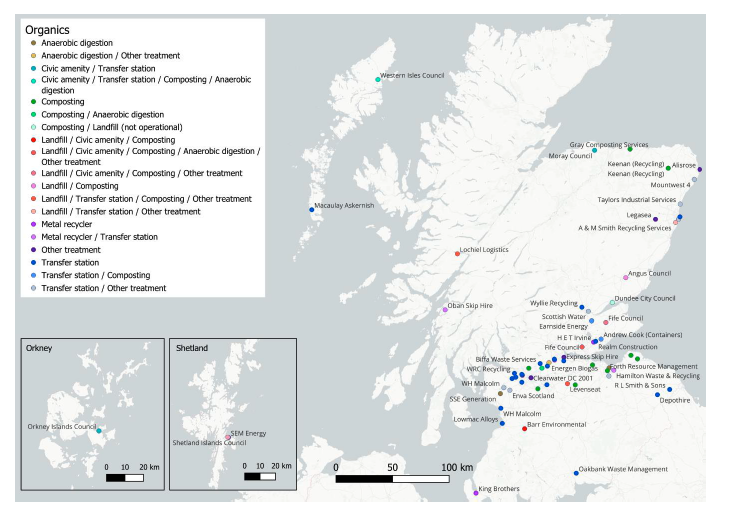
In 2023, 339 licensed sites in Scotland handled organic wastes in Scotland. These include sites which specialise in organic waste and others which manage organic waste as part of a wider operation. 64 licensed sites reported the treatment of organic waste to SEPA in 2023 (Figure 27). A further 39 smaller scale composting and anaerobic digestion (AD) facilities operating under an ‘exemption from licensing’ reported treatment to SEPA in 2023. Treatment may include composting, anaerobic digestion or biodiesel manufacture. 20 composting sites in Scotland are certified to PAS100 standard for quality compost and 11 AD plants are certified to PAS110 standard.
Gap analysis
There may be a capacity gap for reprocessing of organics waste in Scotland. Only a small amount of organic waste is exported and the majority of reported organic material reprocessing takes place in Scotland. However, there is a gap between arisings and capacity of at least 303 kt. While this gap may be the result of managed on site without needing external reprocessing capacity, some may be landfilled or incinerated due to low quality, economic viability of reprocessing, or lack of suitable capacity. It is also likely that additional capacity would be required if a greater proportion of the 456 kt of organic material contained in household residual waste streams was captured for recycling. Increasing the diversion of organic wastes from disposal, and particularly from landfill, is a priority for the Scottish Government due to the greenhouse gas emissions associated from decomposition, and underpins the forthcoming ban on the landfill of biodegradable municipal waste and other priority measures within Scotland’s Circular Economy and Waste Routemap. Policies also seek to reduce the total amount of organic material becoming waste, particularly food waste.
17. Textiles
Textiles waste arisings
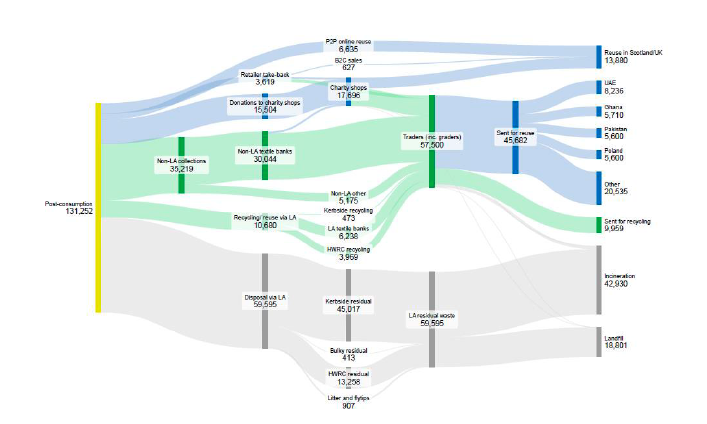
Scotland produced an estimated 131 kt of post-consumption textiles waste in 2023. Approximately 60 kt was disposed of through residual waste streams and were either incinerated (40 kt) or landfilled (20 kt)[89],[90]. The remaining 71 kt was processed through recycling collections, or donated (e.g. to charity shops), or sold online (see Figure 28).
Overall, 58 kt moved from these various streams to textile traders and textile graders. From there, 46 kt were exported for reuse and 10 kt sent for recycling, including both domestic and export, with minimal amounts being sent to incineration or landfill.
The majority of textiles disposed of via textile collections are eventually reused, primarily abroad. Traders appear to use export rather than domestic reuse outlets, which suggests that the non-domestic reuse market may accept items of lesser quality or have different clothing requirements, or that the current domestic reuse market in Scotland is already at capacity.
Around one fifth of textiles accepted by traders are sent for recycling, though data are not available to assess the proportion processed and those exported.
The variety of routes for handling post-consumer textiles arising from Scotland results in an estimated 11% being reused in Scotland or the UK (predominantly Scotland), nearly half of these through charity shop sales. An estimated 35% of textiles is exported for reuse, and 8% sent for recycling – which may be in the UK or overseas, typically recycling into industrial rags or mattress fillings.
Reprocessing Capacity
Infrastructure capacity for textile waste must be considered jointly between those sites which clean, sort or treat material for further processing, and those which offer final reprocessing (that is, recycling of material such that it no longer constitutes a waste product).
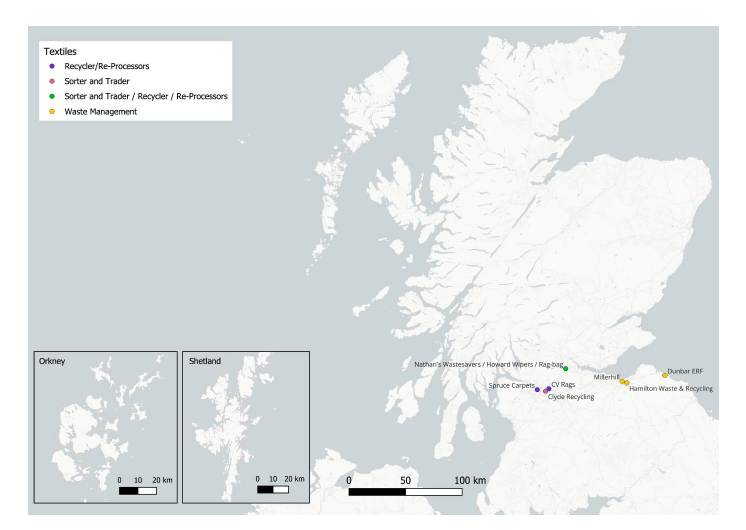
In addition to charity organisations which accept textiles donations for sorting and reselling, the key commercial sites trading and sorting textiles are Textile Recycling International (TRI) (formerly known as Nathan’s Wastesavers Ltd), and Clyde Recycling, with the majority of their activity being driven by reuse markets abroad. Some sites do conduct recycling activities (see Figure 29), but these predominantly revolve around carpets and mattress fibres (Hamilton Waste & Recycling) and wiper production (overseen by Howard Wipers, a subsidiary of TRI). There is a notable absence of suitable chemical recycling infrastructure in Scotland, and consequently many manufacturers send waste textiles abroad for reprocessing.
Gap analysis
Almost half of all post-consumption textiles generated in Scotland are disposed via residual waste streams, with textiles accounting for 32% of the carbon footprint of household waste[91]. While data limitations are set out above, we are not aware of any domestic textiles recycling infrastructure (e.g. fibre to fibre) in Scotland. Increasing the capture of textiles and textile wastes for reuse or recycling represents would likely significantly increase the supply material for reprocessing. However, it is not clear that there would be sufficient material arising in Scotland for domestic reprocessing to be viable, and a wider UK- or Europe-wide approach may be required, particularly in the absence of policies to drive up demand for reprocessed fibres, such a recycled content standards. This is an aim of new proposed circular economy polies in the EU, such as textile extended producer responsibility, and there are opportunities to consider such approaches in Scotland and the rest of the UK.
18. Mattresses
Mattress waste arisings
Mattresses do not map onto the EWC system as relevant EWC codes used in site returns data are not exclusive related to mattress waste. Data on mattress waste arisings and reprocessing are therefore taken from the following reports:
- Mattress Recycling - Scottish Infrastructure Business Case Mattress Extended Producer Responsibility | Zero Waste Scotland
- How to reduce waste and carbon emissions caused by mattresses: A review of global Extended Producer Responsibility schemes (2020)
- NBF Recycling Reports - The National Bed Federation
Information is also used from monitoring of projects funded by the Scottish Government’s Recycling Improvement Fund[92] (RIF), which is administered by Zero Waste Scotland.
Approximately 600,000 mattresses are disposed of in Scotland each year[93]. Of these, it is estimated that around 370,000 mattresses are collected at Household Waste Recycling Centres (HMRCs) and bulky collections, mainly from domestic sources. Some mattresses from domestic sources are also returned to retailers through take-back schemes.
Mattresses from non-domestic sources (e.g. hospitality, student accommodation, NHS, prisons) are disposed of through other routes and are generally considered to be of lesser quality for recycling (mixed textiles) and more likely to be contaminated.
Previous estimates indicate that less than 1 in 10 mattresses are sent for reuse or recycling in Scotland. The UK-wide rate for mattress recycling was estimated to be 24% in 2021[94]. Metals, polyester and flock contents can be recycled, while contaminated mixed fibres are typically sent for energy recovery.
Reprocessing capacity
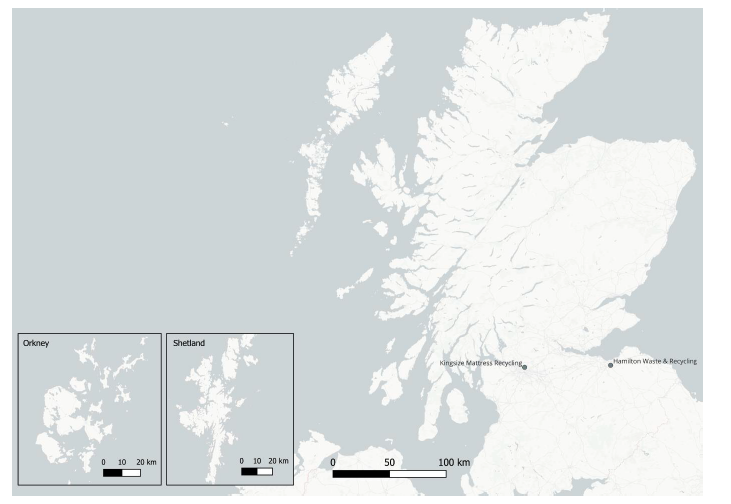
There are two facilities in Scotland which accept mattresses for treatment: Hamilton Waste and Recycling Limited (active SEPA site permit) and Kingsize Mattress Recycling – Glasgow (simple exemption) (Figure 30).
Due to the data limitations set out above, and particularly the lack of specific EWC codes for mattresses, it is not possible to determine what the current reprocessing tonnages are for these facilities through SEPA waste return data.
Gap analysis
It is not possible to determine an accurate gap for mattress reprocessing in Scotland. While mattress recycling facilities exist in Scotland, significant quantities of mattresses are still disposed of through landfill and incineration. Further work is underway to explore mattress reuse and recycling opportunities as part of the forthcoming Product Stewardship Plan.
19. Tyres
Tyre waste arisings
Scotland produced an estimated 51 kt of tyre waste in 2023. However, SEPA WFAS only reports the processing destination for 13 kt of these arisings, of which almost all are incinerated for energy recovery. The majority of tyre waste in Scotland (26 kt) is recorded as “physical treatment” activity at transfer stations, meaning that the end destination for this material is not known based on the data. Waste tyres were banned from being landfilled in Scotland in 2004, by the EU Landfill Directive (1999/31/EU). There has been significant variation in the amount of tyres disposed of annually since 2016 (Figure 31).

The amount of tyre waste has slightly fallen since a peak in 2018. Almost all material is subject to domestic energy recovery in Scotland.
Reprocessing capacity
Infrastructure capacity for tyres includes both sites which sort material for further processing, and sites which offer final reprocessing (that is, recycling of material such that it no longer constitutes a waste product). It is not possible to ascertain specific treatment activities undertaken by each facility from SEPA Waste Sites and Capacity Tool data.
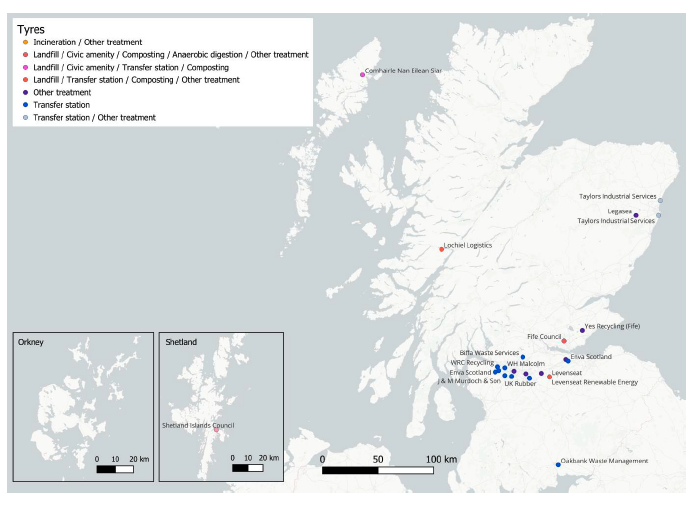
A total of 210 licensed sites handled tyre waste in Scotland in 2023, with 24 sites reporting the treatment of tyre waste[95] (Figure 32). Approximately one quarter of Scotland’s waste tyres are currently used as a feedstock for energy or cement production. There are limited reprocessing facilities within Scotland for waste tyres[96], with the majority undergoing simple treatment such as baling, shredding or granulation ahead of export to England or overseas. Treatment may include shredding and baling for use in the production of recycled rubber products and material suitable for energy recovery or in cement manufacture.
Gap analysis
There appears to be sufficient sorting and transfer capacity for tyres in Scotland, but the majority of waste tyres are subject to energy recovery rather than recycled.
The volume of tyres placed on the market and volume of end-of-life tyres is expected to continue growing modestly through to 2030. This projection is primarily based on a forecast increase in vehicle kilometres travelled across both passenger and commercial vehicle categories. The heavier weight of electric vehicles and their higher torque may also contribute to faster tyre wear, which could result in increased tyre replacement. The continuing long-term decline in truck tyre retreading in the absence of policy intervention may also increase end-of-life tyre volumes in this segment, as fewer casings are reused.
20. Construction materials (Concrete)
Concrete waste arisings
Concrete arisings are contained within the EWC-stat category “Minerals from construction and demolition”. This is not a precise match, as the category also contains other materials such as bricks, bitumen, and plasterboard. According to SEPA WFAS data, 1,405 kt of waste was separately collected in Scotland within this category in 2023. A specific breakdown of the composition of this waste category is not available.
Based on EWC codes alone, concrete waste arisings in Scotland are at least 73 kt, but this is expected to be significantly higher depending on the composition of materials processed at sites which are exempt from completing returns.
Reprocessing capacity
A total of 977 kt of mineral construction waste from Scotland was recycled in Scotland in 2023 and none exported for recycling elsewhere. This level has been fairly constant over the preceding years. A large majority of this material (nearly 97% in 2023) is recycled within Scotland (Figure 33), with the remainder disposed of within Scotland.
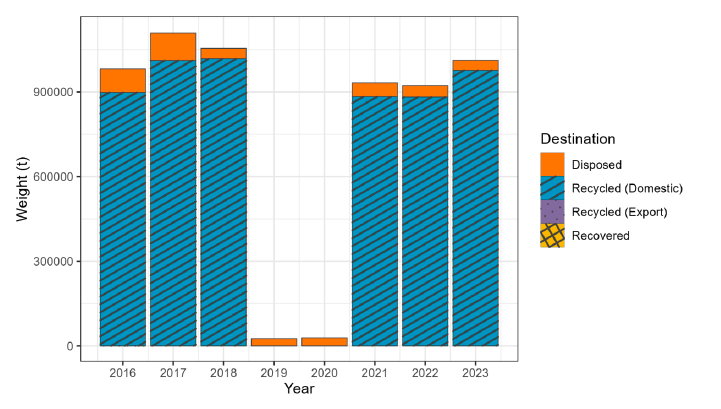
The amount of material has remaining relatively consistent over time, with the majority reprocessed in Scotland.
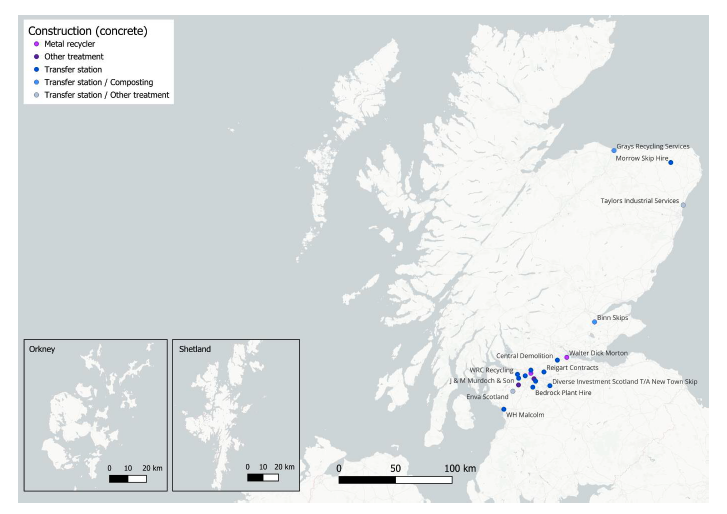
In 2023, 60 licensed sites handled waste concrete and mixtures including concrete in Scotland. 19 sites reported the treatment of concrete waste in 2023[97] (Figure 34). Treatment may include crushing and screening to produce recycled aggregate.
It should be noted that the above reprocessing tonnages do not include concrete collected mixed with other waste streams, which will be a significant contribution to overall tonnage.
Gap analysis
The majority of concrete waste generated in Scotland is currently recycled domestically. It appears that almost no mineral waste or concrete waste arising from construction and demolition is currently exported. Around 3% of overall mineral wastes are sent to landfill, suggesting that there is sufficient capacity to process and recycle these wastes domestically.
21. Mixed Packaging Materials – (Material Recovery Facilities)
Material Recovery Facilities (MRFs) typically provide the first step of reprocessing for packaging materials by sorting mixed materials into single material streams, such as mixed recycling and mixed paper & card into their component parts (plastics, steel, aluminium, paper, card, glass and cartons). Some of them also refine material streams further, such as sorting mixed plastics into films, bottles and pots, tubs & trays, or specific plastic types.
The MRF tonnage for mixed recycling is not fully accounted for using the materials specific EWC codes specified in Appendix 1. Not considering the tonnage of mixed recycling sent to MRFs could therefore underestimate reprocessing capacity in Scotland, and the capacity available for specific materials. Where possible estimates of the material handled by MRFs are included in the above chapters.
MRFs in scope of the 2025 Code of Practice on sampling and reporting at materials facilities (and prior to 2025, those in scope of the previous Materials Recovery Code) are required to report on materials received at the MRFs through the SEPA Recyclate Quality Tool. MRFs are likely to be in scope if they receive 1,000 tonnes or more of dry recyclable waste per year, and separate it into a dry waste stream or streams.. Whilst this source excludes some of the smaller MRFs, it is considered to capture the majority of MRFs in Scotland.
MRF Locations
According SEPA Recyclate Quality Tool, there were 11 MRFs in 2023 treating 289 kt [98] of dry mixed recycling (DMR) (Figure 35).
- WML/E/0020002 BIFFA (Broxburn)
- WML/W/0000026 BIFFA (Glasgow)
- PPC/E/0020083 Cireco, Lochhead
- WML/W/0020110 Enva, Linwood
- WML/E/0020112 Falkirk Council
- WML/W/0020181 Glasgow City Council
- WML/W/0022002 J&M Murdoch Ltd
- PPC/E/0020001 Levenseat Ltd
- WML/W/0220257 Saica Natur (UK) Ltd
- WML/L/1117120 Sibelco Newhouse
- WML/L/5005403 Smurfit Kappa
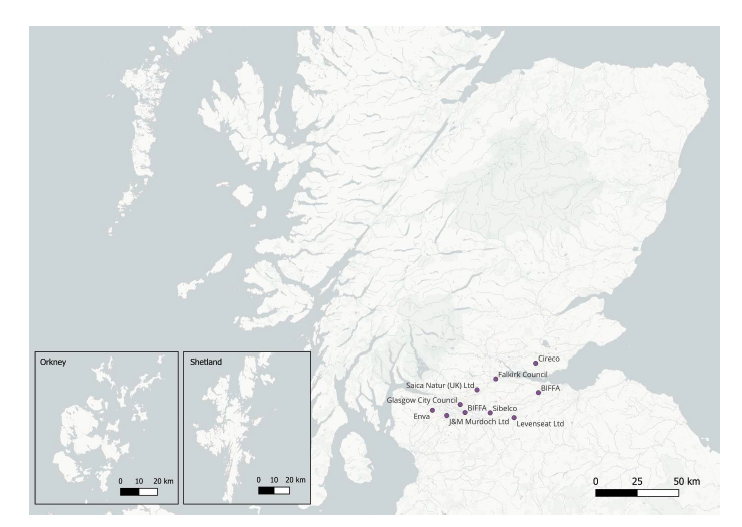
Figure 35: Location of material recovery facilities in Scotland in 2023, based on the SEPA Recyclate Quality Tool.
Some of the MRF tonnage is included in the EWC codes used for materials specific reprocessing tonnages elsewhere in the report and hence the MRF tonnage is not additional reprocessing capacity in its entirety.
SEPA Waste Sites and Capacity Data Tool shows that the 11 sites also received 171 kt[99] of ‘Mixed packaging’ (15 01 06) in 2022. Whilst this is likely to be included in the MRF tonnage above, this is excluded from the EWC codes used for material specific reprocessing tonnages. Therefore, it is estimated that there are an additional 171 kt tonnes per annum of MRF sorting capacity in Scotland, in addition to the material specific reprocessing capacity identified elsewhere in this report.
MRF Outputs
MRF outputs from the 11 MRFs reporting in 2023 were 146 kt, excluding glass processed as a product at Sibelco Green Solutions Plant as this is already accounted for in Chapter 10 (Glass). Table 5 shows the type and quantity of outputs generated by the MRFs.
| Material Category | Material Grade | Total Quantity (tonnes | % of Total Quantity | |
|---|---|---|---|---|
| Glass | Mixed | 40,206 | 28% | |
| Metal | Aluminium | 5,376 | 4% | |
| Metal | Mixed | 245 | <1% | |
| Metal | Scrap | 383 | <1% | |
| Metal | Steel | 7,044 | 5% | |
| Paper | Cardboard | 33,912 | 23% | |
| Paper | Mixed | 30,541 | 21% | |
| Paper | Newspapers and Magazines | 2,108 | 1% | |
| Plastic | Hard | 12 | <1% | |
| Plastic | HDPE Bottles Clear | 801 | 1% | |
| Plastic | HDPE Bottles Coloured | 115 | <1% | |
| Plastic | LDPE Film Clear | 716 | <1% | |
| Plastic | Mixed | 14,976 | 10% | |
| Plastic | Mixed Bottles | 8,585 | 6% | |
| Plastic | Mixed Rigid | 36 | <1% | |
| Plastic | PET Bottles Clear | 112 | <1% | |
| Plastic | Polypropylene (PP) | 16 | <1% | |
| Plastic | Pots, Tubs and Trays (PTT) | 636 | <1% | |
| Total | 145,817 | 100% | ||
Contact
Email: brandon.marry@gov.scot