
Traditional stone walls in Scotland - validation of RdSAP U-value calculation methodology: research
Research looking at the practical performance of buildings around Scotland. Specific stone wall were identified to see if actual u-values measured showed significant improvement when compared with u-values used in RdSAP.
3. Results
3.1 In-situ U-value measurement results vs calculated U-value estimates from RdSAP 10 equations
Results are presented in Table 2. The measured U-values given here are the average measured U-values for each property.
The EPC surveys were carried out by the DEA after the in-situ U-value measurements had taken place. Two of the tested walls (the narrowest and thickest) were subsequently excluded from further analysis as their construction was deemed not to meet the wall type requirements of the project. While it was not possible to confirm the exact construction of the test wall in property 3, the wall measurements, combined with the DEA’s experience of similar style properties (where wall construction had been confirmed by inspection), led the Assessor to conclude that the wall most likely included brick. Property 6 was removed because, on inspection within the roof, it was found to have an internal brick wall lining to the inside of the traditional stone wall. It is likely that this had been introduced to support a new roof structure during a historic renovation rather than being part of the original wall construction. These two results are therefore excluded from Table 3 onwards and from the subsequent graphs.
A direct comparison of the differences between the measured and calculated values is given in Table 3. General observations across all wall types include:
- The average of the measured results for each wall are above and below the respective values calculated by the RdSAP 10 equations for the equivalent wall thicknesses, although 10 of the 14 U-values are lower.
- The unlined walls generally have higher U-value results than the lined walls, which is to be expected, since the lining introduces an air layer behind it that offers additional resistance to heat flow through the wall.
Results are also presented graphically in Figure 2 for sandstone walls and Figure 3 for granite and whinstone walls. Points marked ‘W’ across the graphs included at least one heat flux plate within relatively close proximity of a window reveal, though in these cases the distance to the reveal always exceeded 300mm. Points marked ‘Un’ on the graphs represent ‘unlined’ internal walls. All other points represent walls with an internal lining.
Each graph shows equation lines representing the respective U-value equations for stone walls in RdSAP 10; the orange line shows the U-value versus wall thickness for unlined walls, while the grey line shows the U-value versus wall thickness corrected for internally lined walls.
It can be seen from both graphs that there is no particular pattern in the spread of measured results according to:
- the geographical location of the tested walls;
- city/suburbs versus rural or coastal locations; or
- flats versus houses.
This is not particularly surprising, since the sub-sample of each of these instances was small
| Property number | Location/ description | Stone type | Internal finish | External finish | Measured wall thickness, mm | Average measured U-value, W/m2K | RdSAP 10 calculated U-value, W/m2K |
|---|---|---|---|---|---|---|---|
| 1 | Glasgow, city | Sandstone | Lined | Exposed stone | 600 | 0.96 | 1.21 |
| 2 | Glasgow, city flat | Sandstone | Lined | Exposed stone | 600 | 0.69 | 1.21 |
| 3 | Helensburgh, coastal | Sandstone | Lined | Rendered | 380 | 1.46 | N/A |
| 4 | Kilbarchan, rural | Sandstone | Unlined | Rendered | 640 | 1.71 | 1.46 |
| 5 | Inverclyde, coastal flat | Sandstone | Lined | Exposed stone | 700 | 0.79 | 1.12 |
| 6 | Dunkeld, rural | Sandstone | Lined | Rendered | 970 | 0.84 | N/A |
| 7 | Anstruther, coastal | Sandstone | Lined | Rendered | 780 | 0.88 | 1.07 |
| 8 | Edinburgh flat | Sandstone | Lined | Exposed stone | 685 | 0.91 | 1.14 |
| 9 | Edinburgh flat | Sandstone | Lined | Exposed stone | 720 | 1.22 | 1.11 |
| 10 | Aberdeen, suburb | Granite | Lined | Exposed stone | 610 | 1.51 | 1.31 |
| 11 | Aberdeenshire, rural | Granite | Lined | Rendered | 810 | 0.23 | 1.17 |
| 12 | Aberdeenshire, rural | Granite | Lined | Rendered | 620 | 1.29 | 1.30 |
| 13 | Aberdeen, suburb | Granite | Lined | Exposed stone | 670 | 0.36 | 1.26 |
| 14 | Aberdeen, suburb | Granite | Lined | Exposed stone | 780 | 1.67 | 1.19 |
| 15 | Perth, rural | Whinstone | Lined | Rendered | 680 | 0.88 | 1.26 |
| 16 | Perth, rural | Whinstone | Unlined | Rendered | 600 | 1.64 | 1.70 |
| Property number | Stone type | Internal finish | Measured wall thickness, mm | Difference between measured versus calculated U-value, W/m2K | % difference between measured versus calculated U-value |
|---|---|---|---|---|---|
| 1 | Sandstone | Lined | 600 | -0.25 | -21% |
| 2 | Sandstone | Lined | 600 | -0.52 | -43% |
| 4 | Sandstone | Unlined | 640 | 0.25 | 17% |
| 5 | Sandstone | Lined | 700 | -0.34 | -30% |
| 7 | Sandstone | Lined | 780 | -0.19 | -17% |
| 8 | Sandstone | Lined | 685 | -0.23 | -20% |
| 9 | Sandstone | Lined | 720 | 0.11 | 10% |
| 10 | Granite | Lined | 610 | 0.20 | 15% |
| 11 | Granite | Lined | 810 | -0.94 | -80% |
| 12 | Granite | Lined | 620 | -0.01 | -1% |
| 13 | Granite | Lined | 670 | -0.90 | -72% |
| 14 | Granite | Lined | 780 | 0.48 | 41% |
| 15 | Whinstone | Lined | 680 | -0.37 | -30% |
| 16 | Whinstone | Unlined | 600 | -0.07 | -4% |
Note: Negative values indicate the measured U-value is lower than the calculated U-value. Positive values indicate the measured U-value is higher than the calculated U-value.
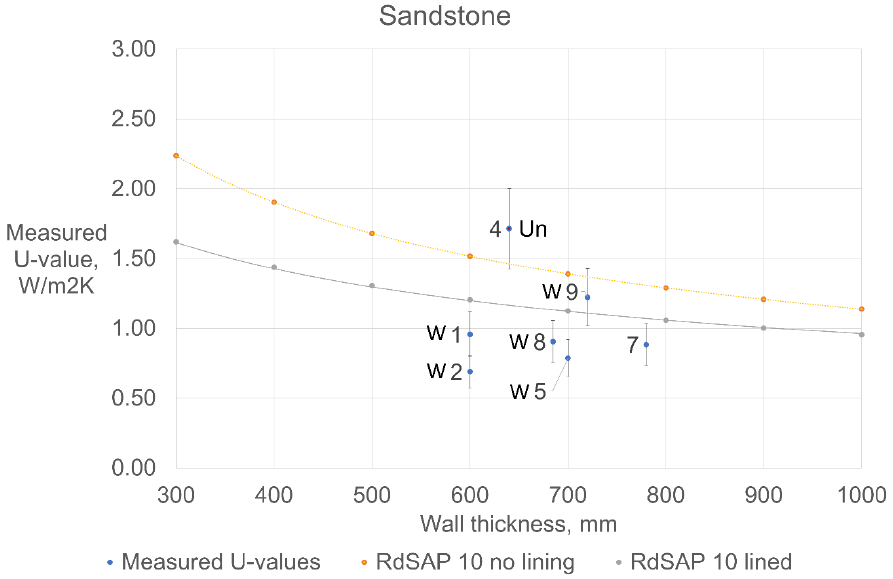
When the associated error is allowed for, two of the seven sandstone wall results correlate with the respective RdSAP 10 equation lines. However, the others are below their respective RdSAP 10 values calculated according to their wall thickness. Unfortunately, it is not appropriate to suggest any general trends from the sandstone wall data.
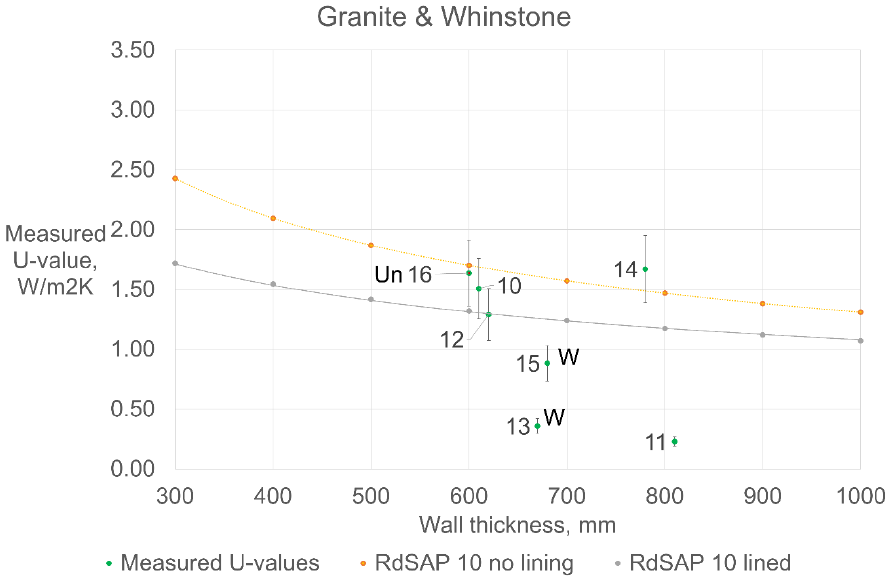
When the associated error is allowed for, three of the seven granite/whinstone results correlate with the respective RdSAP 10 equation lines. However, the remaining results show a wider divergence (above and below) from the RdSAP 10 equation lines than was the case with the sandstone walls. It was again not appropriate to suggest any general trends from the granite wall data.
Two granite walls gave very low measured U-value results (<0.4 W/m2K). In these cases, the pairs of results on which the quoted average results are based show close agreement with each other, and the stability of the measurement data, determined by comparing the U-value determined from the first two thirds of the data with that from the last two thirds of the data at each wall location, was good. (3x plates showed variability of less than 0.5%, and another 1x plate showed 2.6%.) There is no obvious reason why these two stone walls have such low U-values. While internally lined, they are reportedly not insulated (and it was beyond the scope of this study to verify this via intrusive survey). For one of the walls, the test locations were relatively close to a window reveal (360mm away), while the other wall had the lower part of the wall below ground level, though the test locations were clear of this by a height of at least 400mm. In addition, in this latter case, the extent of the heating was significantly reduced part-way through the monitoring period, so the U-value result for this particular wall is based on a shorter period of data (though the results still met the requirement of the Standard). However, none of these factors would be expected to influence the measured U-value results to the extent witnessed. They are therefore considered as unexplained outliers for this study.
Further discussion of potential factors that may influence measured U-value results is made in Appendix B.
3.2 RdSAP 2012 / EPC property assessment
Results from the RdSAP 2012 EPC assessment of the test properties are given in across Tables 4(a) – 4(c).
The space heating demand for each of the properties based on the RdSAP 10 calculated U-values is lower than that for the RdSAP 2012 calculated U-values. This is to be expected, since the RdSAP 10 calculation results in improved U-values, and that is the only metric that is changed in the assessments.
Despite some seemingly large differences between the measured wall U-values and calculated RdSAP 10 U-values in the previous section, this does not translate to such large variations in heating energy demand determined for the EPCs. Variations in space heating demand range from a decrease of 18% with measured U-values to an increase of 8% across the test properties. The changes do not track directly to the changes in wall U-values since there are differing ratios of walls and glazing to heated floor areas across the test properties. However, those with the greatest difference between the measured and calculated U-values also show the largest variations in space heating demand.
Subsequent changes in EPC score show often modest variation of a few EPC ‘points’, with over half (nine of 14) varying by two points or less. The greatest variation is an increase of sic points in property 11, which was one of the granite-walled properties with the unexplained exceptionally low measured U-values.
Overall, the EPC energy assessment outputs from the property scenarios based on the measured U-values are generally closer to the outputs based on the RdSAP 10 U-values than to those that assume the existing RdSAP 2012 defaults.
| Property number | Location/ description | Total floor area, m2 | External exposed stone wall area, m2 | Glazed area (in stone wall),m2 |
|---|---|---|---|---|
| 1 | Glasgow, city | 316 | 238 | 50 |
| 2 | Glasgow, city flat | 64 | 62 | 8 |
| 4 | Kilbarchan, rural | 109 | 79 | 10 |
| 5 | Inverclyde, coastal flat | 45 | 12 | 5 |
| 7 | Anstruther, coastal | 79 | 71 | 9 |
| 8 | Edinburgh flat | 132 | 55 | 16 |
| 9 | Edinburgh flat | 132 | 65 | 13 |
| 10 | Aberdeen, suburb | 302 | 303 | 40 |
| 11 | Aberdeenshire, rural | 78 | 48 | 6 |
| 12 | Aberdeenshire, rural | 68 | 85 | 11 |
| 13 | Aberdeen, suburb | 159 | 103 | 11 |
| 14 | Aberdeen, suburb | 306 | 270 | 31 |
| 15 | Perth, rural | 153 | 157 | 17 |
| 16 | Perth, rural | 226 | 116 | 13 |
Table 4(b): Impact of wall U-value assumptions on RdSAP 2012 metrics on heating energy demand
(Numbers in brackets show variation between metrics with measured wall U-values versus RdSAP 10 calculated U-values)
| Heating energy demand, kWh/m2yr | ||||
|---|---|---|---|---|
| Property number | Location/ description | RdSAP 2012 wall U-values | RdSAP 10 wall U-values | Measured wall U-values |
| 1 | Glasgow, city | 182 | 178 | 172 (-3 %) |
| 2 | Glasgow, city flat | 131 | 124 | 101 (-18%) |
| 4 | Kilbarchan, rural | 359 | 348 | 357 (+3%) |
| 5 | Inverclyde, coastal flat | 108 | 104 | 96 (-7%) |
| 7 | Anstruther, coastal | 215 | 211 | 203 (-4%) |
| 8 | Edinburgh flat | 202 | 200 | 196 (-2%) |
| 9 | Edinburgh flat | 118 | 116 | 118 (+2%) |
| 10 | Aberdeen, suburb | 178 | 171 | 178 (+4%) |
| 11 | Aberdeenshire, rural | 232 | 226 | 198 (-12%) |
| 12 | Aberdeenshire, rural | 260 | 248 | 250 (+1%) |
| 13 | Aberdeen, suburb | 198 | 192 | 174 (-10%) |
| 14 | Aberdeen, suburb | 200 | 194 | 210 (+8%) |
| 15 | Perth, rural | 201 | 193 | 178 (-8%) |
| 16 | Perth, rural | 197 | 190 | 190 (-0%) |
Table 4(c): Impact of wall U-value assumptions on RdSAP 2012 metrics on EPC score
(Numbers in brackets show variation between metrics with measured wall U-values versus RdSAP 10 calculated U-values)
| EPC score | ||||
|---|---|---|---|---|
| Property number | Location/ description | RdSAP 2012 wall U-values | RdSAP 10 wall U-values | Measured wall U-values |
| 1 | Glasgow, city | 51 | 52 | 53 (+1) |
| 2 | Glasgow, city flat | 63 | 64 | 68 (+4) |
| 4 | Kilbarchan, rural | 1 | 1 | 1 (+0) |
| 5 | Inverclyde, coastal flat | 72 | 74 | 76 (+2) |
| 7 | Anstruther, coastal | 32 | 33 | 35 (+2) |
| 8 | Edinburgh flat | 44 | 45 | 45 (+0) |
| 9 | Edinburgh flat | 70 | 71 | 71 (+0) |
| 10 | Aberdeen, suburb | 54 | 55 | 54 (-1) |
| 11 | Aberdeenshire, rural | 19 | 20 | 26 (+6) |
| 12 | Aberdeenshire, rural | 14 | 16 | 16 (+0) |
| 13 | Aberdeen, suburb | 38 | 39 | 44 (+5) |
| 14 | Aberdeen, suburb | 47 | 49 | 45 (-4) |
| 15 | Perth, rural | 34 | 36 | 40 (+4) |
| 16 | Perth, rural | 41 | 42 | 43 (+1) |
Contact
Email: EPCenquiries@gov.scot