
Traditional stone walls in Scotland - validation of RdSAP U-value calculation methodology: research
Research looking at the practical performance of buildings around Scotland. Specific stone wall were identified to see if actual u-values measured showed significant improvement when compared with u-values used in RdSAP.
2. Methodology
2.1 Property selection
Scottish Government identified a range of stone wall types and wall lining options to be investigated under the study as follows:
- Sandstone walls, with and without wall lining present respectively.
- Granite walls, with and without wall lining present respectively.
- Sandstone walls, with wall lining present, specifically in Glasgow-style tenement flats.
- Sandstone or whinstone walls, with wall lining present, specifically in Edinburgh-style tenement flats.
- Granite walls, with wall lining present, specifically in Aberdeen-style tenement flats.
BRE worked with several stakeholders to identify potential stone walled properties for in-situ U-value measurements. Unfortunately, it was not possible to obtain any Aberdeen-style flats for testing. Also, a very small selection of potential properties with unlined walls were identified, and of these, most were either deemed unsuitable for test (due to accessibility issues or unsuitable orientation) or it was not possible to arrange access within the required timeframe of the field trials. BRE therefore sought to identify an equal mix of sandstone versus granite or whinstone walled properties for test. For the sandstone properties, this was further split with an equal division of flats versus houses.
Table 1 summarises the 16 properties that underwent U-value measurement during the study. One wall was chosen for test in each property. Note that seven properties were not occupied during the testing, but this was not an impacting factor, since they were still heated to a sufficient level to give acceptable test results.
| Wall type | Internal finish | Location | Number of properties |
|---|---|---|---|
| Sandstone | Lined | Glasgow and surrounding area | 4 |
| Sandstone | Unlined | Glasgow and surrounding area | 1 |
| Sandstone Flat | Lined | Glasgow and surrounding area | 2 |
| Sandstone Flat | Lined | Edinburgh | 2 |
| Granite | Lined | Aberdeenshire | 5 |
| Whinstone | Lined | Perthshire | 1 |
| Whinstone | Unlined | Perthshire | 1 |
2.2 In-situ U-value measurement
Measurements were carried out in accordance with BS ISO 9869-1:2014. Walls were preferentially selected for this study that were northerly facing, i.e. north of east to west, so the external façade (and temperature) was not significantly influenced by solar gains. In one case, a west-facing wall was assessed, but it was sheltered from solar gain by an external out-building attached to the test wall. Internally, the test positions were assessed by thermography prior to selecting the location to install the test equipment, to ensure that there were no obvious localised features in the wall that could lead to unrepresentative results. The measurement equipment was also placed as far away as possible from features that could influence the flow of heat through a wall (i.e. sources of ‘thermal bridging’) such as windows, and also away from concentrated sources of heat such as radiators.
Heat flow was measured at the inside wall surface using a thermopile – a cluster of thermocouples – in the form of a heat flux ‘plate’ (Hukseflux HFP01 type). To secure the plates to the test wall without the need for adhesive, a telescopic pole was fixed between the floor and ceiling adjacent to the wall, and the plates were then pressure-held against the wall by utilising a semicircular framed clip secured between the pole and the plate edges, so as to leave the reverse surface of the plate exposed to the environment (Figure 1). Temperature sensors were placed close to the surface of the plates and also externally near the outside wall surface, to measure the internal and external temperature over the duration of the test. Stainless steel-sheathed thermistors were used to measure internal temperature, and a logger (TinyTag TGC-0057 type) was used for external temperature measurement. Data from all sensors was logged at 15-minute intervals using standalone battery-powered loggers. The measurement equipment was left in place for two-weeks.
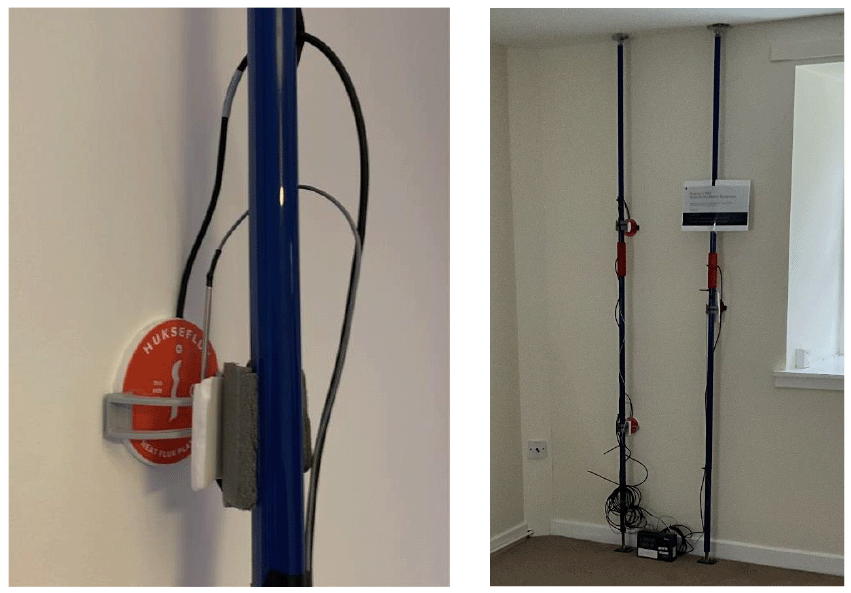
Wherever possible, three heat flux plates were set up for measurement on each test wall to allow an element of redundancy in case it was found that a sensor had not provided good data for any reason. However, in some properties, it was only possible to install two heat flux plates due to space constraints.
U-values were calculated according to the ‘average method’ set out in BS ISO 9869-1:2014. An adjustment of the resulting calculated U-values was made to account for the thermal resistance of the heat flux plate. The % error of the U-value results derived from each of the heat flux plates was determined in accordance with BS ISO 9869-1:2014 to be between 12.3% and 23.8%. This is in line with the typical error quoted within the standard. The upper error margin was subsequently assumed for each plate. Measured wall U-values from two plates were averaged for consistency in final reporting (since only two plates were used for some walls). For properties where three plates were installed, the two plates with the most stable results (when comparing the U-value obtained from the first two thirds of the data with the last two thirds of the data) were selected. The error applied to the averaged result was divided by √2 (since the two independent measurements have the same error), resulting in a final quoted error for the average reported results of 16.8%.
2.3 Calculated stone wall U-values according to RdSAP10 consultation equations
The proposed calculation to assign U-values for stone walls in RdSAP 10 is set out in Appendix A. This is based on the thickness of the wall, as measured at the property.
Wall thicknesses were measured at window reveals in close proximity to the test walls, measured perpendicular to the internal wall surface, from the finished internal wall surface (i.e. including any internal linings) to the finished external wall surface (i.e. including any external finish, such as render).
2.4 Energy performance assessment of dwellings in RdSAP
Property energy surveys were carried out by a qualified Domestic Energy Assessor (DEA) with energy performance calculations carried out using approved RdSAP 2012 software.
The RdSAP models were subsequently amended to investigate the impact on the space heating demand if the wall U-value was varied from the RdSAP 2012 default values to:
1. the U-value derived using the proposed calculations in RdSAP 10; and
2. the U-value as presented by the in-situ measurement.
For the energy surveys, wall thicknesses were measured according to the same principle set out above. However, it should be noted that EPC assessors are directed to judge the overall thickness of walls of the same construction type based on a weighted average. (If wall thickness variations exceed 100mm then they are then to be considered an alternative wall type.) It follows that there was some variability in the wall thickness allocated to the walls in the RdSAP calculations, compared to the wall measurements taken for in-situ U-value testing.
Contact
Email: EPCenquiries@gov.scot