
Less Favoured Area (LFA) farmers and crofters - sustainable and regenerative agricultural practices: report
Research report exploring LFA farmers’ uptake of sustainable practices in Scotland, identifying key motivators, barriers, and support needs to inform future policy.
Appendices
A- Research method and approach
A.1 Research method
First, we conducted short workshops with Strategic Research Programme scientists (5) with expertise relevant to the four outcome areas (carbon emissions, peatland restoration, woodland regeneration, biodiversity) to understand from a research perspective which land management practices are considered sustainable and regenerative in Less favoured Areas. We also assessed the current literature on the definition of sustainable and regenerative practices and on land manager attitudes to changing farm practices and uptake enablers (including incentives).
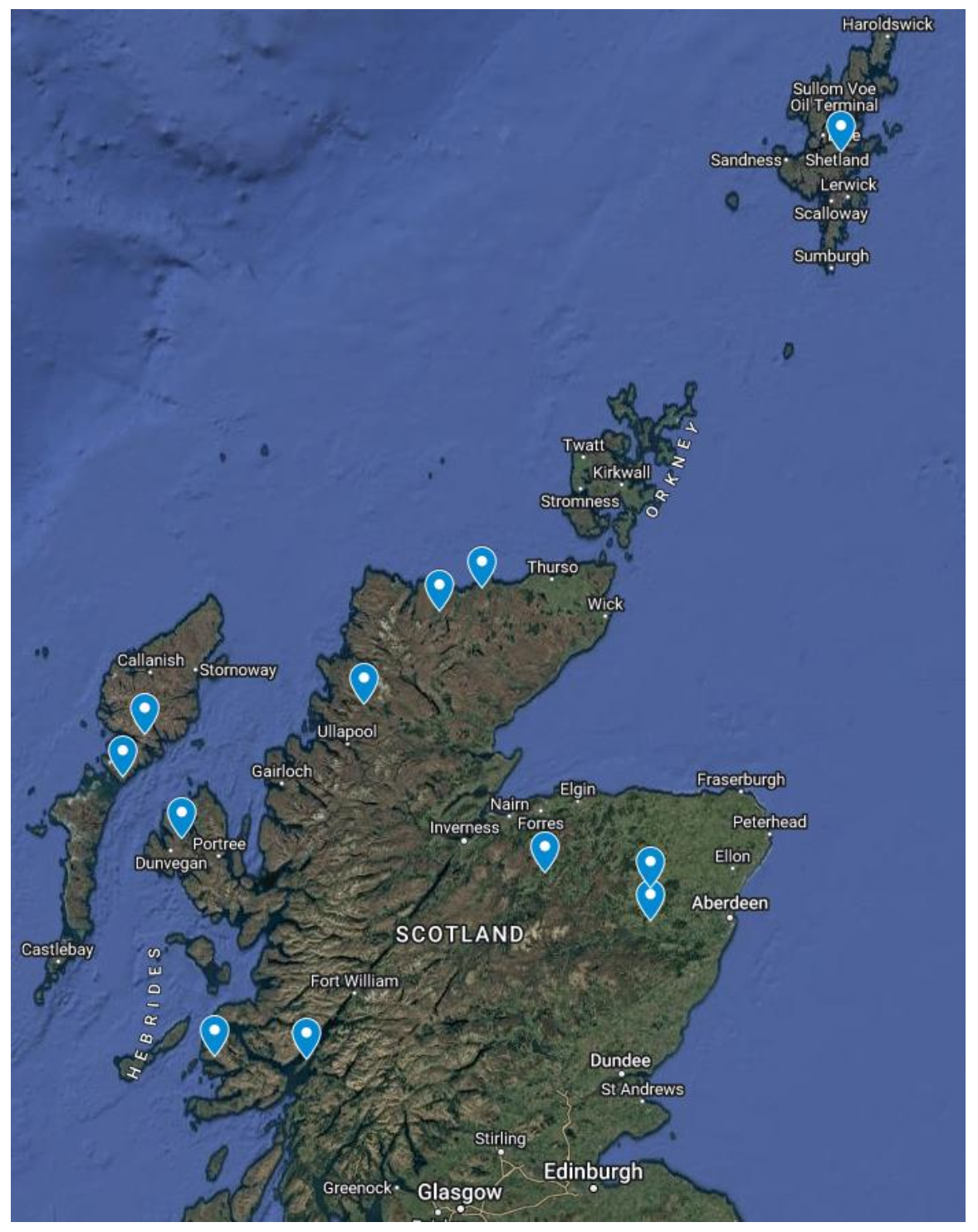
Second, we conducted interviews with stakeholder organisations (‘Key informants’ - 4) involved in working with land managers to collect their observations on the motivations for and barriers to the uptake of alternative farming practices, and how these have been overcome. The Key informant interviews helped us to identify farmers and crofters who are already adopting sustainable farming innovations (‘Opinion Leaders’ – 13) whom we interviewed. Opinion Leaders were located in different LFA regions and farm/croft types to reflect the diversity of LFA farming contexts in Scotland (See Appendix G). The interviews collected information about why they farm/croft, what they consider best practice, motivations for undertaking the practices, what triggered their change process, assessment of options available, how they have overcome barriers, and what incentives or supports were helpful.
Third, we conducted workshops (3) with LFA land managers (34) in different regions of Scotland (Southwest, West Coast, Northeast) during which facilitated discussions focused on understanding of sustainable and regenerative practices, the motivations, opportunities and barriers for uptake, and identifying support mechanisms (existing and hypothetical).
Finally, we conducted online workshops (4) in collaboration with four stakeholder organisations (Scottish Crofting Federation, Soil Association Scotland, Nature-Friendly Farming Network (Scotland), National Farmers Union Scotland). In total, c. 72 participants were asked to work through hypothetical scenarios of incentives being awarded for different types of farming practices presented via an online survey (see Appendix F). This exercise aimed to stimulate discussion amongst participants, facilitated by researchers and host organisations, about their opinion of the hypothetical scheme features, their own experiences of applying for agricultural incentives or support schemes, and their views about scheme characteristics that encourage (or discourage) them from applying.
All interviews and workshops were recorded and transcribed using built-in AI tools and checked for accuracy. Data was extracted from transcriptions, coded and analysed using software Nvivo 12.
A.2 Research rationale
Scotland’s complex framework of land tenancy and crofting legislation makes intervention in this space challenging. Issues include small-scale and fragmented land plots, absentee landlords and owners, and limitations on tenant investment. Common grazings comprise some 600,000 hectares of land, which are managed to varying degrees by local committees. There are substantial areas of de facto and actual land abandonment within LFAs, in line with ongoing depopulation in rural areas. There are also socio-demographic challenges, with a substantial cohort of crofters and farmers in LFAs over the age of 60, and embedded in patriarchal structures which make it difficult for new entrants – particularly women - to enter the sector (Shortall et al. 2017). New measures intended to empower crofters and farmers may have unintended consequences.
LFA farms and crofts in Scotland have traditionally produced primarily cattle and sheep. This production is extensive, and well suited to the land capability of LFAs. Cattle and sheep production in LFAs comprises some 27% of Scottish agriculture’s total Standard Outputs. They also offer both problems and opportunities for mitigating climate change: ruminant livestock are responsible for almost all emissions from LFA holdings. Scotland’s State of Nature report (2023) found that increased intensity of land use and overgrazing is a cause of biodiversity loss. However, some 94% of Scotland’s peatland is located in LFA areas of Land Capability class 5 and 6. There are also considerable untapped opportunities for woodland expansion. The areas thus have significant potential to mitigate the greenhouse gases they emit, while continuing to produce high-quality food.
There is a substantial volume of academic research focused on understanding how and why farmers have taken up (or not) particular agri-environmental actions, typically in relation to biodiversity; there has also been considerable research into agricultural knowledge and innovation systems (AKIS) (i.e. the sources and support structures through which farmers and crofters learn about innovations) (Sutherland et al. 2023). Less research has focused on the specific actions which enable uptake specifically in LFAs. Reviews of the literature undertaken for this research demonstrate some key principles for understanding motivations and behaviour change on agricultural holdings in Scotland (Sutherland et al. 2021; Thompson et al 2021). Farmers and crofters:
- make decisions within a broader system of opportunities and dependencies (e.g. markets, policy supports, off farm employment, labour availability)
- are largely path dependent, reflecting their available capital, land capability, infrastructure, skills and identity
- can be located on a continuum from productivist to environmental orientation, with younger and female farmers more likely to express environmental orientations
- can be located on a spectrum from rapid or proactive adopters through to reactive, later adopters
- are increasingly heterogeneous in their approaches, pursuing a range of diversification activities (including subsidised agri-environmental action) to maintain their holdings
- prefer to learn from their peers (i.e. ‘other farmers’ are their most reliable source of advice)
- increases in agri-environmental activity and plans to increase agri-environmental activity in the future are more likely to be younger, arable farmers and engaged with farmers networks.
In general, cost, lack of time and limited access to knowledge are key barriers to up-take of any agri-environmental measure. Farmers’ initial resistance to agri-environmental measures was argued to be cultural as well as practical (Burton et al. 2008): field margins and promotion of native species was initially not seen as ‘real farming’, and came at a cultural cost – the negative view of peers about apparent weedy or unkempt fields. However, as farmers struggled financially and popular opinion on the environmental role of farmers grew, there was evidence of shifting practices, with farmers integrating agri-environmental actions into a broader set of farming practices (Sutherland 2010, Sutherland 2013).
Similarly, the mantra that ‘farmers are not foresters’ has shifted, with more farmers seeing the opportunity of forestry on their land. Even so, the Farmer Intentions Survey (funded by Scottish Government through the RESAS strategic Research programme) found that farmers who already have forests on their land were by far the most likely to be planning to expand (Hopkins et al 2017). Research by Sutherland & Huttunen (2016) argued that enabling farmers without substantial forests to plant trees could bridge this gap through forestry options which also served productivist orientations (e.g. shelter belts for livestock, hedgerows for soil retention).
Very little research has been undertaken to date on uptake of carbon emissions reduction measures, such as carbon audits and soil testing. Carbon audits on agricultural holdings in Scotland have been supported since the mid-2010s. At present, all farming and crofting businesses which are registered in Scotland Rural Payments and Services and hold a Business Reference Number are eligible for one carbon audit per year through the Farm Advisory Services (Carbon Audits | Helping farmers in Scotland | Farm Advisory Service (fas.scot))
Peatland restoration is a new area for holding-level intervention. Scotland’s peatlands are estimated to store approximately 3 billion tonnes of carbon (Scottish Government 2022), but the majority are net carbon emitters and are in poor ecological condition (Artz et al., 2019). Peatland provides multiple ‘services’ in addition to carbon sequestration: burning for energy, extraction of growing media, food production through grazing, wildlife protection, water quality, game hunting and cultural heritage. In research with Scottish land holders in 2024, Roberts et al. found that the financial value of carbon credits was highly appreciated. Up-take of measures to restore peatland will need to consider trade-offs between this range of ‘ecosystem services’, and the role of private finance in incentivising change.
A critical gap in recent research is about the forms of incentivisation which may be needed to further encourage up-take. Academic research in the past decade has argued for ‘payment by results’ i.e. payments for achievement of particular outcomes, in contrast to traditional measures, which have been based on performance of particular actions. Sutherland et al. (2016) found that when farmers and crofters could see the benefits of these actions, they were more likely to continue to engage in agri-environmental schemes. Although a review of biodiversity outcomes of the 2014-2020 Scottish Rural Development Programme (Pakeman et al. 2021) found that the scheme had benefits for biodiversity, farmers and crofters cannot always see those benefits. Engaging farmers directly with new approaches and for them to see the outcomes is thus critical to long-term engagement. A recent review of Scotland’s Agricultural Knowledge and Innovation System (Sutherland et al 2023) demonstrated that there is a substantial demand for increased investment in peer-to-peer learning supports.
A.3 Data analysis approach.
It is central to understand the reasons why farmer and crofters adopt non-conventional agricultural practices to inform the design of incentives schemes and to inform public policy. To address the research questions (pg. 4), we used two frameworks which are complementary and allow us to understand farmers motivations, barriers and opportunities to encourage the uptake of existing and novel non-conventional practices. Here, we focus on practices that deliver “sustainable and regenerative agriculture”. In the following section we will discuss the terms “sustainable and regenerative”. Here we briefly present the two frameworks we used.
Agricultural practices, farm systems and incentives work at the farm or individual level, therefore we used conceptualisations at the farm or decision-maker level. Here we are interested in what motivates the divergence from conventional farming system, rather than the process of that change itself.
Triggering change theory: The theory argues that major changes in the trajectories of farmers and crofters occur in response to “trigger events” which collapse the path dependencies and impose and propose new options to farmers and crofters. After a process of assessment, implementation and consolidation, new successful practices become established and create the new path dependency (Sutherland et al., 2012). This theory allows us to explain and understand transitions relating to “path-dependency” or “lock-ins”. The theory helps to understand farmers’ decision-making and we will refer to this framework when discussing the results. However, it does not explain farm or individual agency as the initial drive for change; instead it supports the idea of internal and external triggering events as the cause of disruption of existing path-dependencies.
To consider individual motivations, we use Giddens’ framework of structuration theory and agency.
Agency: The central idea is that human free will is not completely realised but neither do social constraints suffice to explain people’s actions (Giddens, A., 1984). The argument is that there is an interaction between individuals’ free will and the social, economic and legal context in which they act. Therefore, at the same time as individuals act and reproduce this context, they also could change it.
We also use the ideas of power, social and cultural capital (Bourdieu, P., 1977) as concepts which help us to understand motivations and contexts for uptake of non-conventional agricultural practices.
B - List of practices used in workshops.
Types of practices
Inputs
- Reduced or no fertiliser
- Crop-livestock systems
- Recycling organic material (slurry, manure, crop residues, green manure)
- Appropriate use of fertiliser / lime, slurry, digestate, farm yard manure
- Covered slurry stores
- Slurry acidification
- Anaerobic digestion
- Cover crops, green manures, catch crops
- Nitrogen fixation measures (legumes in rotation or intercrops)
- Farm drainage and water management
- Irrigation
- Raise water table all year round
- Raise water table part of the year
- Precision agriculture (sowing, fertilisation, inputs)
- Variable rate nitrogen and lime
- Urease and nitrification Inhibitors
Livestock
- Animal breed/genotype selection
- Encourage foraging to reduce feed inputs
- Management of grazed habitats / regenerative grazing practices e.g. mob, strip, adaptive multi-paddock grazing
- Frequent rotation and long resting time/recovery periods for paddocks
Other habitats
- Management and new planting of hedgerows
- Species specific management
- Protected sites management
- Habitat mosaics
- Wildlife friendly crop operations method of cutting silage/rashes to protect nesting grassland birds
- Wildlife friendly crop operations to encourage flowering and provide cover for nesting and fledging birds
- Field margins
- Buffer strips
- Pollinator strips
- Beetle banks
- Wild bird cover
- Damp areas for wading birds
- Predator/pest control: deer, foxes, crows, grey squirrel
- Small and farm woodlands
- Silvo-pastures
- Drystone dykes
- Wildlife corridors between woodland areas
Other management
- No burning
- Avoid burning where regeneration is poor and other plants may displace heather
- Small patch burning of under-used areas to encourage livestock movement
- Burning rotation
- Compliance with the Muirburn Code and any licensing conditions
- Management of existing peatland vegetation
- Peatland vegetation replacement
- Remove all livestock
- Remove some livestock and manage livestock through the year.
- Extensification
- Remove all agriculture
- No domestic peat extraction
- No industrial peat extraction
- Removal of invasive species
Soil
- Increase soil biomass/carbon
- Minimise soil disturbance
- Soil pH management
- Reduced tillage
- Avoid inversion
- Avoid deep ploughing (if no major compaction or large weed burden) by using a direct drill, discs, or different machinery
- Pan busting
- No ploughing
Crops
- Species-rich grassland / forage mix
- Crop diversity
- Increase number of different crops in an arable rotation
- Intercropping, relay cropping
- New or novel crops
- Cultivar choice, cultivar mixing (e.g. pest/disease resistance)
- Incorporation of short and long rotation energy crops
Pest & disease
- Vaccines (animals)
- Targeting antibiotic use (animals)
- Selective use of antibiotics (animals)
- Rotations (crops or animal grazing)
- Monitoring and surveillance (crops or animals)
- Threshold monitoring for pesticide use (crops)
- Natural/botanical pesticides (crops)
- Biological pest control (crops)
- Allelopathic plants (crops)
- Microbial insecticides (crops)
C – Informant list
| Interview Participants | Size of farm | New entrants? | Practice areas | Farm production type | Land capability | Tenure |
|---|---|---|---|---|---|---|
| Rowan | 9.3 ha | Yes | Rotational grazing, actively improving soil health and biodiversity | Sheep and horticultural | 5.3 | Own |
| Maggie | 2266 ha | No – inherited farm | Peatland restoration for improved habitats | Livestock | 6.3 | Own |
| Robin | 2 ha | No – farmed previously on Lewis | Seaweed as fertiliser, tree planting, peatland | Livestock | 5.2 – 6.3 | Own |
| Flora | 60.7 ha | Yes | Biodiversity enhancement, native breeds, local producer | Livestock and small amount of veg | 6.3 | Own |
| Hector | 7.2 ha | Yes | Biodiversity creation, carbon emissions | Livestock | 5.2 | Tenanted |
| Harris | 17 ha | Yes | Woodland creation, biodiversity | Woodland, vegetables | 5.2 | Own |
| Brodie | 100 ha | Yes | Peatland restoration | Livestock | 6.3 | Own |
| Douglas | 4 to 5 ha plus 40.5 ha common grazing | No | Native breeds, rotational grazing for soil health and biodiversity. | Livestock | 6.3 | Tenanted |
| Isla | 3200 ha. | Yes | Carbon emissions, biodiversity creation | Livestock | 6.3 | Tenanted |
| Iona | To have sent in email total area | No – inherited croft | Traditional grazing for biodiversity and habitat creation. | Livestock | 6.3 | Owned |
| Sorrel | 2.7 ha | Yes | Tree planting, rotational grazing | Livestock and veg | 6.1 | Owned |
| Graham | 6.5 ha | Yes | Woodland creation, biodiversity creation, horticultural practices and education. | Poultry and horticulture | 6.3 | Tenanted |
C.1 Stakeholder interviews
For a deeper overall perspective of the topic of sustainable and regenerative farming and crofting, we also held interviews with representatives from stakeholder organisations working with farmers and crofters: Nourish Scotland, SAC Consulting, National Farmers Union Scotland (NFUS) and the Scottish Crofting Federation.
D – Workshops
D.1 In situ workshop
Isle of Lismore: 12 participants – a mix of traditional generational crofters of the island and newcomers into the island. Most had paid employment in addition to crofting or were retired.
SRUC Barony campus: 4 participants – sheep farmers in the LFA that were already undertaking some ‘regenerative practices’ as well as a participant from a conservation charity that works with farmers and landowners in the area.
Nethy Bridge: 15 participants – farmers with a mix of holdings or tenancies of between 80 and 1900 hectares. With a mixture of ‘regenerative practices’ including rotational grazing and reduced inputs with some participants just coming along to learn something new.
D.2 Online workshops
4 online workshops were held in partnership with different organisations to make sure for a variety of voices to be heard. We had c. 72 participants in total. These workshops started with a short web-based activity (see Appendix F) to assess different scheme features, which allowed for them to think about how alternative incentive options might be created. The organisations we partnered with to host the online workshops were Soil Association Scotland (SAS), NFUS, Nature Friendly Farming Network (Scotland) and the Scottish Crofting Federation. Each workshop lasted approx. 2 hours.
E – Maps from in situ workshops
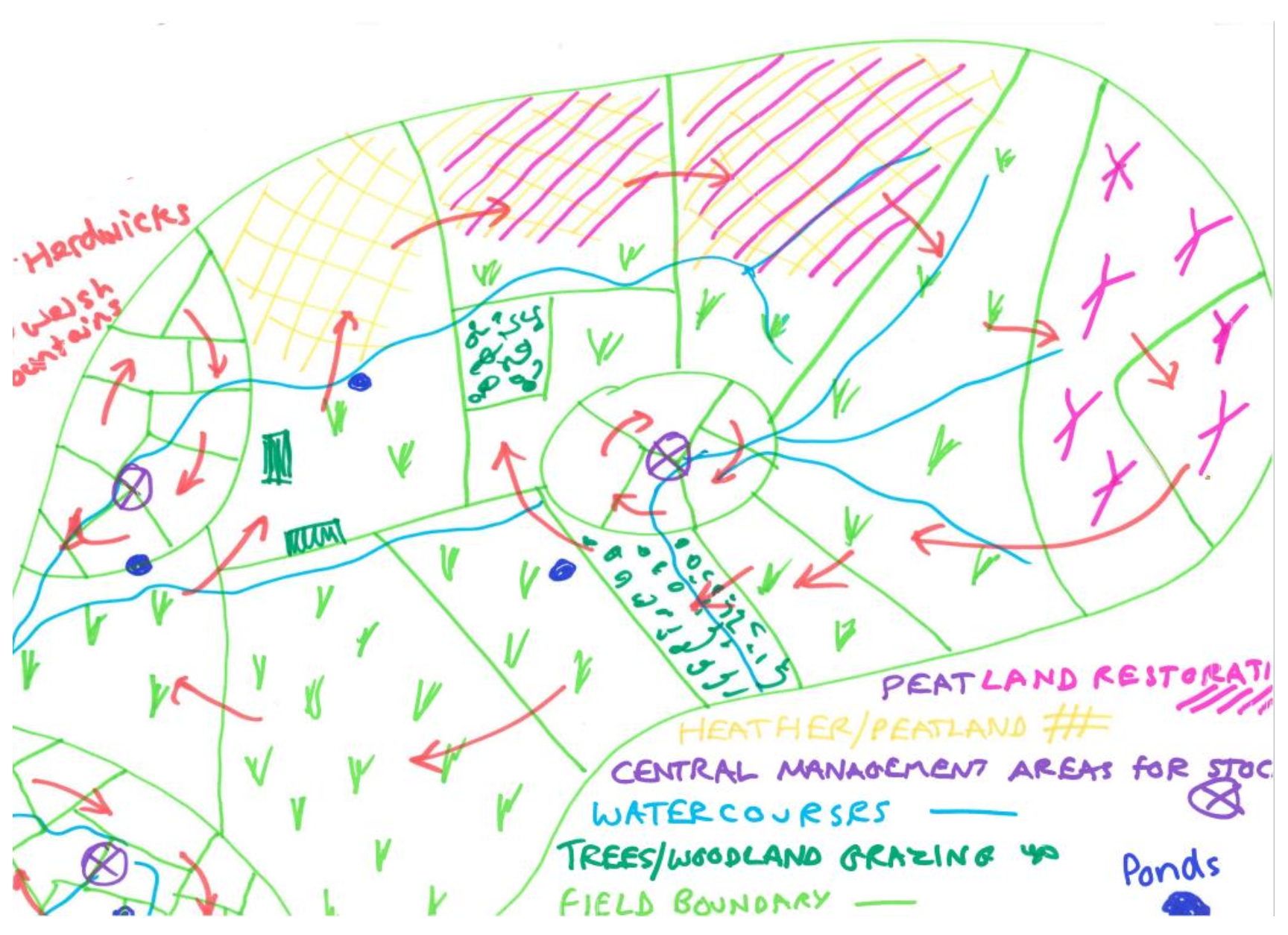
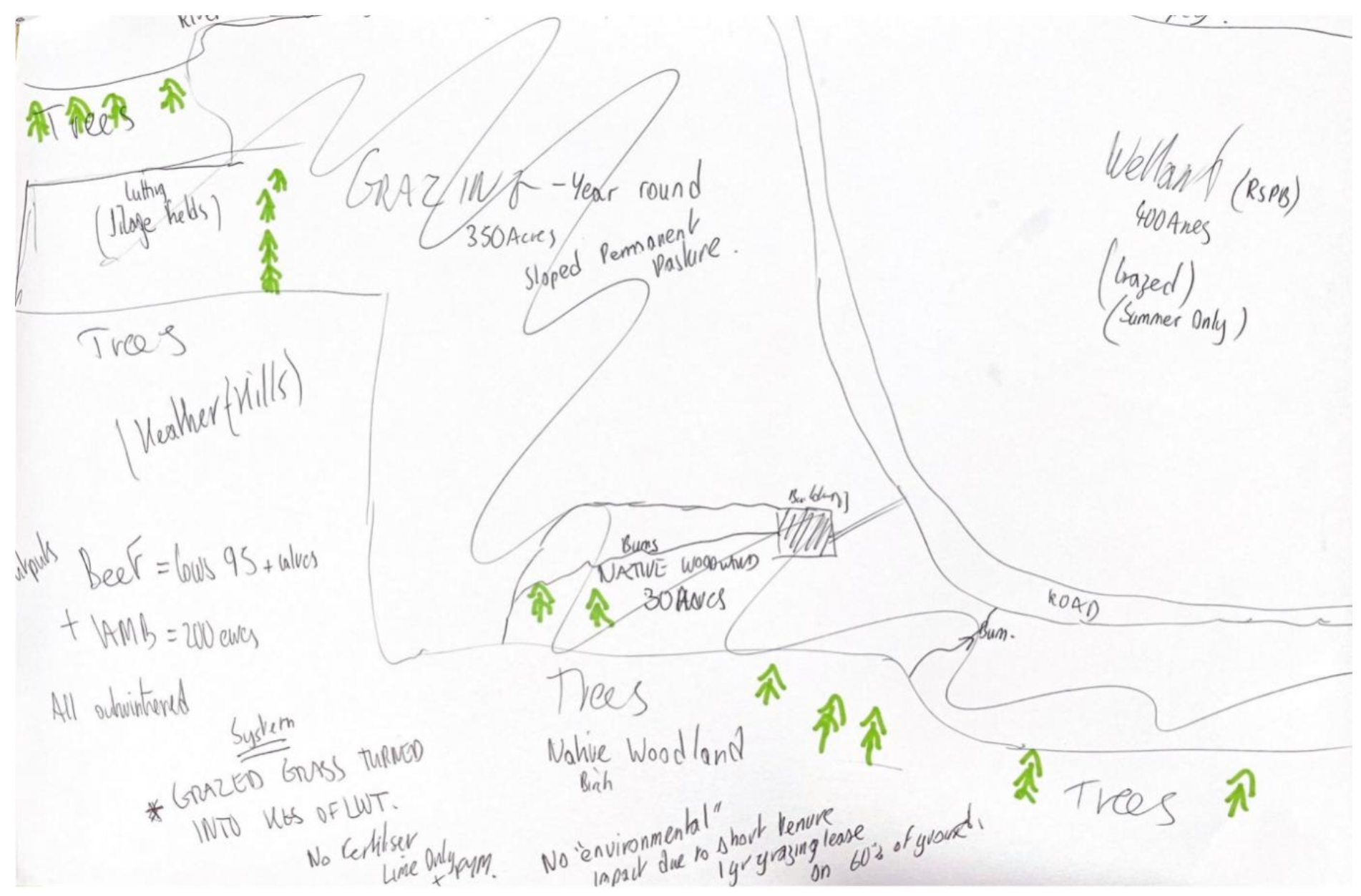
At the beginning of the in-situ workshop we asked participants to draw a map of the farm, including what practices they are currently using and asked them to think about what opportunity they have on their land to integrate new practices. We found that there was a range of farms that all demonstrated their own unique way of working LFA land.
One example of a regenerative system was a farm that produced beef, lamb and pasture raised poultry with 10 cattle, 10 sheep and 400 chickens. The site is split into 100+ sub fields and animals are moved every 24 -72 hours depending on the time of year and growing season with 12 ha used to winter stockpile. This rotational style of grazing management has been known to improve soil health and biodiversity on grazed lands (Teague and Kreuter, 2020). This is done to improve soil health and biodiversity to produce nutrient rich food for themselves and local community. This demonstrated that it can be done on marginal land that experiences high rain fall, high winds and poor access to market for sales.
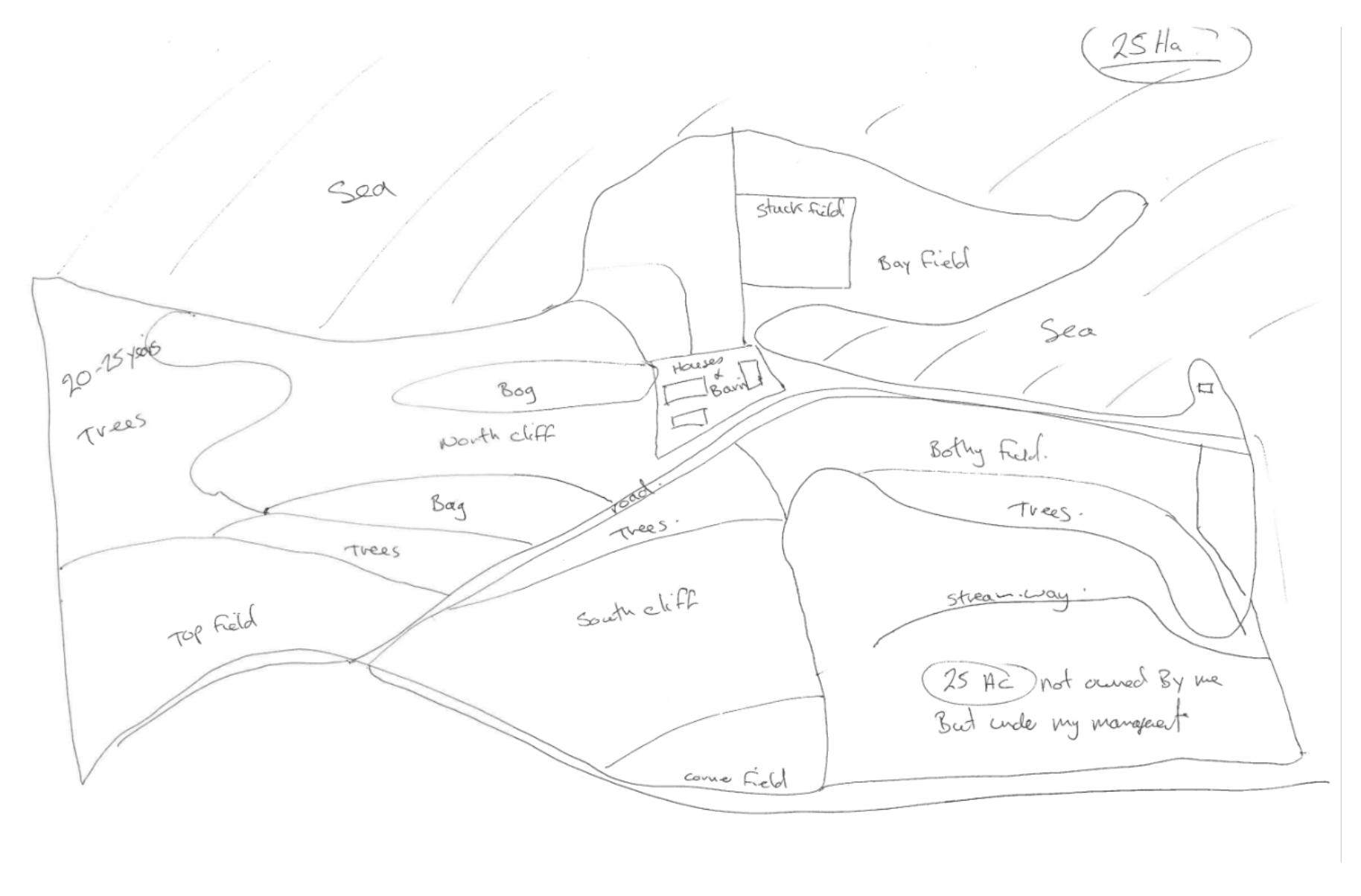
Many of the systems had some form of rotational grazing to different extents across all workshops. With the system below having specific reference to peatland and peatland restoration that had taken place on the farm as well as rotational grazing.
Another system experienced was having dedicated fields for grazing and crops without weekly rotation. A more regenerative practice was found by using lime for fertiliser instead of more chemically based ones to grow a productive crop on LFA land.
F. Online workshops: web-based exercise
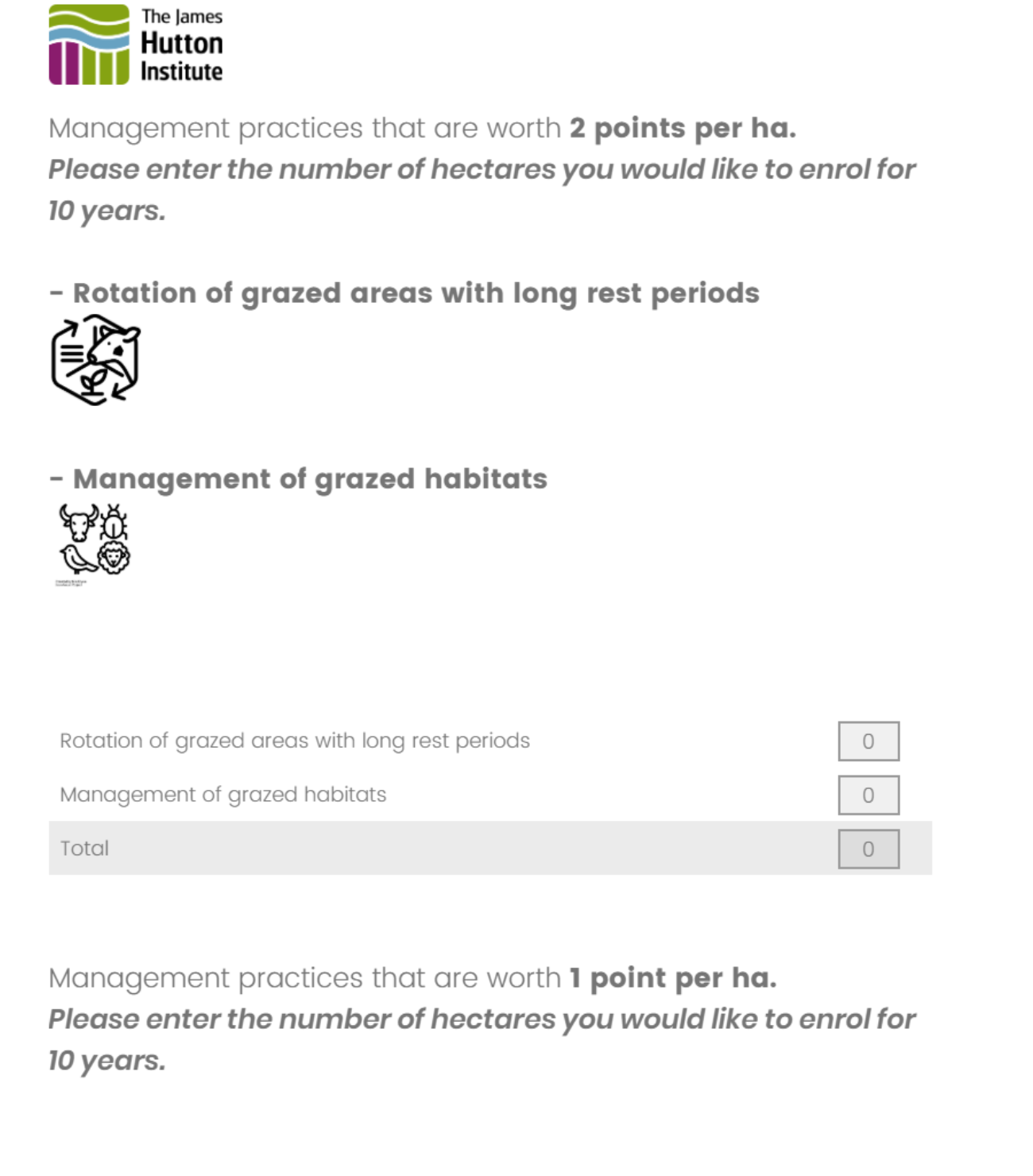
We conducted an online activity at the beginning of the online workshop as a warm up exercise for participants to stimulate discussion and think about different types of support schemes. We asked them to think about the points-based system to assess what sort of funding they would get under different scenarios on their farm.
G – Approximate locations of interview participants
Contact
Email: socialresearch@gov.scot